
Glazed Vitrified Tiles (GVT) Market Size and Share
Market Overview
| Study Period | 2021 - 2031 |
|---|---|
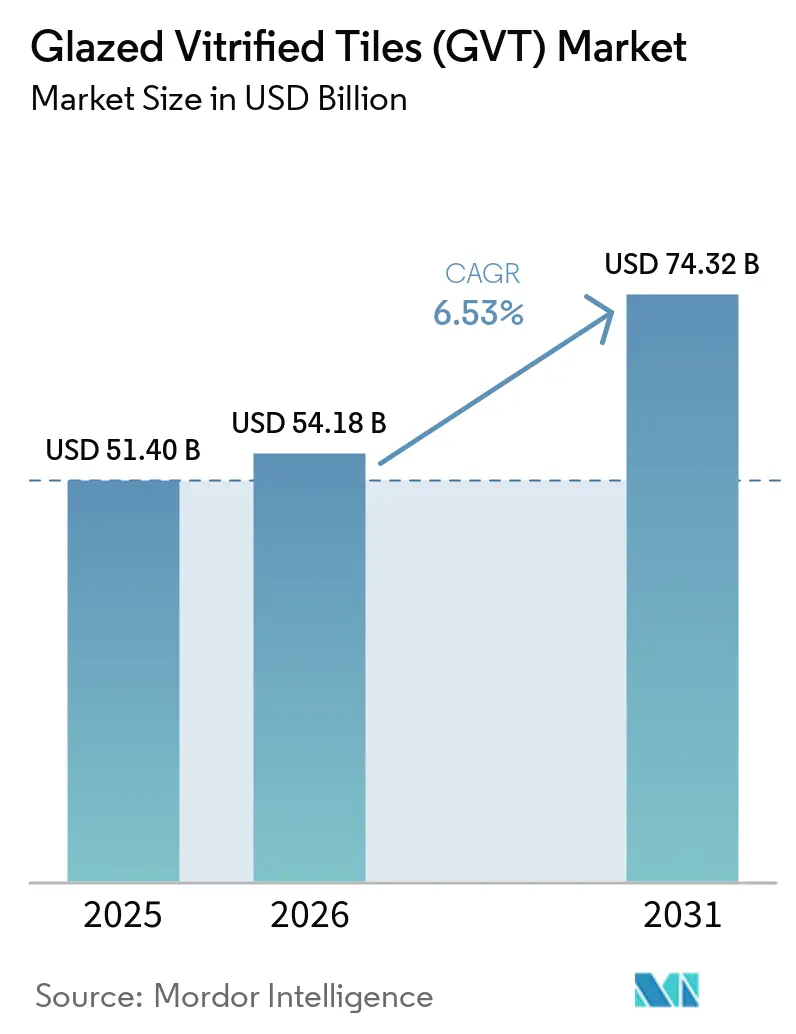
| Market Size (2026) | USD 54.18 Billion |
| Market Size (2031) | USD 74.32 Billion |
| Growth Rate (2026 - 2031) | 6.53 % |
| Fastest Growing Market | Middle East and Africa |
| Largest Market | Asia-Pacific |
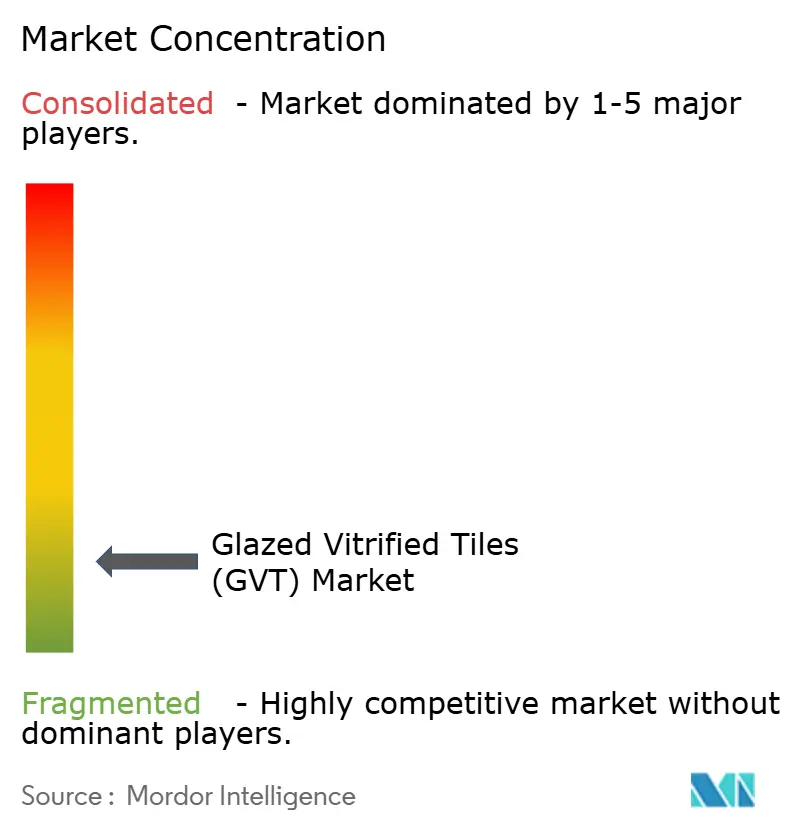
| Market Concentration | Low |
Major Players *Disclaimer: Major Players sorted in no particular order Image © Mordor Intelligence. Reuse requires attribution under CC BY 4.0. | |
Glazed Vitrified Tiles (GVT) Market Analysis by Mordor Intelligence
The glazed vitrified tiles market size is expected to increase from USD 51.4 billion in 2025 to USD 54.2 billion in 2026 and reach USD 74.3 billion by 2031, growing at a CAGR of 6.5% over 2026-2031. Demand in the glazed vitrified tiles market is being supported by renovation-led replacement in mature housing markets and by urban construction activity across Asia and the Middle East. The glazed vitrified tiles market is also benefiting from a broader shift among developers and architects toward porcelain surfaces that offer more predictable costs, lower maintenance requirements, and lighter weight than natural stone in many projects. Digital inkjet printing has expanded design flexibility and shortened product refresh cycles, which is helping premium products reach both residential and commercial buyers more quickly. Commercial retrofits in hospitality, healthcare, offices, and retail are further boosting the glazed vitrified tiles market, as these projects increasingly favor surfaces with stronger wear resistance, improved hygiene performance, and design consistency. Competition remains fragmented, so leading producers are leaning on capacity upgrades, digital glazing systems, large-format lines, and specification support to capture demand without relying only on price [1]Mohawk Industries, “Annual Report 2025,” SEC, sec.gov.
Key Report Takeaways
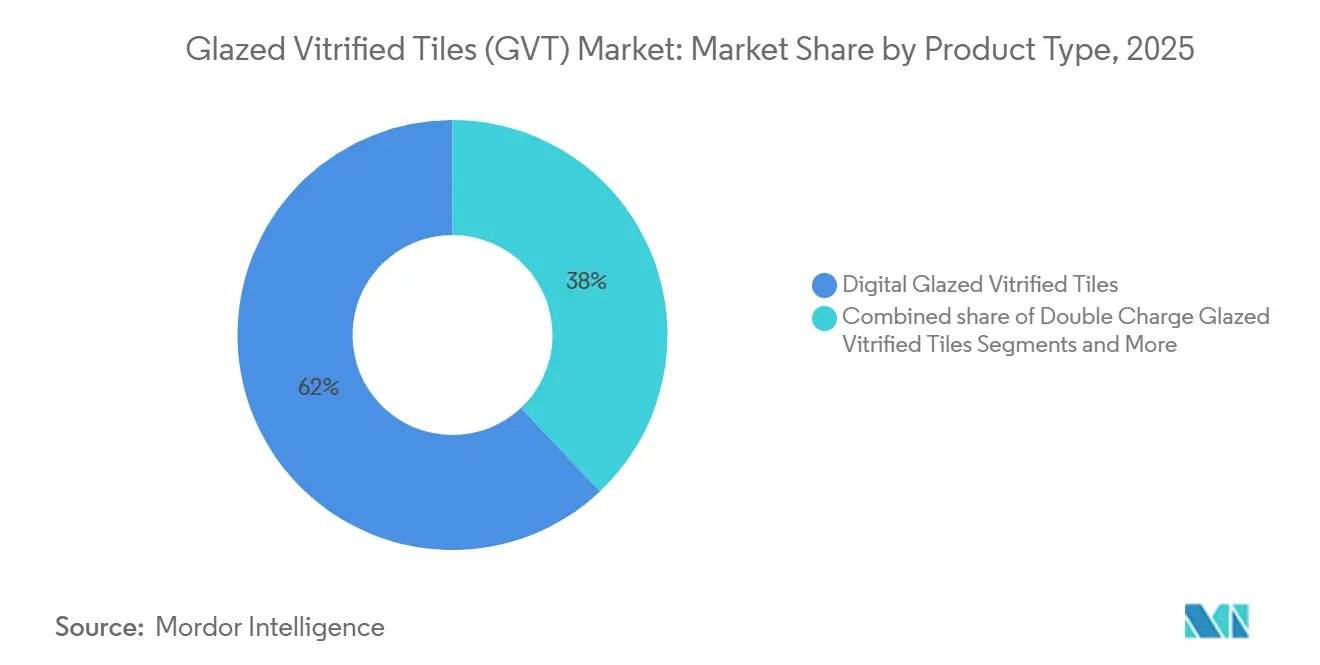
- By product type, digital glazed vitrified tiles led with 62.03% revenue share in 2025 in the glazed vitrified tiles market, while polished GVT is forecast to expand at 7.21% CAGR through 2031.
- By thickness, the 8-12 mm band held 46.73% share in 2025 in the glazed vitrified tiles market, while 20 mm pavers recorded the highest projected CAGR at 6.83% through 2031.
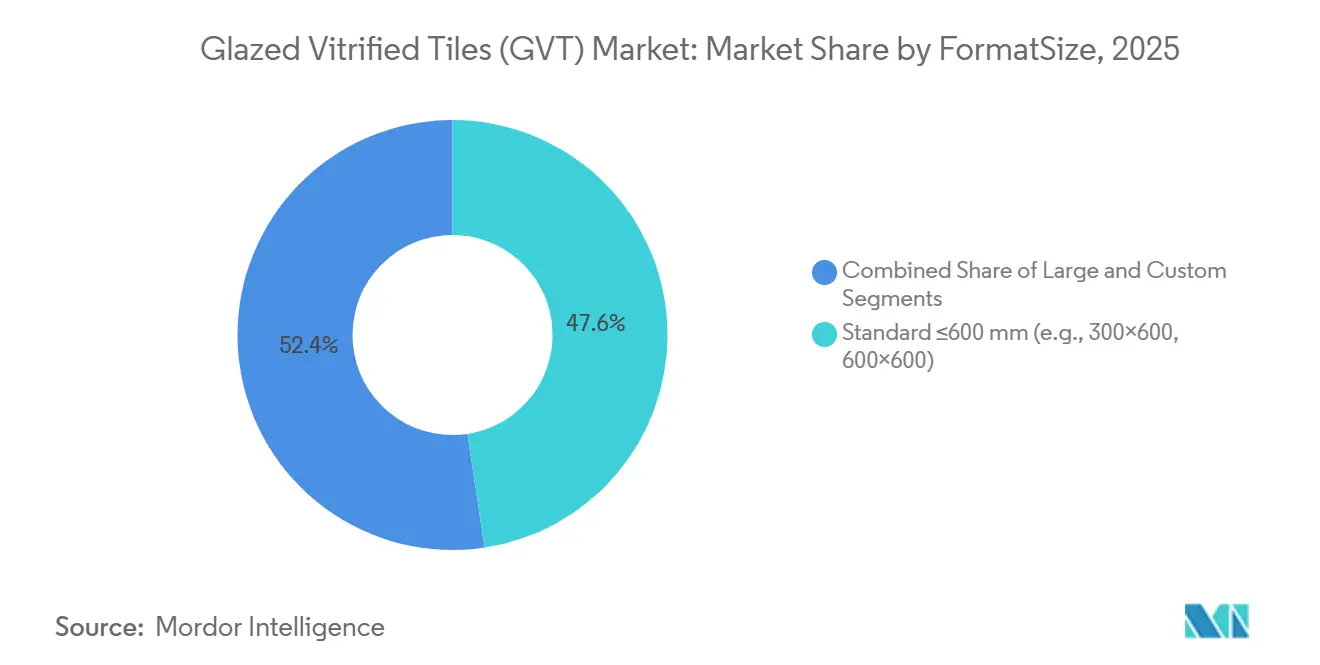
- By format and size, standard tiles up to 600 mm accounted for 47.62% share in 2025 in the glazed vitrified tiles market, while large-format tiles are advancing at 7.34% CAGR through 2031.
- By construction type, renovation and retrofit activity captured 68% of the glazed vitrified tiles market in 2025, while new construction is projected to grow at a 6.6% CAGR through 2031.
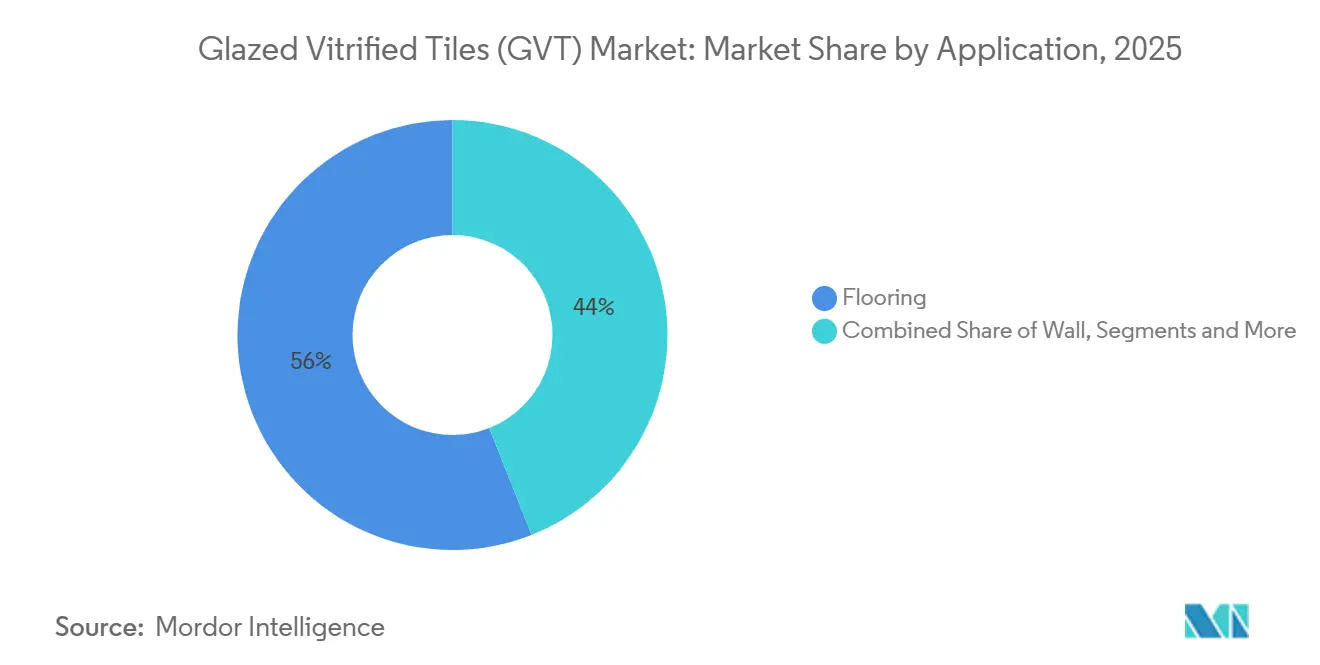
- By application, flooring accounted for 56% of the glazed vitrified tiles market share in 2025, while wall tiles are forecast to expand at a 6.94% CAGR through 2031.
- By end user, residential held 70.06% share in 2025 in the glazed vitrified tiles market, while commercial recorded the fastest projected CAGR at 7.11% through 2031.
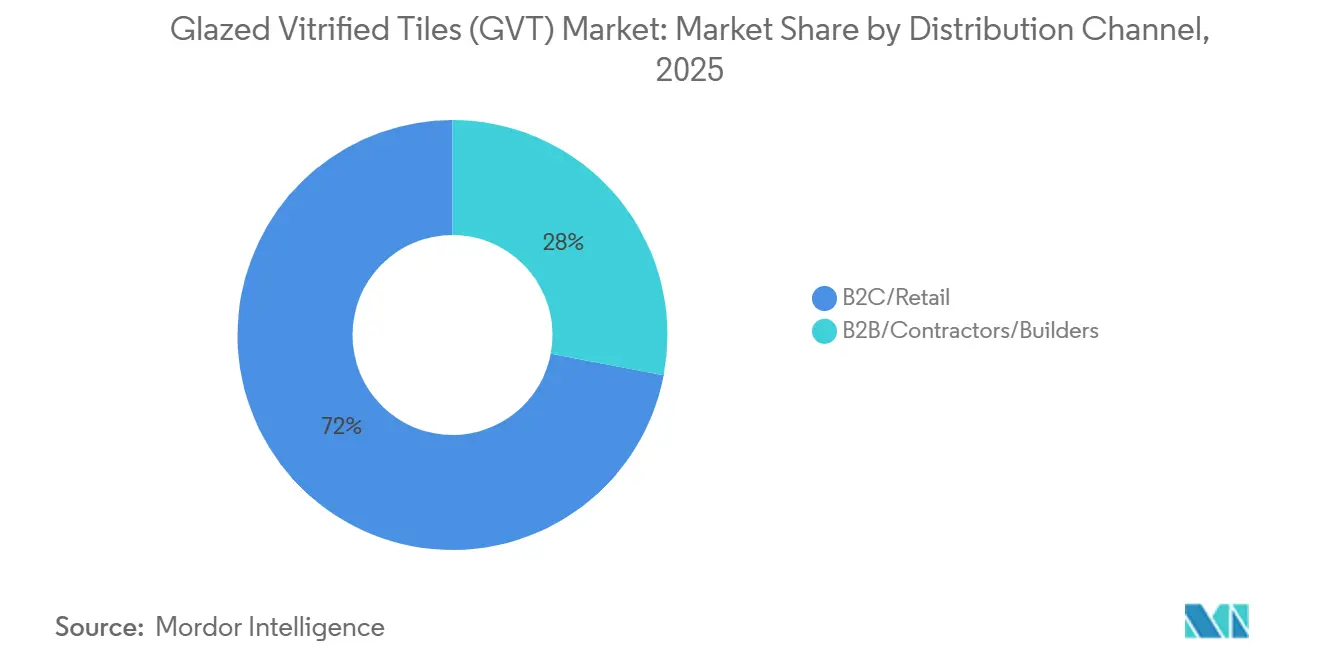
- By distribution channel, B2C and retail accounted for 72% of the glazed vitrified tiles market in 2025, while B2B is projected to grow at a 6.78% CAGR through 2031.
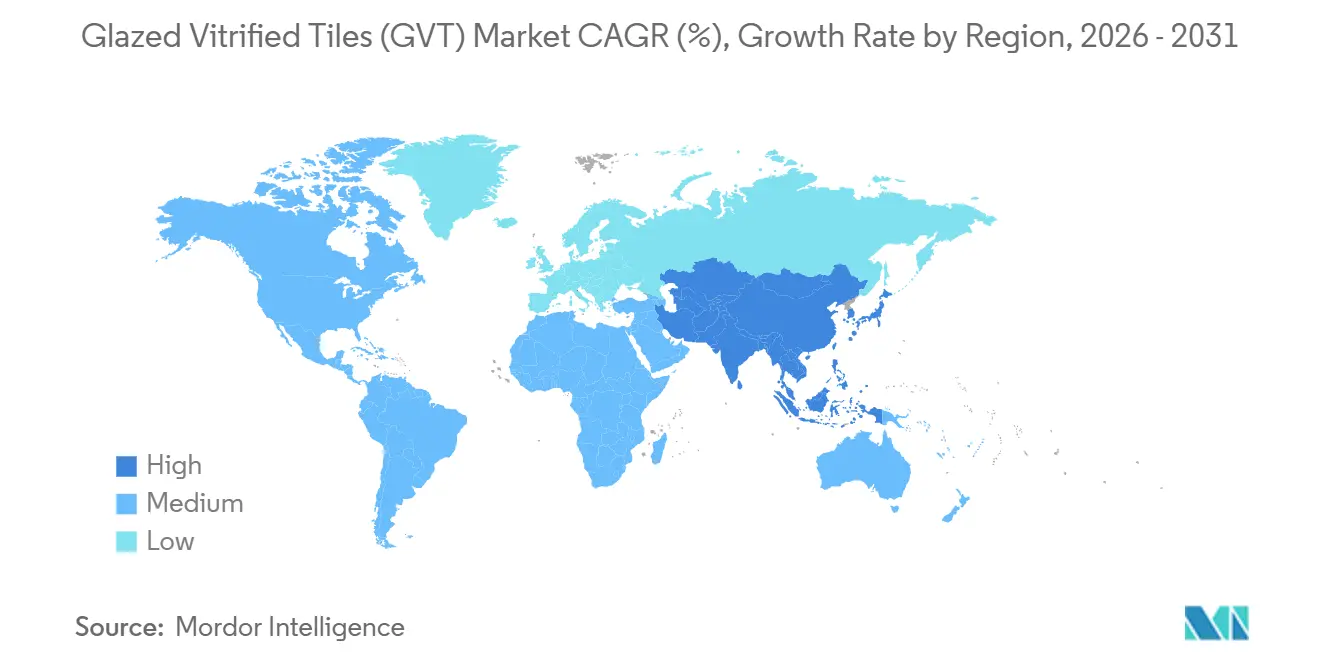
- By geography, Asia-Pacific accounted for 58.90% of the glazed vitrified tiles market in 2025, while the Middle East and Africa are projected to grow at a 7.50% CAGR through 2031.
Note: Market size and forecast figures in this report are generated using Mordor Intelligence’s proprietary estimation framework, updated with the latest available data and insights as of January 2026.
Market Trends and Insights
Drivers Impact Analysis of Glazed Vitrified Tiles (GVT) Market*
| Driver | (~) % Impact on CAGR Forecast | Geographic Relevance | Impact Timeline |
|---|---|---|---|
| Renovation-led replacement of legacy ceramic/laminate with durable low-maintenance GVT | +0.9% | Global, with acute spikes in North America and the European Union's mature housing stock. | Medium term (2-4 years) |
| Commercial upgrades in retail, hospitality, offices, and healthcare favoring stain/wear resistance | +0.7% | Global core commercial districts, GCC hospitality hubs, and China Tier-1 cities | Short term (≤ 2 years) |
| Shift from natural stone/wood to cost-stable, lightweight porcelain alternatives | +0.6% | Asia-Pacific core, North America coastal luxury markets, Middle East premium residential | Medium term (2-4 years) |
| Digital inkjet printing enabling hyper-realistic designs and short-run customization | +0.5% | Asia-Pacific industrial clusters in China, India, Indonesia, with expansion into South America and Africa | Short term (≤ 2 years) |
| Adoption of large-format thin slabs for countertops, wall cladding, and facades | +0.6% | European Union architectural projects, North America high-end residential, and Asia commercial towers | Medium term (2-4 years) |
| Tightening hygiene and safety specs (antibacterial, low-VOC, R10+ slip ratings) lifting premium GVT | +0.4% | North America and European Union healthcare and institutional, GCC luxury hospitality, and India metro post-pandemic | Long term (≥ 4 years) |
| Source: Mordor Intelligence | |||
Renovation-led replacement of legacy ceramic/laminate with durable low-maintenance GVT
Aging housing stock across mature economies continues to direct spending into kitchens and bathrooms, where homeowners favor GVT’s low maintenance and dimensional stability. In wet areas and entryways, matte and structured tiles with R10 to R11 slip ratings per DIN 51130 are specified to improve safety and reduce slip incidents compared with polished natural stone. Online visualizers and guidance from retail platforms help consumers plan large-format layouts, which lowers perceived installation complexity for remodeling projects. Supply-chain financing tightens during strong remodeling cycles because project-based orders turn faster than retail replenishment, which can pressure smaller fabricators in fragmented clusters to shorten payment terms. Larger integrated manufacturers focus on stable tile volumes and capacity utilization while adjusting promotion and dealer incentives across soft seasonal periods. Quality and performance standards, such as ISO 9001 systems and ANSI A137.1 tolerances, increase compliance costs for small-scale producers, which benefits listed leaders with in-house testing and established warranty frameworks [2]Tile Council of North America, “ANSI A137.1 Specifications and DCOF Guidance,” TCNA, tcnatile.com .
Commercial upgrades in retail, hospitality, offices, and healthcare favoring stain/wear resistance
Healthcare and hospitality refurbishments emphasize surface hygiene, chemical resistance, and slip control, which aligns with GVT’s antibacterial glaze options tested per ISO 22196. Technical specifications, such as wet-pendulum targets of at least PTV 36 and DCOF wet thresholds for public spaces, influence project tenders for corridors, lobbies, and patient-facing areas. Facility owners view antimicrobial glazes and clean-in-place compatibility as part of long-run cost control, which adds headroom for premium GVT pricing in these categories. Vendors strengthen consultative support through on-site slip testing, chemical-resistance verification, and submittals that align with fire-safety and low-VOC requirements for green building credits in healthcare and institutional settings. RAK Ceramics reports that large-format porcelain demand in the UAE continues to grow within its tiles portfolio, supported by investment in slab production and a stronger mix in project-based work. These shifts elevate acceptance of higher-spec GVT formats where performance and maintenance predictability drive selection over first-cost criteria.
Shift from natural stone/wood to cost-stable, lightweight porcelain alternatives
Porcelain’s lower weight per square meter compared with natural stone eases installation in high-rise structures and roof terraces where load constraints bind. Outdoor 2 cm porcelain pavers deliver high breaking strength and low water absorption, expanding use into climates with freeze-thaw cycles and into vehicular traffic applications with consistent performance. Reduced life-cycle tasks, such as sealing and resurfacing, lower the lifetime ownership cost for developers who budget across multiyear timelines. Predictable sourcing and vertically integrated raw-material strategies among leading producers limit input volatility, which improves tender pricing and budget certainty for stone-look, wood-look, and terrazzo-look surfaces. For residential and commercial interiors, porcelain surfaces also avoid the periodic sealing and polishing required for marble and select hardwoods, thereby reducing operational costs. Expanded format ranges and edge treatments increase porcelain’s suitability for countertops, feature walls, and façades, displacing heavier, more variable natural alternatives when engineering constraints or consistency requirements apply.
Digital Inkjet Printing Enables Hyper-Realistic Designs and Mass Customization
Digital inkjet systems have shortened setup times and reduced viable batch sizes, allowing manufacturers to produce on-demand runs for boutique projects without overstock. High-resolution heads paired with matte, gloss, and textured overlays create depth and realism across wood, marble, and terrazzo looks, serving design-led commercial and premium residential spaces. Short-run capability reduces inventory obsolescence as color and texture trends cycle more quickly across floor and wall material categories. Plants equipped with fast design-change lines align supply to project timelines for property developers who want unified finishes across floors and vertical surfaces. Low-emission digital inks and controlled application improve permitting prospects in regions where air-quality rules are pressing kilns and glazing operations to tighten emissions. The cumulative effect is a more agile glazed vitrified tiles (GVT) market that competes on speed, design fidelity, and technical data support as much as on volume capacity.
Restraints Impact Analysis of Glazed Vitrified Tiles (GVT) Market*
| Restraint | (~) % Impact on CAGR Forecast | Geographic Relevance | Impact Timeline |
|---|---|---|---|
| Energy-intensive firing and exposure to fuel/carbon price volatility | -0.6% | Global, acute in the European Union under ETS carbon pricing, and regions with coal-to-gas transition | Long term (≥ 4 years) |
| Share loss to resilient LVT/SPC and engineered wood in select residential use-cases | -0.5% | North America suburban residential and Northern Europe cost-sensitive retrofits | Medium term (2-4 years) |
| Dealer-channel credit cycles and working-capital stress in fragmented markets | -0.4% | India Morbi cluster, China Foshan belt, and fragmented South America distributors | Short term (≤ 2 years) |
| Logistics and breakage constraints for >1200 mm slabs limiting penetration in long-haul routes | -0.3% | Export corridors from Asia to the Americas and Africa, inland routes in Brazil and Nigeria | Medium term (2-4 years) |
| Source: Mordor Intelligence | |||
Energy-intensive firing and exposure to fuel/carbon price volatility
Tile firing temperatures and continuous production schedules anchor energy consumption at a level where gas price spikes and carbon charges can compress margins. Emissions footprints from fuel combustion, direct process emissions, and indirect electricity use are tracked closely in Europe, where policy mechanisms increase cost pressure on energy-intensive ceramics manufacturing. Hydrogen-ready kilns and hybrid dryers can hedge against volatility by switching between fuel blends and electric heating as tariffs and supply conditions change [3]SACMI, “Hybrid Dryers and Hydrogen-Ready Kiln Solutions,” SACMI, sacmi.com . Advanced heat-recovery systems in modern slab facilities reduce the energy per square meter required for firing, supporting embodied-carbon reduction efforts, and helping producers qualify for low-carbon procurement criteria. The capital-intensive nature of electrification and hydrogen retrofits means adoption is gradual and staged across pilot lines before full-plant conversion. Producers that prioritize energy flexibility and thermal-efficiency upgrades reduce exposure to sudden cost surges tied to geopolitical or seasonal curtailments in gas supply.
Share Loss to Resilient LVT/SPC and Engineered Wood in Select Residential Use Cases
Resilient categories deliver click-lock installation and thin profiles that fit many living areas where heavy moisture is less common. Low upfront installation costs and reduced height buildup can steer entry-level retrofits toward LVT or SPC in bedrooms and living rooms. In wet rooms and high-use corridors, porcelain’s abrasion resistance and chemical resistance help it outlast resilient alternatives that can scuff or degrade under harsh cleaning regimens. To counter resilient share gains, producers have launched ultra-thin porcelain in the 4.8–6 mm range, reducing weight and speeding handling for renovation projects. Digital wood-grain textures at high resolution close aesthetic gaps and offer plank-like formats that appeal to homeowners who want consistent visuals across open-plan spaces. Over a long service life, porcelain’s resistance to water ingress and surface wear shifts comparisons from first cost to total cost of ownership in applications that experience repeated cleaning and foot traffic.
*Our forecasts treat driver/restraint impacts as directional, not additive. The impact forecasts reflect baseline growth, mix effects, and variable interactions.
Glazed Vitrified Tiles (GVT) Market Segment Analysis
By Product Type:
Digital Formats Lead While Polished Products Grow FasterDigital glazed vitrified tiles held 62.03% of the glazed vitrified tiles market share in 2025, which confirmed that inkjet decoration had already moved into the mainstream across residential and commercial demand. This leadership is tied to manufacturing flexibility because digital systems support faster design changes and broader catalogs without the same inventory burden as older printing methods. The largest benefit is not only visual variety, but also better responsiveness when retailers, contractors, and specifiers want updated designs in shorter cycles. That is why the glazed vitrified tiles market has seen digitally printed products become the standard offer rather than a niche premium layer.
Polished GVT is projected to grow at a 7.21% CAGR through 2031, making it the fastest-growing product subtype in the glazed vitrified tiles industry. Demand is being pulled by aspirational residential upgrades and hospitality projects seeking a marble-like finish without the same maintenance requirements. At the same time, matte, satin, and structured products remain important where slip resistance and lower-glare surfaces matter more than gloss. Producers with stronger glaze chemistry and testing capability are better positioned in this mix because antibacterial, low-VOC, and wear-resistant performance is becoming more important in premium procurement.



By Thickness:
Standard Profiles Hold the Base While 20 mm Pavers Expand Outdoor DemandThe 8-12 mm band accounted for 46.73% of the glazed vitrified tiles market in 2025, underscoring its role as the default specification for most indoor residential and light commercial applications. This thickness range works well because it balances structural performance, ease of handling, shipping efficiency, and familiarity during installation. It therefore remains central to the glazed vitrified tiles market, where buyers want dependable performance without moving into more specialized formats. Standard profiles also fit a broad set of renovation projects where installers and homeowners prefer proven, widely available products.
The 20 mm paver segment is forecast to grow at 6.83% CAGR through 2031 as outdoor hardscaping shifts toward porcelain alternatives. These products are gaining relevance in terraces, pool decks, plazas, and rooftop spaces where strength, low water absorption, and easier replacement can matter more than the traditional stone look alone. Their appeal is also tied to dry-lay and pedestal systems that simplify maintenance and reduce disruption when individual units need to be replaced. This keeps the glazed vitrified tiles market linked to a wider outdoor specification base that had historically leaned more heavily on concrete and natural stone.
By Format/Size:
Standard Tiles Stay Broad While Large Format Products Drive Premium GrowthTiles up to 600 mm held 47.62% of segment revenue in 2025, which shows that standard formats still underpin the broadest installed base of the glazed vitrified tiles market. Their position remains strong because they are easier to transport, cut, and install in renovations where substrate conditions are not ideal. Standard sizes also fit legacy room layouts and common grout spacing practices, which lowers installation complexity for everyday residential jobs. That practical fit keeps them central, even as design-led projects draw attention to larger slabs and rectified tiles.
Large-format tiles are projected to expand at a 7.34% CAGR through 2031, making them the fastest-growing segment of the glazed vitrified tiles industry. Their growth is driven by projects seeking fewer grout lines, more continuous surfaces, and stronger visual impact in lobbies, facades, and open-plan interiors. This is also where producer investment is clearly moving, with large-format lines and slab capacity receiving more strategic capital from major manufacturers. Logistics and breakage remain a constraint for long-haul movement, but mesh backing, improved packing, and automated handling are gradually making these products easier to commercialize at scale.
By Construction Type:
Renovation and Retrofit Form the Core of Current DemandRenovation and retrofit activity accounted for 68% of revenue in 2025, establishing it as the main demand engine in the glazed vitrified tiles market. This reflects the fact that many mature homes and commercial assets are now moving through another replacement cycle for kitchens, bathrooms, and high-traffic interior surfaces. In these settings, GVT gains share when owners want a step up in durability, easier cleaning, and updated appearance in a single project. Producers are responding with ranges aimed at retrofit compatibility, stain resistance, scratch resistance, and more premium room aesthetics.
New construction is projected to grow at a 6.6% CAGR through 2031, keeping it important even though it is smaller than the renovation base. Demand here is supported by commercial, civic, and housing pipelines in Asia-Pacific and GCC markets, where long-run urban development remains active. This side of the glazed vitrified tiles market is especially relevant for project-grade formats, large commercial orders, and products with stronger compliance credentials. The mix shows that future growth will still come from new assets, but near-term resilience will depend more on the repair-and-replacement cycle.
By Application:
Flooring Leads on Scale While Wall Uses Extend Premium Design DemandFlooring accounted for 56% of revenue in 2025, which made it the largest application in the glazed vitrified tiles market. The segment stays ahead because floors consume more tile area and because buyers often require higher abrasion, slip, and moisture performance for these installations. GVT is well-positioned for bathrooms, commercial kitchens, retail spaces, and other areas where chemical exposure and routine cleaning are part of daily operations. That utility keeps flooring as the basic volume anchor of the glazed vitrified tiles market across both residential and commercial work.
Wall tiles are projected to grow at a 6.94% CAGR through 2031, making them the fastest-growing application. Growth is being supported by feature walls, hospitality interiors, restaurant backsplashes, and ventilated facades that value design continuity and thinner, large-format slabs. This also widens the specification base, as facade consultants and building-envelope teams examine fire classification, water performance, and long-term durability more closely. As a result, the glazed vitrified tiles market is expanding beyond decorative wall use into more technical exterior and semi-exterior applications.
By End User:
Residential Holds the Majority, While Commercial Delivers Faster GrowthResidential accounted for 70.06% of revenue in 2025, which made it the largest end-user segment in the glazed vitrified tiles market. This share reflects the large installed base of housing renovations, first-time tile adoption in emerging economies, and the recurring tile demand in kitchens, bathrooms, living areas, and patios throughout a home's life. Residential demand also tends to remain broader and more frequent because purchase decisions are spread across millions of households and small contractors rather than a narrow group of large projects. That makes the segment the main volume cushion when project-led categories become uneven.
Commercial is forecast to grow at a 7.11% CAGR through 2031, placing it ahead of the overall market pace. The strongest pull is coming from hospitality, healthcare, logistics, offices, and civic buildings that need stronger wear resistance and more documented performance. Buyers in these categories are also more willing to pay for antibacterial glazes, higher abrasion classes, and specification support when the surface affects operating standards. This gives the glazed vitrified tiles market a more attractive premium path in commercial work, even though residential remains larger in absolute terms.
By Distribution Channel:
Retail Keeps the Volume Base While B2B Channels Gain SpeedB2C and retail channels accounted for 72% of revenue in 2025, underscoring the glazed vitrified tiles market's continued reliance on fragmented homeowner and small-contractor purchases. Tiles remain a tactile and visual decision for many buyers, so showrooms, display centers, and assisted digital browsing continue to play a large role in conversion. This channel structure also favors brands that can support wide dealer networks, merchandising consistency, and local delivery. Retail, therefore, remains the main volume route even as online search and specification tools become more influential.
B2B is projected to grow at 6.78% CAGR through 2031 as project procurement becomes more important for large-format products and specification-driven installations. Contractors and developers often need technical guidance, adhesive compatibility, structured logistics, and documented compliance, which makes direct project engagement more valuable. The rise of larger commercial orders and professional installation requirements, therefore, supports faster growth in organized B2B channels. At the same time, the glazed vitrified tiles market is likely to continue blending retail discovery with contractor-led fulfillment rather than fully shifting to one route.
Geography Analysis
APAC Glazed Vitrified Tiles (GVT) Market
Asia-Pacific accounted for 58.9% of global revenue in 2025, making it the largest share of the glazed vitrified tiles market. The region benefits from its broad manufacturing base, dense urban construction pipelines, and the central role of China and India in both production and consumption. India remains important because organized producers continue to scale capacity, strengthen branding, and move further into premium and project-grade formats. China also matters because its large installed manufacturing base supports design breadth, export supply, and continued product development in higher-value porcelain categories. Together, these conditions keep Asia-Pacific at the center of the glazed vitrified tiles market across volume, product variety, and cost competitiveness.
MEA Glazed Vitrified Tiles (GVT) Market
The Middle East and Africa are projected to grow at a 7.5% CAGR through 2031, the fastest regional pace in the glazed vitrified tiles market. GCC demand is being supported by hospitality, civic, healthcare, and mixed-use construction, where large-format porcelain and specification-grade tiles are in greater demand. North African and sub-Saharan markets also present longer-run room for expansion as urbanization and local manufacturing investment build a broader supply base. Even with this growth, pricing pressure and energy constraints can still affect the pace at which new regional capacity is absorbed.
Europe and the Americas Glazed Vitrified Tiles (GVT) Market
North America and Europe account for a smaller share of the glazed vitrified tiles market than the Asia-Pacific. Still, both remain strategically important because they influence premium specifications and renovation-led demand. North America is shaped by remodeling and replacement, which keeps product differentiation, antimicrobial credentials, and slip-performance compliance high on the buying agenda. Europe faces a tighter energy environment, so producers that invest in large-format premium lines and more efficient process technology are better placed to protect margins. South America provides a steady base through local production and housing-linked demand, with Mexico and Brazil remaining relevant to regional supply and investment decisions [4]Grupo Lamosa, “Corporate Information and Sustainability Updates,” Grupo Lamosa, lamosa.com.

Competitive Landscape
The global landscape is fragmented with regional clusters that support hundreds of factories supplying local and export markets. Large public companies leverage scale, integrated raw material sourcing, and multi-country footprints to manage energy and logistics volatility. Mohawk Industries’ Global Ceramic segment underscores the importance of product mix, productivity, and pricing to offset volume pressures in a variable-demand environment. RAK Ceramics continues to invest across slab capacity and digital glazing to deepen participation in large-format and façade applications with growing project-based revenue in the UAE. Organized players also focus on direct project pipelines and technical sales that deliver test data, installation support, and documentation aligned to code and green-certification submissions.
Premium innovators emphasize design IP, rapid digital iteration, and control over surface finishes that command value in hospitality, high-end retail, and luxury residential. Italian and Spanish brands maintain an edge in sophisticated stone-and-wood emulations and experimental textures that are hard to replicate at volume. These programs rely on strong dealer and showroom presence that translates tactile evaluation into project awards. Outdoor and façade systems expand porcelain’s reach beyond interior floors and walls as 20 mm pavers and ventilated panels capture landscaping and building-envelope share with modularity and lifecycle performance.
Equipment makers and materials specialists influence market structure by enabling mid-tier producers to adopt digital mass customization and energy-efficient processes. Long kilns, smart scheduling buffers, and heat-recovery dryers raise throughput and cut energy per square meter, which impacts landed cost and embodied carbon for project tenders. Low-VOC inks and controlled application techniques enable compliance in regions with tightening air-quality rules, extending eligibility for public-sector projects. As more producers upgrade to continuous forming and digital glazing, differentiation shifts from basic capacity to agility, certified performance, and project service. The glazed vitrified tiles (GVT) market, therefore, rewards players that can balance line efficiency, design refresh speed, and proof-of-performance documents that ease risk for specifiers and builders.
Glazed Vitrified Tiles (GVT) Industry Leaders
Mohawk Industries (Daltile, Marazzi, Emilgroup, Kerama Marazzi)
Grupo Lamosa
Marco Polo
Dongpeng Holdings
Pamesa Grupo
- *Disclaimer: Major Players sorted in no particular order
Glazed Vitrified Tiles (GVT) Market Companies Covered in this Report
- Kajaria Ceramics Ltd.
- RAK Ceramics PJSC
- Mohawk Industries
- Somany Ceramics Ltd.
- Asian Granito India Ltd. (AGL)
- Grupo Lamosa
- Porcelanosa Grupo
- Florim Ceramiche
- Panariagroup Industrie Ceramiche
- Pamesa Grupo
- SCG Ceramics
- Grupo STN Ceramica
- Dongpeng Holdings
- Newpearl Ceramic Group
- Monalisa Group
- Marco Polo (Wonderful Group)
- Simpolo Ceramics
- Varmora Granito
- Orient Bell Limited
- Nitco Limited

Recent Industry Developments in Glazed Vitrified Tiles (GVT) Market
- November 2025: Somany Ceramics launched its largest single-floor Experience Center (7,000 sq ft) in Mumbai's Andheri East, showcasing large-format slabs, polished and glazed vitrified tiles, heavy-duty varieties, and the full bathware range (French and Signature collections), alongside EZY Fix solutions (adhesives, grouts, waterproofing). The center aims to reinforce Somany's presence across India and provide an elevated retail experience.
- June 2025: RAK Ceramics upgraded to a next-generation Continua+ PCR 2180 slab line in the UAE with a 300-meter kiln, seven-layer horizontal dryer with total heat recovery, smart scheduling, automated QC, matting and auto cutting, robotic packing, and 4 million square meters of annual capacity. The maximum slab size is 180×360 cm, with 162×324 cm at 12 mm as the standard large format.


Global Glazed Vitrified Tiles (GVT) Market Report Scope
Glazed Vitrified Tiles (GVT) are durable, low-porosity flooring materials created by applying a specialized glaze to a vitrified base and firing it at high temperatures. These tiles incorporate digital printing technology to offer a variety of designs, textures, and colors, including matte, glossy, and satin finishes. Their aesthetic versatility and strength make them a preferred option for residential and commercial projects.
The Glazed Vitrified Tiles (GVT) Market Report is Segmented by Product Type (Matte, Glossy, Polished Glazed (PGVT), Satin/Sugar, Structured/Anti-slip), Thickness (≤8 mm, 9–12 mm, 20 mm Pavers), Format/Size (Standard ≤600 mm, Large 601–1200 mm, Customized), Construction Type (New Construction, Renovation/Retrofit), Price Band (Economy, Mid-range, Premium/Luxury), Application (Flooring, Wall, Other Application), End-user (Residential, Commercial), Distribution Channel (Direct Sales, Distributors/Dealers, Online E-commerce), and Geography (North America, South America, Europe, Asia-Pacific, Middle East & Africa). The Market Forecasts are Provided in Terms of Value (USD).
| Polished Glazed Vitrified Tiles (PGVT) |
| Double Charge Glazed Vitrified Tiles |
| Digital Glazed Vitrified Tiles |
| Full Body Glazed Vitrified Tiles |
| Nano Polished Glazed Vitrified Tiles |
| ≤8 mm |
| 8–12 mm |
| 20 mm Pavers |
| Standard ≤600 mm (e.g., 300×600, 600×600) |
| Large 601–1200 mm (e.g., 800×800, 600×1200) |
| Customized |
| New Construction |
| Renovation/Retrofit |
| Flooring |
| Wall |
| Other Application (Facade and Cladding, countertops, Outdoor and Pavers, etc.) |
| Residential |
| Commercial |
| B2C/Retail | Home Centers |
| Specialty Flooring Stores | |
| Online | |
| Local Hardware Shops (unorganized market) | |
| Other Distribution Channels | |
| B2B/Contractors/Builders |
| North America | Canada |
| United States | |
| Mexico | |
| South America | Brazil |
| Peru | |
| Chile | |
| Argentina | |
| Rest of South America | |
| Europe | United Kingdom |
| Germany | |
| France | |
| Spain | |
| Italy | |
| BENELUX (Belgium, Netherlands, Luxembourg) | |
| NORDICS (Denmark, Finland, Iceland, Norway, Sweden) | |
| Rest of Europe | |
| Asia-Pacific | India |
| China | |
| Japan | |
| Australia | |
| South Korea | |
| South-East Asia | |
| Rest of Asia-Pacific | |
| Middle East & Africa | United Arab Emirates |
| Saudi Arabia | |
| South Africa | |
| Nigeria | |
| Rest of Middle East & Africa |
| By Product Type | Polished Glazed Vitrified Tiles (PGVT) | |
| Double Charge Glazed Vitrified Tiles | ||
| Digital Glazed Vitrified Tiles | ||
| Full Body Glazed Vitrified Tiles | ||
| Nano Polished Glazed Vitrified Tiles | ||
| By Thickness | ≤8 mm | |
| 8–12 mm | ||
| 20 mm Pavers | ||
| By Format/Size | Standard ≤600 mm (e.g., 300×600, 600×600) | |
| Large 601–1200 mm (e.g., 800×800, 600×1200) | ||
| Customized | ||
| By Construction Type | New Construction | |
| Renovation/Retrofit | ||
| By Application | Flooring | |
| Wall | ||
| Other Application (Facade and Cladding, countertops, Outdoor and Pavers, etc.) | ||
| By End-User | Residential | |
| Commercial | ||
| By Distribution Channel | B2C/Retail | Home Centers |
| Specialty Flooring Stores | ||
| Online | ||
| Local Hardware Shops (unorganized market) | ||
| Other Distribution Channels | ||
| B2B/Contractors/Builders | ||
| By Geography | North America | Canada |
| United States | ||
| Mexico | ||
| South America | Brazil | |
| Peru | ||
| Chile | ||
| Argentina | ||
| Rest of South America | ||
| Europe | United Kingdom | |
| Germany | ||
| France | ||
| Spain | ||
| Italy | ||
| BENELUX (Belgium, Netherlands, Luxembourg) | ||
| NORDICS (Denmark, Finland, Iceland, Norway, Sweden) | ||
| Rest of Europe | ||
| Asia-Pacific | India | |
| China | ||
| Japan | ||
| Australia | ||
| South Korea | ||
| South-East Asia | ||
| Rest of Asia-Pacific | ||
| Middle East & Africa | United Arab Emirates | |
| Saudi Arabia | ||
| South Africa | ||
| Nigeria | ||
| Rest of Middle East & Africa | ||


Key Questions Answered in the Report
What is the 2031 outlook for glazed vitrified tiles?
The glazed vitrified tiles market is forecast to reach USD 74.3 billion by 2031 from USD 54.2 billion in 2026, at a 6.5% CAGR over 2026-2031.
Which demand source is most important right now?
Renovation and retrofit remain the largest construction type, with a 68% share in 2025, indicating that replacement demand is the current core of volume.
Which product format is growing the fastest?
Large-format tiles are the fastest-growing segment, with a 7.34% CAGR through 2031, driven by demand for fewer grout lines and larger continuous surfaces.
Why are digital products leading sales?
Digital glazed vitrified tiles held 62.03% share in 2025 because digital printing improves design variety, faster changeovers, and broader catalog efficiency.
Which end-user group offers the best growth rate?
Commercial is the fastest-growing end-user segment, with a 7.11% CAGR through 2031, as healthcare, hospitality, and institutional buyers move toward higher-performance surfaces.
What is the biggest risk for manufacturers?
Energy exposure remains the clearest risk because tile firing is fuel-intensive, and gas price volatility can pressure output costs and margins in import-dependent regions.
Page last updated on:





