
GCC Construction Machinery Rental Market Size and Share
Market Overview
| Study Period | 2020 - 2031 |
|---|---|
| Forecast Data Period | 2026 - 2031 |
| Base Year Market Size (2025) | USD 5.30 Billion |
| Market Size (2026) | USD 5.63 Billion |
| Market Size (2031) | USD 7.61 Billion |
| Growth Rate (2026 - 2031) | 6.22 % |
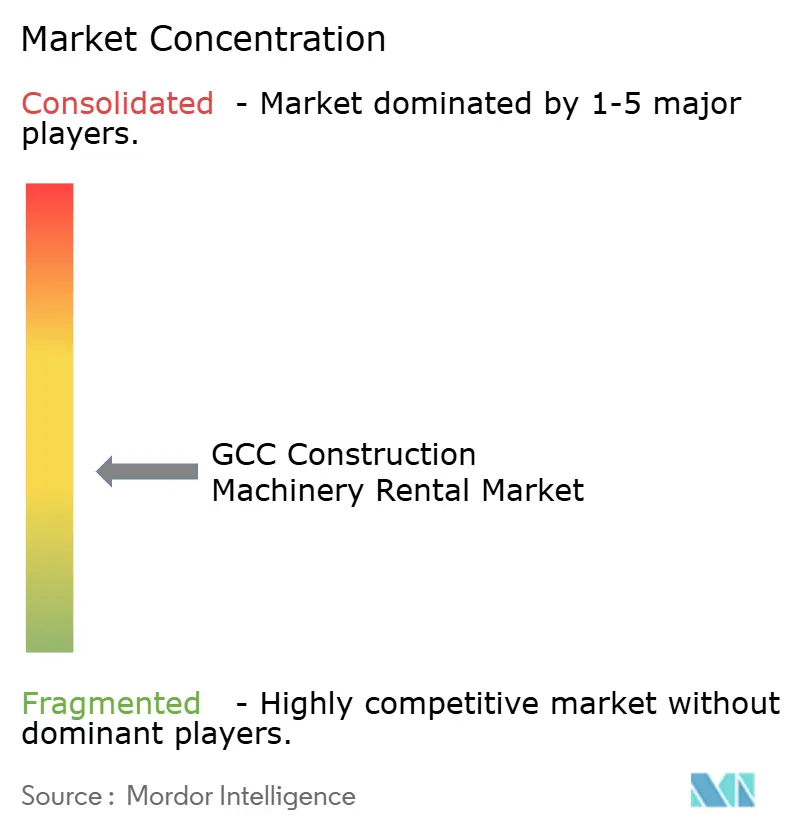
| Market Concentration | Medium |
Major Players *Disclaimer: Major Players sorted in no particular order Image © Mordor Intelligence. Reuse requires attribution under CC BY 4.0. | |
GCC Construction Machinery Rental Market Analysis by Mordor Intelligence
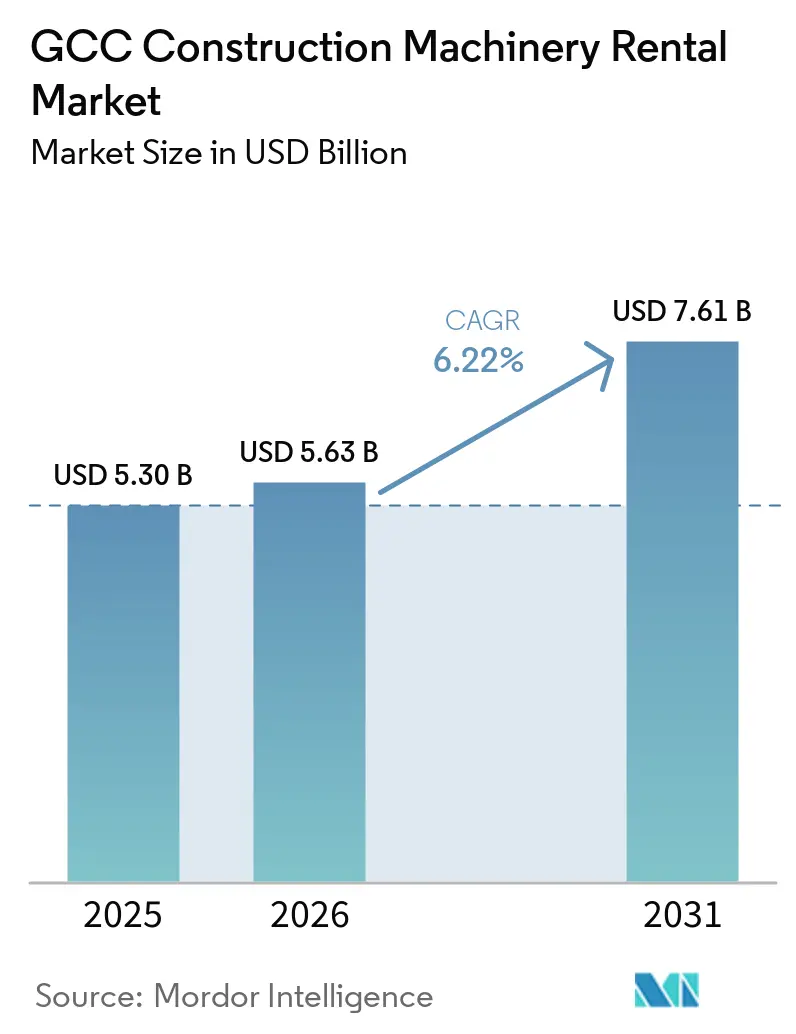
The GCC construction machinery rental market size was valued at USD 5.30 billion in 2025 and estimated to grow from USD 5.63 billion in 2026 to reach USD 7.61 billion by 2031, at a CAGR of 6.22% during the forecast period (2026-2031). This growth reflects contractors’ pivot toward asset-light models as Vision-led megaprojects compress procurement cycles, while tightening margins elevate the appeal of pay-per-use equipment access. Digital fleet optimization now underpins guaranteed uptime commitments, and mandatory Tier-4-Final / EU Stage V import rules accelerate fleet refreshes toward lower-emission assets. Saudi Arabia’s NEOM, UAE’s data-center boom, and Qatar’s LNG expansion anchor multi-year demand, while harsh desert conditions heighten the value of professionally maintained rental fleets. Moving forward, stricter green procurement criteria and COP28-aligned incentives position hybrid and fully electric equipment as the next performance frontier of the GCC construction machinery rental market.
Key Report Takeaways
- By vehicle type, earth-moving equipment represented 44.68% of the GCC construction machinery rental market size in 2025; concrete and hoisting equipment is advancing at a 6.88% CAGR through 2031.
- By propulsion type, IC-engine machines held 87.65% of the GCC construction machinery rental market size in 2025, whereas full-electric and battery-powered units are growing at a 10.18% CAGR.
- By end-user industry, commercial and residential construction captured 38.78% of the GCC construction machinery rental market size in 2025; power and renewables is anticipated to expand at a 6.76% CAGR between 2026-2031.
- By country, Saudi Arabia commanded 54.52% of the GCC construction machinery rental market share in 2025; Qatar is projected to record the fastest 7.44% CAGR to 2031.
Note: Market size and forecast figures in this report are generated using Mordor Intelligence’s proprietary estimation framework, updated with the latest available data and insights as of 2026.
Market Trends and Insights
Drivers Impact Analysis of GCC Construction Machinery Rental Market*
| Driver | (~) % Impact on CAGR Forecast | Geographic Relevance | Impact Timeline |
|---|---|---|---|
| Infrastructure Boom Under GCC Vision | +1.8% | Saudi Arabia, UAE, Qatar | Long term (≥ 4 years) |
| Data-Center and Renewable-Energy Build-Outs | +1.2% | UAE, Saudi Arabia, Oman | Medium term (2-4 years) |
| Shift to OPEX-Light Models | +0.9% | GCC | Short term (≤ 2 years) |
| Mandatory Tier-4-Final / EU Stage V Standards | +0.7% | UAE, Saudi Arabia | Medium term (2-4 years) |
| Digital Fleet-Management and Telematics | +0.5% | UAE, Saudi Arabia, Qatar | Short term (≤ 2 years) |
| COP28-Linked Green Procurement Incentives | +0.4% | GCC | Long term (≥ 4 years) |
| Source: Mordor Intelligence | |||
Infrastructure Boom Under GCC Vision Programs
Megaprojects such as NEOM, the Red Sea Global tourism corridors, and Dubai 2040 drive unprecedented equipment demand, compressing traditional purchase cycles into rental-first decisions. Saudi Arabia’s Public Investment Fund into NEOM, while a new Wolffkran–Zamil joint venture is building a 150-unit-per-year tower-crane plant to serve regional projects [1]. UAE real-estate transactions growth in 2024, reinforcing steady vertical construction pipelines that rely on readily available cranes and concrete pumps. Qatar’s Third National Development Strategy outlines investment in PPP schemes through 2030, further stretching contractor capital. Long project lists across Oman’s Duqm SEZ and Bahrain’s metro program underscore how Vision agendas escalate the need for flexible fleets. Consequently, the GCC construction machinery rental market gains a structural boost from megaproject scheduling volatility and capex discipline requirements.
Rapid Growth Of Data-Center And Renewable-Energy Build-Outs
Hyperscale data-center clusters in Dubai South and Saudi Arabia’s King Salman Energy Park require precision foundation work, heavy lifts for prefabricated modules, and continuous onsite power generation. Concurrently, utility-scale photovoltaic plants such as UAE’s 2 GW Al Dhafra project and Oman’s green-hydrogen concessions demand specialty piling rigs, tracked cranes, and high-capacity telehandlers over multi-year periods [2]. Rental providers tailor equipment packages with thermal-stress kits and dust-protection features suited to desert conditions, lowering upfront costs for developers. As renewables accelerate toward the region’s clean-power target by 2050, specialist rental fleets become indispensable for meeting tight commissioning deadlines.
Contractor Shift To OPEX-Light Models Amid Tightening Project Margins
Public-sector payment cycles in Saudi Arabia and sporadic variation-order approvals tighten working capital, steering contractors away from outright purchases. Elevated interest rates and Basel III lending limits raise the hurdle rate on equipment ownership, prompting firms such as ALEC Engineering to prioritize liquidity preservation. Renting shifts depreciation, maintenance, and resale risk to fleet owners, while guaranteed uptime clauses safeguard project schedules. The monetization of telematics data—ranging from idle-time reporting to productivity dashboards—supports performance-based billing structures that align equipment costs with project cash inflows, reinforcing rental appeal.
Mandatory Tier-4-Final / EU Stage V Import Standards (UAE And KSA)
From 2024, customs authorities in Dubai require diesel machines to carry certified after-treatment systems, driving replacement of Tier 3 fleets ill-suited to particulate-matter thresholds [3]. Compliance upgrades raise purchase costs, whereas UAE construction equipment rental providers amortize the premium over large fleets and embed operator-training packages that prevent costly mismanagement of DPF regeneration. Consequently, contractors adopt rental to secure compliant assets without a balance-sheet hit, and regional distributors accelerate trade-in programs feeding secondary markets in Africa.
Restraints Impact Analysis of GCC Construction Machinery Rental Market*
| Restraint | (~) % Impact on CAGR Forecast | Geographic Relevance | Impact Timeline |
|---|---|---|---|
| Intensifying Price Competition From Chinese Lessors | −1.1% | GCC | Short term (≤ 2 years) |
| Project Delays in Public Megaprojects | −0.8% | Saudi Arabia, Qatar, Kuwait | Medium term (2-4 years) |
| Scarcity of Certified Operators | −0.6% | GCC | Long term (≥ 4 years) |
| Climatic Stress Accelerates Depreciation | −0.4% | GCC | Long term (≥ 4 years) |
| Source: Mordor Intelligence | |||
Intensifying Price Competition From Chinese OEM-Affiliated Lessors
Shandong-based crane makers bundle zero-interest financing with rental offers, undercutting regional incumbents while accelerating regional parts-storage hubs in Dammam and Jebel Ali. Their integrated model leverages scale procurement from domestic factories, squeezing margins for operators reliant on European-sourced fleets. Although stringent Saudi localization rules favor established players, price-sensitive second-tier contractors gravitate toward Chinese alternatives, prompting incumbents to emphasize telematics-backed uptime guarantees and value-added training.
Project Delays And Payment Backlogs In Public-Sector Megaprojects
Riyadh Metro extension revisions and Kuwait’s airport terminal renegotiations push completion schedules beyond contractual horizons, leaving equipment idle on partially mobilized sites. Rental firms must extend credit while absorbing fleet under-utilization, eroding returns. Qatar’s post-World-Cup project reprioritization similarly defers capital-intensive phases, creating gaps in demand across hoisting categories. Effective receivables management and diversified deployment across multiple countries emerge as defensive tactics but carry added logistics complexity.
*Our forecasts treat driver/restraint impacts as directional, not additive. The impact forecasts reflect baseline growth, mix effects, and variable interactions.
GCC Construction Machinery Rental Market Segment Analysis
By Vehicle Type:
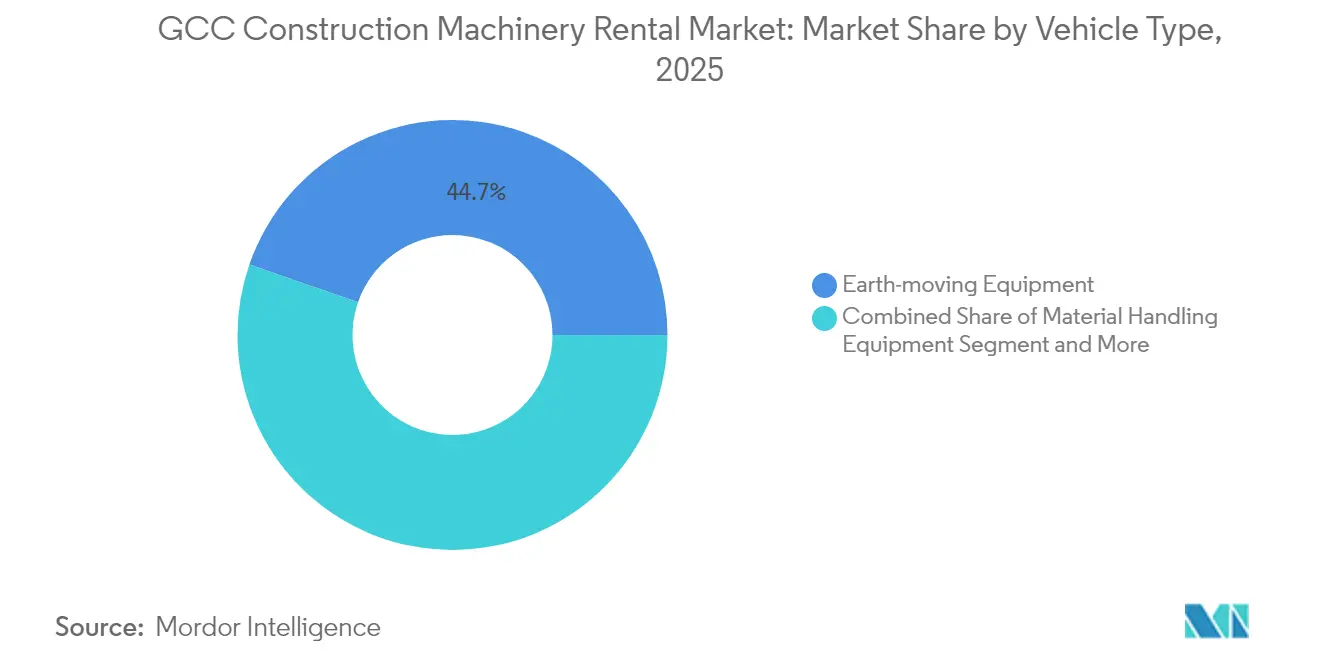
Earth-Moving Leads Infrastructure SurgeEarth-moving assets captured 44.68% of the GCC construction machinery rental market size in 2025 on the back of expansive earthworks for NEOM corridors, UAE freight rail extensions, and Qatar’s gas-processing platforms. Digital blade-control on dozers and 3D-GPS guided graders underpin higher productivity against tight project timelines, reinforcing rental adoption as contractors seek the latest firmware without ownership risk. Material-handling cranes gain momentum in Oman’s Duqm port expansion, while concrete pumps and placing booms post a 6.88% CAGR as high-rise clusters multiply along Riyadh Boulevard and Dubai Creek.
Rental firms integrate OEM telematics into dashboards that allocate equipment across multiple sites, improving utilization and supporting dynamic pricing models. The GCC construction machinery rental market benefits from bundled service packages that include certified operators, maintenance call-outs within four hours, and on-site parts storage. Contractors increasingly benchmark total project cost per cubic meter moved rather than hourly equipment rates, anchoring the shift toward rental contracts that embed performance metrics.

By Propulsion Type:
Electric Transition AcceleratesIC-engine machines retained 87.65% dominance in 2025, yet electric skid steers, mini-excavators, and rough-terrain forklifts register a 10.18% CAGR as municipalities impose emissions and noise caps around residential zones. Rental companies deploy mobile charging trailers powered by hybrid gensets, ensuring flexible job-site power while mitigating range anxiety. The GCC construction machinery rental market share of battery-electric models is set to grow by 2030 as battery energy density surpasses 300 Wh/kg, enabling eight-hour duty cycles in 30-ton excavators.
Hybrid-drive variants emerge as transitional solutions, especially for telehandlers and knuckle-boom lifts operating across dispersed logistics parks. Predictive analytics compare fuel burn between hybrid and diesel variants, guiding contractors toward optimal sustainability-cost trade-offs. Leasing terms incorporate carbon-reduction targets, with rental rates declining once verified telemetry demonstrates emissions savings against baseline Tier 3 fleets.
By End-User Industry:
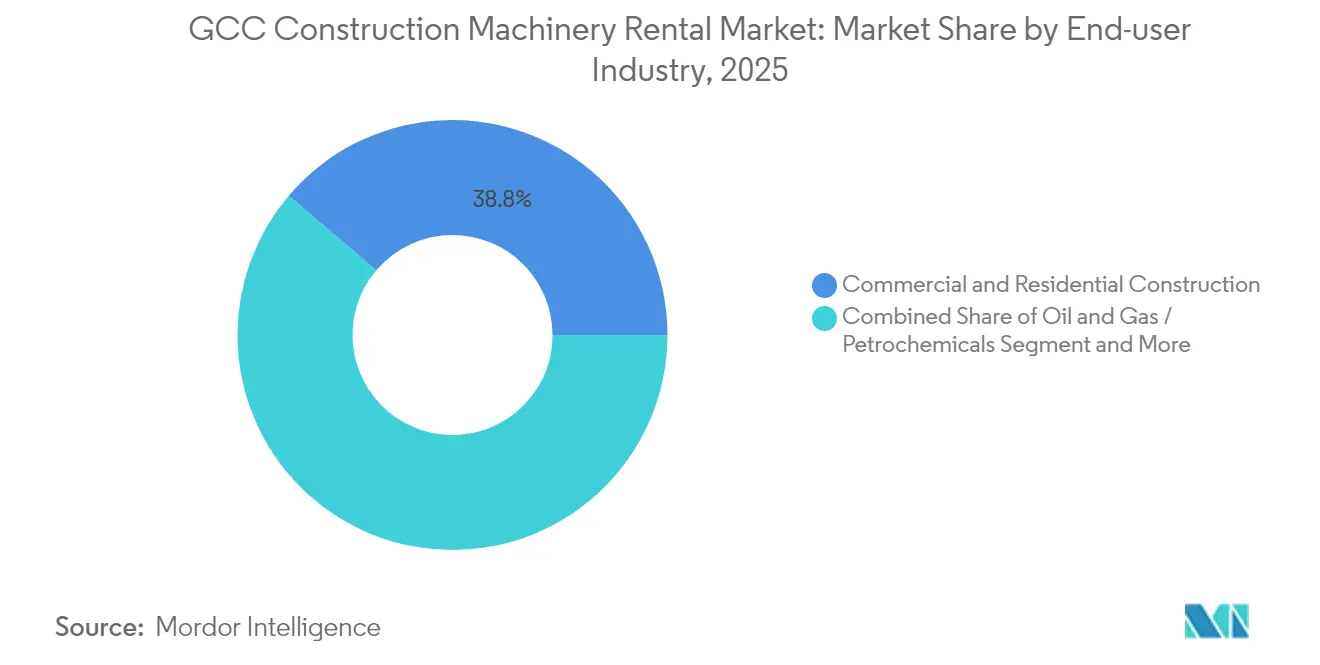
Renewable Power Spurs Specialized DemandCommercial and residential building stayed the largest renter at 38.78% share in 2025, backed by Dubai’s significant real-estate transactions and Saudi giga-projects that include over several new hotel keys. Nonetheless, power and renewables is the fastest-rising segment at 6.76% CAGR as the region adds 15 GW of solar capacity and accelerates green-hydrogen pilots.
Pipeline infrastructure for North Field LNG, Oman’s Duqm refinery, and UAE’s ADNOC ammonia export terminals rely on specialized pipe-layers, vacuum-lift trailers, and modular transporter systems typically available only through rental pools. The GCC construction machinery rental industry therefore tailors fleet mix to sector-specific cycles, balancing housing booms with the multi-year cadence of power-plant builds.
Geography Analysis
Saudi Arabia Construction Machinery Rental Market
Saudi Arabia anchors the GCC construction machinery rental market with a 54.52% share in 2025, buoyed by significant project pipeline spanning NEOM, Qiddiya, and The Line districts. The kingdom’s localization mandate, which requires minimum 25% Saudi-built components on government contracts, favors rental firms with domestic assembly partners, exemplified by the Wolffkran-Zamil tower-crane plant targeting 150 units per year.
GCC Construction Machinery Rental Market
The United Arab Emirates holds a significant position, leveraging its role as a regional commerce hub, with real-estate deals and robust logistics infrastructure that supports rapid cross-emirate equipment redeployment. UAE’s Net Zero charter incentivizes adoption of battery-electric compact machinery through fast-track environmental approvals, propelling the nation’s share of hybrid-ready fleets. Qatar represents the fastest-growing market at a 7.44% CAGR to 2031, tied to several planned projects and the North Field Production Sustainability Phase 2 that extends LNG dominance. Oman, Kuwait, and Bahrain together contribute a steady share of regional revenue, with Oman’s Duqm SEZ alone drawing investment in transport and petrochemical works, necessitating long-reach excavators and heavy haulage rigs. Policy-driven monetary easing since late 2024 lowers borrowing costs, indirectly supporting construction starts and rental penetration across all six GCC states.
Regulatory Landscape
Regulation shaping construction machinery rental across the GCC centers on (i) safety on job sites, (ii) product conformity for imported equipment, and (iii) roadworthiness constraints for heavy vehicles. In Dubai, Decree No. (19) of 2025 concerning safety in construction work mandates compliance with a Code of Construction Safety Practice, binding on contractors and engineering firms, and raising the operational bar for rental providers through documented maintenance, inspections, and safe-operation procedures.
Saudi Arabia controls market access for many machine categories through SASO, including the Heavy Equipment Regulatory Center (established April 2021) and the SABER conformity system used for customs clearance. From January 1, 2025, imported construction machinery requires mandatory SABER conformity certification, while applicable technical regulations reference safety standards such as SASO ISO 12100 and SASO ISO 3471 (ROPS), supporting a shift toward newer, compliant rental fleets. In the UAE, Federal Decree Law No. (12) of 2023 and Cabinet Decree No. 138 of 2023 regulate heavy vehicle weights and dimensions, affecting the rental utilization of lowbed transporters, heavy trucks, and oversized equipment movements, with technical approval regimes also supported by Abu Dhabi entities such as QCC for infrastructure-related requirements.
Value Chain Analysis
The GCC construction machinery rental value chain starts with global OEMs and authorized regional dealers that supply new equipment, parts, and service capability, then flows to fleet owners (large rental groups and specialized lessors), and finally to contractors and project owners through short-term spot hires and multi-year framework agreements with uptime clauses. Dealers and service networks underpin fleet readiness in harsh operating conditions; for example, Mohamed Abdulrahman Al-Bahar operates as an authorized Caterpillar dealer across UAE, Qatar, Bahrain, Kuwait, and Oman, supporting parts availability and rebuild pathways that affect lifecycle cost for rental fleets.
Value creation on the operating side comes from fleet configuration (earth-moving, cranes/hoisting, and specialty attachments), mobilization and heavy-haul logistics, onsite maintenance, and telematics-enabled scheduling across hubs such as Riyadh/Jeddah and the UAE logistics corridor (including Jebel Ali). Cross-border redeployment and compliance checks (import conformity, site safety, and transport limits) add friction and lift the role of documentation and inspection workflows. Increasing integration of telematics and IoT supports utilization management, predictive maintenance, and performance-based billing, while regulatory pressure from bodies such as SASO accelerates replacement cycles toward emissions- and safety-compliant assets.
Competitive Landscape
The GCC construction machinery rental market exhibits moderate fragmentation. Regional champions such as Al Faris Group leverage crane specialization and vertically integrated heavy-haul logistics, while Wolffkran Arabia focuses on tower-crane turnkey services for high-rise contractors. Chinese OEM-affiliated lessors—Zoomlion, XCMG Leasing—enter via joint-venture depots in Dammam and Dubai, offering bundled finance that compresses daily rates.
Digital differentiation defines the next competitive battleground. Al Faris introduced a telematics-backed “95% Uptime Assurance” program in 2025 that offsets liquidated damages for late equipment replacement, exploiting 4G/5G connectivity across NEOM clusters. Wolffkran Arabia equipped its luffing-jib fleet with anti-collision technology integrated into BIM models, reducing tower-crane downtime on Riyadh’s King Salman Park. Chinese entrants counter with AI-based load-moment indicators and multi-year warranties, banking on shorter payback periods due to lower acquisition costs.
Electric-equipment capability emerges as a strategic moat. Regional distributors of Volvo and JCB partner with rental firms to establish rapid-charging hubs at Dubai Logistics City and Riyadh Industrial Valley. Operators able to guarantee emissions-compliant fleets win preferred-supplier status on public tenders, while smaller independents confront capex hurdles tied to electric machines and charger procurement. Intensifying data-center developments further tilt the scale toward players offering combined rental and power-generation solutions.
GCC Construction Machinery Rental Industry Leaders
-
Al Faris Group
-
Bin Quraya
-
Byrne Equipment Rental LLC
-
Zahid Tractor & Heavy Machinery Co.
-
Johnson Arabia LLC
- *Disclaimer: Major Players sorted in no particular order
GCC Construction Machinery Rental Market Companies Covered in this Report
- Al Faris Group
- Bin Quraya
- Arabian Machinery & Heavy Equipment Co. (AMHEC)
- Byrne Equipment Rental LLC
- Mohamed Abdulrahman Al-Bahar LLC
- Zahid Tractor & Heavy Machinery Co.
- Johnson Arabia LLC
- Rezayat Sparrow Arabian Crane Hire Co. Ltd.
- Abdullah H. Al Shuwayer Company
- Hertz Dayim Equipment Rental
- Wolffkran Arabia
- Al Mutawa Crane
- ACT Crane & Heavy Equipment
- Sarens Nass Middle East
- United Gulf Equipment Rentals
- Rapid Access LLC
- Kanoo Machinery Rental
Read Analysis of GCC Construction Machinery Rental Companies
Market Opportunities and Future Outlook
White space in the GCC construction machinery rental market is widening in three areas: specialty lifting and engineered-transport packages, emissions-compliant fleet refresh programs that reduce contractor balance-sheet burden, and digital uptime-backed contracting that fits compressed procurement cycles on megaprojects. Saudi Arabia is the largest addressable pool within the region, and the market already reflects contractors' preference for rental to manage 2-4 year project durations and working-capital constraints. This supports opportunities for providers that can bundle maintenance, certified operators, and site-ready documentation (inspection records, conformity certificates) into framework agreements.
Electrification and compliance-driven procurement create a second monetization lane for rental companies that can supply battery-electric compact equipment and the enabling infrastructure (job-site charging trailers, depot charging hubs) while maintaining guaranteed uptime. Evidence of tightening certification and documentation requirements extends beyond equipment into construction inputs, with the Gulf Standardization Organization (GSO) moving in 2026 toward mutual recognition and conformity marking regimes for materials used in major infrastructure and industrial projects. This increases the value of rental partners that can manage end-to-end compliance and quality records for project access and audits. Consolidation and capital partnerships also open room for fleet scale-ups and network coverage, as demonstrated by GFH Financial Group's majority investment in Byrne Equipment Rental, which highlights investor appetite for platforms that can standardize operations across GCC hubs.
Recent Industry Developments in GCC Construction Machinery Rental Market
- July 2026: Al Faris Group deployed a Liebherr LTM 1750-9.1 (800T mobile crane) for dismantling a tower crane at a stadium project. The move reinforces demand for high-capacity mobile cranes and engineered lift planning delivered as a rental service, not just equipment hire, raising competitive emphasis on heavy-lift capability and safety execution.
- February 2026: GFH Financial Group completed the acquisition of a 60% majority stake in Byrne Equipment Rental LLC. The transaction strengthens Byrne's access to capital for fleet expansion and network upgrades, supporting platform scaling across GCC project hubs where uptime-backed frameworks and multi-site coverage influence award decisions. The deal signals investor appetite for platform operators that can standardize operations and expand regional coverage.
- May 2024: A lump sum turnkey contract for the Master Gas System III Package 5, covering 170 km of pipelines, was awarded by Saudi Aramco. This award increases demand for rented earth-moving, lifting, and support equipment across multiple spreads, favoring providers that can mobilize standardized fleets with maintenance and logistics included.
GCC Construction Machinery Rental Market Report Scope and Research Methodology
Market Definition and Coverage
This market covers revenue earned from renting construction machinery to customers across GCC countries, where the asset is provided for a defined period and billed using daily, weekly, monthly, or project-based terms.
Scope exclusions: Equipment purchase or sale revenue, contractor-owned equipment used in-house, and standalone operator labor charges are excluded unless they are inseparable from the rental invoice.
Segments Covered in This Report
- By Vehicle Type
- Earth-moving Equipment
- Material Handling Equipment
- Road-building and Compaction Equipment
- Concrete and Hoisting Equipment
- Power and Utility Generators
- By Propulsion Type
- IC Engine
- Hybrid Drive
- Full Electric / Battery-Powered
- By End-user Industry
- Commercial and Residential Construction
- Oil and Gas / Petrochemicals
- Infrastructure and Transport (roads, metros, ports, airports)
- Power and Renewables
- Industrial and Manufacturing
- By Country
- Saudi Arabia
- United Arab Emirates
- Qatar
- Kuwait
- Oman
- Bahrain
Data Sources, Market Sizing, and Validation
Desk Research
Desk work started with GCC construction activity signals that can be checked and updated, and then it was translated into rental demand drivers. We reviewed public sources such as national statistics releases and economic bulletins from GCC governments, central bank publications on inflation and interest rates, customs and trade statistics where available, and infrastructure pipeline updates from transport and public works authorities.
To sharpen the machinery angle, we also used materials from industry associations and standards bodies, plus peer-reviewed articles on equipment utilization and fleet productivity. Company annual reports, investor presentations, and credible business press were used to estimate rental penetration, fleet renewal cycles, and typical pricing practices. A paid subscription for company financials and a shipment-level import and export database were used selectively to validate fleet growth and cross-check large equipment inflows. These desk research sources are illustrative, and additional public references were also used to complete data collection, validation, and clarification.
Primary Interviews and Surveys
Fieldwork focused on the pricing and utilization mechanics that are hard to confirm from public information alone, so we spoke with rental companies, large contractors, and project planners. We then checked findings with maintenance and fleet managers who see availability constraints first.
Respondent input was used to tighten assumptions on rental durations, seasonal utilization swings, discounting behavior on long projects, and the split between bare rental and rental with operator (where both are billed as one line item). Coverage was kept across the GCC so country-level project cycles and cost movements were reflected in the assumptions used in the model.
Distribution of primary research fieldwork respondents
| Company type | Respondent position |
|---|---|
| Top tier: 25% | CXOs: 14% |
| Mid tier: 55% | Functional/Unit leaders: 31% |
| Smaller Players: 20% | Managers: 55% |
Market-Sizing & Forecasting
Sizing began with a top-down demand pool build that links construction activity to equipment hours required, then converts those hours into rental revenue using rental penetration and average rental rates. Country totals were built across GCC members and then consolidated, and the same logic was applied by major equipment groups so the mix did not drift unrealistically.
Key inputs used in the model included construction spending direction and project starts, the active project pipeline by type (transport, commercial, residential, and industrial), typical equipment utilization rates by fleet class, average rental duration patterns by project size, and observed rate progression for daily and monthly rentals as fuel, labor, and spare parts costs move. Forecasts were produced using scenario analysis anchored to expected project execution speed and contractor capacity, then adjusted using primary inputs on likely discounting and fleet additions. We corroborated outputs with selective bottom-up approximations, such as sampled rate cards multiplied by reasonable utilization, and then applied gap-handling where smaller local fleets have limited public financial disclosure.
Data Validation & Update Cycle
Outputs were validated by comparing implied rental intensity against independent signals such as construction activity direction, equipment import patterns, and reported fleet expansion plans, and any large variance was reviewed before sign-off. When numbers looked too high or too low, we re-checked rate assumptions, utilization, and the timing of project ramps, then re-contacted sources if the gap could not be explained.
Reports are refreshed annually, and interim updates are completed when major events materially change project timelines, financing conditions, or rental pricing. Before delivery, an analyst runs a fresh pass across the key inputs so clients receive an updated view aligned to the latest available indicators and interview learnings.
Mordor Intelligence's Gcc Construction Machinery Rental Market Size Versus Other Published Estimates
Published figures for GCC construction machinery rental do not always match because refresh timing, currency conversion windows, and the way average rental rates are updated can change the total even when the market label looks similar. Differences also come from whether the model is tied to project execution realities, or it is driven mainly by broad construction growth assumptions.
Rate decks and utilization checks were aligned to the same base-year currency timing and then re-tested through contractor and fleet-manager validation calls. This refresh-led step is what keeps Mordor Intelligence numbers closer to the rental invoices seen in active GCC projects.
Benchmark comparison
| Source | Market Size | Gaps in Research Methodology |
|---|---|---|
| Mordor Intelligence | USD 5.30 B (2025) | |
| Global Consultancy A | USD 4.28 B (2024) | Uses a different base year and a narrower vehicle grouping on the public page, and the rate build appears to rely more on a stated CAGR than on updated day-rate and utilization checks tied to current project execution. |
| Industry Publisher B | USD 2.50 B (2025) | The scope is framed as construction equipment rental and can undercount higher-value machinery categories or bundled rental lines, and it can also reflect more conservative rate progression assumptions for long-term rentals. |
The spread across sources is mainly explained by timing and scope boundaries, followed by how rental rates are trended forward under inflation and competitive discounting. By keeping inputs traceable to project activity, utilization, and rental rate cards that can be rechecked, the final number stays repeatable and easier to reconcile when new project or pricing information arrives.
Key Questions Answered in the Report
How large is the GCC construction machinery rental market in 2026?
The market is valued at USD 5.63 billion in 2026, with a forecast to reach USD 7.61 billion by 2031.
Which country leads demand for rented construction machinery across the GCC?
Saudi Arabia accounts for 54.52% of regional revenue, driven by its USD 680 billion project pipeline.
Which equipment type holds the largest rental share today?
Earth-moving machinery leads with 44.68% share due to extensive grading, excavation, and site preparation works.
What CAGR is expected for the overall market through 2031?
The GCC construction machinery rental market is projected to grow at a 6.22% CAGR over 2026-2031.