
Market Overview
| Study Period | 2020 - 2031 |
|---|---|
| Forecast Data Period | 2026 - 2031 |
| Base Year Market Size (2025) | USD 1.82 Billion |
| Market Size (2026) | USD 1.94 Billion |
| Market Size (2031) | USD 2.71 Billion |
| Growth Rate (2026 - 2031) | 6.85 % |
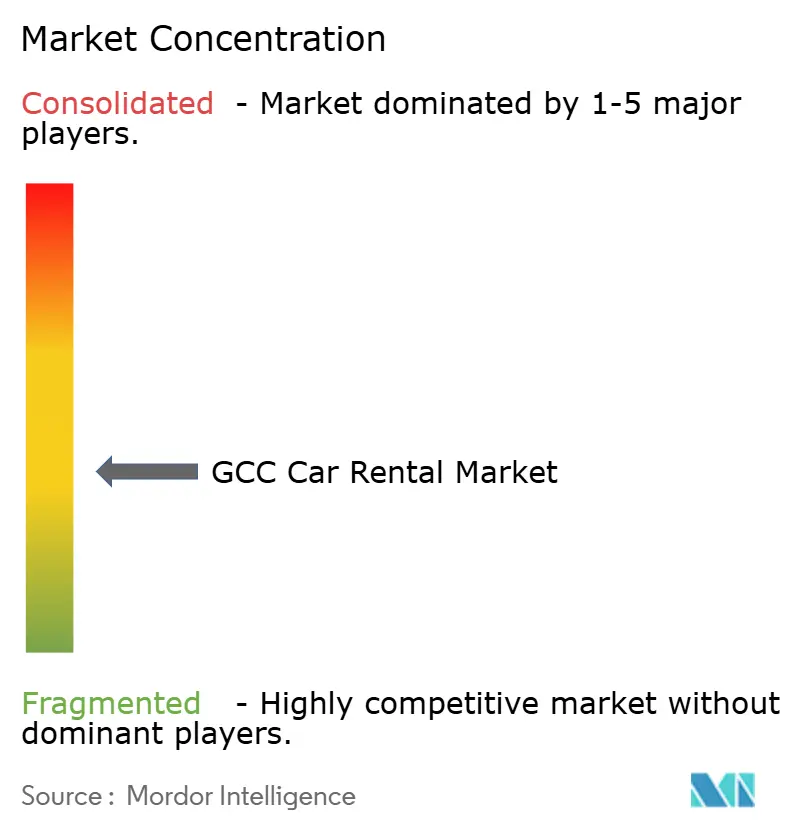
| Market Concentration | Medium |
Major Players *Disclaimer: Major Players sorted in no particular order Image © Mordor Intelligence. Reuse requires attribution under CC BY 4.0. | |
GCC Car Rental Market Analysis by Mordor Intelligence
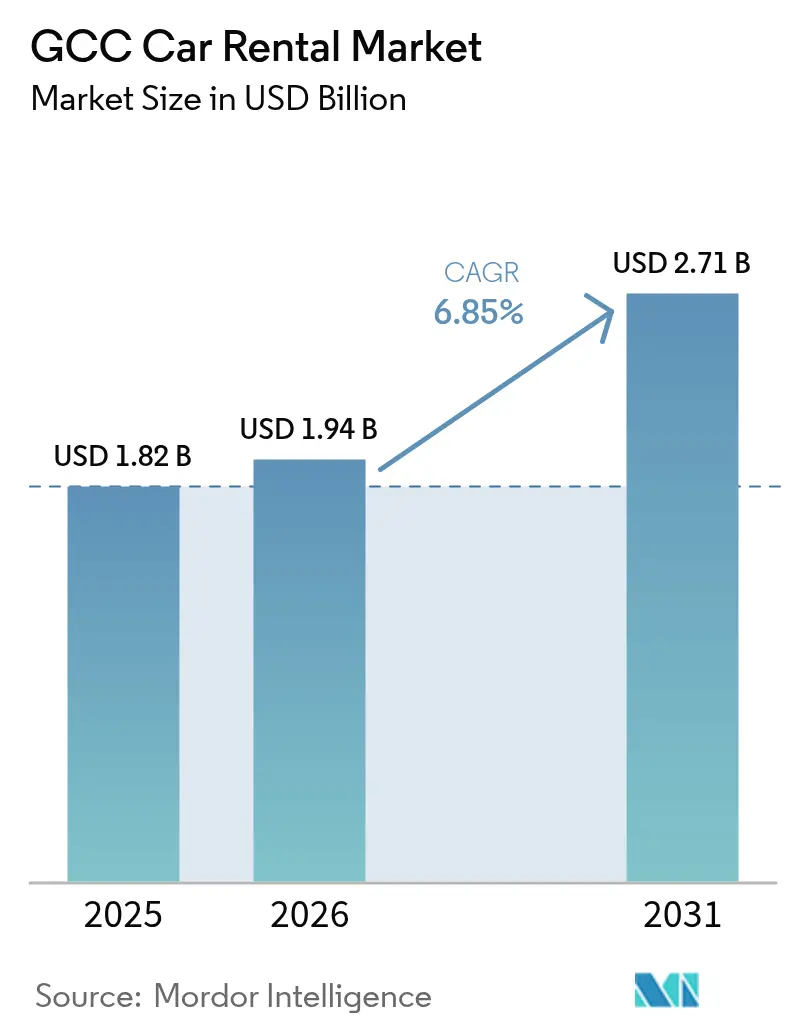
The GCC car rental market size is expected to grow from USD 1.82 billion in 2025 to USD 1.94 billion in 2026 and is forecast to reach USD 2.71 billion by 2031 at 6.85% CAGR over 2026-2031. This growth mirrors the region’s commitment to tourism-led diversification, the rapid rise of super-apps, and an unmistakable preference for access rather than ownership. Greater airline seat capacity, cross-border weekend travel, and increasingly flexible corporate mobility budgets reinforce the sector’s resilience. At the same time, integrating rental services into digital ecosystems and subscription platforms is reshaping competitive moats, while rising electric-vehicle (EV) incentives promise new revenue streams for operators prepared to retool their fleets.
Key Report Takeaways
- By booking channel, offline counters retained 63.52% of the GCC car rental market share in 2025; online platforms are on track to rise at a 7.18% CAGR to 2031.
- By rental duration, short-term bookings captured 70.74% of the GCC car rental market size in 2025, while long-term and operating leases will advance at 7.46% CAGR between 2026-2031.
- By vehicle type, sedans dominated the GCC car rental market, with 38.12% of the share in 2025; SUVs and luxury models are poised for the quickest 6.98% CAGR to 2031.
- By service type, self-drive rentals commanded 63.34% of the GCC car rental market share in 2025 and are expanding at 7.55% CAGR through 2031.
- By end-user, individuals held 48.21% of the GCC car rental market share in 2025, but the corporate segment will outpace at 7.24% CAGR to 2031.
- By country, the United Arab Emirates led with 39.58% of GCC car rental market share in 2025, whereas Saudi Arabia is projected to record the fastest 7.42% CAGR through 2031.
Note: Market size and forecast figures in this report are generated using Mordor Intelligence’s proprietary estimation framework, updated with the latest available data and insights as of 2026.
GCC Car Rental Market Trends and Insights
Drivers Impact Analysis*
| Driver | (~) % Impact on CAGR Forecast | Geographic Relevance | Impact Timeline |
|---|---|---|---|
| Tourism rebound | 1.8% | UAE, Saudi Arabia, Qatar | Medium term (2-4 years) |
| Government Vision programs | 1.5% | Saudi Arabia, UAE, Qatar | Long term (≥ 4 years) |
| Rising digital aggregation platforms | 1.2% | Global, with UAE and Saudi Arabia leading | Short term (≤ 2 years) |
| Gig-economy demand for flexible wheels | 0.9% | UAE, Saudi Arabia core, spill-over to Kuwait | Short term (≤ 2 years) |
| EV adoption incentives | 0.7% | UAE, Saudi Arabia | Long term (≥ 4 years) |
| Cross-border one-way rentals | 0.4% | UAE-Oman, Saudi-Bahrain corridors | Medium term (2-4 years) |
| Source: Mordor Intelligence | |||
Tourism rebound & mega-events pipeline
Gulf governments have synchronized a calendar of global spectacles ranging from Formula 1 races to World Cups, each generating predictable surges that rental companies meet through dynamic pricing and fleet redeployment. Saudi Arabia’s target of 150 million annual visits by 2030 and the UAE’s aim for 40 million overnight stays anchor long-range demand visibility. Dubai welcomed 9.3 million visitors in H1 2024, a 9% year-on-year lift, prompting Dubizzle to debut a dedicated aggregation service to capture the influx.[1] Qatar’s experience during the 2022 World Cup revealed both upside—Careem briefly scaled cross-border ride services—and downside risk once the event concluded. Continuous investments in airports and entertainment precincts entrench car rentals as indispensable infrastructure for the visitor economy.
Government Vision programs boosting inbound mobility
Policy frameworks embedded in Saudi Vision 2030 and the UAE Energy Strategy 2050 couple tourism and sustainability goals with regulatory clarity. Saudi Arabia’s Ministry of Transport has codified rules for leasing brokers, enabling scale while Qatar and Bahrain publish visitor targets of 7.1 million and 14.1 million respectively.[2] UAE authorities simplify cross-border mobility by recognizing GCC licenses, thereby enlarging the addressable tourist pool. Procurement guidelines that favor hybrid or electric fleets incentivize operators to green their inventories, a move that also appeals to corporate clients pursuing ESG metrics.
Rising digital aggregation platforms & super-apps
Super-apps such as Careem now bundle more than a dozen services, including car rental partnerships with Swapp, which compress acquisition costs and lift utilization by keeping users inside a single interface. Dubizzle’s October 2024 rollout leverages a combined 73% share of online automotive marketplaces with DubiCars, underscoring the power of platform economics. Subscription specialists like invygo, backed by USD 1.9 million in recent funding, signal consumer comfort with flexible access models. While small operators gain visibility without heavy marketing spend, established brands face margin pressure as platforms wedge themselves between renter and customer, turning brand equity into a commodity unless firms upgrade their own direct-to-consumer channels.
Gig-economy demand for flexible wheels
Udrive, which surpassed 2 million trips and attracted USD 5 million from Cultiv8 and Oman Holding International, is emblematic of the micro-rental wave reshaping urban transport. Young professionals in Riyadh and Jeddah lean on subscription models for delivery and ride-sharing work, treating vehicles as income-generating tools. Pay-per-minute schemes bridge the affordability gap between daily rentals and ride-hailing, optimizing costs for drivers who work in bursts rather than full shifts. The MENA ride-share sector is projected to grow exponentially through 2028, links directly to incremental rental demand as drivers rotate between owned cars, rentals, and on-demand leases.
Restraints Impact Analysis*
| Restraint | (~) % Impact on CAGR Forecast | Geographic Relevance | Impact Timeline |
|---|---|---|---|
| High insurance premiums | -1.1% | UAE, Qatar, Kuwait | Short term (≤ 2 years) |
| Fragmented regulatory rules | -0.8% | Global GCC, with cross-border operations most affected | Medium term (2-4 years) |
| Limited secondary market | -0.5% | UAE, Saudi Arabia | Long term (≥ 4 years) |
| Shortage of Arabic UX in global OTAs | -0.3% | Global GCC, with Saudi Arabia and UAE most affected | Short term (≤ 2 years) |
| Source: Mordor Intelligence | |||
High insurance premiums on expatriate drivers
UAE motor premiums climbed 40% in 2024, with rental vehicle cover leaping from 2% to 8.5% of asset value. Expatriates pay additional surcharges due to limited local driving histories, compressing operator margins or inflating retail prices. The wider GCC insurance sector is propelled by IFRS 17 compliance costs and reinsurer hardening that flows through to end-customers. Extreme weather loss events amplify claims severity, and when combined with cross-border cover needs, insurers frequently attach bespoke riders that elevate premiums on multi-jurisdiction rentals.
Fragmented regulatory rules across emirates/kingdoms
A mosaic of licensing, vehicle specification, and insurance mandates forces operators to maintain separate compliance regimes for each jurisdiction. Differences extend to emirate level inside the UAE and persist across Saudi Arabia, Qatar, Oman, and Bahrain, complicating fleet allocation and administrative processes. For customers, uneven rules dilute one-way rental convenience because paperwork and coverage rarely align across borders. The absence of unified digital payment standards further obliges companies to duplicate back-office systems, raising operational cost and dampening cross-border growth.
*Our forecasts treat driver/restraint impacts as directional, not additive. The impact forecasts reflect baseline growth, mix effects, and variable interactions.
Segment Analysis
By Booking Channel: Offline dominance endures, yet digital platforms accelerate
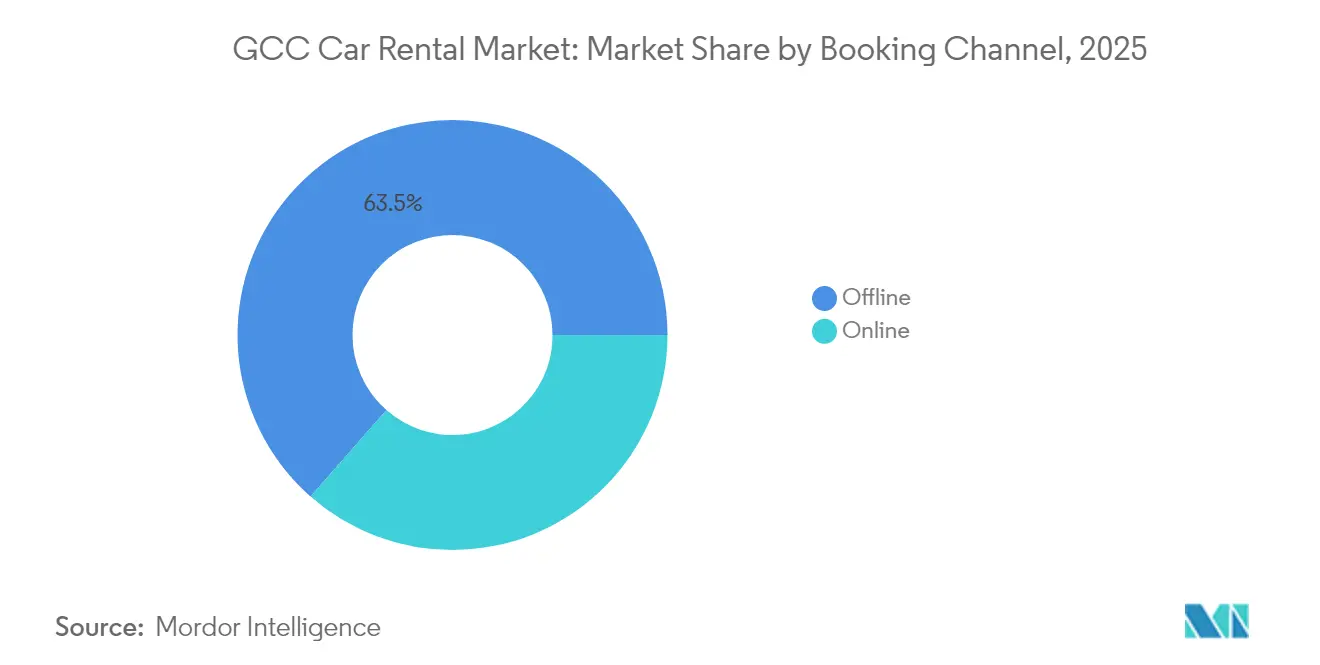
The GCC car rental market retains a 63.52% offline share in 2025, underscoring the appeal of face-to-face interaction for first-time visitors and corporate bookers who favor in-person verification of vehicle condition and insurance coverage. Nevertheless, online channels are on course for a 7.18% CAGR, bolstered by super-apps that promise frictionless reservations in under 60 seconds. Young leisure travelers value transparent pricing and the ability to sync car pick-up with flight itineraries inside the same app, while corporate mobility managers begin to adopt dashboards that consolidate reservation data for expense control.
Dubizzle’s entry in October 2024 immediately broadened digital supply, exploiting its marketplace traffic to funnel tourists—Dubai recorded 9.3 million arrivals in H1 2024—into rental bookings. Zero-commission innovators such as Drife illustrate how aggregator economics may compress commissions further, threatening traditional intermediaries. Still, offline counters continue to shine for premium bookings where renters demand bespoke packages, additional insurance clarifications, or luxury vehicle upgrades negotiated on the spot. The coexistence of channel models suggests that the GCC car rental market will evolve into a hybrid ecosystem rather than a pure-play digital environment.

By Rental Duration: Short-term leadership, but long-term leasing gathers pace
Short-term contracts generated 70.74% of the GCC car rental market size in 2025, buoyed by holidaymakers, business travelers, and weekend shoppers crossing borders within the bloc. Yet long-term and operating leases outstrip in growth, advancing at 7.46% CAGR because corporates embrace asset-light approaches that free balance sheets from depreciation expenses. Regional corporations and project contractors now bundle maintenance, insurance, and telematics in twelve-month contracts that can be upsized or downsized as head-count fluctuates.
This structural pivot is mirrored in the subscription boom led by IndyGo, which raised USD 1.9 million to extend all-inclusive packages across Saudi Arabia and the UAE. Long-term clients prioritize total cost of mobility rather than day rates, rewarding operators who offer predictive maintenance and downtime guarantees. For short-term renters, fleet breadth and airport counter efficiency remain decisive. The coexistence of both duration types underlines how the GCC car rental market accommodates tourist spontaneity while simultaneously embedding itself into corporate supply chains.
By Vehicle Type: Sport Utility Vehicle categories climb the ladder
Sedans accounted for 38.12% of the GCC car rental market share in 2025 due to their fuel efficiency and comfort profile desired by cost-conscious tourists and executives alike. Sport Utility Vehicle marques are forecast to post a 6.98% CAGR, encouraged by rising disposable incomes and corporate perception that upscale vehicles reinforce brand positioning during client visits. Chinese brands experienced a 150% demand spike in June 2024, signaling consumers are open to alternative premium propositions when pricing and features align.
Mohamed Yousuf Naghi Motors’ deal to supply BMW and MINI models to Budget adds credibility to the high-end shift. At the same time, EV adoption gathers momentum as Gulf authorities subsidize charging infrastructure. The UAE targets 25% EV sales by 2035, and Saudi Arabia is installing 50,000 public chargers by 2025, paving the way for greener rental fleets. Customers on longer leases increasingly select SUVs for versatility—ample cargo for family excursions and superior ride height for desert terrain—whereas urban weekend renters still lean towards sedans for parking ease.
By Service Type: Self-drive prevails, chauffeur services find niches
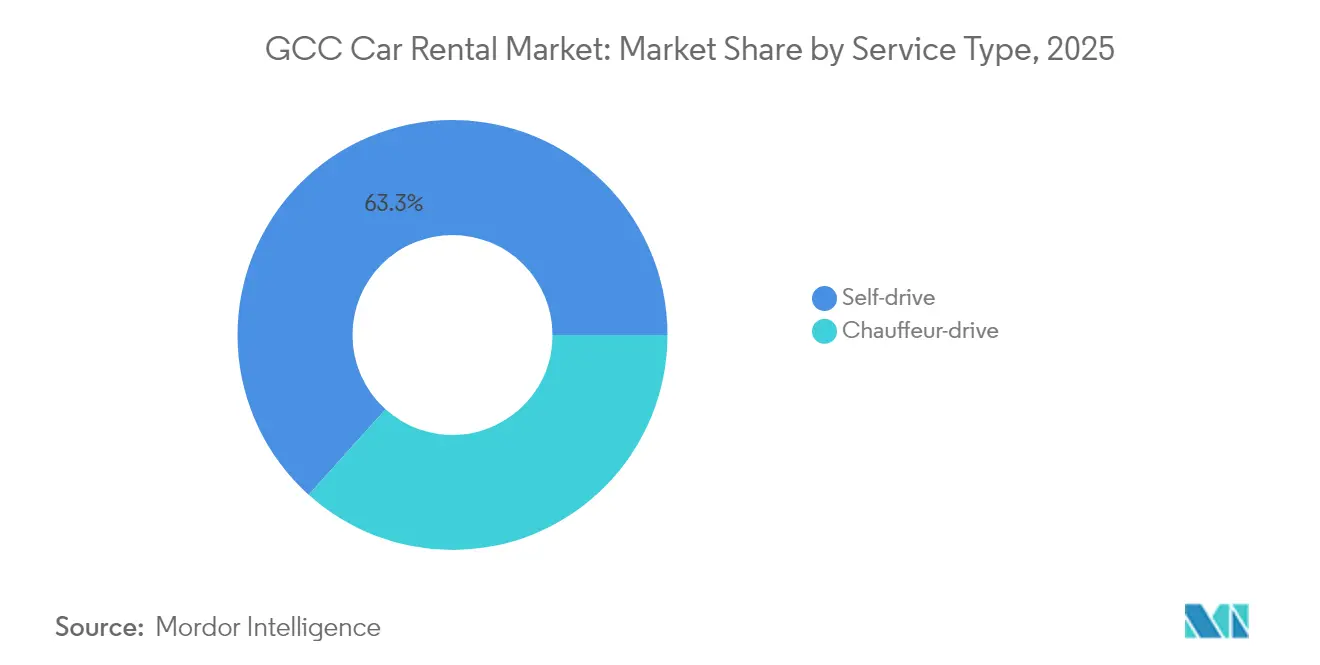
Self-drive arrangements dominated with a 63.34% slice of the GCC car rental market in 2025, growing at 7.55% CAGR as visitors relish the freedom to design bespoke itineraries. The ascent is enabled by upgraded highways, English-Arabic signage, and smartphone navigation tools that lower apprehension for foreign drivers. Chauffeur-driven packages, although smaller, cater to VIP travelers, corporate roadshows, and high-net-worth individuals who value local knowledge and time efficiency.
Dubai Taxi Company’s 2025-2029 roadmap hints at expansion into chauffeur-grade rentals that straddle the boundary between taxi meters and multi-hour hires. Hybrid offerings now permit the same booking to toggle between self-drive and professional driver add-ons, matching service to evolving daily schedules. As a result, the GCC car rental market presents operators with an opportunity to graduate customers up the value chain from economy self-drive to executive chauffeur services during repeat visits.
By End-User: Individuals dominate, but corporates build momentum
Individuals comprised 48.21% of the GCC car rental market share in 2025, reflecting tourism’s weight in Gulf economies. Corporate and SME users, however, register the sharper 7.24% CAGR, spurred by policies that let companies expense rental costs in lieu of owning depreciating fleets. Enterprise Mobility’s USD 38 billion global revenue underscores the appetite for outsourced vehicle management. Within the GCC car rental industry, large construction and energy projects embed rental clauses into contracts, ensuring dedicated fleets for site staff without the capital hurdle of outright purchases.
Gig-economy growth adds a further twist, with freelance drivers renting vehicles only for peak demand windows, thereby distorting the clear-cut individual-versus-corporate dichotomy. Government entities occasionally request specialty fleets, such as electric sedans for diplomatic events, creating niche orders that influence the overall fleet mix. The evidence points to a maturing market in which operators must master both retail volume and fewer, high-value corporate accounts.
Geography Analysis
The United Arab Emirates set the pace with 39.58% of revenue in 2025, leveraging Dubai’s “Destination 2030” tourism blueprint and Abu Dhabi’s status as an MICE powerhouse. Visitor inflows rose 9% year-on-year in the first half of 2024 and underpin high fleet utilization at airport locations, even as insurance premiums climbed by 40% and challenged pricing models. Authorities ease cross-border friction by recognizing GCC licenses, a policy that steers some Saudi and Kuwaiti tourists toward self-drive options upon arrival. Meanwhile, EV incentives, including reduced Salik tolls and free parking for electric cars, coax operators to pilot battery-electric sedans in select fleets.
Saudi Arabia posts the fastest 7.42% CAGR, powered by Vision 2030, which combines vast infrastructure spending with a formal regulatory architecture for leasing brokers. Premium taste evolution is evident in Budget’s procurement of BMW and MINI units supplied by Mohamed Yousuf Naghi Motors, highlighting the country’s appetite for luxury. EV momentum gains traction with 50,000 chargers slated for installation by 2025, and ride-subscription apps like invygo use Riyadh as a test bed for flexible access models.
Qatar, Kuwait, Oman, and Bahrain round out the landscape, each with a tourism and diversification agenda. Qatar Tourism wrapped up 2024 on a high note, underscoring its rising stature in global tourism. The year-end count was a notable 5,076,640 visitors, marking a robust 25% uptick from the 4,046,281 visitors recorded in 2023. Cross-border weekend rentals between Oman and the United Arab Emirates or Bahrain and the Eastern Province of Saudi Arabia create micro-spikes in demand. However, fragmented rules on insurance endorsements occasionally deter spontaneous bookings. Still, the smaller markets’ compact geographies enable high fleet turnover and keep operating costs in check for companies that master regulatory nuances.
Regulatory Landscape
Regulation across the GCC continues to be shaped by country and, in some cases, emirate-level licensing, permitting, and data-reporting requirements that affect rental contracting, pricing disclosure, and fleet eligibility. In Saudi Arabia, the Transport General Authority (TGA) is the primary regulator and has kept the rulebook active through successive updates to the executive regulations for private car rental and brokerage, including amendments published in June 2026 (Board Decision 9/2 TR/4/2026) following major 2025 updates governing electronic brokerage applications and operating standards. These changes reinforce a compliance environment where operators must align fleet and operating processes to regulator-defined requirements, including electronic contracting and platform participation.
In the UAE, Dubai’s Roads and Transport Authority (RTA) requires rental operators to secure permits under Executive Council Resolution No. 47 of 2017 and to use the Transport Activities Rental System (TARS) for activity tracking and standardization, tightening oversight over licensed offices and contract execution. Oman’s Land Transport Law also governs vehicle rental activity licensing, mandating integration of rental data with the Royal Oman Police (ROP) and adherence to vehicle inspection and documentation standards. The resulting multi-jurisdiction framework increases the operational importance of compliant IT integration, standardized contracts, and insurance alignment for cross-border one-way rentals.
Value Chain Analysis
The GCC car rental value chain starts with fleet sourcing and financing, where operators procure vehicles from OEMs and distributor networks (commonly including Toyota, Hyundai, Nissan, and other high-volume brands) and use bank facilities or leasing structures to scale fleets for airport, urban, and corporate demand. Fleet readiness then depends on registration, inspection, insurance placement, and workshop capacity, with OEM-authorized service centers and specialized maintenance partners supporting uptime, safety compliance, and residual value management. Digital layers increasingly sit on top of this physical chain, covering booking, identity verification, payments, and customer support through operator apps, super-app integrations, and OTA-style aggregators.
Downstream execution is increasingly shaped by mandated digital contracting and regulator-facing reporting systems that function as quasi-infrastructure. In Saudi Arabia, TGA-led rules emphasize electronic brokerage and standardized operating requirements, while Dubai RTA requires licensed operators to use TARS for tracking and contract control, making API connectivity, data security, and audit-ready workflows central to service delivery. This increases entry barriers for smaller players that lack compliant technology stacks, while also strengthening the role of platform partners and back-office providers (telematics, fleet management software, and payment gateways) that can help operators meet regulatory and customer-experience expectations across multiple GCC jurisdictions.
Competitive Landscape
Competition is moderate and fragmented. Multinationals such as Hertz, Enterprise, and SIXT tussle with regional stalwarts Al-Futtaim Automall, Yelo, and Thrifty, while digital insurgents ekar and Udrive chip away at legacy market share through app-centric micro-rentals. Execution risk runs high for incumbents that misjudge fleet electrification; Hertz’s chalk-and-cheese experience—selling off 20,000 EVs and replacing its CEO—illustrates the danger of over-aggressive pivots.
Enterprise Mobility’s expansion into Thailand confirms the ambitions of leading groups to transplant know-how into growth markets. Super-app integration places platform operators like Careem in a gatekeeper role, controlling customer access yet offloading fleet risk onto partners.
White-space opportunities remain: Arabic-language UX remains under-served; cross-border one-way rentals need harmonized insurance; and specialized gig-worker packages could unlock latent demand. The winners will be firms that weld fleet-management discipline to data-driven pricing inside ecosystems customers already trust.
GCC Car Rental Industry Leaders
-
Hertz Corporation
-
Yelo
-
Sixt SE
-
Avis Budget Group
-
Enterprise Holdings
- *Disclaimer: Major Players sorted in no particular order
Market Opportunities and Future Outlook
Standardization and digitization programs are creating whitespace for operators that can operationalize compliant e-contracting, regulator reporting, and enterprise-grade governance at scale. Dubai RTA’s March 2026 implementation of a unified car-rental contract via TARS formalizes contract execution for all licensed offices in Dubai, favoring rental brands and aggregators that can integrate seamlessly and reduce friction at pickup and return. In Saudi Arabia, government-led encouragement for leasing over purchasing (Cabinet Decree No. 545, February 2025) supports deeper penetration of long-term and operating-lease packages among government entities and large employers. That, in turn, reinforces opportunities for providers that can bundle maintenance, insurance administration, and telematics into auditable mobility programs.
Capacity expansion and platform partnerships are also reshaping distribution and utilization, especially in Saudi Arabia and the UAE where tourism and corporate travel are key demand pools. Legend Holding Group’s commitment to a 1,000-vehicle fleet valued at over USD 20 million to the Swapp platform (May 2026) points to how fleet scale is being linked to platform distribution, while Lumi’s expansion with new branches in Tabuk, Taif, and Jeddah to reach 44 locations across 20 Saudi cities (June 2026) highlights ongoing coverage build-out. Parallel investments into EV-ready operations add another opportunity layer, with ALSAYER Group opening a 4,550 sqm automotive center in Al Rai, Kuwait (June 2026) with digital-first systems and infrastructure for electric vehicle servicing, aligning facility capability with the growing need for maintenance capacity as rental fleets incorporate more electrified models.
Recent Industry Developments
- May 2026: Hertz announced the launch of its affiliated operating company, Oro Mobility, to provide driver-led and autonomous end-to-end fleet management solutions, building on an existing rideshare rental partnership with Uber. The move broadens Hertz’s operating model beyond traditional rental into managed mobility services, which can influence how fleet utilization and corporate mobility contracts are structured in GCC markets.
- November 2025: Udrive partnered with Al-Futtaim Electric Mobility and BYD to integrate 500 hybrid electric vehicles into its fleet, with Hertz B2B Leasing facilitating the transaction. The deployment increases the availability of electrified options in app-based rentals and presses competitors to secure comparable OEM and distributor partnerships to refresh fleets at scale.
- October 2024: Dubizzle launched a rental-car aggregation service on its marketplace platform, expanding digital access to rental inventory for residents and tourists. The rollout strengthened the role of marketplaces and super-app style ecosystems in customer acquisition, adding competitive pressure on operators that rely primarily on offline counters and direct walk-in traffic.
Research Methodology Framework and Report Scope
Market Definition and Coverage
This market covers paid passenger car rental services across GCC countries, counted when a vehicle is rented for self-drive or with a driver through online or offline booking, and priced as rental revenue before taxes.
Scope exclusions: It excludes long-term vehicle leasing, ride-hailing and taxi trips, and resale of used fleet vehicles.
Segmentation Overview
- By Booking Channel
- Online
- Offline
- By Rental Duration
- Short-term
- Long-term / Operating Lease
- By Vehicle Type
- Hatchback
- Sedan
- Sport Utility Vehicle
- Multi-Purpose Vehicle
- By Service Type
- Self-drive
- Chauffeur-drive
- By End-User
- Individual
- Corporate & SME
- Government & NGO
- By Country
- United Arab Emirates
- Saudi Arabia
- Qatar
- Kuwait
- Oman
- Bahrain
Data Sources, Market Sizing, and Validation
Desk Research
Desk research helped set the outer limits of demand and supply before the interviews were done. We reviewed public transport and tourism indicators that influence rental demand, such as visitor arrivals, airport traffic releases, and hotel performance updates published by government tourism bodies and airport operators in GCC countries.
We also relied on official macro and mobility context sources, including national statistics agencies, central bank bulletins, and transport authority publications. Where relevant for vehicle intake, we checked customs and trade releases tied to vehicle imports. For market structure signals, we used company annual reports, investor presentations, and credible press coverage on fleet additions, pricing, and utilization. When normalization was needed for company revenue snapshots and corporate structure differences, we used a paid subscription for company financials and intelligence. These examples are not exhaustive, and we reviewed many other public sources to collect, validate, and clarify input assumptions.
Primary Interviews and Surveys
Primary work focused on validating utilization, seasonal pricing, and fleet mix differences across major GCC countries, since these factors can change revenue quickly. We spoke with rental operators, fleet managers, travel and corporate mobility buyers, and channel partners to verify assumptions on booking split, average rental length, and the share of premium vehicles, then aligned the model to observed operating patterns across the region.
Distribution of primary research fieldwork respondents
| Company type | Respondent position |
|---|---|
| Top tier: 34% | CXOs: 16% |
| Mid tier: 47% | Functional/Unit leaders: 28% |
| Smaller Players: 19% | Managers: 56% |
Market-Sizing & Forecasting
Our sizing starts with a top-down build where the demand pool is reconstructed using travel and mobility indicators, and then converted into rental days and revenue using validated utilization and pricing assumptions. We cross-check totals with selective bottom-up approximations, such as sampled fleet size by country, typical utilization ranges, and average daily rate checks by vehicle class, followed by adjustments when gaps show up.
Key inputs used in the model include estimated active rental fleet, average rental length, utilization rate by season, online versus offline booking share, and average daily rate progression for economy versus premium vehicles. Country weighting is kept explicit because airports, tourism events, and corporate demand differ across the UAE, Saudi Arabia, and the smaller GCC markets.
For forecasting, we used scenario analysis supported by trend smoothing on core drivers like inbound tourism, airport throughput, and expected fleet expansion plans shared by market participants. When bottom-up checks could not cover smaller operators, revenue was approximated through conservative fleet and utilization bands, then validated through additional calls.
Data Validation & Update Cycle
Model outputs were triangulated against independent signals, such as travel demand changes, reported fleet additions, and visible pricing movements during peak periods. Any large variance by country or channel was reviewed, assumptions were revisited, and respondents were re-contacted when the mismatch could not be explained by seasonality or currency timing.
Before sign-off, the work goes through a multi-step internal review, including logic checks on drivers, unit consistency, and year-over-year movement. Reports are refreshed annually, and interim updates are made when material events occur, including major policy changes, sharp tourism swings, or notable shifts in fleet supply. Right before delivery, we run a final pass to ensure the view reflects the most recent information available.
Mordor Intelligence's Gcc Car Rental Market Size Compared Against Other Published Estimates
Published market values for GCC car rental can appear far apart because the service scope and revenue line item are not always the same, and because assumptions on utilization and daily rates differ by country and season. Differences also come from how currency conversion is handled, and whether the base year reflects a normal tourism year or a rebound year.
Some external estimates fold in longer-term leasing style revenue and broader mobility services that sit next to rentals, so the total number expands quickly. In Mordor Intelligence, only short-term car rental revenue is counted, while leasing, ride-hailing, and vehicle resale proceeds are kept outside the total to keep the demand pool consistent with rental days and average daily rates.
Benchmark comparison
| Source | Market Size | Gaps in Research Methodology |
|---|---|---|
| Mordor Intelligence | USD 1.82 B (2025) | |
| Industry Report A | USD 3.75 B (2025) | Often appears to bundle rentals with adjacent leasing style offerings and uses broader revenue definitions, which can inflate totals versus a rental-days based model. |
| Trade Blog B | USD 1.80 B (2025) | Typically republishes a headline number with limited visibility on utilization, seasonality, and pricing assumptions, which reduces traceability when cross-checking by country and channel. |
The spread is mainly explained by what is counted as rental revenue and how consistently the demand pool is tied back to fleet use and average daily rates. By keeping exclusions explicit and checking utilization and pricing through interviews, the resulting total is easier to reconcile with observable travel and fleet signals.
Key Questions Answered in the Report
What is the current size of the GCC car rental market?
The GCC car rental market is valued at USD 1.94 billion in 2026.
How fast is the market expected to grow?
Revenue is projected to rise at a 6.85% CAGR, reaching USD 2.71 billion by 2031.
Which GCC country holds the largest market share?
The United Arab Emirates leads with 39.58% share in 2025.
Which booking channel is growing the quickest?
Online platforms are expanding at a 7.18% CAGR, outpacing the still-dominant offline counters.
What rental duration segment shows the strongest future momentum?
Long-term and operating leases are projected to grow at 7.46% CAGR as companies shift to asset-light fleet strategies.
How are electric vehicles influencing GCC rental fleets?
Government incentives and charging-station roll-outs are encouraging operators to integrate EVs, opening new revenue opportunities while lowering total cost of ownership.