
GaN Power Device Market Size and Share
Market Overview
| Study Period | 2021 - 2031 |
|---|---|
| Market Size (2026) | USD 0.77 Billion |
| Market Size (2031) | USD 3.83 Billion |
| Growth Rate (2026 - 2031) | 37.83 % |
| Fastest Growing Market | Asia-Pacific |
| Largest Market | Asia-Pacific |
| Market Concentration | Medium |
Major Players *Disclaimer: Major Players sorted in no particular order Image © Mordor Intelligence. Reuse requires attribution under CC BY 4.0. | |
GaN Power Device Market Analysis by Mordor Intelligence
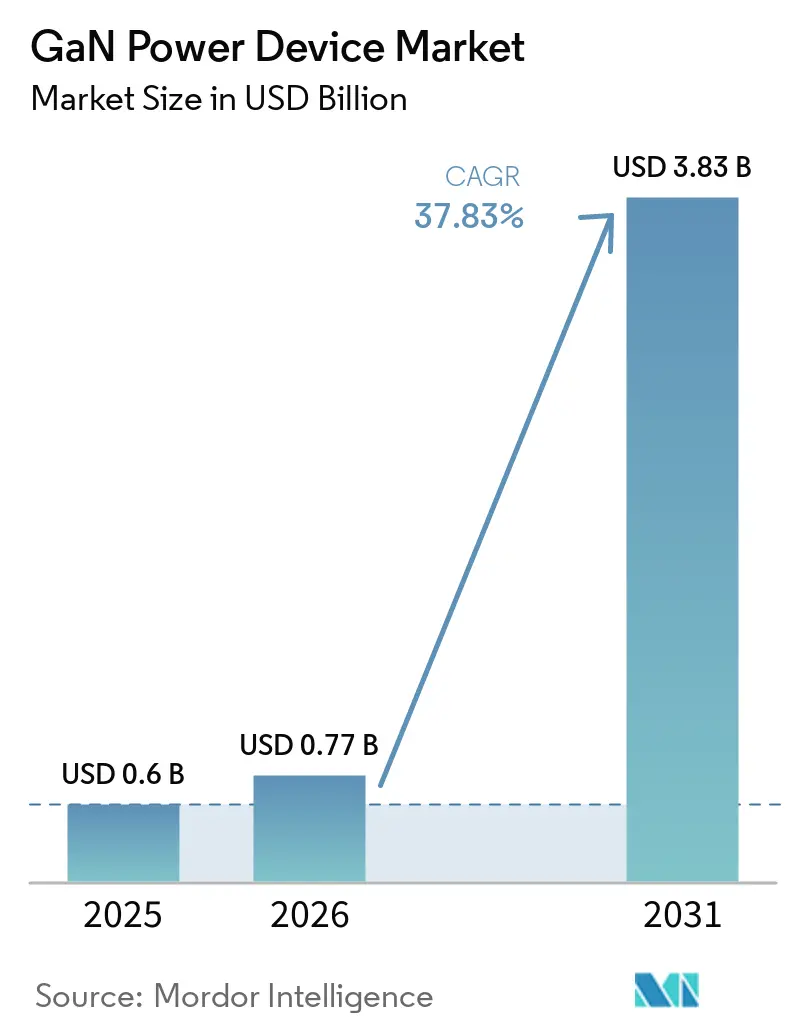
The GaN Power Device Market size is projected to be USD 0.6 billion in 2025, USD 0.77 billion in 2026, and reach USD 3.83 billion by 2031, at a CAGR of 37.83% from 2026 to 2031. The GaN power device market is being shaped by demand for more compact power conversion in AI data centers, electric vehicles, and consumer charging products. Higher switching speed can reduce conversion losses and cooling needs in relevant designs, making efficiency a purchasing factor as well as a performance consideration. Regulatory requirements are also raising the importance of efficient external power supplies in major regions. Design activity is moving ahead of recorded sales because qualified products can remain in customer development cycles before production begins. Competition, therefore, centers on product integration, manufacturing scale, supply security, and the ability to support customers through qualification.
Key Report Takeaways
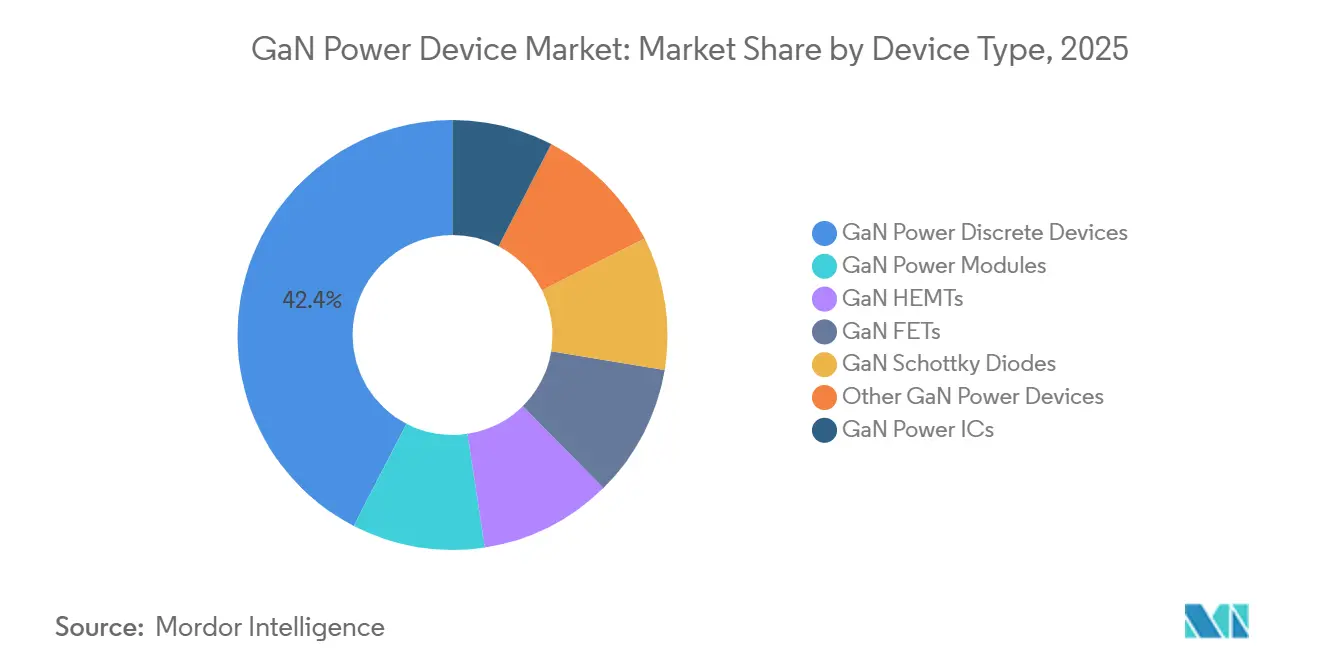
- By device type, GaN power discrete devices held 42.4% of revenue in 2025, while GaN power ICs are forecast to grow at a 38.1% CAGR through 2031.
- By voltage range, the 200-600V range held 46.4% of revenue in 2025, while the 601-1,200 V range is forecast to grow at a 38.6% CAGR through 2031.
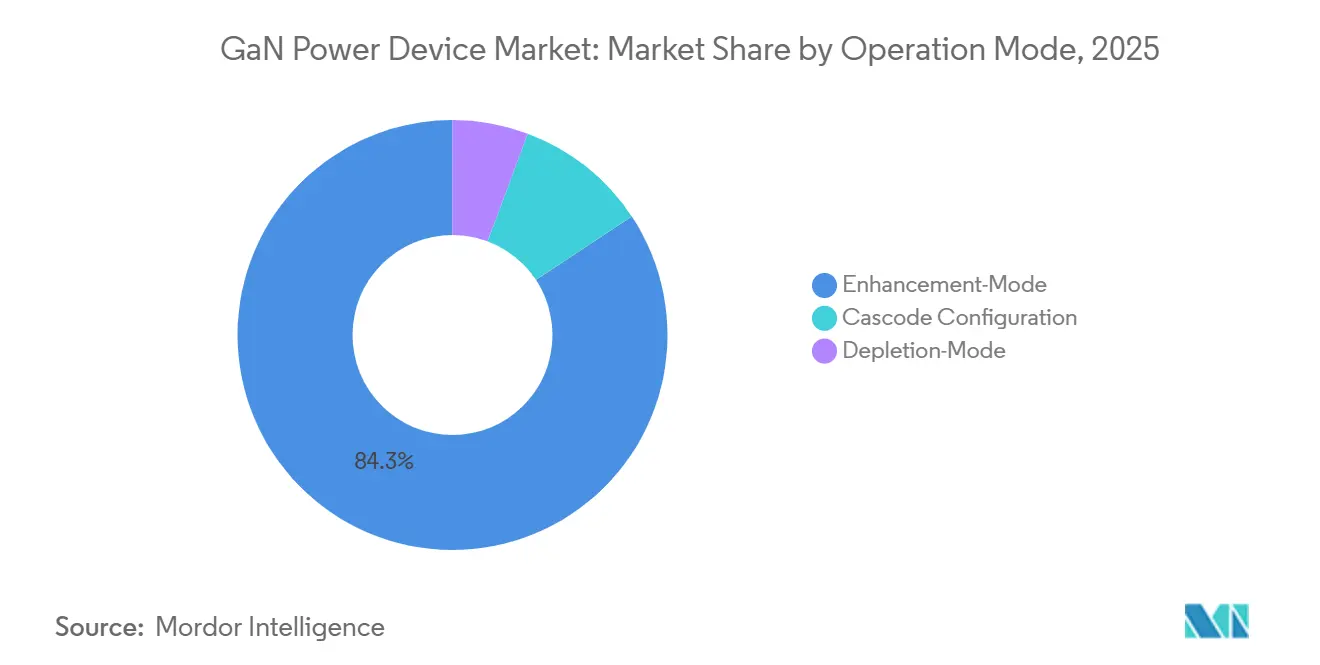
- By operation mode, enhancement-mode devices held 84.3% of revenue in 2025 and is forecast to grow at a 38.3% CAGR through 2031.
- By end-use industry, consumer electronics held 44.3% of revenue in 2025, while automotive is forecast to grow at a 39.6% CAGR through 2031.
- By geography, Asia-Pacific held 36.9% of revenue in 2025 and is forecast to grow at a 39.4% CAGR through 2031.
Note: Market size and forecast figures in this report are generated using Mordor Intelligence’s proprietary estimation framework, updated with the latest available data and insights as of January 2026.
Global GaN Power Device Market Trends and Insights
Drivers Impact Analysis*
| Driver | (~) % Impact on CAGR Forecast | Geographic Relevance | Impact Timeline |
|---|---|---|---|
| Electrification And Higher Power Density In EV Charging | +6.8% | Global, with concentrated gains in China, Europe, and South Korea | Medium term (2-4 years) |
| AI Data-Center Power Demand And High-Voltage DC Architectures | +9.2% | North America and China primary, APAC growing rapidly | Medium term (2-4 years) |
| Fast-Charging And Compact Consumer Power Supplies | +7.3% | APAC core, with spillover to North America and Europe | Short term (≤ 2 years) |
| Energy-Efficiency Regulation And Lower System Losses | +3.9% | EU and North America, with global spillover | Medium term (2-4 years) |
| 5G, Radar, And High-Frequency RF Infrastructure | +3.1% | Global, with early gains in China, the United States, South Korea, and Japan | Medium term (2-4 years) |
| Design Migration To Integrated GaN Power Platforms | +2.5% | Global, with North America and APAC leading adoption | Long term (≥ 4 years) |
| Source: Mordor Intelligence | |||
AI Data-Center Power Demand And High-Voltage DC Architectures
The move toward 800 V high-voltage DC architectures is increasing the relevance of the GaN power device market in AI training and inference infrastructure. Onsemi stated in June 2026 that power and cooling can account for as much as 40% of hyperscale data-center operating expenses, so small efficiency improvements can have material operating effects at large loads. GaN supports high-density conversion in 800 V-to-48 V and 48 V intermediate-bus stages, where switching speed and lower losses can reduce equipment and cooling demands. Navitas has worked with NVIDIA on 800 V HVDC power architectures for IT racks of 1 MW and above, placing GaN and SiC technologies within the applicable power-conversion architecture.[1]This work shifts the discussion from a component replacement toward system design, where design support and qualified supply carry more weight. The GaN power device market can benefit as hyperscalers qualify these architectures and suppliers convert design activity into production orders.
Electrification And Higher Power Density In EV Charging
Electric vehicle on-board chargers require compact designs that can handle rising power ratings, which supports the GaN power device market. Navitas reported in April 2025 that its high-power GaNSafe ICs achieved AEC-Q 100 and AEC-Q 101 qualification after more than 7 years of production data, more than 250 million units shipped, and field failure rates approaching 100 parts per billion across more than 2 trillion device-hours. Changan Automobile brought a GaN-based on-board charger using GaNSafe technology into commercial production, with production ramping during 2026. The shift from 6.6 kW chargers toward 11 kW and 22 kW systems can increase the number of power switches used in each vehicle. This raises GaN content per vehicle in addition to growth in electric vehicle volume. The GaN power device market, therefore, depends on both vehicle platform adoption and the power rating selected for each charger.
Fast-Charging And Compact Consumer Power Supplies
Consumer electronics remained an important volume base for the GaN power device market, holding 44.3% of revenue in 2025. The European Commission stated that around 2 billion external power supplies were in service in the European Union and consumed an estimated 11.6 TWh each year.[2] Commission Regulation (EU) 2025/2052 updates ecodesign requirements for external power supplies, wireless chargers, and USB Type-C cables. EUR-LEX These rules favor designs that can meet tighter active-efficiency requirements while retaining a compact form factor. Navitas reported that its 650 V IsoFast ICs can support single-stage bidirectional designs with up to 50% less size and 20% energy savings than two-stage silicon topologies. Consumer products also provide manufacturing volume, reliability data, and supply-chain learning that later support automotive and industrial qualifications.
Energy-Efficiency Regulation And Lower System Losses
Efficiency regulation is making power conversion performance more relevant to procurement decisions in the GaN power device market. The EU Ecodesign framework and Regulation (EU) 2025/2052 set minimum active-efficiency requirements for external power supplies. EUR-LEX The U.S. Department of Energy maintains efficiency requirements for certain external power supplies, while Japan and South Korea also use energy-efficiency programs that influence product design. Lower switching losses can also reduce cooling infrastructure needs in industrial and data-center installations. This can offset some of the higher component costs when operators evaluate the full system rather than a single device. The effect can take time because regulations must flow through OEM design cycles and supplier qualification processes. The combined regulatory direction gives suppliers a reason to improve qualified designs before compliance dates affect purchasing at scale.
Restraints Impact Analysis*
| Restraint | (~) % Impact on CAGR Forecast | Geographic Relevance | Impact Timeline |
|---|---|---|---|
| Higher Manufacturing And Qualification Cost Versus Silicon | -2.8% | Global, most acute in cost-sensitive APAC consumer applications | Medium term (2-4 years) |
| Reliability, EMI, And Automotive Qualification Timelines | -1.7% | North America and Europe, driven by automotive OEMs | Medium term (2-4 years) |
| Gallium, Wafer, And Epitaxy Supply Concentration | -2.4% | Global, with highest exposure in the United States, Europe, and Japan | Long term (≥ 4 years) |
| ASP Erosion And Competition From SiC And Advanced Silicon | -1.9% | Global, with the highest pricing pressure in APAC and China | Medium term (2-4 years) |
| Source: Mordor Intelligence | |||
Higher Manufacturing And Qualification Cost Versus Silicon
Higher manufacturing and qualification costs limit adoption in price-sensitive areas of the GaN power device market. GaN wafer costs were stated to be 3x-5x above comparable silicon devices because GaN-on-silicon epitaxy adds process steps and defect-management requirements. Automotive parts also require AEC-Q101 stress testing, power-cycle testing, and extended accelerated lifetime testing. These activities can add 12 - 18 months to a design cycle, even where the underlying process is mature. Suppliers with qualified products gain an entry advantage, but the same qualification burden can slow new product introductions. Expansion of 8-inch GaN-on-silicon production in Asian fabs is expected to lower device costs before 2028, although that does not remove the need for system-level validation.
Gallium, Wafer, And Epitaxy Supply Concentration
Gallium supply concentration remains a structural risk for the GaN power device market. The U.S. Geological Survey reported that China supplied 99% of the world's primary low-purity gallium production in 2025, while U.S. gallium import prices averaged USD 580 per kilogram in 2025, compared with USD 277 per kilogram in 2021. China’s restrictions on gallium exports and extraction-related technologies have raised concern over supply availability and the cost of developing alternatives. The U.S. Department of Defense awarded USD 29.9 million in November 2025 for a Louisiana gallium-recovery demonstration facility, and the Department of Energy committed up to USD 6 million for domestic extraction research. Non-Chinese output was only 14,000 kg in 2025 compared with the estimated Chinese production of 900,000 kg. This gap can make long-term pricing and supply commitments harder for device manufacturers and their customers.
*Our forecasts treat driver/restraint impacts as directional, not additive. The impact forecasts reflect baseline growth, mix effects, and variable interactions.
Segment Analysis
By Device Type: Integration Gaining Ground On Discrete Leadership
GaN power discrete devices held 42.4% of the GaN power device market share in 2025. They provide a direct route for engineers replacing silicon MOSFETs in existing circuit designs without changing the broader control architecture. GaN HEMTs, GaN FETs, and GaN Schottky diodes cover a wide range of voltage and application needs. Their position is supported by accumulated application data and established familiarity among power-system designers. GaN power modules represented the smallest device category and serve higher-power industrial and renewable-energy inverter applications. They can simplify assembly and thermal management by integrating several transistors into a packaged solution.
GaN power ICs are forecast to grow at a 38.1% CAGR through 2031 within the GaN power device market. Designers of AI data centers and electric vehicle chargers are seeking fewer components, lower EMI design effort, and smaller circuit boards. An integrated IC can combine a transistor stage with gate drive, protection, and sensing functions. Navitas released production 650 V bidirectional GaNFast ICs in March 2025 for single-stage AC-DC and AC-AC conversion. Onsemi introduced GaNEXUS Smart FETs with integrated protection features in June 2026. EPC’s February 2026 licensing and second-sourcing agreement with Renesas for low-voltage eGaN technology broadened access to that technology for relevant applications.

By Voltage Range: Mid-Voltage Dominates, High-Voltage Accelerates
The 200-600 V range accounted for 46.4% of GaN power device market revenue in 2025. This range serves consumer USB-PD chargers that use 650V GaN FETs, server power supplies with a 400V input bus, and Level 1 and Level 2 vehicle on-board chargers. It has the longest production history among the listed voltage ranges. The segment also has broad component availability and a mature ecosystem of gate drivers and control ICs. Below-200 V products serve AI-server 48 V intermediate-bus conversion, LiDAR power supplies, and automotive Class-D audio amplifiers. These applications are individually smaller, but their needs align with fast switching and compact power conversion.
The 601-1,200 V range is forecast to grow at a 38.6% CAGR through 2031. This range supports bidirectional chargers in 800 V electric vehicle platforms, high-voltage AC-DC front ends for AI power shelves, and solar microinverters. In those applications, a single GaN switching stage can replace some two-stage silicon solutions. Infineon introduced 650 V CoolGaN HEMTs for higher-power-density electric vehicle charger architectures in 2024. Products above 1,200 V remain at an early stage for GaN power conversion. They are drawing research interest for grid-tied and high-reliability industrial systems, where thermal requirements remain important.
By Operation Mode: Enhancement-Mode Dominance Reflects Market Maturity
Enhancement-mode devices accounted for 84.3% of the GaN power device market share in 2025 and are forecast to grow at a 38.3% CAGR through 2031. Their normally off behavior supports a fail-safe power-conversion design and avoids the need for negative gate-drive voltages. This can simplify driver IC selection and reduce the total design burden. The segment benefits from established application notes, reference designs, and qualification data. EPC, Navitas, Innoscience, and Infineon have built product ecosystems around enhancement-mode products. Infineon expanded its GaN capabilities through the acquisition of GaN Systems in 2023.
Depletion-mode devices and cascode configurations remain relevant in specialized applications. Depletion-mode GaN HEMTs are used in RF power amplifiers for 5G base stations and defense radar systems, where high-frequency performance and linearity can outweigh the added gate-drive complexity. Cascode products pair a depletion-mode GaN FET with a low-voltage silicon MOSFET to create normally-off behavior. This approach gives foundries without a native enhancement-mode process a route into power-conversion products. Transphorm used this approach with its SuperGaN portfolio before and after its acquisition by Renesas.
By End-Use Industry: Automotive Surge Emerging Beneath Consumer Electronics Leadership
Consumer electronics held 44.3% of GaN power device market revenue in 2025. USB Power Delivery adapters, laptop power bricks, and gaming accessories contributed much of this volume. High consumer volumes helped advance manufacturing learning and lower costs for later automotive and industrial programs. The segment also generates reliability data that can inform more demanding qualifications. Manufacturers continue to use compact charger designs to compete on size and energy performance. These customer requirements maintain consumer electronics as a foundational demand source even as other applications expand.
Automotive is forecast to grow at a 39.6% CAGR through 2031 in the GaN power device market. The move from 400 V toward 800 V vehicle architectures raises requirements for power density and switching frequency in relevant charger applications. China’s automotive OEM ecosystem is supporting adoption through commercial production activity. Changan’s production GaN-based on-board charger using Navitas technology was cited as an early production example. IT and data centers, telecommunications, and industrial users add demand as AI infrastructure and 5G networks require power conversion equipment. Aerospace, defense, medical, renewable-energy, and grid-tied storage applications remain smaller opportunities that use GaN’s high-frequency and compact design characteristics.
Geography Analysis
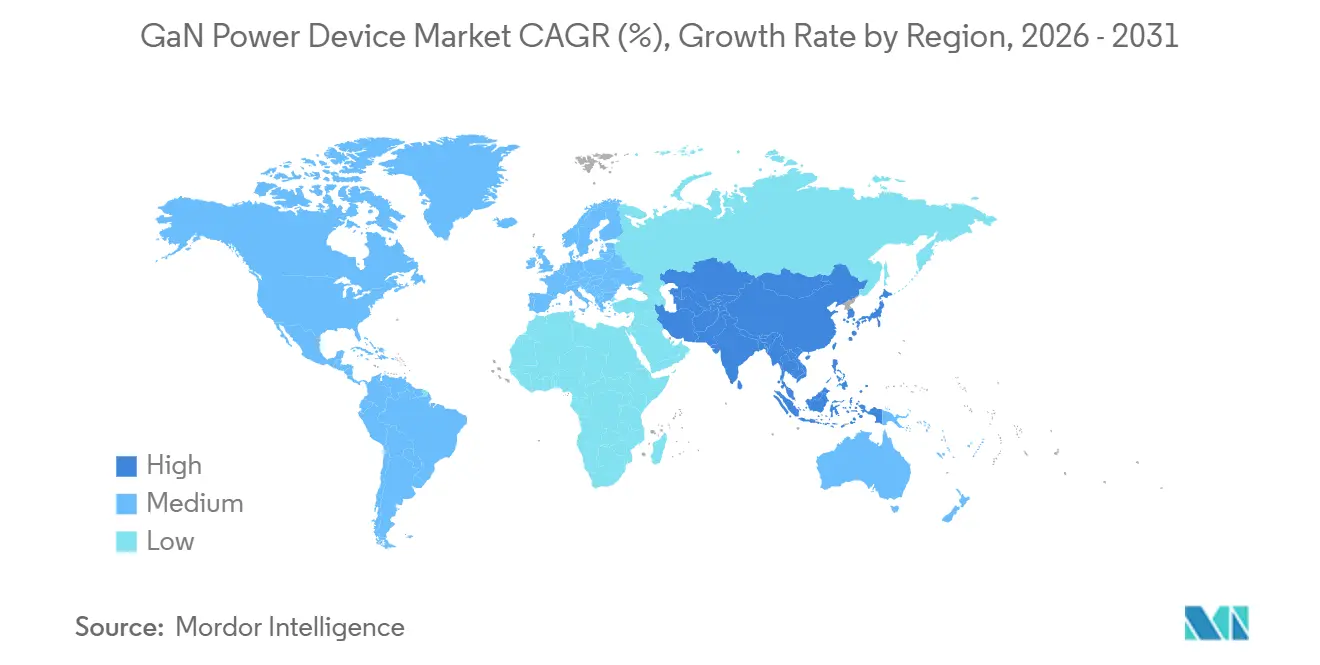
Asia-Pacific held 36.9% of global revenue in 2025 and is forecast to grow at a 39.4% CAGR through 2031. The region’s consumer-electronics production base supports process maturity and yield improvement that can lower costs for automotive and industrial products. China’s gallium position also connects regional production strength with a supply risk faced by the global GaN power device market. North America has a strong demand base in AI data centers, where hyperscalers are qualifying 650 V and below-200 V devices for power conversion. U.S. investments in gallium recovery and domestic manufacturing reflect concern over supply resilience. Europe has a strong automotive supplier base, with Germany playing a central role in vehicle power electronics. Infineon’s 300mm power GaN pilot production in Villach, Austria, announced in September 2024, aims to use established silicon manufacturing infrastructure for GaN scale-up.
EU ecodesign requirements support the European distribution of efficient consumer and industrial chargers. South America, the Middle East, Africa, and smaller APAC markets are adopting GaN products as lower costs improve access to fast chargers and power infrastructure. Brazil offers entry opportunities through electric vehicle charging and consumer-electronics supply chains. Saudi Arabia and the United Arab Emirates have longer-term potential linked to planned data-center capacity for sovereign AI programs. India is building domestic design capability through Cyient Semiconductors’ May 2026 launch of 7 650 V GaN power ICs developed with Navitas technology.
Competitive Landscape
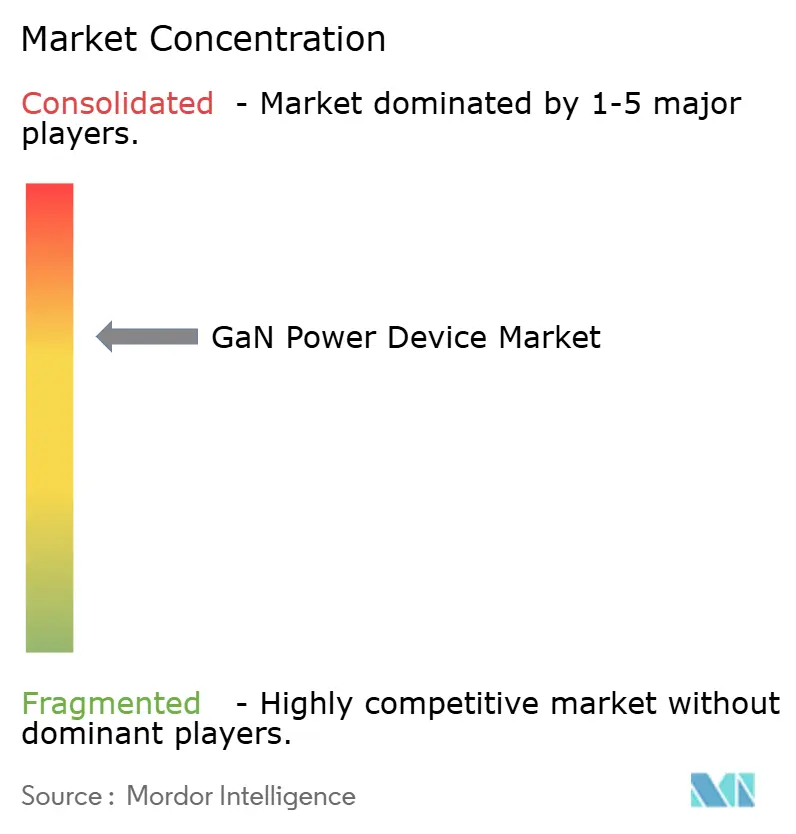
The GaN power device market is moderately consolidated and includes integrated device manufacturers, fabless suppliers, and smaller specialist firms. Infineon has a broad portfolio after acquiring GaN Systems for USD 830 million in 2023. It added Bangalore-based C2i Semiconductors in August 2026 to extend its capability in software-defined multiphase controllers and smart power stages for AI server applications. This combination places GaN, SiC, and silicon products alongside digital power-management functions. Renesas completed its acquisition of Transphorm in 2025, gaining SuperGaN products and AEC-Q101-qualified high-voltage devices for industrial and automotive use.
Navitas is shifting from consumer charging toward AI, electric vehicle, and grid-infrastructure applications. It began shipping U.S.-manufactured Gen 5 GaNFast ICs from GlobalFoundries’ 200mm GaN-on-silicon facility in Burlington, Vermont, in September 2026. The company also announced an agreement in September 2026 to acquire Claros for up to USD 232.8 million, extending its position toward integrated voltage regulation and vertical power delivery for AI data centers. Onsemi entered the GaN portfolio race in June 2026 with GaNEXUS products spanning 40 V to 650 V. Product integration and access to qualified manufacturing are becoming important ways to compete for high-value designs.
Smaller suppliers such as Cambridge GaN Devices, Nexperia, and Innoscience compete through process specialization and regional supply proximity. They can be attractive where large suppliers have longer lead times or high minimum order requirements. The GaN power device market also has open technical space in ultra-high-voltage products above 1,200 V and RF-power integration. These areas are not yet firmly controlled by established silicon carbide suppliers or depletion-mode HEMT specialists. The available material does not provide combined top-player share data, so it does not support a quantified claim of a tightly concentrated supplier base. Competitive positioning is instead indicated by acquisitions, qualified product portfolios, manufacturing partnerships, and the ability to meet automotive and data-center requirements.
GaN Power Device Industry Leaders
-
Infineon Technologies AG
-
STMicroelectronics N.V.
-
Texas Instruments Incorporated
-
Navitas Semiconductor Corporation
-
Renesas Electronics Corporation
- *Disclaimer: Major Players sorted in no particular order
Recent Industry Developments
- September 2026: Navitas Semiconductor began shipping U.S.-manufactured Gen 5 GaNFast ICs from GlobalFoundries' Burlington, Vermont 200 mm GaN-on-Si facility, marking the first volume production of domestically manufactured GaN ICs for AI infrastructure and national-security-sensitive applications
- September 2026: Navitas Semiconductor announced an agreement to acquire Claros, an integrated voltage regulator and vertical power delivery solutions company, for up to USD 232.8 million, extending its GaN and SiC power-semiconductor platform into AI data-center vertical power delivery architectures.
- August 2026: Infineon Technologies announced the acquisition of Bangalore-based C2i Semiconductors, specializing in software-defined multiphase controllers and smart power stages. The transaction is intended to complement Infineon’s GaN, SiC, and silicon power semiconductors with digital power-management capability for AI data-center servers.
Global GaN Power Device Market Report Scope
GaN power devices are semiconductor components manufactured using gallium nitride. They handle high voltages and switch significantly faster and more efficiently than conventional silicon-based devices.
The global GaN power device market is segmented by device type, voltage range, operation mode, end-use industry, and geography. The Market Forecasts are Provided in Terms of Value (USD). By device type, the market is segmented into GaN power discrete devices, GaN power ICs, GaN power modules, GaN HEMTs, GaN FETs, GaN Schottky diodes, and others. By voltage range, the market is segmented into below 200 V, 200–600 V, 601–1,200 V, and above 1,200 V. By operation mode, the market is segmented into enhancement-mode, depletion-mode, and cascode configuration. By end-use industry, the market is segmented into consumer electronics, automotive, IT and data centers, telecommunications, industrial, renewable energy, aerospace and defense, military, healthcare and medical, and other. The report also covers the market size and forecasts for the global GaN power device market across 26 countries in the key regions. For each segment, market sizing and forecasts are provided in terms of value (USD).
| GaN Power Discrete Devices |
| GaN Power ICs |
| GaN Power Modules |
| GaN HEMTs |
| GaN FETs |
| GaN Schottky Diodes |
| Other GaN Power Devices |
| Below 200 V |
| 200 - 600 V |
| 601 - 1,200 V |
| Above 1,200 V |
| Enhancement-Mode |
| Depletion-Mode |
| Cascode Configuration |
| Consumer Electronics |
| Automotive |
| IT and Data Centers |
| Telecommunications |
| Industrial |
| Renewable Energy |
| Aerospace and Defense |
| Military |
| Healthcare and Medical |
| Other Industries |
| North America | United States |
| Canada | |
| Mexico | |
| Europe | Germany |
| France | |
| Italy | |
| Spain | |
| United Kingdom | |
| Poland | |
| Russia | |
| Rest of Europe | |
| Asia-Pacific | China |
| India | |
| Japan | |
| South Korea | |
| Australia | |
| Indonesia | |
| Vietnam | |
| Thailand | |
| Rest of Asia-Pacific | |
| South America | Brazil |
| Argentina | |
| Chile | |
| Rest of South America | |
| Middle East and Africa | Saudi Arabia |
| United Arab Emirates | |
| Egypt | |
| South Africa | |
| Morocco | |
| Rest of Middle East and Africa |
| By Device Type | GaN Power Discrete Devices | |
| GaN Power ICs | ||
| GaN Power Modules | ||
| GaN HEMTs | ||
| GaN FETs | ||
| GaN Schottky Diodes | ||
| Other GaN Power Devices | ||
| By Voltage Range | Below 200 V | |
| 200 - 600 V | ||
| 601 - 1,200 V | ||
| Above 1,200 V | ||
| By Operation Mode | Enhancement-Mode | |
| Depletion-Mode | ||
| Cascode Configuration | ||
| By End-Use Industry | Consumer Electronics | |
| Automotive | ||
| IT and Data Centers | ||
| Telecommunications | ||
| Industrial | ||
| Renewable Energy | ||
| Aerospace and Defense | ||
| Military | ||
| Healthcare and Medical | ||
| Other Industries | ||
| By Geography | North America | United States |
| Canada | ||
| Mexico | ||
| Europe | Germany | |
| France | ||
| Italy | ||
| Spain | ||
| United Kingdom | ||
| Poland | ||
| Russia | ||
| Rest of Europe | ||
| Asia-Pacific | China | |
| India | ||
| Japan | ||
| South Korea | ||
| Australia | ||
| Indonesia | ||
| Vietnam | ||
| Thailand | ||
| Rest of Asia-Pacific | ||
| South America | Brazil | |
| Argentina | ||
| Chile | ||
| Rest of South America | ||
| Middle East and Africa | Saudi Arabia | |
| United Arab Emirates | ||
| Egypt | ||
| South Africa | ||
| Morocco | ||
| Rest of Middle East and Africa | ||
Key Questions Answered in the Report
What is the projected value of the GaN power device market by 2031?
The GaN power device market is projected to reach USD 3.83 billion by 2031, growing at a 37.83% CAGR from 2026.
Which GaN power device application is growing fastest?
Automotive is the fastest-growing end-use segment, with a forecast CAGR of 39.6% through 2031.
Why are AI data centers adopting GaN power devices?
AI power systems need high-density conversion in 800 V-to-48 V and intermediate-bus stages, where GaN can reduce conversion losses and cooling demands.
Which voltage range leads GaN power device demand?
The 200-600 V range led with 46.4% of revenue in 2025, supported by chargers, server power supplies, and on-board chargers.
What is the main supply risk for GaN device manufacturers?
China supplied 99% of global primary low-purity gallium production in 2025, making gallium availability and pricing a key risk.
Which region leads GaN power device adoption?
Asia-Pacific led with 36.9% of revenue in 2025 and is forecast to grow at a 39.4% CAGR through 2031.