
Foundry Chemicals Market Size and Share
Market Overview
| Study Period | 2022 - 2032 |
|---|---|
| Market Size (2027) | USD 7.16 Billion |
| Market Size (2032) | USD 9.08 Billion |
| Growth Rate (2027 - 2032) | 4.87 % |
| Fastest Growing Market | Asia-Pacific |
| Largest Market | Asia-Pacific |
| Market Concentration | Medium |
Major Players *Disclaimer: Major Players sorted in no particular order Image © Mordor Intelligence. Reuse requires attribution under CC BY 4.0. | |
Foundry Chemicals Market Analysis by Mordor Intelligence
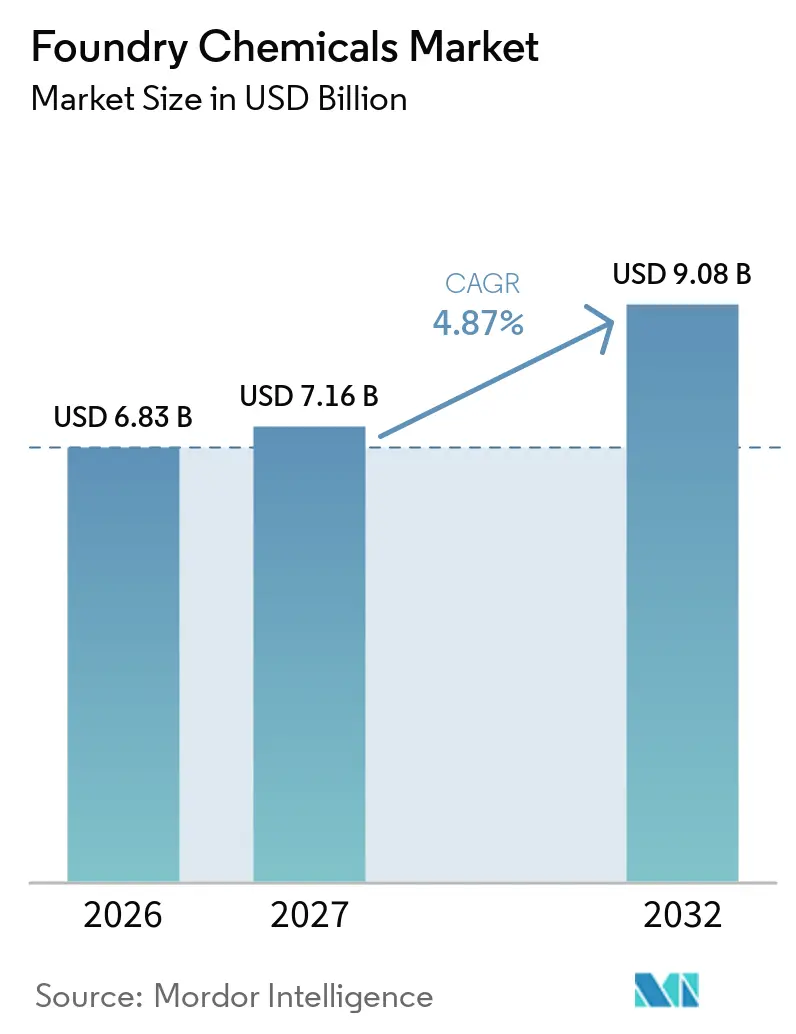
The Foundry Chemicals Market size is expected to increase from USD 6.83 billion in 2026 to USD 7.16 billion in 2027 and reach USD 9.08 billion by 2032, at a CAGR of 4.87% over 2027-2032. The foundry chemicals market is evolving as electric vehicle production shifts casting demand toward larger aluminum structural parts, including battery enclosures, subframes, and motor housings. These components impose different demands on the materials used to form molds, cores, and die surfaces, requiring reliable binder and coating systems that ensure dimensional control, surface quality, repeatable production, and stable performance at the temperatures and cycle times associated with modern automotive casting. This shift changes the chemical mix used by foundries rather than reducing overall chemical consumption, as conventional ferrous castings and newer non-ferrous applications require different formulations, product qualification approaches, and technical support from suppliers. The foundry chemicals market has an opportunity to shift toward lower-emission. These higher-performing products meet both technical and regulatory requirements, while the fundamental need for reliable mold and core performance remains unchanged. Supplier success also depends on supporting foundries through process changes, as a new chemistry must be compatible with the customer's existing equipment, sand system, production schedule, quality procedures, and cost structure. This places value on suppliers that can demonstrate a product's effect on the full casting process, including emissions, defect control, cleaning requirements, and consistent performance after system qualification.
Key Report Takeaways
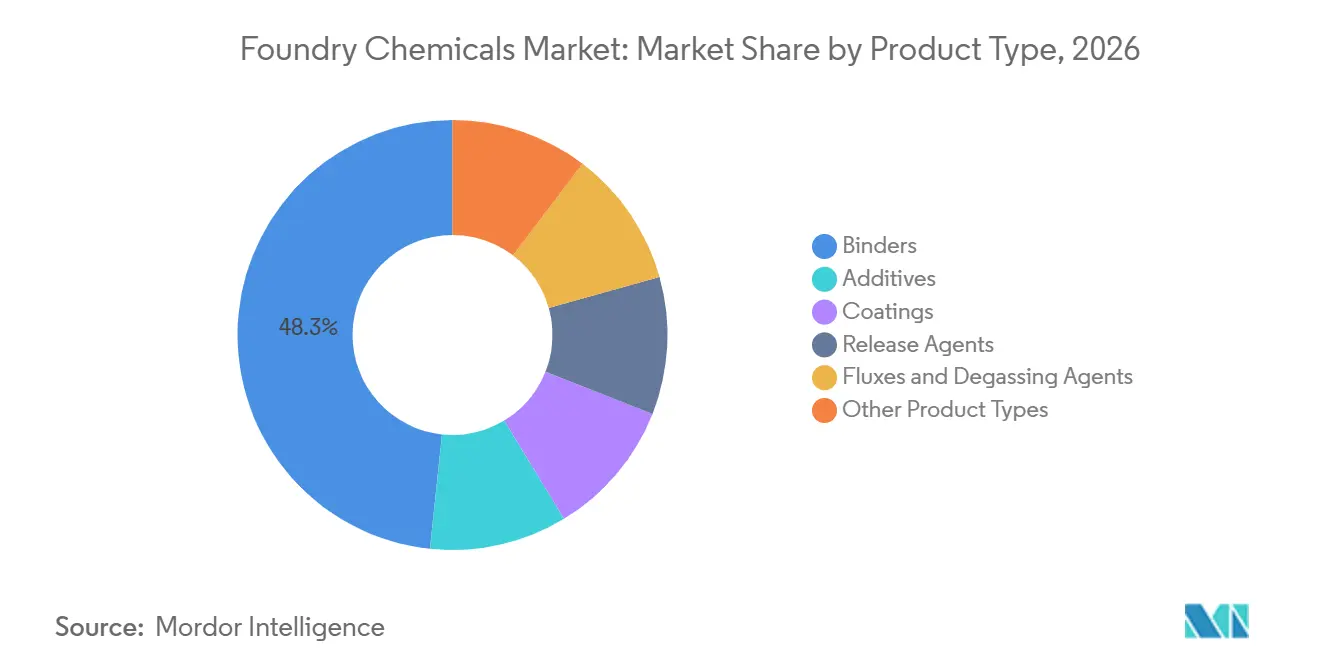
- By product type, binders held 48.34% of the Foundry chemicals market share in 2026, while coatings are forecast to grow at a 5.45% CAGR through 2032.
- By foundry metal, ferrous metals held 60.77% of the Foundry chemicals market share in 2026, while non-ferrous metals are forecast to grow at a 5.63% CAGR through 2032.
- By foundry process, sand casting held 57.13% of the Foundry chemicals market share in 2026, while die casting is forecast to grow at a 5.31% CAGR through 2032.
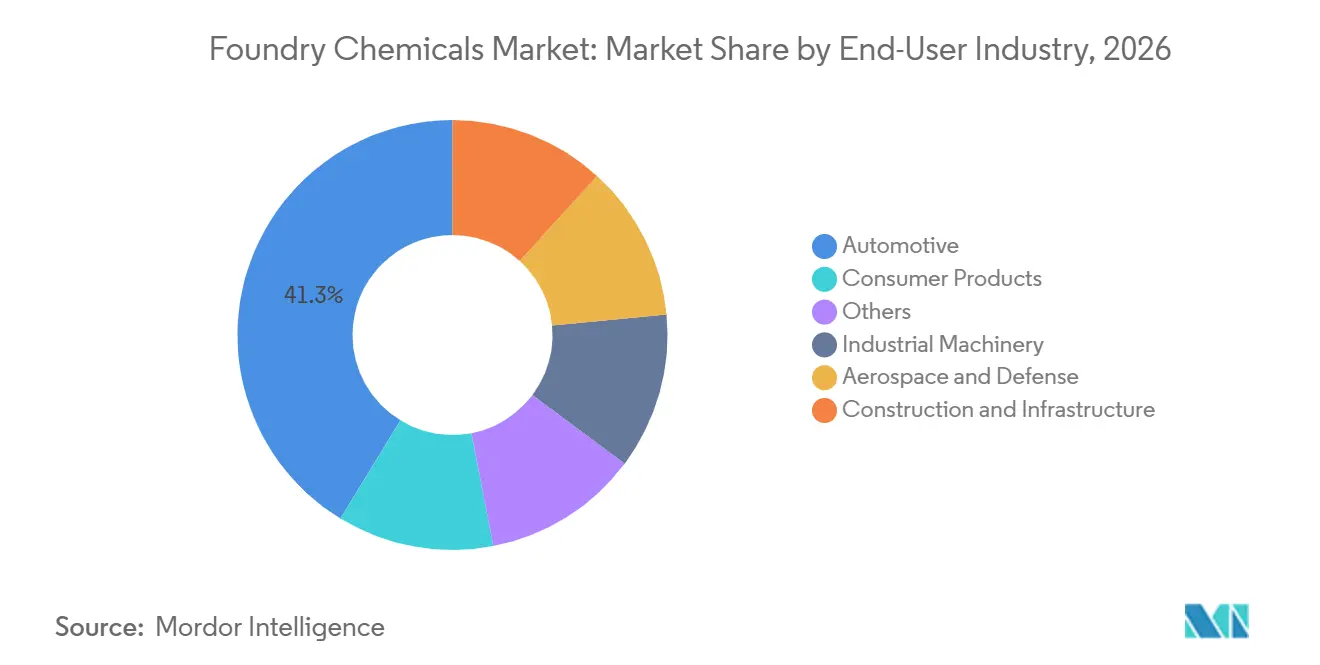
- By end-user industry, automotive held 41.28% of the Foundry chemicals market share in 2026 and is forecast to grow at a 5.72% CAGR through 2032.
- By geography, Asia-Pacific held 43.26% of the Foundry chemicals market share in 2026 and is forecast to grow at a 5.66% CAGR through 2032.
Note: Market numbers in this report are based on Mordor Intelligence's proprietary estimation framework, which combines nine months of actuals with Q4 projections for base year 2026.
Global Foundry Chemicals Market Trends and Insights
Drivers Impact Analysis*
| Drivers | (~) % Impact on CAGR Forecast | Geographic Relevance | Impact Timeline |
|---|---|---|---|
| Automotive Light weighting and Electric Vehicle (EV) Structural Castings | +1.3% | Global, concentrated in China, Germany, and the U.S. | Medium term (2-4 years) |
| Low-Emission Binders and Water-Based Coatings | +0.9% | EU and China lead, with spillover to North America and Asia-Pacific | Medium term (2-4 years) |
| Industrial Automation and Precision Casting Requirements | +0.7% | Global, with Asia-Pacific leading deployment intensity | Long term (≥ 4 years) |
| Foundry Capacity Expansion in India, China, and Mexico | +0.8% | Asia-Pacific and Mexico, with spillover to North American OEMs | Medium term (2-4 years) |
| Rising Demand for Aluminum, Magnesium, and Zinc Castings | +0.6% | Global, strongest in China and India, with secondary demand in the EU and the United States | Medium term (2-4 years) |
| Source: Mordor Intelligence | |||
Automotive Light weighting and Electric Vehicle (EV) Structural Castings
The shift toward battery-electric vehicles is changing the type of casting demand that supports the foundry chemicals market. Electric vehicle platforms use fewer conventional iron powertrain parts, but require large aluminum castings for battery enclosures, thermal management housings, and chassis assemblies. These applications require binder, coating, and release-agent systems that maintain reliable dimensions during demanding casting cycles. In June 2025, Uno Minda committed INR 2,100 million (USD 25 million) to an electric vehicle casting facility in Aurangabad, India, focused on battery enclosures and powertrain housings. Chongqing Xinyuan Intelligent Manufacturing also approved EUR 17 million (USD 18.4 million) for the expansion of magnesium alloy die-casting to support electric vehicle seat frames and drive housings. These investments favor water-based release agents and specialized die coatings for aluminum and magnesium, which can improve the value mix for suppliers serving automotive foundries.
Low-Emission Binder and Water-Based Coating Adoption
Emissions compliance is changing product requirements across the foundry chemicals market as customers require formulations that reduce exposure while maintaining output. The U.S. Occupational Safety and Health Administration extended the comment period for its proposed revision of the Formaldehyde standard to November 1, 2025, following the issuance of the related proposal on July 1, 2025[1]. An industrial-scale study of several binder systems reported that inorganic sodium silicate and geopolymer systems reduced benzene, toluene, ethylbenzene, and xylene (BTEX) emissions by 95%-97%, polycyclic aromatic hydrocarbon (PAH) emissions by more than 94%, and nitrogen oxides (NOx) emissions by more than 98% compared with phenolic urethane no-bake systems. Hüttenes-Albertus introduced the HA Pure Cold-Box platform in January 2026 with free phenol and formaldehyde monomer content below 1.0%, while retaining core-making performance. European emissions rules also influence product development, including the 2.5 mg/m³ amine limit referenced in cold-box core making. Suppliers that validate lower-emission systems within the customer's process can reduce adoption concerns more effectively than suppliers offering reformulated chemistry alone.
Industrial Automation and Precision Casting
Industrial automation is raising the required level of consistency for the foundry chemicals market. Automated shell lines, robotic dipping systems, and high-pressure die-casting cells expose variation in curing, viscosity, and coating adhesion that manual operations may absorb. Doncasters Precision Castings commissioned an automated shell line in Groton, Connecticut, in 2025 after a USD 13 million investment, increasing output from 10 to 40 hangers per day. This type of equipment requires process-stable coatings and binders that perform predictably at set cycle times and temperatures. Huangshi Donper Foundry invested CNY 1.5 billion (USD 0.22 billion) in an unmanned precision casting project designed to produce 250,000 tons annually, with automation exceeding 95% and production efficiency 30% higher than conventional operations. Chemical suppliers that provide product certification and process support can become more important to automated operations than suppliers competing primarily on unit price.
Foundry Capacity Expansion in India, China, and Mexico
New casting capacity in India, China, and Mexico is creating additional demand for binders, release agents, coatings, and process additives. Precision Autocastings Pvt. Ltd. opened a greenfield facility in Kaladera, Jaipur, in July 2025, with an annual capacity of 30,000 metric tons for automotive customers. MAT Foundry Group started full production at its Pachuca, Mexico, facility in July 2025, with a 14,380 m² plant designed to produce 50,000 tons annually, serving brake drum and truck hub customers. India's primary foundry alloy market is growing at 6.5% annually, compared with a global rate of 5.8%, supported by electric vehicle adoption, production-linked incentives, and localized manufacturing. New facilities initially require large quantities of essential binders and release agents during commissioning. As operations stabilize, they can add more coatings, fluxes, and specialized process chemicals, creating a longer revenue path for suppliers that establish technical relationships early.
Restraints Impact Analysis*
| Restraints | (~) % Impact on CAGR Forecast | Geographic Relevance | Impact Timeline |
|---|---|---|---|
| Volatile Organic Compound (VOC), Formaldehyde, and Hazardous-Emission Compliance Costs | -0.7% | Global, most acute in the EU, the United States, and China | Short term (≤ 2 years) |
| Volatility in Resin, Bentonite, and Specialty-Chemical Inputs | -0.5% | Global, with furfuryl alcohol exposure concentrated in Europe and China-dependent supply chains | Short term (≤ 2 years) |
| Application Engineering and Qualification Burden for Smaller Foundries | -0.3% | Asia-Pacific, Latin America, the Middle East, and Africa | Medium term (2-4 years) |
| Source: Mordor Intelligence | |||
Volatile Organic Compound (VOC), Formaldehyde, and Hazardous-Emission Compliance Costs
VOC, formaldehyde, and hazardous-emission controls can limit profitability in the foundry chemicals market, even as casting output increases. Foundries may need afterburners, sand reclamation systems, and fume extraction equipment to manage emissions from organic binder systems. These investments can increase customer pressure on chemical prices and make it harder for suppliers to pass through higher raw-material costs. The proposed U.S. revision to the formaldehyde standard signals a tighter compliance baseline for resin systems used in cold-box and no-bake applications. European evidence from pilot and industrial work supports inorganic systems, but conversion still involves equipment, process, and training costs. Mid-sized formulators face a particular challenge, as they must fund reformulation and compliance work while continuing to support existing customers.
Volatility in Resin, Bentonite, and Specialty-Chemical Inputs
Volatility in resin, bentonite, and specialty inputs remains an immediate operating issue for manufacturers in the foundry chemicals market. Furan-based no-bake binders depend on furfuryl alcohol, while cold-box systems depend on phenol and isocyanates that follow petroleum-derived feedstock cycles. Bentonite is essential to green-sand systems and is exposed to changes in demand, supply availability, and transport conditions. Chinese supply concentration can increase the impact of an environmental shutdown or export change on other regions. Price movement can occur before supplier contracts allow a full adjustment in finished chemical prices. Hybrid binder portfolios that combine furan, phenolic, and inorganic components can reduce dependence on a single input, though they do not eliminate the underlying supply risk.
*Our forecasts treat driver/restraint impacts as directional, not additive. The impact forecasts reflect baseline growth, mix effects, and variable interactions.
Segment Analysis
By Product Type: Binders Maintain the Core Base While Coatings Support Higher-Value Requirements
Binders accounted for 48.34% of the foundry chemicals market share in 2026, reflecting their central role in holding molds and cores together across casting processes. Their share reflects widespread use in green-sand, no-bake, and cold-box operations. Foundries depend on binder performance for mold strength, gas behavior, dimensional stability, and shakeout. Conventional organic systems still support a large installed base, particularly in iron and steel casting. At the same time, customers are requesting systems that reduce formaldehyde, phenol, benzene, toluene, ethylbenzene, and xylene (BTEX), and related emissions. Hüttenes-Albertus introduced HA Pure Cold-Box in January 2026 with free monomer content below 1.0%, indicating the direction of binder development. Product development is increasingly focused on maintaining production performance while improving workplace and environmental outcomes. This requires suppliers to demonstrate results under real foundry conditions rather than relying on formulation claims.
Coatings are forecast to expand at a 5.45% CAGR through 2032, giving them the strongest growth outlook among product types. Tighter requirements for surface finish and dimensional control in electric-vehicle and aerospace castings drive growth in the coatings segment. Mold washes and refractory coatings protect surfaces, manage metal flow, and reduce defects, making them important in premium applications. Coating selection affects both the appearance of the finished part and the stability of the casting process, which gives customers reason to carefully qualify products before changing suppliers. Additives remain technically specialized, as they address surface defects, veining, and metallurgical control in individual processes. Release agents, fluxes, and degassing agents represent smaller output but are important in high-pressure aluminum and magnesium die casting. Water-based and low-volatile organic compound (VOC) release agents are gaining relevance where regulators restrict solvent-based alternatives. Suppliers offering binders, coatings, release agents, and additives on a single qualified platform can simplify purchasing and technical coordination for foundry customers. A broader product offering can also help a foundry consolidate several connected process inputs under a single technical team. In contrast, each product category is still selected based on the specific alloy, mold system, and production conditions.

By Foundry Metal: Ferrous Metals Retain the Largest Base While Non-Ferrous Metals Expand Faster
Ferrous metals accounted for 60.77% of the foundry chemicals market share in 2026, supported by the broad installed base of gray iron, ductile iron, and steel foundries. These foundries supply heavy equipment, construction, industrial machinery, and commercial vehicle applications. Their scale sustains demand for green-sand additives, bentonite systems, organic binders, and coatings. Ferrous casting remains necessary across many durable-goods supply chains, which limits the risk of a sudden decline in chemical consumption. Inorganic chemistry is also becoming more relevant in iron casting as suppliers address historical issues with collapsibility and shakeout. HA Group has demonstrated an inorganic core technology with Brembo for brake disc casting under industrial conditions, indicating that lower-emission binder systems can be more widely adopted in ferrous applications once process concerns are resolved.
Non-ferrous metals are projected to grow at a 5.63% CAGR through 2032, making them the fastest-growing metal category. Aluminum accounts for much of this growth because electric vehicles require lightweight structural components produced by high-pressure die casting. The foundry chemicals market serves this activity with release agents, coatings, fluxes, and degassing systems designed for aluminum alloys. Magnesium is a more specialized opportunity, but its reactivity requires carefully matched chemical products for applications such as seat frames and console brackets. Zinc casting also relies on controlled surface and die conditions for detailed components. These applications require suppliers to consider interactions among the metal, the die surface, the casting temperature, and the expected production cycle, rather than treating non-ferrous casting as a single chemical application. The shift toward non-ferrous metals creates specialized demand rather than entirely displacing ferrous chemical consumption. This supports a higher chemical value per unit of casting output, particularly when advanced materials and complex shapes are required. It also increases the value of application knowledge, as a formulation suitable for one alloy or process may not deliver the same outcome in another casting environment.
By Foundry Process: Sand Casting Provides the Base, While Die Casting Gains from Electric Vehicle Production
Sand casting accounted for 57.13% of the foundry chemicals market share in 2026 because it supports a wide range of alloys, component sizes, and production volumes. Its versatility keeps it relevant for automotive, industrial, infrastructure, and machinery applications. Green-sand and chemically bonded processes continue to require consistent binders, additives, bentonite, and coatings. Sand casting also serves producers making low- to medium-output parts where the economics of permanent tooling are less favorable. The process can accommodate large castings and diverse design requirements, which is why it remains the primary basis for chemical consumption across foundries. Improvements in emissions control and sand reclamation can also help sand-casting users maintain this position while meeting new regulatory requirements.
Die casting is forecast to grow at a 5.31% CAGR through 2032, driven by large-format, high-pressure die casting for electric-vehicle structures. The foundry chemicals market tied to die casting is growing, driven by demand for water-based release agents and low-emission die coatings. Large-scale integrated die casting, as referenced by Chinese manufacturers, is increasing the scale of aluminum structural components. Larger parts increase the importance of a stable release process, as surface defects, die deposits, and uneven thermal performance can degrade output quality and disrupt high-output production. Investment casting continues to hold an important position in aerospace and defense, as precision shell molding requires waxes, colloidal silica slurries, and refractory ceramic coatings. PTC Industries has expanded its investment casting capacity in Mehsana, Gujarat, to support demand in the aerospace supply chain. Centrifugal casting has lower output but remains specialized for pipes, rolls, and bearings. Restrictions affecting silica flour in investment-casting shell molds can also create opportunities for alternative refractory coatings and additives.
By End-User Industry: Automotive Leads Demand While Industrial and Aerospace Applications Broaden the Customer Base
Automotive accounted for 41.28% of the foundry chemicals market share in 2026 and is projected to grow at a 5.72% CAGR through 2032, making it both the largest and fastest-growing end-user segment. Vehicle manufacturers require cast components for conventional vehicles, electric vehicles, thermal systems, brakes, and drivetrains. The shift toward large aluminum castings increases demand for products that support die performance, surface finish, and controlled metal flow. Automotive customers also place strong emphasis on repeatable output and qualified processes, making their order patterns a key signal for suppliers planning capacity, technical service, and inventory. This concentration also poses a risk, as any decline in automotive production can significantly affect demand for foundry chemicals.
Industrial machinery is the second-largest end-user segment, with demand from pumps, valves, compressors, and heavy-equipment parts. These applications sustain the base load of iron and steel casting output and therefore support continued use of established binder and additive systems. Aerospace and defense are smaller by casting output but require demanding chemical performance. Turbine alloys, titanium structural components, and precision investment castings require low-contamination coatings, precise binders, and carefully controlled process materials. Technical requirements can differ significantly across programs, making customer approval a relevant factor in supplier selection and in supporting longer commercial relationships once chemistry has been established. These requirements can also support stronger pricing because qualification periods are long and switching suppliers is difficult once approval is granted. Construction and infrastructure continue to use cast iron pipes, fittings, and structural connectors, particularly in developing markets. Consumer-product casting is also expanding in China and India as local production of appliances, hardware, and leisure equipment grows.
Geography Analysis
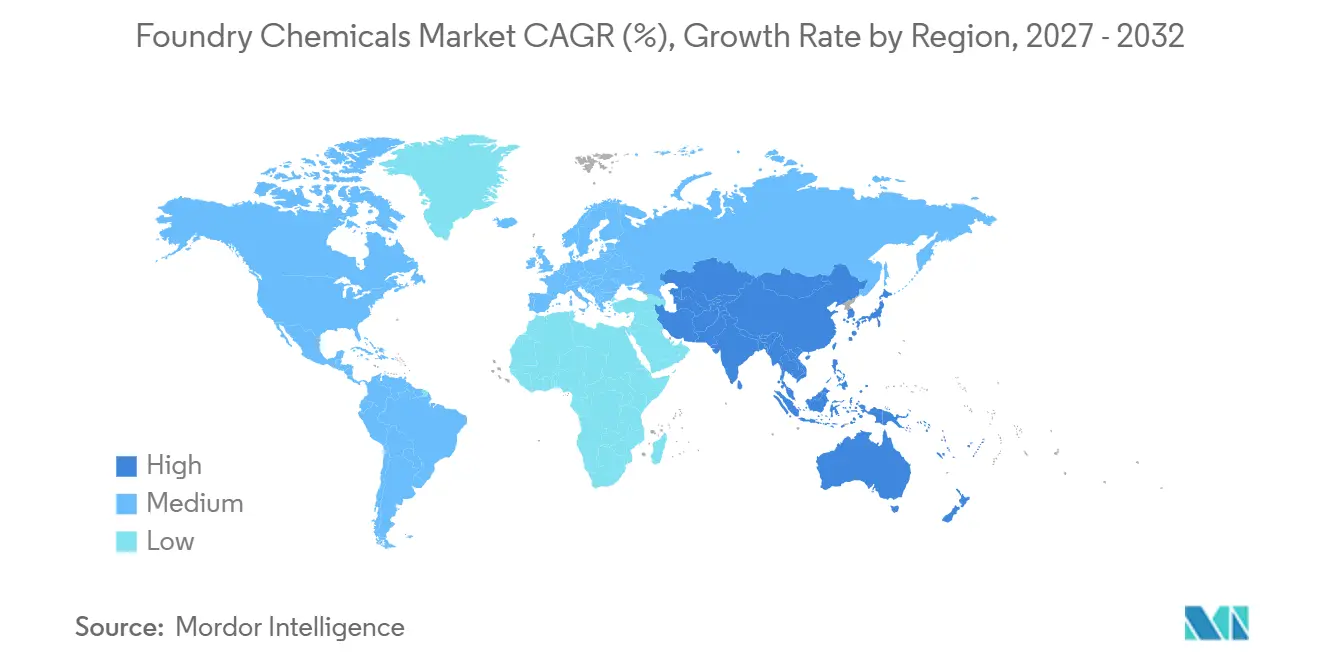
Asia-Pacific held 43.26% of the foundry chemicals market share in 2026 and is expected to grow at a 5.66% CAGR through 2032. China remains central to this market due to its large casting output and rising production of aluminum and magnesium alloy components. The China Foundry Association reported in May 2026 that the country's industry continued to expand aluminum and magnesium alloy casting in 2025. Large-die-cast integrated components for electric vehicle platforms are increasing demand for specialized release agents and low-emission die coatings. China also has an extensive supplier base that supports high-volume automotive and industrial casting, while the shift toward more automated and low-emission operations is increasing the value of advanced chemistry. India is gaining momentum through automotive localization, electric-vehicle demand, production-linked incentives, and domestic sourcing requirements. India's primary foundry alloy market is growing at 6.5% annually, ahead of the global rate of 5.8%. South Korea and Japan remain important premium markets where demanding quality standards support the use of advanced binder and coating formulations.
HA Group opened a coatings production plant in Miryang, South Korea, in March 2026, adding local capacity alongside its existing Siheung operation[2]. This investment shows we're committed to serving Korean and wider Asian customers with closer technical and production support. Local production can improve supply responsiveness and enable suppliers to work more closely with customers who require consistent coating performance and prompt process assistance. Thailand, Vietnam, and Indonesia are also receiving increased automotive assembly activity, which can create secondary demand for cast parts and foundry chemicals. North America has mature casting output, but the foundry chemicals market is evolving through electric vehicle production, defense demand, and aerospace activity. The U.S. foundry sector supplies components to more than 90% of the durable goods sector. Mexico is an active capacity-addition location, serving North American vehicle and industrial customers. Its growth strengthens demand for chemicals that support brake drums, truck hubs, and other regional OEM applications.
Europe faces stringent requirements for VOCs, amines, and other emissions, encouraging a shift from organic cold-box binders toward inorganic alternatives. The LIFE GREENCASTING project provided industrial evidence of significant reductions in hazardous emissions from inorganic binder systems. This supports changes in procurement rules among European foundry groups, though conversion costs can slow adoption. European suppliers must therefore balance demonstrated emission performance with practical requirements involving core quality, shakeout, equipment changes, and the economics of production conversion. South America is centered on Brazil's automotive and machinery casting base, while Argentina contributes specialty castings for oil and gas and agricultural equipment. Both countries import advanced foundry chemicals. The Middle East and Africa represent earlier-stage opportunities tied to Saudi infrastructure development and South African automotive assembly. In these regions, suppliers that combine reliable technical service with cost-competitive formulations can address a supply gap where qualified binder and coating systems are still primarily imported.
Competitive Landscape
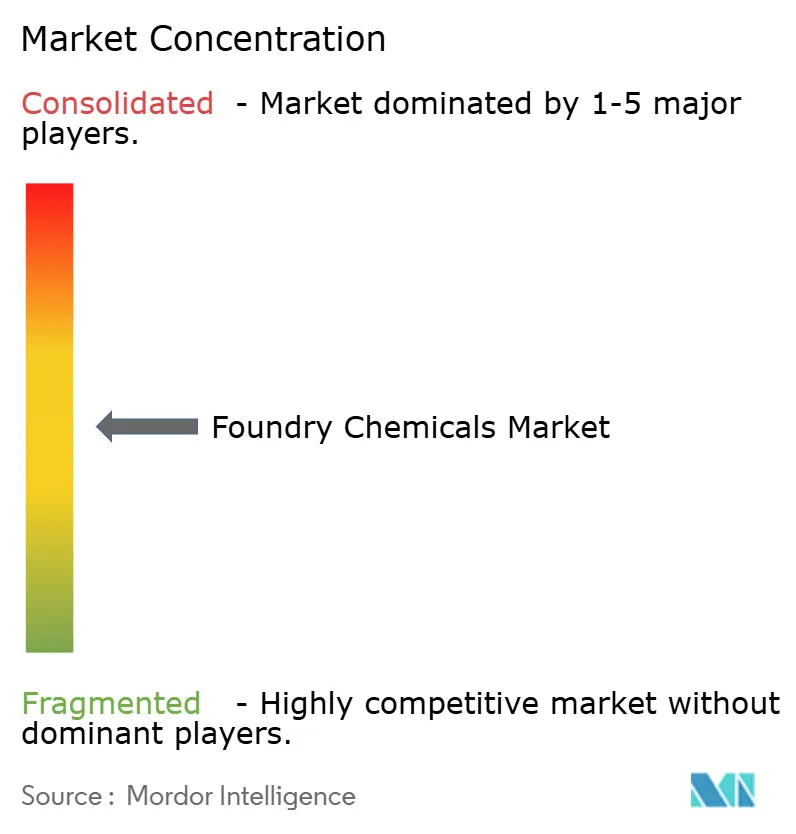
The foundry chemicals market is moderately fragmented among suppliers with broad portfolios and strong technical capabilities. Hüttenes-Albertus, ASK Chemicals, Vesuvius, and HA-International compete across binders, coatings, and additives for iron, steel, aluminum, and magnesium applications. Their advantage comes from formulation depth and application engineering rather than product availability alone. Foundries converting lines to inorganic binders or water-based coatings require support with process parameters, testing, and operator practices. This increases the importance of suppliers capable of supporting a production line through qualification. A supplier that understands the customer's casting method and operating constraints is better positioned to retain business than one whose offering is limited to a single chemical product. Regional suppliers in India and China remain competitive by offering proximity, local service, and lower-cost options. The foundry chemicals market, therefore, includes both global formulation leaders and regional firms that are close to customers' operating needs.
ASK Chemicals rolled out the DISKOVER PP/DS detailed production-planning system across six manufacturing locations in Germany, Spain, the United States, and Mexico in September 2026. The move is intended to improve synchronization with customer production schedules and strengthen service levels where timing and product consistency are important. Better planning can be particularly useful in a market where foundries expect deliveries to match production needs and where interruptions can affect a customer's casting line. Elkem completed the sale of its Silicones division to Bluestar in April 2026, making its business more focused on metals and materials, including Elkem Foundry Alloys. Elkem also approved NOK 260 million (USD 24.8 million) for the renewal of the furnace at Elkem Rana in Norway in September 2026. The investment supports the long-term supply of ferrosilicon and microsilica for foundry customers. These developments indicate that suppliers are improving production capability and refining portfolio focus in response to customer demand for a more secure supply.
Opportunities remain in inorganic systems for ferrous casting and in digital integration with customer processes. Adoption of inorganic mold and core systems in European iron foundries has been gradual, as conversion costs, core collapsibility, and shakeout performance remain concerns. Suppliers that provide a complete conversion service can address a need that a standalone product supply cannot. This service model may include product trials, adjustments to operating parameters, operator training, and ongoing technical review after a new system enters routine production. HA Group's South Korean coatings plant is an example of a supplier adding regional production capacity near a growing customer base. Smaller and regional suppliers can compete by offering responsive technical support and appropriate pricing for local foundries. The market remains open to firms that can validate low-emission performance, maintain process stability, and ensure supply continuity. Competition is therefore based on technical fit, compliance support, and customer service as much as on chemistry itself.
Foundry Chemicals Industry Leaders
-
ASK Chemicals
-
Vesuvius
-
Hüttenes-Albertus
-
Elkem ASA
-
IVP Limited
- *Disclaimer: Major Players sorted in no particular order
Recent Industry Developments
- August 2026: Foseco India's board approved the acquisition of Vesuvius India's Mehsana, Gujarat manufacturing plant for INR 432.5 million (approximately USD 5.15 million) via slump sale. The acquisition adds crucible, non-ferrous, and foundry consumable production capacity for foundry chemicals to Foseco India's western India operations, with completion expected by December 2026, pending regulatory approvals.
- March 2026: HA Group opened a new coatings production plant in Miryang, South Korea. The facility supplemented its existing Siheung plant with additional local production capacity to meet demand for foundry chemicals across Korea and the broader Asian markets.
Global Foundry Chemicals Market Report Scope
Foundry chemicals are specialized chemical formulations and additives used in metal-casting facilities to produce molds and cores, treat molten metal, and control the quality of final cast products. These chemicals play a functional role across various stages of the metal-casting process, including mold preparation, core making, metal treatment, and surface finishing.
The foundry chemicals market is segmented by product type, foundry metal, foundry process, end-user industry, and geography. By product type, the market is segmented into binders, additives, coatings, release agents, fluxes and degassing agents, and other product types. By foundry metal, the market is segmented into ferrous metals and non-ferrous metals. By foundry process, the market is segmented into sand casting, investment casting, die casting, centrifugal casting, and others. By end-user industry, the market is segmented into automotive, industrial machinery, aerospace and defense, construction and infrastructure, consumer products, and others. The report also covers the market size and forecasts for foundry chemicals in 16 countries across major regions. The market sizes and forecasts are provided in terms of value (USD).
| Binders |
| Additives |
| Coatings |
| Release Agents |
| Fluxes and Degassing Agents |
| Other Product Types |
| Ferrous Metals |
| Non-Ferrous Metals |
| Sand Casting |
| Investment Casting |
| Die Casting |
| Centrifugal Casting |
| Others |
| Automotive |
| Industrial Machinery |
| Aerospace and Defense |
| Construction and Infrastructure |
| Consumer Products |
| Others |
| Asia-Pacific | China |
| India | |
| Japan | |
| South Korea | |
| ASEAN Countries | |
| Rest of Asia-Pacific | |
| North America | United States |
| Canada | |
| Mexico | |
| Europe | Germany |
| United Kingdom | |
| France | |
| Italy | |
| NORDIC Countries | |
| Russia | |
| Rest of Europe | |
| South America | Brazil |
| Argentina | |
| Rest of South America | |
| Middle East and Africa | Saudi Arabia |
| South Africa | |
| Rest of Middle East and Africa |
| By Product Type | Binders | |
| Additives | ||
| Coatings | ||
| Release Agents | ||
| Fluxes and Degassing Agents | ||
| Other Product Types | ||
| By Foundry Metal | Ferrous Metals | |
| Non-Ferrous Metals | ||
| By Foundry Process | Sand Casting | |
| Investment Casting | ||
| Die Casting | ||
| Centrifugal Casting | ||
| Others | ||
| By End-User Industry | Automotive | |
| Industrial Machinery | ||
| Aerospace and Defense | ||
| Construction and Infrastructure | ||
| Consumer Products | ||
| Others | ||
| By Geography | Asia-Pacific | China |
| India | ||
| Japan | ||
| South Korea | ||
| ASEAN Countries | ||
| Rest of Asia-Pacific | ||
| North America | United States | |
| Canada | ||
| Mexico | ||
| Europe | Germany | |
| United Kingdom | ||
| France | ||
| Italy | ||
| NORDIC Countries | ||
| Russia | ||
| Rest of Europe | ||
| South America | Brazil | |
| Argentina | ||
| Rest of South America | ||
| Middle East and Africa | Saudi Arabia | |
| South Africa | ||
| Rest of Middle East and Africa | ||
Key Questions Answered in the Report
What is current market size of Foundry Chemicals Market?
The Foundry Chemicals Market size is expected to increase from USD 6.83 billion in 2026 to USD 7.16 billion in 2027 and reach USD 9.08 billion by 2032, at a CAGR of 4.87% over 2027-2032.
Why are binders important in foundry operations?
Binders held a 48.34% share in 2026 because they provide mold and core integrity across green-sand, no-bake, and cold-box processes. Their performance can affect mold strength, dimensional stability, gas behavior, shakeout, and the consistency of the final casting.
Which metal category has the strongest outlook?
Non-ferrous metals are projected to grow at a CAGR of 5.63% through 2032, supported mainly by aluminum castings for electric vehicles. This category also includes specialized demand for magnesium and zinc casting chemistry.
Which region leads demand for foundry chemicals?
Asia-Pacific led with a 43.26% share in 2026 and is forecast to expand at a CAGR of 5.66% through 2032. China’s extensive casting base, India’s localized automotive expansion, and technically demanding operations in South Korea and Japan support regional demand.