
Forestry Equipment Market Size and Share
Market Overview
| Study Period | 2020 - 2031 |
|---|---|
| Market Size (2026) | USD 11.41 Billion |
| Market Size (2031) | USD 13.58 Billion |
| Growth Rate (2026 - 2031) | 3.54 % |
| Fastest Growing Market | Asia Pacific |
| Largest Market | North America |
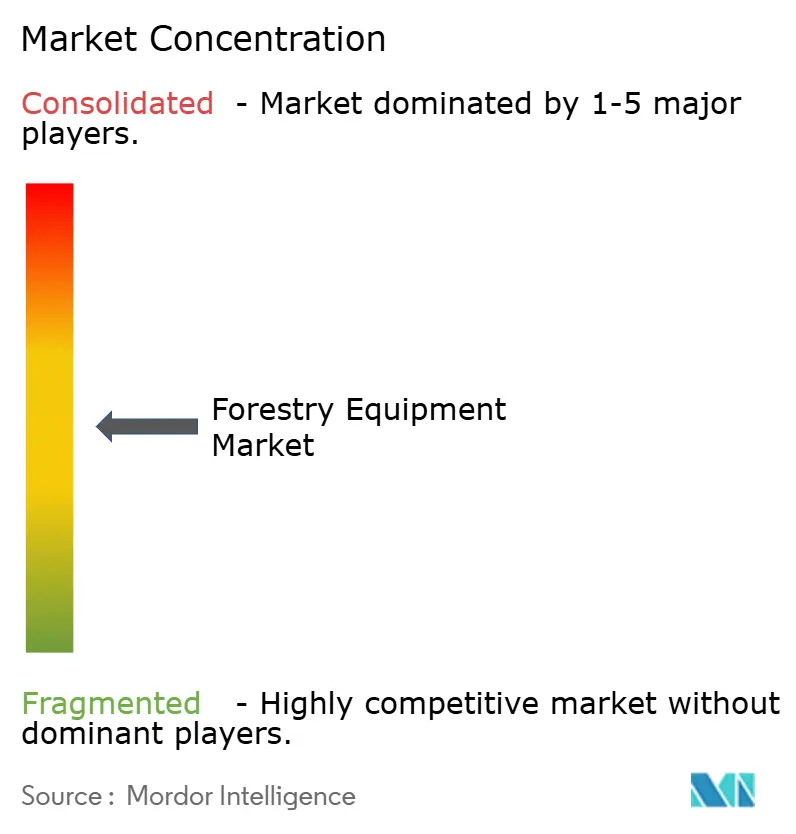
| Market Concentration | Medium |
Major Players *Disclaimer: Major Players sorted in no particular order Image © Mordor Intelligence. Reuse requires attribution under CC BY 4.0. | |
Forestry Equipment Market Analysis by Mordor Intelligence
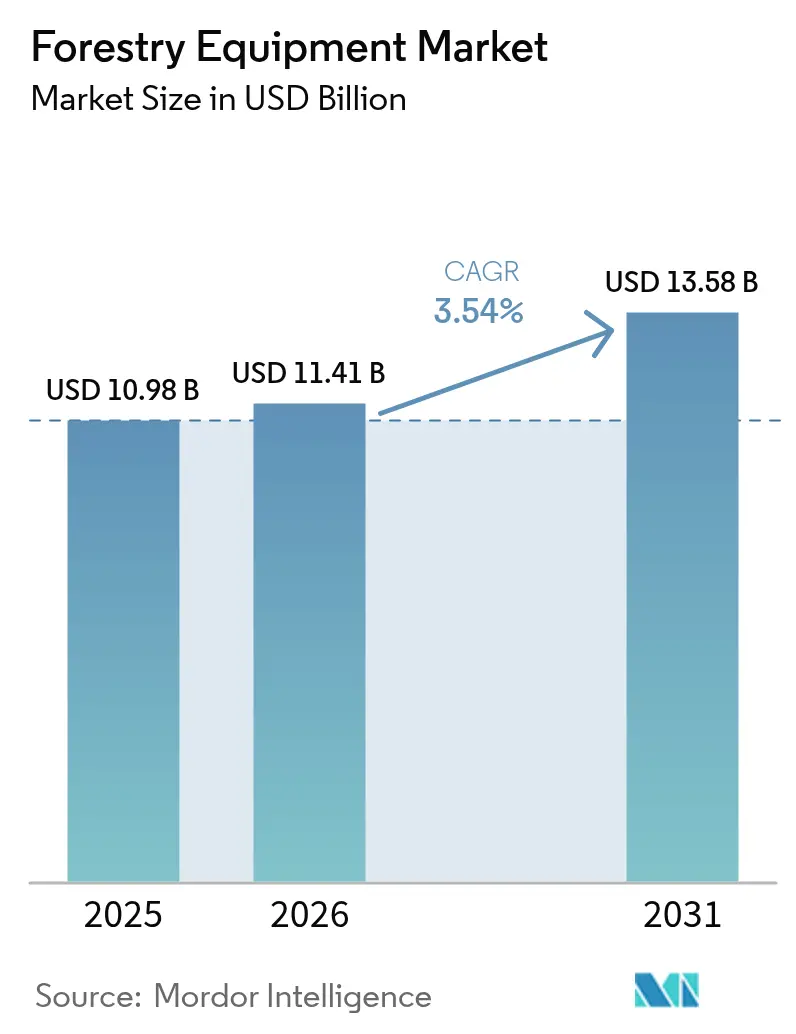
The Forestry Equipment Market size is expected to grow from USD 10.98 billion in 2025 to USD 11.41 billion in 2026 and is forecast to reach USD 13.58 billion by 2031 at 3.54% CAGR over 2026-2031.
Demand growth is shaped by stricter emission rules, rapid mechanization in emerging economies, and rising post-wildfire salvage volumes. Large operators are testing hybrid fleets to comply with carbon caps, yet most small and mid-sized contractors keep refurbishing diesel machines to contain capital costs. Rental fleets are expanding quickly because contractors prefer paying for short-term use rather than locking scarce cash into ownership. Technology is a decisive differentiator as leading manufacturers deploy telematics, AI-assisted controls, and predictive maintenance to reduce downtime and offset a widening skilled-operator gap.
Key Report Takeaways
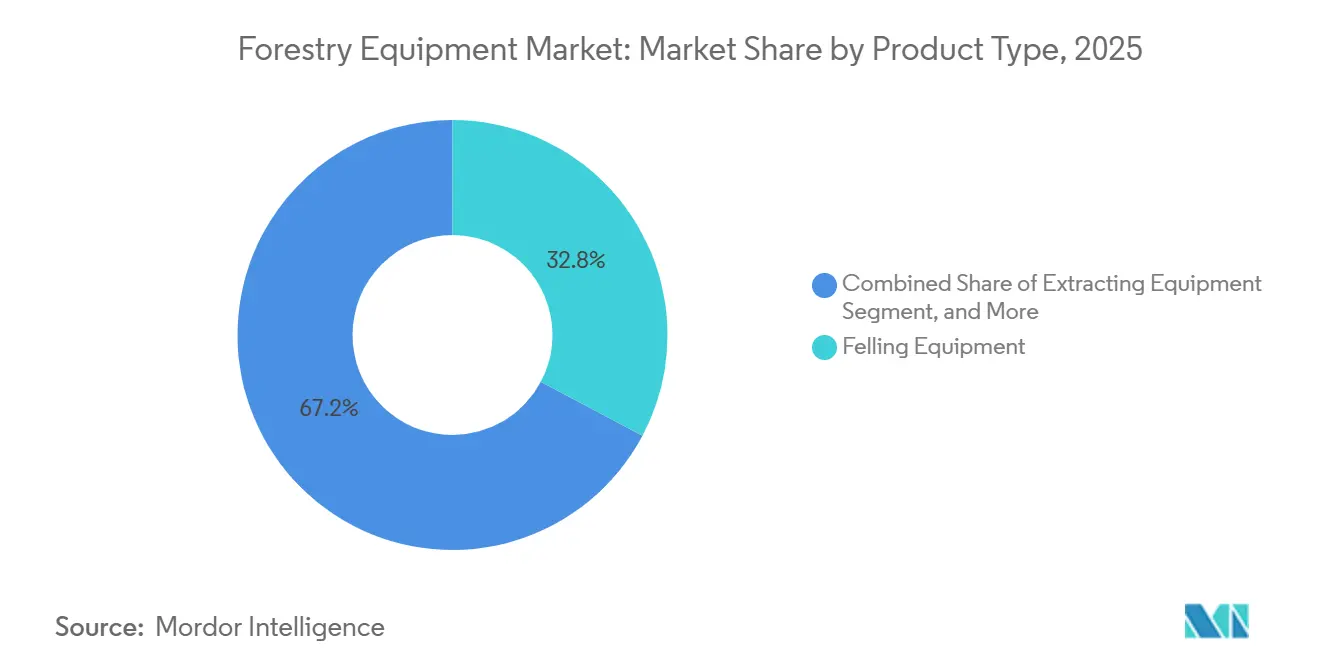
- By product type, felling equipment commanded 32.76% of the forestry equipment market share in 2025, while other forestry equipment (loaders, mulchers, and others) is projected to advance at a 4.31% CAGR through 2031.
- By power source, diesel systems held 62.07% of the forestry equipment market share in 2025, whereas electric-powered units are forecast to grow at a 4.52% CAGR to 2031.
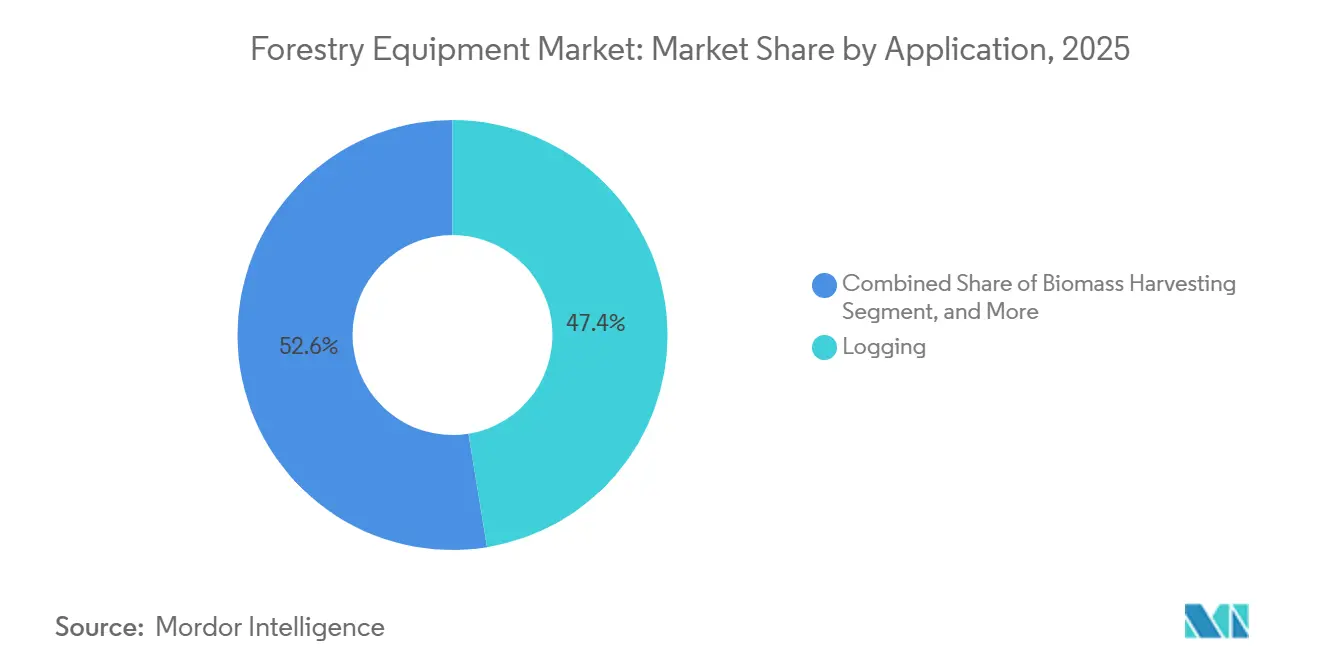
- By application, logging led with 47.43% revenue share in 2025, and biomass harvesting is forecast to expand at a 4.71% CAGR to 2031.
- By end-user, commercial logging companies accounted for 53.21% share of the forestry equipment market size in 2025, whereas rental service providers are expected to record the fastest 4.49% CAGR through 2031.
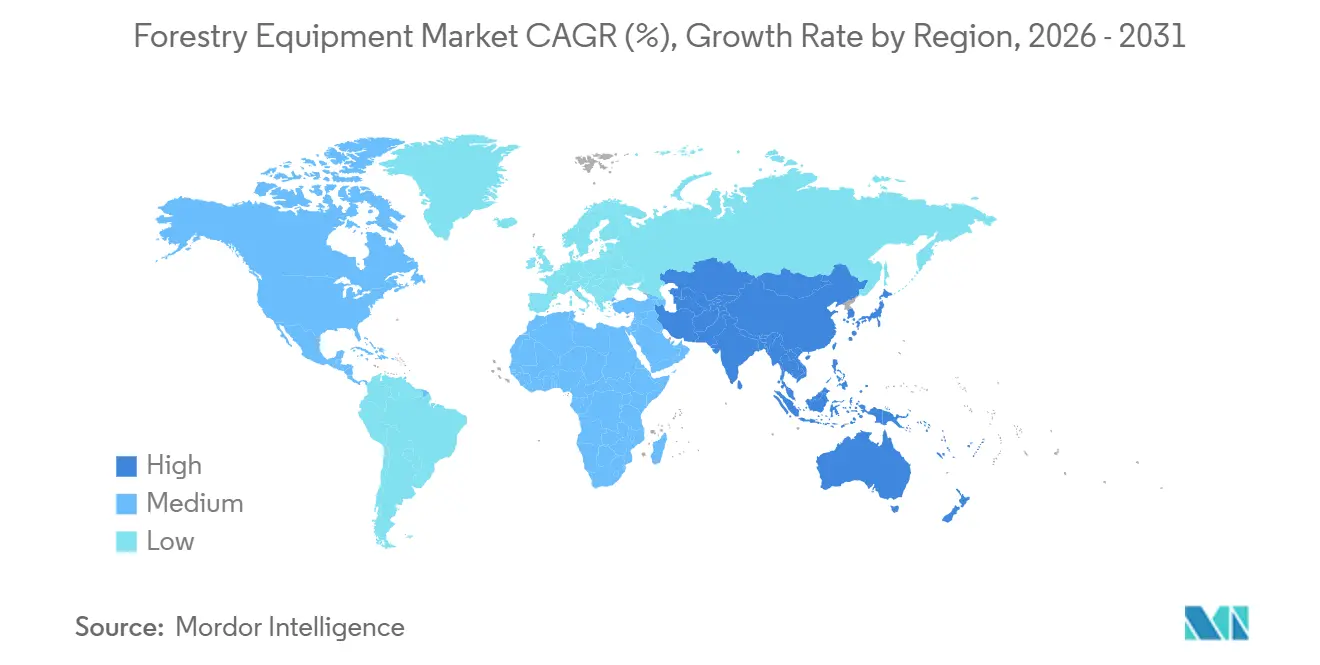
- By geography, North America dominated with 39.32% of global demand in 2025, while Asia-Pacific is projected to post the highest 4.57% CAGR to 2031.
Note: Market size and forecast figures in this report are generated using Mordor Intelligence’s proprietary estimation framework, updated with the latest available data and insights as of 2026.
Market Trends and Insights
Drivers Impact Analysis of Forestry Equipment Market*
| Driver | (~) % Impact on CAGR Forecast | Geographic Relevance | Impact Timeline |
|---|---|---|---|
| Rising Demand for Mechanised Selective Logging | +0.8% | North America and Europe | Medium term (2–4 years) |
| Adoption of Electric and Hybrid Forestry Machinery | +0.6% | North America and Europe, spill-over to Asia-Pacific | Long term (≥ 4 years) |
| Expansion of Biomass and Bioenergy Projects | +0.9% | Europe, North America, Asia-Pacific | Medium term (2–4 years) |
| Government Incentives for Precision and Sustainable Forestry | +0.5% | North America, Europe, Australia, New Zealand | Short term (≤ 2 years) |
| Integration of Telematics and AI Fleet Optimisation | +0.4% | Global | Medium term (2–4 years) |
| Post-Wildfire Salvage Harvesting Needs | +0.3% | North America, Australia, Mediterranean Europe | Short term (≤ 2 |
| Source: Mordor Intelligence | |||
Rising Demand for Mechanised Selective Logging
Labor shortages and stricter habitat rules are steering selective logging away from chainsaw crews toward harvesters and forwarders that minimize residual stand damage. Oregon’s 80-year Elliott State Research Forest permit highlights this shift because managers must thin steep slopes without harming protected bird habitats. Komatsu’s 951XC-1 harvester, released in 2025, uses advanced hydraulics to precisely buck logs on uneven ground, reducing waste and increasing fiber yield. Institutional timberland investors such as Stafford Capital Partners prioritize certification-compliant mechanization to lock in predictable returns across 6.3 million acres. While small contractors still run skidders and chainsaws, rising insurance costs and safety regulations continue to tilt economics toward integrated machines that cut cycle times and reduce labor intensity.
Increasing Adoption of Electric and Hybrid Forestry Machinery
Volvo showcased the first electric articulated dump trucks in 2025, framing a long-range transition to zero-emission haulage. Adoption of deep-forest tasks remains cautious because charging points are scarce beyond 50 kilometers from the grid, and diesel generators undermine emission gains. Nonetheless, European and Californian mandates force pilot programs, with Volvo trialing 5G-controlled electric loaders in Scandinavian forests. Surveys indicate 77% of operators still trust hydraulic diesels over electric-hydraulic hybrids, forecasting a multi-stage path in which hybrids bridge technology gaps until batteries store more energy per kilogram. Government subsidies covering battery packs and fast chargers shorten payback for fleet owners operating near mills, helping the segment outpace the overall forestry equipment market.
Expansion of Global Biomass and Bioenergy Projects
Bioenergy programs in the European Union and the United States are boosting demand for chippers, grinders, and debarkers that convert low-grade timber into uniform fuel. Terex CBI’s 6800CT grinder processes standing deadwood at an Arizona biomass plant, demonstrating how salvage material can be converted into renewable heat and power. The U.S. Department of Energy projects forest biomass supply could double to 62.7 million tonnes annually in mature markets, sustaining a 4.71% CAGR for biomass harvesting gear. Morbark’s 2355 Flail Chiparvestor offers 1,200 HP capacity and integrated dirt separators to boost chip quality. Even where pulp mills close, redirected slash fuels distributed boiler networks, keeping demand buoyant despite cyclic lumber prices.[1]
Government Incentives for Precision and Sustainable Forestry
Oregon deployed USD 26.6 million in Urban and Community Forestry grants during 2024-2025 to fund workforce programs, LiDAR mapping, and telematics-ready machinery.[2] Europe links subsidy eligibility to ISO 14001 and FSC compliance, accelerating purchases of Stage V harvesters with remote diagnostics. New Zealand’s Precision Silviculture Programme lifted LiDAR use to 93% by 2025, cutting waste and reducing fuel burn. These schemes temper capital barriers, letting mid-tier contractors trial Komatsu’s Smart Forestry suite, which wires machine health data to cloud dashboards for real-time optimization. Regional priorities differ: North America rewards emission cuts, whereas Asia-Pacific backs simple mechanization to replace manual labor, so manufacturers tailor features to local funding rules.
Restraints Impact Analysis of Forestry Equipment Market*
| Restraint | (~) % Impact on CAGR Forecast | Geographic Relevance | Impact Timeline |
|---|---|---|---|
| High Upfront Capital Expenditure for Advanced Machines | -0.6% | Global, particularly affecting small to medium operators | Short term (≤ 2 years) |
| Shortage of Skilled Heavy-Equipment Operators in Rural Areas | -0.5% | Global, most acute in North America and Europe | Medium term (2-4 years) |
| Limited Charging Infrastructure in Remote Forest Regions | -0.4% | Global, with highest impact in North America and Nordic countries | Long term (≥ 4 years) |
| Volatility of Global Timber Prices Impacting CAPEX Cycles | -0.3% | Global, with particular sensitivity in commodity-dependent regions | Short term (≤ 2 years) |
| Source: Mordor Intelligence | |||
High Upfront Capital Expenditure for Advanced Machines
Electric harvesters cost 30-50% more than diesel peers, putting ownership out of reach for many small firms. Morbark’s 2355 Flail Chiparvestor, weighing 115,200 pounds, lists above USD 1 million, restricting sales to large loggers and rental companies.[3] Smart controls and Stage V after-treatment add USD 50,000-100,000 to Komatsu excavators. Regions with high interest rates, notably parts of Asia-Pacific and South America, face steeper hurdles because shorter loan tenures inflate monthly outlays. Consequently, many operators sweat older fleets longer, boosting demand for parts and rebuilds instead of new units.
Shortage of Skilled Heavy-Equipment Operators in Rural Areas
A projected 700,000-person deficit in qualified operators by 2031 squeezes utilization across North American and European forests. Retirements outpace apprenticeships, and younger workers choose urban logistics roles. Vendors respond with automation: John Deere’s autonomous articulated dump truck uses terrain memory to run without a driver on mapped routes.[4] Link-Belt’s Payload Assist app sends load tickets to smartphones, simplifying recordkeeping. Yet remote forests still lack reliable data coverage, limiting the benefit of connected tech. Wage premiums of 20-30% persist, elevating cost structures until autonomous systems mature.
*Our forecasts treat driver/restraint impacts as directional, not additive. The impact forecasts reflect baseline growth, mix effects, and variable interactions.
Forestry Equipment Market Segment Analysis
By Product Type:
Growing Demand for Multi-Role MachinesFelling equipment controlled 32.76% of the forestry equipment market share in 2025. Harvesters, feller bunchers, and swing machines dominate both cut-to-length and whole-tree systems, with Komatsu’s TN785D improving slope stability to unlock steep-terrain fiber. Extracting gear, mainly forwarders and skidders, remains indispensable because it bridges the stump and landing. On-site processors, such as chippers and delimbers, become relevant when biomass plants pay for uniform chips. Separately sold parts and attachments deliver recurring margins, as OEMs guarantee chain and bar supply for decades.
Other forestry equipment (loaders, mulchers, and others) is poised to grow fastest at a 4.31% CAGR through 2031, boosting the market for loaders, mulchers, and ancillary assets. Bobcat’s 32-item attachment range turns compact skid-steers into land-clearing specialists. Rayco’s T415 mulcher tackles firebreaks, pipeline corridors, and right-of-way clearing with 415 HP hydrostatic power. Tigercat’s reinforced H-Series feller-bunchers extend machine life, helping contractors capture value through harsher cycles. Versatility drives investment as contractors seek assets that pivot between logging, land clearing, and infrastructure jobs to maximize uptime.

By Power Source:
Diesel Dominance Meets Early ElectrificationDiesel units retained 62.07% forestry equipment market share in 2025 because remote fuel delivery systems, technician familiarity, and robust torque keep them indispensable. Caterpillar’s FM528 GF/LL integrates efficient diesels that meet Stage V while maintaining the ruggedness demanded by steep-slope thinnings. Petrol models, mainly chainsaws, fill portable needs.
Electric-powered machines are forecast to post a 4.52% CAGR, yet their advance hinges on batteries and charging. Volvo’s A30 and A40 Electric articulated dump trucks headline this frontier, but viable ranges stay near 50 kilometers unless mobile battery banks are financed. Hybrids that capture brake energy stand as stop-gaps, shaving fuel during idle or low-load cycles without range anxiety. Surveys reveal that most operators still rate hydraulic reliability above electric drives, signaling a decade-long transition toward parity.
By Application:
Core Logging Steady, Bioenergy Lifts GrowthLogging absorbed 47.43% of 2025 demand as managed forests maintain stable harvest schedules supported by long-term permits such as the 83,326-acre Elliott State plan. Land clearing accompanies roadway, pipeline, and agricultural projects, while fire management upsizes mulcher fleets following severe wildfire seasons. Forest road construction continues, although conservation caps, such as the 40-mile limit in Elliott State, constrain hard infrastructure.
Biomass harvesting will grow at a 4.71% CAGR, outpacing conventional logging. Terex CBI’s ChipMax 364T whole-tree chipper, transportable without special permits, supports high-volume power producers. Morbark’s 50/48X drum chipper processes entire trees into boiler-ready chips, aligning with European feed-in tariffs for renewable heat. Where pulp mills shutter, low-grade timber diverts into energy loops, preserving equipment utilization even when sawlog prices soften.
By End-User:
Capital-Light Models Gain FavorCommercial logging companies held 53.21% share of forestry equipment market size in 2025, operating 10-50-unit fleets focused on utilization and total cost of ownership. TIMOs mandate telematics reporting to validate ESG metrics across multi-country portfolios, reinforcing demand for smart machines. Government agencies procure niche gear for fire mitigation and habitat work, often funded by stimulus grants.
Rental service providers will expand fastest at 4.49% CAGR. United Rentals and Sunbelt stock specialized harvesters and mulchers, letting contractors match fleet scale to episodic jobs like post-wildfire salvage. Telematics supports pay-per-hour billing and predictive maintenance, ensuring uptime vital for short contract windows. Younger entrepreneurs favor asset-light models, reinforcing rental momentum across mature and emerging regions.
Geography Analysis
North America Forestry Equipment Market
North America generated 39.32% of 2025 revenue, cementing the region’s leadership. Extensive pine plantations in the U.S. South, mechanized Douglas fir stands in the Pacific Northwest, and salvage programs in western states provide a balanced demand base. Canadian loggers invest in steep-slope harvesters to reach fire-prone interior forests, while Mexico’s community forestry programs opt for compact loaders and chainsaws. Manufacturers strengthen local assembly: Volvo expanded U.S. capacity in 2025, and John Deere launched L-III skidders optimized for dense hardwood tracts.
Europe Forestry Equipment Market
Europe emphasizes compliance with emissions standards and ecosystem services. Germany and France push Stage V harvesters integrated with LiDAR silviculture planning, while Sweden’s biomass-for-district-heat sector fuels grinder uptake. Russia retains vast unrealized potential, but infrastructure and geopolitics slow mechanization. The forestry equipment market size for European biomass harvesting keeps growing as carbon pricing rewards renewable fuels.
APAC, South America and Africa Forestry Equipment Market
Asia-Pacific is set to post a 4.57% CAGR through 2031. China scales up subsidies for forest harvesters, India modernizes plantation management, and Australia pivots toward fuel-reduction equipment after repeated bushfires. New Zealand logging firms, already early adopters of telematics, now trial hybrid forwarders on radiata pine slopes. Southeast Asian exporters mechanize selectively to satisfy certification audits, driving sales of mid-sized skidders and rough-terrain loaders. Elsewhere, South America’s eucalyptus plantations in Brazil and Argentina quicken harvester demand to lift pulpwood yields, while Africa’s nascent sectors in South Africa adopt cost-efficient cut-to-length systems as mills expand.
Regulatory Landscape
Regulation increasingly ties forestry operations and adjacent equipment specifications to safety, traceability, and emissions compliance. In Europe, the EU Deforestation Regulation (Regulation (EU) 2023/1115, as amended by Regulation (EU) 2025/2650) strengthens due-diligence and information-system use across timber supply chains. Commission Implementing Regulation (EU) 2026/1565 (published July 2026) adds contingency arrangements for the supporting IT system, increasing the need for digital documentation and data capture in mechanized harvesting and transport workflows.
Safety and trade rules also shape equipment design choices and cross-border costs. ISO 11680:2025 (published June 2025) sets updated safety and test requirements for portable pole-mounted powered pruners, with effectivity linked to February 2026 for newly manufactured machinery. In the United States, Section 232 tariff adjustments effective from October 14, 2025, on specified timber and wood products introduce procurement volatility for OEMs and fleet operators managing parts and attachment supply across borders.
Value Chain Analysis
The value chain begins with steel, hydraulics, engines/aftertreatment, electronics, sensors, and software, then flows through OEM design and assembly, attachment integration, and dealer networks that provide configuration, financing, service, and parts. Digitization is increasingly embedded across the chain as OEMs and technology firms connect machines to planning and compliance data flows: Trimble launched Forestry One in May 2025 as a common data environment to integrate operations, spatial data, and supply-chain traceability, aligning operational data capture with compliance needs such as EU deforestation-related due diligence.
Downstream, distribution and aftermarket performance are differentiated by uptime services, telemetry-enabled maintenance, and life-cycle support. Contractors and TIMOs use dealers and rental fleets for rapid machine availability and rebuild capability as capital costs rise, while manufacturers expand circular pathways to secure components and reduce lead-time risk. Ponsse announced the EU LIFE-funded ExtendedLIFE project in July 2026 to establish a Refactory in Iisalmi, Finland, focused on industrial-scale refurbishment and recycling of used forest machine components, signaling a broader shift toward remanufacturing and component reuse alongside traditional parts supply. Parallel technology pathways such as teleoperation and operator-assist AI are being piloted through OEM collaborations and forestry research bodies (for example, Komatsu forwarder teleoperation work in Sweden), tightening the linkage between equipment, connectivity, and operational workflows.
Competitive Landscape
Deere, Caterpillar, Komatsu, and Volvo anchor the market with broad portfolios, global dealer coverage, and captive finance. Komatsu’s Smart Forestry suite blends telematics, AI, and inventory data to cut downtime by 20% for early adopters, while Deere’s autonomous truck prototype illustrates progress toward driverless timber transport. Nordic specialists Ponsse and Tigercat concentrate on purpose-built harvesters and forwarders, earning strong loyalty where uptime in cold, remote forests is critical.
Niche players enlarge white-space segments. Terex CBI leverages interchangeable rotors to switch from mulch to chip modes fast, appealing to contractors juggling biomass and land-clearing contracts. Morbark positions lifetime parts availability as a hedge against second-hand price erosion, and Rayco markets multi-head mulchers for storm cleanup and firebreak creation. Bobcat and Kubota expand compact equipment with forestry-grade attachments, challenging full-size OEMs on small-site agility.
Rental channel concentration shifts bargaining power. United Rentals demands OEM-installed telematics for fleet-wide dashboards, steering product roadmaps. Digital services emerge as the next battleground: Link-Belt’s payload app, Morbark’s Integrated Control System, and Komatsu’s Intelligent Machine Control 3.0 all promise lower cost per cubic meter. Consolidation remains measured, leaving room for regional champions, yet technology costs spur partnerships between sensor startups and legacy manufacturers keen to accelerate automation.
Forestry Equipment Industry Leaders
-
Deere & Company
-
Caterpillar Inc.
-
Komatsu Ltd.
-
Ponsse Oyj
-
Tigercat Industries Inc.
- *Disclaimer: Major Players sorted in no particular order
Forestry Equipment Market Companies Covered in this Report
- Deere & Company
- Caterpillar Inc.
- Komatsu Ltd.
- Ponsse Oyj
- Tigercat Industries Inc.
- Volvo Construction Equipment AB
- Hitachi Construction Machinery Co. Ltd.
- Barko Hydraulics LLC
- HD Hyundai Infracore Co. Ltd.
- Kesla Oyj
- Rottne Industri AB
- Eco Log Sweden AB
- AGCO Corporation
- Kubota Corporation
- Bell Equipment Limited
- CNH Industrial N.V.
- Husqvarna AB
- Doosan Bobcat Inc.
- SENNEBOGEN Maschinenfabrik GmbH
- Logset Oy
Market Opportunities and Future Outlook
White space is emerging around compliance-ready digital operations that connect machine data to timber traceability and sustainability reporting. The EU Deforestation Regulation raises the practical value of common data environments and standardized data exchange in harvesting and logistics, and platforms such as Trimble Forestry One (launched May 2025) target integrated operational and traceability workflows. OEMs that package telematics, mapping, and documentation tools with machines and dealer support have a clearer route to differentiation with timberland investment managers and larger contractors that already require ESG-aligned reporting.
A second opportunity area is purpose-built solutions for thinning, regeneration, and lower-impact forestry, where lightweight machines, attachments, and automation reduce soil disturbance and operator burden. Komatsu Forest completed its acquisition of Malwa Forest AB in April 2026, expanding access to compact cut-to-length machines used in thinning operations, and signaling continued portfolio investment in this niche. Circular-economy service models are also becoming more investable as operators extend fleet life: Ponsse's July 2026 ExtendedLIFE Refactory initiative in Iisalmi, Finland, supports industrial refurbishing and recycling of components, strengthening the value proposition for contractors and rental providers focused on total cost of ownership, parts availability, and faster turnaround over full fleet replacement.
Recent Industry Developments in Forestry Equipment Market
- July 2026: Ponsse launched the EU LIFE-funded ExtendedLIFE project to establish a Refactory in Iisalmi, Finland, for industrial-scale refurbishment and recycling of used forestry machine components. The initiative strengthens circular aftermarket capability and supports contractors and rental fleets that extend asset life to manage high equipment costs.
- April 2026: Komatsu Forest completed the acquisition of Malwa Forest AB in Sweden, adding lightweight and compact cut-to-length machinery focused on thinning operations. The deal broadens Komatsu Forest's portfolio depth in smaller-machine segments where soil impact reduction and access to dense stands drive equipment selection.
- May 2024: UPM Biochemicals reported results from its Smart Forestry 4.0 concept work supporting transparent and efficient wood supply chains for its Leuna biorefinery. The program highlights how operational digitization and standardized data flows across harvesting and logistics can pull through demand for connected equipment and data-enabled services.
Forestry Equipment Market Report Scope and Research Methodology
Market Definition and Coverage
The forestry equipment market, for this study, covers machinery and related attachments used to fell, extract, process, and move timber and biomass across managed forests and logging sites, and it is measured as equipment revenue in USD.
Scope exclusions: Hand tools and general-purpose construction equipment that is not configured for forestry work are not counted.
Segments Covered in This Report
- By Product Type
- Felling Equipment
- Chainsaws
- Harvesters
- Feller Bunchers
- Extracting Equipment
- Forwarders
- Skidders
- Other Extracting Equipment
- On-Site Processing Equipment
- Chippers and Grinders
- Delimbers and Slashers
- Other On-Site Processing Equipment
- Separately Sold Parts and Attachments
- Saw Chain, Guide Bars, Discs, and Teeth
- Harvesting and Other Cutting Heads
- Other Separately Sold Parts and Attachments
- Other Forestry Equipment
- Loaders
- Mulchers
- Other Forestry Equipment
- Felling Equipment
- By Power Source
- Diesel-Powered Equipment
- Petrol / Oil-Powered Equipment
- Electric-Powered Equipment
- Hybrid-Powered Equipment
- Other Power Source
- By Application
- Logging
- Land Clearing
- Forest Fire Management
- Forest Road Construction
- Biomass Harvesting
- Other Application
- By End-User
- Commercial Logging Companies
- Timberland Investment Managers
- Government Forestry Agencies
- Individual Contractors and Small Operators
- Rental Service Providers
- By Geography
- North America
- United States
- Canada
- Mexico
- Europe
- Germany
- United Kingdom
- France
- Russia
- Rest of Europe
- Asia-Pacific
- China
- Japan
- India
- South Korea
- Australia
- Rest of Asia-Pacific
- Middle East
- Saudi Arabia
- United Arab Emirates
- Rest of Middle East
- Africa
- South Africa
- Egypt
- Rest of Africa
- South America
- Brazil
- Argentina
- Rest of South America
- North America
Data Sources, Market Sizing, and Validation
Desk Research
Desk work is used to set the market frame and anchor the model to measurable activity in forestry and wood supply chains. We reviewed public sources including FAO forestry production statistics, UN Comtrade trade flows for relevant machinery categories, the US Forest Service and other national forestry agency publications, and Eurostat indicators where applicable.
To keep assumptions grounded in how the market actually operates, we also used company annual reports and investor presentations, regulatory and safety guidance from occupational agencies, and coverage from industry press and association websites. When needed, paid subscriptions for company financials, news and financials, patent databases, and shipment-level import and export data were used to cross-check directionally. This list is not exhaustive, and additional sources were used during data collection, validation, and clarification.
Primary Interviews and Surveys
Primary work focused on validating what is purchased and used in the field, and then translating those observations into realistic pricing and volume assumptions. We spoke with a mix of equipment makers, dealer and rental channels, and end users such as logging contractors and forestry agencies across APAC, EMEA, and the Americas, to close data gaps and sanity-check our inputs.
Distribution of primary research fieldwork respondents
| Company type | Respondent position | Region |
|---|---|---|
| Top tier: 37% | CXOs: 12% | APAC: 43% |
| Mid tier: 49% | Functional/Unit leaders: 29% | EMEA: 30% |
| Smaller Players: 14% | Managers: 59% | Americas: 27% |
Market-Sizing & Forecasting
Sizing starts with a top-down build that reconstructs demand from forestry activity and equipment adoption, and then converts that demand into value using price points that were checked in the field. Since equipment categories behave differently, inputs are set separately for areas like felling, extracting, on-site processing, and separately sold parts and attachments.
Key model inputs include roundwood and biomass harvesting levels, mechanization rates by forest type, replacement cycles for high-wear machines, the mix shift across diesel versus electric or hybrid power, and the share of work done through rental fleets. When parts and attachments are modeled, we use utilization and maintenance intensity assumptions so revenue is not overstated during weaker logging years.
Forecasts are produced using scenario analysis supported by expert views on timber demand, forest-fire management spending, and policy-driven land clearing constraints, and then smoothed by the expected replacement cycle effect. Bottom-up checks are run selectively through supplier and channel sampling, such as sampled average selling price ranges multiplied by estimated unit volumes, and gaps are handled using proxy indicators like trade flows and dealer inventory commentary before totals are finalized.
Data Validation & Update Cycle
Outputs are checked against independent signals such as timber production trends, machinery trade balances, and visible shifts in equipment mix across applications, and then reviewed for odd jumps by product type and region. If a variance appears too large, we re-check the input driving it, and then re-contact interviewees when a clarification is needed.
Before sign-off, the model and narrative go through multiple analyst reviews so assumptions stay consistent across sections and the math ties out. Reports are refreshed annually, with interim updates when material events occur, and a fresh pre-delivery review is completed so clients receive the most current view.
Mordor Intelligence's Forestry Equipment Market Size Compared With Other Published Estimates
Published market values for forestry equipment often do not match because firms choose different year anchors, include different equipment and attachment revenue, and apply their own pricing progression and currency conversion timing.
Some sources fold used equipment turnover and broad logging tool coverage into the same number, but Mordor Intelligence counts revenue for defined forestry equipment categories (including separately sold parts and attachments) and keeps general-purpose machinery and hand tools outside the total, which changes the market value for the same year.
Benchmark comparison
| Source | Market Size | Gaps in Research Methodology |
|---|---|---|
| Mordor Intelligence | USD 11.41 B (2026) | |
| Industry Publisher A | USD 11.74 B (2026) | Uses a wider sales-type lens that can blend used and new equipment values, which can lift totals in years with active resale markets, and pricing steps may be applied more uniformly across equipment types. |
| Research Group B | USD 11.33 B (2024) | Anchors the series to an earlier year and may use broader macro assumptions for demand without the same product-type level checks, so the level can drift if replacement cycles and attachment revenue intensity are not updated. |
Across the three figures, most of the spread can be traced to year selection and what is treated as equipment revenue versus adjacent activity like used turnover or non-specialized tools. By keeping the model tied to forestry work indicators and then pressure-testing pricing and adoption with field feedback, we can keep the estimate reproducible and easier to reconcile across regions and applications.
Key Questions Answered in the Report
What is the expected value of the forestry equipment market by 2031?
The market is projected to reach USD 13.58 billion by 2031.
Which product segment is forecast to grow fastest through 2031?
Other forestry equipment such as loaders and mulchers is set to expand at a 4.31% CAGR.
Why are rental service providers gaining share?
High capital costs and volatile timber prices push contractors toward flexible rental agreements, driving a 4.49% CAGR for this segment.
How quickly are electric-powered forestry machines growing?
Electric units are projected to register a 4.52% CAGR, outpacing the overall market but from a small base.
Which region will post the highest growth rate to 2031?
Asia-Pacific is expected to lead with a 4.57% CAGR as China and India mechanize large state forests.
What technology trends are shaping future equipment design?
Telematics, AI-driven fleet optimization, and hybrid or electric drivetrains are key areas of innovation among leading OEMs.