
Flat Antenna Market Size and Share
Market Overview
| Study Period | 2020 - 2031 |
|---|---|
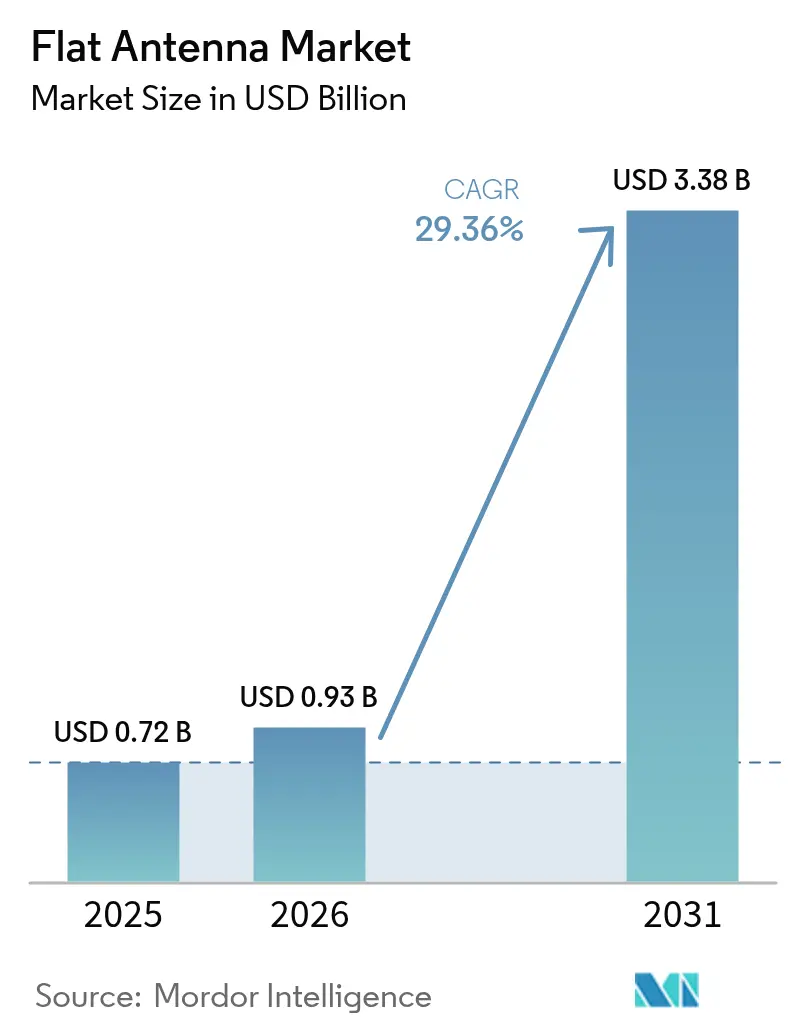
| Market Size (2026) | USD 0.93 Billion |
| Market Size (2031) | USD 3.38 Billion |
| Growth Rate (2026 - 2031) | 29.36 % |
| Fastest Growing Market | Asia Pacific |
| Largest Market | North America |
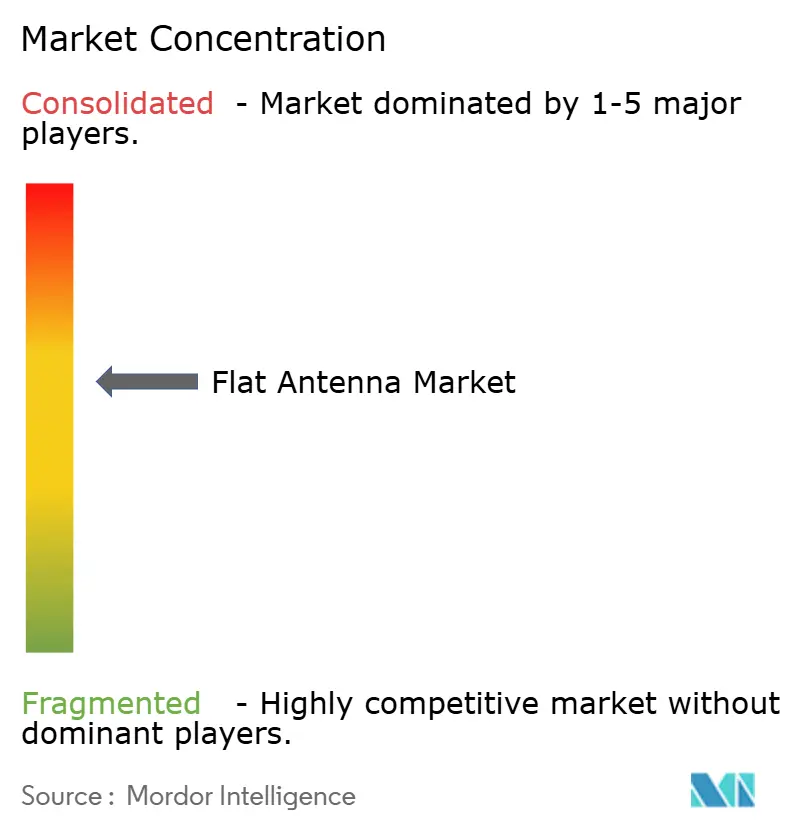
| Market Concentration | Medium |
Major Players *Disclaimer: Major Players sorted in no particular order Image © Mordor Intelligence. Reuse requires attribution under CC BY 4.0. | |
Flat Antenna Market Analysis by Mordor Intelligence
The Flat Antenna Market size was valued at USD 0.72 billion in 2025 and estimated to grow from USD 0.93 billion in 2026 to reach USD 3.38 billion by 2031, at a CAGR of 29.36% during the forecast period (2026-2031).
Intensifying low-earth-orbit (LEO) constellation roll-outs, mounting defense modernization budgets, and airline retrofit programs are steadily shifting preference from parabolic dishes to compact electronically steered panels.[1]Telesat, “Telesat Contracts Intellian to Build Lightspeed User Terminal,” telesat.com Demand is further reinforced by maritime broadband upgrades, remote area connectivity initiatives, and the emergence of eVTOL air-taxi services that require always-on, multi-orbit links. Regulatory clarity on non-geostationary service rules in the United States and Europe also compresses certification timelines and lowers adoption risk for enterprise users. Meanwhile, supply agreements between terminal makers and satellite network operators are locking in production volumes, accelerating economies of scale and reducing unit prices of flat‐panel arrays.[2]Hughes Network Systems, “HL1100W ESA Announcement,” echostar.com
Key Report Takeaways
- By application, Defense and Government led with 37.52% of flat antenna market share in 2025, whereas eVTOL/Urban Air Mobility is set to expand at a 33.44% CAGR to 2031.
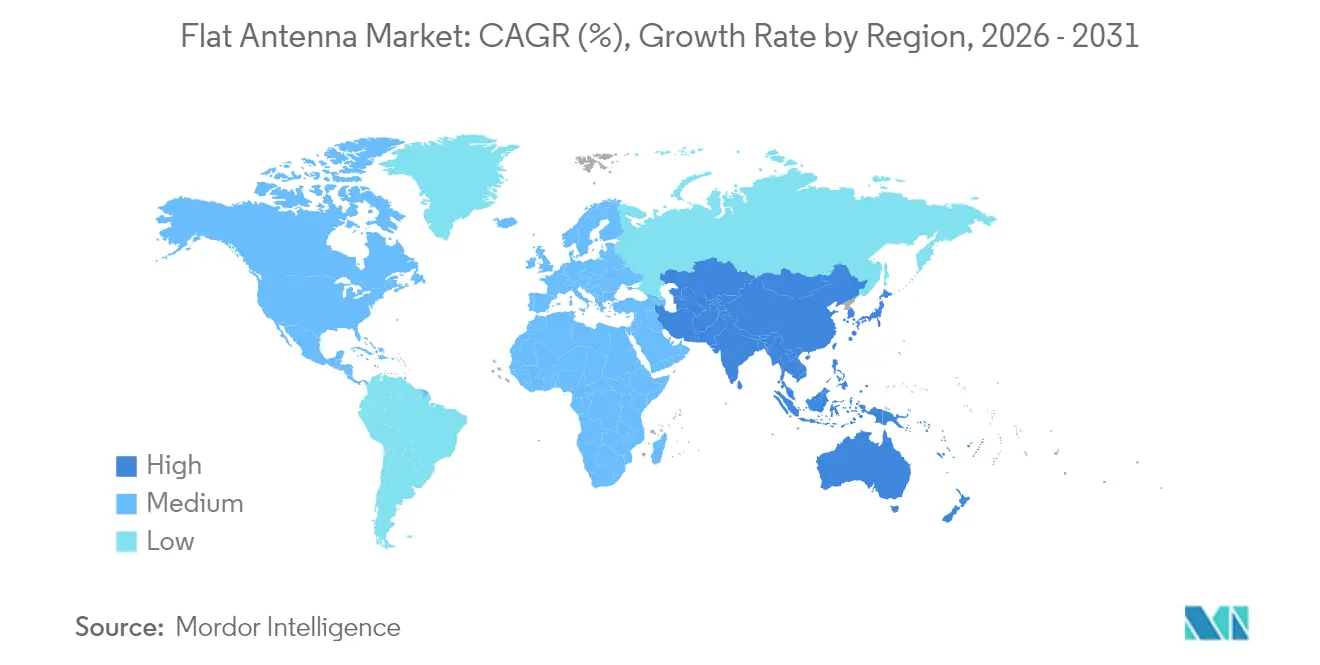
- By region, North America captured 40.55% revenue share in 2025; Asia Pacific is projected to grow at a 31.24% CAGR through 2031.
- By technology, electronically steered phased arrays held 54.30% of the flat antenna market share in 2025, while metamaterial/RIS-based designs are forecast to post a 36.85% CAGR to 2031.
- By frequency band, Ku/Ka systems commanded 45.62% share of the flat antenna market size in 2025; V/EHF solutions are pacing at a 30.58% CAGR to 2031.
- By platform, land-mobile installations accounted for a 33.41% share of the flat antenna market size in 2025, whereas portable/man-pack units are advancing at a 34.92% CAGR through 2031.
Note: Market size and forecast figures in this report are generated using Mordor Intelligence’s proprietary estimation framework, updated with the latest available data and insights as of 2026.
Market Trends and Insights
Drivers Impact Analysis of Flat Antenna Market*
| Driver | ( ~ )% Impact on CAGR Forecast | Geographic Relevance | Impact Timeline |
|---|---|---|---|
| LEO-constellation rollout drives demand for compact user terminals | +8.5% | North America and Europe initially, global thereafter | Medium term (2-4 years) |
| Rising broadband connectivity needs for maritime and remote areas | +6.2% | Asia-Pacific sea lanes and Arctic passages | Long term (≥ 4 years) |
| Commercial aircraft retrofits for IFC upgrades | +4.8% | North America and Europe, expanding to Asia Pacific | Medium term (2-4 years) |
| Unmanned systems adoption in defense and ISR | +3.7% | Tri-regional defense markets | Short term (≤ 2 years) |
| eVTOL and autonomous-vehicle SatCom requirements | +2.9% | Urban centers in major economies | Long term (≥ 4 years) |
| Metamaterial manufacturing cuts cost and weight | +2.1% | Global manufacturing hubs | Medium term (2-4 years) |
| Source: Mordor Intelligence | |||
LEO-Constellation Rollout Drives Demand for Compact User Terminals
- Mega-constellation operators are commissioning hundreds of satellites, forcing ground terminals to support rapid handovers and wide look-angles. Intellian’s Ka-band panel for the Telesat Lightspeed network exemplifies the shift, enabling millisecond beam switching and obsoleting mechanically driven dishes. The flat antenna market benefits because electronically steered arrays shrink size, weight, and maintenance, thereby fitting enterprise rooftops, mobility platforms, and government vehicles. New supply contracts are already scaling annual production into tens of thousands of units, accelerating per-terminal cost declines. Low latency also opens premium use cases such as algorithmic trading and remote industrial control, which further increases addressable revenues. Hughes’ HL1100W single-panel ESA for the OneWeb network demonstrates how operators are racing to certify turnkey terminals for service launch in 2025.
Commercial Aircraft Retrofits for IFC Upgrades
Airlines are pursuing cabin connectivity as a competitive differentiator and are installing flush-mounted flat panels that cut drag and fuel burn compared with radome-topped dishes. Delta Air Lines’ selection of Hughes’ Fusion solution with ThinKom’s Ka2517 unit highlights carrier demand for multi-orbit flexibility across LEO and GEO links. Drag reduction studies show 75-90% lower aerodynamic penalty, translating to significant lifetime fuel savings that offset upfront hardware costs. Regulatory agencies have simplified supplemental type certification, compressing downtime for retrofit installations. Hawaiian Airlines’ Starlink rollout indicates how early adopters are influencing peer carriers to adopt similar architectures. Viasat’s Amara IFC platform adds a dual-beam ESA that dynamically allocates capacity based on route congestion, underscoring the importance of intelligent terminal software in tandem with hardware innovation.[3]Viasat, “Amara IFC Platform Launched,” viasat.com
Unmanned Systems Adoption in Defense and ISR
Modern defense doctrine favors distributed, unmanned assets that require beyond-line-of-sight satellite links. The U.S. Army’s metaferrite conformal antenna research promises ultra-thin panels that blend into airframes while retaining multi-band agility. General Atomics is embedding AESA apertures into its EagleEye radar to double range and cut maintenance, illustrating private-sector adoption of the same architecture. Resilient communications are essential for contested environments, so contracts such as L3Harris’ USD 89.4 million DEUCSI award demonstrate government intent to leverage commercial multipath space internet while retaining encrypted waveforms. Viasat’s Phased Array R&D contract underscores sustained funding for lighter, lower-profile terminals that resist jamming.
eVTOL and Autonomous-Vehicle SatCom Requirements
Electric vertical-takeoff aircraft operate across congested urban corridors where terrestrial links may fail. NASA’s UAM research notes satellite channels as vital backup for command-and-control, and minimalist flat panels satisfy strict weight budgets. Regulatory bodies crafting UAM standards are leaning toward mandatory redundancy, which will lock satellite transceivers into every certified air-taxi. Flat arrays also suit maritime drones and autonomous trucks that venture beyond cellular coverage, expanding total addressable demand. 5G–satellite network slicing is emerging, creating blended connectivity packages that further lift unit volumes. As prototype eVTOL fleets scale commercial service from 2026 onward, repeat purchases of standardized antennas will drive high-margin aftermarket revenue for suppliers.
Restraints Impact Analysis of Flat Antenna Market*
| Restraint | % Impact on CAGR Forecast | Geographic Relevance | Impact Timeline |
|---|---|---|---|
| High R&D and production cost of active phased-arrays | -4.2% | Global, particularly affecting emerging market adoption | Short term (≤ 2 years) |
| Thermal management & RF power-handling limits | -3.1% | Global, especially high-power applications | Medium term (2-4 years) |
| GaN/RF-IC supply-chain choke-points | -2.8% | Global, concentrated impact in Asia Pacific manufacturing | Short term (≤ 2 years) |
| Emerging orbital-debris rules restricting terminal density | -1.9% | Global, with stricter enforcement in developed markets | Long term (≥ 4 years) |
| Source: Mordor Intelligence | |||
High R&D and Production Cost of Active Phased Arrays
Developing a new flat-panel architecture routinely exceeds USD 50 million in non-recurring engineering spend, largely due to expensive gallium nitride power amplifiers that cost 3-5 times more than silicon chips. Specialized clean-room lines and near-field test chambers impose added capital. These economics favor incumbents and elongate payback for start-ups, decelerating new-entrant diversity in the flat antenna market. Component vendors are exploring 3D-printed passive layers and automated pick-and-place to trim labor, while system primes negotiate long-term take-or-pay wafer contracts. As metamaterial designs mature, they may undercut legacy phased arrays by collapsing element count and simplifying bias networks, but wide-band efficiency must first reach parity.
GaN/RF-IC Supply-Chain Choke-Points
China controls 98% of primary gallium extraction, and its 2024 export license regime introduced real risk to North American and European fab flows. Spot shortages have already stretched lead times past 40 weeks for some high-power monolithic microwave ICs, raising working-capital requirements for antenna OEMs. Intel’s accelerated foundry build-out and allied government subsidies aim to localize wide-bandgap transistor supply. In parallel, research groups are pushing silicon carbide and high-k dielectric substitutes for lower power nodes, reserving scarce GaN only for mission-critical amplifiers. Diversification will take several years, holding near-term production risk and restraining the flat antenna market CAGR.
*Our forecasts treat driver/restraint impacts as directional, not additive. The impact forecasts reflect baseline growth, mix effects, and variable interactions.
Flat Antenna Market Segment Analysis
By Application:
Defense Drives Current Demand While eVTOL Shapes Future GrowthDefense and Government represented 37.52% of the flat antenna market share in 2025 due to multiband tactical terminals and unmanned vehicle roll-outs that command premium pricing. Commercial airlines rank second on the back of rising in-flight connectivity retrofits. Ship operators continue adopting hybrid GEO-LEO packages to improve crew welfare and cargo tracking. In value terms, the application segment contributed the largest portion of the flat antenna market size, and is expected to retain primacy until 2027 as NATO members refresh satcom inventories.
The eVTOL/Urban Air Mobility category is projected to register a 33.44% CAGR, the highest within applications, as regulatory corridors open after 2026. City-pair operators will require small, lightweight, multi-orbit panels that integrate with avionics without compromising battery payload. Concurrently, consumer broadband terminals will leverage falling hardware prices to penetrate underserved rural territories. Emergency-response agencies are also adding man-portable kits to restore connectivity during disasters, widening the customer base for the flat antenna market.




By Frequency Band:
Ku/Ka Dominance Faces V/EHF InnovationKu/Ka solutions held 45.62% share of the flat antenna market size in 2025 because of robust satellite capacity and long-standing regulatory allocations. Rain-fade resilience at Ku-band suits maritime use, while Ka-band’s higher throughput supports video, cloud, and VPN backhaul. X-band remains a defense preserve for secure links and radar fusion.
The V-/EHF-band slice is set to grow at a 30.58% CAGR as militaries move toward low-probability-of-intercept waveforms and commercial constellations target sub-TeraHertz capacity. Hardware challenges such as tighter phase tolerance and higher path loss are spurring innovations in thermal substrates and meta-lens gain structures. Multi-band antennas that switch between K, Ku, and Ka within a single aperture are gaining traction, promising fleet operators flexibility without hardware swap-outs.
By Platform:
Land-Mobile Leadership Challenged by Portable InnovationLand-mobile vehicles, including trucks, emergency response vans, and defense armored carriers, accounted for 33.41% of the flat antenna market share in 2025, retaining leadership through proven reliability and well-defined installation standards. Ground fixed stations, though stationary, continue serving enterprises requiring high uptime, especially in the energy sector.
Portable/man-pack kits are forecast to expand at a 34.92% CAGR, spurred by soldier modernization and disaster-relief agencies that prize rapid deployment and battery efficiency. Advances in low-power beamforming ASICs and carbon-fiber chassis reduce carry weight below 4 kg, opening dual-use markets for journalists and remote mining crews. Airborne and maritime platforms strengthen baseline growth as hybrid GEO-LEO subscriptions improve coverage continuity.

By Antenna Technology:
ESA Dominance Faces Metamaterial DisruptionElectronically steered phased arrays controlled 54.30% of flat antenna market share in 2025, underpinned by proven reliability on almost 1,550 commercial aircraft and millions of maritime streaming hours. Solid-state switching delivers millisecond beam agility needed for LEO satellites while removing moving parts that historically drove maintenance spend. Hybrid electromechanical approaches persist for cost-sensitive land terminals, blending coarse mechanical azimuth with fine electronic elevation control to keep the bill of materials low.
Metamaterial and reconfigurable intelligent surface (RIS) architectures are on course for a 36.85% CAGR to 2031, potentially slashing element counts by embedding phase gradients in passive surfaces. Early prototypes fabricated by additive manufacturing have halved weight relative to classic ESAs, encouraging aerospace primes to fund pilot lines. Should large-scale printing reach six-sigma yield, metamaterials could reset flat antenna market cost curves and hasten mass adoption in consumer electronics.
Geography Analysis
North America Flat Antenna Market
North America captured 40.55% of flat antenna market share in 2025 following early LEO constellation deployments by SpaceX and OneWeb, a high concentration of defense projects, and aggressive airline connectivity upgrades. The U.S. Federal Communications Commission has issued streamlined non-geostationary licensing rules, lowering administrative barriers for terminal certification while extending spectrum sharing rights that protect incumbent services. Canada’s export-control liberalization is also enabling cross-border supply-chain integration, accelerating joint development programs.
APAC Flat Antenna Market
Asia Pacific is projected to generate the fastest regional CAGR of 31.24% to 2031 as governments in Japan, South Korea, and Australia allocate budget for sovereign space assets and satellite broadband programs. Chinese vendors have achieved export-class safety certifications on Ku-band panels, opening Southeast-Asian maritime markets. Seoul’s Electronics and Telecommunications Research Institute is trialing low-profile Ku antennas for high-speed rail, signaling diversification beyond defense. Rapidly expanding e-commerce and telemedicine in remote islands create incremental demand for enterprise VSAT, reinforcing the growth trajectory of the flat antenna market.
EMEA Flat Antenna Market
Europe remains a stable growth arena where ESA technology permeates commercial aviation, cruise shipping, and governmental networks. SES’s planned USD 3.1 billion takeover of Intelsat will consolidate multi-orbit capacity, pairing the merged fleet with in-house terminal roadmaps to protect margins. National defense agencies, led by the Netherlands and France, are channeling procurement toward low observable flat arrays that integrate with next-generation combat aircraft. Middle East and Africa show nascent but accelerating orders, especially from offshore energy rigs and humanitarian agencies that require resilient links during crises.

Regulatory Landscape
Regulation for flat antennas centers on spectrum access, interference protection, and equipment compliance for NGSO and multi-orbit satcom across mobility and fixed use cases. In the United States, the Federal Communications Commission (FCC) continues to update satellite broadband rules under 47 CFR Part 25 and, in May 2026, adopted an order shifting from an EPFD-based approach toward performance-based GSO protection criteria, which affects how flat-panel terminals and networks demonstrate coexistence in Ku/Ka deployments.
In Europe, equipment conformity pathways are supported by ETSI harmonised standards used in radio equipment compliance, while national measures are emerging for new service models. The UK introduced the Wireless Telegraphy (Direct to Device Satellite Communications) (Exemption) Regulations 2026, in force from February 25, 2026, exempting certain direct-to-device apparatus from licensing when specified technical conditions are met. Separately, the FCC also placed a space-licensing overhaul (SB Docket No. 25-306) on its July 22, 2026 open meeting agenda, proposing a move from Part 25 to a new Part 100 framework, keeping regulatory timelines and filing requirements in focus for terminal OEMs and service providers.
Value Chain Analysis
The flat antenna value chain starts with RF and semiconductor inputs (GaN power devices, RFICs/beamforming ICs, phase shifters, and thermal materials), then moves through substrate and panel fabrication (including advanced glass, ceramics, and composite structures). The process continues with antenna module build, calibration, and test in near-field/OTA chambers, while final integration typically occurs at terminal OEMs that combine the panel with modems, power, and software. Distribution follows through satellite operators and service providers that bundle capacity and service-level agreements for aviation, maritime, land-mobile, and defense customers.
Manufacturing scale-up increasingly depends on partnerships between antenna innovators and high-volume industrial producers or EMS partners to improve yields and automate assembly. An example is the February 2026 master supply agreement between Kymeta and Japan Display Inc. (JDI) to develop a next-generation multi-band metasurface aperture for concurrent Ku and Ka operation, pairing JDI's TFT glass substrate manufacturing with Kymeta's metasurface antenna technology. On the component-to-panel path, Sivers Semiconductors and Doosan Corporation established a development partnership in November 2025 focused on scalable Ka-band ESA panels using Sivers beamforming ICs, alongside Doosan-led manufacturing and testing, highlighting how BFIC availability, test capacity, and qualified manufacturing lines have become gating factors for delivery timelines.
Competitive Landscape
The supplier base comprises a mix of vertically integrated satellite operators, established aerospace primes, and venture-backed specialists. Market power is notably concentrated in firms able to deliver antenna hardware bundled with capacity and service-level agreements, creating sticky customer lock-ins. ThinKom’s VICTS architecture has accumulated more than 17 million flight hours, earning de-risking credentials that airlines value. Viasat, meanwhile, leverages the installed base of Inmarsat to cross-sell its newly launched Aera ESA through a multi-orbit service wrapper, a tactic that widens switching costs for end users.
Acquisition strategy underpins the race for RF talent and patent portfolios. Honeywell’s USD 1.9 billion purchase of CAES injects heritage microwave engineering into its defense division, providing a springboard for next-gen AESA airborne radomes. L3Harris continues to pick up small fabless designers to shore up DEUCSI program deliverables, aiming for interoperability between commercial LEO providers and classified networks. On the innovation flank, Hanwha Phasor and Kymeta pursue metamaterial and liquid-crystal polymer substrates to outflank cost curves, attracting airline trials that could unlock high-volume production if performance holds.
For now, supply-chain constraints around GaN wafers and test equipment temper aggressive expansion plans, nudging vendors toward collaborative sourcing consortia. The Federal Communications Commission’s 2024 technical filing rules that mandate detailed beam contours and debris mitigation add compliance overhead, which entrenches seasoned incumbents. Nonetheless, the impending commercialization of eVTOL platforms presents a white-space opening where nimble entrants can win design-ins before certification hardens around legacy players, preserving healthy competitive tension within the flat antenna market.
Flat Antenna Industry Leaders
Cobham plc
Kymeta Corporation
Airbus SE
Honeywell International Inc.
L3Harris Technologies
- *Disclaimer: Major Players sorted in no particular order
Flat Antenna Market Companies Covered in this Report
- Kymeta Corporation
- Cobham (Chelton)
- Intellian Technologies
- ThinKom Solutions
- L3Harris Technologies
- Honeywell International
- Airbus SE
- General Dynamics Mission Systems
- Phasor (Hanwha Systems)
- Ball Aerospace
- Viasat Inc.
- SES S.A. (SES Techcom)
- Anokiwave Inc.
- China Starwin
- All.Space (Isotropic Systems)
- Hughes Network Systems
- SatixFy Communications
- C-COM Satellite Systems
- Gilat Satellite Networks
- ArrayComm LLC
- Mars Antenna and RF Systems
- MacDonald, Dettwiler and Associates (MDA)
- Mitsubishi Electric

Market Opportunities and Future Outlook
Near-term whitespace is most visible where end users need multi-orbit resilience without the drag and maintenance penalties of mechanically tracked antennas. Airline connectivity programs and business aviation upgrades are formalizing ESA adoption through certification and modular install pathways, including EASA certification in May 2026 for Gogo Galileo FDX on Airbus ACJ320/320neo aircraft using an electronically steerable flat antenna. Airframe-level approval lowers friction for line-fit and retrofit offerings that use flat panels as the primary radome alternative.
Product and manufacturing roadmaps are also expanding opportunity beyond single-band terminals toward multi-band, multi-beam panels and higher-frequency architectures. Kymeta and JDI's February 2026 agreement to develop a Ku/Ka multi-band metasurface aperture points to efforts to industrialize advanced flat-panel structures using established substrate manufacturing, supporting scaling unit volumes across mobility platforms. In parallel, progress in beamforming and integration is opening new addressable segments, including 2026 academic and applied research on D-band phased-array antenna-in-package modules and photonic true-time-delay multi-beamforming approaches, which support compact, fast-steering antennas for multi-beam satcom and emerging 6G-adjacent backhaul and terminal designs.
Recent Industry Developments in Flat Antenna Market
- May 2026: Airbus received EASA certification for the Gogo Galileo FDX in-flight connectivity solution on ACJ320/320neo aircraft using an electronically steerable flat antenna. Certification supports certified installation pathways for business aviation operators and enables broader adoption of low-profile ESAs in aircraft connectivity upgrades.
- April 2026: Kymeta won a three-year Office of Naval Research development contract to advance multi-band, multi-beam antenna architecture, including concurrent full-duplex beams in Ku and Ka bands. The award strengthens defense-funded R&D into multi-orbit-capable flat panels and accelerates maturation of architectures relevant to contested and mobile environments.
- September 2024: Viasat secured a USD 33.6 million US Air Force contract to develop AESA terminals for tactical aircraft. The program reinforces sustained government demand for low-profile, electronically steered apertures that can be integrated into airborne platforms with stringent SWaP and survivability requirements.


Flat Antenna Market Report Scope and Research Methodology
Market Definition and Coverage
For this methodology, the flat antenna market covers low-profile, flat or near-flat antenna hardware used to transmit and receive RF signals, mainly for satellite and high-capacity terrestrial links in fixed and mobility use cases.
Scope exclusions: We exclude traditional parabolic dishes, thicker conventional antenna structures that are not flat-form, and stand-alone RF components that are not sold as antennas.
Segments Covered in This Report
- By Application
- Aerospace
- Defense and Government
- Commercial Aviation
- Maritime
- Land Mobile / 5G Backhaul
- Consumer Broadband and Others
- By Frequency Band
- Ku-Band
- Ka-Band
- K/u//Ka Multi-band
- X-Band
- V-/EHF-Band
- By Platform
- Ground Fixed Stations
- Land-Mobile (Vehicular)
- Airborne
- Maritime and Offshore
- Portable / Man-pack
- By Antenna Technology
- Electronically-Steered Phased Array (ESA)
- Hybrid Electronically/Mechanically Steered
- Mechanically Steered Flat Panel
- Metamaterial / RIS-based
- By Geography
- North America
- United States
- Canada
- Mexico
- South America
- Brazil
- Argentina
- Rest of South America
- Europe
- United Kingdom
- Germany
- France
- Rest of Europe
- Asia Pacific
- China
- Japan
- India
- South Korea
- Rest of Asia Pacific
- Middle East and Africa
- United Arab Emirates
- Saudi Arabia
- South Africa
- Rest of Middle East and Africa
- North America
Data Sources, Market Sizing, and Validation
Desk Research
Desk research starts by mapping the demand pool and supply signals that can be checked in public information. We referenced sources such as the International Telecommunication Union (ITU) for spectrum context, FCC filings and licensing databases for satellite and earth-station activity, and NASA and other public space program releases for launch and mission cadence that influences terminal adoption.
To anchor the model with real market activity, we also reviewed trade and customs statistics for relevant RF and antenna shipments, standards and technical publications (including IEEE papers) to track technology shifts like electronically steered arrays, and public defense procurement notices where mobility terminals are specified. Company filings, investor decks, and reputable press were used to confirm price direction and product availability, while a paid subscription database for company financials and a patent database were used selectively to cross-check revenues and innovation intensity. These examples are not exhaustive, and other public sources were also used for data collection, validation, and clarification.
Primary Interviews and Surveys
Primary work was used to pressure-test desk assumptions that usually drive the largest sizing errors, especially what is counted as a flat antenna versus a complete terminal, and how fast pricing changes with volume. We spoke with a mix of component suppliers, terminal and system integrators, distributors, and buyers across mobility, government, and enterprise connectivity, and we balanced inputs across APAC, EMEA, and the Americas to reduce a single-region bias.
Distribution of primary research fieldwork respondents
| Company type | Respondent position | Region |
|---|---|---|
| Top tier: 28% | CXOs: 16% | APAC: 46% |
| Mid tier: 50% | Functional/Unit leaders: 28% | EMEA: 30% |
| Smaller Players: 22% | Managers: 56% | Americas: 24% |
Market-Sizing & Forecasting
The sizing logic starts with a top-down demand reconstruction. We build the addressable install base for key use cases like mobility SATCOM terminals and high-throughput fixed links, then apply adoption and replacement rates based on market observations. After the frame is built, we use selective bottom-up checks to keep totals grounded, including sampled shipment-to-revenue conversions and channel checks on average selling prices for flat-form terminals.
Inputs that mattered most include satellite connectivity adoption in maritime and aeronautics, defense and government terminal procurement activity, the mix shift toward electronically steered antennas, band migration signals (Ku and Ka trends), and the observed pricing progression as volumes scale. Where bottom-up visibility is patchy, we avoid forcing a full supplier roll-up and instead bracket totals using multiple independent indicators, then reconcile to the final value through stepwise adjustments.
For forecasting, scenario analysis is used with a set of drivers agreed during expert calls, mainly volume ramp expectations, mobility penetration, and the pace of cost reduction. This keeps the forecast explainable and makes it easier to revise assumptions when adoption accelerates or slows.
Data Validation & Update Cycle
Validation is done by checking whether the modeled market value behaves like the real-world signals it should track, such as terminal shipment momentum, program wins, and visible pricing movement. Outliers are flagged, assumptions are revisited, and sensitive variables are re-tested before final numbers are signed off through a multi-step internal review.
The report is refreshed annually, with interim updates when material events shift the demand curve, such as major deployment announcements or step-changes in pricing. Before delivery, a final review pass is completed so clients receive an updated view that reflects the latest available public data and recent interview learnings.
Mordor Intelligence's Flat Antenna Market Size Versus Other Published Estimates
Published market sizes for flat antennas can vary because the boundary between an antenna, a terminal, and a full connectivity kit is not always treated the same way. Differences also come from the base year selected, the way pricing is projected as volumes scale, and whether mobility use cases are counted as separate or bundled demand.
By tracking shipment signals, adoption by key mobility platforms, and ASP movement through refresh checks, Mordor Intelligence keeps the counted revenue tied to flat-form antenna hardware and terminal-level demand rather than adjacent connectivity services or unrelated RF components.
Benchmark comparison
| Source | Market Size | Gaps in Research Methodology |
|---|---|---|
| Mordor Intelligence | USD 0.93 B (2026) | |
| Industry Publisher A | USD 0.82 B (2026) | Uses a slower price decline assumption for electronically steered designs and applies more conservative mobility penetration, which compresses near-term value even if unit growth is similar. |
| Industry Publisher B | USD 0.70 B (2025) | Anchors on a prior base year and appears to emphasize antenna hardware only, with narrower inclusion of integrated terminal revenue and fewer cross-checks against mobility and government demand signals. |
The spread in estimates is mostly explained by what each model counts in-scope and how quickly pricing is expected to normalize as shipments rise. Our approach keeps the market number traceable to clear adoption drivers, observed pricing behavior, and a repeatable set of checks that can be revisited during each update cycle.


Key Questions Answered in the Report
What is the current size of the Flat Antenna Market?
The Flat Antenna Market size stood at USD 0.93 billion in 2026 and is forecast to hit USD 3.38 billion by 2031.
Which application dominates flat-panel demand today?
Defense and Government holds the largest share at 37.52% owing to robust funding for multi-band, unmanned, and tactical communication programs.
Which region will grow the fastest through 2031?
Asia Pacific is projected to clock a 31.24% CAGR due to expanding satellite infrastructure and government-backed broadband initiatives.
Why are airlines adopting flat antennas for IFC?
Electronically steered arrays reduce aerodynamic drag by up to 90%, cut fuel burn, and enable multi-orbit switching for consistent passenger connectivity.
How will metamaterial antennas impact the market?
Metamaterial designs could lower weight and production cost, driving a 36.85% CAGR for the segment and potentially broadening consumer device adoption.
What supply-chain risks could slow growth?
Dependence on gallium nitride wafers and thermal management challenges may constrain production capacity in the short term, tempering the overall CAGR.
Page last updated on:


 Your data is secure and never sold or shared.


