
Antenna, Transducer, And Radome Market Size and Share
Market Overview
| Study Period | 2019 - 2030 |
|---|---|
| Market Size (2025) | USD 16.03 Billion |
| Market Size (2030) | USD 23.21 Billion |
| Growth Rate (2025 - 2030) | 7.68 % |
| Fastest Growing Market | Asia Pacific |
| Largest Market | North America |
| Market Concentration | Medium |
Major Players *Disclaimer: Major Players sorted in no particular order Image © Mordor Intelligence. Reuse requires attribution under CC BY 4.0. | |

Antenna, Transducer, And Radome Market Analysis by Mordor Intelligence
The antenna, transducer, and radome market size is valued at USD 16.03 billion in 2025 and is projected to reach USD 23.21 billion by 2030, advancing at a 7.68% CAGR over the forecast period. Demand scales with military modernization budgets, a surge in low-Earth-orbit (LEO) satellite constellations, and additive-manufacturing techniques that compress production lead-times while enabling complex geometries. Active electronically-scanned array (AESA) radars now migrate from high-end fighters to tactical unmanned platforms, spurring the need for radomes that survive higher power densities without compromising signal integrity.[1]Source: —, “General Atomics unveils new AESA radar for Gray Eagle 25M,” DEFENSENEWS.COM Ground-based air-defense networks stimulate procurement of multi-band antennas protected by lightweight composites optimized for rapid deployment. Meanwhile, 5G millimeter-wave (mmWave) backhaul and satcom gateways lure commercial buyers, encouraging dual-use designs that straddle defense and telecommunications segments. Supply chain pressure on ceramic dielectrics and aerospace-grade resins triggers vertical-integration strategies as firms seek to secure critical materials and capture greater value.
Key Report Takeaways
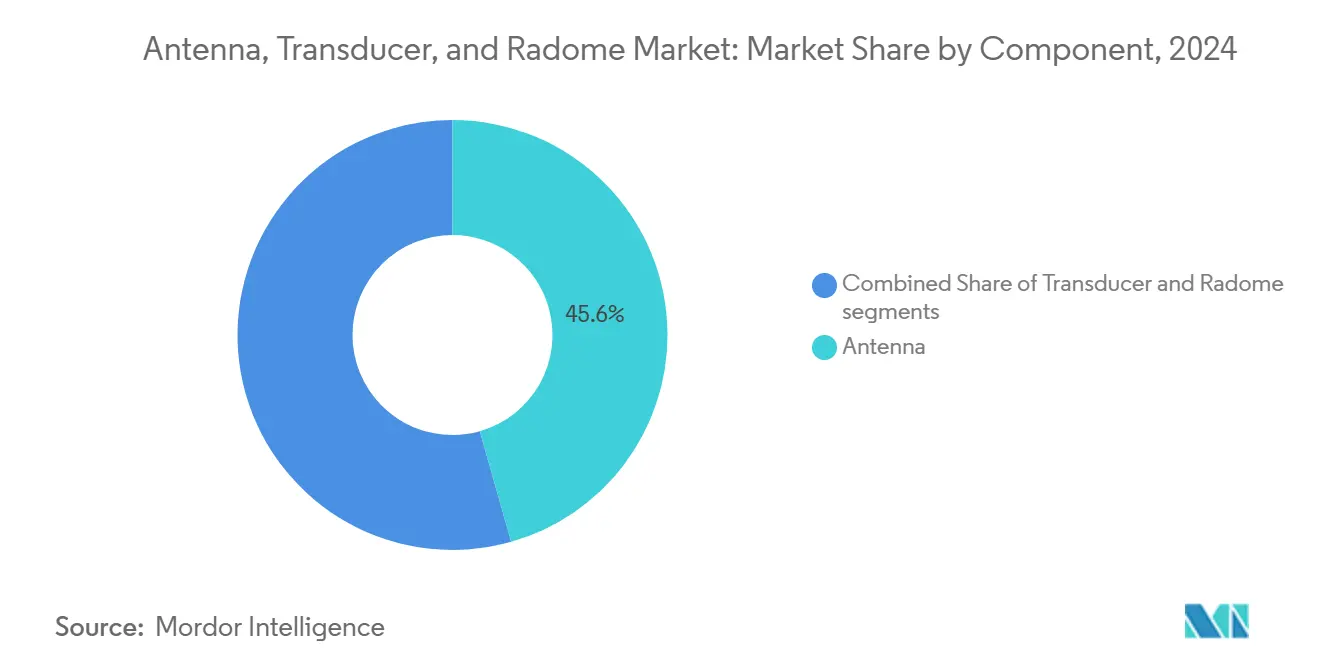
- By component, antennas led with 45.60% revenue share in 2024 and are expanding at an 8.90% CAGR through 2030.
- By platform, airborne systems commanded 40.52% of the antenna, transducer, and radome market share in 2024, while ground-based platforms are projected to grow at an 8.65% CAGR to 2030.
- By frequency band, C/X-band held 30.45% share of the antenna, transducer, and radome market size in 2024; HF/VHF/UHF frequencies are advancing at an 8.01% CAGR through 2030.
- By application, defense accounted for a 67.80% share of the antenna, transducer, and radome market size in 2024, and commercial usage is progressing at an 8.70% CAGR to 2030.
- By geography, North America captured 36.78% of 2024 sales, whereas Asia-Pacific is forecasted to record a 9.65% CAGR between 2025 and 2030.
Market Trends and Insights
Drivers Impact Analysis of Antenna, Transducer, And Radome Market*
| Driver | (~)% Impact on CAGR Forecast | Geographic Relevance | Impact Timeline |
|---|---|---|---|
| Proliferation of active electronically-scanned array (AESA) radars | +1.8% | Global, concentrated in North America and APAC | Medium term (2-4 years) |
| Rapid satellite-constellation deployment for LEO communications | +1.5% | Global, led by North America with APAC expansion | Long term (≥ 4 years) |
| Growth in unmanned aerial vehicle (UAV) fleet size for ISR | +1.2% | Global, strongest in North America and Europe | Short term (≤ 2 years) |
| 3D printed composite radomes cutting lead-time and costs | +0.9% | North America and Europe, expanding to APAC | Medium term (2-4 years) |
| Military modernization budgets across NATO and APAC | +1.4% | NATO countries and APAC core markets | Long term (≥ 4 years) |
| Emerging mmWave 5G/B5G backhaul and ground-station demand | +0.8% | Global, urban centers first | Short term (≤ 2 years) |
| Source: Mordor Intelligence | |||
Proliferation of active electronically-scanned array radars
AESA technology now equips airborne, naval, and ground platforms that once relied on mechanically scanned arrays, enabling simultaneous surveillance, target tracking, and communications. The move toward distributed aperture systems raises power-density thresholds that conventional fiberglass radomes cannot handle, pushing demand for advanced ceramics and metamaterial skins able to maintain phase stability across wide angles of incidence. The US upgrades Patriot air-defense radar under a USD 736 million LTAMDS contract, while South Korea’s KF-21 integrates indigenous AESA modules, illustrating the technology’s geographic diffusion. Modular radome designs that accommodate slide-in antenna panels speed maintenance cycles and lower life-cycle costs. Suppliers that master multi-layer dielectric matching enjoy a first-mover advantage as navies and armies accelerate procurement schedules to counter hypersonic and low-observable threats.
Rapid satellite-constellation deployment for LEO communications
Mega-constellations such as Amazon’s Project Kuiper, OneWeb Gen-2, and China’s Guowang propel a build-out of multi-orbit ground terminals that rely on electronically steerable antennas housed inside low-profile radomes.[2]Source: —, “Amazon Kuiper satellites launch preparations,” SPACENEWS.COM Operators favor COTS architectures that switch beams across Ku, Ka, and V-bands within milliseconds, heightening dielectric-constant and thermal-cycling requirements. Regional broadband initiatives in Europe and South America mimic these deployments, diversifying demand beyond US programs. Dual-use satcom terminals that satisfy military hardening and commercial throughput standards gain traction, especially where defense ministries seek assured connectivity via commercial assets. Consequently, specialty material suppliers secure long-term contracts for quartz-based laminates that deliver stable permittivity across -55 °C to +85 °C.
Growth in unmanned aerial vehicle fleet size for ISR
Defense ministries and border-security agencies enlarge UAV fleets to expand persistent intelligence, surveillance, and reconnaissance (ISR). The US Army’s Gray Eagle 25M upgrade packs multi-mode radars and SATCOM links beneath streamlined nose radomes, increasing aperture density without compromising aerodynamic drag. European NATO members deploy medium-altitude long-endurance (MALE) drones with beyond-line-of-sight (BLOS) data relays encased in lightweight composite shells that resist hail and sand erosion. Counter-UAS systems also multiply, demanding ground and shipboard radomes that house electronically scanned arrays optimized for agile beamforming. Commercial drone services for precision agriculture and energy-infrastructure inspection fuel uptake, although cost-sensitive buyers favor thermoplastic skins over high-cost ceramics. Suppliers capable of balancing weight, cost, and environmental survivability gain competitive leverage.
3D printed composite radomes cutting lead-time and costs
Additive manufacturing reduces design-to-product cycles from months to weeks by enabling complex lattice geometries that tailor dielectric gradients within a single print run.[3]Source: —, “Automated Fiber Placement Advances,” COMPOSITESMANUFACTURINGMAGAZINE.COM Multi-material printers embed resistive heaters and conductive meshes during fabrication, eliminating secondary bonding steps and lowering scrap rates. This democratizes access to advanced radome designs for mid-tier defense contractors and commercial satellite providers. Fielded examples include conformal wingtip radomes printed via automated fiber placement that integrate lightning-strike protection directly into the laminate. While certification frameworks evolve, early adopters benefit from weight reductions of up to 18% and cost savings nearing 25% versus autoclave-cured lay-ups, widening the technology gap with legacy suppliers.
Restraints Impact Analysis of Antenna, Transducer, And Radome Market*
| Restraint | (~)% Impact on CAGR Forecast | Geographic Relevance | Impact Timeline |
|---|---|---|---|
| Brittleness of high-frequency ceramic materials raising failure rates | -0.7% | Global, critical in harsh environments | Short term (≤ 2 years) |
| Export-control and ITAR barriers limiting global supply chains | -1.1% | Global, strongest impact on non-allied nations | Long term (≥ 4 years) |
| Slow qualification cycles for next-gen airborne radomes | -0.8% | Global, concentrated in aviation markets | Medium term (2-4 years) |
| Volatility in aerospace-grade resin prices | -0.6% | Global, supply chain dependent | Short term (≤ 2 years) |
| Source: Mordor Intelligence | |||
Export-control and ITAR barriers limiting global supply chains
Expanded US export-control lists now cover advanced composite lay-up processes and metamaterial formulations previously considered commercial, amplifying compliance overhead for multi-national programs. Nations outside traditional alliances face procurement delays, prompting indigenous material-science initiatives in India, Brazil, and the UAE. China’s export restrictions on gallium and germanium further complicate sourcing for high-frequency ceramic substrates. Tier-2 suppliers, unable to shoulder the audit burden, cede market share to vertically integrated primes that maintain in-house compliance teams. The resulting supply-chain bifurcation slows technology diffusion and increases transaction costs across non-aligned regions.
Slow qualification cycles for next-gen airborne radomes
Regulatory bodies continue tightening electromagnetic-compatibility thresholds under evolving RTCA DO-160 and FAA Advisory Circulars, extending test campaigns for each new radome-antenna configuration. Concurrent military standards diverge from civil requirements, forcing dual-certification paths that double documentation and test-article builds. Environmental qualification covering bird-strike resistance, hail impact, and lightning attachment is especially stringent for wide-body airliners and rotorcraft. Lead times lengthen when test-house capacity is constrained, hindering the rapid insertion of additive-manufactured parts. Smaller firms often lack the capital to sustain multi-year certification cycles, pushing them toward niche aftermarket segments rather than prime-program pursuits.
*Our forecasts treat driver/restraint impacts as directional, not additive. The impact forecasts reflect baseline growth, mix effects, and variable interactions.
Antenna, Transducer, And Radome Market Segment Analysis
By Component:
Dominance of multifunctional antennasIn 2024, antennas captured 45.60% of revenue, reflecting elevated demand for arrays that consolidate communications, radar, and electronic warfare (EW) roles within shared apertures. This segment's antenna, transducer, and radome market size is forecasted to grow at an 8.90% CAGR, buoyed by defense modernization budgets emphasizing spectrum agility. AESA front-ends increasingly pair with digital beamforming modules, forcing closer mechanical and electromagnetic coupling with radomes to minimize mismatch loss. While the most minor revenue contributor, transducers remain indispensable for sonar and acoustic positioning in naval and oil-and-gas operations. Radomes themselves evolve into active subsystems, embedding phase-compensation layers and thermal-management circuits that transform them from passive covers into functional components. Overall, convergence blurs traditional lines, prompting suppliers to bundle antenna, transducer, and radome expertise in integrated proposals that reduce platform-level weight and cost.
R&D funds are increasingly funneling toward metamaterial and plasma-spray coatings that adaptively tune dielectric properties in response to frequency-hopping waveforms. As 3D-printing matures, small-batch customization becomes viable, allowing battlefield commanders to re-role sensors with minimal logistics. Antenna specialists collaborate with composite fabricators to validate co-curing techniques that embed coaxial feeds during lay-up, eliminating connectors that historically introduced failure points. Consequently, the antenna, transducer, and radome market experiences a technology-pull cycle, where platform designers demand holistic solutions instead of discrete parts.



By Platform:
Ground systems accelerate modernizationAirborne platforms held 40.52% share in 2024, underpinned by fleet upgrades across combat aircraft, airborne early-warning assets, and commercial jets outfitted for broadband Wi-Fi. The antenna, transducer, and radome market share may dilute slightly as ground-based systems log the fastest expansion at 8.65% CAGR through 2030. Nations deploying layered air-defense networks require relocatable radar units protected by composite radomes that limit backscattered sidelobes under electronic attack. NATO’s theater missile-defense roadmap and Asia-Pacific counter-hypersonic initiatives anchor multi-year procurement budgets, giving suppliers revenue visibility.
Though smaller in dollar terms, Naval installations demand ruggedized radomes that withstand salt-spray corrosion and high-velocity impacts from green water over deck. Conformal topside arrays integrated into ship superstructures illustrate growing emphasis on stealth signatures. Meanwhile, mobile land vehicles adopt retractable SATCOM domes that must operate reliably despite vibration and dust infiltration. As multi-domain command-and-control (C2) frameworks mature, platform-specific distinctions blur; ground and maritime nodes increasingly share standard aperture designs scaled for size, weight, and power envelopes, allowing manufacturers to amortize research outlays across larger addressable volumes.
By Frequency Band:
Resurgent low-frequency demandC/X-band remained dominant with 30.45% of 2024 revenue due to legacy air-defense radars and GEO satcom links. Yet HF/VHF/UHF slices are projected to post the highest 8.01% CAGR as militaries revive low-frequency communications for beyond-line-of-sight resilience against jamming. The antenna, transducer, and radome market size for HF-centric systems benefits from doctrinal shifts that favor expeditionary mesh networks capable of penetrating dense foliage and urban canyons. Design challenges revolve around accommodating electrically large apertures without inflating radome drag or radar cross-section.
Ku/Ka-band solutions target high-throughput satcom, where small-form-factor user terminals require aerodynamic, radially symmetric covers to minimize pointing loss during aircraft maneuvers. Emerging 5G infrastructure stretches upward into mmWave E-band, introducing thermal-management issues as power-amplifier densities rise. Suppliers that master multi-band dielectric grading gain a strategic advantage, enabling single radome SKUs that function from VHF through Ka-band when paired with frequency-selective surfaces. Continued spectrum auctions and civilian broadband initiatives expand the customer base, de-risking defense budget cycles.

By Application:
Commercial momentum buildsDefense end-users drove 67.80% of 2024 spending, but commercial programs are set to grow 8.70% annually as telecom operators, airlines, and space startups converge on high-bandwidth connectivity markets. mmWave 5G small cells mount on lamp posts and rooftops, using radome-shielded phased arrays that must tolerate ultraviolet exposure and urban pollution without detuning. The allocation of antenna, transducer, and radome market size steadily tilts toward these civil deployments, especially where public-private partnerships subsidize rural broadband.
Cross-pollination of defense-grade reliability into commercial offerings accelerates product cycles; for example, metamaterial-based electronic beam steering born in ballistic-missile defense now appears in cruise-line Wi-Fi domes. Startups leverage cloud-native design tools to iterate and certify kits for unmanned aerial logistics networks rapidly. Consequently, suppliers diversify revenue streams, balancing regulated defense schedules with faster-moving commercial bids, and mitigating exposure to budget sequesters.
Geography Analysis
North America Antenna, Transducer, And Radome Market
North America led with a 36.78% revenue share in 2024, backed by the Pentagon’s USD 842 billion budget and multi-billion-dollar Patriot radar refresh programs that embed AESA arrays within thermally managed composite domes. Silicon Valley’s satellite-internet ventures supplement defense demand, while Canadian Arctic surveillance and Mexican aero-structures manufacturing broaden regional depth. Federal pressure to onshore critical material supply chains propels investments in ceramic powder sintering and quartz-fiber weaving facilities, reinforcing domestic control over high-frequency substrates.
APAC Antenna, Transducer, And Radome Market
Asia-Pacific exhibits the fastest 9.65% CAGR, driven by Japan’s record JPY 8.9 trillion (USD 60 billion) military budget, South Korea’s KF-21 fighter program, and China’s expanding LEO broadband architecture. Australia’s nuclear-powered submarine roadmap and India’s private-sector space policies further elevate regional opportunity. While export-control restrictions constrain Western vendors in sensitive Chinese programs, indigenous champions scale composite-fabrication capacity, fostering local ecosystems. Suppliers skilled in technology-transfer partnerships and offset agreements stand to capture incremental share as governments mandate domestic industrial participation.
Europe Antenna, Transducer, And Radome Market
Europe maintains moderate growth, supported by NATO radar modernization and a mature aerospace supply base across France, Germany, Italy, and the United Kingdom. Sovereignty initiatives push for EU-origin satcom terminals and airborne early-warning sensors, buffering regional firms against dollar-denominated currency swings. Eastern European nations accelerate air-defense procurements in response to ongoing security concerns, opening refurbishment and upgrade niches for second-tier integrators.
MEA and South America Antenna, Transducer, And Radome Market
The Middle East and Africa show nascent potential as Gulf Cooperation Council members invest in layered missile defenses and African telecom operators chase rural 4G/5G coverage. However, political risk and limited industrial depth hinder long-term program continuity. South America’s demand centers on civil aviation radars and disaster-management satcom, but budget volatility tempers forecasts. Overall, geographic demand dispersion underscores a strategic shift toward indigenous capacity building, challenging global suppliers to tailor go-to-market models by region.


Competitive Landscape
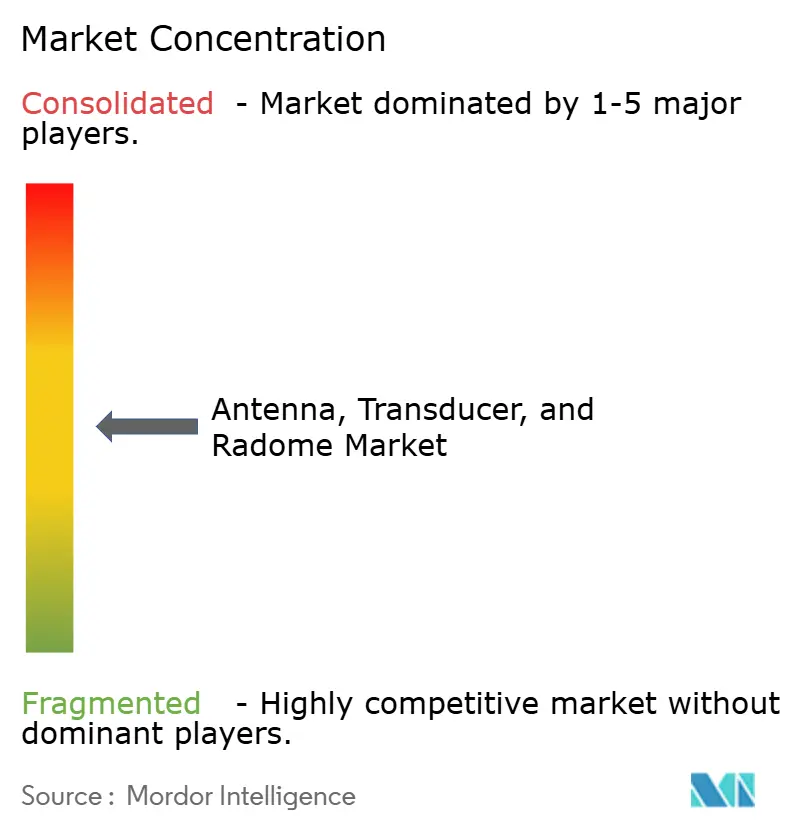
The antenna, transducer, and radome market features moderate fragmentation, with top aerospace primes controlling complex military programs and a vibrant cohort of specialists targeting high-growth niches. RTX, L3Harris Technologies, and Thales leverage vertical integration to secure scarce ceramic powders and aerospace-grade epoxies, locking in long-term supply under classified contracts. Mid-sized disruptors employ 3D printed lattices and metamaterial films to deliver comparable performance at lower cost, appealing to commercial satcom and drone operators.
Strategic acquisitions reshape market boundaries. AeroVironment’s USD 4.1 billion purchase of BlueHalo fuses ISR drones with counter-UAS phased-arrays, illustrating convergence around multi-domain solutions. Boeing’s takeover of Spirit AeroSystems folds composite radome production into in-house structures, enabling design-for-manufacture optimization and better schedule control. Suppliers experiment with subscription-based maintenance analytics that predict radome delamination or antenna phase-shifter drift, creating service revenue streams alongside hardware sales.
Regulation shapes competition: firms domiciled in export-control-friendly nations enjoy preferential access to global tenders, while vendors in non-aligned jurisdictions focus on domestic markets and South-South partnerships. Start-ups circumvent capital barriers by offering drop-in replacement kits for legacy radar shelters, accelerating time-to-revenue. As additive manufacturing matures, intellectual-property protection and digital-rights-management for print files emerge as new battlegrounds, influencing future alliances and licensing models.
Antenna, Transducer, And Radome Industry Leaders
L3Harris Technologies, Inc.
RTX Corporation
Thales Group
Honeywell International Inc.
BAE Systems plc
- *Disclaimer: Major Players sorted in no particular order
Antenna, Transducer, And Radome Market Companies Covered in this Report
- BAE Systems plc
- Honeywell International Inc.
- Communications & Power Industries LLC
- General Dynamics Mission Systems, Inc. (General Dynamics Corporation)
- HENSOLDT AG
- Hughes Network Systems, LLC
- L3Harris Technologies, Inc.
- Leonardo S.p.A.
- Northrop Grumman Corporation
- Norsat International Inc.
- Meggitt Ltd. (Parker-Hannifin Corporation)
- RTX Corporation
- Saab AB
- Smiths Interconnect Group Limited (Smiths Group plc)
- Thales Group
- Safran SA
- Astronics Corporation
- Royal Engineered Composites, Inc.
- Teledyne FLIR LLC (Teledyne Technologies Incorporated)
- Kongsberg Gruppen ASA

Recent Industry Developments in Antenna, Transducer, And Radome Market
- August 2025: BHEL secured a radar dome manufacturing technology from DMRL, marking a strategic development in India's defense market. This move enables BHEL to produce fused silica radar domes for missile guidance systems domestically, enhancing self-reliance in critical defense components.
- April 2025: NASA engineers developed an ultralight aerogel antenna for satellite communications in power—and space-constrained environments. This innovation, featuring 95% air content and adjustable flexibility, can be embedded into aircraft exteriors, enhancing aerodynamics and communication reliability for drones and future air transport. It marks a significant advancement in aerospace technology.


Global Antenna, Transducer, And Radome Market Report Scope
Segmentation Overview
| Antenna |
| Transducer |
| Radome |
| Ground |
| Naval |
| Airborne |
| HF/VHF/UHF |
| L/S-band |
| C/X-band |
| Ku/Ka-band |
| Others |
| Defense |
| Commercial |
| North America | United States | |
| Canada | ||
| Mexico | ||
| Europe | United Kingdom | |
| France | ||
| Germany | ||
| Italy | ||
| Russia | ||
| Rest of Europe | ||
| Asia-Pacific | China | |
| India | ||
| Japan | ||
| South Korea | ||
| Rest of Asia-Pacific | ||
| South America | Brazil | |
| Rest of South America | ||
| Middle East and Africa | Middle East | Saudi Arabia |
| Israel | ||
| United Arab Emirates | ||
| Rest of Middle East | ||
| Africa | South Africa | |
| Rest of Africa | ||
| By Component | Antenna | ||
| Transducer | |||
| Radome | |||
| By Platform | Ground | ||
| Naval | |||
| Airborne | |||
| By Frequency Band | HF/VHF/UHF | ||
| L/S-band | |||
| C/X-band | |||
| Ku/Ka-band | |||
| Others | |||
| By Application | Defense | ||
| Commercial | |||
| By Geography | North America | United States | |
| Canada | |||
| Mexico | |||
| Europe | United Kingdom | ||
| France | |||
| Germany | |||
| Italy | |||
| Russia | |||
| Rest of Europe | |||
| Asia-Pacific | China | ||
| India | |||
| Japan | |||
| South Korea | |||
| Rest of Asia-Pacific | |||
| South America | Brazil | ||
| Rest of South America | |||
| Middle East and Africa | Middle East | Saudi Arabia | |
| Israel | |||
| United Arab Emirates | |||
| Rest of Middle East | |||
| Africa | South Africa | ||
| Rest of Africa | |||


Key Questions Answered in the Report
What is the 2025 valuation for the antenna transducer radome market?
It antenna, transducer, and radome market stands at USD 16.03 billion, reflecting steady demand from defense upgrades and commercial connectivity programs.
Which component segment is projected to record the fastest compound annual growth rate by 2030?
Antennas, with an 8.90% CAGR, buoyed by rising adoption of multifunction AESA radars.
Why are ground-based platforms forecast to expand more quickly than airborne systems?
Nations are fielding next-generation air-defense networks that require relocatable multi-band radars shielded by rugged composite domes, pushing ground demand to an 8.65% CAGR.
Which geography is expected to deliver the highest growth momentum through 2030?
Asia-Pacific, led by Japanese, South Korean, and Australian modernization programs, is forecast at a 9.65% CAGR.
How is additive manufacturing reshaping radome production?
3D printed composites cut lead-times from months to weeks, integrate thermal and conductive features during fabrication, and lower costs by nearly 25%.
What key hurdle could slow deployment of next-generation airborne radomes?
Lengthy qualification cycles under evolving electromagnetic-compatibility and environmental standards delay certification and raise development costs.
Page last updated on:





