
Flame Arrestor Market Size and Share
Market Overview
| Study Period | 2021 - 2031 |
|---|---|
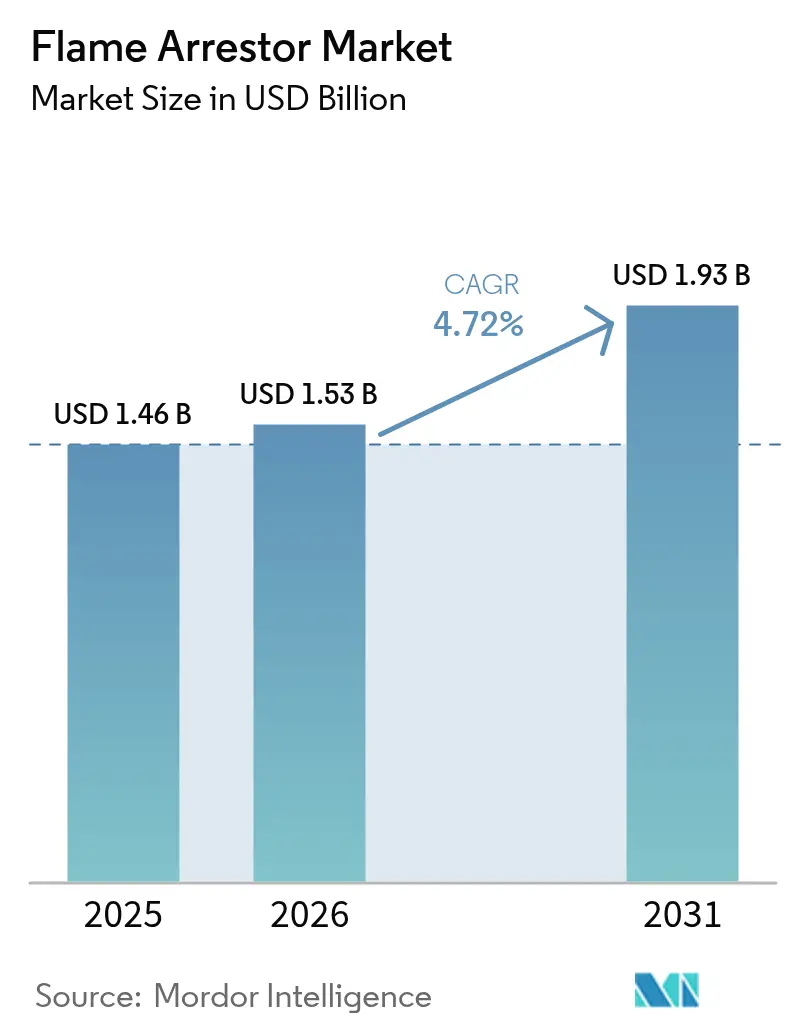
| Market Size (2026) | USD 1.53 Billion |
| Market Size (2031) | USD 1.93 Billion |
| Growth Rate (2026 - 2031) | 4.72 % |
| Fastest Growing Market | Asia Pacific |
| Largest Market | North America |
| Market Concentration | Medium |
Major Players *Disclaimer: Major Players sorted in no particular order Image © Mordor Intelligence. Reuse requires attribution under CC BY 4.0. | |
Flame Arrestor Market Analysis by Mordor Intelligence
The Flame Arrestor market size is expected to grow from USD 1.46 billion in 2025 to USD 1.53 billion in 2026 and is forecast to reach USD 1.93 billion by 2031 at 4.72% CAGR over 2026-2031.
Demand remains anchored in mature oil and gas applications; however, regulatory pressure surrounding hydrogen transport infrastructure, LNG-fueled shipping, and electric-vehicle battery plants is reshaping procurement patterns. Hydrogen midstream operators are prioritizing high-performance arrestors that can quench deflagrations at very low ignition energies, while refinery modernization in Asia and the Middle East is upgrading decades-old tank-vent safety hardware to ISO 16852-certified designs. Material substitution toward nickel and other exotic alloys is accelerating where sour-gas corrosion undermines the service life of stainless steel, and insurers are beginning to reward Safety Integrity Level (SIL)-rated installations with lower premiums, tilting total lifecycle economics toward higher-specification products. Concurrently, OEMs are integrating smart diagnostics, enabling users to meet the tighter NFPA 69 test intervals now in effect across North America.
Key Report Takeaways
- By type, in-line arrestors held 57.30% of the flame arrestors market share in 2025, while combination/spark arrestors are forecast to grow at a 7.2% CAGR to 2031.
- By material, stainless steel accounted for 48.20% of the flame arrestors market size in 2025; nickel and exotic alloys are projected to expand at an 8% CAGR through 2031.
- By end user, the oil and gas sector captured 40.30% of the revenue in 2025, whereas chemicals and petrochemicals are projected to rise at a 5.65% CAGR over the forecast period.
- By geography, North America led with a 34.60% market share in 2025, but the Asia-Pacific region is expected to post the fastest growth rate of 6.55% from 2025 to 2031.
Note: Market size and forecast figures in this report are generated using Mordor Intelligence’s proprietary estimation framework, updated with the latest available data and insights as of 2026.
Market Trends and Insights
Drivers Impact Analysis of Flame Arrestor Market*
| Driver | (~) % Impact on CAGR Forecast | Geographic Relevance | Impact Timeline |
|---|---|---|---|
| Explosion-proof mandates in hydrogen mid-stream infrastructure | +1.20% | Global, early gains in North America and EU | Medium term (2-4 years) |
| Rising refinery upgrades in APAC and MENA | +0.80% | Predominantly APAC, spill-over to MENA | Long term (≥4 years) |
| Electrification-driven solvent recovery in battery gigafactories | +0.70% | Global, concentrated in APAC and North America | Short term (≤2 years) |
| Accelerated LNG bunkering adoption in marine sector | +0.60% | Global maritime routes, EU and APAC focused | Medium term (2-4 years) |
| Tightening NFPA 69 testing intervals | +0.40% | North America with spill-over to aligned regions | Short term (≤2 years) |
| Insurance-premium discounts for SIL-rated arrestors | +0.30% | North America and EU | Long term (≥4 years) |
| Source: Mordor Intelligence | |||
Explosion-Proof Mandates in Hydrogen Mid-Stream Infrastructure
Hydrogen safety frameworks across the United States, Europe, and Asia now specify the installation of flame arrestors in storage vessels, vent headers, and mobile refuelers, driving the next wave of spending in the flame arrestor market.(1) Technical guidance, such as FMVSS 307 and 308, obliges vehicle tank suppliers to embed thermally activated devices with integrated arrestors to stop flame front regression in crash scenarios.(2) The UN Global Technical Regulation 13 echoes these provisions, harmonizing testing protocols on quenching distance, maximum experimental safe gap, and pressure-pulse survivability. These converging rulesets are nudging operators to replace legacy vent screens with certified detonation-proof models machined to far tighter tolerances. Vendors able to validate performance in hydrogen at pressures above 700 bar are securing early framework contracts that underpin the flame arrestors market for the medium term.
Rising Refinery Upgrades in APAC & MENA
Refinery owners in China, India, Saudi Arabia, and the United Arab Emirates are upgrading their vapor control trains to meet sulfur and benzene emission caps, which translates directly into larger purchase orders for in-line detonation arrestors and end-of-line tank vents. Operators are specifying ISO 16852-tested units during basic engineering phases, so every new vacuum gas-oil hydrotreater or delayed coker is budgeted with multi-point flame protection. Long-cycle capital programs spanning crude-to-chemicals complexes in Zhejiang and Jubail are securing demand visibility into the late 2020s, sustaining a robust backlog for suppliers targeting the flame arrestor market.
Electrification-Driven Solvent Recovery in Battery Gigafactories
Lithium-ion cell plants rely on N-Methyl-2-pyrrolidone extraction systems that vent flammable vapors during desorption. Integrated flame arrestors are now mandatory on these closed-loop skids to mitigate flashback risks while maintaining 99% solvent recovery. Battery energy-storage systems are also incorporating miniature detonation arrestors in thermal-runaway exhaust ducts, ensuring that any jet fire remains confined to the module—a specification already adopted by several US-based data-center operators. This pivot toward electrification is adding a new, high-volume downstream channel for the flame arrestors market, one that values compact geometry and very low pressure drop just as much as traditional hydrocarbon service.
Accelerated LNG Bunkering Adoption in Marine Sector
Dual-fuel containerships and ferries operating on liquefied natural gas must comply with the International Maritime Organization's IGF-Code provisions, which mandate the use of flame arrestors in fuel preparation rooms and cargo-handling systems.(3) Classification societies such as ABS further stipulate detonation-proof arrestors on vapor return lines during ship-to-ship and truck-to-ship bunkering, tightening technical specifications and inspection regimes. With more than 250 LNG bunkering ports planned or operational worldwide, equipment backorders for cryogenic-rated arrestors have multiplied, reinforcing the medium-term growth outlook for the flame arrestor market.
Restraints Impact Analysis of Flame Arrestor Market*
| Restraint | (~) % Impact on CAGR Forecast | Geographic Relevance | Impact Timeline |
|---|---|---|---|
| Clogging and pressure-drop failures in sour-gas service | -0.60% | Global, concentrated in MENA and North America | Short term (≤2 years) |
| Scarcity of detonable-grade test labs outside OECD | -0.40% | Non-OECD APAC and MEA | Medium term (2-4 years) |
| Shift to intrinsic-safe sensors replacing small arrestors in VOC vents | -0.30% | Global, first movers in North America and EU | Long term (≥4 years) |
| High NACE-compliant alloy costs | -0.50% | Global, most acute in cost-sensitive markets | Short term (≤2 years) |
| Source: Mordor Intelligence | |||
Clogging & Pressure-Drop Failures in Sour-Gas Service
Hydrogen sulfide streams accelerate pitting and sulfur deposition inside arrestor passages, causing step-changes in pressure drop that undermine flow assurance and safety margins. Operators meeting NACE MR0175 compliance often resort to nickel-alloy internals, which increase capital costs by 80-120%, thereby restraining adoption among marginal fields. Elevated fouling also shortens cleaning cycles to quarterly intervals, resulting in increased downtime and higher spares inventory. Consequently, some E&P firms postpone upgrades, denting short-term volume growth in the flame arrestors market.
Scarcity of Detonable-Grade Test Labs Outside OECD
European laboratories, such as DNV Spadeadam, offer large-scale detonation rigs; however, equivalent capacity is scarce in Asia and the Gulf. Consequently, local manufacturers must ship prototypes overseas for compliance, which stretches lead times and certification budgets. The deficit of home-region facilities slows product homologation and delays project awards, tempering the expansion of the flame arrestors market in emerging economies.
*Our forecasts treat driver/restraint impacts as directional, not additive. The impact forecasts reflect baseline growth, mix effects, and variable interactions.
Flame Arrestor Market Segment Analysis
By Type:
In-Line Dominance Meets Combination GrowthIn-line designs, positioned directly within process piping, secured 57.30% revenue in 2025 as their bidirectional protection supports continuous throughput without disrupting flow regimes. This share reflects entrenched deployment across crude distillation units, compressor stations, and hydrogen dispensers, each governed by rigorous deflagration-isolation rules. The flame arrestors market size for in-line units is projected to expand significantly, in line with the overall 4.72% CAGR, as most brownfield upgrades still default to like-for-like replacement.
Combination or spark-integrated arrestors are slated for a 7.2% CAGR, outpacing all other formats as operators value consolidated hardware that merges pressure-vacuum relief with flame quenching in a single nozzle. Marine bunkering manifolds and solvent-recovery dryers illustrate use cases where footprint, weight, and maintenance access are constrained. As maritime LNG fueling becomes mainstream, these compact assemblies are poised to capture an incremental share of the flame arrestors market, especially when vendors can certify severe-duty endurance against cryogenic thermal cycles.


By Material:
Stainless Steel Leadership Challenged by Exotic AlloysStainless steel retained 48.20% of 2025 sales thanks to its corrosion resistance across moderate H₂S, CO₂, and chloride exposures, while offering economic parity with user budgets. Users cite proven weldability and global availability as reasons to standardize on 316 L or duplex grades for most refinery, pipeline, and chemical reactor vents. The flame arrestors market share for stainless steel will decline only slowly because engineering specifications still default to this alloy when sour-gas concentration is modest.
Nickel, Hastelloy, and other exotic grades are tracking the fastest 8% CAGR, owing to the development of deep sour-gas fields and stringent refinery sulfur-recovery mandates. Operators running H₂S burdens above 28% or CO₂ above 8% must employ NACE-compliant metallurgy, which automatically steers procurement toward high-nickel internals, despite the associated cost premium. Suppliers with precision laser-welding capabilities to meet minimum quenching gap tolerances of below 0.04 inches are leveraging this trend to upsell niche, high-margin SKUs within the flame arrestors market.
By End User:
Oil & Gas Dominance Faces Chemical Sector ChallengeOil and gas retained 40.30% revenue in 2025, anchored in upstream flare headers, midstream compressor stations, and downstream tank farms. Mandatory equipment audits by global majors maintain a stable replacement volume, even when drilling activity plateaus, thereby providing the flame arrestors market with a dependable base load. However, unit pricing pressure persists because many specifications were written years ago around mature stainless steel designs.
Chemicals and petrochemicals are set to rise 5.65% CAGR through 2031 as plant owners invest in aromatics complexes, propylene oxide units, and lithium-processing facilities. These process trains generate diverse vapor streams that require tailored flame-quench solutions, opening the door for premium engineered products. As a result, this vertical will chip away at the oil sector’s revenue weight in the flame arrestors market despite the latter’s absolute dominance.

Geography Analysis
North America Flame Arrestor Market
North America generated 34.60% of 2025 revenue, driven by NFPA adoption, refinery life-extension projects in the United States, and LNG export terminal buildouts on the Gulf Coast. The region remains the principal aftermarket for SIL-rated upgrades because insurers tie premiums to documented validation protocols.
APAC Flame Arrestor Market
Asia-Pacific is forecast to generate the fastest 6.55% CAGR as China commissions new crude-to-chemicals complexes exceeding 1.2 million barrels per day and India upgrades Bharat Stage VI fuels. These expansions embed flame protection from the plot plan phase, boosting unit counts per facility and raising average selling prices, positioning the region as the future demand engine for the flame arrestors market.
EMEA and LATAM Flame Arrestor Market
Europe sustains steady growth through LNG marine bunkering hubs across the North Sea and Baltic, while Russia’s brownfield refinery maintenance supports niche detonation-rated retrofits despite geopolitical headwinds. Latin America and Africa post modest gains, driven by Brazilian petrochemicals, Argentine shale gas, Saudi condensate splitters, and South African methane-abatement projects in mining, collectively broadening the global footprint of the flame arrestors market.

Regulatory Landscape
Global flame arrester requirements are shaped by harmonized performance and test standards for explosive atmospheres, with ISO/IEC 80079-49:2024 providing updated international requirements and test methods for flame arresters. In oil and gas, widely referenced design and selection practices continue to be guided by American Petroleum Institute documents such as API RP 2210 (reconfirmed in 2025) for tank-vent applications and API RP 2028 (reconfirmed in 2025) for piping systems, together with facility codes including NFPA 30 and NFPA 69 in North America.
Compliance is also influenced by air-emissions rules that affect venting and flaring system design and monitoring, where flame arresters operate as part of broader control-device and flare trains. In the United States, the EPA issued a final rule in April 2026 amending NSPS and Emission Guidelines requirements for the crude oil and natural gas source category, including adjustments tied to temporary flaring provisions and continuous monitoring requirements for vent gas net heating value, and June 2026 marked an extended compliance deadline for specific monitoring requirements. At the same time, ISO technical committees are developing ISO 4201 (Part 1 and Part 2) for oil and gas and lower-carbon energy applications, pointing to more sector-specific qualification and maintenance guidance.
Competitive Landscape
The flame arrestors market is moderately consolidated, with multinational process-safety specialists owning test laboratories and global certification portfolios. Emerson’s Enardo and Anderson Greenwood brands offer ATEX, USCG, and FM-approved product lines spanning deflagration and detonation services, giving the company a pole position among integrated refining clients. PROTEGO and Groth Corporation leverage deep application engineering expertise to design and manufacture custom skids for cryogenic LNG, biomethane, and high-pressure hydrogen.
Second-tier suppliers, including Elmac Technologies and Cashc,o, differentiatthemselves themselves through quicker lead times and flexible design packages, especially in the 1-to-4-inch diameter range used by specialty-chemicals producers. Patent filing reveals incremental innovation, including corrugated ribbon elements, turbulence-inducing baffles, and active cooling fins, aimed at reducing cell-plate temperature rise at the flame front impact. This reflects an industry preference for evolutionary rather than disruptive change.
Forward-looking strategies emphasize coupling flame arrestor cores with real-time temperature and pressure sensors that feed plant DCS platforms, allowing predictive maintenance and compliance reporting. Pilot deployments in Canadian hydrogen hubs and Japanese battery plants underline how digital integration can preserve installed-base loyalty and expand aftermarket revenue, buttressing growth prospects for incumbent leaders within the flame arrestors market.
Flame Arrestor Industry Leaders
-
Emerson Electric Co.
-
WITT-Gasetechnik GmbH & Co KG
-
PROTEGO Braunschweiger Flammenfilter GmbH
-
Elmac Technologies Ltd
-
The Protectoseal Company Inc.
- *Disclaimer: Major Players sorted in no particular order

Flame Arrestor Market Companies Covered in this Report
- Emerson Electric (Enardo)
- Elmac Technologies
- PROTEGO Braunschweiger Flammenfilter
- Protectoseal
- WITT-Gasetechnik
- Cashco
- Paradox IP
- Groth Corporation
- L&J Technologies
- Parker Hannifin (Veriflo)
- BS&B Safety Systems
- Kimray
- D-KTC Fluid Control
- Flammer GmbH
- Sunflow Technologies
- Sureseal
- Dresser Natural Gas Solutions
- Paladon Systems
- Essex Industries
- Detronics
Market Opportunities and Future Outlook
The move toward ISO/IEC 80079-49:2024, alongside the ongoing development of ISO 4201 for oil and gas and lower-carbon energy, creates a visible need around recertification, documentation, and maintenance programs, particularly where installed bases were built around older test regimes. This supports suppliers that bundle qualified hardware with inspection intervals, field verification, and traceable documentation aligned to plant safety management systems and insurer requirements for validated protection layers.
Demand is also diversifying by application across hydrogen infrastructure, LNG-fueled marine systems governed by the IMO IGF Code, and solvent-recovery equipment used in battery manufacturing. These requirements tend to shift procurement toward higher-performance arrestors, including lower MESG service, cryogenic-rated duty, and compact low pressure-drop designs. A parallel opportunity exists in reducing certification and lead-time bottlenecks outside OECD markets, where limited detonable-grade test capacity slows homologation, and where vendors with access to accredited test facilities and modular designs can reduce project engineering and qualification friction. On the technology side, OEM integration of smart monitoring and diagnostics into flame protection hardware supports condition-based maintenance and tighter test-interval compliance, providing a differentiation path beyond commodity stainless steel offerings during replacement cycles.
Recent Industry Developments in Flame Arrestor Market
- June 2026: PROTEGO Braunschweiger Flammenfilter GmbH reported publishing technical work in Chemical Engineering Progress (AIChE) addressing interaction effects when flame arresters are installed in series. The focus on series-installation behavior supports more rigorous engineering guidance for complex vapor-control and piping configurations, strengthening specification credibility in high-consequence applications.
- January 2025: Emerson expanded its Anderson Greenwood portfolio with combination pressure-vacuum relief valves integrating flame arrestors for storage tanks. Bundling relief and flame protection into consolidated assemblies targets footprint and maintenance constraints on tank farms and can simplify procurement for standardized venting packages.
- October 2024: Superflash Compressed Gas Equipment introduced UL-approved flashback arrestors featuring 100-micron inlet filters and thermal shutoff valves. Product moves like this address contamination management and automatic isolation, aligning with user priorities for safer operation and reduced downtime in gas handling and related industrial applications.
Flame Arrestor Market Report Scope and Research Methodology
Market Definition and Coverage
This market covers the value of flame arrestor devices sold for installation in industrial systems to stop flame propagation, mainly in storage, venting, and pipeline configurations, across key process and energy industries and across major geographies.
Scope exclusions: We exclude fire suppression equipment, explosion-proof electrical enclosures, and general ventilation hardware that does not perform a certified flame arresting function.
Segments Covered in This Report
- By Type
- In-line Arrestor
- Deflagration In-line Arrestor
- Detonation In-line Arrestor
- End-of-line Arrestor
- Vent-stack Arrestor
- Tank-breather Arrestor
- Combination/Spark Arrestor
- In-line Arrestor
- By Material
- Stainless Steel
- Carbon Steel
- Aluminum
- Nickel and Exotic Alloys
- By End User
- Oil and Gas
- Chemicals and Petrochemicals
- Pharmaceutical and Biotechnology
- Mining and Metals
- Power Generation
- Water and Waste-water
- Food and Beverage
- Others (Marine, Aerospace and Defense)
- By Geography
- North America
- United States
- Canada
- Mexico
- Europe
- Germany
- United Kingdom
- France
- Russia
- Rest of Europe
- Asia Pacific
- China
- India
- Japan
- South Korea
- ASEAN Countries
- Rest of Asia Pacific
- South America
- Brazil
- Argentina
- Rest of South America
- Middle East and Africa
- Saudi Arabia
- United Arab Emirates
- South Africa
- Rest of Middle East and Africa
- North America
Data Sources, Market Sizing, and Validation
Desk Research
Desk research is used to build the basic demand context and to anchor the model to repeatable public indicators. We review safety and certification references and technical notes from public standards bodies and regulators, followed by industry demand signals from sources such as OSHA guidance, the US Energy Information Administration, Eurostat industrial production series, UN Comtrade trade statistics, and association material from groups such as API.
To translate those signals into a usable market model, we also pull directionally consistent inputs from company annual reports, investor presentations, and reputable press coverage of refinery, chemical, and terminal projects. Where available, we supplement with paid subscriptions for company financials and intelligence, patent databases, and shipment-level trade views to cross-check product mix and country-level flows. These examples are not exhaustive, and many other public sources were also used for data collection, validation, and clarification.
Primary Interviews and Surveys
Primary work is used to confirm what gets bought, how replacement cycles work, and how pricing changes by material and certification requirements. We speak with a mix of manufacturers, distributors, EPC and maintenance stakeholders, and end-user safety and reliability teams. Respondent input is balanced across APAC, EMEA, and the Americas, so the final assumptions reflect multiple project cycles rather than a single region's timing.
Distribution of primary research fieldwork respondents
| Company type | Respondent position | Region |
|---|---|---|
| Top tier: 33% | CXOs: 12% | APAC: 46% |
| Mid tier: 50% | Functional/Unit leaders: 28% | EMEA: 34% |
| Smaller Players: 17% | Managers: 60% | Americas: 20% |
Market-Sizing & Forecasting
The core model is built using a top-down approach where industrial activity, hazardous-area equipment needs, and installed-base replacement patterns are reconstructed by end-user industries and region, and then translated into annual demand for flame arrestors. Once that demand pool is formed, it is converted into value using a practical pricing logic that accounts for typical unit mix and certification-driven material choices.
To keep the totals grounded, we add selective bottom-up checks, such as rolling up a sampled set of supplier revenues, validating distributor channel feedback, and sanity-checking implied unit volumes against trade movements for relevant product categories. Inputs that commonly matter in this market include refinery and chemical capacity additions, midstream storage and terminal buildouts, maintenance turnaround cadence, the share of stainless steel and exotic alloy units in corrosive services, and whether applications are framed around deflagration versus detonation risk, since this affects specification and price. For forecasting, we use scenario analysis because project timing and turnaround cycles can shift year to year, and we tune those scenarios using consensus views gathered from industry practitioners. Where country or application detail is thin, we handle gaps by using proxy indicators, such as regional industrial output and trade intensity, and then recheck through interviews before finalizing totals.
Data Validation & Update Cycle
Outputs are validated through multiple checks so the final numbers stay aligned with observable demand signals. We compare regional totals against independent indicators such as industrial production trends, upstream and downstream investment announcements, and import and export patterns, then investigate any sharp variances before sign-off.
A second analyst review is completed to verify calculations, assumptions, and conversions, followed by re-contact triggers when expert feedback conflicts with the modeled direction, or when a material event changes project timing. Reports are refreshed annually, and interim updates are made when major regulatory changes, project pipeline shifts, or price movements materially change the outlook. Before delivery, a final pass is done so clients receive the latest updated view available at that time.
Mordor Intelligence's Flame Arrestors Market Sizing Compared With Other Published Estimates
Different published market values for flame arrestors can look far apart, even when everyone is describing the same safety function. The gaps usually come from how the scope is drawn, what years are used as the base, and how pricing and replacement demand are treated when public data is limited.
The main gap comes from whether adjacent explosion protection products are counted alongside flame arrestors, and in Mordor Intelligence calculations only dedicated flame arrestor devices are included. Value is built from end-user demand drivers and certification-linked pricing rather than bundling broader hazardous-area equipment. Differences also show up when some estimates rely on aggressive project pipelines, apply a single average price across materials, or use older currency timing, which can inflate or depress the current-year value.
Benchmark comparison
| Source | Market Size | Gaps in Research Methodology |
|---|---|---|
| Mordor Intelligence | USD 1.46 B (2025) | |
| Trade Journal A | USD 2.71 B (2024) | Often reflects a broader hazardous-area safety equipment bundle and may treat project-led demand as immediate purchases, which can lift the near-term total versus a device-only view. |
| Industry Data Publisher B | USD 0.82 B (2024) | Uses a narrower definition that emphasizes flame and detonation arrestors in specific line items and can undercount end-user replacement demand and higher-value alloy configurations in corrosive services. |
The spread in the table is mainly explained by scope choices and how pricing and timing are handled. By keeping the device definition tight, tying demand to industrial activity and maintenance cycles, and checking price logic by material and certification needs, the estimate stays traceable to inputs that can be reviewed and repeated.
Key Questions Answered in the Report
What is the current size of the global flame arrestors market?
The flame arrestors market size reached USD 1.53 billion in 2026 and is forecast to grow to USD 1.93 billion by 2031.
Which end-user industry is expected to see the fastest growth?
The chemicals and petrochemicals sector is projected to expand at a 5.65% CAGR through 2031 as new aromatics and battery-materials plants add specialized vapor-control systems.
Why are hydrogen infrastructure projects important for flame arrestor vendors?
Emerging regulations such as FMVSS 307/308 and UN GTR-13 require certified arrestors in hydrogen storage and vent lines, driving premium demand for detonation-proof designs.
How do tightening NFPA 69 testing intervals affect aftermarket revenue?
The 2024 NFPA 69 revision mandates more frequent inspection and validation, increasing sales of replacement elements and field-testing services.
Which geographic region will add demand most rapidly?
Asia-Pacific is forecast to post the highest 6.55% CAGR to 2031, led by refinery upgrades in China and India plus LNG bunkering infrastructure across key ports.
What role does material selection play in purchase decisions?
Buyers in sour-gas and corrosive environments are shifting toward nickel and other exotic alloys despite higher cost because these materials meet NACE compliance and extend service life.