
Market Overview
| Study Period | 2020 - 2031 |
|---|---|
| Market Size (2026) | USD 52.82 Billion |
| Market Size (2031) | USD 64.84 Billion |
| Growth Rate (2026 - 2031) | 4.19 % |
| Fastest Growing Market | Europe |
| Largest Market | North America |
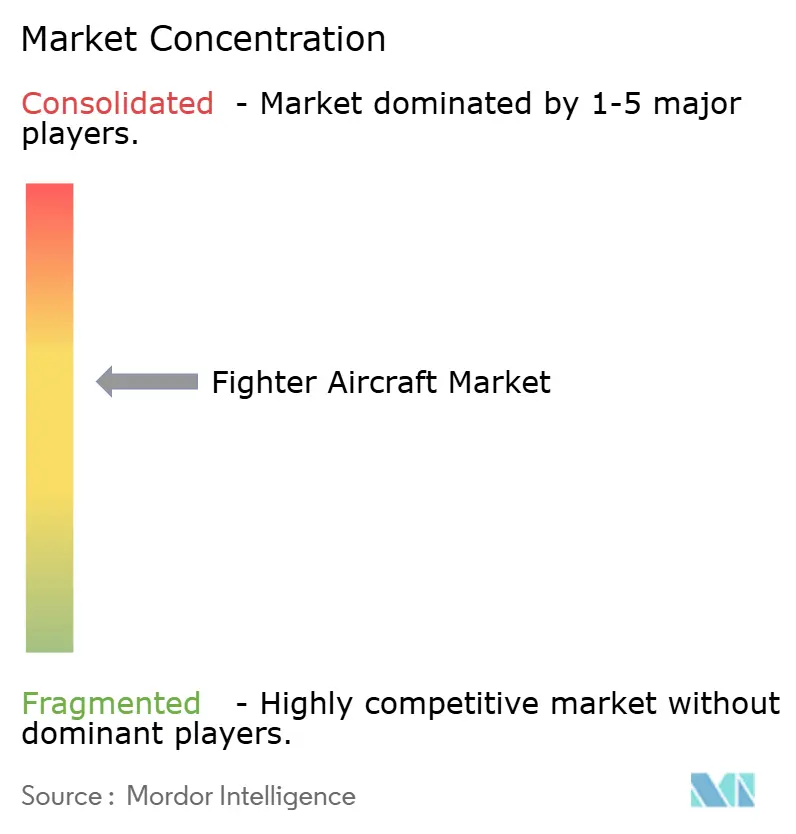
| Market Concentration | Medium |
Major Players *Disclaimer: Major Players sorted in no particular order Image © Mordor Intelligence. Reuse requires attribution under CC BY 4.0. | |
Fighter Aircraft Market Analysis by Mordor Intelligence
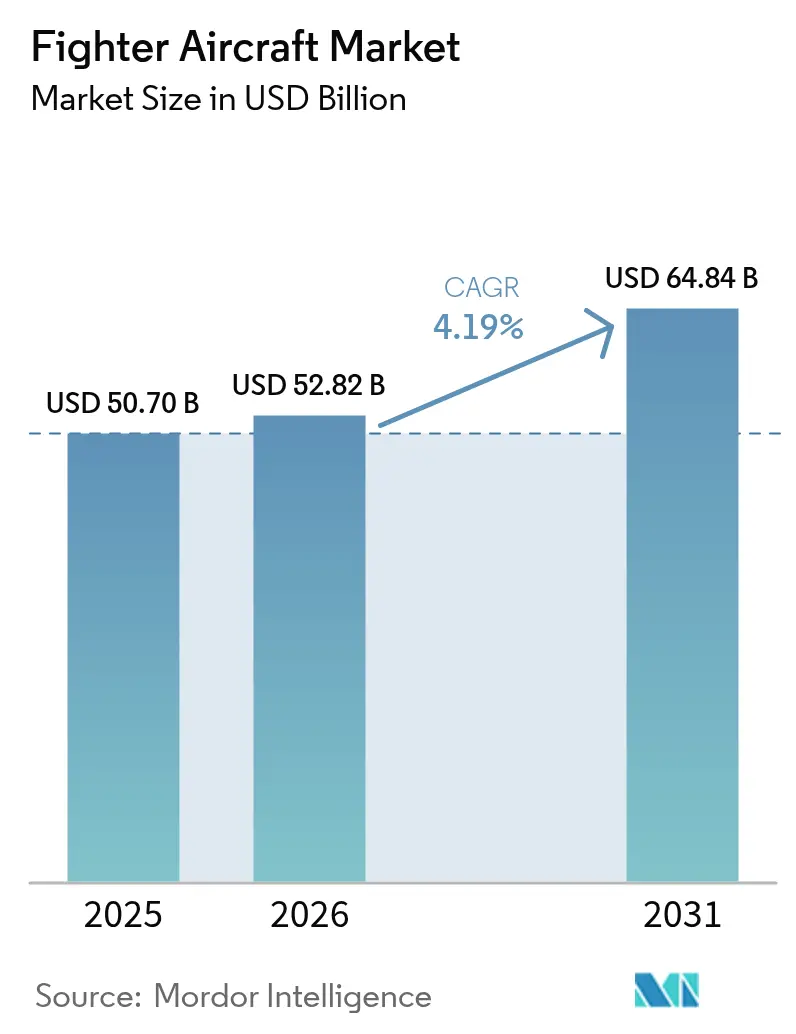
The fighter aircraft market size was valued at USD 50.70 billion in 2025 and estimated to grow from USD 52.82 billion in 2026 to reach USD 64.84 billion by 2031, at a CAGR of 4.19% during the forecast period (2026-2031). Surging defense budgets in the Indo-Pacific, accelerated fleet recapitalization across NATO, and the emergence of 6th-generation air-dominance concepts are steering steady expansion, although program delays and rising pilot-training costs temper momentum. Sustained procurement appetite is visible in the shift from 4.5th-generation toward manned-unmanned teaming, the growing influence of naval aviation requirements, and intensified investment in indigenous design programs that promise strategic sovereignty for host nations. Competitive dynamics are transitioning from platform-centric to software-defined offerings, rewarding suppliers that master digital-twin workflows, open architectures, and AI-enabled autonomy. Meanwhile, environmental regulations on engine emissions, looming talent shortages, and ITAR compliance hurdles continue to pose structural challenges for OEMs and operators alike.
Key Report Takeaways
- By take-off and landing, CTOL platforms commanded 57.96% of the fighter aircraft market share in 2025, while VTOL/STOVL platforms are projected to expand at a 6.27% CAGR through 2031.
- By end user, naval aviation is advancing at a 7.72% CAGR to 2031, outpacing the Air Force segment, which held a 52.41% share of the fighter aircraft market in 2025.
- By fighter generation, 4.5th-generation platforms captured 41.37% of the fighter aircraft market share in 2025; 6th-generation systems are forecasted to grow at 8.16% CAGR between 2026 and 2031.
- By mission role, air-superiority platforms accounted for 48.31% of the market in 2025, and the multi-role segment is set to grow by a 6.25% CAGR from 2026 to 2031.
- By engine configuration, single-engine models accounted for 51.88% of the fighter aircraft market size in 2025, whereas twin-engine platforms are set to grow at a 5.18% CAGR over the forecast window.
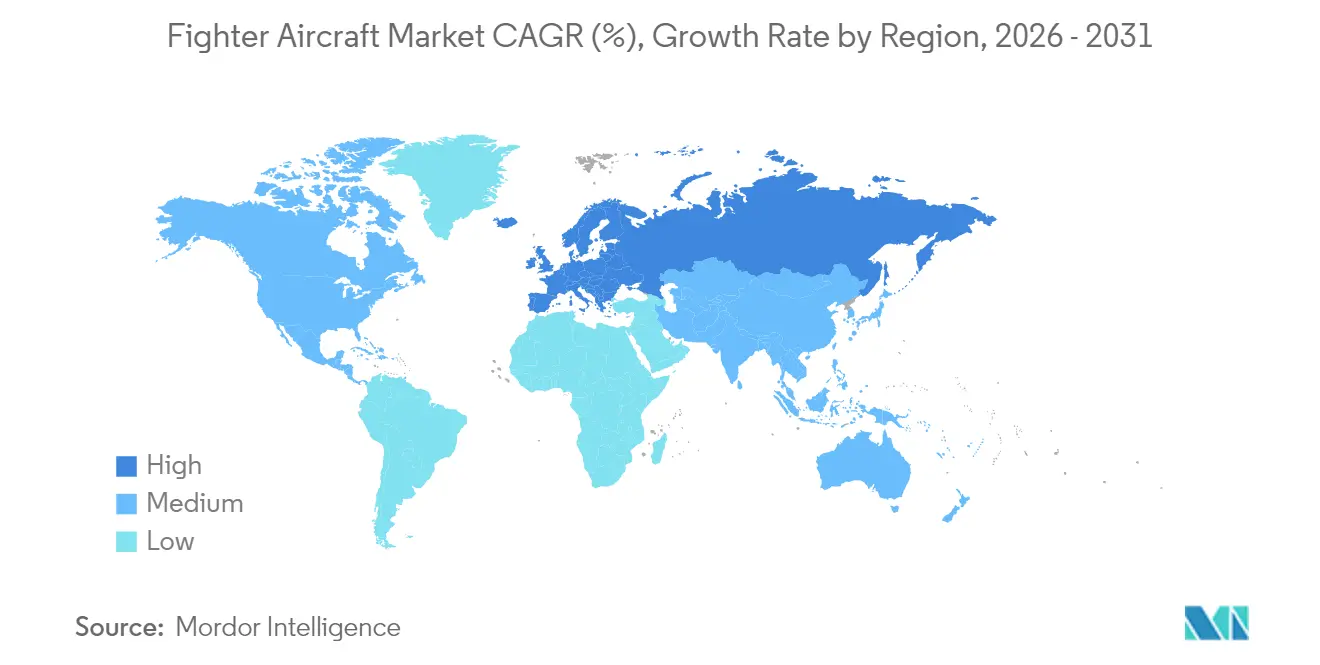
- By geography, North America retained 36.62% fighter aircraft market share in 2025, while Europe is projected to post the fastest 6.43% CAGR through 2031.
Note: Market size and forecast figures in this report are generated using Mordor Intelligence’s proprietary estimation framework, updated with the latest available data and insights as of 2026.
Market Trends and Insights
Drivers Impact Analysis of Fighter Aircraft Market*
| Driver | (~) % Impact on CAGR Forecast | Geographic Relevance | Impact Timeline |
|---|---|---|---|
| Increasing defense budgets in emerging APAC economies | +1.20% | APAC core, spill-over to MEA | Medium term (2-4 years) |
| Recapitalization of aging 4th-gen fleets with 5th-gen aircraft | +0.90% | North America, Europe | Long term (≥4 years) |
| Advanced avionics enabling multi-domain operations | +0.70% | Global | Medium term (2-4 years) |
| Indigenous fighter programs for strategic sovereignty | +0.80% | APAC, Europe, Middle East | Long term (≥4 years) |
| Rapid prototyping and digital-twin design workflows | +0.40% | Global | Short term (≤2 years) |
| Export-credit and G-to-G financing packages | +0.30% | Global | Short term (≤2 years) |
| Source: Mordor Intelligence | |||
Increasing Defense Budgets in Emerging APAC Economies
East Asian military spending rose to USD 411 billion in 2023, marking 6.2% annual growth that eclipsed the global average.[1]Gregory Allen & Isaac Goldston, “CCA Signals a New Era in AI-Driven Air Combat,” csis.org India allocated USD 75 billion for defense in FY 2024-25, funneling roughly 30% of that toward capital projects such as the AMCA program. South Korea boosted its 2024 budget to USD 44.2 billion, prioritizing KF-21 production and F-35A expansion to deter regional threats. These sustained outlays underpin multi-year procurement pipelines for indigenous fighters and foreign military sales (FMS). Local production offsets, meanwhile, are catalyzing new joint-venture assembly lines and increasing long-term MRO workloads in the fighter aircraft market.
Recapitalization of Aging 4th-Generation Fleets with 5th-Generation Aircraft*
The US Air National Guard secured approval in 2025 to swap 54 F-15C/D jets for 42 F-35As and 21 F-15EXs, underscoring the urgency to retire maintenance-intensive airframes.[2]Department of the Air Force, “Record of Decision—F-15EX and F-35A Operational Beddowns,” federalregister.gov Similar patterns prevail in Europe, where Spain ordered 25 additional Typhoons in 2024 and Finland’s 64-unit F-35A program stays on track for 2030 completion. Escalating sustainment costs for legacy fighters—often aggravated by component cannibalization—are accelerating replacement schedules despite budget pressure. Operators also seek step-change stealth, sensor fusion, and electronic warfare (EW) performance unattainable via incremental upgrades. These tendencies anchor a stable demand baseline for 5th-generation jets through the decade.
Advanced Avionics Enabling Multi-Domain Operations
An F-35 recently commanded autonomous drones in flight through AI-enabled links, illustrating how sensor fusion converts fighters into network nodes rather than isolated shooters.[3]Lockheed Martin, “F-35 Demonstrates Autonomous Control of Drone,” lockheedmartin.com Pilots can offload surveillance, electronic attack, and decoy tasks to unmanned wingmen, freeing bandwidth for strategic decision-making. Air forces now draft requirements around open architectures and rapid software drops rather than solely thrust-to-weight ratios. This pivot fuels lucrative upgrade cycles for mission computers, data links, and cyber-hardened operating systems. Vendors that master secure DevSecOps pipelines quickly gain a competitive advantage in the fighter aircraft market.
Indigenous Fighter Programs for Strategic Sovereignty
India’s USD 15 billion AMCA and Turkey’s KAAN—fresh off a February 2024 first flight—exemplify a global quest for defense autonomy. These projects cultivate domestic supply chains, build aerospace talent pools, and promise export leverage once maturity is reached. Europe is pursuing the tri-national GCAP and the Franco-German-Spanish FCAS with aggregate commitments exceeding USD 100 billion through 2040. Such programs often include generous R&D tax credits and public-private consortia that de-risk early-stage technology work. For global suppliers, aligning with local tier-2 manufacturers is essential to remain present in future tenders.
Restraints Impact Analysis of Fighter Aircraft Market*
| Restraint | (~) % Impact on CAGR Forecast | Geographic Relevance | Impact Timeline |
|---|---|---|---|
| Long development lead-times and cost overruns | −0.8% | Global | Long term (≥4 years) |
| High pilot-training and retention costs | −0.6% | Global | Medium term (2-4 years) |
| Environmental/noise-emission regulations at airbases | −0.3% | Europe, North America | Medium term (2-4 years) |
| Geopolitical export and ITAR compliance hurdles | −0.5% | Global | Short term (≤2 years) |
| Source: Mordor Intelligence | |||
Long Development Lead-Times and Cost Overruns
Weapons integration averages 38 months per store-aircraft combo, driving cumulative delays that balloon life-cycle cost projections.[4]Defense Acquisition University, “Accelerating Weapons Integration for Fighter and Bomber Aircraft,” dau.edu Europe’s FCAS struggles to reconcile capability ambition with affordability, pushing milestone dates to the right. NGAD faces similar headwinds, with a unit-cost whisper number near USD 300 million sparking calls for program rescope. Prolonged design phases also risk obsolescence as threat envelopes evolve faster than certification queues. Customers, therefore, hedge with mixed fleets of proven 4.5th-generation platforms while monitoring next-gen maturation.
High Pilot-Training and Retention Costs
The US Air Force’s 1,142-fighter-pilot deficit in 2024 forced pipeline changes that diverted trainees to mobility aircraft, slowing fighter-unit manning. Bonuses and improved quality-of-life initiatives have yielded marginal gains but have not closed the gap. European and Asia-Pacific air arms face similar churn as commercial airlines rebound and entice aviators with higher pay. Unmanned wingman programs promise workload relief but introduce new training syllabi and simulator requirements. Ultimately, elevated personnel costs eat into procurement budgets, tempering fleet-expansion aspirations.
*Our forecasts treat driver/restraint impacts as directional, not additive. The impact forecasts reflect baseline growth, mix effects, and variable interactions.
Fighter Aircraft Market Segment Analysis
By Take-off and Landing:
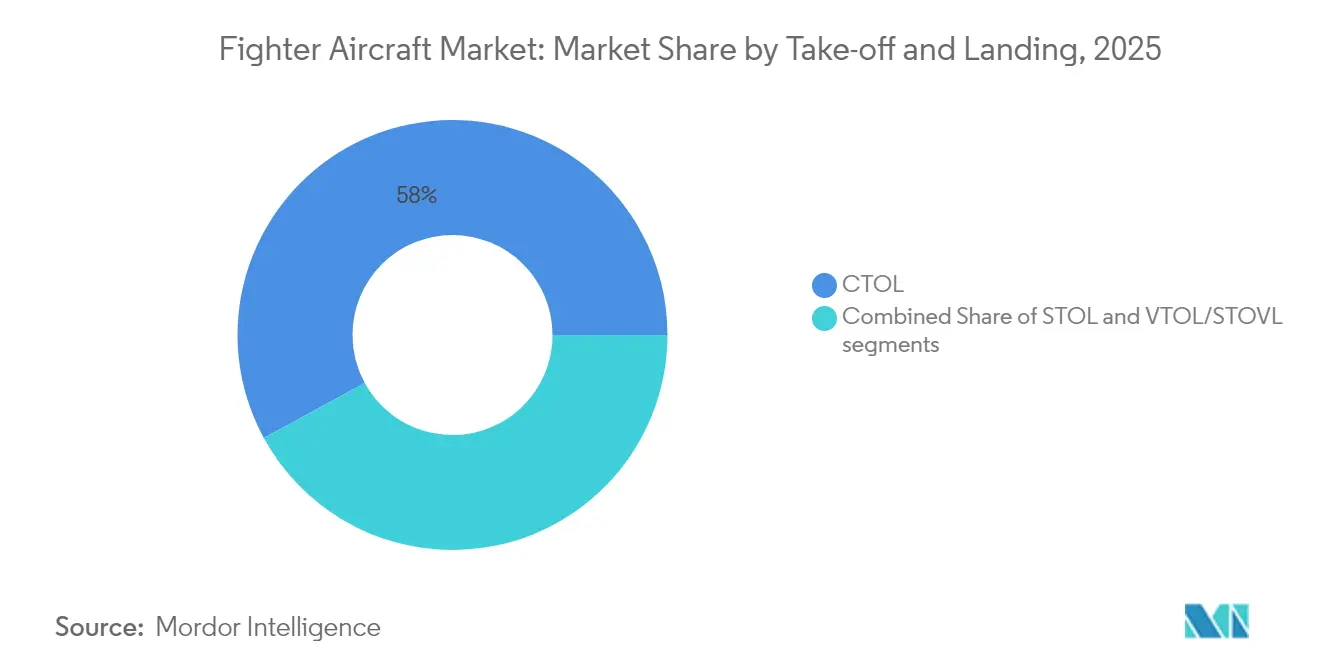
Carrier Operations Drive VTOL InnovationConventional CTOL aircraft generated 57.96% of the 2025 fighter aircraft market size, reflecting broad runway infrastructure and proven logistics chains. VTOL fighters, led by the F-35B, are rising at a 6.27% CAGR as European navies and the Indo-Pacific seek deck-launched capabilities for dispersed operations.
VTOL demand is further boosted by Agile Combat Employment doctrines that require flexibility under runway-denied conditions. STOL platforms remain niche but could see uplift as dispersed basing gains traction. These trends reshape OEM R&D budgets toward compact propulsion and thrust-vectoring modules to secure future fighter aircraft market share in carrier and expeditionary roles.



By Fighter Generation:
6th-Generation Emergence Accelerates4.5th-generation designs controlled 41.37% of the fighter aircraft market share in 2025 amid ongoing upgrades to Typhoon, Rafale, and Super Hornet. Yet 6th-generation programs post an 8.16% CAGR, fueled by NGAD and GCAP roadmaps that feature adaptive engines, collaborative combat aircraft, and AI-enabled sensor fusion.
Producers of legacy 4th-generation fleets face dwindling order books as sustainment costs climb, pushing them toward service-life extensions and export financing solutions. In contrast, 5th-generation backlogs remain robust but are constrained by production chokepoints, keeping delivery slots full through 2030 even as 6th-generation demonstrators mature.
By Engine Configuration:
Twin-Engine Growth Reflects Mission ComplexitySingle-engine fighters—primarily the F-35A and F-16—held 51.88% of the fighter aircraft market in 2025, favored by lower life-cycle costs and simpler maintenance footprints. Twin-engine platforms will grow 5.18% CAGR as extended-range strike missions, high electrical loads, and survivability imperatives gain prominence.
Air forces valuing deep-strike capacity or heavy electronic-warfare payloads increasingly gravitate toward twin-engine options such as the F-15EX, Rafale, and Typhoon. The consensus among emerging 6th-generation designs is that a twin-engine baseline ensures ample power and thermal margins for directed-energy weapons and broadband sensors.
By Mission Role:
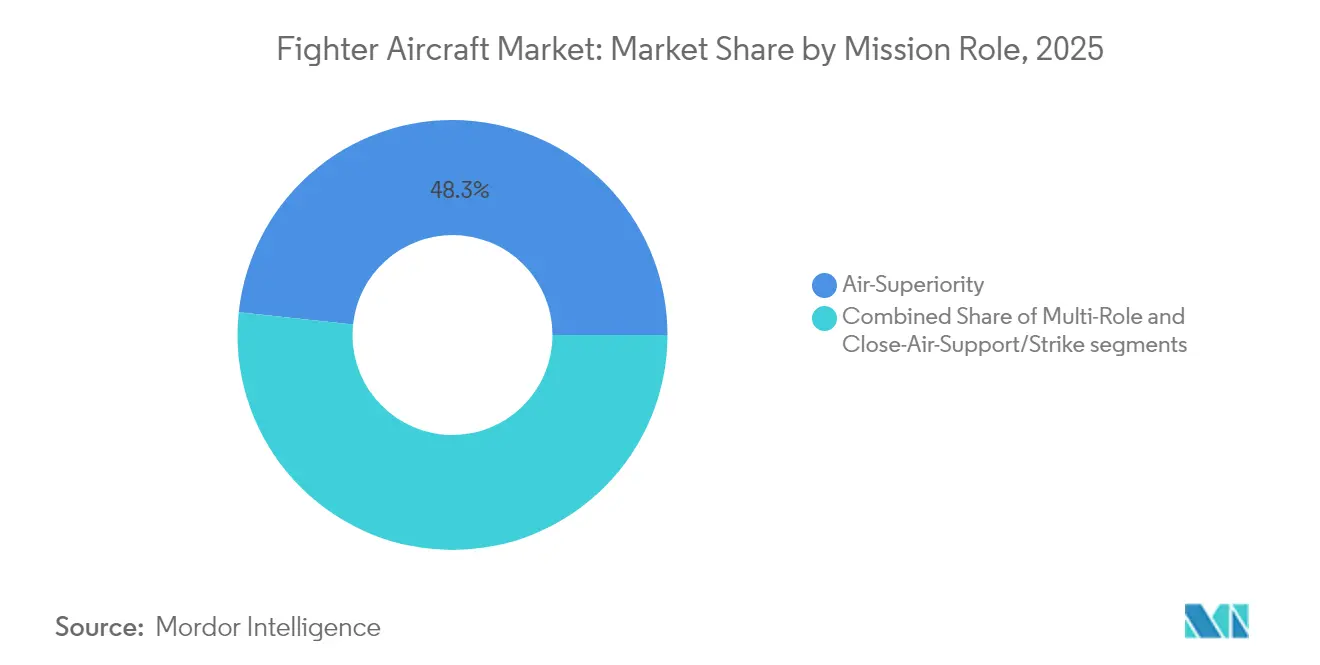
Multi-Role Platforms Dominate ProcurementAir-superiority variants held 48.31% of the fighter aircraft market share in 2025; however, multi-role aircraft are expanding at a 6.25% CAGR as budget-constrained operators demand swing-role flexibility.
Sensor fusion and precision-guided munitions equip multi-role fighters to suppress air defenses, execute close-air support, and gather ISR in one sortie. Dedicated CAS or strike airframes continue to fade as generational upgrades integrate advanced weapons and data links, boosting demand elasticity for multi-role offerings within the fighter aircraft market.
By End User:
Naval Aviation Drives Market ExpansionAir Force operators retained a 52.41% share in 2025 but face the slowest growth. Naval aviation traffic—buoyed by Indo-Pacific carrier investments—will outpace all other segments at 7.72% CAGR through 2031.
India’s USD 7.5 billion Rafale Marine acquisition and France’s continued Rafale-M buys reinforce blue-water strike ambitions. Marine and Army aviation upgrades center on vertical-lift concepts, but naval air wings stand out as prime adopters of collaborative combat aircraft, enlarging addressable opportunities for mission-system suppliers.
Geography Analysis
North America Fighter Aircraft Market
North America generated 36.62% of the global fighter aircraft market revenue in 2025, anchored by F-35A, F-15EX, and forthcoming CCA orders. The region’s share is stable, yet growth moderates as production ramps plateau and governmental focus tilts toward sustainability efficiencies.
Europe Fighter Aircraft Market
Europe’s fighter aircraft market size is forecasted to rise at a 6.43% CAGR. Russia’s invasion of Ukraine catalyzed defense-spending uplifts exceeding NATO’s 2% GDP pledge across multiple member states. FCAS and GCAP consortia inject substantial R&D outlays, while short-run deliveries of Typhoon Tranche 4 and Rafale F4 support immediate readiness.
APAC and Middle East Fighter Aircraft Market
Asia-Pacific exhibits bifurcated trajectories: US allies continue F-35 adoption, whereas China advances J-20 and J-31 production. India and South Korea pursue indigenous programs that stretch beyond 2030 but redirect local value addition upwards of 60%. Middle East operators prioritize turnkey capability, sustaining repeat F-15SA, F-35I, and Rafale contracts despite fiscal volatility linked to oil prices.

Regulatory Landscape
Fighter aircraft programs operate under a split regime of aviation safety standards and defense export controls. On the export side, the United States regulates fighter-aircraft hardware, software, and technical data under the Arms Export Control Act via the Department of State Directorate of Defense Trade Controls (DDTC) and International Traffic in Arms Regulations (ITAR), with the U.S. Munitions List (USML) defining covered items. Targeted ITAR and USML revisions were published in August 2025, reinforcing the need for ongoing classification and licensing discipline across primes and sub-tiers involved in multinational programs.
In Europe, airworthiness and safety governance is anchored by the European Union Aviation Safety Agency (EASA), supported by standard-setting bodies such as EUROCAE and ASD-STAN, and operational standardisation inputs from EUROCONTROL for civil-military interoperability. The regulatory baseline continued to evolve in 2026 through Implementing Regulation (EU) 2026/100 (adopted in January 2026), which updated elements of airworthiness review and occurrence reporting processes that affect certification pathways for military-derived technologies and dual-use subsystems integrated into fighter platforms.
Value Chain Analysis
The fighter aircraft value chain is dominated by a small set of primes integrating airframes, propulsion, mission systems, and weapons interfaces, backed by concentrated sub-tier ecosystems for engines, castings and forgings, fasteners, avionics microelectronics, and energetic materials. Production ramp-up efforts have also highlighted structural bottlenecks at lower tiers, where single-source dependencies can constrain multiple fighter lines at the same time; the February 2025 fire at SPS Technologies, a critical aerospace fastener supplier, illustrates how one facility disruption can ripple into delivery-risk management across multiple OEM and engine programs.
Manufacturing, final assembly, and flight-test and certification gates remain the critical path for capacity increases, and suppliers are shifting from just-in-time toward resilience-oriented sourcing and greater visibility. Dassault Aviation cited parts availability and final-assembly constraints affecting its Rafale ramp-up in 2024, while engine supply has been a recurring pacing item in Asia, including inspection needs around GE Aerospace F404-IN20 deliveries supporting HAL Tejas Mk-1A production. Governments and defense departments have also expanded supply-chain transparency initiatives, including the U.S. Department of Defense SCREEn effort to improve sub-tier visibility, reinforcing the trend toward deeper prime involvement in supplier qualification, dual-sourcing, and long-lead material planning.
Competitive Landscape
The fighter aircraft industry remains moderately consolidated. Five incumbents—Lockheed Martin Corporation, The Boeing Company, Airbus SE, Dassault Aviation SA, and BAE Systems plc—accounted for a major share of new-build deliveries in 2024. Second-tier challengers like Saab, KAI, HAL, and Turkish Aerospace capture niche orders tied to sovereign-capability agendas.
Competitive focus is shifting from airframe performance to software and mission-systems agility. In 2025, the US Air Force selected General Atomics and Anduril as CCA finalists, signaling openness to non-traditional primes that excel in autonomy and rapid prototyping. Partnerships across cybersecurity, AI, and edge-cloud computing proliferate as OEMs seek digital supremacy.
Sustainability also shapes differentiation. In 2025, Lockheed Martin approved 50% synthetic-fuel blends for the F-35 fleet, and Airbus is exploring SAF compatibility for FCAS demonstrators. Suppliers able to certify low-carbon operations gain ESG credibility, which increasingly influences procurement scoring in Europe.
Fighter Aircraft Industry Leaders
Lockheed Martin Corporation
The Boeing Company
Airbus SE
Dassault Aviation SA
BAE Systems plc
- *Disclaimer: Major Players sorted in no particular order
Fighter Aircraft Market Companies Covered in this Report
- Lockheed Martin Corporation
- The Boeing Company
- Airbus SE
- Saab AB
- Dassault Aviation SA
- BAE Systems plc
- United Aircraft Corporation
- Hindustan Aeronautics Limited
- Mitsubishi Heavy Industries, Ltd.
- Korea Aerospace Industries, Ltd.
- Turkish Aerospace Industries, Inc.
- Leonardo S.p.A.
- Embraer S.A.
- Textron Inc.
- Northrop Grumman Corporation
- Kawasaki Heavy Industries, Ltd.

Market Opportunities and Future Outlook
White space is expanding around the shift from platform-centric procurement to family-of-systems architectures, where fighters are specified as software-defined nodes that coordinate sensors, weapons, and collaborative uncrewed aircraft. Concrete pull-through is visible in sixth-generation program activity: the U.S. Air Force awarded Boeing the NGAD fighter development contract for the F-47 in March 2025, and the U.S. Navy released a revised request for proposals for the F/A-XX program in April 2026, with a downselect scheduled for August 2026. Together, these actions create near-term opportunities for open-architecture avionics, secure data links, mission computing upgrades, and test-and-evaluation tooling aligned with rapid software drops.
A second opportunity cluster centers on industrial capacity and sustainment-enablement as nations balance next-gen R&D with near-term inventory needs. China has been reported to be expanding fighter manufacturing infrastructure in Chengdu and Shenyang (March 2026), while the United States has extended production relevance for advanced 4.5th-generation assets through higher F-15EX procurement targets (June 2026 reporting), alongside continued 5th-generation demand. At the same time, engine availability and sub-tier constraints, including F404 supply dynamics for Tejas Mk-1A, lift the need for localization, alternate sourcing, and MRO capacity building, particularly in regions prioritizing indigenous programs and operational sovereignty.
Recent Industry Developments in Fighter Aircraft Market
- April 2026: Lockheed Martin confirmed Peru selected the F-16 Block 70 for a planned 12-aircraft purchase to modernize the Peruvian Air Force. The potential acquisition points to continued demand for new-build 4th-generation upgrades in Latin America, while also highlighting how domestic political processes can influence contract finalization and delivery timing for fighter procurements.
- March 2025: Boeing announced the U.S. Air Force selected the company for the Next Generation Air Dominance (NGAD) fighter platform, designated F-47. The award formalized a sixth-generation development track and supports the market shift toward high-value R&D, digital engineering, and mission-system ecosystems built around manned-unmanned teaming.
- December 2024: Airbus reported Spain signed for 25 additional Eurofighter aircraft under the Halcon II program via NETMA, with deliveries planned to start from 2030. The order reinforces the role of 4.5th-generation fighters in NATO fleet recapitalization and sustains European industrial workloads alongside longer-horizon FCAS and GCAP development efforts.


Fighter Aircraft Market Report Scope and Research Methodology
Market Definition and Coverage
This market covers the value of fighter aircraft sold for military use, including new-build fixed wing fighter platforms and major aircraft level upgrades that extend capability for combat missions (air-to-air, air-to-ground, and electronic warfare).
Scope exclusions: We exclude unmanned combat aerial vehicles, weapons and munitions, routine maintenance and spares, pilot training services, and ground support equipment unless they are bundled within an aircraft procurement or upgrade contract.
Segments Covered in This Report
- By Take-off and Landing
- Conventional Take-off and Landing (CTOL)
- Short Take-off and Landing (STOL)
- Vertical Take-off and Landing (VTOL/STOVL)
- By Fighter Generation
- 4th Generation
- 4.5th Generation
- 5th Generation
- 6th Generation/NGAD
- By Engine Configuration
- Single-Engine
- Twin-Engine
- By Mission Role
- Air-Superiority
- Multi-Role
- Close-Air-Support/Strike
- By End User
- Air Force
- Naval Aviation
- Marine/Army Aviation
- By Geography
- North America
- United States
- Canada
- Mexico
- Europe
- United Kingdom
- France
- Germany
- Russia
- Rest of Europe
- Asia-Pacific
- China
- India
- Japan
- South Korea
- Rest of Asia-Pacific
- South America
- Brazil
- Rest of South America
- Middle East and Africa
- Middle East
- United Arab Emirates
- Saudi Arabia
- Rest of Middle East
- Africa
- South Africa
- Rest of Africa
- Middle East
- North America
Data Sources, Market Sizing, and Validation
Desk Research
Desk research starts with mapping the procurement and production footprint by country, followed by a cross-check of aircraft fleet plans and budget intent. We referenced public sources such as SIPRI arms transfer and military expenditure data, World Bank and IMF macro series for deflators and currency context, and government budget and procurement documents from defense ministries and audit bodies.
To avoid over-counting, we also reviewed open tender notices and contract award releases, trade and customs statistics where aircraft parts or complete aircraft are visible, and peer-reviewed aerospace and defense journals that discuss program timelines and capability roadmaps. Company filings, annual reports, and investor presentations were used to understand delivery timing, backlog behavior, and major program exposure, and a paid subscription for company financials and contract intelligence helped verify contract values and award dates where public disclosures were incomplete. These desk sources are not exhaustive, and many other public documents were used for data collection, validation, and clarification during the study.
Primary Interviews and Surveys
Primary work was used to validate delivery schedules, upgrade content, and typical pricing movements, which are often not fully clear from public releases. We spoke with a mix of air force and naval aviation stakeholders, defense procurement advisers, and industry participants involved in aircraft production, integration, and sustainment planning across APAC, EMEA, and the Americas. Follow-up checks were then used to close gaps where contract scope or timing looked uncertain.
Distribution of primary research fieldwork respondents
| Company type | Respondent position | Region |
|---|---|---|
| Top tier: 35% | CXOs: 13% | APAC: 37% |
| Mid tier: 50% | Functional/Unit leaders: 35% | EMEA: 36% |
| Smaller Players: 15% | Managers: 52% | Americas: 27% |
Market-Sizing & Forecasting
Sizing uses a combined top-down and bottom-up approach. On the top-down side, defense budget and procurement line items are reconstructed into a fighter aircraft demand pool by country, and then filtered through program status (new buys versus upgrades), delivery cadence, and expected unit pricing. The totals are then corroborated using selective bottom-up approximations such as a roll-up of announced aircraft orders and upgrade contracts, plus sampled unit price ranges multiplied by expected deliveries.
Key inputs used in the model include planned squadron replacements and fleet age profiles, contract award timelines and delivery schedules, mix shifts across take-off and landing formats (CTOL, STOL, VTOL), upgrade intensity (avionics and mission system refresh versus full mid-life upgrade), and currency timing for cross-border procurement. Where public disclosure is limited, gaps are handled by using comparable program benchmarks, then tightening the assumption range through expert checks before the final number is set.
For forecasting, scenario analysis is applied around budget growth, program slippage, and delivery ramp rates. Each scenario is anchored to what primary respondents view as realistic for manufacturing capacity and certification milestones. When the model outputs drift from observed signals such as announced awards or visible delivery plans, assumptions are adjusted and documented so the path stays reproducible.
Data Validation & Update Cycle
Validation is done through repeated cross-checks, where we compare the modeled totals against independent signals like announced contract values, expected delivery counts, and known program ramp profiles. Outliers are reviewed for one-off events such as delayed approvals, partial funding, or contract scope that includes non-aircraft elements, and then the impacted assumptions are reworked before sign-off.
A second analyst review is used to test whether the numbers still make sense when key inputs are moved within a reasonable range, and follow-up outreach is triggered when a variance cannot be explained with public evidence. Reports are refreshed annually, and interim updates are done when material events occur such as large awards, cancellations, or major delivery schedule changes. Before delivery, we do a final pass so the figures reflect the most current set of public and interview-validated inputs.
Mordor Intelligence's Fighter Aircraft Market Size Measured Against Other Published Estimates
Published fighter aircraft market values often differ because the included revenue items are not consistent, and the timing rules for when contract value is recognized can vary by publisher. Differences also show up when one estimate leans on deliveries and another leans on announced awards, especially when programs slip across years.
The table shows a noticeable spread, and in Mordor Intelligence's model the value is built around fighter aircraft procurement and major platform upgrades, with routine sustainment, weapons, and unmanned combat platforms kept out. That scope boundary is a direct driver of differences versus other estimates that bundle adjacent spend areas or apply different award-to-delivery timing rules.
Benchmark comparison
| Source | Market Size | Gaps in Research Methodology |
|---|---|---|
| Mordor Intelligence | USD 52.82 B (2026) | |
| Industry Publisher A | USD 48.15 B (2024) | Uses a different base year and mixes revenue with output framing, and it can compress totals when contract awards are not fully translated into delivery value timing for the stated year. |
| Newswire Summary B | USD 45.64 B (2023) | Earlier base year and a shorter window can miss newer modernization awards, and the scope detail is limited, which can lead to inconsistent inclusion of upgrade programs and contract currency timing. |
Looking across the three figures, the main takeaway is that timing and scope create most of the variance rather than pure math differences. By tying the model to observable procurement signals, delivery cadence, and upgrade intensity, the estimate stays traceable to clear inputs that can be reviewed and repeated when new contract and program updates come out.


Key Questions Answered in the Report
How large is the fighter aircraft market in 2026?
The fighter aircraft market size was USD 52.82 billion in 2026 and is projected to reach USD 64.84 billion by 2031.
Which segment is growing fastest through 2031?
Naval aviation demand leads with a 7.72% CAGR, driven by Indo-Pacific carrier acquisitions and blue-water strategies.
What share do 4.5th-generation platforms hold today?
5th-generation fighters accounted for 41.37% of fighter aircraft market share in 2025.
Which companies dominate current deliveries?
Lockheed Martin Corporation, The Boeing Company, Airbus SE, Dassault Aviation SA, and BAE Systems plc collectively shipped more than 65% of new fighters in 2024.
How are pilot shortages affecting procurement?
Persistent pilot deficits are accelerating investment in autonomous loyal-wingman systems to sustain sortie rates without proportional increases in trained pilots.
What environmental measures impact future fighters?
New particulate-matter limits and synthetic-fuel requirements in the US and Europe compel OEMs to certify engines for lower emissions and higher SAF blends.
Page last updated on:


 Your data is secure and never sold or shared.


