
Market Overview
| Study Period | 2020 - 2031 |
|---|---|
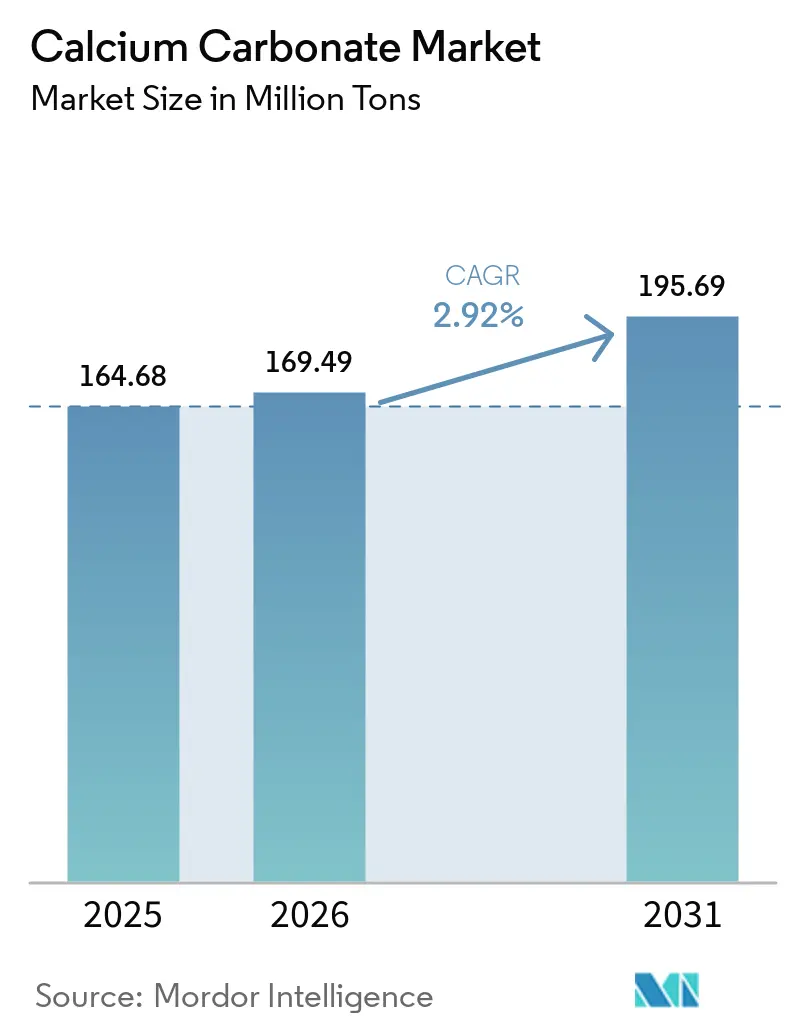
| Market Volume (2026) | 169.49 Million tons |
| Market Volume (2031) | 195.69 Million tons |
| Growth Rate (2026 - 2031) | 2.92 % |
| Fastest Growing Market | Asia-Pacific |
| Largest Market | Asia-Pacific |
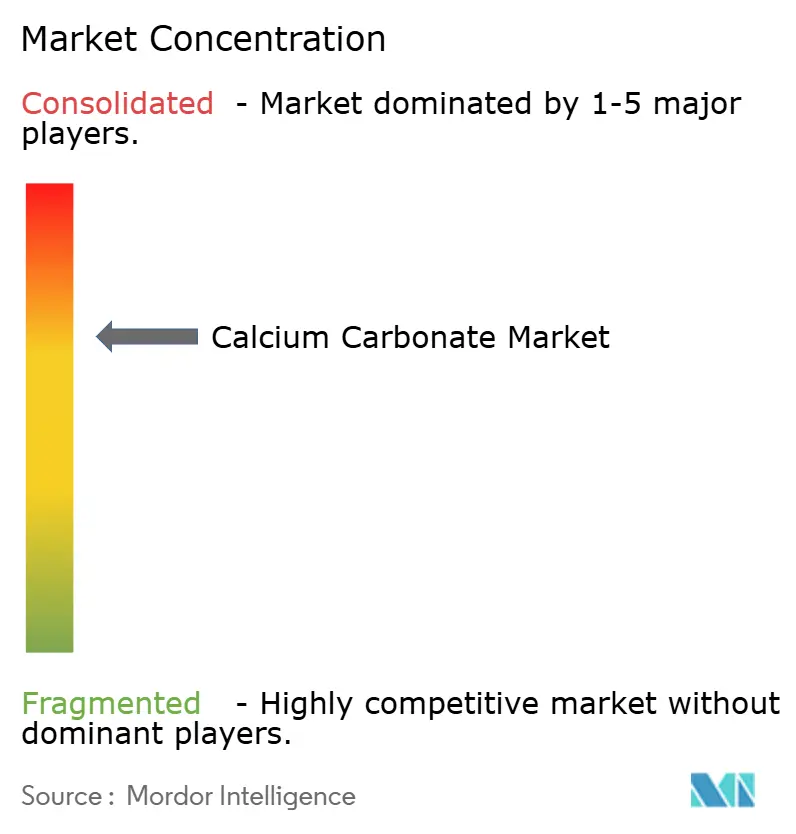
| Market Concentration | Medium |
Major Players *Disclaimer: Major Players sorted in no particular order Image © Mordor Intelligence. Reuse requires attribution under CC BY 4.0. | |
Calcium Carbonate Market Analysis by Mordor Intelligence
Calcium Carbonate market size in 2026 is estimated at 169.49 million tons, growing from 2025 value of 164.68 million tons with 2031 projections showing 195.69 million tons, growing at 2.92% CAGR over 2026-2031. This steady volume-based growth underscores the mineral’s entrenched role as both a cost-saving filler and a performance enhancer in plastics, paper, construction materials, pharmaceuticals, and agriculture. Demand is reinforced by rising infrastructure outlays in emerging economies, sustained packaging and paper requirements tied to e-commerce, and a steady pivot toward health-and-nutrition products that incorporate calcium supplements. Producers with integrated mine-to-application capabilities are benefiting from favorable logistics and the ability to tailor grades to end-use specifications. Meanwhile, environmental regulations are accelerating investment in energy-efficient grinding, low-carbon precipitation lines, and recycled limestone feedstocks, reshaping cost structures across every major region.
Key Report Takeaways
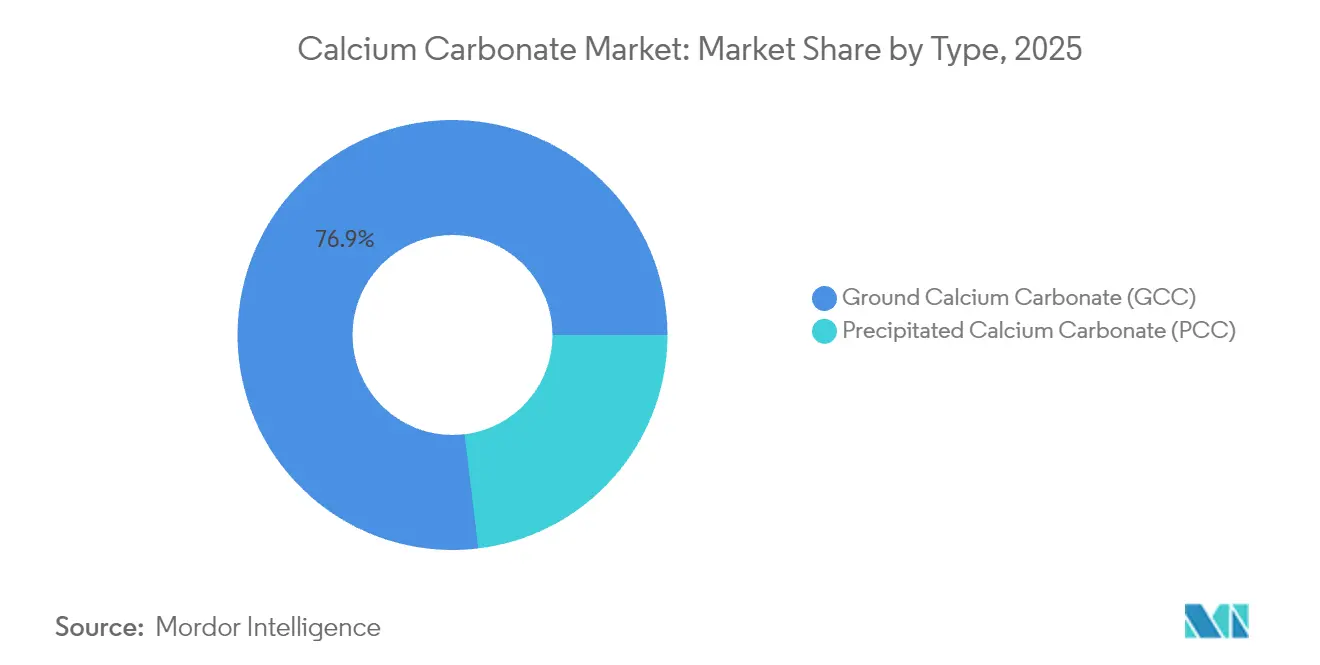
- By type, ground calcium carbonate held 76.92% of the calcium carbonate market share in 2025, while precipitated calcium carbonate is projected to expand at a 4.58% CAGR through 2031.
- By application, filler and pigment uses accounted for 56.60% of the calcium carbonate market size in 2025; dietary supplement applications are forecast to rise at a 3.36% CAGR to 2031.
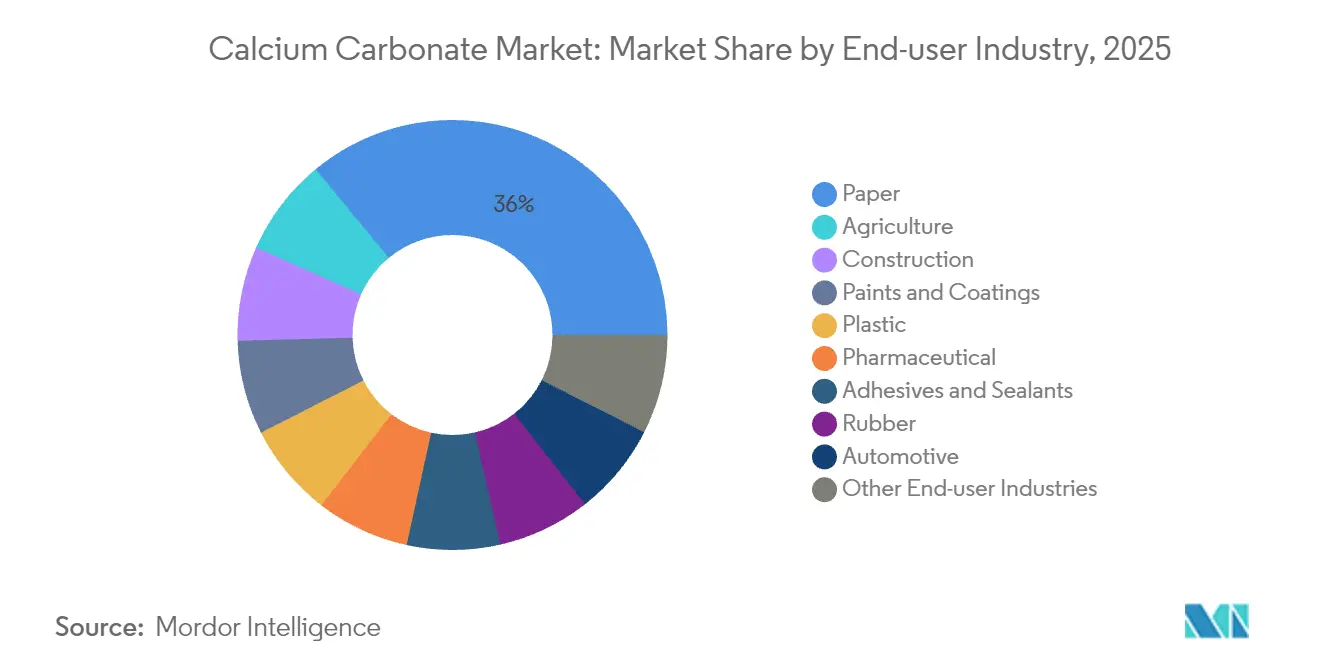
- By end-use industry, the paper sector captured 35.98% revenue share in 2025, whereas agriculture is advancing at a 3.55% CAGR through 2031.
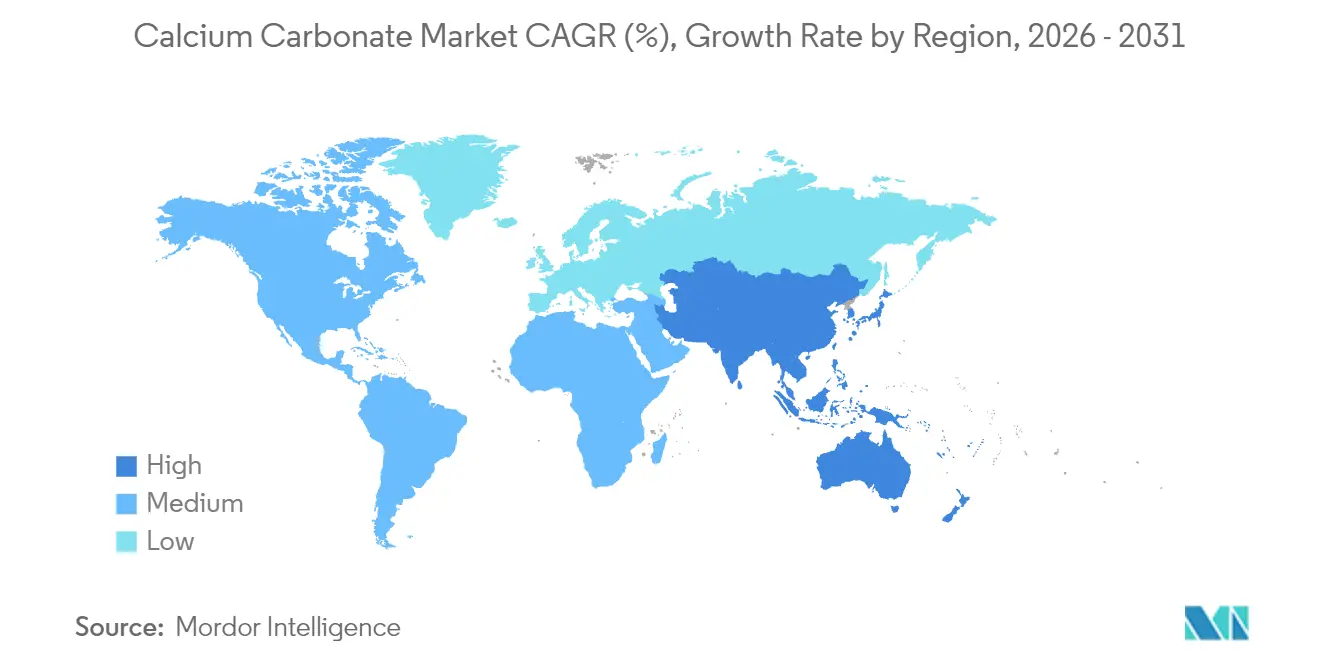
- By geography, Asia-Pacific dominated with 48.25% of global demand in 2025 and leads expansion at a 3.62% CAGR over the outlook period.
Note: Market size and forecast figures in this report are generated using Mordor Intelligence’s proprietary estimation framework, updated with the latest available data and insights as of 2026.
Market Trends and Insights
Drivers Impact Analysis of Calcium Carbonate Market*
| Drivers | (~) % Impact on CAGR Forecast | Geographic Relevance | Impact Timeline |
|---|---|---|---|
| Accelerating construction and infrastructure development | +0.8% | Asia-Pacific core, spill-over to Middle East and Africa | Medium term (2-4 years) |
| Expanding plastic and polymer applications | +0.7% | Global, concentrated in North America and Europe | Long term (≥ 4 years) |
| Growing demand from the paper and packaging industry | +0.5% | Global, emphasis on Asia-Pacific and North America | Short term (≤ 2 years) |
| Rising healthcare and pharmaceutical usage | +0.4% | North America and Europe core, expanding into Asia-Pacific | Long term (≥ 4 years) |
| Source: Mordor Intelligence | |||
Accelerating Construction and Infrastructure Development
Surging public-works spending across Asia-Pacific is boosting the calcium carbonate market as builders seek cost-effective mineral fillers for cement, polymer-modified concrete, architectural coatings, and sealants. Integrated producers have ramped up capacity to meet this requirement: Imerys doubled output at its Sylacauga, Alabama unit to supply construction-grade material and improve lead times for North American customers. Urban planners’ push for low-carbon building materials is also raising demand for products such as ReMined, a 100% pre-consumer recycled calcium carbonate that reduces embodied carbon while maintaining strength and durability benchmarks. These sustainability-linked niches allow sellers to command higher margins even as bulk volumes grow steadily.
Expanding Plastic and Polymer Applications
Rapid advances in nano-scale grinding and surface-treatment chemistries have shifted the performance ceiling for film, masterbatch, and engineered-plastic grades. Nano-calcium carbonate enhances tensile strength, barrier properties, and thermal stability in packaging while preserving clarity, letting converters cut resin intensity by up to 5% on a weight basis. Chinese producer Hubei Micro Crystal New Materials demonstrated how sub-100 nm particles dispersed in biodegradable polymers can both toughen films and fine-tune degradation rates, directly supporting circular-economy packaging mandates. Automotive OEMs and electronics brands are increasingly specifying these functional fillers to meet lightweighting, heat-resistance, and recyclability targets.
Growing Demand from the Paper and Packaging Industry
Despite digitalization trends, board and specialty-sheet production continues to expand in line with e-commerce packaging and hygiene-paper usage. Precipitated grades synthesized from marble waste have achieved superior filler retention, higher brightness, and improved burst strength versus conventional ground grades, as documented in peer-reviewed trials. Paper makers are adopting such value-added formulations to reduce fiber consumption and energy load during calendaring, reinforcing the calcium carbonate market as an enabler of cost control and performance upgrades.
Rising Healthcare and Pharmaceutical Usage
Specialty precipitated calcium carbonate grades with tightly controlled particle size and porosity are gaining momentum in chewable tablets, controlled-release drug carriers, and functional foods. Researchers have shown that porous particles can encapsulate actives and release them in a pH-responsive manner, improving bioavailability while minimizing excipient load[1]. Growing awareness of osteoporosis and an aging population underpin sustained demand for high-purity, food-grade supplies that meet FDA 21 CFR and European Pharmacopoeia specifications, giving established producers with cGMP facilities a competitive edge.
Restraints Impact Analysis of Calcium Carbonate Market*
| Restraints | (~) % Impact on CAGR Forecast | Geographic Relevance | Impact Timeline |
|---|---|---|---|
| Health Hazards Associated with Calcium Carbonate | -0.3% | Global, with stricter enforcement in Europe and North America | Short term (≤ 2 years) |
| Environmental and Mining Regulations | -0.5% | Global, with particular emphasis on Europe and developed markets | Medium term (2-4 years) |
| Logistics and Supply Chain Challenges | -0.4% | Global, with acute impact on Asia-Pacific to North America trade routes | Short term (≤ 2 years) |
| Source: Mordor Intelligence | |||
Health Hazards Associated with Calcium Carbonate
Worker exposure to respirable calcium carbonate dust has sharpened regulatory oversight, prompting lower permissible exposure limits and more stringent containment norms in mills and downstream plants. Nanoparticle toxicology remains under study, and approvals for food or pharma applications now routinely require extensive risk assessments, which can prolong commercialization timelines and inflate compliance costs. Small producers with limited capital often struggle to install closed-loop handling and high-efficiency filtration, constraining supply flexibility.
Environmental and Mining Regulations
Quarry operators face stricter licensing criteria that mandate biodiversity offsets, water-table monitoring, and rehabilitation plans, particularly in Europe, where limestone deposits intersect sensitive karst landscapes. Producers are responding with life-cycle assessments, in-pit crushing to curb truck traffic, and investments in alternative feedstocks such as reclaimed marble fines. The University of Oulu’s wastewater-treatment study further shows how industrial residues can substitute virgin limestone for pollutant removal, supporting circular-materials strategies. While these measures enhance sustainability credentials, they also elevate fixed costs and elongate permitting schedules.
*Our forecasts treat driver/restraint impacts as directional, not additive. The impact forecasts reflect baseline growth, mix effects, and variable interactions.
Calcium Carbonate Market Segment Analysis
By Type:
Ground Calcium Carbonate Dominance Faces Precipitated Calcium Carbonate (PCC) InnovationGround calcium carbonate continues to anchor the calcium carbonate market, claiming 76.92% of 2025 demand thanks to abundant limestone deposits and low-energy milling routes. In volume-driven sectors such as basic paper, polyolefin film, and ready-mix concrete, GCC’s favorable price-performance ratio remains decisive. Yet precipitated calcium carbonate is setting the pace with a 4.58% CAGR through 2031 as customers pay premiums for narrow particle-size distribution, higher brightness, and customizable surface chemistry. This shift was underscored when researchers achieved enzyme-induced precipitation using soybean urease, signaling cost-reduction paths that could widen PCC’s reach.
Mature GCC producers are therefore retooling plants with classified grinding systems and dry-coating units to edge closer to PCC performance without incurring the steep capex of carbonation reactors. Meanwhile, PCC suppliers are scaling captive carbon-dioxide recovery and renewable-energy inputs to shrink their carbon footprint, an increasingly important procurement criterion for multinational customers. As these strategies converge, competitive intensity is rising, but the calcium carbonate market size for both sub-segments is projected to expand steadily, given differentiated demand profiles across construction, plastics, and life-science industries.

By Application:
Specialty Segments Drive GrowthFiller and pigment applications accounted for 56.60% of the calcium carbonate market size in 2025, anchored by bulk consumption in paper coating and polymer compounding lines. Nonetheless, dietary supplement use is growing faster at a 3.36% CAGR, reflecting consumer interest in bone health and the scaling of fortified foods and beverages. Manufacturers supplying chewable tablets and milk powder fortificants seek ultra-low-lead PCC grades, fostering higher-margin opportunities.
Thermoplastic additives are another bright spot, where nano-scale GCC helps producers hit lightweighting targets and lowers polypropylene consumption in auto interiors. Construction material uses enjoy steady support from global infrastructure budgets, while soil-neutralization demand tracks the adoption of regenerative farming practices. In the adhesives space, substrate-specific rheology tuning enables calcium carbonate fillers to replace more expensive synthetic thickeners in water-borne systems. Collectively, these specialty outlets are diluting the calcium carbonate market’s historical reliance on paper, improving its resilience to digital substitution risk.
By End-user Industry:
Agriculture Emerges as Growth LeaderPaper remained the single largest outlet, controlling 35.98% of 2025 demand, yet its share has begun to erode as sustainable farming practices expand calcium carbonate uptake in agriculture. The segment’s 3.55% CAGR is linked to heightened attention on soil acidification and crop-yield optimization. Cemex USA’s pelletized products illustrate how finely milled material enables precision spreading and faster pH correction, enhancing nutrient uptake in row crops.
Plastics, paints, and construction remain indispensable demand pillars, each benefiting from unique performance attributes ranging from scratch resistance in automotive bumpers to rheology control in architectural coatings. Pharmaceuticals and nutraceuticals command premium pricing but require validated manufacturing environments. Rubber compounding and flue-gas-desulfurization systems round out the portfolio, giving the calcium carbonate market diversified end-use exposure that smooths cyclical swings in any single sector.
Geography Analysis
APAC Calcium Carbonate Market
Asia-Pacific dominated the calcium carbonate market with a 48.25% share in 2025 and is projected to advance at a 3.62% CAGR through 2031. China accounts for the lion’s share of regional demand; Imerys operates facilities in Wuhu, Qingyang, and Yueyang to supply packaging, construction, and life-science customers. Southeast Asian economies are also adding coated-board and PVC-pipe capacity, broadening the regional demand base.
The Americas and EMEA Calcium Carbonate Market
North America maintains a solid foothold owing to advanced plastics and pharmaceutical supply chains that prioritize technical grades and stringent quality control. Recent investments in Alabama and Georgia underscore the region’s appetite for localized supply that cuts freight emissions and ensures rapid technical support. Europe’s stringent carbon-reduction and quarry-rehabilitation rules make recycled feedstocks and energy-efficient precipitation plants critical. South America is leveraging construction booms in Brazil and Argentina alongside agribusiness growth that lifts soil-treatment consumption. The Middle East sees steady demand from petrochemical complexes and large-scale infrastructure projects, while Africa’s quarrying potential remains underdeveloped but promising, particularly in Egypt, Nigeria, and South Africa. Geographic dispersion of high-grade limestone deposits will continue to influence trade flows and regional pricing, but localized precipitation units and upgraded grinding hubs are gradually trimming transport intensity across the global calcium carbonate market.
Regulatory Landscape
Calcium carbonate producers work within a mix of chemical, environmental, and end-use safety frameworks that affect permitting, operating costs, and grade qualification. In the European Union, REACH (Regulation (EC) No 1907/2006) remains central for substance registration and downstream user compliance, while climate policy is also shaping trade documentation. The EU Carbon Border Adjustment Mechanism (CBAM) starts applying from 2026 for covered goods, pushing suppliers to improve emissions traceability across energy-intensive processing routes.
Regulatory anchors also differ by application and geography. In China, the Ministry of Industry and Information Technology implemented HG/T 2776-2025 on 2026-07-01, tightening technical requirements for fine precipitated calcium carbonate and activated precipitated calcium carbonate used in industrial applications. In the United States, operations are shaped by federal requirements including US EPA effluent guidelines for calcium carbonate production under 40 CFR Part 415 Subpart AD. For food uses, FDA provisions such as 21 CFR 73.70 govern color additive usage conditions, which reinforces the need for documented quality systems for high-purity grades.
Value Chain Analysis
The calcium carbonate value chain begins with securing mineral feedstocks (limestone, chalk, or marble) through quarrying and beneficiation. It then splits into mechanical processing for ground calcium carbonate (crushing, milling, and classification) or chemical processing for precipitated calcium carbonate (calcination to quicklime, slaking, and carbonation). For GCC, competitiveness depends on deposit quality, proximity to end users, and energy-efficient grinding and coating. For PCC, reliable CO2 sourcing and tight process control support particle engineering for paper, plastics, and life-science specifications.
Downstream distribution relies on bulk trucking, rail, marine transport, and bags. Many leaders also run application labs and technical service to reduce formulation switching. The market also includes on-site and near-site models in paper and board, where producers build satellite PCC plants to reduce logistics exposure and stabilize supply, a structure commonly associated with large integrated suppliers such as Omya, Imerys, Minerals Technologies, and Huber Engineered Materials. Environmental compliance, including dust control, water use, and wastewater standards, remains a recurring cross-chain constraint, highlighted in the United States by EPA point-source requirements for calcium carbonate production facilities under 40 CFR Part 415 Subpart AD.
Competitive Landscape
The calcium carbonate market features partial consolidation: top multinationals such as Imerys, Omya, and Minerals Technologies combine mining rights, global processing footprints, and application laboratories to deliver consistent quality and customized grades. These players are enhancing resilience through on-site carbon-capture units that supply CO₂ for PCC lines and through digital twins that optimize mill energy use. Sustainability credentials increasingly influence purchase decisions. Firms with validated life-cycle footprints, renewable-energy sourcing, and closed-loop water systems report smoother permitting for expansions. The introduction of EU Carbon Border Adjustment Mechanism (CBAM) from 2026 will reward calcium carbonate exporters that can document low upstream emissions, reinforcing the strategic advantage of energy-efficient precipitation and value-added recycling routes.
Calcium Carbonate Industry Leaders
-
Imerys
-
Sibelco
-
Huber Engineered Materials
-
Minerals Technologies Inc.
-
Omya International AG
- *Disclaimer: Major Players sorted in no particular order
Calcium Carbonate Market Companies Covered in this Report
- ACCM
- GCCP Resources Limited
- Gulshan Polyols Ltd.
- Huber Engineered Materials
- Imerys
- Jordan Carbonate Company
- Manaseer Group
- Minerals Technologies Inc.
- Niğtaş
- OKUTAMA KOGYO CO.,LTD.
- Omya International AG
- Provencale SA
- SaudiCarbonate
- SCHAEFER KALK GmbH & Co. KG
- Shiraishi Group
- Sibelco
- SigmaRoc Plc
- VMPC Joint Stock Company.
- Zantat Sdn. Bhd.
Market Opportunities and Future Outlook
Opportunity is building around on-site and captive PCC supply models that reduce freight intensity and improve runnability for paper and board lines. A concrete example is Kuantum Papers commissioning an expansion in February 2026 that doubled PCC output at its facility from 25,000 to 50,000 TPA, including added storage and a second reactor line, showing how end users are securing in-house filler supply and process stability. Similar opportunities extend to plastics compounding and coatings, where consistent particle-size distribution, surface treatment, and tight impurity control enable higher-value grades rather than commodity GCC.
Green and circular routes are also becoming more commercial as concrete, construction chemicals, and packaging buyers formalize decarbonization requirements in procurement. Holcim invested in Vateris in April 2026 to scale technology that converts flue gas CO2 into calcium-based additives for ready-mix and precast concrete, indicating how CO2 mineralization can complement conventional calcium carbonate supply while adding new performance-led additives for construction applications. In emerging supply hubs, localized processing investment continues to appear, including the March 2026 commissioning of a 3 t/h ring-roller grinding plant for a GCC producer in Minya, Egypt, which highlights both near-resource processing and import-substitution demand tied to construction and plastics filler use.
Recent Industry Developments in Calcium Carbonate Market
- April 2026: Imerys entered into a binding agreement to acquire Great Lakes Minerals, a US-based mineral processor serving refractory and abrasive end markets. The deal broadens Imerys presence in specialty minerals adjacent to calcium carbonate, strengthening its ability to bundle engineered mineral solutions across industrial applications. It also supports portfolio positioning toward higher-value, performance-driven segments rather than purely volume-led filler demand.
- October 2025: CarbonFree and Univar Solutions signed a letter of intent to expand distribution of endurocal, described as a carbon-neutral, mine-free calcium carbonate alternative. The arrangement improves market access for lower-carbon mineral inputs through an established chemical distribution network, helping downstream customers operationalize decarbonization targets in formulations. It also increases competitive pressure on conventional GCC and PCC suppliers to document footprints and offer circular or low-carbon grades.
- April 2024: Omya International AG implemented a price increase for calcium carbonate products in Europe, linked to sustainability initiatives and continued support for paper and board customers. The action reflects cost pass-through dynamics in energy- and logistics-sensitive processing and reinforces the importance of regional supply reliability for large-volume paper applications. It also signals continued investment and service prioritization in core European end-use chains despite broader digitization pressures on paper demand.
Calcium Carbonate Market Report Scope and Research Methodology
Market Definition and Coverage
For this study, the calcium carbonate market covers demand for calcium carbonate supplied as a material input across industrial and consumer uses, measured in value terms, and tracked across major producing and consuming regions.
Scope exclusions: We exclude mined limestone and other calcium-bearing minerals that are not processed and sold as calcium carbonate, and we also exclude downstream finished goods where calcium carbonate is only a minor ingredient.
Segments Covered in This Report
- Type
- Ground Calcium Carbonate (GCC)
- Precipitated Calcium Carbonate (PCC)
- Application
- Raw Substance for Construction Material
- Dietary Supplement
- Additive for Thermoplastics
- Filler and Pigment
- Component of Adhesives
- Desulfurization of Fuel Gas
- Neutralizing Agent in Soil
- Other Applications
- End-user Industry
- Paper
- Plastic
- Adhesives and Sealants
- Construction
- Paints and Coatings
- Pharmaceutical
- Automotive
- Agriculture
- Rubber
- Other End-user Industries
- Geography
- Asia-Pacific
- China
- India
- Japan
- South Korea
- ASEAN Countries
- Australia and New Zealand
- Rest of Asia-Pacific
- North America
- United States
- Canada
- Mexico
- Europe
- Germany
- United Kingdom
- France
- Italy
- Russia
- Rest of Europe
- South America
- Brazil
- Argentina
- Rest of South America
- Middle-East
- Saudi Arabia
- United Arab Emirates
- Iran
- Iraq
- Kuwait
- Qatar
- Rest of the Middle-East
- Africa
- South Africa
- Rest of Africa
- Asia-Pacific
Data Sources, Market Sizing, and Validation
Desk Research
Desk research was used to set the market boundaries, build the initial demand map, and anchor assumptions that can be checked against public data. We referred to sources such as the USGS for industrial mineral production notes, the United States International Trade Commission trade statistics, UN Comtrade trade flows, the US EPA air and water program references linked to industrial uses, and peer-reviewed papers that discuss filler loadings in paper, plastics, and coatings.
On top of this, we used company annual reports, investor presentations, plant announcements, and trade association pages to understand capacity moves and application trends. A paid subscription for company financials and intelligence helped us normalize private company visibility, while a patent database was used selectively to sense innovation intensity around precipitated routes and performance grades. These desk sources are not exhaustive, and we reviewed many other public documents to collect data points, validate assumptions, and clarify inconsistencies.
Primary Interviews and Surveys
Primary work was carried out through expert interviews and structured surveys with a mix of producers, distributors, and large end users across paper, plastics, construction materials, and paints and coatings. We used these discussions to validate real pricing behavior, typical grade mixes, and what drives switching between ground and precipitated forms, and then used follow-ups when desk signals and field feedback did not align.
Distribution of primary research fieldwork respondents
| Company type | Respondent position | Region |
|---|---|---|
| Top tier: 31% | CXOs: 13% | APAC: 52% |
| Mid tier: 55% | Functional/Unit leaders: 32% | EMEA: 29% |
| Smaller Players: 14% | Managers: 55% | Americas: 19% |
Market-Sizing & Forecasting
Sizing starts with a top-down reconstruction where production and trade signals are translated into an apparent consumption pool by region, and then split using application intensity and typical calcium carbonate loading rates. To keep the model grounded, the totals are corroborated with selective bottom-up checks, such as sampled supplier revenue splits where available, capacity utilization sense checks, and volume times average selling price builds for key applications.
Inputs that materially affect the totals include mine and plant capacity additions, the share of precipitated versus ground material, import dependence in net consuming regions, average selling price ranges by grade and end use, and demand indicators from paper production, plastics conversion, and construction activity. Where bottom-up visibility is incomplete, gaps are handled through conservative utilization and mix assumptions that were validated in calls, and then adjusted if they break known trade or production constraints.
For forecasting, scenario analysis is used so demand can be flexed under different paper substitution rates, plastics growth paths, and construction cycles, and then refined with expert consensus on which drivers are likely to dominate in each region. The final forecast keeps a consistent currency treatment and applies price progression that reflects the observed lag between energy, freight, and contract price resets.
Data Validation & Update Cycle
Model outputs are checked against independent signals such as trade balances, capacity announcements, and the implied per-capita consumption levels in major countries, and any sharp variance is investigated before numbers are finalized. When inconsistencies show up, we re-check unit conversions, re-test price and mix inputs, and re-contact selected participants to confirm whether the change is real or just timing noise.
Before publication, the work is reviewed in steps, with a second analyst checking calculations and assumption logic, followed by a final sign-off pass that focuses on outliers and scope compliance. Reports are refreshed annually, and interim updates are made when there are material events such as large plant start-ups, major shutdowns, or policy shifts that can move trade and pricing.
Mordor Intelligence's Calcium Carbonate Market Size Compared Against Other Published Estimates
Published market numbers for calcium carbonate often differ because the counted scope is not identical, and because price and mix assumptions can move totals a lot in a commodity-like material. Differences also come from whether the study is value-led or volume-led, which year currency conversion is applied, and how aggressively the forecast path is built.
The table shows a noticeable spread, and in the Mordor Intelligence model the market is monetized from a volume base using application-level mix and average selling price logic rather than treating all tons as a single blended price, which can pull the value estimate away from approaches that use broader pricing averages.
Benchmark comparison
| Source | Market Size | Gaps in Research Methodology |
|---|---|---|
| Mordor Intelligence | USD 0.00 B (2026) | |
| Global Research House A | USD 50.57 B (2024) | Uses a 2024 base year with a faster price and demand expansion curve, and the scope tends to read as a broad value market without clearly separating grade mix and application pricing differences. |
| Industry Data Publisher B | USD 50.48 B (2024) | Reports a single 2024 base value with limited visibility on the conversion from volume to value, which can over-smooth regional pricing and understate mix shifts between ground and precipitated material. |
Overall, the gap mostly comes down to how value is constructed from tons, along with the base year timing and how much grade and end-use mix is allowed to shift over the forecast. By tying the market to observable demand drivers and then testing the result against production, trade, and field feedback, the estimate stays traceable and repeatable even when individual inputs need to be updated.
Key Questions Answered in the Report
What is the projected demand for calcium carbonate by 2031?
Consumption is expected to reach 195.69 million tons by 2031, rising at a 2.92% CAGR from 2026.
Which region will lead future growth?
Asia-Pacific is set to post the fastest regional expansion at 3.62% CAGR, supported by infrastructure projects and manufacturing output gains.
Which segment is growing fastest within plastics?
Nano-calcium carbonate grades for high-clarity films and biodegradable polymers are registering the highest uptake due to performance and sustainability benefits.
Why is agriculture a high-growth end-use?
Farmers are increasingly applying calcium carbonate to neutralize acidic soils and boost nutrient absorption, driving a 3.55% CAGR in the sector.
How are environmental rules affecting suppliers?
Stricter quarry and emission standards are pushing producers to adopt recycled feedstocks and energy-efficient precipitation, raising capex but enhancing sustainability positioning.