
Feed Flavors, Sweeteners, and Natural Enhancers Market Size and Share
Market Overview
| Study Period | 2021 - 2031 |
|---|---|
| Market Size (2026) | USD 2.65 Billion |
| Market Size (2031) | USD 3.36 Billion |
| Growth Rate (2026 - 2031) | 4.87 % |
| Fastest Growing Market | Asia-Pacific |
| Largest Market | Asia-Pacific |
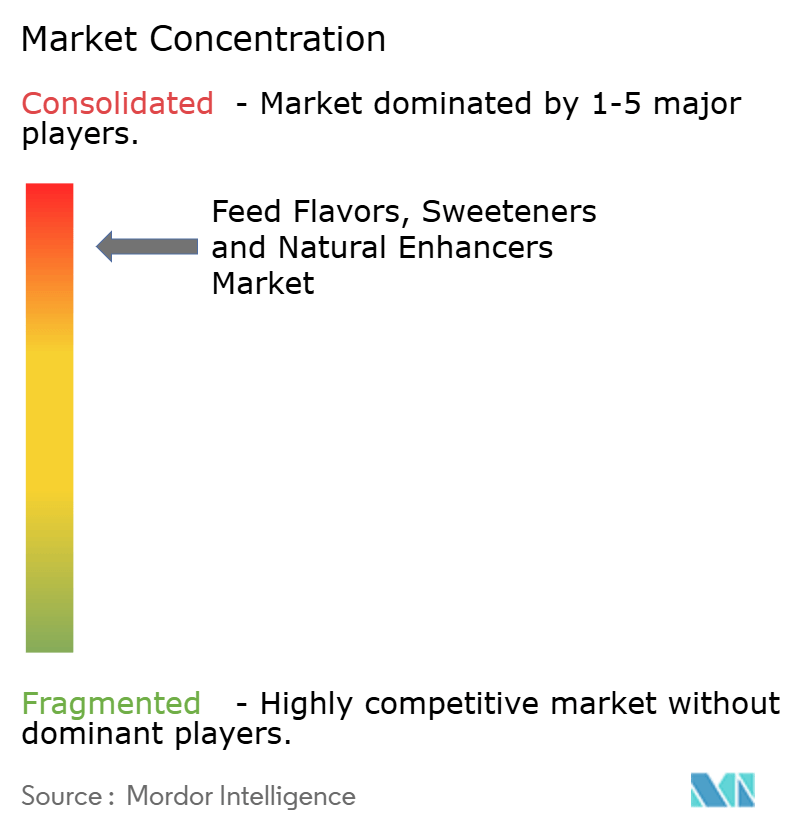
| Market Concentration | Medium |
Major Players *Disclaimer: Major Players sorted in no particular order Image © Mordor Intelligence. Reuse requires attribution under CC BY 4.0. | |
Feed Flavors, Sweeteners, and Natural Enhancers Market Analysis by Mordor Intelligence
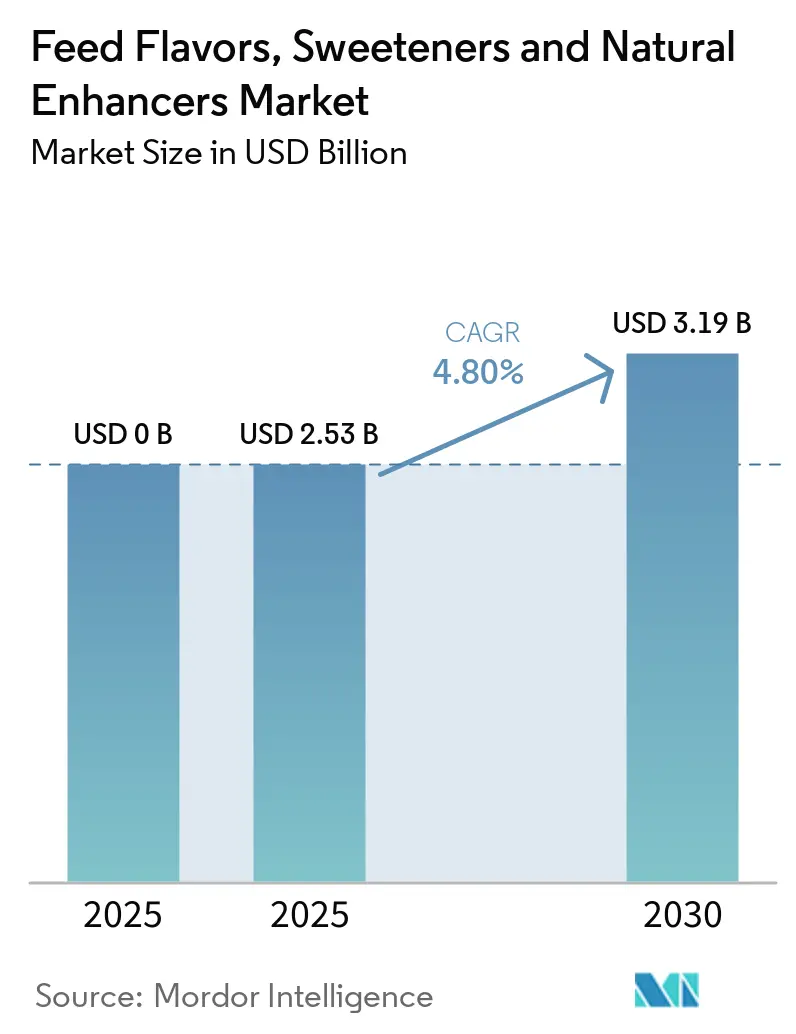
The feed flavors, sweeteners, and natural enhancers market size was valued at USD 2.53 billion in 2025 and is projected to reach USD 2.65 billion in 2026 and USD 3.36 billion by 2031, growing at a CAGR of 4.87% from 2026 to 2031. Rising animal protein production is driving greater demand for commercial compound feed, particularly in poultry and aquaculture, where intensive production systems rely heavily on nutritionally balanced formulated feeds to support growth, feed efficiency, and production yields. This change increases the need to manage feed odor, taste, and intake when formulations contain denser nutrient packages or unfamiliar raw materials. Suppliers are responding with blends that combine flavor, sweetness, masking, and functional natural ingredients. Encapsulation and species-specific formulation are also becoming more important, where heat processing or variable feed ingredients can reduce sensory consistency. The feed flavors, sweeteners, and natural enhancers market, as a result, benefits from both growth in livestock and aquaculture production and the increasing need to maintain feed palatability.
Key Report Takeaways
- By product type, flavors were the largest product type, accounting for 37.4% of the feed flavors, sweeteners, and natural enhancers market share in 2025, while sweeteners are forecast to be the fastest-growing product type, with a CAGR of 5.6% from 2026 to 2031.
- By source, synthetic ingredients were the largest segment, accounting for 61.9% of the market in 2025, while natural ingredients are forecast to be the fastest-growing segment, with a CAGR of 6.3% from 2026 to 2031.
- By animal type, poultry was the largest animal type, accounting for 44.2% of the feed flavors, sweeteners, and natural enhancers market size in 2025, while aquaculture is forecast to be the fastest-growing animal type, with a CAGR of 8.2% from 2026 to 2031.
- By geography, Asia-Pacific was the largest region, accounting for 33.6% of the feed flavors, sweeteners, and natural enhancers market in 2025, and is forecast to be the fastest-growing region, with a CAGR of 8.4% from 2026 to 2031.
Note: Market size and forecast figures in this report are generated using Mordor Intelligence’s proprietary estimation framework, updated with the latest available data and insights as of January 2026.
Market Trends and Insights
Drivers Impact Analysis of Feed Flavors, Sweeteners, and Natural Enhancers Market*
| Driver | (~) % Impact on CAGR Forecast | Geographic Relevance | Impact Timeline |
|---|---|---|---|
| Rising demand for animal protein | +1.4% | Global | Long term (≥ 4 years) |
| Higher feed intake and performance requirements | +0.8% | Global, intensive in Asia-Pacific and North America | Short term (≤ 2 years) |
| Growth of antibiotic-free and natural production systems | +1.0% | European Union, North America, and Asia-Pacific | Medium term (2-4 years) |
| Intensification of aquaculture and young-animal feeding | +0.7% | Asia-Pacific and South America | Medium term (2-4 years) |
| Heat-stable encapsulation and precision sensory formulation | +0.5% | North America, European Union, and Asia-Pacific | Long term (≥ 4 years) |
| Formulation complexity from alternative protein and circular feed ingredients | +0.4% | Global | Long term (≥ 4 years) |
| Source: Mordor Intelligence | |||
Rising Demand for Animal Protein
Demand for animal protein remains a durable source of demand for the feed flavors, sweeteners, and natural enhancers market, supported by population growth, rising household incomes, urbanization, and dietary shifts toward higher-protein foods. These trends are particularly pronounced in developing Asian economies, where improving purchasing power is increasing the consumption of meat, poultry, and other animal-based foods. Global meat production is projected to increase by 13%, or 46 million metric tons, to 406 million metric tons by 2034, with Asia accounting for 55% of this growth, further supporting demand for commercial animal feed and associated feed flavor, sweetener, and natural enhancer products[1]. Higher output requires greater use of standardized compound feed rather than farm-mixed rations. These feeds often contain tighter amino acid balances, added minerals, and premixes that can reduce voluntary intake when their sensory profile is not controlled. The feed flavors, sweeteners, and natural enhancers market benefits because feed producers need additives that limit unpleasant notes without disrupting nutritional specifications. Suppliers are also offering flavor and sweetener combinations that support intake and complement gut health formulations.
Higher Feed Intake and Performance Requirements
Commercial livestock operators are focusing more closely on feed conversion ratio (FCR), as energy and protein costs remain significant operating expenses. A 2025 review reported that sweeteners increased feed intake by 18% to 26% in weaning-phase swine, supporting early growth and reducing the post-weaning intake decline. Poultry producers seeking an FCR below 1.7 also value more uniform feed intake, as it can reduce downgrading at slaughter. Flavor supplementation is being used by large dairy operations in India and the Middle East, where heat stress reduces dry matter intake during lactation. These conditions move palatability from a discretionary formulation choice toward a more regular part of feed design. This supports demand in the feed flavors, sweeteners, and natural enhancers market for ingredients that work across different species and production settings.
Growth of Antibiotic-Free and Natural Production Systems
The phase-out of antibiotic growth promoters (AGP) has given palatability a more functional role in livestock diets. A 2025 review found that phytogenic feed additives (PFA), including terpenoids, polyphenols, and phenolics, can influence the gut microbiota and exert antimicrobial effects that partly replace AGP-related responses[2]. These ingredients can still require flavor masking to maintain consistent feed intake. Regulation (EC) No. 1831/2003 and the European Food Safety Authority's authorization framework govern the use of new sensory additives and phytogenic ingredients in the European Union. The resulting demand is more pronounced for botanical enhancers that offer both palatability and functional positioning than for standard flavor ingredients. The Food and Agriculture Organization reported that 20% members of the World Organization for Animal Health still reported antimicrobial use for growth promotion, indicating that regulatory pressure will continue beyond established markets.
Intensification of Aquaculture and Young-Animal Feeding
Aquaculture capacity continues to expand, particularly for shrimp, salmon, tilapia, and pangasius in Asia-Pacific. Replacing fishmeal with plant protein and newer protein sources can introduce unfamiliar tastes that reduce feed acceptance. Young piglets, early-phase broilers, and post-larval shrimp can be especially responsive to sensory cues because their feeding behavior is still developing. Carnivorous finfish respond more strongly to amino acid-based umami attractants, while sweetener-led systems are more relevant for some omnivorous species. This means suppliers need distinct formulations instead of a universal aquafeed product. Research on phytogenic compounds also supports their nutritional and palatability role across ruminant and monogastric systems.
Restraints Impact Analysis of Feed Flavors, Sweeteners, and Natural Enhancers Market*
| Restraint | (~) % Impact on CAGR Forecast | Geographic Relevance | Impact Timeline |
|---|---|---|---|
| High cost of natural and encapsulated additives | -1.3% | Global, most acute in Africa and South America | Short term (≤ 2 years) |
| Limited awareness and technical service in emerging markets | -0.9% | Africa, Middle East, and parts of South America | Long term (≥ 4 years) |
| Inconsistent raw-material sensory profiles | -0.6% | Global | Medium term (2-4 years) |
| Species-specific regulatory and labeling constraints | -0.7% | European Union, China, and North America | Medium term (2-4 years) |
| Source: Mordor Intelligence | |||
High Cost of Natural and Encapsulated Additives
Natural botanical extracts and microencapsulated products carry a 40% to 60% price premium over standard synthetic grades. This premium limits adoption in markets where compound feed margins are under pressure from commodity price volatility. Liquid encapsulated products can require cold-chain and moisture-control systems, adding 8% to 12% to landed costs in some cases. The economic case can be particularly difficult in tropical markets where farm-level budgets remain tight. Suppliers are developing partly synthetic and natural blends to provide a more accessible option. These products can improve price competitiveness, although they may not meet all requirements for premium antibiotic-free certification.
Limited Awareness and Technical Service in Emerging Markets
Limited awareness and limited technical service can constrain the adoption of feed flavors, sweeteners, and natural enhancers in emerging livestock markets across Africa and the Middle East. Farmers and small- to medium-sized feed mills may lack the formulation expertise and performance data needed to evaluate how sensory additives can improve feed acceptance, intake, or production outcomes. As a result, purchasing decisions may remain primarily cost-driven rather than based on demonstrated formulation benefits and return on investment. Technical support from larger suppliers may also be concentrated in established compound-feed markets, leaving some developing regions with fewer opportunities for product trials, formulation guidance, and on-farm validation. This limitation can be more significant when variable-quality or less palatable feed ingredients create sensory challenges. Wider adoption will therefore depend on localized field trials, formulation support, and practical evidence demonstrating the economic benefits of using sensory additives under regional livestock and feeding conditions.
*Our forecasts treat driver/restraint impacts as directional, not additive. The impact forecasts reflect baseline growth, mix effects, and variable interactions.
Feed Flavors, Sweeteners, and Natural Enhancers Market Segment Analysis
By Product Type:
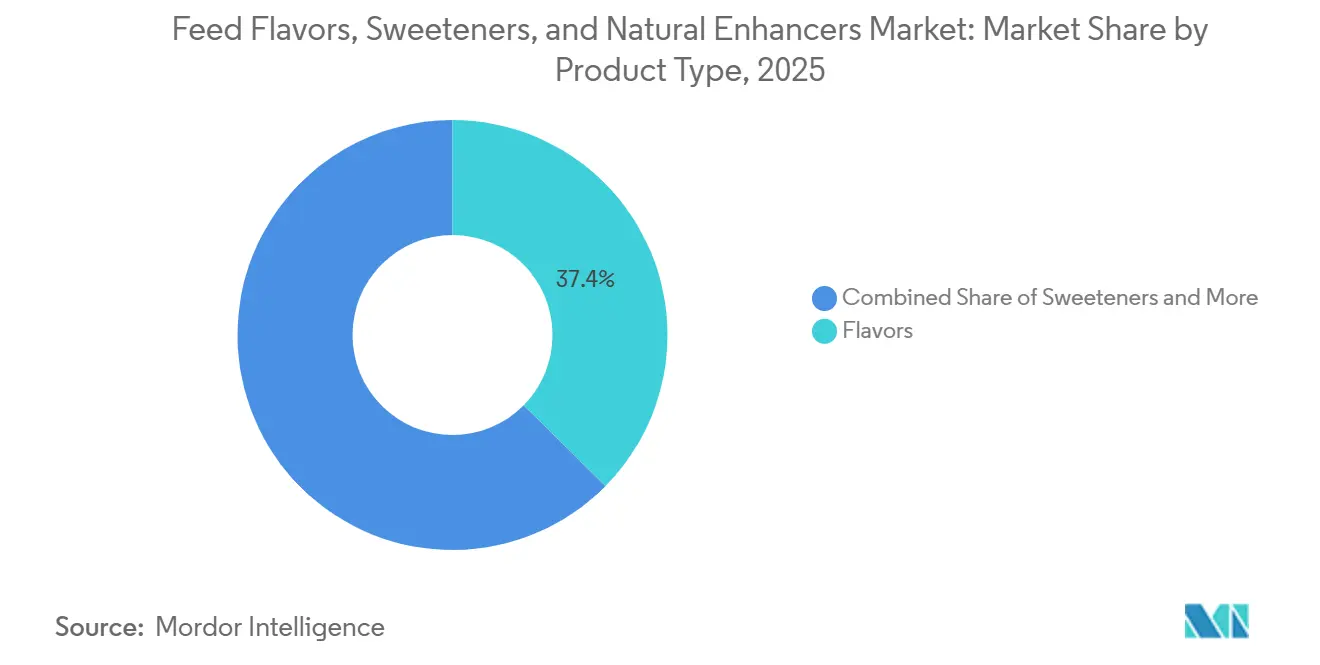
Flavors are Largest and Sweeteners are FastestFlavors were the largest product type, accounting for 37.4% of the feed flavors, sweeteners, and natural enhancers market share in 2025. Their leading position is supported by their broad application across major animal species and feed stages, including dairy cattle transition diets, broiler starter diets, swine feed, and aquafeed. Flavors address multiple sensory challenges by improving aroma, masking undesirable off-notes, and supporting feed acceptance when animals experience dietary changes, stress, or exposure to less-palatable ingredients. This broad functionality allows flavors to be incorporated across a wider range of commercial feed formulations than products used for more specific sensory requirements, supporting their larger overall demand base. Natural enhancers, including botanical extracts, yeast-derived compounds, and fermentation-based palatants, are increasingly used for additional functional benefits related to oxidative stress, immune response, and microbial balance. Suppliers are also combining flavor and natural-enhancer functionalities into integrated sensory solutions, further expanding the role of flavors within premium feed-additive formulations.
Sweeteners are forecast to be the fastest-growing product type, growing at a CAGR of 5.6% from 2026 to 2031. Their strongest uses are in swine nursery diets and aquafeed starter rations, where early feed intake can affect later feed conversion ratio (FCR) performance. Saccharin, neohesperidin dihydrochalcone, and plant-derived steviol glycosides are being evaluated across species. Stevia-based options have appeal in antibiotic-free systems that value naturally positioned ingredients. Large swine operators in China, Germany, and Brazil use intake support as a direct production lever during the weaning period. Across product types, compound feed manufacturers are seeking multi-component solutions that reduce formulation complexity and simplify supplier management. This preference is reshaping purchasing priorities in the feed flavors, sweeteners, and natural enhancers market.

By Source:
Synthetic is Largest and Natural is FastestSynthetic ingredients were the largest segment, accounting for 61.9% of the feed flavors, sweeteners, and natural enhancers market size in 2025. Price consistency, repeatable batches, and long-standing familiarity among feed formulators support their position. Synthetic high-intensity sweeteners such as saccharin and neohesperidin dihydrochalcone offer reliable performance at low inclusion levels. They are compatible with standard mixing, pelleting, and storage processes. Synthetic aroma compounds can replicate vanilla, strawberry, and milk profiles used in young-animal starter feed. Commodity livestock systems are likely to retain these ingredients because margin pressure limits the acceptable cost per metric ton of feed.
Natural ingredients are forecast to be the fastest-growing source segment, growing at a CAGR of 6.3% from 2026 to 2031. Meat, dairy, and aquaculture producers increasingly seek traceable inputs for claims that avoid specified ingredients. Botanical flavors, essential oil plants, yeast autolysates, and fermentation-derived attractants support this demand. Research on phytogenic feed additives supports their dual roles of palatability and antimicrobial activity in livestock production[3]. Natural definitions vary across jurisdictions, creating uncertainty in product positioning. Suppliers with traceability systems and third-party certification can target the premium portion of the feed flavors, sweeteners, and natural enhancers industry. Their pricing position is generally stronger than for commodity natural extracts.
By Animal Type:
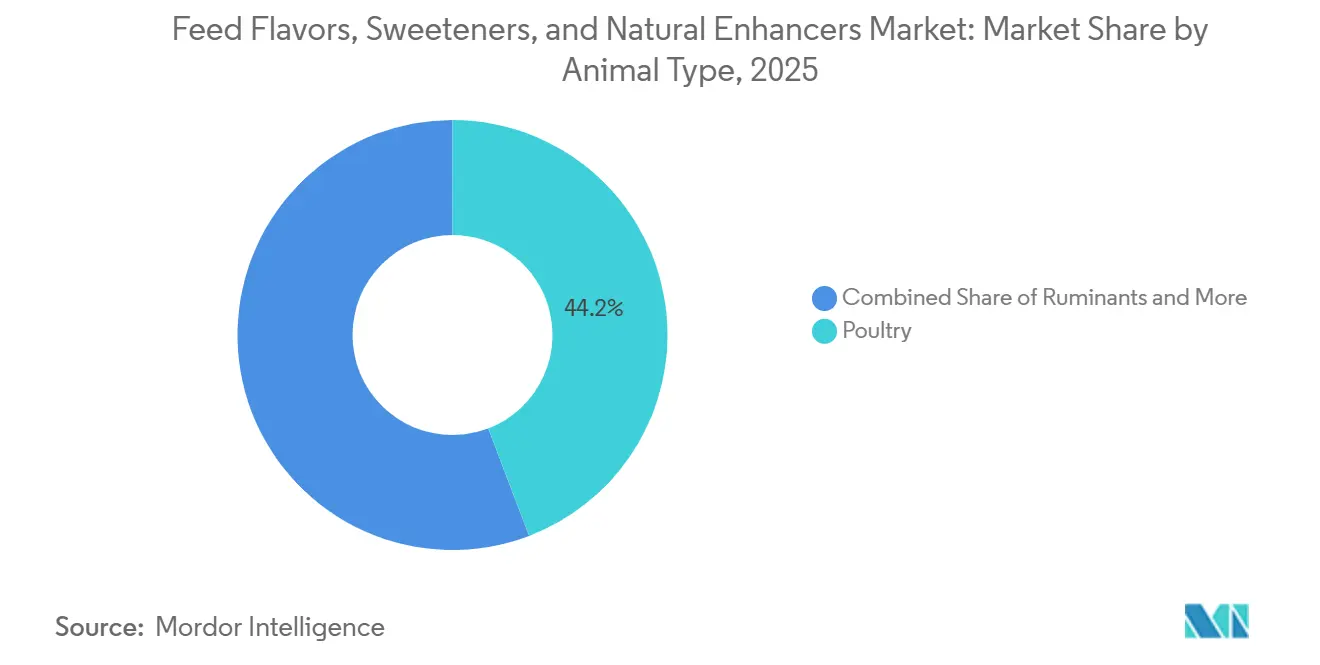
Poultry is Largest and Aquaculture is FastestPoultry was the largest animal type, accounting for 44.2% of the feed flavors, sweeteners, and natural enhancers market share in 2025. Its largest share reflects the extensive use of commercial feed in poultry production and the frequent application of sensory additives across broiler, layer, and breeder diets. Poultry remains central to the global meat supply and is widely consumed in fast-growing urban markets across Asia, Africa, and South America. World meat production reached 387 million metric tons in 2025, while poultry production rose 3.7% to 156 million metric tons. Demand is also shifting toward layer and breeder nutrition in Asia, where egg production and reproductive performance create different palatability requirements. Ruminant diets use flavors and sweeteners for transition cow feeding, dairy heat-stress management, and calf nutrition. Swine feed continues to use sweeteners during the nursery and grow-finish stages, particularly when zinc oxide reductions require reformulation.
Aquaculture was the fastest-growing animal type and is forecast to grow at a CAGR of 8.2% from 2026 to 2031. Growth extends beyond salmon and shrimp to tilapia, pangasius, sea bass, grouper, and marine finfish, increasing demand for species-specific palatability solutions. Carnivorous finfish typically require amino acid-based umami attractants, while tilapia can respond more strongly to sweeteners and flavor blends, supporting greater use of sensory additives as aquaculture production intensifies. Pet represents a higher-value application for natural flavors and palatability enhancers. Although aquaculture and pet food have lower volumes than poultry, their faster growth and higher-value applications are anticipated to support a greater share of value growth through 2031.
Geography Analysis
APAC Feed Flavors, Sweeteners, and Natural Enhancers Market
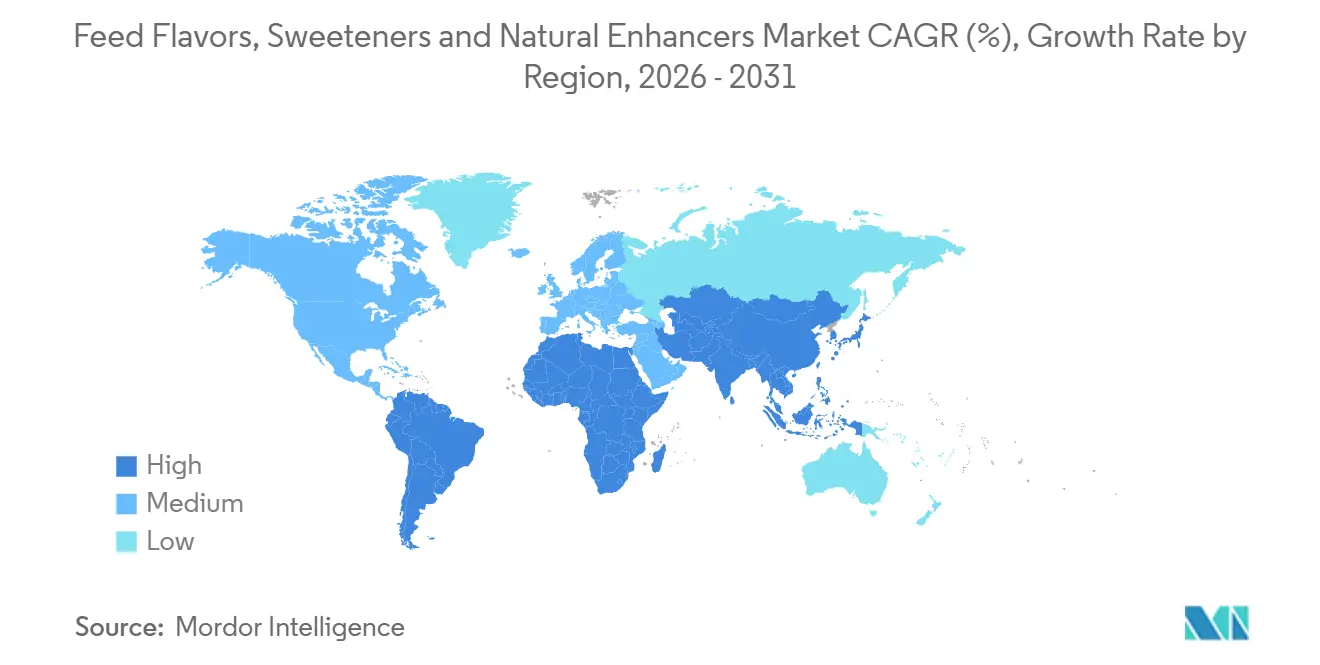
Asia-Pacific was the largest regional segment, with a 33.6% share of the feed flavors, sweeteners, and natural enhancers market in 2025. It was also the fastest-growing region and is forecast to grow at a CAGR of 8.4% from 2026 to 2031. China is the main regional market, supported by large swine and poultry production systems, and it is forecast to produce 17.3 million metric tons of chicken meat in 2026, 5% more than in 2025. India, Vietnam, Thailand, and Indonesia add demand as meat consumption rises, smallholder operations become more commercial, and aquaculture producers increase fishmeal substitution. Japan and Australia remain mature markets for premium natural enhancers and encapsulated systems within the feed flavors, sweeteners, and natural enhancers market.
North America and Europe Feed Flavors, Sweeteners, and Natural Enhancers Market
North America is a technology-intensive area for the feed flavors, sweeteners, and natural enhancers market, supported by pet food, specialty aquaculture, and antibiotic-free pork and poultry production. The United States has a mature compound-feed infrastructure and a developed pet food sector that uses tightly specified flavors and palatants. Canada emphasizes feed safety, livestock productivity, and quality-assured production, while Mexico uses integrated poultry and swine networks that link closely to suppliers in the United States. Europe is shaped by Regulation (EC) No. 1831/2003, sustainability requirements, and advanced antibiotic-free production practices, which support demand for traceable botanical extracts.
MEA and South America Feed Flavors, Sweeteners, and Natural Enhancers Market
South America is supported by Brazil’s large compound-feed sector and cattle herd, which exceeded 54,500 thousand head in 2024. Ruminant and swine diets provide the region’s principal volume demand, including applications in total mixed ration (TMR) and grow-finish feeding. The Middle East is expanding domestic livestock and aquaculture systems as part of food security planning. Saudi Arabia and the United Arab Emirates are important examples of technically managed production environments that need specialty additives. Africa remains less developed in commercial feed adoption, though South Africa and Egypt indicate how demand may evolve as urbanization, income growth, and commercial feed use continue.
Competitive Landscape
The feed flavors, sweeteners, and natural enhancers market is moderately consolidated in 2025, with diversified ingredient and flavor companies competing with dedicated feed-additive specialists. Evonik Industries AG, Cargill, Incorporated, Alltech, Inc., Adisseo France SAS, and Kerry Group plc are among the companies identified in the supplied material. Larger suppliers use global distribution, sensory science capabilities, and product portfolios covering multiple species. Regional specialists compete through technical service, faster customization, and local manufacturing. Encapsulation capacity, data-supported sensory screening, and expansion in Asia-Pacific and South America are central areas of competitive investment.
In February 2026, DSM-Firmenich AG agreed to divest its Animal Nutrition and Health business to CVC Capital Partners for EUR 2.2 billion (USD 2.6 billion), including an earnout of up to EUR 0.5 billion (USD 0.6 billion). The business generated EUR 3.5 billion (USD 3.8 billion) in annualized net sales in 2025 and is set to separate into performance solutions and essential products. In February 2025, DSM-Firmenich AG also agreed to sell its 50% stake in the Feed Enzymes Alliance to Novonesis for EUR 1.5 billion (USD 1.6 billion). These actions change the competitive structure around a major supplier of animal nutrition solutions and create an opportunity for competitors to strengthen market access or acquire capabilities in the feed flavors, sweeteners, and natural enhancers market.
Opportunity areas include palatability systems for alternative proteins, species-specific aquafeed attractants beyond salmon, and natural enhancers with documented traceability. These areas have greater technical requirements than conventional flavor supply. Chinese synthetic aroma producers in Shandong and Zhejiang compete strongly in price-sensitive Asia-Pacific applications, but their participation in premium natural and encapsulated systems is more limited, as buyers require research capabilities and traceability records. In February 2026, Symrise AG opened a palatability enhancer and pet nutrition facility in Querétaro, Mexico, expanding its North American manufacturing footprint.
Feed Flavors, Sweeteners, and Natural Enhancers Industry Leaders
-
Evonik Industries AG
-
Cargill, Incorporated
-
Alltech, Inc.
-
Adisseo France SAS
-
Kerry Group plc
- *Disclaimer: Major Players sorted in no particular order
Feed Flavors, Sweeteners, and Natural Enhancers Market Companies Covered in this Report
- Evonik Industries AG
- Cargill, Incorporated
- Alltech, Inc.
- Adisseo France SAS
- Kerry Group plc
- Archer Daniels Midland Company
- DSM-Firmenich AG
- Kemin Industries, Inc.
- Symrise AG
- Nutreco N.V. (SHV Holdings N.V.)
- Associated British Foods plc
- BASF SE
- BioMar Group A/S (Aktieselskabet Schouw and Co.)
- Novus International, Inc. (Mitsui and Company, Ltd. and Nippon Soda Co., Ltd.)
- International Flavors and Fragrances Inc. (IFF)
Read Analysis of Feed Flavors, Sweeteners, and Natural Enhancers Companies
Recent Industry Developments in Feed Flavors, Sweeteners, and Natural Enhancers Market
- February 2026: DSM-Firmenich AG announced an agreement to divest its Animal Nutrition and Health business to private equity firm CVC Capital Partners for an enterprise value of EUR 2.2 billion (USD 2.6 billion), including an earnout of up to USD 0.58 billion. The business, which generated USD 3.8 billion in annualized net sales in 2025, will be separated into 2 standalone companies covering performance solutions and essential products.
- February 2026: Symrise AG inaugurated a new palatability enhancer and pet nutrition production facility in Querétaro, Mexico, expanding its manufacturing footprint in North America to better serve Mexico's dynamic and growing pet food and livestock feed market.
- September 2025: Archer Daniels Midland Company (ADM) and Alltech, Inc. signed a definitive agreement to establish a North American animal feed joint venture, combining ADM's 11 U.S. feed mills with Alltech's Hubbard Feeds business, comprising 18 U.S. feed mills, and Masterfeeds, comprising 15 Canadian feed mills, to create an integrated feed manufacturing and animal nutrition platform.
Global Feed Flavors, Sweeteners, and Natural Enhancers Market Report Scope
Feed flavors, sweeteners, and natural enhancers are additive products used in compound feed to enhance palatability. The Global Feed Flavors, Sweeteners, and Natural Enhancers Market is segmented by Type (Flavors, Sweeteners, and Natural Enhancers) and by Animal Type (Ruminant, Swine, Poultry, Aquaculture, and Pets), by Source (Natural and Synthetic), and by Geography (North America, Europe, Asia-Pacific, South America, Middle East & Africa). The report offers market size and forecasts in terms of value (USD) and volume (metric tons) for all the above segments.
Segmentation Overview
| Flavors |
| Sweeteners |
| Natural Enhancers |
| Natural |
| Synthetic |
| Ruminants | Beef Cattle |
| Dairy Cattle | |
| Other Ruminants | |
| Swine | |
| Poultry | |
| Aquaculture | |
| Pets |
| North America | United States |
| Canada | |
| Mexico | |
| Rest of North America | |
| South America | Brazil |
| Argentina | |
| Rest of South America | |
| Europe | Germany |
| United Kingdom | |
| France | |
| Italy | |
| Spain | |
| Russia | |
| Rest of Europe | |
| Asia-Pacific | China |
| India | |
| Japan | |
| Australia | |
| Rest of Asia-Pacific | |
| Middle East | Saudi Arabia |
| United Arab Emirates | |
| Turkey | |
| Rest of Middle East | |
| Africa | South Africa |
| Egypt | |
| Rest of Africa |
| By Product Type | Flavors | |
| Sweeteners | ||
| Natural Enhancers | ||
| By Source | Natural | |
| Synthetic | ||
| By Animal Type | Ruminants | Beef Cattle |
| Dairy Cattle | ||
| Other Ruminants | ||
| Swine | ||
| Poultry | ||
| Aquaculture | ||
| Pets | ||
| By Geography | North America | United States |
| Canada | ||
| Mexico | ||
| Rest of North America | ||
| South America | Brazil | |
| Argentina | ||
| Rest of South America | ||
| Europe | Germany | |
| United Kingdom | ||
| France | ||
| Italy | ||
| Spain | ||
| Russia | ||
| Rest of Europe | ||
| Asia-Pacific | China | |
| India | ||
| Japan | ||
| Australia | ||
| Rest of Asia-Pacific | ||
| Middle East | Saudi Arabia | |
| United Arab Emirates | ||
| Turkey | ||
| Rest of Middle East | ||
| Africa | South Africa | |
| Egypt | ||
| Rest of Africa | ||
Key Questions Answered in the Report
What is the projected value of the Feed flavors, sweeteners, and natural enhancers market by 2031?
The market is forecast to reach USD 3.36 billion by 2031 and grow at a CAGR of 4.87% from 2026 to 2031.
Which product category leads feed flavors, sweeteners, and natural enhancers?
Flavors were the largest product category, holding 37.4% share in 2025.
Why are natural feed enhancers gaining adoption?
Traceability requirements and antibiotic-free production systems are increasing interest in botanical, yeast-derived, and fermentation-derived ingredients.
Which region is most important for future demand?
Asia-Pacific was the largest region in 2025, with a 33.6% share, and is forecast to be the fastest-growing region, with a CAGR of 8.4% from 2026 to 2031.