
Fatty Amines Market Size and Share
Market Overview
| Study Period | 2020 - 2031 |
|---|---|
| Forecast Data Period | 2026 - 2031 |
| Historical Data Period | 2020 - 2024 |
| Growth Rate | 4.98 % |
| Fastest Growing Market | Asia Pacific |
| Largest Market | Asia Pacific |
| Market Concentration | Medium |
Major Players *Disclaimer: Major Players sorted in no particular order Image © Mordor Intelligence. Reuse requires attribution under CC BY 4.0. | |
Fatty Amines Market Analysis by Mordor Intelligence
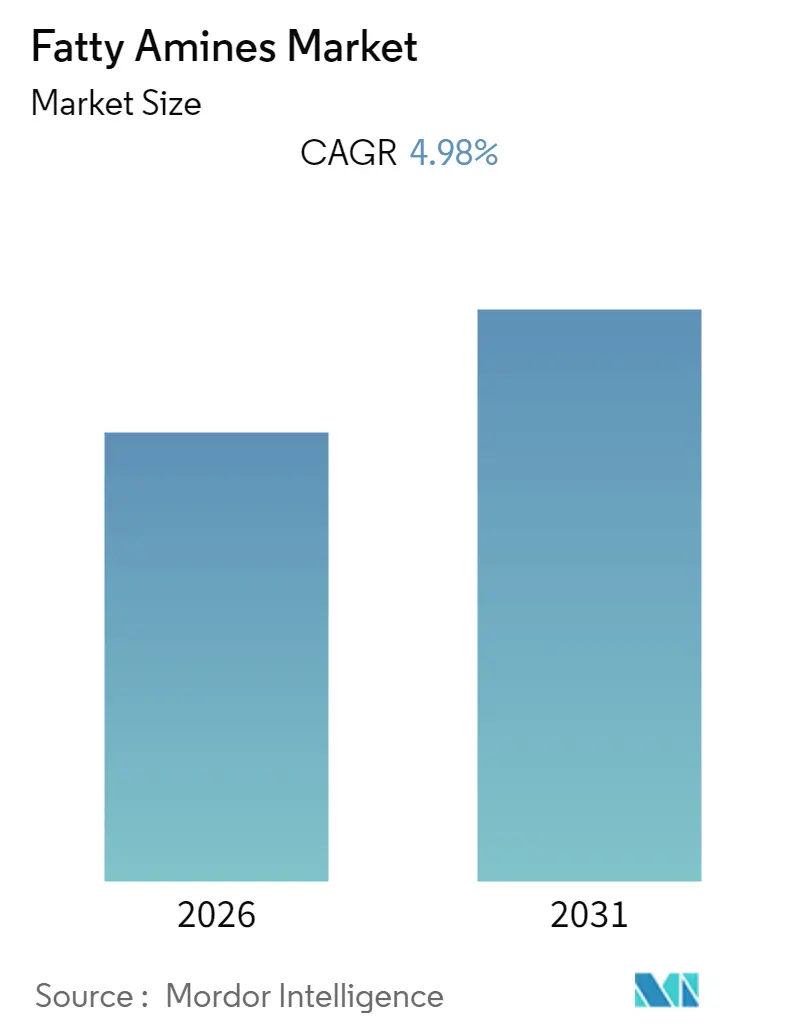
The Fatty Amines Market size is expected to register a CAGR of greater than 4.98% during the forecast period (2026-2031).
Note: Market size and forecast figures in this report are generated using Mordor Intelligence’s proprietary estimation framework, updated with the latest available data and insights as of 2026.
Global Fatty Amines Market Trends and Insights
Soaring Demand from Water Treatment Segment
- Fatty amines are nitrogen derivatives of fatty acids, olefins, or alcohols, prepared from natural sources, fats, and oils, or petrochemical raw materials. The commercially available fatty amines are prepared by either distillation of fatty acids or when fatty alcohols are reacted with ammonia or primary, secondary amines.
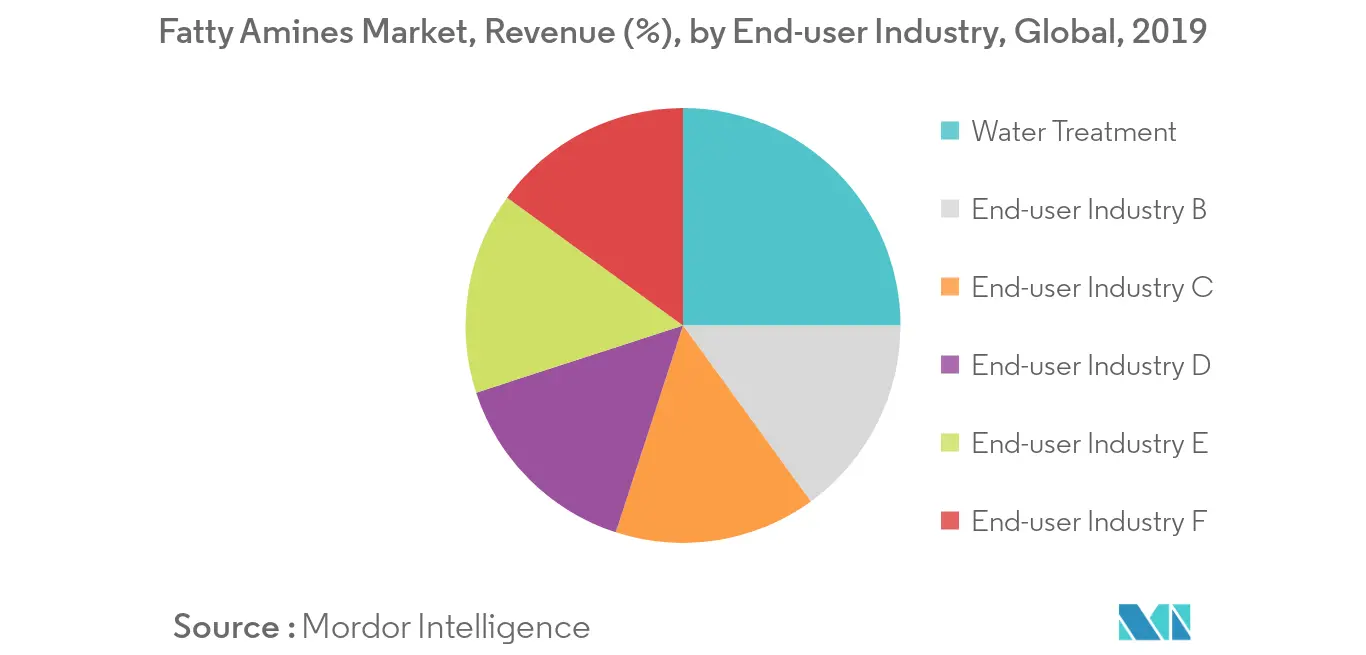
- Water treatment industry is the dominant end-user industry for the use of fatty amines, accounting for more than one-fifth of the total global market share of fatty amines.
- One of the major factors driving the market is the high demand for fatty amines as a water softener, corrosion inhibitor, and scale dispersant.
- Various industrial plants, refineries, and manufacturing industries, use fatty amines for wastewater treatment, which has led to their increasing demand in the water treatment industry.
- There has been a considerable stress on water supplies over the past few years, owing to increase in global population, the growing need for clean water in industrial applications and the impact of climate change, which has led to the scarcity of water across the world and thus mandating the need for water treatment activities.
- Such factors in turn are boosting the demand for fatty amines.
Asia-Pacific to Dominate the Market
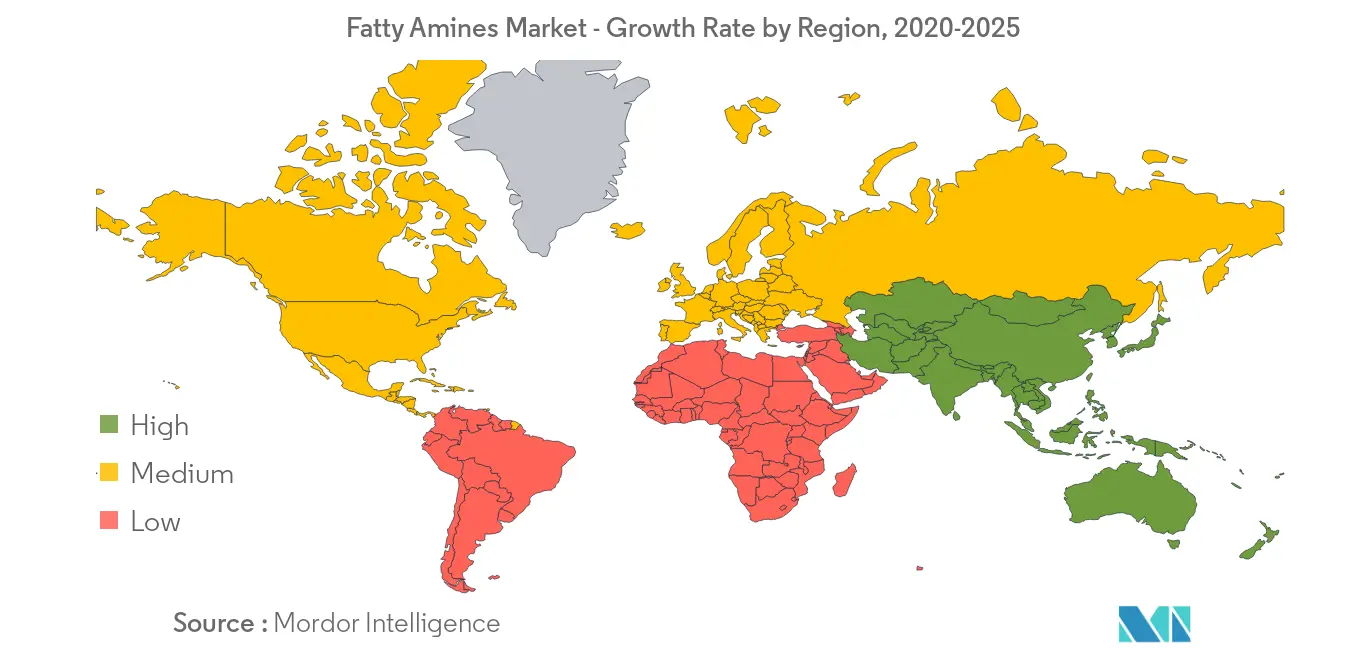
- Asia-Pacific region dominated the market during the forecast period primarily due to the increasing demand from the agriculture and water treatment sector.
- China, India, and Japan are the major contributors to the increasing demand for fatty amines across the region as well as the globe.
- Increasing water treatment activities across the region primarily from power generation and oil & gas activities are propelling the market demand.
- Furthermore, agriculture is the backbone of many countries in Asia-Pacific and the demand for treated water is continuously increasing.
- This scenario is expected to continue during the forecast period and act as a great boosting factor for the fatty amines market.
Competitive Landscape
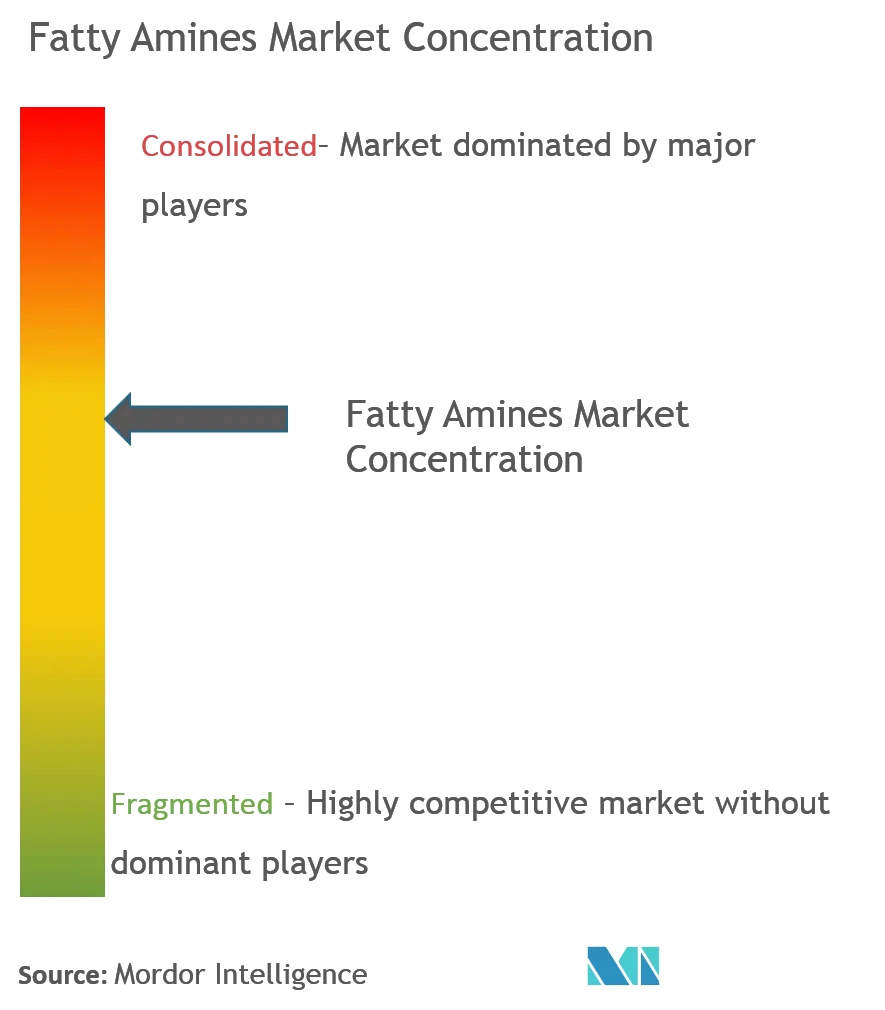
The fatty amines market is partially consolidated among the few players. Key players in the market include Evonik Industries AG, Huntsman International LLC, Nouryon, and Solvay, among others.
Fatty Amines Industry Leaders
-
Nouryon
-
Solvay
-
Huntsman International LLC
-
Evonik Industries AG
- *Disclaimer: Major Players sorted in no particular order
Market Opportunities and Future Outlook
Water treatment is the largest end-user for fatty amines, accounting for more than one-fifth of global demand in the report context. With tighter operating requirements across industrial water and wastewater systems, demand is building for corrosion inhibitors, scale dispersants, and softening chemistries that can reduce dosing and maintain performance across variable water quality.
Asia-Pacific continues to anchor volume consumption, and manufacturing moves in the region underline capacity and qualification demand. For example, Evonik started operation of expanded specialty amine production in Nanjing, China in April 2026, which supports the case for suppliers to shorten lead times and qualify grades locally for water treatment, infrastructure-related additives, and adjacent formulations. Sustainability-linked procurement is adding a second track, particularly where fatty amines feed into surfactants, personal care, and specialty formulations through mass-balance and certification programs. Kemira also launched ISCC PLUS certified biomass-balanced polyamines in February 2024, while Kao inaugurated a tertiary amine plant in Pasadena, Texas in August 2025 with 20,000 tons per year capacity, highlighting ongoing investment in regionalized supply for amine intermediates.
Recent Industry Developments
- May 2026: The East Kalimantan regional government introduced an Investment Project Ready to Offer (IPRO) for a fatty amine industrial plant in Bontang, Indonesia, targeting 20,000 tons per year of fatty amines and 4,000 tons per year of glycerol. The proposal points to feedstock proximity in Indonesia as a lever for new capacity buildouts and a way to strengthen local and regional supply chains for oleochemical derivatives.
- March 2026: Nouryon announced halal certification for selected ingredients made at its Boxing, China facility that produces fatty amines and quaternary ammonium compounds. The certification expands eligibility for supply into halal-sensitive personal care and cleaning channels, supporting product differentiation beyond commodity positioning.
- August 2025: Kao Corporation inaugurated a new tertiary amine production plant in Pasadena, Texas, with an annual capacity of 20,000 tons. The added US capacity supports more localized supply of tertiary amines for downstream formulations and reduces customers' reliance on longer interregional shipments in North America.
Research Methodology Framework and Report Scope
Market Definition and Coverage
For this study, the fatty amines market covers revenues from commercially sold fatty amines used as functional ingredients in formulated products across industrial and consumer end uses. Revenues are counted at the point of sale by manufacturers and distributors.
Scope exclusions: Excludes in-house captive transfers within integrated chemical complexes and excludes non-fatty amines that are not derived from fatty feedstocks.
Segmentation Overview
- Type
- Primary Amines
- Secondary Amines
- Tertiary Amines
- Application
- Water Softener
- Emulsifier
- Corrosion Inhibitor
- Asphalt Additives
- Anti-caking
- Other Applications
- End-user Industry
- Water Treatment
- Agriculture
- Oil and Gas
- Infrastructure
- Personal Care
- Other End-user Industries
- Geography
- Asia-Pacific
- China
- India
- Japan
- South Korea
- Rest of Asia-Pacific
- North America
- United States
- Canada
- Mexico
- Europe
- United Kingdom
- France
- Germany
- Italy
- Rest of Europe
- South America
- Brazil
- Argentina
- Rest of South America
- Middle-East and Africa
- South Africa
- Saudi Arabia
- Rest of Middle-East and Africa
- Asia-Pacific
Data Sources, Market Sizing, and Validation
Desk Research
Desk research is used to map the value chain, validate end-use pull, and build initial assumptions around volumes and pricing. We refer to public sources such as USGS and other national geological and industrial statistics, UN Comtrade trade flows for relevant intermediates, EPA and ECHA regulatory and chemical registry notes, and peer-reviewed journals that cover surfactants and specialty chemicals.
In parallel, we review supplier annual reports, investor presentations, technical datasheets, and reputable industry and association publications that discuss applications such as water treatment, agriculture formulations, and asphalt additives. Where helpful, paid subscriptions for company financials and intelligence, patent databases, and shipment-level import and export data are used to cross-check capacity signals and trade direction. This list is illustrative only, and other sources were also used during the work for data collection, validation, and clarification.
Primary Interviews and Surveys
Primary work is carried out through expert interviews and structured surveys with manufacturers, distributors, formulators, and downstream users across key consuming regions. Respondent input helps confirm application splits, typical pricing progression by chain length and purity, and how demand shifts with agriculture cycles, water treatment spending, and oil and gas activity.
Distribution of primary research fieldwork respondents
| Company type | Respondent position | Region |
|---|---|---|
| Top tier: 31% | CXOs: 15% | APAC: 43% |
| Mid tier: 47% | Functional/Unit leaders: 39% | EMEA: 31% |
| Smaller Players: 22% | Managers: 46% | Americas: 26% |
Market-Sizing & Forecasting
Sizing starts with a top-down build where production, trade signals, and downstream consumption indicators are used to reconstruct the addressable demand pool for fatty amines by region. The model is then stress-tested with selective bottom-up checks, such as rolling up a sample of supplier revenues, applying observed utilization to known capacities, and validating implied average selling prices against distributor quotes and contract-index movement.
Key inputs include oleochemical feedstock trends that influence cost pass-through, operating rates and planned expansions for amines capacity, regional fertilizer and crop protection formulation activity (where anti-caking and related functions matter), water treatment chemical consumption, and oil and gas drilling and production activity that drives corrosion inhibitor demand. Forecasts are developed using scenario analysis supported by expert views, so upside and downside cases reflect different feedstock price paths and end-use growth rates. When primary coverage is thin in a niche geography or application, gaps are addressed using proxy indicators such as trade intensity, downstream production indices, and comparable regional pricing, and then re-checked in follow-up calls.
Data Validation & Update Cycle
Validation is done by comparing outputs against independent signals, such as capacity announcements, regional trade balances, and changes in major end-use production indices, and then checking that pricing and volume movements remain consistent together. If a region shows an unusual jump, the assumptions are reviewed, and the relevant experts are contacted again to confirm whether a real event occurred or an input needs correction.
Before sign-off, the model and write-up go through multiple analyst reviews so calculation steps and definitions stay consistent across years. Reports are refreshed annually, with interim adjustments when there are material events such as large capacity additions, regulation changes, or sharp feedstock shocks. Right before delivery, a final data pass is performed so clients receive the most current view available.
Mordor Intelligence's Fatty Amines Market Size Versus Other Published Estimates
Published market values for fatty amines can differ substantially even when the topic sounds the same, because firms may not align on what is counted, the price point used, and the base year exchange rate assumptions. Differences can also come from how aggressively growth is projected when feedstock prices and agriculture demand move quickly.
The benchmark table shows a noticeable spread, and in Mordor Intelligence's model the total is built around merchant sales of fatty amines across stated applications. Pricing logic is checked against observed regional quote ranges rather than blending in adjacent amine categories or broader surfactant value.
Benchmark comparison
| Source | Market Size | Gaps in Research Methodology |
|---|---|---|
| Mordor Intelligence | USD 4.66 B (2024) | |
| Global Research Publisher A | USD 2.86 B (2025) | Uses a later base year and appears to apply a narrower counted scope, which can understate industrial grades used in oil and gas, infrastructure, and water treatment. It may also apply more conservative price progression assumptions. |
| Industry Research Publisher B | USD 4.91 B (2025) | Reports a higher value partly due to base-year timing and potential inclusion of wider formulated chemical value or different price points in the supply chain, which can lift the revenue total versus counting only fatty amines as sold. |
Looking across the three figures, the gap is mainly explained by scope boundaries and how prices and the counted revenue point are set for each application. By keeping inputs tied to observable capacity, trade direction, and end-use pull indicators, the resulting number stays traceable to clear variables and repeatable steps, which helps decision-makers reconcile differences quickly.
Key Questions Answered in the Report
What is the current Fatty Amines Market size?
The Fatty Amines Market is projected to register a CAGR of 4.98% during the forecast period (2026-2031)
Who are the key players in Fatty Amines Market?
Nouryon, Solvay, Huntsman International LLC and Evonik Industries AG are the major companies operating in the Fatty Amines Market.
Which is the fastest growing region in Fatty Amines Market?
Asia Pacific is estimated to grow at the highest CAGR over the forecast period (2026-2031).
Which region has the biggest share in Fatty Amines Market?
In 2025, the Asia Pacific accounts for the largest market share in Fatty Amines Market.
What years does this Fatty Amines Market cover?
The report covers the Fatty Amines Market historical market size for years: 2019, 2020, 2021, 2022, 2023, 2024 and 2025. The report also forecasts the Fatty Amines Market size for years: 2026, 2027, 2028, 2029, 2030 and 2031.