
Experience-Based Managed Services Market Size and Share
Market Overview
| Study Period | 2021 - 2032 |
|---|---|
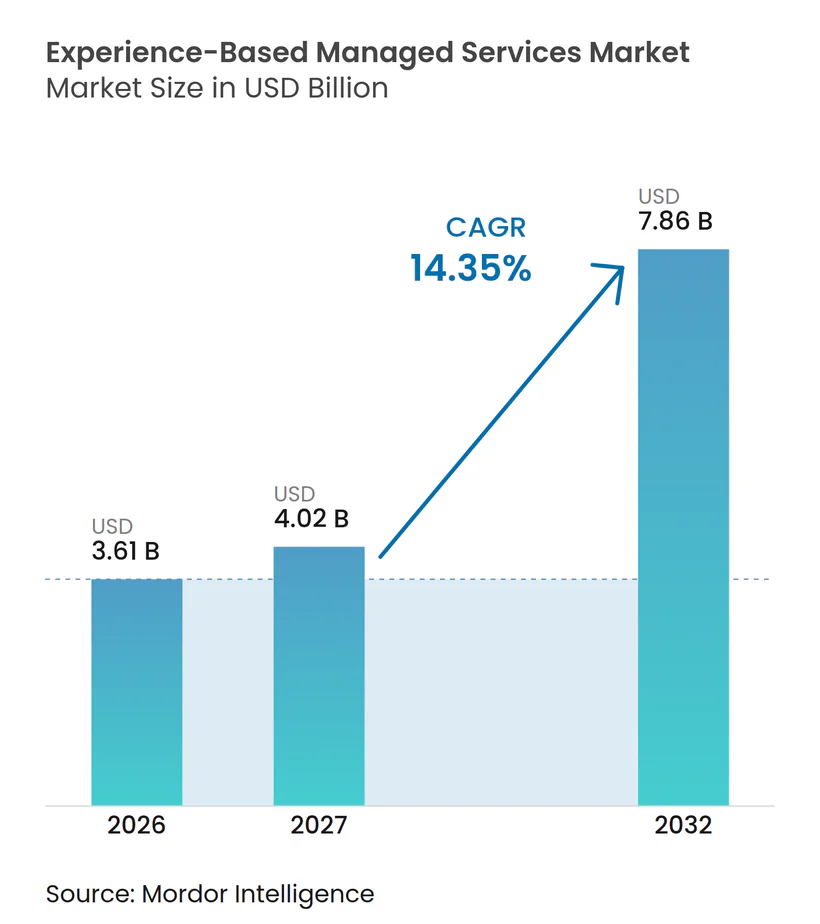
| Market Size (2027) | USD 4.02 Billion |
| Market Size (2032) | USD 7.86 Billion |
| Growth Rate (2027 - 2032) | 14.35 % |
| Fastest Growing Market | Asia-Pacific |
| Largest Market | North America |
| Market Concentration | Medium |
Major Players *Disclaimer: Major Players sorted in no particular order Image © Mordor Intelligence. Reuse requires attribution under CC BY 4.0. | |
Experience-Based Managed Services Market Analysis by Mordor Intelligence
The experience-based managed services market size was valued at USD 3.61 billion in 2026 and is estimated to grow from USD 4.02 billion in 2027 to reach USD 7.86 billion by 2032, at a CAGR of 14.35% during the forecast period (2027-2032). The experience-based managed services market is moving from staffing-led outsourcing toward accountable delivery of customer, employee, digital, and workplace experiences. Enterprises are seeking providers that can combine service operations with AI orchestration, measurement tools, and specialist delivery capabilities. Outcome-based contracts are gaining importance because buyers want evidence that service quality improves, not only that tickets are closed. Data residency requirements and hybrid operating models are also increasing the need for providers that can coordinate work across cloud and on-premises environments. Competition is broad, but acquisitions, security credentials, and experience measurement capabilities are separating the providers that can support larger enterprise programs.
Key Report Takeaways
- By service type, Managed Customer Support and Contact Center Services held 27.83% of the experience-based managed services market share in 2026, while Managed Experience Remediation and Value Assurance is projected to expand at a 16.28% CAGR through 2032.
- By experience domain, Customer Experience held 32.64% share in 2026, while Digital Experience is projected to expand at a 15.73% CAGR through 2032.
- By deployment mode, Cloud-Based Managed Services held 72.51% share of the experience-based managed services market in 2026, while Hybrid deployments are projected to expand at a 17.64% CAGR through 2032.
- By organization size, Large Enterprises held 71.54% share in 2026, while SMEs are projected to expand at a 16.21% CAGR through 2032.
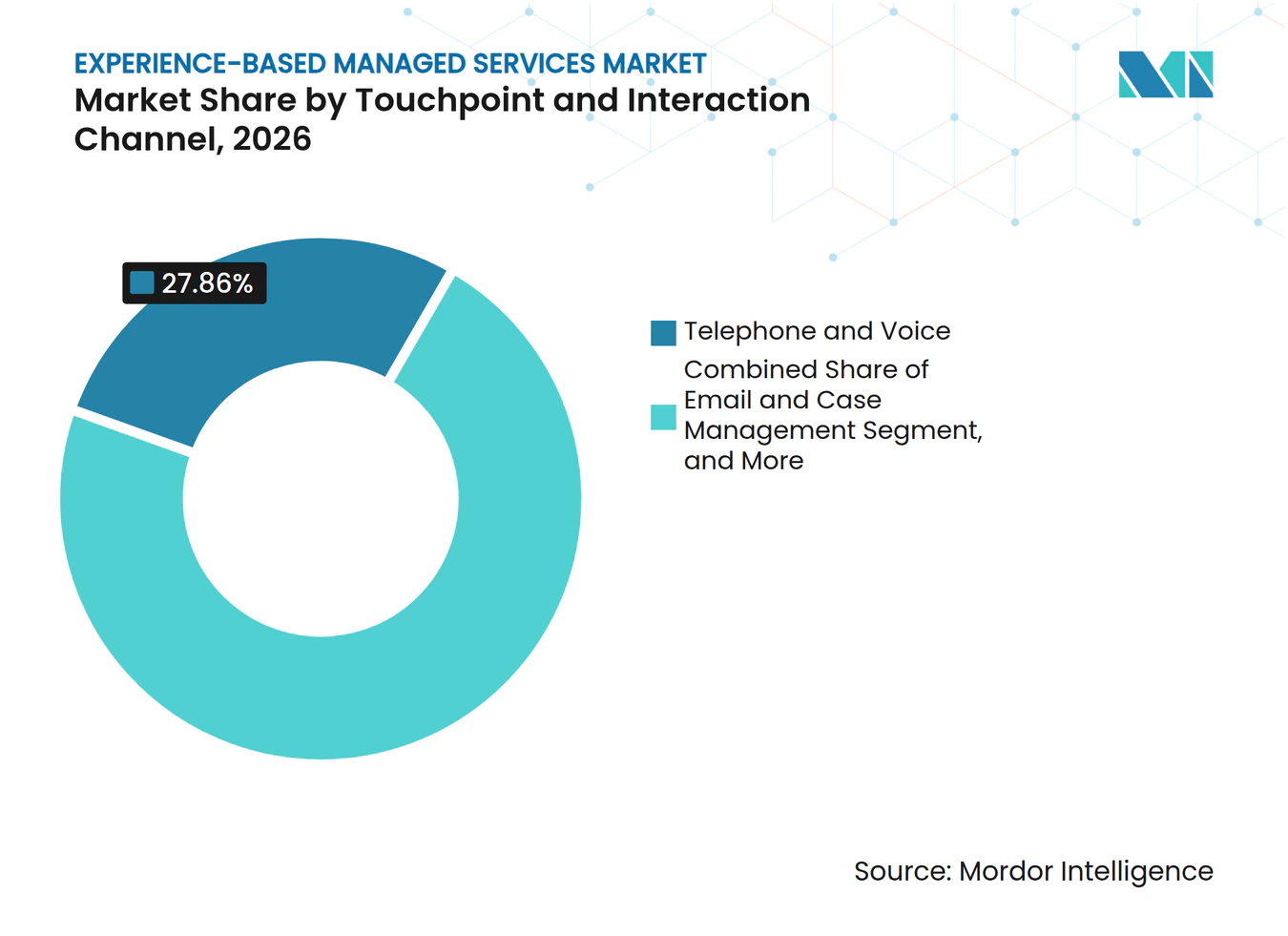
- By touchpoint and interaction channel, Telephone and Voice interaction management held 27.86% share in 2026, while Video, Co-Browsing, and Immersive Channels are projected to expand at a 15.32% CAGR through 2032.
- By end-user industry, BFSI held 29.86% share in 2026, while the healthcare and life sciences is projected to expand at a 17.52% CAGR through 2032.
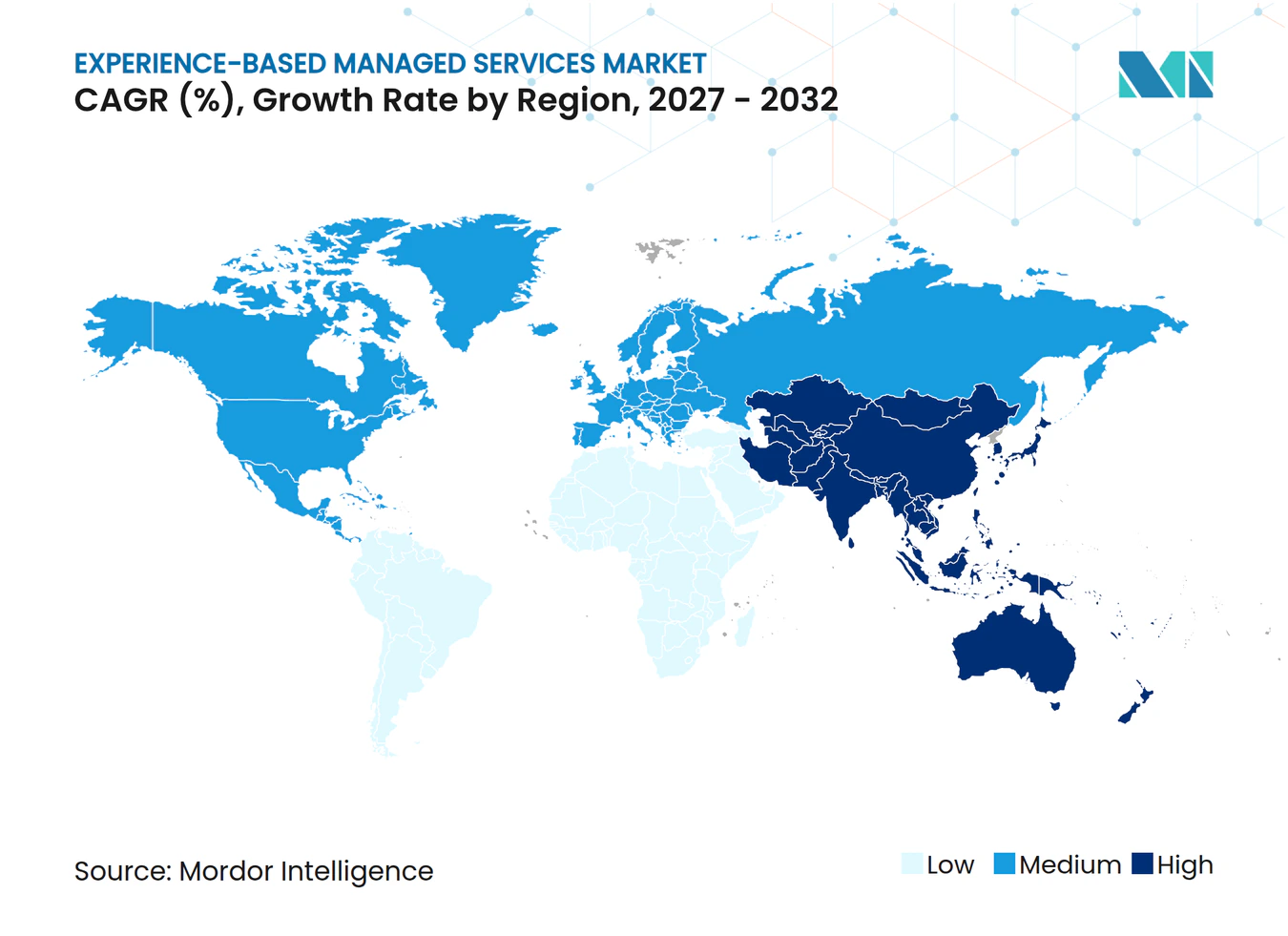
- By geography, North America held 38.64% share of the experience-based managed services market in 2026, while Asia-Pacific is projected to expand at a 17.49% CAGR through 2032.
Note: Market numbers in this report are based on Mordor Intelligence's proprietary estimation framework, which combines nine months of actuals with Q4 projections for base year 2026.
Market Trends and Insights
Drivers Impact Analysis of Experience-Based Managed Services Market*
| Driver | (~) % Impact on CAGR Forecast | Geographic Relevance | Impact Timeline |
|---|---|---|---|
| AI-Enabled Experience Operations and Agentic Workflows | +3.8% | Global, with early scaling in North America and Western Europe and rapid pilot-to-production activity in Asia-Pacific | Short term (≤ 2 years) |
| Enterprise Shift From SLA Reporting to Experience-Level Agreements | +2.8% | Global, with institutional momentum in Europe and South America | Medium term (2-4 years) |
| Hybrid-Workplace Complexity and Distributed User Support | +2.1% | North America and Europe, with spillover to Asia-Pacific enterprises and Gulf states | Short term (≤ 2 years) |
| Omnichannel Personalization and First-Party Data Activation | +1.7% | Global, with high spending in North America, the United Kingdom, and Australia and New Zealand | Medium term (2-4 years) |
| Experience Analytics Expansion Into Closed-Loop Actioning | +1.3% | North America and the European Union, with Asia-Pacific emerging | Medium term (2-4 years) |
| Convergence of CX, EX, Digital, and Workplace Operations | +0.9% | Global, with platform-led consolidation in North America and Northern Europe | Long term (≥ 4 years) |
| Source: Mordor Intelligence | |||
AI-Enabled Experience Operations and Agentic Workflows
The experience-based managed services market is benefiting as enterprises move AI programs from pilot work into daily customer and employee operations. Agentic workflows can classify demand, route work, complete defined tasks, and record outcomes with less manual intervention. This increases the value of a provider that can combine automation with human oversight across a complex technology estate, including clear controls for exceptions, escalation, auditability, and the continued involvement of experienced staff when a customer or employee case needs judgment. In the experience-based managed services market, that combination helps buyers introduce automation without giving up accountable service ownership. DXC Technology introduced DXC OASIS in April 2026 as an orchestration platform that combines AI with human expertise across enterprise IT environments.[1] The experience-based managed services market has a clear opening where enterprises operate many disconnected customer support and workplace systems. Providers that can manage these systems through a single operating layer can reduce handoffs and make service outcomes easier to monitor.
Enterprise Shift From SLA Reporting to Experience-Level Agreements
The move from service-level agreements to experience-level agreements is changing how buyers define service value. The XLA Institute reported that 66% of organizations were familiar with XLAs, while 43% had implemented them and 68% of non-adopters planned adoption within 6 to 18 months.[2] The experience-based managed services market can benefit because XLA contracts require providers to measure sentiment, effort, resolution completeness, and continuity across a journey. These measures extend the provider role beyond availability reporting and ticket closure. Providers with digital experience monitoring, coaching tools, and feedback management can support buyers that want more direct links between operations and user outcomes. This contract shift is especially relevant for regulated service environments where buyers need clear proof of service quality.
Hybrid-Workplace Complexity and Distributed User Support
Hybrid work continues to create demand for end-user support that is available across devices, locations, and time zones. Enterprises need coordinated support for device setup, collaboration tools, access management, and issue resolution before employees raise a request. This workload often spans internal IT teams, cloud platforms, and external technology vendors. The experience-based managed services market therefore has a role in operating standardized support processes that work across distributed environments. The growing importance of device and application performance also shifts attention from network uptime to the employee experience at the point of work. Providers that prevent recurring issues and explain performance patterns can build deeper relationships than providers focused only on reactive helpdesk activity.
Omnichannel Personalization and First-Party Data Activation
The end of third-party cookies and tighter consent requirements have increased the importance of customer data collected directly by enterprises. Businesses need support to operate data platforms, manage consent, and activate relevant content across web, email, mobile, and voice interactions. The experience-based managed services market is positioned to benefit when providers can manage the daily processes behind those activities. A managed provider that operates a customer data platform becomes part of the client’s core engagement architecture. This can make a provider relationship harder to replace because the work connects data governance, campaign execution, service delivery, and continuous operational learning across customer journeys. The model also supports longer contracts when providers demonstrate that personal data is handled consistently in line with consent requirements across every channel.
Restraints Impact Analysis of Experience-Based Managed Services Market*
| Restraint | (~) % Impact on CAGR Forecast | Geographic Relevance | Impact Timeline |
|---|---|---|---|
| Privacy, Consent, and Employee-Telemetry Governance | -1.8% | European Union, India, Turkey, Denmark, and wider global spillover | Short term (≤ 2 years) |
| Cyber Risk From Privileged Outsourced Access | -1.4% | Global, with pronounced exposure in North America, the European Union, and Australia | Short term (≤ 2 years) |
| Legacy Integration and Multi-Platform Data Fragmentation | -1.0% | Global, especially enterprises with long-standing multi-vendor IT estates | Medium term (2-4 years) |
| Outcome-Measurement Ambiguity and Buyer Procurement Friction | -0.7% | Global, especially public sector and mid-market buyer groups | Medium term (2-4 years) |
| Source: Mordor Intelligence | |||
Privacy, Consent, and Employee-Telemetry Governance
The collection and use of employee behavioral data can make managed experience programs more difficult to design and approve. The International Labour Organization identified gaps in the protection of workers’ data rights and called for worker-centered governance approaches in a 2025 working paper. India notified the Digital Personal Data Protection Rules, 2025, creating phased obligations that affect how managed providers process personal data. The experience-based managed services market faces longer contracting cycles when buyers must define the permitted use, retention, and access rules for telemetry data. Programs that use monitoring or AI-supported coaching may receive narrower scope where local rules place limits on workplace analysis. Providers need strong privacy controls, clear data processing terms, and service designs that allow clients to apply local governance requirements.
Cyber Risk From Privileged Outsourced Access
Managed providers often need access to client networks, identity systems, customer records, and business applications. Verizon reported that third parties were involved in 30% of breaches in its 2025 Data Breach Investigations Report. This exposure raises buyer scrutiny of access controls, subcontractor practices, and independent security assurance. The experience-based managed services market can face delayed decisions when a provider cannot show evidence of least-privilege access and strong authentication. At the same time, the requirement supports established providers that have invested in security governance and audit readiness. Clear access management practices can therefore limit risk while improving a provider’s ability to qualify for regulated assignments.
*Our forecasts treat driver/restraint impacts as directional, not additive. The impact forecasts reflect baseline growth, mix effects, and variable interactions.
Experience-Based Managed Services Market Segment Analysis
By Service Type:
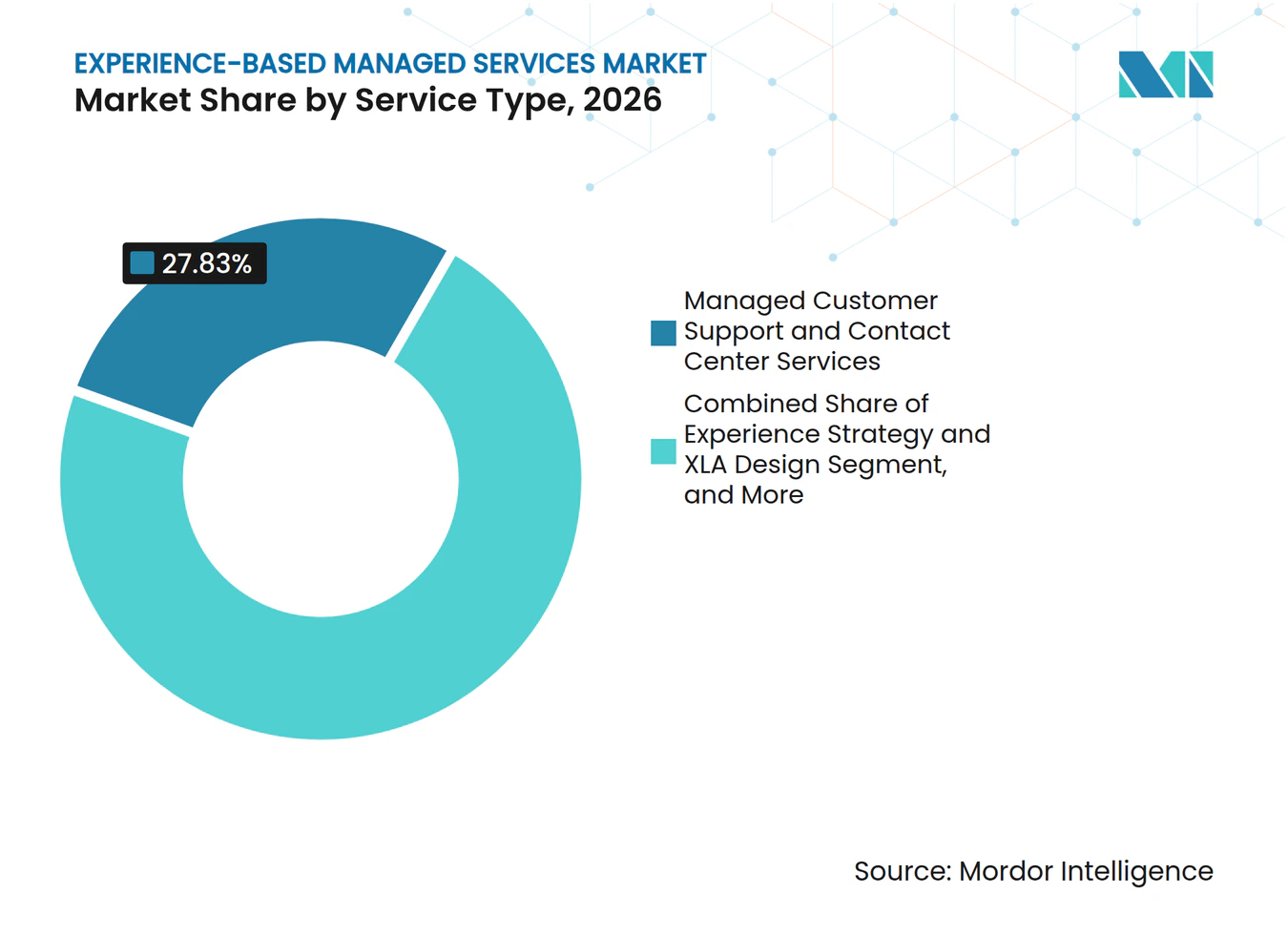
Contact Center Services Anchor Revenue While Remediation Commands Premium GrowthManaged Customer Support and Contact Center Services held 27.83% of the experience-based managed services market share in 2026. The segment remains the most established outsourced category because BFSI, telecommunications, and retail organizations need broad coverage for high volumes of customer contact. Its operating model relies on 24/7 availability, multilingual capabilities, omnichannel routing, and consistent quality assurance. Managed Service Desk and Employee Support benefits from the continuing need for workplace support across distributed teams. Managed Digital Workplace and End-User Services extends that work into device lifecycle management, persona-based support, and remote setup. Experience Baseline Assessment and Benchmarking, together with Experience Strategy and XLA Design, can act as early entry points for providers seeking to establish a role in a client’s governance model.
Managed Experience Remediation and Value Assurance is projected to expand at a 16.28% CAGR through 2032. This service type becomes more relevant as contracts move toward outcome accountability and buyers need continuous remediation of experience failures. It includes closed-loop action processes, integration of experience signals, and review of whether improvement activity delivers value. ServiceNow reported that accounts with quality closed-loop engagement had NPS scores 19 points higher year over year.[3] The combination of AI-supported signal capture and human remediation can distinguish providers that offer ongoing improvement from legacy operators focused on handling volumes. This work gives providers a route to higher-value assignments because it addresses the resolution of underlying service problems, helping buyers connect operational changes with the service outcomes that their customers and employees can observe. The experience-based managed services market can therefore reward providers that maintain a clear action record from signal capture through follow-up.



By Experience Domain:
Customer Experience Leads as Digital Experience Scales FastestCustomer Experience held 32.64% of the experience-based managed services market size in 2026. Its leading position reflects long-standing investment in contact centers, CRM systems, and loyalty programs that require continuous operation and improvement. Employee Experience also has a substantial role because hybrid work makes workplace support more visible to employees. Workplace Experience combines physical and digital office needs through space use data, environmental tools, and service coordination. Citizen, Partner, and Field-Service Experience is emerging as public institutions and B2B organizations apply similar models to external stakeholders. Together, these domains create demand for providers that can link service operations with measurement of how people experience an interaction, rather than treating separate teams and touchpoints as unrelated delivery work. The experience-based managed services market is increasingly shaped by the need for a common operating view.
Digital Experience is projected to expand at a 15.73% CAGR through 2032. Digital-first journeys across websites, mobile applications, and in-app services require monitoring that can identify failures before customers abandon a process. Organizations using several cloud platforms also need visibility across systems that can affect latency, continuity, and data flow. Managed providers can use this requirement to operate monitoring and remediation processes across digital touchpoints. The experience-based managed services industry is also seeing buyers combine customer, employee, digital, and workplace programs under a shared governance structure. This approach can reduce supplier coordination for clients while making the provider relationship more integrated. Providers with broad operating capabilities are better placed to support this cross-domain model.
By Deployment Mode:
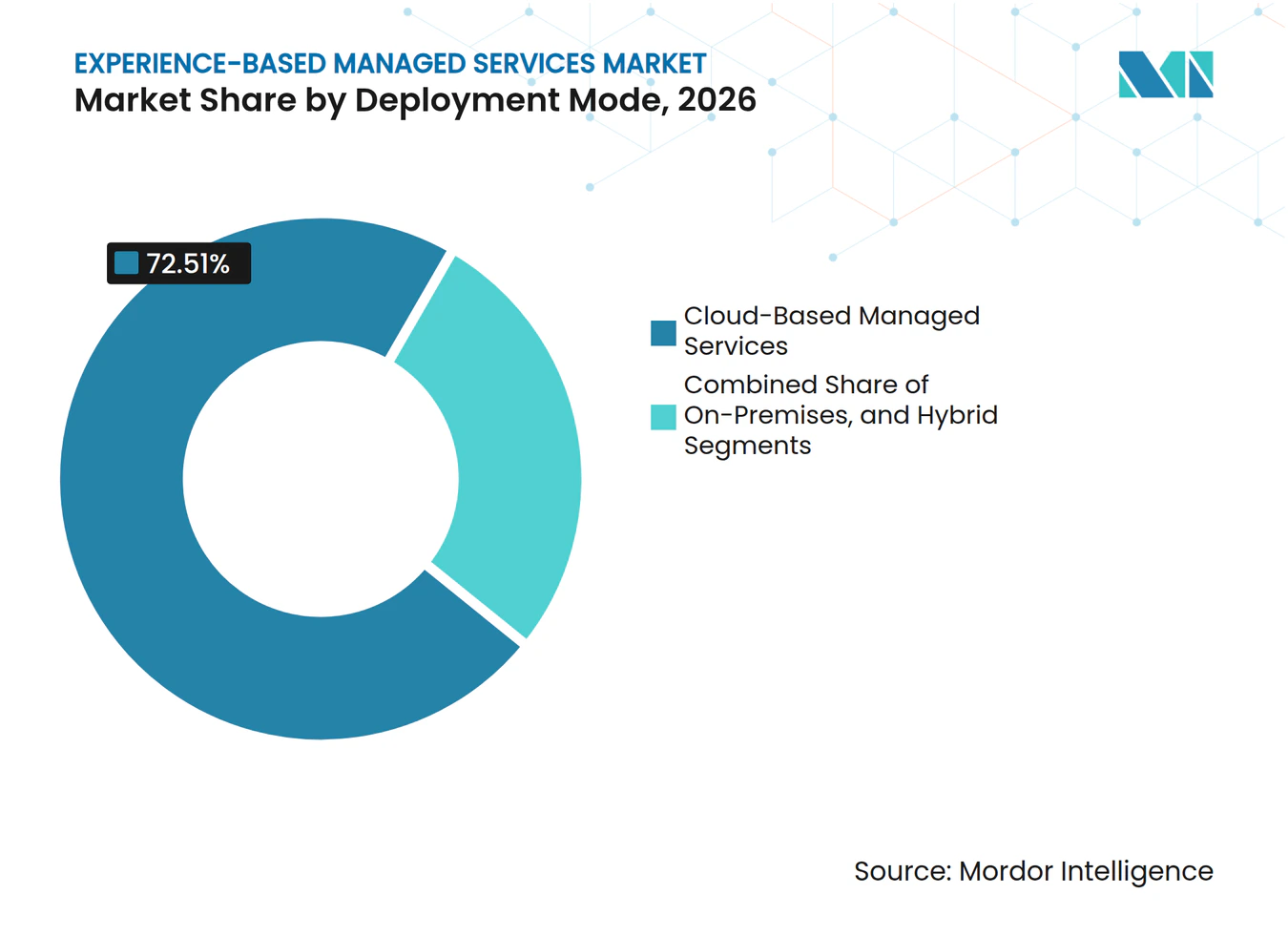
Cloud Dominates as Hybrid Architectures Address Sovereignty RequirementsCloud-Based Managed Services held 72.51% share in 2026. Cloud delivery gives providers the capacity to manage changing demand without matching every increase with an equivalent increase in infrastructure. It supports contact center and digital workplace workloads where service volume can vary by season, event, or location. Cloud-native platforms can also make it easier to introduce new AI functionality and standardize monitoring. On-Premises deployments remain important in defense, financial services, and healthcare, where data residency, audit trails, and latency requirements limit full migration. Providers serving these settings need established governance and technical capability for local delivery.
Hybrid deployments are projected to expand at a 17.64% CAGR through 2032. Sovereign AI policies, data residency requirements, and cross-border processing provisions are encouraging enterprises to keep selected workloads under direct local control. This creates a need for providers that can operate cloud and on-premises systems as a coordinated service. The provider must maintain performance and compliance without moving accountability back to the client. Hybrid operating models also allow organizations to balance the flexibility of cloud services with the control required for sensitive data. The experience-based managed services market will favor providers that can maintain this balance across experience platforms and operational data, particularly when clients must apply different policies to the same end-to-end service journey. This work requires operational accountability as well as technical coordination.

By Organization Size:
Large Enterprises Lead as SMEs Drive the Next Growth CycleLarge Enterprises held 71.54% share in 2026. Their buying power, multi-domain service requirements, and ability to fund transition work support large managed experience programs. A typical program can bring together contact center operations, workplace support, journey orchestration, and experience analytics under a multi-year arrangement. These buyers increasingly expect providers to show more than ticket volumes or service availability. XLA adoption raises the need for outcome measurement infrastructure and creates room for providers with mature reporting tools. Large organizations can also use broader supplier programs to manage service consistency across regions and business units.
SMEs are projected to expand at a 16.21% CAGR through 2032. Productized offerings and cloud delivery reduce the minimum contract scale that previously kept smaller organizations outside many managed service programs. Providers can address this demand through pre-configured tiers, clear service boundaries, and practical onboarding processes. South Korea’s AI Integrated Voucher Program offered support of up to KRW 69.1 million (USD 50,100) per company for eligible cloud consulting and managed service fees. This support illustrates how public programs can lower adoption barriers for smaller businesses. The experience-based managed services industry can build on this shift when its offerings provide transparent outcomes without requiring a complex enterprise implementation. The experience-based managed services market can also benefit when suppliers adapt service tiers to the limited internal resources of smaller organizations.
By Touchpoint and Interaction Channel:
Voice Retains Structural Weight as Immersive Channels Open Premium TiersTelephone and Voice interaction management held 27.86% share in 2026. Voice remains important for high-value, sensitive, and complex conversations where customers expect direct human assistance. The French outsourced customer relations barometer from SP2C reported that voice and web-callback channels together represented 74% of outsourced contact center revenue in 2025. Email and Case Management, along with Web and Portals, support high-volume and lower-complexity interactions. Social Media and Messaging adds channels that require faster responses and consistent brand control. Employee Service Desk and Collaboration Channels have also expanded as organizations integrate workplace messaging into managed IT support.
Video, Co-Browsing, and Immersive Channels are projected to expand at a 15.32% CAGR through 2032. CCaaS platforms are broadening the use of video support, AI-assisted co-browsing, and early remote support formats. Financial services providers can use managed video advisory services for premium customer groups where a personal interaction remains important. AI support during a live session can help an agent act on sentiment or compliance signals without replacing the human conversation. These services create a higher-value tier than voice or email when the interaction needs more context. Providers with limited channel capabilities may find it difficult to add these services quickly because they require integrated technology and service operations. In the experience-based managed services market, this can make channel breadth a practical measure of a provider’s ability to serve complex customer needs.
By End-User Industry:
BFSI Anchors Demand as Healthcare Emerges as the Fastest VerticalBFSI held 29.86% share in 2026. The sector has high interaction volumes, strict compliance requirements, fraud-related workflows, and direct financial consequences when customers leave. Banks, insurers, and financial service firms are active users of experience analytics and managed journey orchestration. These organizations can measure the value of retaining a customer or improving a cross-selling process more directly than many other sectors can. IT and Telecommunications is another major buyer group because technical helpdesks and managed contact centers are established parts of enterprise delivery. Retail and E-Commerce are also expanding their use of managed service programs as brands move from transaction-based interactions to ongoing customer relationships.
The healthcare and life sciences industry is projected to expand at a 17.52% CAGR through 2032. HCLTech reported that 71% of healthcare members expect personalized engagement, and 87% of payer organizations consider modern platforms critical to member experience. These expectations support demand for providers that can combine engagement operations with healthcare-specific compliance controls. Payers and providers are moving beyond traditional staffing arrangements toward managed partnerships that use automation, analytics, and process intelligence. HIPAA requirements in the United States and evolving patient data requirements in other countries favor providers with established compliant delivery systems. Generalist BPO providers without healthcare investment may face a higher qualification barrier in this vertical. The experience-based managed services market has room for providers that can show healthcare-specific controls while maintaining a consistent member and patient engagement model.
Geography Analysis
North America Experience-Based Managed Services Market
North America held 38.64% of the experience-based managed services market in 2026. The region combines enterprise cloud maturity with a large installed base of customer and employee experience technologies. The United States is the largest source of demand, particularly from BFSI, healthcare, and technology organizations. Canada and Mexico add demand through bilingual service needs and nearshore delivery relationships. North American buyers are also positioned to adopt agentic AI operations and XLA-based contracts across large accounts. Video, Co-Browsing, and Immersive Channels may gain importance in premium financial services assignments where clients expect personal interaction.
APAC and South America Experience-Based Managed Services Market
Asia-Pacific is projected to expand at a 17.49% CAGR through 2032. The region benefits from digital adoption, cloud and AI programs, and expanding delivery center capacity that serves local and global clients. China, India, Japan, and South Korea lead in scale, while Vietnam, Indonesia, Thailand, and the Philippines are developing both delivery capacity and domestic demand. South Korea’s Ministry of Science and ICT reported that cloud management services and MSP segments expanded 31.4% in 2024. South America presents a distinct opportunity, with Brazil showing active interest in experience management adoption. The XLA Institute identified South America as a region where 27% of organizations planned XLA implementation within 3 to 6 months. Argentina and other South American markets remain at earlier adoption stages, with demand supported by BFSI, retail, and nearshore service programs.
EMEA Experience-Based Managed Services Market
Europe is shaped by the requirements of Germany, the United Kingdom, and France, where outsourcing demand differs by sector and regulatory setting. SP2C reported that the French outsourced customer-relations sector reached EUR 3.5 billion (USD 3.745 billion) in 2025, with insurance, retail and e-commerce, and social media showing strong activity. EU data governance requirements increase delivery costs but support providers that can demonstrate strong controls. The Middle East is developing through Saudi Arabia and the United Arab Emirates, where public digitization programs support demand for citizen and employee experience services. Africa remains both a developing domestic market and a delivery base, with South Africa and Nigeria supporting contracts for European and North American clients. Improving connectivity and the expansion of certified delivery centers could strengthen this dual role during the forecast period.
Competitive Landscape
Market Concentration
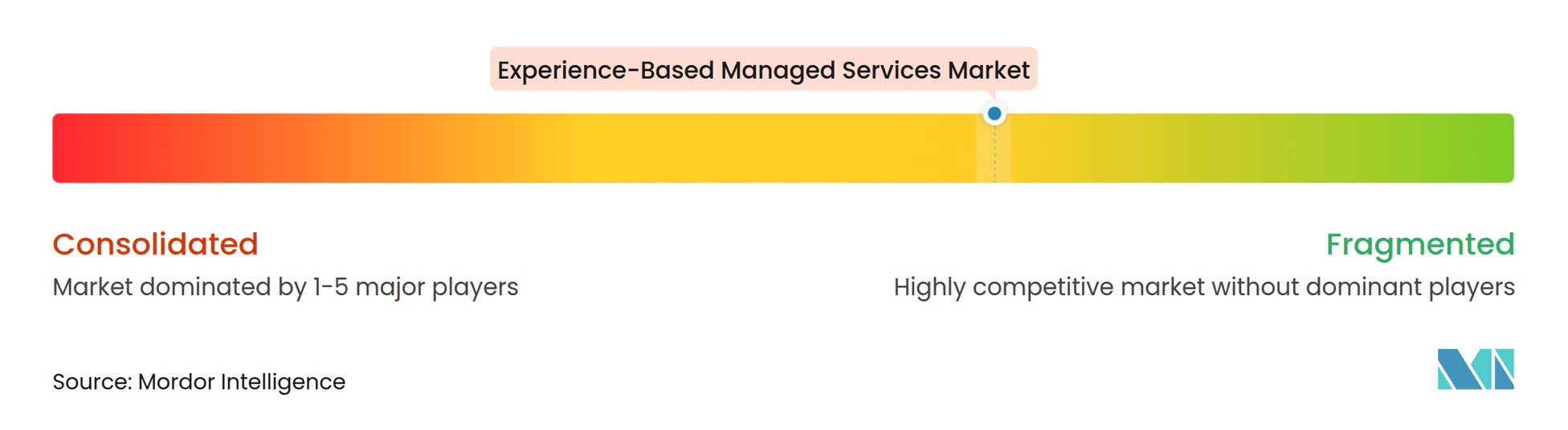
The experience-based managed services market is moderately fragmented. Accenture, Concentrix Corporation, Teleperformance SE, Tata Consultancy Services, Cognizant, Capgemini, and IBM have substantial revenue pools and broad international delivery capacity. Mid-sized specialists compete through sector expertise, regional delivery, and more focused operating models. Providers increasingly use acquisitions to add capabilities in AI, security, digital commerce, and customer intelligence. Accenture completed its acquisition of CyberCX in February 2026, adding cybersecurity capabilities and approximately 1,400 professionals in Asia-Pacific. The move strengthens the link between secure technology operations and the delivery of managed experience.
Accenture also acquired Sagacity Solutions in 2026 to expand AI-led customer intelligence capabilities within its United Kingdom and Ireland operations. Concentrix acquired SAI Digital in September 2025 to extend its digital commerce and customer experience technology capabilities in Asia-Pacific. Teleperformance outlined its Future Forward plan in July 2025, with a focus on an AI-first experience services model and a Technology-as-a-Service arm. These actions show how established customer experience providers are responding to larger technology-led assignments. Security assurance and clear XLA measurement methods are also becoming important selection factors for regulated buyer groups.
The experience-based managed services market still has opportunities where provider offerings are incomplete, especially where a client wants one provider to own the connection between detection, action, and validation of a service fix. Managed remediation is an opening because clients need continuous correction of journey failures, not only closure of individual tickets. SME-oriented bundles are another opening because smaller organizations often need enterprise-grade support with less complex procurement and implementation. Platform vendors in CCaaS, experience analytics, and ITSM are also packaging technology with service operations, which increases competitive pressure on traditional providers. TaskUs, WNS Holdings, and TELUS Digital Experience can compete through specialized vertical knowledge and AI-focused service investments. The resulting structure gives buyers a choice between global scale, sector depth, and technology-led service designs.
Experience-Based Managed Services Industry Leaders
-
Accenture plc
-
Concentrix Corporation
-
Teleperformance SE
-
Cognizant Technology Solutions Corporation
-
Tata Consultancy Services Limited
- *Disclaimer: Major Players sorted in no particular order
Experience-Based Managed Services Market Companies Covered in this Report
- Accenture plc
- Concentrix Corporation
- Teleperformance SE
- Cognizant Technology Solutions Corporation
- Tata Consultancy Services Limited
- Wipro Limited
- HCL Technologies Limited
- Capgemini SE
- International Business Machines Corporation
- NTT DATA Group Corporation
- Infosys Limited
- Tech Mahindra Limited
- Genpact Limited
- Sutherland Global Services, Inc.
- WNS Holdings Limited
- TELUS Digital Experience
- TTEC Holdings, Inc.
- TaskUs, Inc.
- Unisys Corporation
- DXC Technology Company
- Qualtrics International Inc.
- Medallia, Inc.
- NICE Ltd.
- Genesys Telecommunications Laboratories, Inc.
- Sprinklr, Inc.
- Pegasystems Inc.
- Freshworks Inc.
- ServiceNow, Inc.
- Deloitte Touche Tohmatsu Limited
- Publicis Groupe S.A.
- EPAM Systems, Inc.
Recent Industry Developments in Experience-Based Managed Services Market
- April 2026: DXC Technology launched DXC OASIS, an intelligent orchestration platform combining agentic AI with human expertise across enterprise IT estates. The platform introduced a new managed services operating model shifting from reactive support to real-time predictive operations, with unified visibility across all systems and providers, representing a structural repositioning of managed IT experience delivery toward AI-first architectures.
- February 2026: Teleperformance SE’s Q4 FY2025 earnings disclosed that the company had launched more than 500 AI projects during 2025 and initiated an internal AI efficiency program targeting savings exceeding USD 100 million in 2026, reflecting a deliberate structural shift toward AI-led delivery economics across its managed experience operations globally.
- February 2026: Accenture completed its acquisition of CyberCX, the largest privately owned cybersecurity services provider in Australia and New Zealand with approximately 1,400 professionals and end-to-end managed security capabilities. Originally announced in August 2025, the deal represented Accenture’s largest cybersecurity acquisition to date, significantly extending its managed security and experience services footprint across Asia-Pacific.
- January 2026: Accenture acquired Sagacity Solutions, a United Kingdom-based data and customer intelligence firm, to expand AI-driven customer analytics and managed personalization capabilities within Accenture Song’s United Kingdom and Ireland operations. The acquisition addressed enterprise demand to integrate data, AI, and managed operations infrastructure into outcome-linked, XLA-accountable experience programs.
Global Experience-Based Managed Services Market Report Scope
Experience-based managed services market is externally delivered IT or business services where commercial value and performance are measured primarily by the end-user, customer, or employee experience rather than only by infrastructure uptime or ticket volumes. Providers monitor experience metrics such as application responsiveness, service quality, satisfaction, productivity, and friction points, then proactively optimize the underlying technology and processes to improve those outcomes.
The Experience-Based Managed Services Market Report is Segmented by Service Type (Experience Strategy and XLA Design, Experience Baseline Assessment and Benchmarking, Managed Experience Monitoring and Analytics, Managed Service Desk and Employee Support, Managed Customer Support and Contact Center Services, Managed Digital Workplace and End-User Services, Managed Journey Orchestration and Personalization, and Other Service Types), Experience Domain (Customer Experience, Employee Experience, Digital Experience, Workplace Experience, and Citizen, Partner, and Field-Service Experience), Deployment Mode (Cloud-Based, On-Premises, and Hybrid), Organization Size (Large Enterprises, and Small and Medium-Sized Enterprises), Touchpoint and Interaction Channel (Telephone and Voice, Email and Case Management, Web and Portals, Social Media and Messaging, Video, Co-Browsing, and Immersive Channels, and Employee Service Desk and Collaboration Channels), End-User Industry (Banking, Financial Services and Insurance (BFSI), IT and Telecommunications, Healthcare and Life Sciences, Government and Public Sector, Industrial Manufacturing, Retail and E-Commerce, and Other End-User Industries), and Geography (North America, South America, Europe, Asia-Pacific, Middle East, and Africa). The Market Forecasts are Provided in Terms of Value (USD).
Segmentation Overview
| Experience Strategy and XLA Design |
| Experience Baseline Assessment and Benchmarking |
| Managed Experience Monitoring and Analytics |
| Managed Service Desk and Employee Support |
| Managed Customer Support and Contact Center Services |
| Managed Digital Workplace and End-User Services |
| Managed Journey Orchestration and Personalization |
| Other Service Types |
| Customer Experience |
| Employee Experience |
| Digital Experience |
| Workplace Experience |
| Citizen, Partner, and Field-Service Experience |
| Cloud-Based |
| On-Premises |
| Hybrid |
| Large Enterprises |
| Small and Medium-Sized Enterprises |
| Telephone and Voice |
| Email and Case Management |
| Web and Portals |
| Social Media and Messaging |
| Video, Co-Browsing, and Immersive Channels |
| Employee Service Desk and Collaboration Channels |
| Banking, Financial Services and Insurance (BFSI) |
| IT and Telecommunications |
| Healthcare and Life Sciences |
| Government and Public Sector |
| Industrial Manufacturing |
| Retail and E-Commerce |
| Other End-User Industries |
| North America | United States |
| Canada | |
| Mexico | |
| South America | Brazil |
| Argentina | |
| Rest of South America | |
| Europe | Germany |
| United Kingdom | |
| France | |
| Italy | |
| Spain | |
| Rest of Europe | |
| Asia-Pacific | China |
| India | |
| Japan | |
| South Korea | |
| Rest of Asia-Pacific | |
| Middle East | Saudi Arabia |
| United Arab Emirates | |
| Rest of Middle East | |
| Africa | South Africa |
| Nigeria | |
| Rest of Africa |
| By Service Type | Experience Strategy and XLA Design | |
| Experience Baseline Assessment and Benchmarking | ||
| Managed Experience Monitoring and Analytics | ||
| Managed Service Desk and Employee Support | ||
| Managed Customer Support and Contact Center Services | ||
| Managed Digital Workplace and End-User Services | ||
| Managed Journey Orchestration and Personalization | ||
| Other Service Types | ||
| By Experience Domain | Customer Experience | |
| Employee Experience | ||
| Digital Experience | ||
| Workplace Experience | ||
| Citizen, Partner, and Field-Service Experience | ||
| By Deployment Mode | Cloud-Based | |
| On-Premises | ||
| Hybrid | ||
| By Organization Size | Large Enterprises | |
| Small and Medium-Sized Enterprises | ||
| By Touchpoint and Interaction Channel | Telephone and Voice | |
| Email and Case Management | ||
| Web and Portals | ||
| Social Media and Messaging | ||
| Video, Co-Browsing, and Immersive Channels | ||
| Employee Service Desk and Collaboration Channels | ||
| By End-User Industry | Banking, Financial Services and Insurance (BFSI) | |
| IT and Telecommunications | ||
| Healthcare and Life Sciences | ||
| Government and Public Sector | ||
| Industrial Manufacturing | ||
| Retail and E-Commerce | ||
| Other End-User Industries | ||
| By Geography | North America | United States |
| Canada | ||
| Mexico | ||
| South America | Brazil | |
| Argentina | ||
| Rest of South America | ||
| Europe | Germany | |
| United Kingdom | ||
| France | ||
| Italy | ||
| Spain | ||
| Rest of Europe | ||
| Asia-Pacific | China | |
| India | ||
| Japan | ||
| South Korea | ||
| Rest of Asia-Pacific | ||
| Middle East | Saudi Arabia | |
| United Arab Emirates | ||
| Rest of Middle East | ||
| Africa | South Africa | |
| Nigeria | ||
| Rest of Africa | ||
Key Questions Answered in the Report
What is the experience-based managed services market size?
The experience-based managed services market size was valued at USD 3.61 billion in 2026 and is estimated to grow from USD 4.02 billion in 2027 to reach USD 7.86 billion by 2032, at a CAGR of 14.35% during the forecast period (2027-2032).
Which service type leads experience-based managed services?
Managed Customer Support and Contact Center Services leads with a 27.83% share in 2026.
Which deployment model is expanding the fastest?
Hybrid deployments are projected to expand at a 17.64% CAGR through 2032 as enterprises balance cloud flexibility with data and governance requirements.
Which customer group is driving adoption by organization size?
SMEs are projected to expand at a 16.21% CAGR through 2032 as productized offerings lower adoption barriers.
Which end-user sector has the highest projected expansion?
Healthcare and Life Sciences is projected to expand at a 17.52% CAGR through 2032.
Which region has the strongest projected expansion?
Asia-Pacific is projected to expand at a 17.49% CAGR through 2032, supported by digital adoption and delivery capacity.