
Managed Digital Employee Experience Services Market Size and Share
Market Overview
| Study Period | 2021 - 2032 |
|---|---|
| Market Size (2027) | USD 3.42 Billion |
| Market Size (2032) | USD 6.51 Billion |
| Growth Rate (2027 - 2032) | 13.74 % |
| Fastest Growing Market | Asia-Pacific |
| Largest Market | North America |
| Market Concentration | Medium |
Major Players *Disclaimer: Major Players sorted in no particular order Image © Mordor Intelligence. Reuse requires attribution under CC BY 4.0. | |
Managed Digital Employee Experience Services Market Analysis by Mordor Intelligence
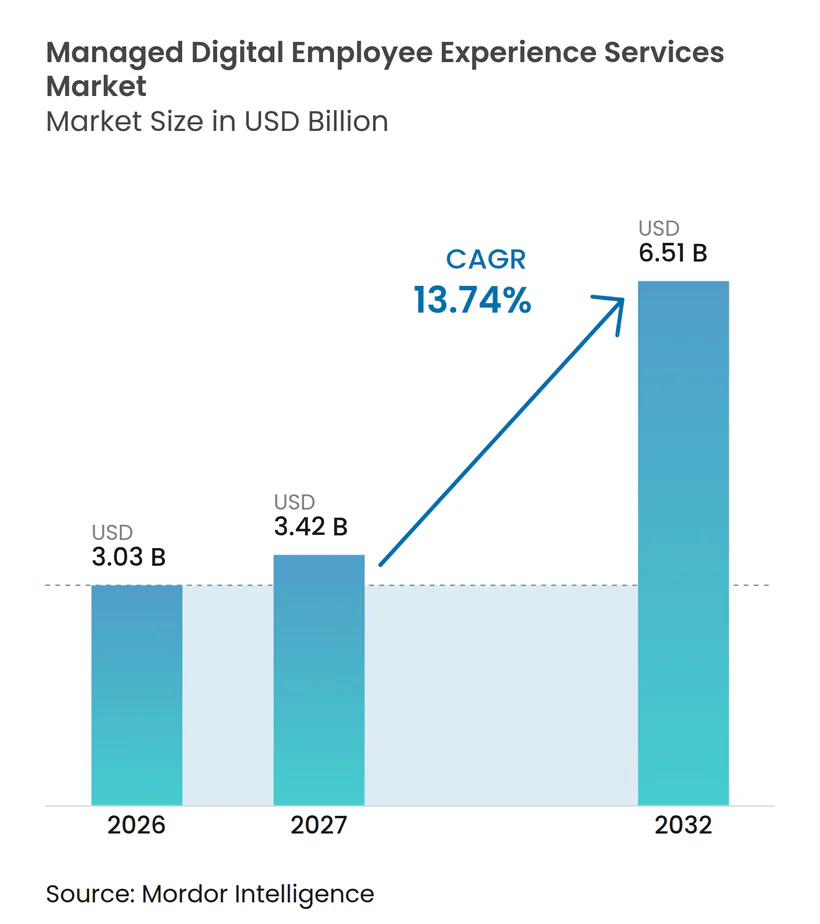
The Managed Digital Employee Experience Services market size is projected to expand from USD 3.03 billion in 2026 and USD 3.42 billion in 2027 to USD 6.51 billion by 2032, registering a CAGR of 13.74% between 2027 to 2032. The managed digital employee experience (DEX) services market is moving beyond incident handling because employers need consistent technology support across home, office, and frontline settings. Cloud workplace platforms and AI-enabled support are changing how providers position their services, with productivity and employee experience becoming more important in buying decisions. Providers are also moving from service-level commitments toward experience-level agreements that link delivery to employee outcomes. This shift favors firms that can combine endpoint data, remote remediation, security controls, workflow improvement, and clear operating accountability in one service model, especially where employers need to identify recurring technology problems before they interrupt employee work or reduce customer service quality.
Key Report Takeaways
- By service type, DEX Monitoring and Analytics held 16.23% of the managed digital employee experience services market share in 2026, while Self-Heal and Automation is projected to expand at a 14.13% CAGR through 2032.
- By deployment mode, Cloud accounted for 60.28% of the managed digital employee experience services market size in 2026 and is projected to expand at a 14.16% CAGR through 2032.
- By organization size, Large Enterprises held 76.84% revenue share in 2026, while Small and Medium Enterprises are projected to expand at a 13.99% CAGR through 2032.
- By enterprise type, the Private Sector accounted for 78.26% revenue share in 2026 and is projected to expand at a 14.26% CAGR through 2032.
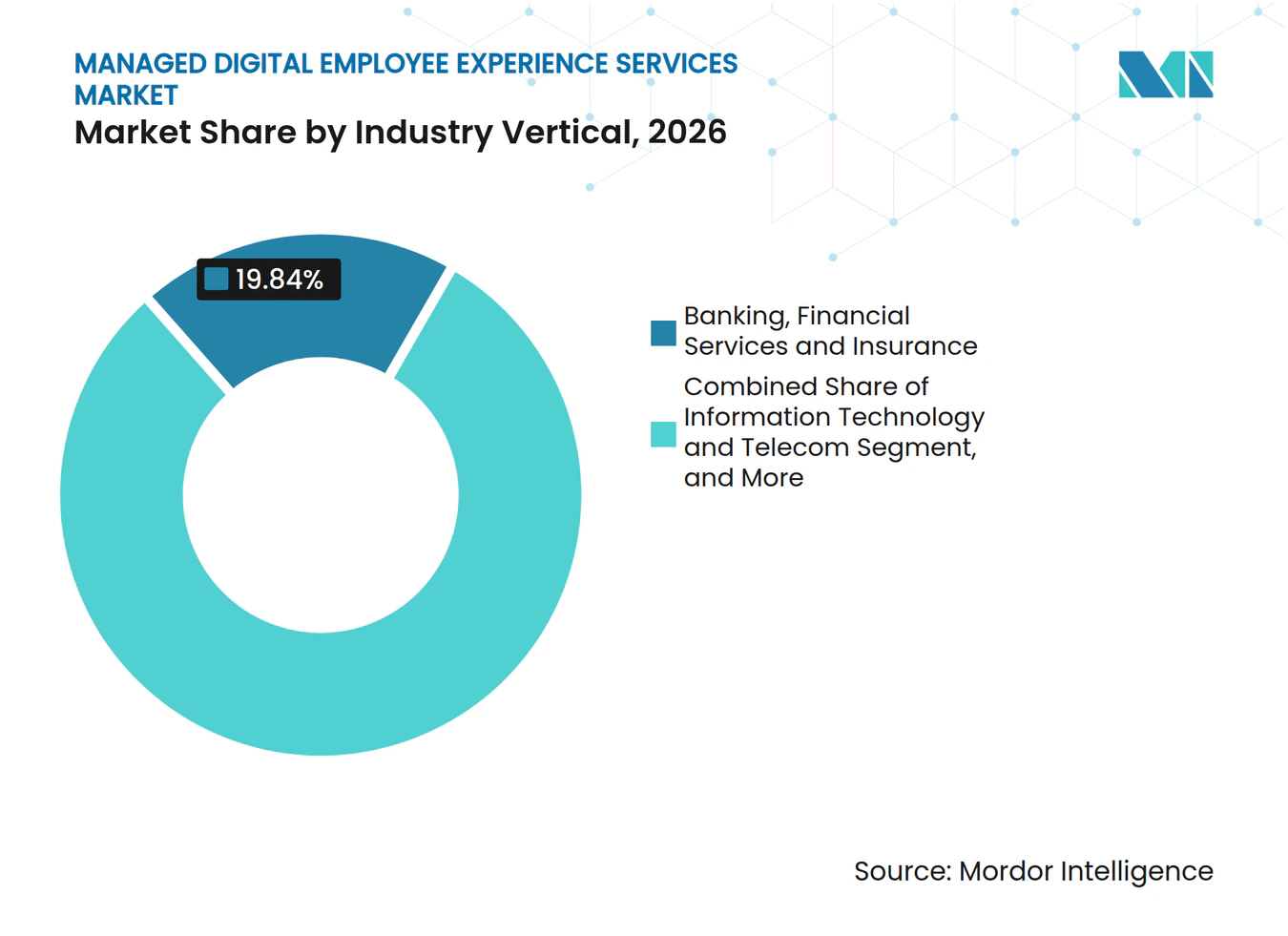
- By industry vertical, BFSI held 19.84% revenue share in 2026, while Information Technology and Telecom are projected to expand at a 14.34% CAGR through 2032.
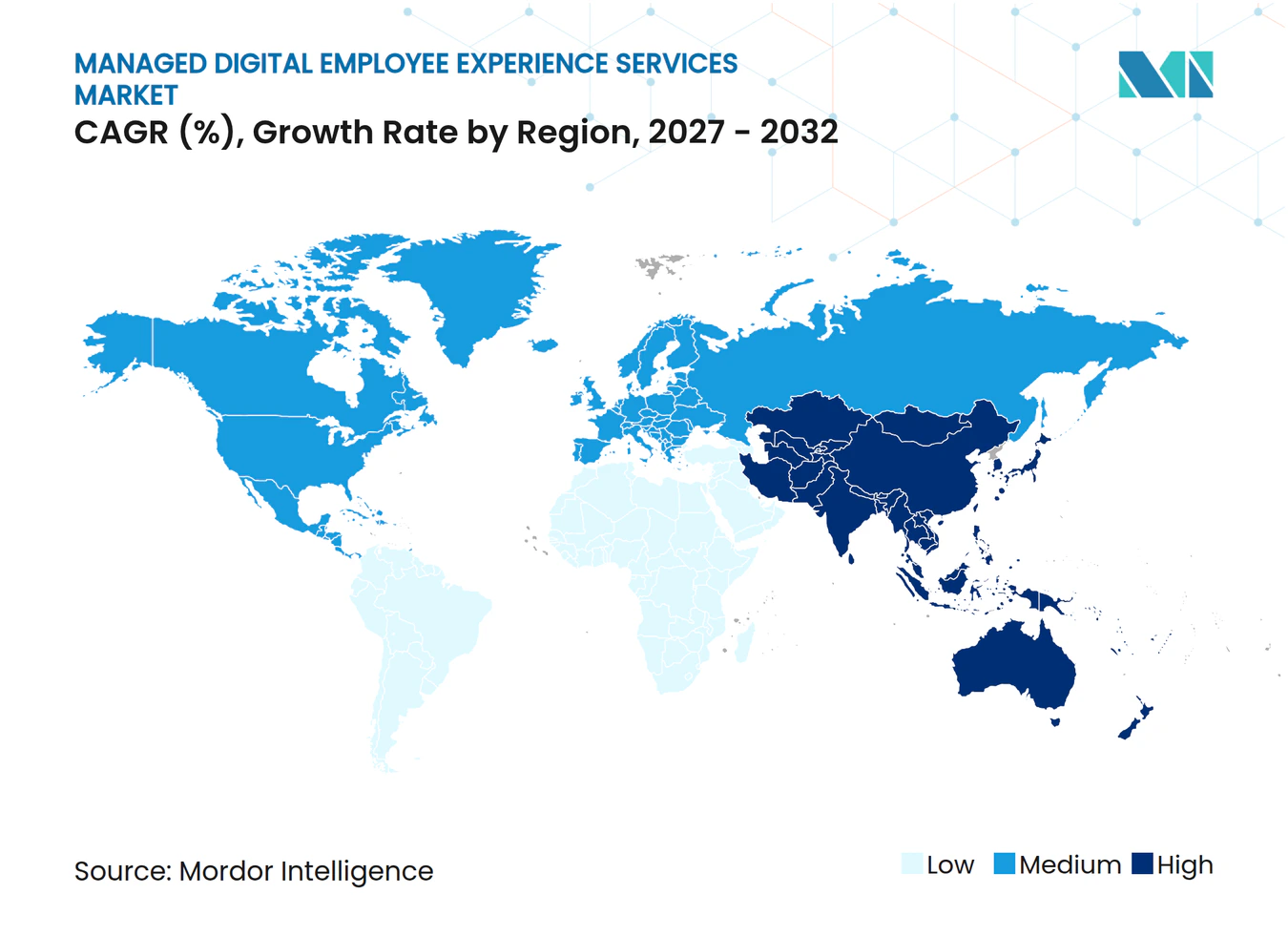
- By geography, North America accounted for 41.88% revenue share in 2026, while Asia-Pacific is projected to expand at a 14.28% CAGR through 2032.
Note: Market numbers in this report are based on Mordor Intelligence's proprietary estimation framework, which combines nine months of actuals with Q4 projections for base year 2026.
Market Trends and Insights
Drivers Impact Analysis of Managed Digital Employee Experience Services Market*
| Driver | (~) % Impact on CAGR Forecast | Geographic Relevance | Impact Timeline |
|---|---|---|---|
| Hybrid Work Support Complexity | +2.80% | Global, concentrated in North America and Europe | Short term (≤ 2 years) |
| Cloud Workplace Platform Adoption | +2.50% | Global, strongest in North America and Asia-Pacific | Short term (≤ 2 years) |
| AI-Enabled Service Desk Modernization | +2.30% | Global, early adoption in North America and Europe | Medium term (2-4 years) |
| Experience-Level Agreements and Outcome-Based Contracting | +1.90% | North America and Europe, with spillover to Asia-Pacific core markets | Medium term (2-4 years) |
| Agentic Workplace Orchestration and Self-Healing Operations | +1.50% | North America, Europe, and Asia-Pacific core markets | Medium term (2-4 years) |
| Mobile and Frontline Workforce Observability | +1.00% | Global, especially Middle East and Africa, South America, and Asia-Pacific emerging markets | Long term (≥ 4 years) |
| Source: Mordor Intelligence | |||
Hybrid Work Support Complexity Reshapes IT Delivery Models
Hybrid work has widened the support environment to include home networks, personal and corporate devices, and cloud applications. Internal IT teams often cannot manage this wider environment with the staffing models used before 2020. The managed digital employee experience (DEX) services market benefits when providers centralize observability, remote remediation, and support across locations. This model gives employers a single operating approach for distributed workforces rather than separate local processes. A larger mix of endpoint types, applications, and work locations raises the need for coordinated technology support. Providers that can show stable employee experience across these settings are better placed to win outcome-based contracts.
Cloud Workplace Platform Adoption Expands the Managed DEX Opportunity Set
Cloud workplace adoption requires ongoing monitoring, optimization, and governance that many enterprises obtain from external providers. Microsoft 365, Google Workspace, and collaboration platforms have made employee experience management a continuous service rather than a periodic technology project. Cloud deployment accounted for 60.28% of revenue in 2026, underscoring its fit with subscription-based managed service delivery. A TeamViewer survey reported that 95% of IT executives planned to consolidate vendors, while 80% cited reduced use of point solutions as the main reason. The managed digital employee experience services market gains scope when one provider can manage monitoring, remediation, and service desk activities through a shared cloud platform. Cloud delivery in the managed digital employee experience services market also supports consumption-based contracts that can reduce adoption barriers for mid-sized organizations.
AI-Enabled Service Desk Modernization Redefines Support Economics
AI is changing both the cost structure and the capability expectations of managed service desks. DXC Technology stated that its August 2026 Workplace Services launch reduced service desk calls by 60% and addressed 50% of device issues before employees noticed them. Riverbed introduced Aternity Self-Service in October 2025 for autonomous diagnosis and remediation with human oversight controls. These offerings reduce reliance on entry-level support tasks and increase the value of experience design, automation governance, and service improvement. The managed digital employee experience services market is, therefore, rewarding providers that can commit to measurable automation outcomes. Traditional providers need comparable orchestration capabilities to avoid competing mainly on labor cost.
Experience-Level Agreements and Outcome-Based Contracting Transform Procurement
Experience-level agreements measure satisfaction, perceived productivity, and service quality instead of relying only on uptime and ticket closure. Computacenter reported that 66% of organizations knew about XLAs, 43% had adopted them, and 68% planned adoption within 18 months. This approach requires providers to use sentiment data, persona-based dashboards, and shared improvement plans. It also makes the commercial relationship more dependent on the provider's ability to interpret workplace data and act on it. The managed digital employee experience (DEX) services market is shifting toward suppliers that can link technical activity to employee outcomes. Smaller providers may face a higher entry barrier when enterprise buyers request mature measurement and governance capabilities.
Restraints Impact Analysis of Managed Digital Employee Experience Services Market*
| Restraint | (~) % Impact on CAGR Forecast | Geographic Relevance | Impact Timeline |
|---|---|---|---|
| Employee Telemetry Privacy and Consent Requirements | -1.20% | European Union and United Kingdom primarily, with spillover to BFSI and healthcare globally | Short term (≤ 2 years) |
| Cyber Risk from Privileged Outsourced Support Access | -0.90% | Global, concentrated in regulated BFSI, healthcare, and government sectors | Medium term (2-4 years) |
| Tool Overlap Across DEX, UEM, ITSM, and Observability Platforms | -0.70% | North America and Europe, where tool estates are most complex | Medium term (2-4 years) |
| DEX Outcome Attribution and Mid-Market Budget Scrutiny | -0.50% | Global, with stronger effects for SMEs and emerging-market mid-market buyers | Long term (≥ 4 years) |
| Source: Mordor Intelligence | |||
Employee Telemetry Privacy and Consent Requirements Constrain Deployment Scope
DEX monitoring can collect device performance, application use, network experience, and employee sentiment data. These data practices must meet privacy requirements that limit how employers collect and use workforce information. The UK Information Commissioner's Office identifies large-scale systematic worker monitoring as high-risk processing that requires a data protection impact assessment.[1] The Italian supervisory authority fined a company EUR 120,000, or USD 135,600, in 2025 for improper employee vehicle tracking.[2] The managed digital employee experience services market must accommodate data minimization, purpose limitation, consent, and regional governance requirements. These controls can lengthen deployments and require providers to design telemetry systems with clearer compliance boundaries.
Cyber Risk From Privileged Outsourced Support Access Elevates Procurement Scrutiny
Managed DEX providers often need administrative access to endpoints, identity directories, and network systems. This access can become a concentrated attack path if credentials are misused or a service provider is compromised. The New York State Department of Financial Services classified IT managed services and outsourced help desk providers as high-risk third parties in October 2025 because of their privileged access.[3] Autonomous remediation can add further audit requirements because software agents use many of the same permissions as human technicians. Buyers are responding with privileged access management, real-time access review, and more detailed liability provisions. These requirements can extend procurement cycles in financial services, healthcare, and government accounts.
*Our forecasts treat driver/restraint impacts as directional, not additive. The impact forecasts reflect baseline growth, mix effects, and variable interactions.
Managed Digital Employee Experience Services Market Segment Analysis
By Service Type:
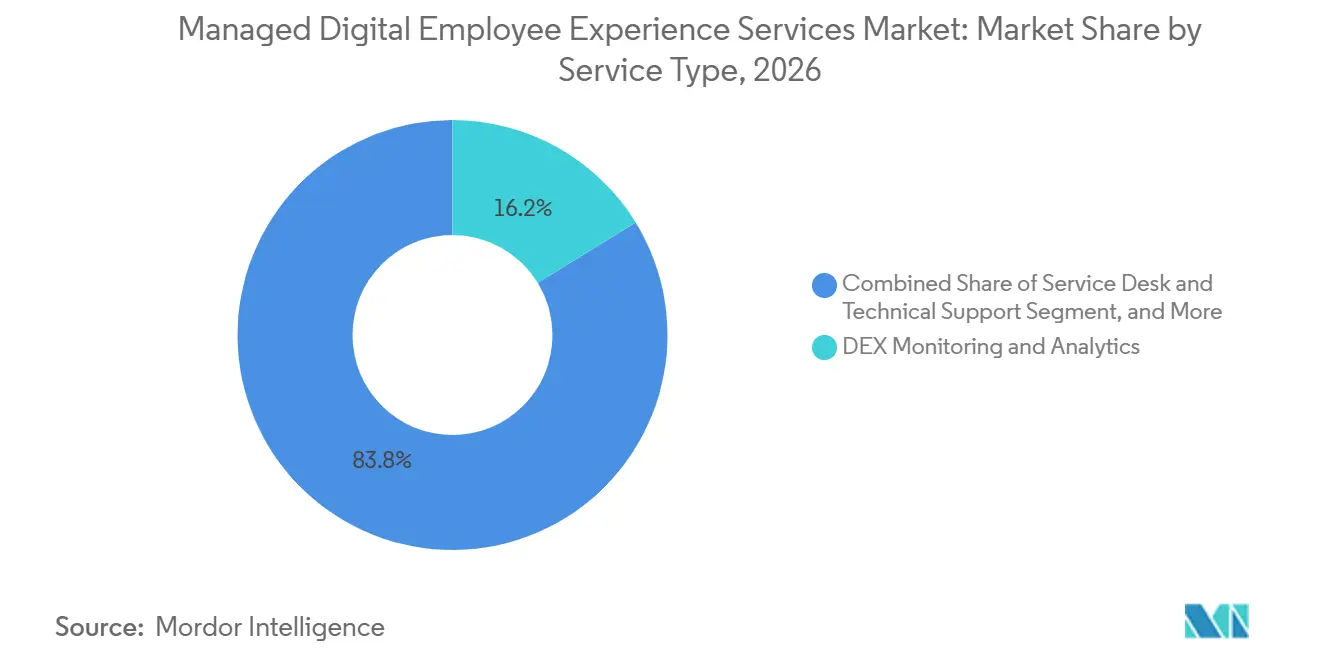
Analytics Supports Current Demand While Automation Sets the PaceDEX Monitoring and Analytics held 16.23% of revenue in 2026, the largest service type share. It provides the endpoint and application data needed before an organization can automate support actions. NTT DATA launched a Nexthink Infinity-based service in July 2026 for approximately 60,000 endpoints in Japan. The company reported a reduction of up to 30% in inquiry response time and savings from identifying redundant software licenses. Service Desk and Technical Support remain important where employees need direct assistance, while experience management identifies recurring technical causes.
Self-Heal and Automation are projected to expand at a 14.13% CAGR through 2032, the fastest rate among service types. The category reduces the need for repeated Level 1 and Level 2 support work through automated diagnosis and remediation. Persona and Sentiment Management is gaining importance as XLA contracts measure experience by employee role and workflow. The managed digital employee experience (DEX) services market is moving toward portfolios that combine automation with data-use controls and service-quality governance. Proprietary orchestration can distinguish premium engagements from basic remote support.



By Deployment Mode:
Cloud Maintains Scale Through Flexible DeliveryCloud held 60.28% of the managed digital employee experience (DEX) services market share in 2026 and is projected to expand at a 14.16% CAGR through 2032. For the managed digital employee experience (DEX) services market, the model aligns with subscription delivery, elastic capacity, and frequent software updates. SaaS platforms can provide telemetry, remote remediation, and AI model updates without a large customer-side infrastructure project. TeamViewer launched TeamViewer ONE in May 2025 to combine endpoint management, DEX monitoring, remote connectivity, and AI diagnostics under one license. The product illustrates the vendor's effort to reduce fragmented tool stacks.
On-premise deployment continues to serve organizations with strict data sovereignty, security, or legacy requirements. Hybrid deployment lets these organizations retain local systems while using cloud-based monitoring and automation. The managed digital employee experience services market size for cloud delivery is driven by enterprises seeking a single management layer for monitoring, service desk, and remediation. Providers that control cloud orchestration platforms can update AI capabilities more quickly than resellers of disconnected products. Vendor consolidation is likely to favor suppliers that connect tools and operations in a coherent platform.
By Organization Size:
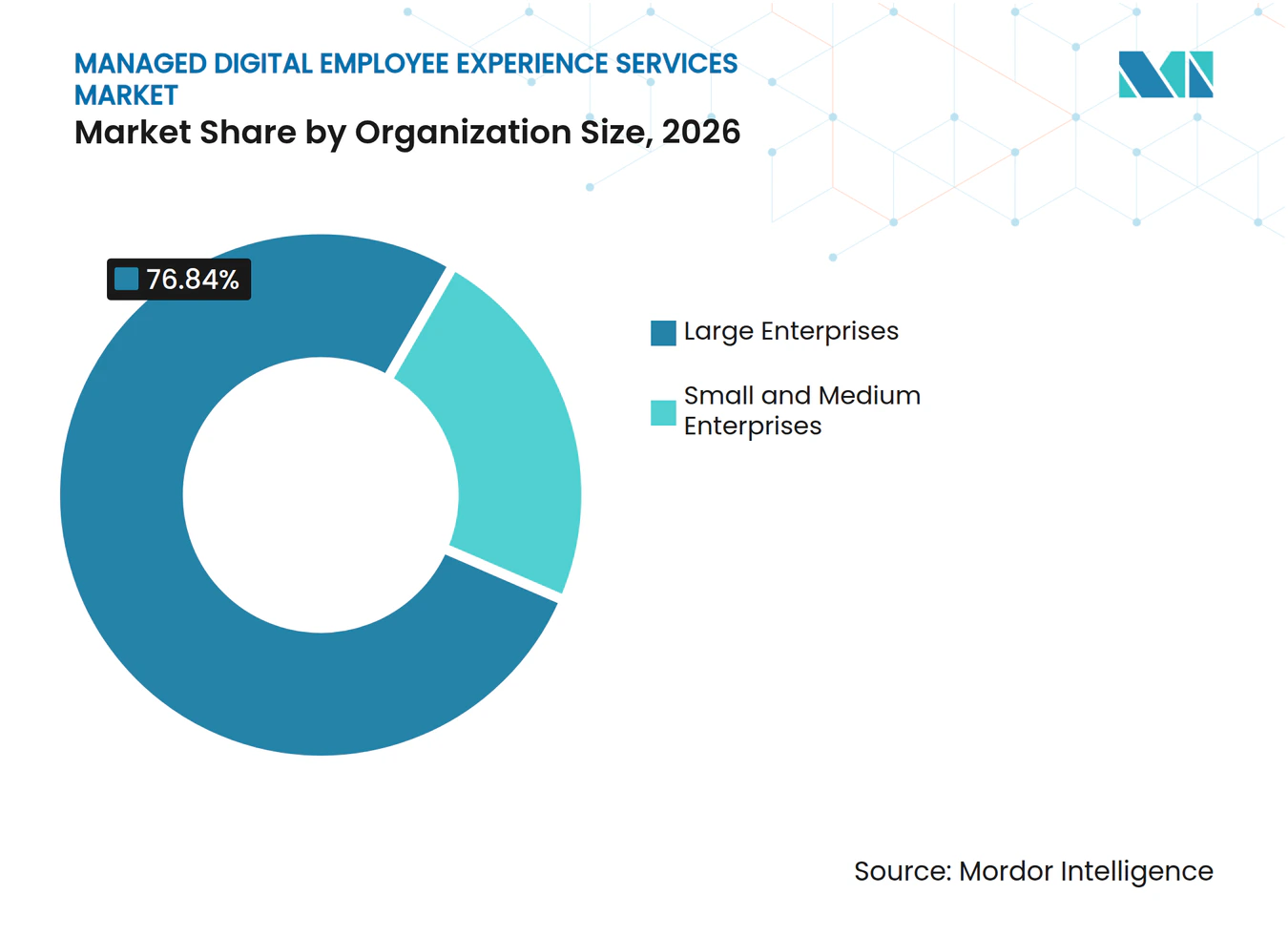
Large Enterprises Hold Revenue While SMEs Expand AccessLarge Enterprises held 76.84% of revenue in 2026, reflecting their broad device estates and complex work environments. Within the managed digital employee experience (DEX) services market, these organizations manage large seat counts, multiple software vendors, and employees across regions. Kyndryl was named a Leader in the 2025 Gartner Magic Quadrant for Outsourced Digital Workplace Services, and it reported fivefold year-over-year growth in XLA deal penetration. Wipro renewed its Global Digital Workplace Services contract with ABB in September 2026, using AI Live Workspace and the WINGS AI-powered delivery platform WIPRO.COM. These examples show how large providers defend enterprise accounts through automation and the delivery of outcomes.
Small and Medium Enterprises are projected to expand at a 13.99% CAGR through 2032. Platform-based delivery can lower per-seat implementation effort and make managed support accessible without a large internal IT organization. Microland states that its zero-touch service desk resolves up to 30% of tickets through conversational AI bots and can reduce service desk costs by 60-80%. The managed digital employee experience (DEX) services market has wider potential in this customer group when delivery is packaged and priced for smaller technology teams. Asia-Pacific and South America are important because cloud adoption is creating new buyers rather than only replacing legacy outsourcing.

By Enterprise Type:
Private Organizations Drive Current Scale and ExpansionThe Private Sector accounted for 78.26% of revenue in 2026 and is projected to expand at a 14.26% CAGR through 2032. Commercial employers within the managed digital employee experience services market face direct costs when employee technology systems interrupt work or degrade customer service. Tata Communications estimated USD 24 million in annual attrition costs and 3,750 productive hours lost daily at a large financial institution with weak employee experience infrastructure. The managed digital employee experience services market gives private employers a way to identify problems before they become persistent workforce issues. Providers that document the link between IT operations and business continuity are better placed in commercial procurement.
Public organizations are expanding the use of managed DEXs as government digital programs reach more administrative and frontline workers. Their requirements can include data sovereignty, accessibility, procurement transparency, and support for varied work roles. Outcome-based contracts are beginning to appear in public procurement as agencies seek better measures of employee service quality. The managed digital employee experience (DEX) services market is relevant to governments that need consistent workplace support across dispersed offices and public-service locations. These opportunities favor suppliers with strong compliance records and established government delivery capability.
By Industry Vertical:
BFSI Leads Demand While IT and Telecom AcceleratesBFSI held 19.84% of revenue in 2026, the largest share among industry verticals. Financial institutions have large distributed workforces and stringent requirements for resilience, access control, and auditability. Kyndryl's program for Belfius Bank and Insurance covered 12,000 employees using Microsoft 365, zero-trust security, and continuous experience monitoring. HCLTech also reported a banking engagement that used persona-based personalization and task automation for tens of thousands of employees. The managed digital employee experience services market serves this vertical through integrated support, security, and monitoring.
Information Technology and Telecom is projected to expand at a 14.34% CAGR through 2032. These employers work with complex technology environments where employee friction can affect customer delivery. Kyndryl completed the acquisition of Healthcare IT Leaders in September 2026 for up to USD 350 million, expanding its healthcare consulting and managed services capabilities. Manufacturing, Retail and E-Commerce, and Government are also increasing adoption to support frontline employees. The managed digital employee experience services market requires tailored service models for these settings rather than a single office-focused offering.
Geography Analysis
North America Managed Digital Employee Experience Services Market
North America accounted for 41.88% of the managed digital employee experience (DEX) services market share in 2026. The region has mature IT outsourcing demand and strong requirements for auditable workforce technology in banking, healthcare, and critical infrastructure. TCS received a digital workplace services engagement for the National Energy System Operator in August 2025, covering service desk, end-user computing, Microsoft 365, and identity management. Canada and Mexico add demand through multinational workplace modernization programs.
APAC Managed Digital Employee Experience Services Market
Asia-Pacific is projected to expand at a 14.28% CAGR through 2032, the fastest regional rate. India is seeing significant workplace transitions as global capability centers and IT services firms expand their use of cloud collaboration tools. Japan's telework adoption is also driving demand for purpose-built managed DEX offerings. Southeast Asia and South Asia provide further opportunity as their technology services sectors create new managed workplace buyers.
The Americas and EMEA Managed Digital Employee Experience Services Market
Europe has high enterprise digital maturity but operates under a demanding privacy and workforce-governance environment. Germany is a key demand center because industrial employers support office, remote, and production-floor employees. T-Systems was named a Leader across 6 categories in the ISG Provider Lens Future of Work 2025 Germany assessment. South America is developing through multinational employers and stronger IT outsourcing adoption in Brazil and Mexico. The Middle East and Africa is supported by Saudi Arabia's Vision 2030 and the UAE's Smart Dubai program.
Competitive Landscape
Market Concentration
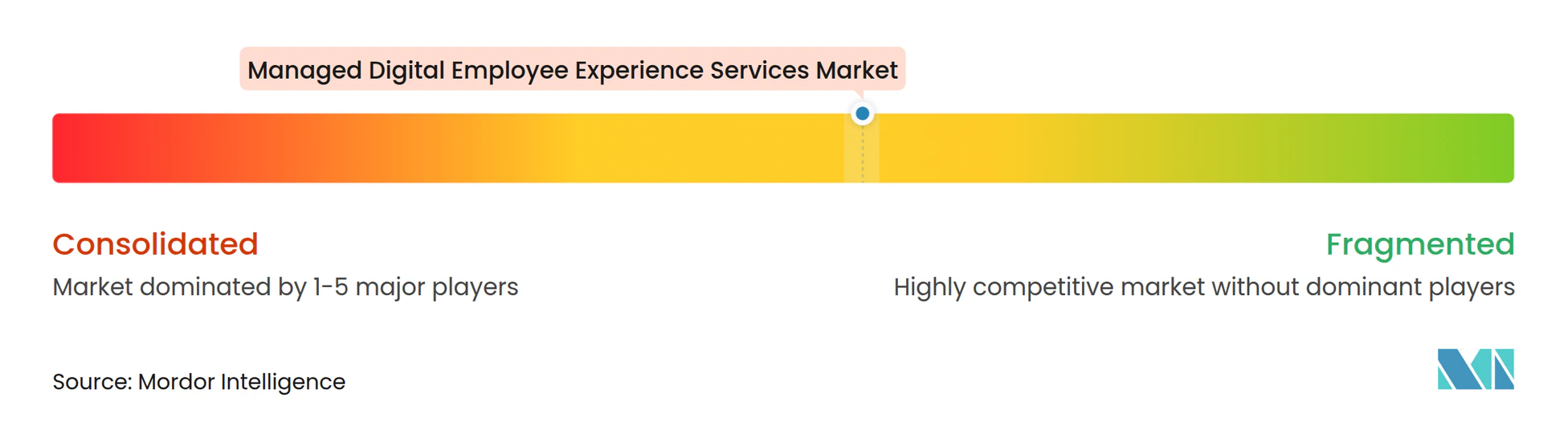
The managed digital employee experience (DEX) services market has a moderately concentrated global tier. Accenture, HCL Technologies, Kyndryl, TCS, Wipro, Cognizant, and Infosys compete for large enterprise contracts. Their competition centers on XLA maturity, AI orchestration, security, and global delivery capacity. Regional and specialist firms address mid-sized buyers and vertical needs that require closer local delivery.
Cognizant was selected by Daimler Truck in February 2026 for a global AI-driven workplace transformation using WorkNEXT across factories and offices. Wipro renewed and expanded its ABB engagement in September 2026 through AI Live Workspace, WINGS, virtual agents, and automated remediation. TeamViewer and ServiceNow announced a multiyear technology partnership in July 2026 to connect DEX and remote connectivity capabilities with the ServiceNow AI Platform. The managed digital employee experience services market is becoming more dependent on partnerships between service providers and platform companies. These arrangements help providers combine observability, remediation, and workflow control.
Healthcare, manufacturing, frontline work, and government often require material adaptation of standard managed services. These environments have specific device categories, workflow requirements, and compliance rules. Suppliers that build reusable vertical configurations may gain a clearer position in these areas. The managed digital employee experience (DEX) industry also includes platform vendors that enable delivery but do not compete directly as managed services providers. TeamViewer and ServiceNow are examples of enabling platform providers rather than outsourced DEX service providers.
Managed Digital Employee Experience Services Industry Leaders
-
Accenture plc
-
Kyndryl Holdings, Inc.
-
DXC Technology Company
-
Atos SE
-
Wipro Limited
- *Disclaimer: Major Players sorted in no particular order
Managed Digital Employee Experience Services Market Companies Covered in this Report
- Accenture plc
- Kyndryl Holdings, Inc.
- DXC Technology Company
- Atos SE
- Wipro Limited
- HCL Technologies Limited
- Unisys Corporation
- NTT DATA Corporation
- Tata Consultancy Services Limited
- Cognizant Technology Solutions Corporation
- Capgemini SE
- Infosys Limited
- Fujitsu Limited
- International Business Machines Corporation
- Computacenter plc
- Logicalis Group Limited
- Getronics N.V.
- Microland Limited
- TeamViewer SE
- ServiceNow, Inc.
Recent Industry Developments in Managed Digital Employee Experience Services Market
- September 2026: Wipro renewed and expanded its Global Digital Workplace Services contract with ABB, deploying AI Live Workspace, the WINGS AI-powered delivery platform, GenAI-powered self-service, virtual agents, and auto-remediation across ABB's global operations, with telemetry-driven device lifecycle management embedded into the managed service.
- September 2026: Kyndryl completed its acquisition of Healthcare IT Leaders, LLC for up to USD 350 million, combining healthcare consulting and application managed services expertise across clinical, operational, and workforce systems with Kyndryl's infrastructure and AI capabilities for hospital and health system clients.
- August 2026: DXC Technology launched DXC Workplace Services, an AI-native managed workplace offering powered by the OASIS agentic AI orchestration platform, delivering 40% reduction in operational complexity, 60% fewer service desk calls, and resolution of 50% of device issues before employees notice them.
- July 2026: TeamViewer and ServiceNow announced a multiyear strategic technology partnership integrating TeamViewer's DEX and remote connectivity solutions with the ServiceNow AI Platform for end-to-end agentic IT workflows, available as a packaged add-on to ServiceNow customers globally across IT Service Management, Field Service Management, and Customer Service Management.
Global Managed Digital Employee Experience Services Market Report Scope
The Managed Digital Employee Experience Services Market comprises outsourced services that monitor, measure, and improve the end-to-end technology experience of employees across devices, applications, collaboration tools, networks, and service desks. These services combine DEX monitoring and analytics (device performance, application health, network quality, user sentiment), proactive/self-healing automation, service desk and technical support, and persona-based experience management to shift IT support from reactive to proactive.
The Managed Digital Employee Experience Services Market Report is Segmented by Service Type (DEX Monitoring and Analytics, Self-Heal and Automation, Service Desk and Technical Support, Persona and Sentiment Management, and Device, Application and Network Experience Management), Deployment Mode (Cloud, On-Premise, and Hybrid), Organization Size (Large Enterprises and Small and Medium Enterprises), Enterprise Type (Private Sector and Public Sector), Industry Vertical (Banking, Financial Services and Insurance, Information Technology and Telecom, Healthcare, Manufacturing, Retail and E-Commerce, Government, and Other Industry Vertical), and Geography (North America, South America, Europe, Asia-Pacific, and Middle East and Africa). The Market Forecasts Are Provided in Terms of Value (USD).
Segmentation Overview
| DEX Monitoring and Analytics |
| Self-Heal and Automation |
| Service Desk and Technical Support |
| Persona and Sentiment Management |
| Device, Application and Network Experience Management |
| Cloud |
| On-Premise |
| Hybrid |
| Large Enterprises |
| Small and Medium Enterprises |
| Private Sector |
| Public Sector |
| Banking, Financial Services and Insurance |
| Information Technology and Telecom |
| Healthcare |
| Manufacturing |
| Retail and E-Commerce |
| Government |
| Other Industry Vertical |
| North America | United States |
| Canada | |
| Mexico | |
| South America | Brazil |
| Argentina | |
| Rest of South America | |
| Europe | Germany |
| United Kingdom | |
| France | |
| Italy | |
| Spain | |
| Rest of Europe | |
| Asia-Pacific | China |
| Japan | |
| India | |
| South Korea | |
| Rest of Asia-Pacific | |
| Middle East and Africa | Saudi Arabia |
| United Arab Emirates | |
| South Africa | |
| Egypt | |
| Rest of Middle East and Africa |
| By Service Type | DEX Monitoring and Analytics | |
| Self-Heal and Automation | ||
| Service Desk and Technical Support | ||
| Persona and Sentiment Management | ||
| Device, Application and Network Experience Management | ||
| By Deployment Mode | Cloud | |
| On-Premise | ||
| Hybrid | ||
| By Organization Size | Large Enterprises | |
| Small and Medium Enterprises | ||
| By Enterprise Type | Private Sector | |
| Public Sector | ||
| By Industry Vertical | Banking, Financial Services and Insurance | |
| Information Technology and Telecom | ||
| Healthcare | ||
| Manufacturing | ||
| Retail and E-Commerce | ||
| Government | ||
| Other Industry Vertical | ||
| By Geography | North America | United States |
| Canada | ||
| Mexico | ||
| South America | Brazil | |
| Argentina | ||
| Rest of South America | ||
| Europe | Germany | |
| United Kingdom | ||
| France | ||
| Italy | ||
| Spain | ||
| Rest of Europe | ||
| Asia-Pacific | China | |
| Japan | ||
| India | ||
| South Korea | ||
| Rest of Asia-Pacific | ||
| Middle East and Africa | Saudi Arabia | |
| United Arab Emirates | ||
| South Africa | ||
| Egypt | ||
| Rest of Middle East and Africa | ||
Key Questions Answered in the Report
What is the managed digital employee experience services market size?
The managed digital employee experience services market is projected to expand from USD 3.03 billion in 2026 and USD 3.42 billion in 2027 to USD 6.51 billion by 2032, at a 13.74% CAGR.
What is driving demand for managed DEX services?
Hybrid work complexity, cloud workplace adoption, AI-enabled service desks, and experience-level agreements are increasing demand for managed support and monitoring.
Which deployment mode has the largest share?
Cloud held 60.28% of revenue in 2026 and is projected to expand at a 14.16% CAGR through 2032.
Which customer group accounts for the largest revenue share?
Large enterprises held 76.84% of revenue in 2026 because they operate complex, distributed technology environments.
Which industry vertical leads managed DEX adoption?
BFSI held 19.84% of revenue in 2026 due to its need for workforce technology controls, resilience, and auditability.
Which region is expected to expand the fastest?
Asia-Pacific is projected to expand at a 14.28% CAGR through 2032, supported by large digital workplace transitions and telework adoption.