
Market Overview
| Study Period | 2020 - 2031 |
|---|---|
| Forecast Data Period | 2026 - 2031 |
| Base Year Market Size (2025) | USD 1.46 Billion |
| Market Size (2026) | USD 1.54 Billion |
| Market Size (2031) | USD 2.02 Billion |
| Growth Rate (2026 - 2031) | 5.61 % |
| Market Concentration | Medium |
Major Players *Disclaimer: Major Players sorted in no particular order Image © Mordor Intelligence. Reuse requires attribution under CC BY 4.0. | |
Europe Autoimmune Disease Diagnostics Market Analysis by Mordor Intelligence
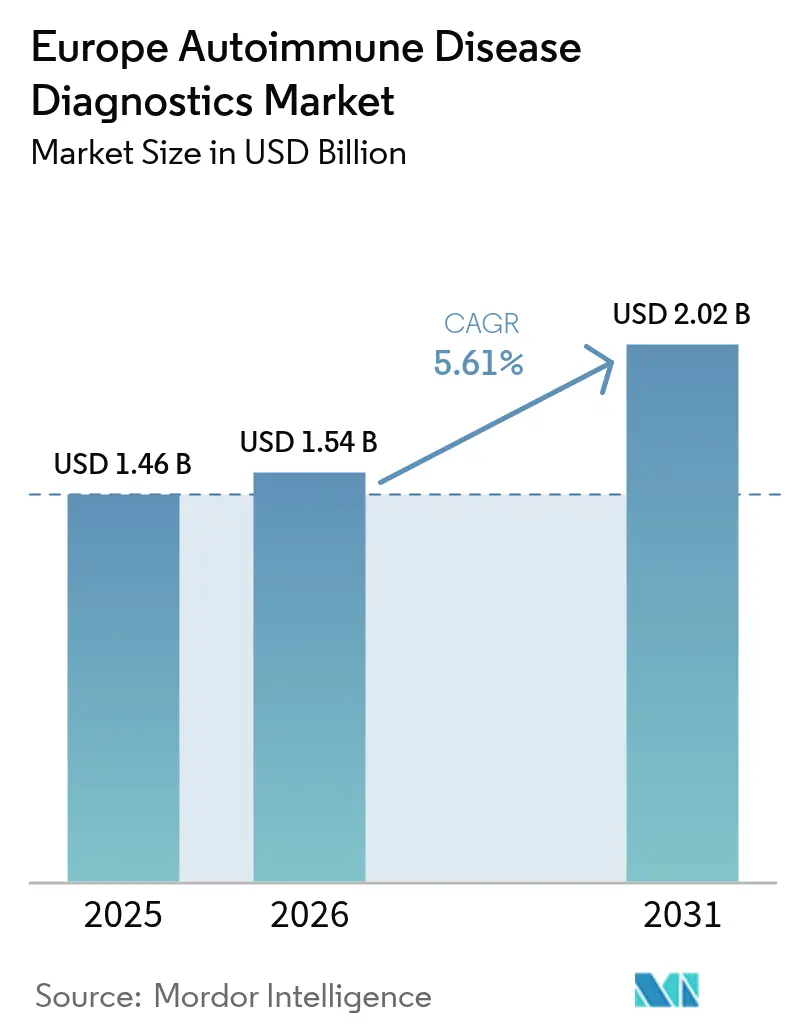
Europe Autoimmune Disease Diagnostics Market size in 2026 is estimated at USD 1.54 billion, growing from 2025 value of USD 1.46 billion with 2031 projections showing USD 2.02 billion, growing at 5.61% CAGR over 2026-2031.
The major factors driving the market are the increasing prevalence, along with the rising public awareness, technological advancements, and improved laboratory automation.
European countries are being confronted with an increase in the occurrence of the most autoimmune immune disorders. The prevalence rate of multiple sclerosis in Europe is estimated at 83 out of 100,000. Moreover, multiple sclerosis is more common among women than men. In addition, two million people are affected by rheumatoid arthritis and nearly 2-3% of the population is estimated to be affected by psoriasis, which is one of the most common forms of autoimmune diseases. Owing to the aforementioned conditions, early diagnosis and onset of treatment can make a significant difference in preventing permanent damage and disability. Results of autoimmune disease diagnostic tests can confirm a disorder, estimate disease severity, aid in assessing prognosis. They are also useful to follow disease activity.
The increasing awareness of auto-immune diseases, through programs of research, education, support, and advocacy is a key factor augmenting the usage rates. The European Commission is taking several steps to increase awareness among the public regarding the risk factors in developing autoimmune diseases. Thus, as symptoms occur, they can seek diagnosis and begin a treatment regimen.
Note: Market size and forecast figures in this report are generated using Mordor Intelligence’s proprietary estimation framework, updated with the latest available data and insights as of 2026.
Market Trends and Insights
Rheumatoid Arthritis is Expected to Dominate the Systemic Autoimmune Disease Segment in the Coming Future
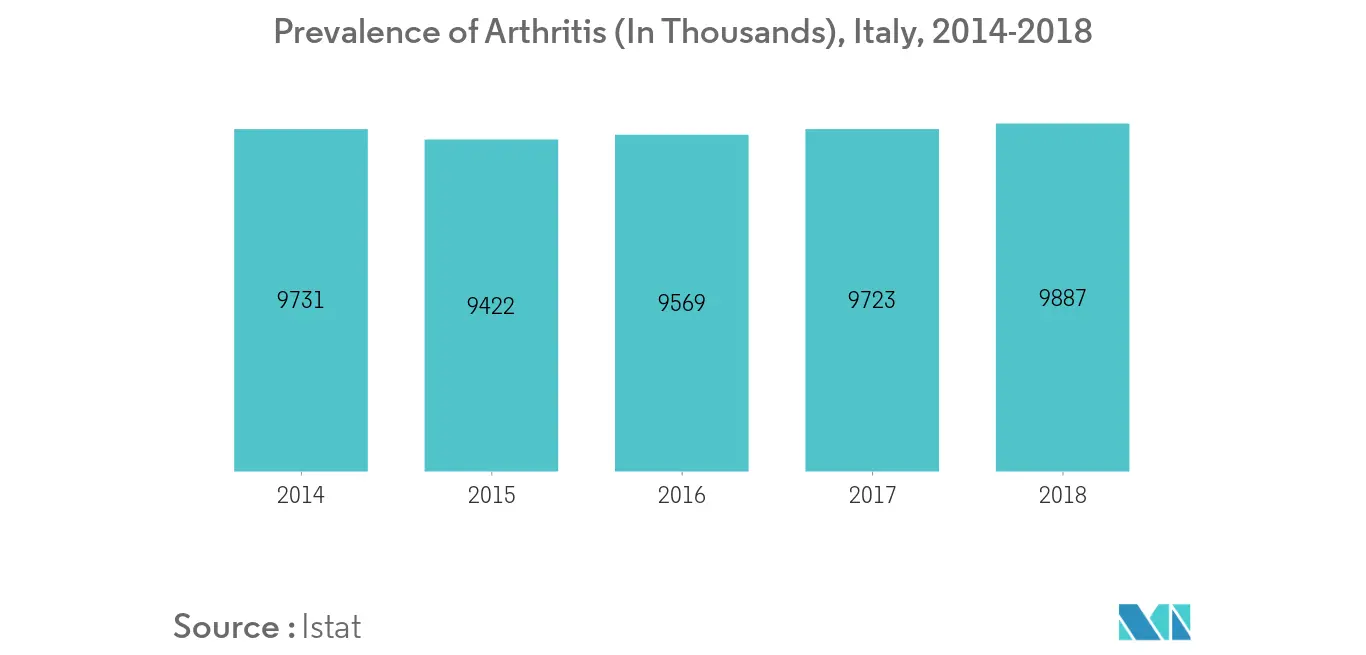
Rheumatoid arthritis is a chronic, progressive, and inflammatory autoimmune disease associated with HLA-DR4 and HLA-DR1 serotypes, characterized by persistent inflammation of the synovium that leads to the destruction of joints. The availability of treatment options, such as biologics, increasing awareness about rheumatoid arthritis, and the presence of reimbursement schemes across many countries are driving the growth of the segment. Rheumatoid arthritis (RA) is more prevalent in females. For instance, the United Kingdom has a prevalence rate of 1.2% in females and 0.4% in males.
Increasing incidence of autoimmune diseases, off-label prescription of NSAIDs, and other pain management drugs are expected to increase the demand for RA diagnosis. In addition, extensive focus on the high specificity and sensitivity of RA kits from kit manufacturers, and favorable regulatory guidelines for rapid RA diagnostic kits are expected to fuel the market growth.
Competitive Landscape
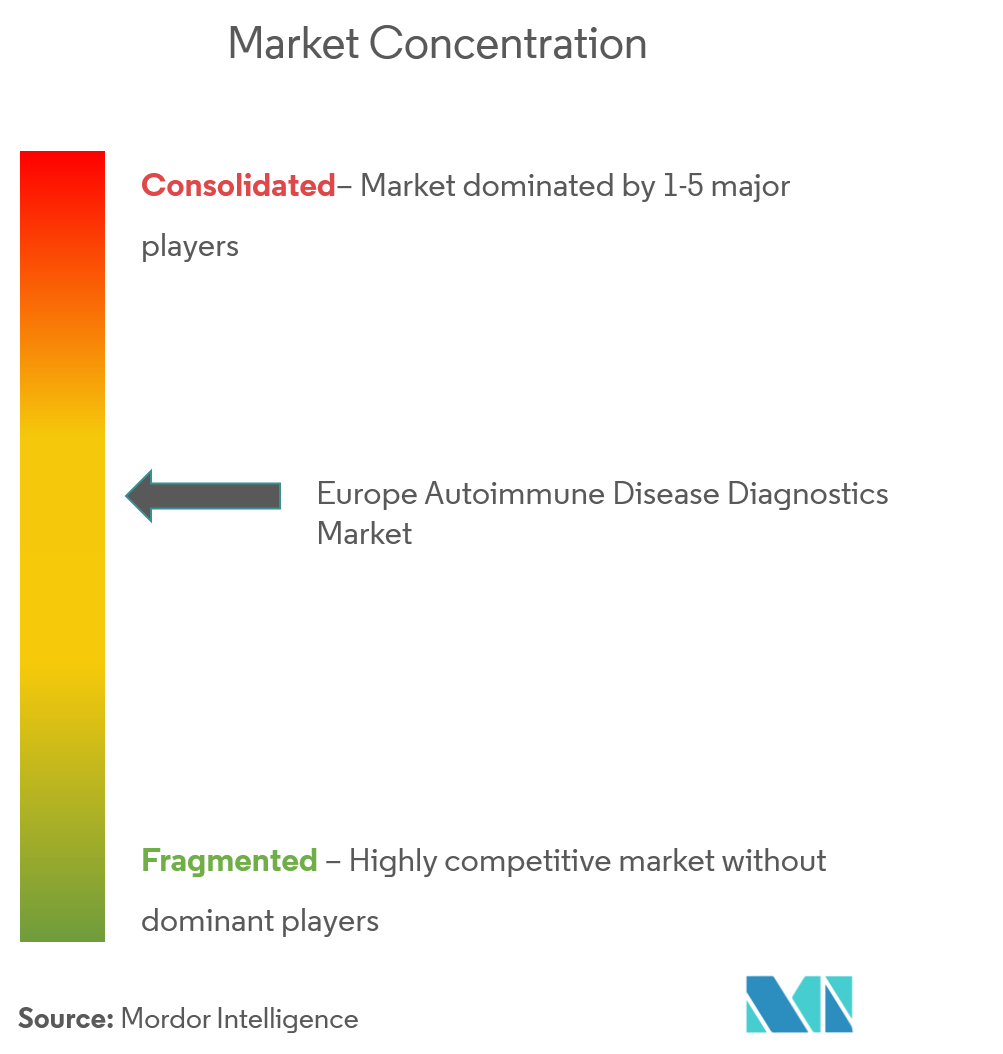
The European autoimmune disease diagnostics market is moderately competitive in nature. Some of the well-known players in the market are Abbott Laboratories, Biomérieux, Bio-rad Laboratories, F. Hoffmann-la Roche, and Thermo Fisher Scientific Inc. However, there are some new companies that are focusing on market penetration, owing to the growing market for autoimmune disease diagnostics in Europe.
Europe Autoimmune Disease Diagnostics Industry Leaders
-
Abbott Laboratories
-
bioMérieux Inc.
-
Bio-Rad Laboratories Inc.
-
Thermo Fisher Scientific Inc.
-
Siemens Healthineers Inc.
- *Disclaimer: Major Players sorted in no particular order
Europe Autoimmune Disease Diagnostics Market Companies Covered in this Report
- Abbott Laboratories
- bioMérieux
- Bio-Rad Laboratories
- Euroimmun
- Roche
- Inova Diagnostics
- Myriad Genetics
- Siemens Healthineers
- Thermo Fisher Scientific
- Trinity Biotech
Read Analysis of Europe Autoimmune Disease Diagnostics Companies
Market Opportunities and Future Outlook
Opportunities in Europe are opening around biomarker-led patient stratification and test portfolios that can meet strengthened performance and documentation requirements under EU IVDR (Regulation (EU) 2017/746), especially for assays that sit at the diagnostics and therapeutics interface. EMA materials on companion diagnostics and the EMA-notified body consultation process, including the February 2026 work of the Combination Products Operational Group (COMBO), point to the need for clearer, less redundant evidence packages. This creates space for manufacturers that can operationalize compliant clinical evidence generation and lifecycle documentation across immunoassays and multiplex workflows.
A second opportunity cluster is building around decision support and data integration tools for earlier identification and monitoring of autoimmune disease, aligned with the market drivers of awareness, technological advancement, and laboratory automation already visible across Europe. Horizon Europe initiatives provide infrastructure and pipelines for diagnostic translation, including IgG4-TREATs European biobank with over 750 characterized samples for biomarker discovery and validation. Projects such as ENDOTARGET and iPROLEPSIS are developing AI-informed prediction and digital ecosystems for rheumatic and psoriatic arthritis. In parallel, EMA qualification work on islet autoantibodies as enrichment biomarkers for type 1 diabetes prevention clinical trials supports broader use of validated autoantibody panels in research-to-clinic pathways, reinforcing demand for standardized assays, controls, and interoperable reporting in both central laboratories and near-patient settings.
Recent Industry Developments in Europe Autoimmune Disease Diagnostics Market
- April 2026: Bio-Rad Laboratories reported incremental costs related to EU IVDR compliance in its first-quarter 2026 disclosure. The update highlighted the continuing operational and quality-system effort needed to maintain and renew European IVD access, influencing portfolio prioritization and documentation investments.
- March 2026: bioMerieux received IVDR CE marking for the BIOFIRE SPOTFIRE Respiratory/Sore Throat plus (R/STplus) Panel and the BIOFIRE SPOTFIRE R/STplus Panel Mini for Europe. The clearance supports near-patient multiplex testing deployment under the IVDR framework, strengthening competitive positioning in decentralized diagnostics environments.
- October 2025: Bio-Rad Laboratories launched the Specialty Immunoassay Plus (SPIA Plus) quality control system in Europe. The consolidated liquid control design targets routine immunoassay monitoring needs and supports laboratories working to standardize and document assay performance across increasingly automated workflows.
Europe Autoimmune Disease Diagnostics Market Report Scope and Research Methodology
Market Definition and Coverage
This market covers revenue generated in Europe from diagnostic testing used to identify and monitor autoimmune diseases, including assay based techniques used in laboratories and hospital settings, and the related test reagents and instrument use tied to those tests.
Scope exclusions: We exclude autoimmune therapeutics, general imaging not ordered for autoimmune workups, and broader routine panels when they are not used for autoimmune diagnosis or follow-up.
Segments Covered in This Report
- By Disease Type
- Systemic Autoimmune Disease
- Rheumatoid Arthritis
- Psoriasis
- Systemic Lupus Erythematosus (SLE)
- Multiple Sclerosis
- Other Systemic Autoimmune Diseases
- Localized Autoimmune Disease
- Inflammatory Bowel Disease
- Type-1 Diabetes
- Thyroid
- Other Localized Autoimmune Diseases
- Systemic Autoimmune Disease
- By Diagnostic Technique
- Immunofluorescence Assays (IFA)
- Enzyme-linked Immunosorbant Assay (ELISA)
- Western Blotting
- Multiplex Immunoassay
- Agglutination
- Other Diagnostic Techniques
- Geography
- Europe
- Germany
- United Kingdom
- France
- Italy
- Spain
- Rest of Europe
- Europe
Data Sources, Market Sizing, and Validation
Desk Research
Desk research was used to set the fact base for demand, testing patterns, and pricing logic across Europe, then to confirm country coverage before modeling. We reviewed public sources such as Eurostat health statistics, the European Commission and ECDC health publications, and OECD health data. We also used guidance documents published by European clinical and laboratory medicine bodies (for example on ANA testing and related algorithms) to align how autoimmune test pathways are expected to run.
For technique and utilization signals, we also checked peer reviewed journal articles for testing pathways, positivity rates, and shifts from IFA to ELISA or multiplex methods. To keep the model grounded in commercial reality, we reviewed company annual reports, investor presentations, association websites, and reputable medical press that discuss assay launches and lab automation trends. For cross checks on company revenue footprints and patent activity, we selectively used paid subscriptions that provide company financial intelligence and patent database access, since they help validate whether a firm is present in the category by country. The desk research sources cited here are illustrative only, and additional public references were used for data collection, validation, and clarification.
Primary Interviews and Surveys
We use expert interviews and surveys with CXOs, functional and unit leaders, and managers involved in autoimmune testing, laboratories, reimbursement, and diagnostics distribution in Europe. Respondents help test secondary figures, clarify assay use and pricing, and resolve country-level assumptions before final analysis. Re-contact is considered when answers conflict with observed laboratory or reimbursement signals.
Distribution of primary research fieldwork respondents
| Company type | Respondent position |
|---|---|
| Top tier: 28% | CXOs: 18% |
| Mid tier: 47% | Functional/Unit leaders: 31% |
| Smaller Players: 25% | Managers: 51% |
Market-Sizing & Forecasting
Sizing starts with a top-down build where we reconstruct the diagnostic demand pool by country using healthcare activity signals and autoimmune disease testing intensity, then allocate it across major techniques used in routine practice. The totals are corroborated with selective bottom-up approximations, such as sampling assay volumes and price bands by technique, and cross checking supplier exposure and channel feedback, which are used to adjust the country totals when gaps appear.
Key inputs that shaped the model included the mix of systemic versus localized autoimmune testing, the share of ANA and related autoantibody panels within overall autoimmune workups, technique mix shifts between immunofluorescence assays, ELISA, western blotting, multiplex immunoassay, and agglutination, and the split of testing between hospitals and independent clinical laboratories. We also tracked practical pricing markers, including reagent kit ASP ranges by technique, instrument placement intensity in larger labs, and the effect of reimbursement and procurement cycles on adoption timing.
For forecasting, scenario analysis was used, since changes in guideline driven testing pathways and lab automation adoption can create step changes rather than smooth curves. Assumptions for growth by country and technique were kept consistent with what primary experts described for utilization, procurement timelines, and the speed at which labs standardize new panels. When bottom-up checks were thin in smaller countries, we used proxy ratios from comparable markets and then validated them with regional distributors and lab stakeholders.
Data Validation & Update Cycle
Validation was handled through triangulation across three layers, model outputs, independent market signals, and expert feedback, so one weak data point did not drive the final number. Variance checks were run at country and technique levels, and outliers were reviewed again against the assumed test mix and price ladders before sign-off. If a mismatch persisted, we re-contacted respondents to confirm whether it was driven by procurement timing, reimbursement effects, or a one-time event.
Every report is refreshed annually, and interim updates are done when a material event changes demand or pricing (for example, a major guideline change or a large procurement shift). Before delivery, an analyst performs a final pass to incorporate the latest public signals and interview feedback, so clients receive an updated view rather than an older snapshot.
Mordor Intelligence's European Autoimmune Disease Diagnostics Market Sizing Compared With Other Published Estimates
Published market values for autoimmune disease diagnostics in Europe can differ because each study draws the line differently on what counts as autoimmune diagnostics revenue, and because pricing and technique mix are treated differently across models. Differences also show up when one estimate uses an older base year, applies a single Europe level growth rate, or does not recheck country totals against real testing pathways.
The main gap comes from whether routine inflammatory markers and broad panels are fully counted as autoimmune diagnostics, and how quickly newer multiplex testing is assumed to replace older methods, which shifts the weighted ASP over time. Some estimates also model Europe as one block, while our approach keeps country level checks so higher spend markets do not over-influence the rest of the region, and currency timing and inflation assumptions stay consistent across the series.
Benchmark comparison
| Source | Market Size | Gaps in Research Methodology |
|---|---|---|
| Mordor Intelligence | USD 1.46 B (2025) | |
| Trade Research Group A | USD 4.07 B (2025) | Broader test scope appears to include routine panels and inflammatory markers as core autoimmune diagnostics revenue across settings, which can inflate totals when test intent is not filtered to autoimmune workups. |
| Industry Publisher B | USD 1.54 B (2024) | Uses a different base year and segment scope that can blend in instruments and services more widely, and the shorter forecast window can apply a higher growth profile than what technique level adoption supports. |
The table shows that scope decisions explain most of the spread, and the gap is largest when routine testing is counted without confirming the autoimmune diagnostic pathway. The scope filter that limits counting to autoimmune specific testing intent, and the technique level ASP mix that is refreshed using country checks, are the steps that keep Mordor Intelligence tied to a repeatable Europe demand build rather than a broad lab testing total.
Key Questions Answered in the Report
How big is the Europe Autoimmune Disease Diagnostics Market?
The Europe Autoimmune Disease Diagnostics Market size is expected to reach USD 1.54 billion in 2026 and grow at a CAGR of 5.61% to reach USD 2.02 billion by 2031.
What is the current Europe Autoimmune Disease Diagnostics Market size?
In 2026, the Europe Autoimmune Disease Diagnostics Market size is expected to reach USD 1.54 billion.
Who are the key players in Europe Autoimmune Disease Diagnostics Market?
Abbott Laboratories, bioMérieux Inc., Bio-Rad Laboratories Inc., Thermo Fisher Scientific Inc. and Siemens Healthineers Inc. are the major companies operating in the Europe Autoimmune Disease Diagnostics Market.
What years does this Europe Autoimmune Disease Diagnostics Market cover, and what was the market size in 2025?
In 2025, the Europe Autoimmune Disease Diagnostics Market size was estimated at USD 1.54 billion. The report covers the Europe Autoimmune Disease Diagnostics Market historical market size for years: 2019, 2020, 2021, 2022, 2023 and 2024. The report also forecasts the Europe Autoimmune Disease Diagnostics Market size for years: 2026, 2027, 2028, 2029, 2030 and 2031.