
Market Overview
| Study Period | 2021 - 2031 |
|---|---|
| Forecast Data Period | 2026 - 2031 |
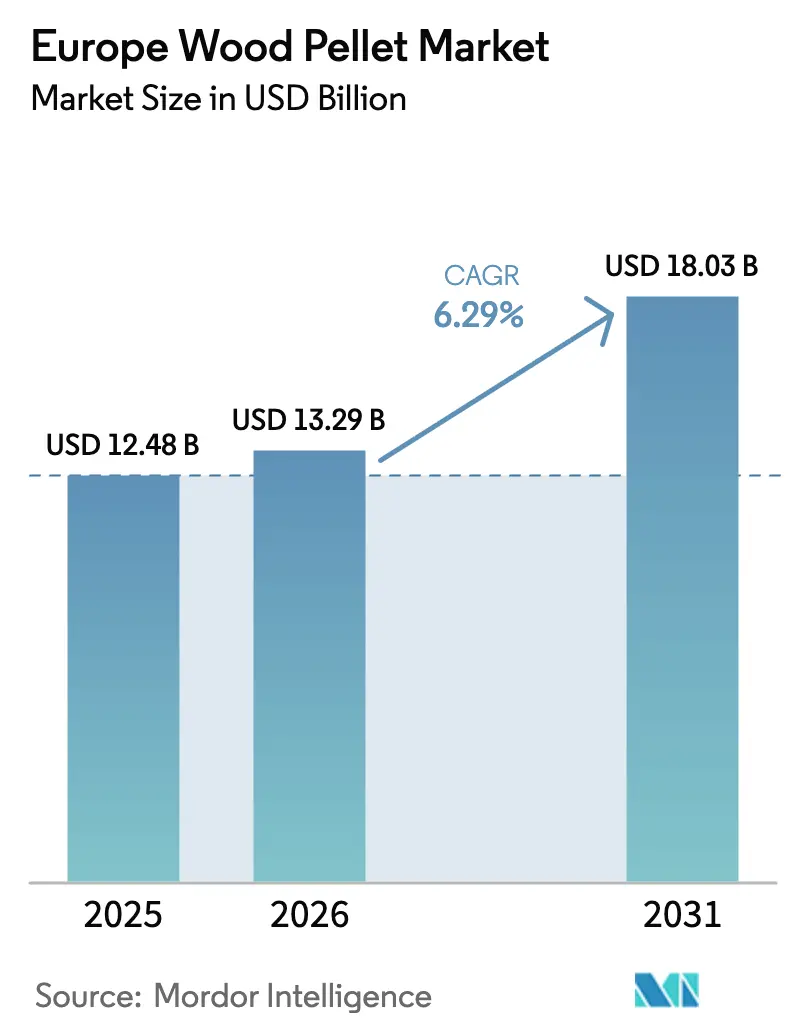
| Base Year Market Size (2025) | USD 12.48 Billion |
| Market Size (2026) | USD 13.29 Billion |
| Market Size (2031) | USD 18.03 Billion |
| Growth Rate (2026 - 2031) | 6.29 % |
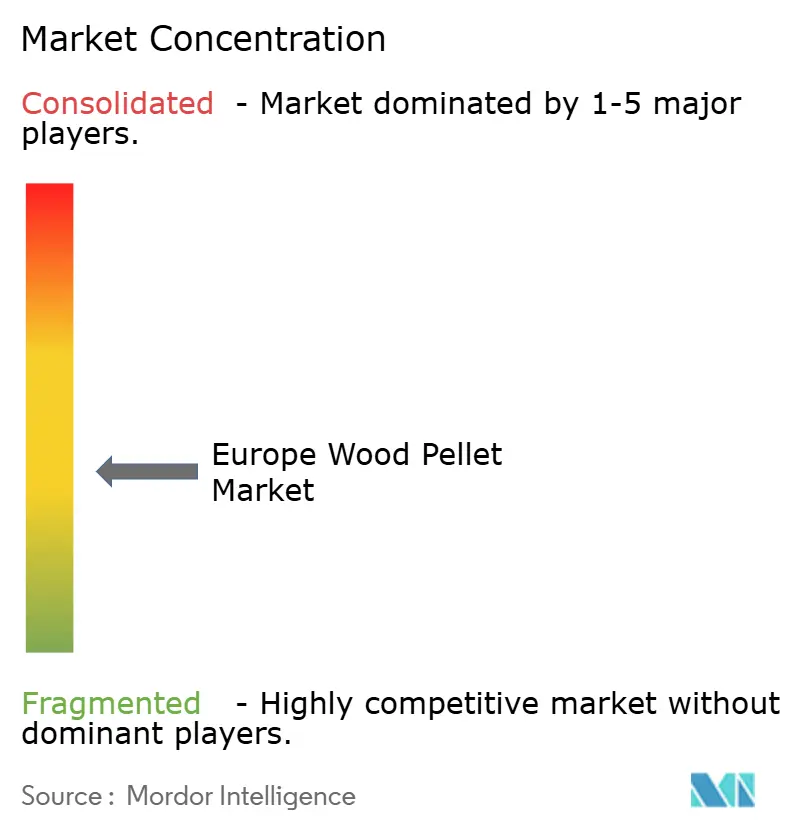
| Market Concentration | Medium |
Major Players *Disclaimer: Major Players sorted in no particular order Image © Mordor Intelligence. Reuse requires attribution under CC BY 4.0. | |
Europe Wood Pellet Market Analysis by Mordor Intelligence
The Europe Wood Pellet Market size is projected to be USD 12.48 billion in 2025, USD 13.29 billion in 2026, and reach USD 18.03 billion by 2031, growing at a CAGR of 6.29% from 2026 to 2031.
The market is powered by coal-to-biomass conversions in utilities, fresh incentives for negative-emission BECCS, and resilient residential heating demand amid volatile fossil-fuel prices. Vertically integrated suppliers are rushing to secure long-term offtake agreements as supply-chain localization efforts reduce exposure to Russian feedstock, while torrefied pellets gain momentum because they match coal’s energy density. Pricing pressure persists, however, as sawmill closures tighten residue availability and EU sustainability rules lift compliance costs.[1]Bioenergy Europe, “Statistical Report 2025: Biomass Supply, Transformation & Consumption,” bioenergyeurope.orgCompetitive dynamics favor players that control feedstock, logistics, and carbon-credit monetization across the entire value chain.
Key Report Takeaways
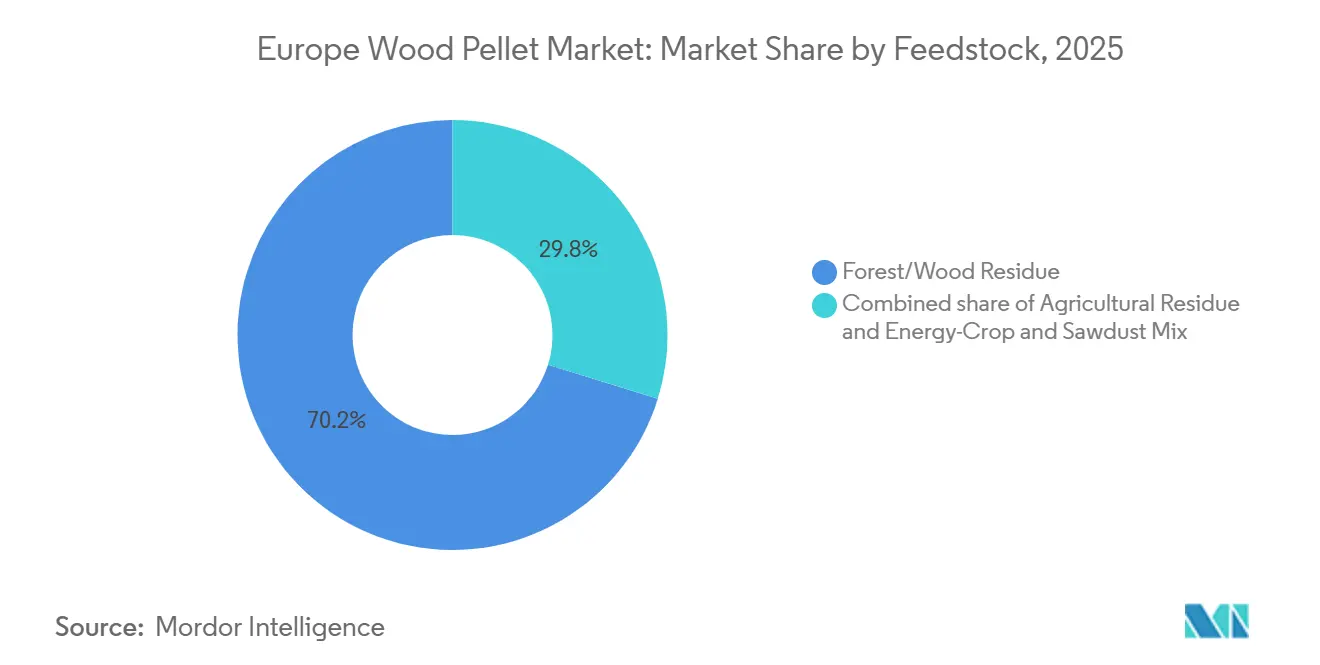
- By feedstock, forest and wood residues captured 70.2% of Europe's wood pellet market share in 2025, while agricultural residues are expanding at a 7.8% CAGR through 2031.
- By grade, utility-grade pellets accounted for 55.8% of the European wood pellet market size in 2025; torrefied pellets are accelerating at a 9.4% CAGR to 2031.
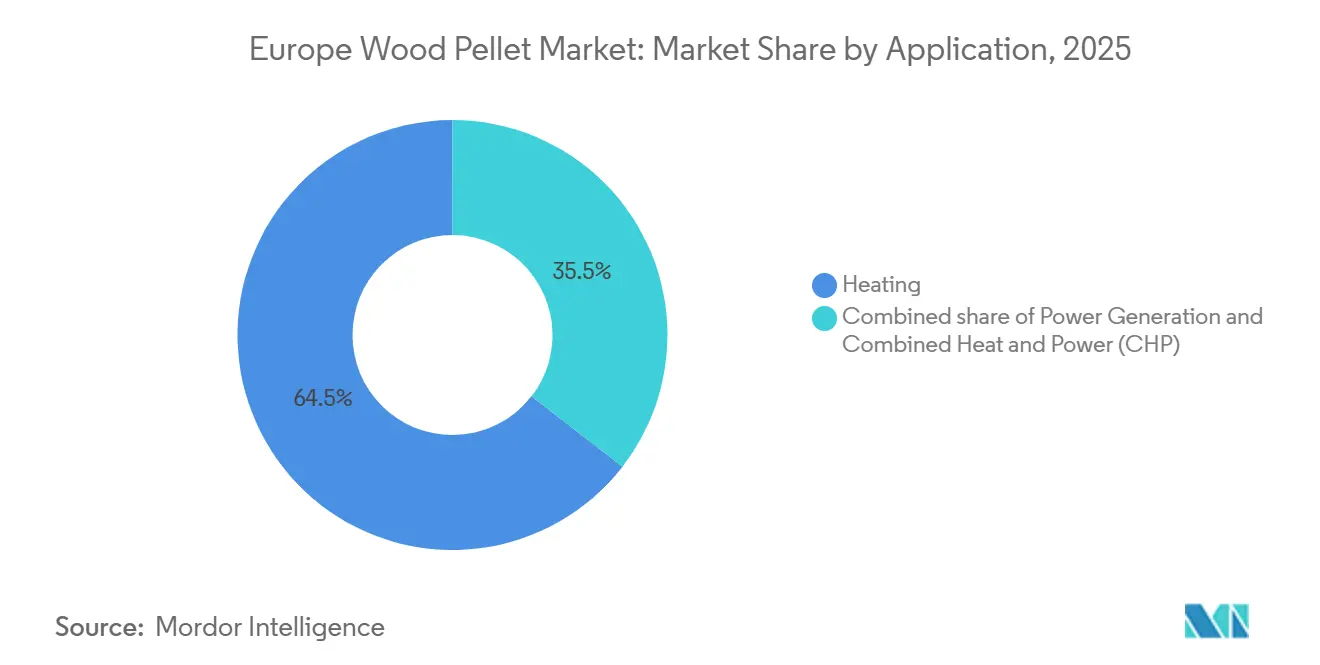
- By application, heating commanded a 64.5% share of the European wood pellet market size in 2025, whereas combined heat and power installations are advancing at an 8.9% CAGR through 2031.
- By end-user, industrial and utility users held 53.9% of the European wood pellet market share in 2025 and are set to grow at an 8.5% CAGR between 2026 and 2031.
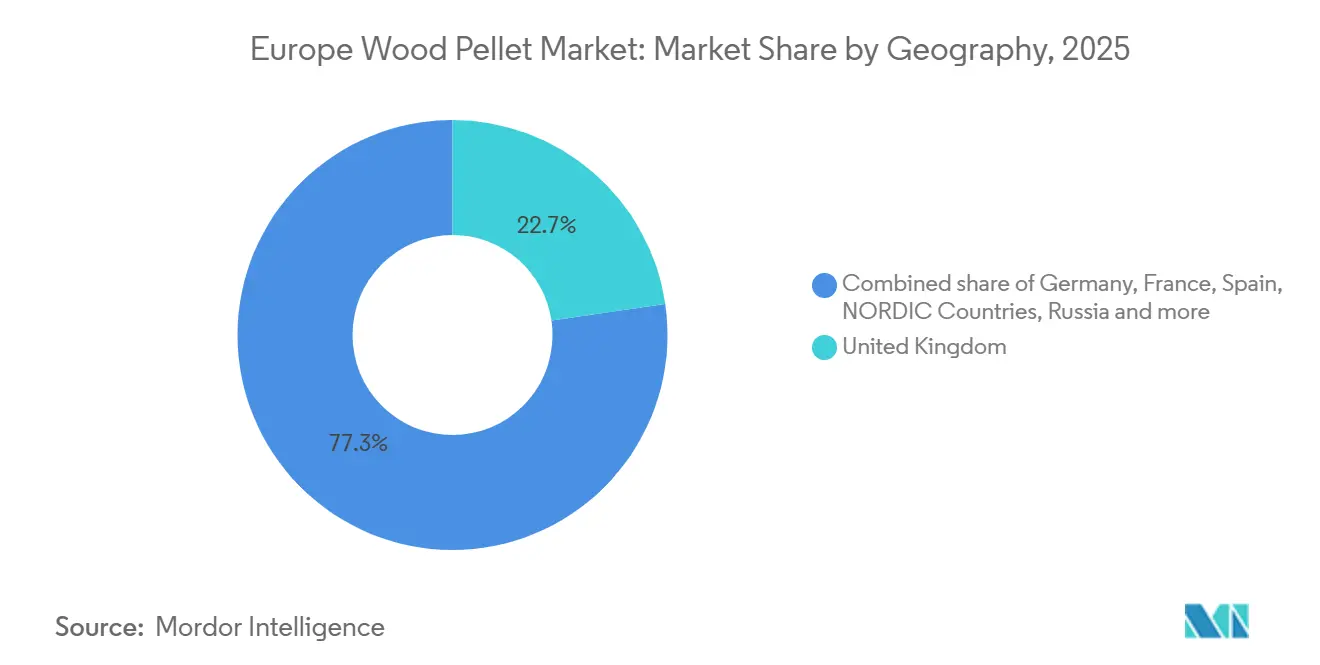
- By geography, the United Kingdom led with 22.7% revenue share in 2025; Nordic Countries posted the fastest growth at 9.1% CAGR through 2031.
Note: Market size and forecast figures in this report are generated using Mordor Intelligence’s proprietary estimation framework, updated with the latest available data and insights as of January 2026.
Market Trends and Insights
Drivers Impact Analysis of Europe Wood Pellet Market*
| Driver | (~) % Impact on CAGR Forecast | Geographic Relevance | Impact Timeline |
|---|---|---|---|
| Robust residential heating demand amid record fossil-fuel prices | 1.20% | Germany, France, Austria, Nordic Countries | Short term (≤ 2 years) |
| Accelerated coal-to-biomass conversion of EU power plants | 1.50% | United Kingdom, Germany, Spain | Medium term (2-4 years) |
| New EU-ETS incentives for negative-emission BECCS projects | 0.90% | United Kingdom, Nordic Countries | Long term (≥ 4 years) |
| Surge in heat-pump / pellet-hybrid boiler retrofits | 0.80% | Germany, Netherlands, Rest of Europe | Medium term (2-4 years) |
| Fast-track permitting for post-Russia supply-chain localization | 0.70% | EU27 | Medium term (2-4 years) |
| Source: Mordor Intelligence | |||


Robust Residential Heating Demand Amid Record Fossil-Fuel Prices
Gas prices in Europe stayed elevated through 2024, making wood pellets a cost-competitive option for space heating in single-family homes and small businesses. Austria maintained solid boiler installations thanks to unchanged incentives, while Germany and France still absorbed considerable volumes despite subsidy revisions. ENplus certification encouraged cross-border pellet trade by guaranteeing burn quality. The share of residential demand reached 7% of total European consumption in 2024.[2]USDA Foreign Agricultural Service, “United Kingdom Biofuels Annual Report 2024,” usda.gov Although Germany’s August 2024 BEG reform curtailed standalone biomass subsidies, residential suppliers are smoothing earnings by expanding into appliance financing and doorstep retail programs. Vertical integration is therefore becoming essential to offset the inherent volatility of spot-based sales.
Accelerated Coal-to-Biomass Conversion of EU Power Plants
Drax Group’s restart of Unit 4 in 2024 injected about 3 million t of extra pellet demand and revived UK biomass electricity output. New projects, such as ArcelorMittal’s Torero facility in Belgium, illustrate biomass applications in hard-to-abate industries by delivering bio-coal to steel blast furnaces. Spain’s La Robla plant, backed by the European Investment Bank, shifted to domestic agricultural residues, cutting logistics emissions and broadening feedstock flexibility.[3]European Investment Bank, “La Robla Biomass Plant Financing,” eib.org Retrofit economics remain favorable because existing grid connections and turbines are reused, but post-2027 policy uncertainty in the UK may halve offtake, underscoring the need for diversified demand portfolios. EU cascading-use principles, which prioritize residues over roundwood, likewise cap future supply scalability.
New EU-ETS Incentives for Negative-Emission BECCS Projects
Revisions adopted in 2024 allow utilities to monetize negative emissions when biomass combustion is paired with carbon capture and storage. Drax plans full-scale BECCS integration by 2027, targeting the sale of high-value EU Allowances alongside renewable electricity. EU carbon prices fluctuated between EUR 60-90 t in 2024, meaning that negative-emission credits could surpass power revenues. However, projected capture retrofits cost roughly GBP 2 billion per plant, testing the adequacy of support frameworks. Profitability, therefore, hinges on predictable carbon prices and timely disbursement of BECCS incentives, which together will determine whether utilities expand pellet contracts or pivot toward other negative-emission technologies.
Surge in Heat-Pump / Pellet-Hybrid Boiler Retrofits
Hybrid systems that combine air-source heat pumps with pellet burners grew rapidly in Germany and the Netherlands in 2024, enabling households to toggle between fuels as prices fluctuate. Germany’s BEG reform now restricts new biomass incentives to hybrid installations, quickening adoption in rural areas where gas grids are absent. These hybrids trim pellet usage by up to 40% yet raise equipment sales for firms like Viessmann and Ökofen, which launched smart-control models in 2025. Producers must revise demand forecasts because hybrid flexibility dampens winter consumption spikes but stabilizes year-round take-off, reshaping residential segment dynamics.
Restraints Impact Analysis of Europe Wood Pellet Market*
| Restraint | (~) % Impact on CAGR Forecast | Geographic Relevance | Impact Timeline |
|---|---|---|---|
| Termination of national pellet boiler subsidies in core markets | -1.10% | Germany, Netherlands, France | Short term (≤ 2 years) |
| Rising competition from heat-pump-only solutions | -0.80% | Germany, France, Netherlands, Rest of Europe | Medium term (2-4 years) |
| Feed-wood fiber scarcity & price spikes post-Ukraine war | -0.80% | EU27 | Short term (≤ 2 years) |
| EUDR sustainability compliance costs | -0.70% | Global | Medium term (2-4 years) |
| Source: Mordor Intelligence | |||
Termination of National Pellet Boiler Subsidies and Heat-Pump Competition
Germany scrapped standalone biomass incentives in August 2024, causing a 55% plunge in boiler sales from 2023 to 2024. France recorded an even steeper 73% drop as incentives shifted toward electric heat pumps. The Netherlands stopped subsidizing biomass heat in new homes, funneling funds exclusively to electrification. Accelerated manufacturing scale in China lowered heat-pump equipment prices by 15-20%, eroding pellets’ cost advantage. Urban air-quality rules also tightened particulate limits, limiting pellet uptake in dense areas. Together, subsidy withdrawal and cheaper electric alternatives weaken residential demand, forcing producers to rely more heavily on industrial buyers that negotiate longer-term contracts at thinner margins.
Feed-Wood Fiber Scarcity, Price Spikes, and EUDR Compliance Costs
European pellet output slipped 7% in 2024 to 22.7 million t because construction slowdowns shuttered sawmills, slashing residue flows. Bark-beetle infestations further degraded timber quality and redirected salvage wood into energy, heightening feedstock competition with panel-board makers. Industrial pellet spot prices rebounded in late 2024 as Drax's ramp-up absorbed surplus volumes. Starting December 30, 2025, for large operators, the EU Deforestation Regulation obliges traceability, satellite monitoring, and TRACES uploads for every shipment, adding EUR 2-5 t to production costs and squeezing small producers.[4]European Commission, “EU Deforestation Regulation Implementation,” europa.eu Compliance timelines, combined with tight residue supply, compress margins and encourage consolidation among non-integrated players.
*Our forecasts treat driver/restraint impacts as directional, not additive. The impact forecasts reflect baseline growth, mix effects, and variable interactions.
Europe Wood Pellet Market Segment Analysis
By Feedstock:
Forest Residues Anchor Supply, Agricultural Streams Gain MomentumForest and wood residues generated 70.2% of the European wood pellet market size in 2025, reflecting robust sawmill networks and mature ENplus logistics. Agricultural residues, however, are rising at a 7.8% CAGR, aided by mobile pelletizing platforms that shrink transport energy by 38%. Spain’s La Robla plant validated local straw sourcing to cut supply-chain emissions. Even though agricultural streams carry higher ash (2-5%) and lower energy density, the EU Deforestation Regulation treats them preferentially, spurring trial blends at CHP units. Producers are adopting advanced sieving and additive dosing to manage quality variability, signaling a longer-term pivot toward multi-feedstock procurement strategies.
Over 2026-2031, forest residues will still underpin the European wood pellet market, but agricultural inputs provide the incremental growth needed to meet utility demand while easing pressure on over-harvested forests. Blending also hedges against residue shortages when housing cycles slow sawmill output. Stakeholders that can certify diverse feedstock pools stand to capture new contracts as utilities seek compliance-ready pellets.


By Grade:
Utility Pellets Dominate, Torrefied Variants Disrupt Coal ReplacementUtility-grade white pellets accounted for 55.8% of the European wood pellet market share in 2025, supplying large-scale power projects that value low delivered cost over premium specs. The European wood pellet market size for torrefied variants is expanding at a 9.4% CAGR, catalyzed by ANDRITZ’s 60,000 t Joensuu Biocoal plant in Finland. Torrefaction raises energy density to 22-28 GJ t, enabling coal-plant co-firing without major retrofit. Early adopters include ArcelorMittal, which feeds torrefied pellets into steel furnaces, demonstrating cross-sector potential. Capital intensity remains EUR 100-150 t cap, so deployment concentrates near residue-rich clusters where CHP waste heat can supply the drying step. As more European coal units face retirement, utilities weigh torrefaction as a transitional decarbonization pathway.
Industry consensus sees torrefied pellets reaching double-digit share by 2031, particularly in Northern and Central Europe, where coal assets represent dispatchable capacity. Standard and premium grades will maintain relevance in residential boilers, but growth moderates as hybrids and heat pumps take hold. Manufacturers that diversify across grade portfolios will mitigate demand swings while capturing high-margin torrefied contracts.
By Application:
Heating Leads, CHP Captures Industrial Efficiency GainsHeating applications commanded 64.5% of Europe's wood pellet market size in 2025, spanning residential stoves, commercial buildings, and district-heating networks. Combined heat and power systems, however, are growing at 8.9% CAGR as industrial sites monetize both steam and electricity under national feed-in frameworks. THEURL's Austrian complex, commissioned in autumn 2025, marries an 80,000 t pellet line with on-site generation at 85% efficiency. CHP adoption is also buoyed by the EU's Carbon Border Adjustment Mechanism, which rewards low-carbon process heat in export-oriented metallurgy and chemicals.
Power-only generation stagnated in 2024 amid subsidy uncertainty, though Drax's restart provided a temporary lift. Looking forward, BECCS retrofits could rekindle growth, but their timeline hinges on carbon-credit liquidity. Animal-bedding demand remains a niche outlet, absorbing lower-grade output during energy market lulls. Diversified producers that can switch between heating and CHP grades will weather policy shifts more effectively.
By End-User:
Residential Base Erodes, Industrial Demand ScalesResidential consumers absorbed 53.9% of Europe's wood pellet market share in 2025, and while Industrial & Utility segment is forecast to grow at an 8.5% CAGR as coal-to-biomass conversions and BECCS projects proliferate. Residential users, once the growth engine, face subsidy roll-backs and heat-pump competition, causing boiler sales to plunge 55% in Germany and 73% in France during 2024. Commercial institutions such as schools and hotels maintain moderate demand where district-heating links are absent.
The European wood pellet market will increasingly revolve around industrial offtake contracts that bundle fuel supply with carbon-credit sharing. Producers must recalibrate product mix, emphasizing high-volume utility pellets and torrefied grades while maintaining a smaller, premium certified line for niche retail channels. Residential decline nonetheless frees up capacity that can be redirected to export or industrial hybrids, cushioning revenue volatility.
Geography Analysis
United Kingdom Wood Pellet Market
The United Kingdom ruled the European wood pellet market with a 22.7% share in 2025 and is advancing at an 8.6% CAGR, primarily because Drax alone imported 9.641 million t in 2024, equal to roughly one-third of total continental demand. U.K. transitional support for BECCS extends into 2031, offering revenue security, yet post-2027 subsidy reductions could cut Drax demand by 50%, exposing import volumes to downside risk.
Germany and France Wood Pellet Market
Germany remains Europe’s second-largest producer at near 3 million t in 2024 but saw residential sales shrink after subsidy cuts. Industrial CHP retrofits partially offset the decline as factories chase decarbonization targets. France charts a similar course, with residential weakness but rising industrial steam projects.
Nordics and Broader European Markets
Nordic Countries combine production strength with aggressive CHP deployment. Sweden burned 1.9 million t in district networks during 2023, while Finland hosts the Joensuu torrefaction plant, cementing regional leadership in advanced biomass processing. Spain, though smaller, illustrates feedstock diversification by pivoting to straw at the La Robla plant. Eastern Europe and Austria offer pockets of residential resilience, with Austria sustaining boiler installations thanks to stable incentives.
United Kingdom and Continental Europe Wood Pellet Market
EU Deforestation Regulation compliance will reshape trade lanes post-2025, favoring shipments with granular geolocation data. Supply-side tightness may foster intra-European sourcing, but capacity expansion hinges on residue availability and permitting. Overall, geographic demand is drifting from Central-European households toward U.K. BECCS and Nordic-centered industrial CHP, reshaping logistics and contracting patterns.
Regulatory Landscape
The regulatory environment for wood pellets in Europe is tightening around sustainability verification and deforestation-free supply chains. The EU Deforestation Regulation (EUDR) introduces plot-level geolocation traceability and due-diligence submissions (including via TRACES), with enforcement timelines set at 30 December 2026 for large and medium operators and 30 June 2027 for small and micro operators. This raises documentation and audit burdens for pellet producers and traders.
On the demand-side, the EU Renewable Energy Directive sustainability criteria (including RED III updates) and associated national implementation continue to shape the eligibility of forest biomass for energy, including greenhouse-gas savings and land-use requirements. Voluntary schemes used for compliance are being formalized, including the Sustainable Biomass Program (SBP) recognized under EU Implementing Decision 2024/3191. At the same time, market-specific verification rules, such as the Netherlands Enterprise Agency (RVO) protocols for pellets used in SDE++ and EU ETS-linked installations, add chain-of-custody requirements that influence supplier selection and contracting.
Competitive Landscape
The European wood pellet market remains moderately fragmented, yet vertical integration is rising. Enviva, the top U.S. exporter, filed Chapter 11 in March 2024 and then emerged five months later with USD 1.3 billion in fresh financing, highlighting the capital strain of trans-Atlantic supply chains. The firm sold its Sampson plant for USD 94 million and restarted Hamlet to concentrate on high-margin assets.
ANDRITZ demonstrated technology leadership by bringing Finland’s Joensuu torrefaction unit online in May 2025, giving utilities a coal-compatible fuel without retrofitting boilers. Drax leverages long-term contracts and in-house port infrastructure to secure supply for its four biomass units. Graanul Invest and Scandbio dominate the Baltic and Nordic markets, respectively, each integrating forestry, production, and logistics.
White-space growth centers on torrefaction build-outs and hybrid boiler ecosystems that merge pellets with heat pumps, using smart controls to switch fuels automatically. Mobile pelletizers backed by EU-funded pilots lower feedstock transport costs, enabling on-farm agricultural pellet production. Increased certification costs under the EU Deforestation Regulation may drive smaller standalone mills to consolidate or exit, lifting market concentration over the next five years.
Europe Wood Pellet Industry Leaders
AS Graanul Invest
Drax Group plc
Enviva Inc.
Stora Enso Oyj
Scandbio AB
- *Disclaimer: Major Players sorted in no particular order
Europe Wood Pellet Market Companies Covered in this Report
- Stora Enso Oyj
- Enviva Inc.
- AS Graanul Invest
- Drax Group plc
- Segezha Group PJSC
- Svenska Cellulosa AB (SCA)
- German Pellets GmbH
- Pure Biofuel Ltd
- Pfeifer Group
- Erdenwerk Gregor Ziegler GmbH
- Scandbio AB
- RZ Pellets GmbH
- Ante-Holz GmbH
- CM Biomass Partners A/S
- Lignetics of Idaho Inc.
- Wismar Pellets GmbH
- Vida AB
- Balcas Energy
- Burpellet SL
- FRP Pellets SpA

Market Opportunities and Future Outlook
A near-term opportunity lies in compliance-ready pellet supply chains that can meet stricter proof-of-origin requirements without disrupting deliveries. The EUDR timeline (large and medium operators from 30 December 2026) is pushing buyers and intermediaries toward audited, geolocation-backed sourcing and documented chain-of-custody. That shift favors producers with recognized schemes, such as SBP under EU Implementing Decision 2024/3191, and quality programs such as ENplus, while creating whitespace for digital traceability services, certification support, and segregated logistics that reduce compliance friction.
Industrial and utility procurement is also moving toward longer-term partnerships tied to security-of-supply and decarbonization roadmaps. That creates room for suppliers that bundle fuel supply, logistics, and verification into a single offer. One visible signal is the May 2026 collaboration between Graanul Invest and thyssenkrupp Materials Trading to supply pellets into German industrial operations, reflecting demand for structured, enterprise-grade sourcing rather than spot purchases. At the same time, policies and verification regimes in markets such as the Netherlands (RVO verification protocols for biomass in SDE++ and EU ETS contexts) support premium contracting for documented pellets, including multi-feedstock strategies where agricultural residues diversify supply while meeting sustainability screens.
Recent Industry Developments in Europe Wood Pellet Market
- April 2026: Drax announced that the M.V. Ultra Yorkshire completed its first transatlantic voyage delivering biomass pellets to the Port of Liverpool, using biofuel for the journey. The update highlights tighter inbound logistics planning for UK biomass generation while aligning transport with lower-carbon supply-chain requirements.
- February 2026: Drax reported full-year 2025 results, including record wood pellet production of 4.2 million tonnes, up from 4.0 million tonnes in 2024. Higher output supports contracted supply programs and reinforces scale advantages for vertically integrated pellet platforms serving utility demand.
- August 2024: Koehler Group disclosed that its subsidiary Zollikofer Group acquired French fuelwood and biomass supplier SAS REKO Energie Bois (REKO). The transaction expands Koehler's upstream sourcing and distribution footprint in France, improving access to biomass feedstock and customer channels as sustainability and traceability requirements tighten.


Europe Wood Pellet Market Report Scope and Research Methodology
Market Definition and Coverage
This market covers the value generated from wood pellets sold and used across Europe for energy, including heating and power use, where demand is linked to pellet consumption volumes and pricing in major consuming countries.
Scope exclusions: It excludes loose wood fuels such as chips and briquettes, and it also excludes non-wood pellet types that sit within broader biomass solid fuels.
Segments Covered in This Report
- By Feedstock
- Forest/Wood Residue
- Agricultural Residue
- Energy-Crop and Sawdust Mix
- By Grade
- Utility-Grade (White)
- Premium-Grade
- Standard-Grade
- Torrefied “Black” Pellets
- By Application
- Heating
- Power Generation
- Combined Heat and Power (CHP)
- By End-user
- Residential
- Commercial
- Industrial and Utility
- Animal Bedding
- By Geography
- United Kingdom
- Germany
- France
- Spain
- NORDIC Countries
- Russia
- Rest of Europe
Data Sources, Market Sizing, and Validation
Desk Research
Desk research is used to set the factual boundaries for volumes, trade flows, and policy drivers, before assumptions are built into the model. We refer to public statistics and policy documents that shape pellet demand, such as Eurostat energy balances, Eurostat international trade by HS codes, and EU renewable energy directive requirements and sustainability guidance.
To understand supply capacity, demand shifts, and seasonal patterns, we also review sources such as Bioenergy Europe and European Pellet Council releases, USDA FAS wood pellet annual reports, and customs and port level trade summaries where available. Company annual reports and investor materials help validate how producers and distributors describe capacity utilization, sourcing, and end use exposure. In addition, we use select paid subscriptions for company financials and intelligence, shipment-level import and export checks, and patent databases to sanity-check technology and equipment direction. The desk sources listed here are illustrative, and many other public documents and datasets were also used for data collection, validation, and clarification.
Primary Interviews and Surveys
We conduct expert interviews and surveys with pellet producers, distributors, heating appliance channels, utilities, and policy specialists across Europe. Functional leaders and managers help check country-level volumes, delivered prices, inventory changes, appliance demand, and policy effects, while senior respondents test the main assumptions. These inputs help resolve gaps in public data, clarify movements in consumption and pricing, and triangulate the final analysis.
Distribution of primary research fieldwork respondents
| Company type | Respondent position |
|---|---|
| Top tier: 28% | CXOs: 18% |
| Mid tier: 49% | Functional/Unit leaders: 31% |
| Smaller Players: 23% | Managers: 51% |
Market-Sizing & Forecasting
Sizing starts with a top-down rebuild of the demand pool, where country-level pellet consumption and cross-border trade signals are translated into value using observed price ranges and mix. We then cross-check with selective bottom-up approximations, such as sampled price per ton by application and channel, importer and distributor channel checks, and producer capacity and utilization logic, which are used to adjust totals when gaps show up.
Key inputs that shape the model include pellet consumption volumes (million tons), import and export flows by relevant HS codes, industrial versus residential share shifts, average selling price movement linked to freight and feedstock conditions, and policy-linked demand markers like subsidy changes and sustainability requirements that affect eligible supply. Where direct price points are missing for a country or year, we interpolate using neighboring market references and inflation-adjusted ranges, and then we re-test the outcome against trade-weighted averages.
For forecasting, scenario analysis is used to translate policy and demand uncertainty into a structured range, and then a central case is selected based on what most primary respondents view as realistic for industrial demand normalization and heating demand. The forward view stays consistent with observed drivers like winter severity impacts, utility conversion and retirement timelines, and import dependence sensitivity to logistics and compliance costs.
Data Validation & Update Cycle
Validation is done in layers so the final numbers do not depend on any single dataset. We compare the modeled market values against independent checks such as implied per-ton values from trade statistics, changes in consumption volumes reported by public bodies, and producer-reported direction on pricing and volumes.
When a country shows an unusual jump or drop, the inputs are re-opened and the cause is traced back to a specific change, such as a trade swing, a pricing spike, or an application mix shift, before the estimate is accepted. A second analyst review is completed before sign-off, and follow-up calls are triggered when field feedback conflicts with desk indicators. Reports are refreshed annually, and interim updates are made when material events occur, followed by a final pre-delivery pass so clients receive the latest updated view.
Mordor Intelligence's Europe Wood Pellet Market Size Compared Against Other Published Estimates
It is normal to see different market sizes published for European wood pellets, even when everyone is working from the same broad energy transition narrative. The spread usually comes from how Europe is defined, whether values are built from volumes or from revenue reporting, and how prices are converted and timed across countries.
By tracking trade-weighted consumption signals and refreshing price-per-ton assumptions each year, Mordor Intelligence keeps the estimate tied to pellet volumes that are actually consumed and imported across Europe, instead of widening the scope to adjacent biomass fuels or mixing in non-comparable price points.
Benchmark comparison
| Source | Market Size | Gaps in Research Methodology |
|---|---|---|
| Mordor Intelligence | USD 12.48 B (2025) | |
| Trade Publisher A | USD 7.80 B (2024) | This estimate appears to anchor on a single base year and may apply narrower country coverage and a different revenue boundary, which can undercount industrial demand linked to imported pellets and utility offtake. |
| Industry Brief B | USD 10.90 B (2025) | The gap is consistent with using conservative price assumptions and treating pellets mainly as a heating fuel, which can reduce the implied value when industrial power and district heating volumes are not fully captured. |
The table shows that the biggest drivers are usually scope boundaries and the price logic applied to convert tons into dollars. Our approach stays repeatable because the build is anchored to observable volume signals, and then adjusted using interviews that clarify mix changes, import dependence, and realistic pricing behavior.


Key Questions Answered in the Report
How large is the Europe wood pellets market in 2026?
The sector is projected to surpass USD 13.29 billion in 2026.
What is driving industrial demand for pellets?
Utilities are converting coal units to biomass and planning BECCS retrofits to earn high-value negative-emission credits, pushing industrial contracts higher.
Why are torrefied pellets gaining popularity?
Torrefaction lifts energy density to coal-like levels, allowing co-firing without costly boiler modifications and improving outdoor storage stability.
How will the EU Deforestation Regulation affect suppliers?
From late 2025, producers must upload geolocation data and due-diligence files in TRACES, adding EUR 2-5 t to costs and favoring larger, certified operators.
Which countries are the biggest pellet importers?
The United Kingdom tops the list, relying on imports for more than 90% of its demand, followed by Denmark and the Netherlands for CHP applications.
What is the outlook for residential pellet heating?
Sales are weakening in Germany and France after subsidy cuts, but hybrid heat-pump systems keep a niche role in rural areas without gas grid access.
Page last updated on:


 Your data is secure and never sold or shared.


