
Market Overview
| Study Period | 2021 - 2031 |
|---|---|
| Forecast Data Period | 2026 - 2031 |
| Base Year Market Size (2025) | USD 30.55 Billion |
| Market Size (2026) | USD 31.99 Billion |
| Market Size (2031) | USD 40.27 Billion |
| Growth Rate (2026 - 2031) | 4.71 % |
| Market Concentration | Medium |
Major Players *Disclaimer: Major Players sorted in no particular order Image © Mordor Intelligence. Reuse requires attribution under CC BY 4.0. | |
Europe Frozen Desserts Market Analysis by Mordor Intelligence
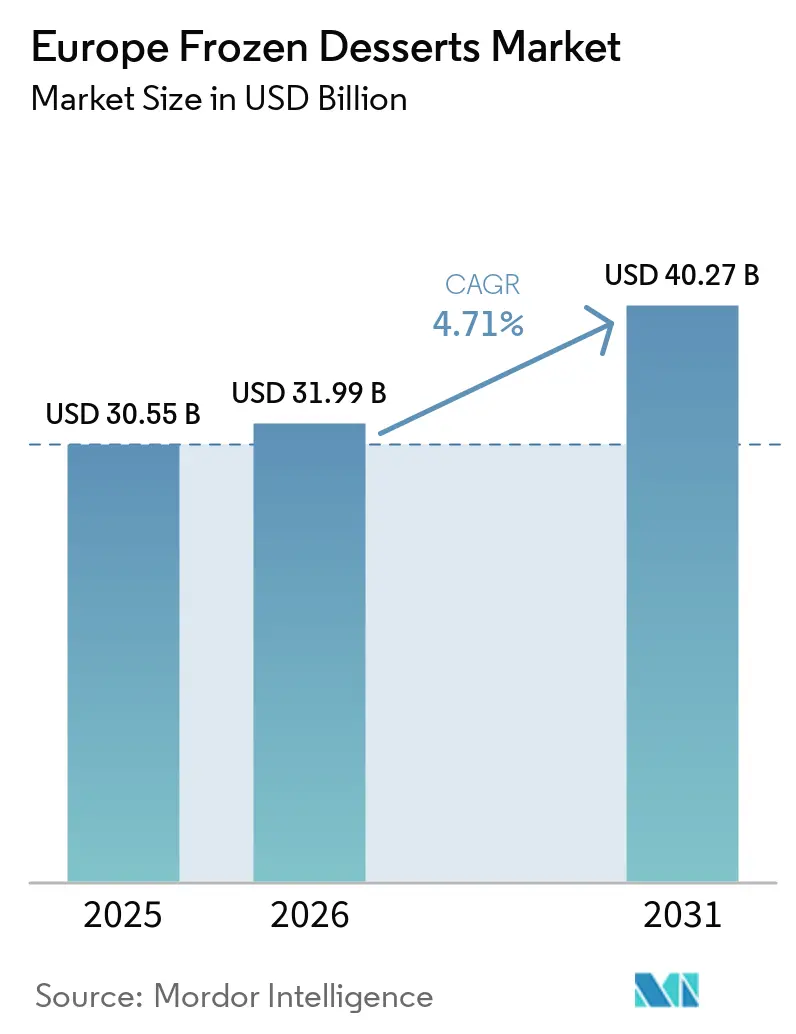
The European Frozen Desserts Market was valued at USD 30.55 billion in 2025 and is estimated to grow from USD 31.99 billion in 2026 to reach USD 40.27 billion by 2031, at a CAGR of 4.71% during the forecast period (2026–2031). Market growth is driven by consumers' continued preference for convenient, ready-to-enjoy treats and products offering consistent taste and quality. Frozen desserts remain an established part of everyday food consumption, supported by their convenience, versatility, and ability to deliver enjoyable eating experiences without extensive preparation. Evolving consumer preferences are also driving demand for distinctive flavors, premium ingredients, improved textures, and formulations that align with changing dietary expectations.
Key Report Takeaways
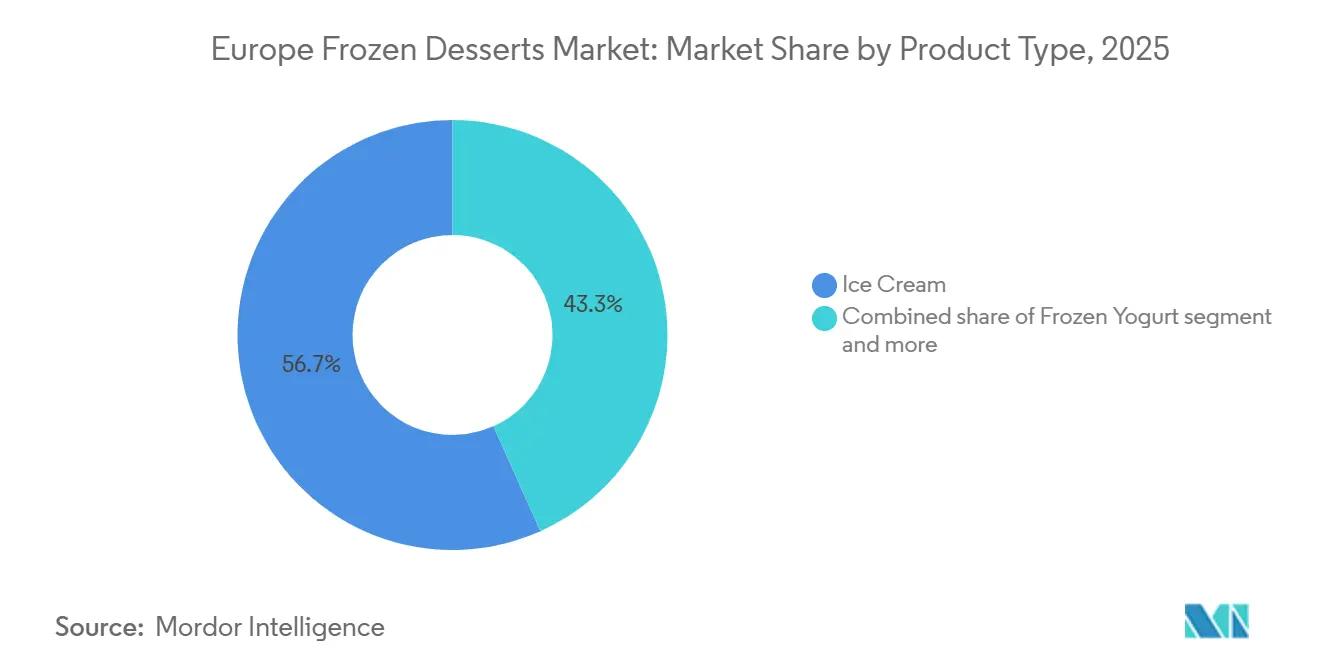
- By product type, ice cream held 56.71% of the European frozen desserts market share in 2025, while frozen yogurt is projected to grow at a 5.87% CAGR through 2031.
- By category, conventional products accounted for 81.19% of the European frozen desserts market share in 2025, while organic frozen desserts are forecast to expand at a 6.63% CAGR through 2031.
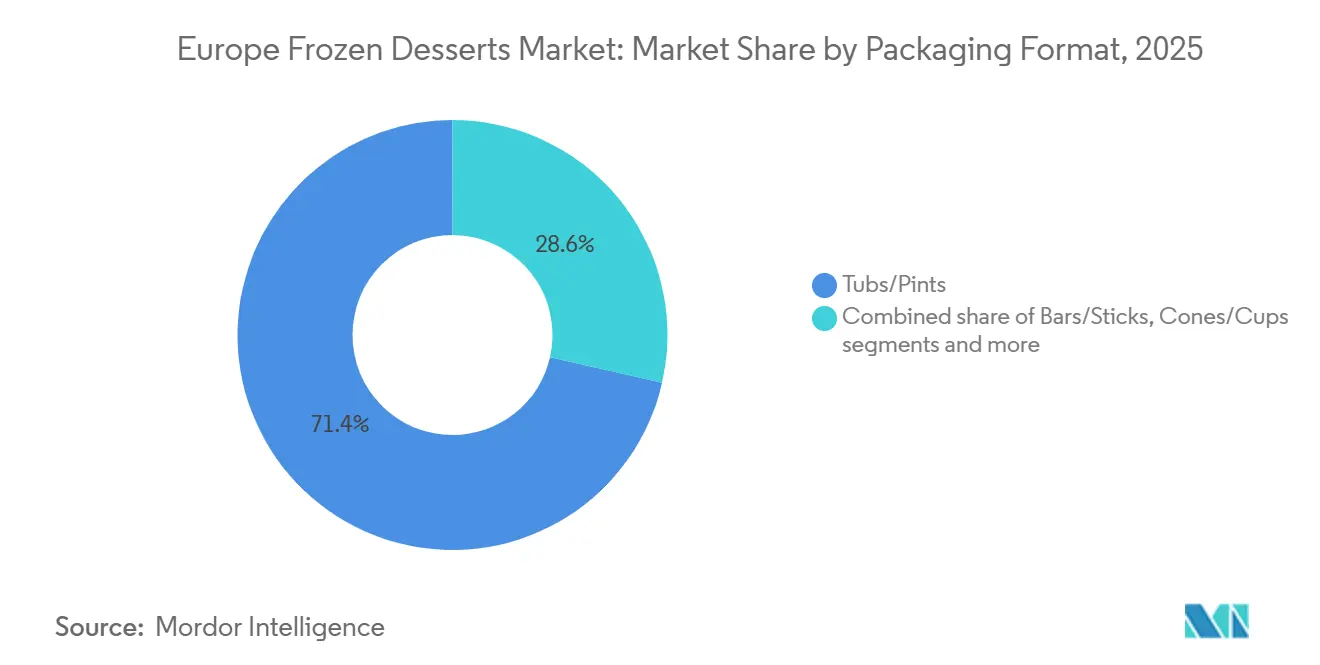
- By packaging format, tubs and pints represented 71.43% of the European frozen desserts market share in 2025, while bars and sticks are expected to grow at a 5.72% CAGR through 2031.
- By distribution channel, retail accounted for 82.55% of the European frozen desserts market share in 2025, while foodservice and HoReCa are projected to grow at a 5.46% CAGR through 2031.
- By geography, Germany held 24.56% of the European frozen desserts market share in 2025, while Poland is forecast to grow at a 6.41% CAGR through 2031.
Note: Market size and forecast figures in this report are generated using Mordor Intelligence’s proprietary estimation framework, updated with the latest available data and insights as of January 2026.
Market Trends and Insights
Drivers Impact Analysis of Europe Frozen Desserts Market*
| Driver | (~) % Impact on CAGR Forecast | Geographic Relevance | Impact Timeline |
|---|---|---|---|
| Growing demand for convenient, ready-to-eat desserts | +1.2% | Strongest in the United Kingdom, Germany, Benelux | Medium term (2–4 years) |
| Preference for premium and artisanal frozen desserts | +0.9% | Germany, Italy, France, the United Kingdom, Spain | Medium term (2–4 years) |
| Rising demand for plant-based frozen desserts | +0.7% | Northwestern Europe; spill-over to Central and Eastern Europe | Long term (≥ 4 years) |
| Increasing adoption of sustainable and clean-label formulations | +0.5% | Europe wide | Medium term (2–4 years) |
| Innovation in regional and international flavors | +0.4% | Europe wide, led by Italy, Germany, United Kingdom | Short term (≤ 2 years) |
| Technological advancements in freezing and texture development | +0.3% | Europe wide | Long term (≥ 4 years) |
| Source: Mordor Intelligence | |||
Growing Demand for Convenient, Ready-to-Eat Desserts
Growing demand for convenient, ready-to-eat desserts is supporting the expansion of the Europe Frozen Desserts Market. Consumers increasingly seek products that require minimal preparation and can be enjoyed at home or on the go. Frozen desserts offer a practical solution for quick snacking and after-meal consumption, eliminating the need for extensive preparation while delivering consistent taste and texture. Individually packaged ice cream bars, sticks, cones, and single-serve frozen treats cater to consumers seeking portion-controlled options, while tubs and multipacks allow households to store products for consumption across different occasions. The availability of these formats through supermarkets, convenience stores, and online grocery platforms further supports accessibility and purchasing flexibility.
Preference for Premium and Artisanal Frozen Desserts
Growing consumer preference for premium and artisanal frozen desserts is driving the European Frozen Desserts Market. Consumers are increasingly seeking distinctive ingredients, sophisticated flavor profiles, and differentiated product experiences. Demand is supported by products that combine familiar dessert formats with premium ingredients, carefully developed textures, and visually appealing finishes, enabling brands to create greater perceived value beyond basic refreshment. For instance, in April 2026, The Magnum Ice Cream Company introduced its premium Signature range in Europe, featuring La Pistache and La Pêche. These products incorporate a distinctive shell made with pistachio paste or dried peach juice, demonstrating how ingredient-led coatings and refined flavor combinations can differentiate frozen desserts in the premium segment.
Rising Demand for Plant-Based Frozen Desserts
Rising demand for plant-based frozen desserts is being driven by vegan and flexitarian consumers increasingly seeking alternatives to dairy-based products without compromising taste, creaminess, or indulgence. Products formulated with oat, coconut, almond, and soy ingredients allow brands to cater to consumers with diverse dietary preferences and lifestyle choices. Improvements in plant-based ingredients are also helping enhance texture, mouthfeel, and product stability, addressing common challenges associated with dairy-free frozen desserts. The growing availability of plant-based ice cream, sorbet, and frozen yogurt alternatives is expanding consumer choice and encouraging product diversification across the category. As these products become more accessible and deliver sensory qualities closer to conventional dairy desserts, plant-based frozen desserts are attracting a broader consumer base and creating additional growth opportunities across Europe.
Increasing Adoption of Sustainable and Clean-Label Product Formulations
Growing adoption of sustainable and clean-label product formulations is supporting the market as consumers increasingly value ingredient transparency, simpler ingredient lists, and environmentally responsible packaging. Demand for products made with recognizable ingredients, natural flavoring components, and fewer artificial additives is encouraging brands to reformulate their offerings while maintaining taste, texture, and product stability. Sustainability considerations are also influencing packaging choices, prompting companies to explore recyclable materials, reduced packaging weight, and packaging designs that minimize waste. This transition is reinforced by the European Union's Packaging and Packaging Waste Regulation (PPWR), which entered into force on 11 February 2025, with key measures on packaging recyclability and waste reduction taking effect in 2030[1]. These regulatory developments are encouraging frozen dessert companies to assess packaging materials and improve circularity across their product portfolios.
Restraints Impact Analysis of Europe Frozen Desserts Market*
| Restraint | (~) % Impact on CAGR Forecast | Geographic Relevance | Impact Timeline |
|---|---|---|---|
| Concerns associated with high sugar and saturated fat content | -1.0% | Europe wide | Long term (≥ 4 years) |
| Seasonal fluctuations in demand | -0.8% | Northern Europe; spill-over to Benelux | Short term (≤ 2 years) |
| Volatility in dairy, cocoa, sugar, and fruit ingredient prices | -0.7% | Europe wide | Medium term (2–4 years) |
| Stringent food labeling and nutritional disclosure requirements | -0.5% | Europe wide | Long term (≥ 4 years) |
| Source: Mordor Intelligence | |||
Concerns Associated with High Sugar and Saturated Fat Content
High sugar and saturated fat content in frozen desserts restrains market growth, as health-conscious consumers increasingly scrutinize nutritional labels and moderate their intake of products perceived as less healthy. Conventional ice creams and other rich frozen desserts can contain substantial amounts of added sugars and saturated fats, creating challenges for brands seeking to appeal to consumers who prioritize balanced diets. Growing awareness of the relationship between excessive free-sugar consumption, dental caries, and unhealthy weight gain may encourage some consumers to reduce the frequency or portion size of frozen dessert consumption. Reformulating products with reduced sugar or saturated fat content presents additional technical challenges, as these ingredients contribute to sweetness, texture, creaminess, and overall product structure.
Volatility in Dairy, Cocoa, Sugar, and Fruit Ingredient Prices
Volatility in dairy, cocoa, sugar, and fruit ingredient prices restrains the European Frozen Desserts Market by increasing production costs and creating uncertainty in procurement and pricing decisions. Dairy ingredients, including milk, cream, butterfat, and milk powders, are essential to many frozen dessert formulations, while cocoa, sugar, and fruit preparations contribute to flavor, sweetness, and product quality. Fluctuations in agricultural output, weather conditions, energy costs, and global supply availability can lead to unpredictable input costs, making it difficult for manufacturers to maintain stable production budgets. Rising ingredient costs can also compress profit margins, particularly when retailers and price-sensitive consumers resist increases in finished-product prices.
*Our forecasts treat driver/restraint impacts as directional, not additive. The impact forecasts reflect baseline growth, mix effects, and variable interactions.
Europe Frozen Desserts Market Segment Analysis
By Product Type:
Ice Cream Anchors Volume, Frozen Yogurt Rides the Wellness WaveIce cream accounted for 56.71% of the European Frozen Desserts Market in 2025, supported by its established consumer appeal and strong production base across the European Union. According to Eurostat, Europe produced 3.44 billion litres of ice cream in 2025, representing a 1.9% increase from 3.38 billion litres in 2024[2]. This production growth reflects the continued importance of ice cream within Europe's frozen dessert industry and the market's capacity to sustain output through established manufacturing infrastructure and product availability. The expansion of production, alongside ongoing innovation in flavors, textures, and product formats, supports the segment's ability to maintain consumer interest and strengthen its position in the wider frozen desserts market.
Frozen yogurt is emerging as a growth driver in the Europe Frozen Desserts Market by combining traditional dessert indulgence with growing consumer interest in nutrition-oriented food choices. Its yogurt-based formulation appeals to consumers seeking a refreshing alternative to conventional creamy desserts, particularly those who value tangy flavor profiles, lighter textures, and the nutritional attributes associated with fermented dairy products. The segment's appeal is further supported by opportunities to incorporate fruit preparations, varied toppings, and distinctive flavor combinations that allow consumers to personalize their dessert experience. Interest in digestive wellness also supports product positioning around yogurt cultures, although probiotic benefits depend on the presence, viability, and substantiation of specific cultures in the finished product.



By Category:
Conventional Holds the Volume Base, Organic Accelerates at the MarginConventional frozen desserts accounted for 81.19% of the European Frozen Desserts Market in 2025, driven by established formulation standards, consistent sensory quality, and broad compatibility with existing food production systems. The segment maintains its dominance because conventional recipes allow manufacturers to control sweetness, creaminess, melting behavior, and flavor intensity while maintaining consistency across production batches. The wide availability of established dairy ingredients, sweeteners, stabilizers, and flavoring components further supports formulation flexibility and dependable product quality.
Organic frozen desserts are the fastest-growing category in the Europe Frozen Desserts Market, projected to expand at a CAGR of 6.63% during 2026–2031. Growth is supported by increasing consumer interest in ingredient transparency, certified organic agriculture, and food products aligned with natural and environmentally conscious lifestyles. Organic certification helps distinguish these desserts through defined requirements governing agricultural production and ingredient sourcing, appealing to consumers who pay closer attention to how their food is produced. For instance, The Nice Company in the Netherlands offers ice creams and fruit pops made with organic ingredients, demonstrating how brands can combine frozen indulgence with organic positioning and recognizable ingredients.
By Packaging Format:
Tubs/Pints Dominate, Bars/Sticks Expand on Impulse PositioningTubs and pints accounted for 71.43% of the European Frozen Desserts Market in 2025, supported by their practical storage design, resealable packaging, and suitability for repeated consumption. Their dominance is reinforced by their ability to preserve product quality between servings, allowing consumers to control portion sizes while retaining the remaining contents in a freezer. Rigid containers also provide structural protection against handling damage and help maintain the dessert's shape during storage and transportation. The format offers flexibility in container capacity, lid design, and material selection, enabling manufacturers to accommodate different household storage needs and packaging preferences.
Bars and sticks are the fastest-growing packaging format in the Europe Frozen Desserts Market, projected to expand at a CAGR of 5.72% during 2026–2031. Their growth is driven by the convenience of individually portioned products, which eliminate the need for scooping and minimize direct handling of the dessert. The integrated stick or wrapper makes these products easier to hold and consume, while individual packaging supports portion control and helps maintain hygiene before consumption. This format also provides opportunities for product differentiation through layered coatings, contrasting textures, filled centers, and combinations of chocolate, nuts, and frozen ingredients.

By Distribution Channel:
Retail is the Foundation, Foodservice Unlocks the Growth PremiumRetail accounted for 82.55% of the European Frozen Desserts Market in 2025, supported by extensive product availability, established refrigerated merchandising infrastructure, and direct access to household consumers. The channel's dominance is reinforced by consumers' ability to compare ingredient lists, nutritional information, pack sizes, and product characteristics before purchasing, making retail an important environment for product discovery and brand selection. Well-maintained freezer cabinets preserve frozen desserts throughout storage and display, while organized shelf presentation enables retailers to accommodate a wide variety of products and packaging options. Retail also benefits from established inventory replenishment systems and coordinated cold-chain handling, which help maintain product consistency and reduce quality deterioration.
Foodservice/HoReCa is the fastest-growing distribution channel in the European Frozen Desserts Market, projected to register a CAGR of 5.46% during 2026–2031. Growth is supported by consumers' continued engagement with out-of-home dining and hospitality experiences, encouraging restaurants, hotels, cafés, and catering establishments to strengthen their dessert offerings. According to IfD Allensbach, in 2025, almost 11.1 million people in Germany stated that they frequently ate out during their leisure time, highlighting the importance of dining-out occasions within the country's consumer lifestyle[3]. This consumer behavior creates opportunities for foodservice operators to use frozen desserts to complement meals, broaden menu choices, and enhance the overall dining experience.
Geography Analysis
Germany Frozen Desserts Market
Germany holds the largest share in the European Frozen Desserts Market, supported by its established frozen food sector, widespread product availability, and well-developed retail infrastructure. With a 24.56% market share in 2025, Germany benefits from strong consumer familiarity with frozen desserts and the ability of retailers to maintain product availability through dedicated freezer cabinets and cold-chain networks. The country's sizeable grocery retail sector supports product visibility and repeat purchases, while a broad range of established and premium offerings helps sustain demand. These factors reinforce Germany's position as a key contributor to the regional market.
Poland Frozen Desserts Market
Poland is the fastest-growing geography in the European Frozen Desserts Market, projected to register a CAGR of 6.41% during 2026–2031. Growth is supported by increasing consumer engagement with ice cream and other frozen treats, alongside expanding product variety and the availability of impulse and take-home formats. The country's evolving dessert market creates opportunities for brands to attract consumers through new flavor combinations, premium offerings, and competitively priced products. The outlook for Poland's ice cream market points to continued expansion, with younger consumers driving demand for novel textures, seasonal flavors, and visually distinctive products.
United Kingdom, France, Italy and Spain Frozen Desserts Market
The United Kingdom, France, Italy, and Spain also contribute to the European market through distinct consumption patterns and established dessert traditions. In the United Kingdom, broad retail availability and demand for convenient take-home products support category sales. France benefits from an established dessert culture and consumer interest in premium frozen treats, while Italy's strong association with gelato and artisanal desserts creates opportunities for differentiated products. Spain's warm climate and outdoor dining culture support demand for refreshing frozen treats, particularly during warmer months. Across these markets, varied flavor preferences, product positioning, and retail and foodservice availability shape local demand, allowing brands to tailor their offerings to national preferences.
Competitive Landscape
Market Concentration
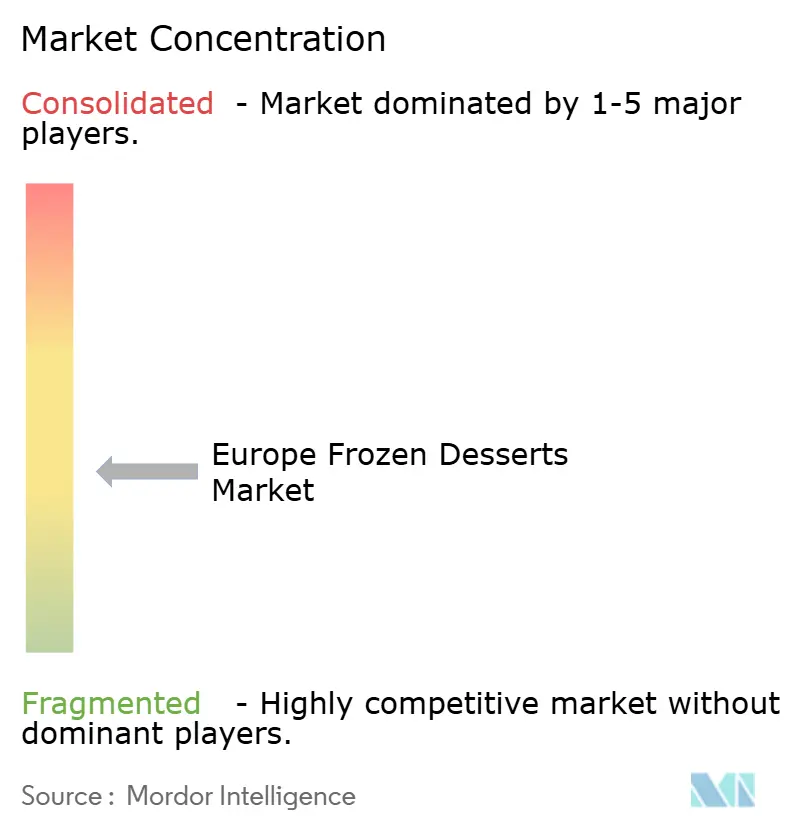
The European frozen desserts market is moderately consolidated, with international and regional players such as Unilever PLC, Nestlé S.A., General Mills, Inc., Mars, Incorporated, Sammontana S.p.A., and Froneri competing alongside specialist regional manufacturers. Competition is shaped by brand recognition, product quality, distribution reach, pricing strategies, and portfolio diversification. Companies are investing in distinctive flavor profiles, premium ingredients, layered textures, and dessert-inspired combinations to differentiate their offerings and strengthen consumer loyalty. Established brands benefit from extensive retail distribution networks and strong market visibility, while regional manufacturers compete through locally preferred flavors, artisanal positioning, and specialized product ranges.
Technology adoption is emerging as a competitive factor as companies seek to accelerate product development, improve demand forecasting, and enhance operational efficiency. Artificial intelligence is being explored for identifying emerging flavor trends, reformulating products, and developing new recipes that respond to changing consumer preferences. In September 2025, The Magnum Ice Cream Company announced a collaboration with food-tech company NotCo to use AI in product innovation and reformulation, including work on plant-based products and reduced-calorie formulations. Unilever has also reported using AI and digital tools to improve ice cream demand forecasting, optimize production, and reduce raw-material waste across its supply chain. These developments indicate how digital capabilities can support faster innovation, more efficient resource use, and stronger responsiveness to market trends.
Regional and international players are strengthening their competitive positions by expanding product portfolios to include plant-based, organic-certified, and clean-label frozen desserts. Companies are exploring dairy alternatives made from oat, coconut, almond, and soy to cater to vegan and flexitarian consumers, while organic-certified products appeal to shoppers seeking ingredients sourced in accordance with organic production standards. Manufacturers are also focusing on improving creaminess, flavor delivery, and product stability to make alternative formulations more competitive with conventional ice cream. Recyclable packaging, transparent ingredient declarations, and reduced use of artificial additives are also becoming important elements of product differentiation.
Europe Frozen Desserts Industry Leaders
-
Unilever PLC
-
Nestlé S.A.
-
General Mills, Inc.
-
Mars, Incorporated
-
Sammontana S.p.A.
- *Disclaimer: Major Players sorted in no particular order
Europe Frozen Desserts Market Companies Covered in this Report
- Unilever PLC
- Nestle S.A.
- General Mills, Inc.
- Mars, Incorporated
- Sammontana S.p.A.
- Ferrero Group
- Froneri International Limited
- Schwarz Group
- Bofrost Dienstleistungs GmbH & Co. KG
- Glacio NV
- Lotus Bakeries NV
- DMK Group
- Wells Enterprises, Inc.
- Lotte Corporation
- Pasticceria Veneta SpA
- R&R Ice Cream Poland
- Gelati Roberto SRL
- Guestrower Milcheis GmbH
- Oatly Group AB
- Mister Softee UK Limited
Recent Industry Developments in Europe Frozen Desserts Market
- July 2026: Glacier, a manufacturer of private-label and co-manufactured ice cream and frozen desserts, announced a EUR 45 million investment programme to expand production capacity, accelerate innovation, and support international growth across its European operations.
- June 2026: Froneri International Limited completed the acquisition of Food Union's ice cream business in Northern Europe. Food Union holds market-leading positions across Northern and Eastern Europe, including Denmark, Estonia, Latvia, and Lithuania.
- September 2025: Aldi launched cake-inspired ice cream tubs in Cherry Bakewell, Red Velvet, and Birthday Cake flavors, alongside Lemon & Pistachio and Chocolate & Orange tubs, as well as new dessert-inspired ice cream products.
Europe Frozen Desserts Market Report Scope
A frozen dessert is a broad category of sweet foods made by freezing liquids, semi-solids, or mixtures. The European Frozen Desserts Market is segmented by product type, category, packaging format, distribution channel, and geography. Based on product type, the market is segmented into ice cream, frozen yogurt, frozen cakes and pastries, and others. Based on category, the market is segmented into conventional and organic. Based on packaging format, the market is segmented into tubs/pints, bars/sticks, cones/cups, and others. Based on distribution channel, the market is segmented into foodservice/HoReCa and retail, with retail further segmented into supermarkets/hypermarkets, convenience/grocery stores, online retail stores, and other distribution channels. Based on geography, the market is segmented into the United Kingdom, Germany, France, Italy, Spain, the Netherlands, Poland, Belgium, Sweden, and the rest of Europe. The report provides market size and forecasts in both value (USD) and volume (Tons) for all the mentioned segments.
Segmentation Overview
By Product Type
| Ice Cream |
| Frozen Yogurt |
| Frozen Cakes and Pastries |
| Others |
By Category
| Conventional |
| Organic |
By Packaging Format
| Tubs/Pints |
| Bars/Sticks |
| Cones/Cups |
| Others |
By Distribution Channel
| Foodservice/HoReCa | |
| Retail | Supermarkets/Hypermarkets |
| Convenience/Grocery Stores | |
| Online Retail Stores | |
| Other Distribution Channels |
By Geography
| United Kingdom |
| Germany |
| France |
| Italy |
| Spain |
| Netherlands |
| Poland |
| Belgium |
| Sweden |
| Rest of Europe |
| By Product Type | Ice Cream | |
| Frozen Yogurt | ||
| Frozen Cakes and Pastries | ||
| Others | ||
| By Category | Conventional | |
| Organic | ||
| By Packaging Format | Tubs/Pints | |
| Bars/Sticks | ||
| Cones/Cups | ||
| Others | ||
| By Distribution Channel | Foodservice/HoReCa | |
| Retail | Supermarkets/Hypermarkets | |
| Convenience/Grocery Stores | ||
| Online Retail Stores | ||
| Other Distribution Channels | ||
| By Geography | United Kingdom | |
| Germany | ||
| France | ||
| Italy | ||
| Spain | ||
| Netherlands | ||
| Poland | ||
| Belgium | ||
| Sweden | ||
| Rest of Europe | ||
Key Questions Answered in the Report
What is the projected size of the Europe frozen desserts market by 2031?
The Europe frozen desserts market is forecast to reach USD 40.27 billion by 2031, rising from USD 31.99 billion in 2026 at a 4.71% CAGR.
Which product type leads frozen dessert sales in Europe?
Ice cream leads the category with a 56.71% share in 2025, supported by broad retail availability, established brands, and premium product launches.
Which frozen dessert category is growing fastest in Europe?
Organic frozen desserts are the fastest-growing category, with a projected CAGR of 6.63% through 2031. Organic certification and demand for traceable ingredients support this growth.
Which packaging format has the largest share in Europe?
Tubs and pints hold the largest share at 71.43% in 2026 because they suit take-home consumption and support premium, artisanal, and private-label offerings.