
Market Overview
| Study Period | 2021 - 2031 |
|---|---|
| Forecast Data Period | 2026 - 2031 |
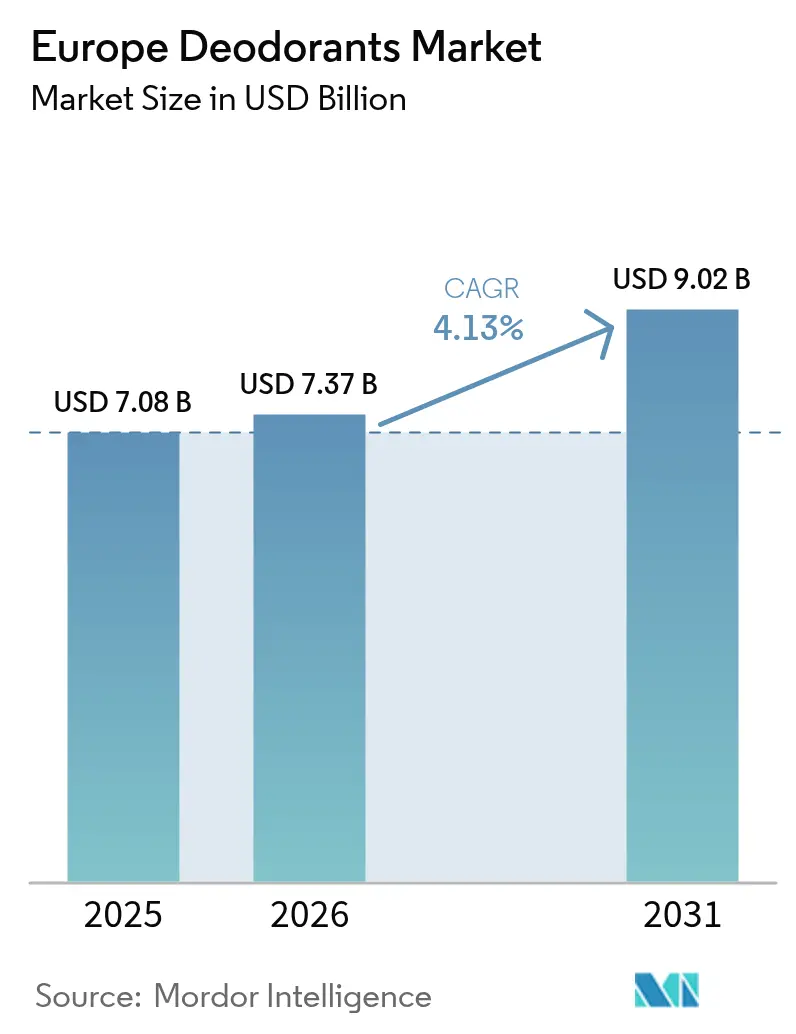
| Base Year Market Size (2025) | USD 7.08 Billion |
| Market Size (2026) | USD 7.37 Billion |
| Market Size (2031) | USD 9.02 Billion |
| Growth Rate (2026 - 2031) | 4.13 % |
| Market Concentration | Medium |
Major Players *Disclaimer: Major Players sorted in no particular order Image © Mordor Intelligence. Reuse requires attribution under CC BY 4.0. | |
Europe Deodorants Market Analysis by Mordor Intelligence
The Europe deodorants market size was valued at USD 7.08 billion in 2025 and estimated to grow from USD 7.37 billion in 2026 to reach USD 9.02 billion by 2031, at a CAGR of 4.13% during the forecast period (2026-2031). The growth is driven by increasing awareness of personal hygiene and grooming, the incorporation of fitness and sports into daily routines, and the integration of deodorants into self-care practices. These factors contribute to higher adoption rates among late-adopting demographics and increased usage frequency among existing consumers. Structural trends are also reshaping the market, including a shift toward natural and organic formulations, rising demand for aluminum-free and sensitive-skin products, and the growing emphasis on sustainability. Features such as eco-friendly packaging, refillable formats, and cleaner ingredient profiles are gaining traction, fostering opportunities for premiumization and innovation beyond traditional mass-market sprays and roll-ons.
Key Report Takeaways
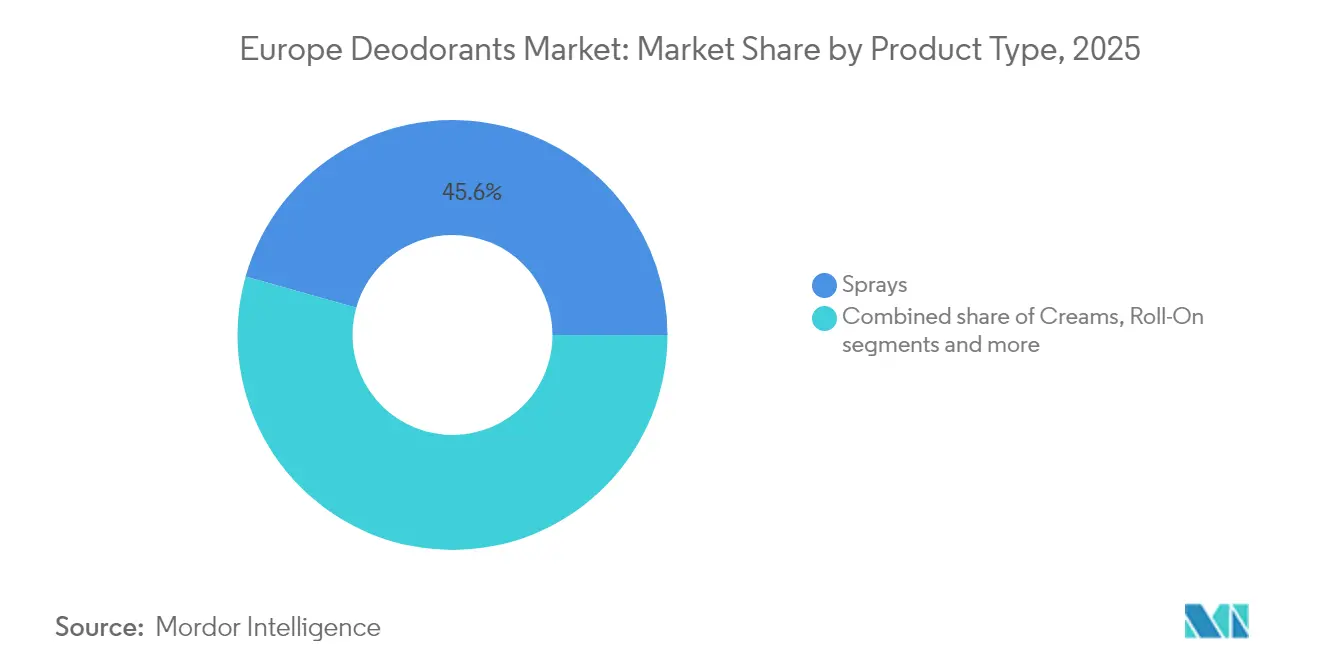
- By product type, sprays led with 45.62% volume share in 2025, while roll-ons are advancing at a 4.53% CAGR to 2031.
- By category, conventional lines captured 86.05% of the Europe deodorants market share in 2025; organic and natural variants are growing at a 5.29% CAGR through 2031.
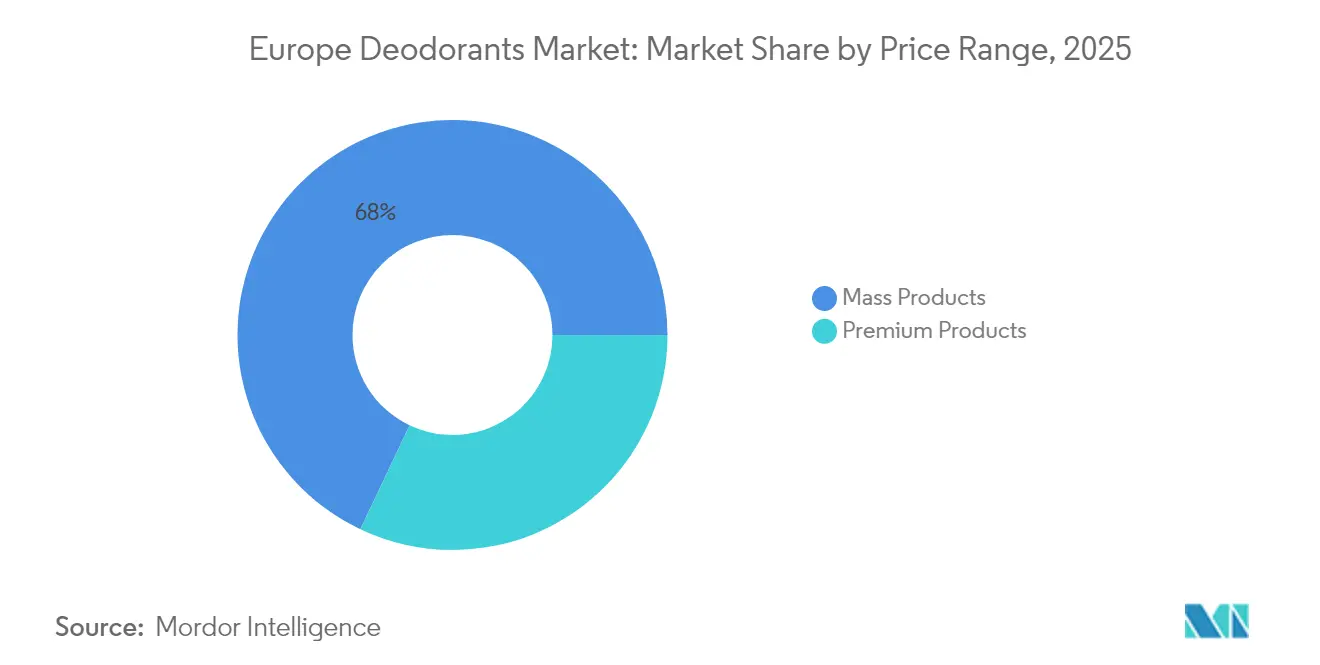
- By price range, mass products held 67.95% share of the Europe deodorants market size in 2025, whereas premium offerings are rising at a 5.5% CAGR.
- By distribution channel, supermarkets and hypermarkets accounted for 40.55% value in 2025, yet online retail is expanding at a 6.28% CAGR to 2031.
- By geography, Germany commanded 21.32% of the Europe deodorants market in 2025; Poland records the highest projected CAGR at 5.2% to 2031.
Note: Market size and forecast figures in this report are generated using Mordor Intelligence’s proprietary estimation framework, updated with the latest available data and insights as of 2026.
Europe Deodorants Market Trends and Insights
Drivers Impact Analysis*
| Driver | (~) % Impact on CAGR Forecast | Geographic Relevance | Impact Timeline |
|---|---|---|---|
| Increasing personal hygiene and grooming awareness | +0.7% | Germany, the United Kingdom, the Netherlands, Poland, and accelerating in Spain, Italy post-pandemic | Medium term (2-4 years) |
| Influence of fitness and sports culture | +0.5% | United Kingdom, Germany, Netherlands, Poland; urban centers and younger cohorts | Medium term (2-4 years) |
| Sustainability and eco-packaging | +1.2% | Regional, with highest adoption in Germany, Netherlands, France, Sweden | Medium term (2-4 years) |
| Social media and influencer marketing | +0.6% | The United Kingdom, Germany, Spain, France; younger demographics across all markets | Short term (≤ 2 years) |
| Premiumization and specialization | +0.9% | Germany, the United Kingdom, France, Italy; spillover to Poland, Spain | Long term (≥ 4 years) |
| Product and format innovation | +0.8% | Regional, led by Western Europe (Germany, the United Kingdom, France); Poland rapid adoption | Short term (≤ 2 years) |
| Source: Mordor Intelligence | |||
Increasing personal hygiene and grooming awareness
Rising awareness of personal hygiene and grooming is a key factor driving the Europe deodorants market. Consumers in the region are increasingly prioritizing cleanliness, freshness, and daily self-care routines. This trend is influenced by changing lifestyle standards, greater health consciousness, and a cultural focus on maintaining a well-groomed appearance in both social and professional environments. Younger demographics are adopting deodorants at an earlier age, incorporating them into multi-step grooming routines shaped by social media, wellness trends, and peer influences. Additionally, increased awareness of body odor management, sweat control, and overall hygiene, supported by public health campaigns, workplace expectations, and the growing popularity of fitness and outdoor activities, continues to enhance the market's significance. The demand for innovative deodorant formulations, such as natural, eco-friendly, and long-lasting products, is also rising as consumers seek options that align with their values and preferences, further driving market growth.
Influence of fitness and sports culture
The increasing emphasis on fitness and sports culture is a significant driver for the Europe deodorants market. As consumers adopt more active lifestyles, there is a growing demand for deodorants that offer enhanced odor and sweat protection. The rise in participation in gyms, sports clubs, outdoor activities, and structured fitness programs has made deodorants a vital part of daily routines, providing freshness and confidence before, during, and after physical activity. This trend is particularly noticeable in regions with expanding fitness engagement. For instance, according to Sport England, in 2024, approximately 6.7 million people participated in fitness classes in England, highlighting the substantial and growing need for effective deodorant solutions tailored to high-intensity and frequent workouts [1]. Consumers increasingly prefer deodorants that deliver endurance, long-lasting protection, anti-sweat performance, and quick-drying application.
Sustainability and eco‑packaging
Sustainability and eco-packaging are significant drivers in the Europe deodorants market, as consumers increasingly prioritize environmentally responsible products and brands committed to reducing waste and minimizing ecological impact. With growing awareness of plastic pollution, carbon footprints, and ethical sourcing, European consumers are shifting toward deodorants that feature recyclable, refillable, biodegradable, or reduced-plastic packaging. In response, manufacturers are innovating by developing products such as solid sticks in paper tubes, aluminum-free refills, and packaging made from post-consumer recycled materials to meet the demand for eco-conscious grooming options. For instance, in June 2023, cosmetics brand Respectueuse introduced a deodorant line utilizing Sonoco’s fully recyclable EnviroStick packaging. These products are vegan, 100% natural, and certified organic, aligning with consumer expectations for sustainability and ingredient purity. Such initiatives demonstrate how brands are incorporating environmental responsibility into both product formulation and packaging, fostering consumer trust and driving market growth.
Social media and influencer marketing
Social media and influencer marketing are significant drivers of the Europe deodorants market, shaping consumer preferences, increasing awareness, and enhancing brand engagement across various demographics. Platforms like Instagram, TikTok, and YouTube enable brands to highlight product innovations, emphasize natural or premium formulations, and deliver lifestyle-oriented messages that appeal to younger, digitally active consumers. Influencers and content creators play a vital role in educating audiences about product benefits, demonstrating application techniques, and fostering trust, which directly influences purchase decisions and brand loyalty. The impact of these channels is further strengthened by high social media penetration. For example, according to the World Population Review, 73.61% of people in Russia are expected to be active on social media in 2025, showcasing the extensive reach and influence potential of digital marketing campaigns [2]. By utilizing visually engaging content, tutorials, reviews, and collaborations with fitness, wellness, and lifestyle influencers, deodorant brands can enhance visibility, encourage trials of new formats such as natural or eco-friendly products, and establish emotional connections with consumers.
Restraints Impact Analysis*
| Restraint | (~) % Impact on CAGR Forecast | Geographic Relevance | Impact Timeline |
|---|---|---|---|
| Stringent Europe cosmetic regulations | -0.5% | Europe-wide, with strictest enforcement in Germany, France, Netherlands | Long term (≥ 4 years) |
| Allergic reactions and skin sensitivity | -0.4% | Regional, with higher clinical reporting in Germany, the United Kingdom, France, Netherlands | Medium term (2-4 years) |
| Market saturation and intense competition | -0.7% | Germany, the United Kingdom, France, Italy, Spain (mature markets); less impact in Poland, Belgium | Medium term (2-4 years) |
| Proliferation of counterfeit and grey-market products | -0.3% | Spain, Italy, Poland, Belgium; e-commerce platforms across all markets | Short term (≤ 2 years) |
| Source: Mordor Intelligence | |||
Stringent Europe cosmetic regulations
Stringent cosmetic regulations in Europe significantly restrain the deodorants market, as manufacturers must address complex compliance requirements that can delay product launches, increase costs, and restrict formulation flexibility. The regulatory framework in Europe is highly rigorous, with frequent updates to ingredient safety standards, labeling requirements, and usage restrictions aimed at protecting consumer health. For example, the EU Cosmetics Regulation amendments in 2024 (Regulation 2024/858) introduced stricter controls on the use of nanomaterials, mandating extensive safety testing, documentation, and approval processes before products containing such ingredients can be marketed. These additional compliance demands pose challenges for deodorant brands, particularly those focusing on advanced formulations, natural nano-encapsulated actives, or high-performance odor-control technologies. Smaller and emerging brands are disproportionately impacted, as the associated costs and technical complexities can create significant barriers to market entry.
Allergic reactions and skin sensitivity
Allergic reactions and skin sensitivity represent a significant restraint on the Europe deodorants market. Concerns about irritation, rashes, and allergic responses can hinder consumer adoption and affect brand loyalty. Deodorants often include active ingredients such as aluminum salts, alcohol, synthetic fragrances, preservatives, and essential oils, any of which can cause skin sensitivity in some individuals. These reactions can lead to discomfort, redness, or even more severe dermatological issues, further discouraging usage. Consumers with sensitive skin or dermatological conditions may avoid conventional deodorants entirely or frequently switch products in search of options that do not irritate. This behavior impacts trial and repeat purchases, particularly for mass-market products and high-fragrance formulations, where the perceived risk of adverse reactions is higher. Additionally, the growing awareness of ingredient safety and demand for hypoallergenic products adds pressure on manufacturers to reformulate or innovate, which can increase production costs and affect market dynamics.
*Our forecasts treat driver/restraint impacts as directional, not additive. The impact forecasts reflect baseline growth, mix effects, and variable interactions.
Segment Analysis
By Product Type: Roll-On Precision Drives Format Shift
Spray deodorants accounted for approximately 45.62% of the Europe deodorants market in 2025, maintaining their dominance due to their combination of performance, sensory appeal, and continuous innovation. Sprays offer fast, even coverage and quick drying, catering to busy, urban, and fitness-oriented lifestyles where consumers prioritize immediate freshness without residue on clothing or sticky underarms. This format is strongly associated with effective odor protection and a cooling sensation, making it particularly popular among men and younger consumers. These groups perceive sprays as more effective and less intimate compared to roll-ons or creams, contributing to high usage frequency and strong brand loyalty.
Roll-on deodorants in Europe are expanding at a compound annual growth rate (CAGR) of approximately 4.53% through 2031, serving as a complementary growth driver to sprays. This format addresses emerging consumer needs for control, skin comfort, and a cleaner product positioning. Roll-ons provide precise, close-to-skin application with minimal product wastage, appealing to users seeking targeted protection and those concerned about inhaling aerosols. Additionally, roll-ons are widely perceived as gentler and more moisturizing due to their liquid or gel bases, which often include emollients, soothing agents, and sensitive-skin claims. These attributes make roll-ons particularly appealing to consumers with sensitive or recently shaved skin, as well as in markets where dermatological endorsements and clinical efficacy are key purchasing factors.

By Category: Organic Acceleration Amid Conventional Dominance
Conventional deodorants, which held an 86.05% market share in 2025, continue to dominate the European market due to their established consumer trust, proven efficacy, and widespread availability across major brands. This category benefits from decades of formulation advancements, providing consumers with reliable odor and sweat protection that is often perceived as more effective than emerging natural or alternative options. Conventional deodorants are available in various formats, including sprays, roll-ons, sticks, and creams, offering diverse fragrances and advanced features such as anti-stain properties, long-lasting protection, and dermatologically tested solutions. Over time, these products have seen significant improvements in performance, including time-release odor control, enhanced sweat absorption, alcohol-free formulations, and skin-conditioning ingredients, which enhance their appeal to users seeking both effectiveness and comfort.
Organic and natural deodorant variants in Europe, projected to grow at a CAGR of 5.29% through 2031, are reshaping the market as health- and eco-conscious consumers seek alternatives to aluminum salts, synthetic fragrances, and harsh preservatives found in conventional products. These deodorants typically feature plant-based odor-control ingredients, essential oils or allergen-reduced fragrance systems, and skin-friendly bases, appealing to users with sensitive skin or concerns about long-term chemical exposure. This allows brands to position these products at a premium price while expanding their market penetration. For instance, in March 2024, Eticos launched a refillable deodorant formulated with 100% natural, organic, and safe ingredients designed for effective odor control. The product is positioned as a sustainable option that reduces single-use plastic in daily routines, demonstrating how natural claims are increasingly combined with circular-economy packaging in this rapidly growing segment.
By Price Range: Premium Surge Reshapes Margin Mix
Mass-range deodorants, which accounted for a 67.95% market share in 2025, continue to lead the European market due to their strong value proposition, widespread consumer acceptance, and extensive product variety tailored to everyday personal care needs. These products benefit from established brand familiarity and trust, providing reliable odor and sweat protection at affordable price points without compromising performance. Over time, mass deodorants have incorporated advanced features such as long-lasting freshness, anti-stain technology, sensitive-skin formulations, and a wide range of fragrance options. These enhancements not only enable them to compete effectively with premium and niche alternatives but also reinforce their appeal by addressing diverse consumer preferences and maintaining affordability for the majority of users.
Premium deodorants, projected to grow at a 5.5% CAGR through 2031, are gaining momentum in the European market as consumers increasingly seek enhanced personal-care experiences, superior formulations, and products aligned with their lifestyle and wellness preferences. This segment benefits from a growing demand for high-quality, performance-focused ingredients, including botanical actives, advanced odor-neutralizing complexes, long-wear technologies, and dermatologist-approved formulations. These features appeal to users prioritizing efficacy, skin health, and sophisticated sensory experiences. Premium deodorants also differentiate themselves through refined fragrance profiles inspired by fine perfumery, minimalist or luxury packaging, and inclusive, gender-neutral designs that resonate with contemporary consumer preferences.
By Distribution Channel: E-Commerce Disrupts Shelf Dynamics
Supermarkets and hypermarkets accounted for approximately 40.55% of deodorant distribution in Europe in 2025. These outlets remain the primary distribution channel due to their ability to offer a wide assortment of brands, formats, and price points in one location. They cater to high-traffic shopping trips where personal care items are often purchased alongside groceries and household goods. Large retail chains typically dedicate significant shelf space to deodorants, facilitating strong brand visibility, frequent in-store promotions, and secondary placements near checkout areas or personal care aisles. This approach enhances brand awareness and supports high-volume sales for leading mass-market and mid-priced brands.
Online retail stores, growing at a compound annual growth rate (CAGR) of approximately 6.28% through 2031, are emerging as the fastest-growing distribution channel for deodorants in Europe. This growth is supported by the region's high internet penetration, with about 93% of individuals using the internet in 2024, according to the International Telecommunication Union (ITU) . E-commerce platforms and brand websites provide consumers with access to a broader range of deodorant formats, niche natural and premium products, and specialized fragrances compared to physical stores. Additionally, these platforms enable bulk purchases, dynamic pricing, and subscription-based delivery services, aligning with the convenience-driven lifestyles of digitally active shoppers.
Geography Analysis
Germany accounted for a 21.32% share of the Europe deodorants market in 2025, driven by its large population, high per-capita deodorant usage, and the strong presence of both multinational and domestic personal care manufacturers. The country benefits from a well-established hygiene culture, a diverse range of conventional and increasingly natural deodorant products, and a robust innovation ecosystem. Major brands in Germany often pilot advanced formulations, such as microbiome-friendly and sensitive-skin lines, which later expand across the region. Germany's significant market share also reflects the strength of its leading companies, which ensure efficient local production, frequent product updates, and strong consumer trust in domestic and European brands.
Poland is the fastest-growing deodorants market in Europe, with a projected CAGR of 5.2% through 2031. This growth is fueled by rising urbanization, increasing adoption of personal care products, and the rapid emergence of modern beauty and grooming habits, which are driving deodorant penetration beyond basic usage. The market's expansion is further supported by a relatively young population, growing middle-class aspirations, and the swift adoption of both mainstream and natural deodorant formats. These factors enable Poland to scale both volume and value from a lower base compared to Western Europe. Meanwhile, the United Kingdom, despite being a more mature market, continues to grow steadily. This growth is attributed to consumers trading up to premium, sustainable, and aluminum-free options, as well as experimenting with new formats and fragrances, which sustain positive value growth even in a high-demand market.
The Netherlands, Belgium, and Sweden, though smaller in absolute market size, are notable for their high penetration of private-label deodorants. This trend reflects sophisticated retail structures and consumer willingness to switch from global brands to retailer brands that offer comparable quality at lower prices. The rest of Europe, including markets such as Austria, Switzerland, Portugal, and the broader Nordic region, exhibits diverse market dynamics. Affluent markets tend to favor natural, organic, and eco-designed deodorants, while Southern and some Central/Eastern European markets remain more focused on value-oriented conventional products. However, these regions are rapidly catching up in the adoption of premium and clean-label deodorant options.
Regulatory Landscape
Deodorants sold in Europe are regulated as cosmetic products under Regulation (EC) No 1223/2009, which requires a responsible person, a product information file with a safety assessment, and notification via the Cosmetic Products Notification Portal (CPNP) before products are placed on the market. The framework is revised through technical amendments that affect common deodorant ingredients and claims substantiation, increasing compliance workload for both mass and emerging natural brands.
In 2026, the European Commission issued major amendments to the Cosmetics Regulation annexes that affect formulation choices and time-to-market. Commission Regulation (EU) 2026/78 (dated 12 January 2026, applicable from 1 May 2026) updates Annexes II and IV for substances classified as CMR, including restrictions related to certain nanomaterial uses (for example, silver nanoparticles). Commission Regulation (EU) 2026/909 (published 27 April 2026) amends Annexes II, III, V, and VI and sets transition dates, with non-compliant products not to be placed on the market from 1 January 2027 and not made available from 1 August 2028, reinforcing the need for early reformulation planning and packaging and label updates aligned with the revised ingredient conditions.
Competitive Landscape
The Europe deodorants market exhibits a moderately concentrated competitive environment, dominated by a few global leaders driving category development. Companies such as Unilever, Beiersdorf, Procter & Gamble, L’Oréal, and Henkel collectively hold a significant share of deodorant sales across major European markets. These players leverage extensive brand portfolios that cater to mass, masstige, and premium price segments. Their scale advantages in areas like fragrance development, dermatological testing, and cross-category marketing enable them to maintain shelf space and consumer mindshare against regional brands and independent natural product manufacturers. They also lead in core formats such as sprays and roll-ons.
Market leaders are actively evolving their strategies by incorporating AI-enabled research and development to accelerate formulation cycles, refine fragrance compositions, and predict consumer preferences. Companies are further strengthening their market presence through omnichannel ecosystems that combine traditional retail partnerships with direct-to-consumer platforms, subscription models, and data-driven loyalty programs. A notable example of long-term capacity building and localization efforts occurred in October 2025, when Unilever announced an investment of approximately USD 76 million in a new deodorant manufacturing facility in Hungary. This expansion enhances its European production capabilities, enabling more efficient supply to both Western and Central/Eastern European markets.
White-space opportunities in the market are increasingly focused on functional and territory extensions beyond traditional underarm antiperspirants. Both leading and challenger brands are investing in innovative formulations, such as microbiome-modulating products that aim to support skin flora rather than merely masking odor. Other developments include aluminum-free antiperspirants that offer comparable sweat and odor control without traditional salts, as well as whole-body deodorants targeting areas like feet, intimate regions, and overall body freshness, aligning with broader self-care trends.
Europe Deodorants Industry Leaders
-
Unilever PLC
-
Beiersdorf AG
-
Procter & Gamble Company
-
L’Oréal SA
-
Coty Inc.
- *Disclaimer: Major Players sorted in no particular order

Market Opportunities and Future Outlook
Packaging-led innovation is creating whitespace in Europe, especially for refillable and lower-waste deodorant systems that fit modern retail requirements. In February 2026, Unilever launched a refillable 72-hour antiperspirant range under Dove in Europe, using a reusable case made with recycled content and refills using plant-based packaging. The rollout signals that refill formats are moving beyond niche propositions into scaled brand programs.
Manufacturing and supply-chain localization in Central and Eastern Europe also opens opportunity for faster rollout of sticks and other non-aerosol formats, shorter lead times, and improved service levels for Western and CEE markets. Unilever completed an investment exceeding PLN 150 million at its Bydgoszcz, Poland facility (May 2025), adding an automated high-bay warehouse and two new stick-deodorant production lines serving markets including the UK, Italy, and Germany. Together with tightening EU packaging requirements under the Packaging and Packaging Waste Regulation (PPWR), these moves increase demand for compliant materials, refill engineering, and scalable regional production that can support both mass and premium propositions across supermarkets/hypermarkets and fast-growing online retail.
Recent Industry Developments
- June 2026: Unilever raised marketing investment for Rexona by 10% alongside its FIFA World Cup 2026 sponsorship, supported by experiential activations such as House of Fresh pop-up spaces. The increased spend expands brand visibility and deodorant category engagement through major sports-linked campaigns, which can support higher trial across core and adjacent formats.
- March 2026: Beiersdorf completed the transition of its European Nivea deodorant spray aerosol cans to 100% post-consumer recycled aluminium in collaboration with Ball Corporation. This packaging shift keeps aerosol portfolios aligned with rising recycled-content and circularity requirements, helping protect shelf access as retailers and regulators tighten packaging standards.
- January 2025: Unilever launched Sure Whole Body Deodorant and Lynx in the United Kingdom as part of a multi-year innovation program backed by a GBP 12.5 million investment campaign. The company used the launch to broaden its whole-body proposition across the UK deodorant market.
Research Methodology Framework and Report Scope
Market Definition and Coverage
This market covers the value of deodorant products sold across Europe for personal odor control, counted across mainstream retail and online channels and reflected in USD terms for a given year.
Scope exclusions: We exclude perfumes and broader body-care items that are not positioned and sold as deodorants.
Segmentation Overview
- By Product Type
- Sprays
- Creams
- Roll-On
- Other Product Types
- By Category
- Conventional
- Organic/Natural
- By Price Range
- Mass Products
- Premium Products
- By Distribution Channel
- Supermarkets/Hypermarkets
- Specialty Stores
- Online Retail Stores
- Other Distribution Channels
- By Geography
- Germany
- United Kingdom
- Italy
- France
- Spain
- Netherlands
- Poland
- Belgium
- Sweden
- Rest of Europe
Data Sources, Market Sizing, and Validation
Desk Research
Desk research was used to set the factual base for Europe, and then to pressure test what we heard in interviews. We referred to public sources such as Eurostat for household spend signals, national statistics offices for retail and CPI series, and European Commission materials that clarify labeling and chemicals compliance requirements.
To keep the model grounded in trade movement and category direction, we also reviewed customs and trade data sources such as UN Comtrade, along with trade association and retailer channel publications that discuss deodorant format trends. Company annual reports, investor presentations, and reputable press were used to validate brand footprints and route-to-market changes. We complemented that with paid subscriptions for company financials and intelligence, shipment-level import and export checks, and patent databases to track product-claim momentum. These sources are illustrative, and many other public references were used during data collection, cross-checking, and assumption cleanup.
Primary Interviews and Surveys
Primary work focused on brand owners, ingredient and packaging ecosystem participants, distributors, and retail-facing stakeholders, so that pricing, promotion intensity, and channel mix could be verified in plain terms. Since this is a Europe-level market, inputs were tested across major Western and Central European demand centers. We then adjusted the shape where local format preferences (spray versus roll-on versus stick) visibly changed the volume and value mix.
Distribution of primary research fieldwork respondents
| Company type | Respondent position |
|---|---|
| Top tier: 33% | CXOs: 14% |
| Mid tier: 47% | Functional/Unit leaders: 30% |
| Smaller Players: 20% | Managers: 56% |
Market-Sizing & Forecasting
The sizing starts with a top-down build where population, deodorant usage incidence, and per-capita spend signals are used to reconstruct the addressable value pool for Europe. Then country weights are applied to reflect retail maturity and price levels. Once this shape was set, it was corroborated with selective bottom-up approximations, such as sampled format-level average selling prices multiplied by estimated consumption volumes, followed by channel checks for modern trade and online.
Key inputs that guided the model included format mix shifts (sprays, roll-ons, creams, and sticks), average selling price movement linked to inflation and pack-size changes, promotional intensity in large retailers, online share gains, and the pace of natural and aluminum-free adoption that can lift unit prices. Where direct volume reads were patchy, gaps were handled by using proxy indicators like country-level personal care CPI and retailer assortment breadth, and then re-tested through interview feedback.
For forecasting, scenario analysis was applied around two practical drivers, pricing progression and format and channel mix. These are the levers that most respondents could validate without speculation. The forward path was then reviewed against macro indicators for discretionary personal care and the expected normalization of inflation-driven pricing, before a final set of year-by-year values was locked.
Data Validation & Update Cycle
Validation was done through multiple checks so the final numbers do not depend on one single input. Outputs were compared against independent signals like consumer spend direction, retail pricing movement, and import and export patterns, and then any large variances were investigated at country and channel level.
A second analyst review is used to re-check formulas, assumptions, and unit consistency. Then we re-contact sources when a key driver like pricing or online share is moving outside the expected band. Reports are refreshed annually, and interim updates are made if a material change occurs, such as a major regulatory shift or an abrupt inflation swing. Before delivery, a fresh pass is completed so clients receive the most current view that can be supported with traceable steps.
Mordor Intelligence's Europe Deodorants Market Size Compared With Other Published Estimates
Different published values for Europe deodorants do not always match because researchers often pick different year cutoffs, scope boundaries, and pricing logic, and those choices push the total up or down. We also see gaps when the geographic definition of Europe differs, or when the market is counted at consumer price versus a closer-to-manufacturer valuation.
Retail price movement and country-level spend direction are two signals that were used to keep Mordor Intelligence aligned to a Europe-only deodorants pool at USD 7.08 B (2025), which is then carried forward using interview-validated assumptions on format mix and pricing. In other publications, the spread is usually explained by broader inclusion rules (deodorant plus adjacent body-spray items), different base years, and more aggressive inflation pass-through that raises average selling prices faster than what retailers and brand teams indicate.
Benchmark comparison
| Source | Market Size | Gaps in Research Methodology |
|---|---|---|
| Mordor Intelligence | USD 7.08 B (2025) | |
| Global Consultancy A | USD 10.78 B (2025) | This estimate appears to use a wider product basket and a different price basis, and it can also reflect broader regional roll-ups inside Europe, which expands the counted value pool. |
| Industry Publisher B | USD 10.84 B (2023) | A different base year and a higher assumed price escalation path can inflate comparisons, and the scope may group deodorants and antiperspirants more loosely than a deodorants-only boundary. |
Seen together, the table shows that the biggest differences come from scope boundaries and how pricing is carried across years, not from a single hidden variable. By keeping the inputs tied to observable spend, pricing, and channel mix, we get a balanced figure that can be reproduced and updated with the same steps next year.
Key Questions Answered in the Report
How large is the Europe deodorant market in 2026?
The Europe deodorant market size is USD 7.37 billion in 2026, with a forecast CAGR of 4.13% to 2031.
Which product format is growing fastest across Europe?
Roll-on deodorants lead growth at a 4.53% CAGR thanks to precision applicators that support refill and waste-reduction goals.
Which European country is the fastest growing market for deodorants?
Poland posts the highest projected CAGR at 5.2% through 2031, fueled by rising incomes and strong subscription interest.
How are online channels reshaping deodorant sales?
Direct-to-consumer models and e-commerce subscriptions grow at 6.28% CAGR, cutting acquisition costs and driving repeat purchases.