
Market Overview
| Study Period | 2021 - 2031 |
|---|---|
| Forecast Data Period | 2026 - 2031 |
| Base Year Market Size (2025) | USD 48.69 Billion |
| Market Size (2026) | USD 53.81 Billion |
| Market Size (2031) | USD 88.73 Billion |
| Growth Rate (2026 - 2031) | 10.52 % |
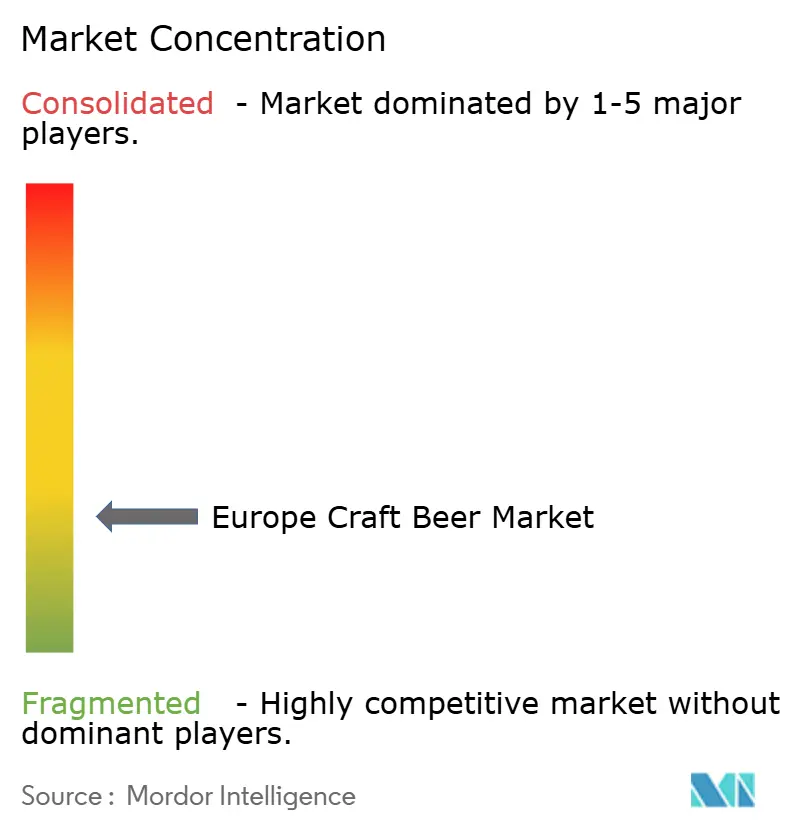
| Market Concentration | Low |
Major Players *Disclaimer: Major Players sorted in no particular order Image © Mordor Intelligence. Reuse requires attribution under CC BY 4.0. | |
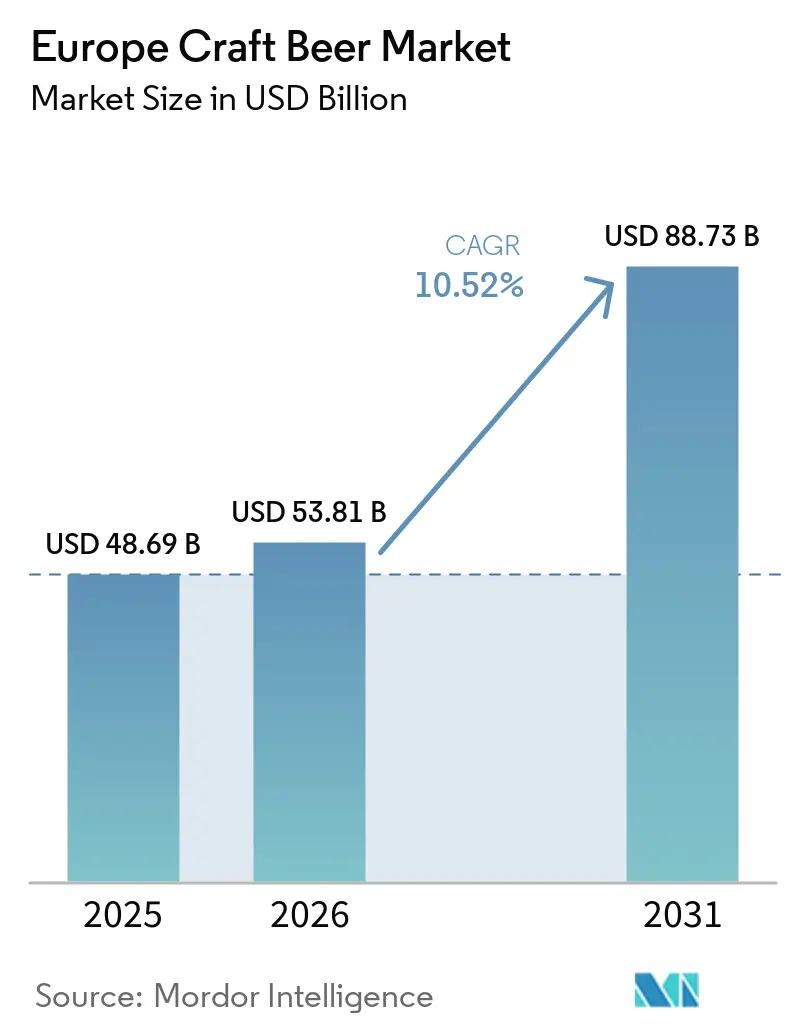
Europe Craft Beer Market Analysis by Mordor Intelligence
The Europe craft beer market size is expected to grow from USD 48.69 billion in 2025 to USD 53.81 billion in 2026 and is forecast to reach USD 88.73 billion by 2031 at 10.52% CAGR over 2026-2031. Premiumization is actively driving category value upward, supported by continuous flavor experimentation and the rapid growth of non-alcoholic styles. As mainstream lager volumes stabilize, these trends are reshaping the market. Cans have emerged as the dominant packaging choice, as they effectively reduce logistics costs and meet increasingly strict sustainability regulations. Retailers are actively creating craft-only aisles to replicate the exploratory experience of pubs, while breweries are expanding taprooms to strengthen hyperlocal demand. However, cost inflation and disparities in excise duties continue to challenge profitability. Larger brewers are addressing these challenges by acquiring smaller brands to enhance their authenticity. At the same time, agile microbreweries are capitalizing on opportunities by focusing on direct-to-consumer channels, ensuring they remain competitive in the evolving market landscape.
Key Report Takeaways
- By product type, ale led with 38.23% of the Europe craft beer market share in 2025, while lager is advancing at a 10.83% CAGR through 2031.
- By end user, men captured 68.31% of value in 2025, yet women are forecast to expand at an 11.23% CAGR to 2031.
- By packaging, cans accounted for 57.65% of value in 2025 and are growing at a 10.67% CAGR through 2031.
- By distribution channel, on-trade held 62.04% value share in 2025, whereas off-trade is projected to post an 11.68% CAGR to 2031.
- By geography, the United Kingdom commanded 34.64% value in 2025, while Germany is the fastest-growing country at a 10.87% CAGR to 2031.
Note: Market size and forecast figures in this report are generated using Mordor Intelligence’s proprietary estimation framework, updated with the latest available data and insights as of 2026.
Market Trends and Insights
Drivers Impact Analysis of Europe Craft Beer Market*
| Driver | (~) % Impact on CAGR Forecast | Geographic Relevance | Impact Timeline |
|---|---|---|---|
| Rising consumer preference for premium and artisanal beverages | +1.8% | Regional, with strongest uptake in UK, Belgium, Netherlands | Medium term (2-4 years) |
| Growing number of microbreweries and brewpubs across European countries | +1.5% | France, Spain, Italy (emerging); UK, Germany (mature saturation) | Long term (≥ 4 years) |
| Increasing demand for innovative flavors and experimental brewing styles | +1.2% | Urban centers across UK, Germany, Scandinavia; spillover to Eastern Europe | Short term (≤ 2 years) |
| Premiumization trend encouraging higher spending on specialty beverages | +1.0% | UK, Germany, France, Belgium, Netherlands | Medium term (2-4 years) |
| Increasing consumer interest in locally produced and authentic products | +0.9% | Regional strongholds: Bavaria, Yorkshire, Flanders; expanding to Poland, Spain | Long term (≥ 4 years) |
| Strong tourism and beer festival culture supporting craft beer awareness | +0.8% | Germany (Oktoberfest), Belgium (Beer Weekend), UK (GBBF), Czech Republic | Short term (≤ 2 years) |
| Source: Mordor Intelligence | |||
Rising consumer preference for premium and artisanal beverages
In Europe, a surge in consumer preference for premium and artisanal beverages has significantly propelled the craft beer market. Drinkers are increasingly favoring small-batch, flavorful brews over the traditional mass-produced lagers. Emphasizing authenticity, local sourcing, and craftsmanship, consumers are gravitating towards breweries that spotlight their origin stories, innovative recipes, and superior ingredients. This trend reflects a broader shift in consumer behavior, where quality and uniqueness are prioritized over quantity. With rising disposable incomes and a culture leaning towards experiential drinking, many are opting for pricier specialty beers. This includes IPAs, barrel-aged varieties, and seasonal releases, which offer distinct and memorable drinking experiences. Notably, urban millennials are at the forefront of this trend, showcasing a keen interest in diverse flavors and limited-edition launches. They are actively supporting taprooms, microbreweries, and beer festivals in major European cities, further driving the growth of the craft beer market.
Growing number of microbreweries and brewpubs across European countries
The growing number of microbreweries and brewpubs across European countries acted as a major driver for the Europe craft beer market, as it significantly expanded local production capacity and product diversity. This proliferation enabled more experimentation with beer styles, ingredients, and flavor profiles, catering to consumers seeking unique and regionally distinctive offerings. France emerged as one of the key examples, with over 2,500 microbreweries in 2024 and production reaching 24 million hectoliters, positioning the country as the fifth-largest beer producer in Europe[1]. This rapid expansion illustrated how microbreweries helped shift the market away from standardized lagers toward differentiated craft products. In the United Kingdom, the momentum continued, with the total number of active breweries reaching 1,641 by the end of March 2025, as reported by the Society of Independent Brewers Association[2]. This dense brewery network, spanning rural areas, towns, and major cities, strengthened local supply, shortened distribution chains, and fostered closer connections between brewers and consumers.
Increasing demand for innovative flavors and experimental brewing styles
Increasing demand for innovative flavors and experimental brewing styles acted as a strong driver for the market, as consumers moved beyond traditional lagers and pilsners toward more distinctive taste experiences. Brewers responded by developing a wide range of styles, including hop-forward IPAs, sour ales, barrel-aged beers, and fruit- or spice-infused variants, which appealed to curious and trend-driven drinkers. Limited editions and seasonal releases created a sense of novelty and urgency, encouraging repeat purchases and higher engagement with brands. Collaboration brews between local and international breweries further expanded flavor possibilities and helped transfer brewing knowledge across markets. This innovation wave also aligned with food-pairing trends in gastronomy, where complex craft beers complemented premium dining and street-food concepts. As a result, experimental brewing became a key differentiation tool for small and mid-sized breweries, allowing them to stand out against mainstream beer producers and capture value in premium price segments.
Strong tourism and beer festival culture supporting craft beer awareness
Strong tourism and a vibrant beer festival culture played a crucial role in supporting craft beer awareness across Europe, as visitors sought local, authentic drinking experiences that highlighted regional brewing traditions. Beer-focused events, city beer weeks, and brewery tours exposed international tourists to a wide variety of craft styles, helping small and independent producers gain visibility beyond their home markets. In major destinations such as Spain, a robust tourism base further amplified this effect; Spain’s travel and tourism sector was forecasted to reach EUR 260.5 billion in GDP contribution in 2025, equal to almost 16% of the national economy, underscoring the scale of potential exposure for local craft breweries through hospitality channels[3]. As tourists discovered distinctive beers during their trips, they often translated this interest into repeat purchases and word-of-mouth promotion in their home countries. Beer festivals also acted as innovation showcases, where brewers tested new recipes, gathered consumer feedback, and built brand loyalty in a highly engaging environment.
Restraints Impact Analysis of Europe Craft Beer Market*
| Restraint | (~) % Impact on CAGR Forecast | Geographic Relevance | Impact Timeline |
|---|---|---|---|
| High production and raw material costs impacting profitability of small breweries | -1.5% | Regional, acute in UK, Germany, France due to energy costs | Short term (≤ 2 years) |
| Limited distribution networks restricting market reach of independent brewers | -1.0% | Southern and Eastern Europe (Spain, Italy, Poland); rural UK, France | Medium term (2-4 years) |
| Strict alcohol taxation and regulatory compliance requirements across countries | -0.8% | High-tax jurisdictions: UK, Ireland, Netherlands, Finland | Long term (≥ 4 years) |
| Operational complexity due to small-batch and artisanal production methods | -0.5% | Regional, acute in Spain, Italy | Medium term (2-4 years) |
| Source: Mordor Intelligence | |||
High production and raw material costs impacting profitability of small breweries
High production and raw material costs significantly constrained the profitability of small breweries in the Europe craft beer market. Rising prices of key inputs such as malt, hops, specialty yeasts, and energy increased per-unit production costs, which were harder to absorb at low volumes. Small brewers lacked the purchasing power and long-term supplier contracts enjoyed by large multinationals, so they often paid higher prices and faced more volatile input costs. Investment in quality equipment, packaging, and compliance with stringent food safety and environmental regulations further added to fixed cost burdens. Because many craft beers used premium or experimental ingredients, their recipes were inherently more expensive to produce than standard lagers. Passing these costs on to consumers via higher prices risked narrowing the customer base, especially in price-sensitive markets or economic downturns. Limited access to financing also restricted the ability of small breweries to modernize, scale up, or improve efficiency, keeping unit costs elevated.
Limited distribution networks restricting market reach of independent brewers
Limited distribution networks restricted the market reach of independent brewers in Europe, limiting their ability to compete with large, established beer companies. Many craft breweries relied on local taprooms, nearby bars, and small retailers, which constrained volume growth and brand visibility. Access to national retail chains and export channels often required scale, consistent supply, and strong negotiating power, which smaller brewers frequently lacked. In several markets, long-term agreements between major breweries and distributors or on-trade outlets further reduced shelf and tap space available for craft products, intensifying competition within the beer industry. Logistics costs for cold-chain, small-batch, and geographically dispersed deliveries also made broader distribution less economical for independents. As a result, many promising craft brands remained regionally concentrated despite strong consumer interest.
*Our forecasts treat driver/restraint impacts as directional, not additive. The impact forecasts reflect baseline growth, mix effects, and variable interactions.
Europe Craft Beer Market Segment Analysis
By Product Type:
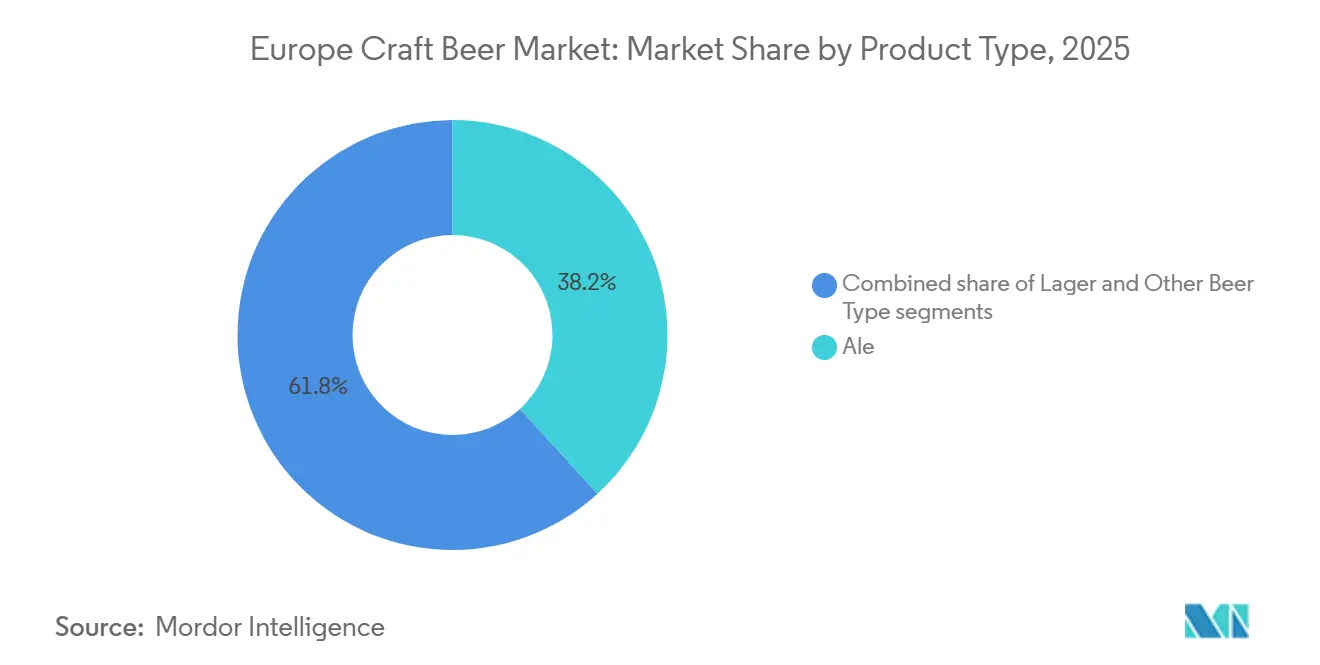
Lager Narrows the Gap with AleAle accounted for the largest share of the Europe craft beer market in 2025, representing 38.23% of total market revenue. The dominance of ale can be attributed to its wide variety of styles, flavors, and brewing techniques that appeal strongly to craft beer consumers seeking diversity and authenticity. Many craft breweries prioritize ale production due to shorter fermentation times and greater flexibility for experimentation with ingredients and flavor profiles. Consumer preference for bold, aromatic, and specialty beers has further strengthened the position of ales across both on-trade and off-trade channels. Additionally, the strong presence of pale ales, IPAs, and specialty seasonal variants has supported consistent demand across key European markets.
Lager is emerging as the fastest-growing segment in the Europe craft beer market and is projected to expand at a CAGR of 10.83% through 2031. The growth of craft lager is largely driven by increasing consumer demand for lighter, more refreshing beer options that offer both quality and drinkability. Craft brewers are increasingly introducing premium and specialty lagers that combine traditional brewing methods with modern flavor innovation. The segment is also benefiting from the transition of mainstream beer consumers toward craft alternatives without significantly changing taste preferences. Improved brewing technologies have enabled smaller breweries to produce high-quality lagers more efficiently, supporting wider product availability.

By End User:
Women Drive Incremental GrowthMen accounted for the largest share of the Europe craft beer market by end user in 2025, contributing 68.31% of total market value. This substantial share reflects the traditionally higher beer consumption rates among male consumers across many European countries. Craft beer brands have historically targeted male demographics through product positioning, flavor intensity, and marketing strategies centered on heritage and brewing craftsmanship. Established social drinking cultures and strong participation of men in beer festivals, pub gatherings, and tasting events have further reinforced this dominance. Additionally, men tend to exhibit higher brand loyalty within the craft segment, supporting consistent repeat purchases. The broad acceptance of diverse ale and specialty beer styles among male consumers continues to underpin their leading contribution to overall market revenue.
Women represent the fastest-growing end-user segment in the Europe craft beer market and are projected to expand at a CAGR of 11.23% through 2031. This accelerated growth is driven by changing social norms, rising disposable incomes, and increasing participation of women in premium beverage consumption. Craft breweries are introducing lighter, fruit-infused, low-alcohol, and aesthetically branded options that appeal to evolving female preferences. Marketing strategies are also becoming more inclusive, moving away from traditionally male-focused branding toward gender-neutral and experience-driven positioning. Growing interest in artisanal, locally produced, and premium beverages among women is further stimulating demand.
By Packaging:
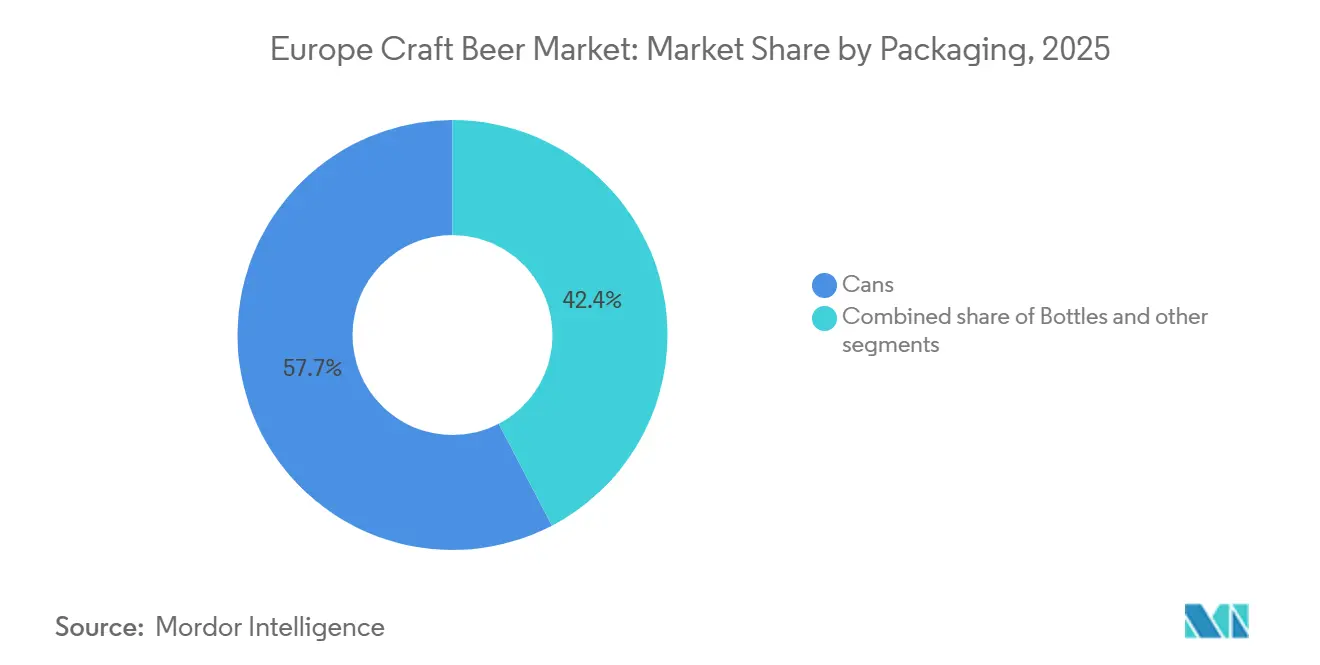
Cans Consolidate Leadership Through SustainabilityIn 2025, cans captured a dominant 57.65% market share and are expected to grow at a strong 10.67% CAGR from 2026 to 2031. Their growth stems from superior light and oxygen barriers, which preserve product quality, and their logistical efficiency, which reduces costs. Aluminum's impressive 75% average recycling rate in the EU aligns with breweries' efforts to disclose carbon footprints, allowing brands to showcase measurable environmental benefits to eco-conscious consumers. Lightweight can formats further enhance sustainability by cutting freight emissions and minimizing breakage costs. These advantages enable smaller producers to expand their retail presence while maintaining product quality and reducing operational expenses.
Advancements in liner technology now protect delicate hop oils, addressing previous concerns about flavor loss that once made glass the preferred choice. Custom shrink-sleeves and advanced digital printing techniques provide a boutique aesthetic, effectively challenging the perception that only bottles convey a premium image. Although returnable bottle schemes still exist, deposit-return legislation increasingly favors cans due to their ease of sorting and recycling. Consequently, craft breweries are increasingly installing canning lines in new facilities, reinforcing the dominance of cans and positioning them as a key driver in the next phase of growth for Europe's craft beer market.
By Distribution Channel:
Off-Trade Gains as Retail PremiumizesOn-trade distribution accounted for the largest share of the Europe craft beer market in 2025, holding 62.04% of total market value. The strong performance of this segment is primarily driven by the deep-rooted pub and bar culture across many European countries, where consumers prefer experiencing craft beer in social settings. Brewpubs, taprooms, restaurants, and specialty bars play a crucial role in promoting craft beer by offering fresh brews and a wide variety of styles on tap. Consumers often associate on-trade venues with product discovery, tasting experiences, and brand engagement, which strengthens sales within this channel. In addition, collaborations between breweries and hospitality operators help expand product visibility and encourage trial among new consumers.
Off-trade distribution is projected to be the fastest-growing segment in the Europe craft beer market, expanding at a CAGR of 11.68% through 2031. The growth of this segment is supported by increasing availability of craft beer across supermarkets, specialty retail stores, and online platforms. Changing consumption patterns, including at-home drinking and convenience-driven purchasing behavior, are encouraging consumers to buy craft beer for personal consumption. Retailers are also expanding shelf space for craft brands, enabling wider product accessibility and brand exposure. The rise of e-commerce and direct-to-consumer sales channels has further accelerated off-trade growth by improving product reach beyond traditional venues.
Geography Analysis
United Kingdom Craft Beer Market
The United Kingdom accounted for the largest share of the Europe craft beer market in 2025, contributing 34.64% of total market value. The country’s leadership position is supported by a well-established craft brewing culture and a high concentration of microbreweries and independent brewers. Strong consumer acceptance of premium and locally produced beer has encouraged continuous product innovation and brand diversification. The widespread presence of pubs, taprooms, and beer festivals has also played a significant role in promoting craft beer consumption across different consumer groups. In addition, the mature retail and hospitality infrastructure enables efficient product distribution and strong brand visibility.
Germany Craft Beer Market
Germany is projected to be the fastest-growing country in the Europe craft beer market, registering a CAGR of 10.87% through 2031. Growth in the German market is largely driven by evolving consumer preferences beyond traditional beer styles toward more diverse and innovative craft offerings. While Germany has a long-standing brewing heritage, younger consumers are increasingly exploring specialty beers, limited editions, and modern flavor profiles. The rise of independent breweries and craft-focused taprooms is further supporting market expansion. Increasing exposure to international craft beer trends and collaborations between local and global brewers are also contributing to accelerated growth.
Southern and Western Europe Craft Beer Market
Other European countries, including Spain, Italy, and France, are also demonstrating steady development within the Europe craft beer market. These countries are experiencing rising consumer interest in premium and locally produced beverages, supported by growing tourism and expanding urban hospitality sectors. The increasing number of small and independent breweries has strengthened product diversity and regional identity in craft beer offerings. Consumers in these markets are gradually shifting from mass-produced beer toward specialty and artisanal alternatives, encouraging innovation among brewers. Retail expansion and improved availability through supermarkets and specialty stores are further supporting market penetration.
Regulatory Landscape
Regulation affecting Europe craft beer spans excise duties, product and quality rules, and packaging compliance, with country-level differences under a shared EU framework. Council Directive (EU) 2020/1151 sets a harmonized basis for reduced excise duty for small independent breweries, which member states can implement through rate reductions (commonly cited in the 20% to 50% range). As a result, scale and independence definitions become a practical compliance topic for craft producers alongside ongoing differences in national alcohol taxes.
Packaging and sustainability rules are also tightening operational choices and cost structures. The Brewers of Europe reported active engagement in March 2026 trilogue discussions on the EU Packaging and Packaging Waste Regulation (PPWR), while deposit-return scheme rollouts, including Poland and Hungary, add reporting, labeling, and take-back requirements that can be more burdensome for smaller brewers than for large groups. In parallel, EU Technical Regulation Information System (TRIS) notifications and debates around mutual recognition, including discussions tied to beer quality rules and ingredient definitions, highlight how national proposals can affect cross-border marketing and labeling of craft styles.
Competitive Landscape
The European craft beer market operates with a fragmented structure, but consolidation is increasing as major brewing companies actively acquire craft brands. At the same time, independent breweries are driving innovation by adopting advanced technologies and implementing direct-to-consumer strategies. Although acquisition activities are on the rise, the market remains relatively unconcentrated. Heineken exemplifies a dual strategy by both developing its own craft brands organically and strategically acquiring independent breweries to expand its portfolio. Key players shaping the market include BrewDog PLC, Heineken Holding N.V., Anheuser-Busch InBev, Mikkeller A/S, and Molson Coors Beverage Company.
European Union directives have standardized regulations, significantly transforming the competitive dynamics of the craft beer market. These directives have introduced unified certification systems, which simplify compliance processes for smaller producers, reducing their administrative and operational challenges. Additionally, tax rate reductions across various member states have provided smaller breweries with notable financial benefits. By implementing these regulatory measures, the EU has created a more equitable competitive environment, empowering independent breweries to compete more effectively against larger, corporate-owned craft beer operations.
Craft breweries are actively leveraging opportunities at the intersection of sustainability and direct consumer engagement to differentiate themselves from mass-market alternatives. They are prioritizing environmental sustainability and creating unique consumer experiences to stand out in the market. For example, indoor hop cultivation technology allows craft breweries to achieve supply chain independence while producing higher-quality raw materials. Spanish breweries have demonstrated the effectiveness of this approach by achieving higher alpha acid content in hops grown indoors compared to those cultivated using traditional field methods. This innovation highlights how craft breweries are combining sustainability with quality to gain a competitive edge.
Europe Craft Beer Industry Leaders
-
Anheuser-Busch InBev
-
Molson Coors Beverage Company
-
BrewDog Plc
-
Heineken Holding N.V
-
Mikkeller A/S
- *Disclaimer: Major Players sorted in no particular order
Europe Craft Beer Market Companies Covered in this Report
- Anheuser-Busch InBev
- BrewDog PLC
- Heineken Holding N.V.
- Molson Coors Beverage Company
- Mikkeller A/S
- Beavertown Brewery
- Camden Town Brewery
- Cloudwater Brew Co.
- Omnipollo AB
- Stone Brewing Co.
- Magic Rock Brewing Ltd.
- Sierra Nevada Brewing Co.
- D.G. Yuengling and Son Inc.
- Carlsberg Group (Jacobsen)
- Stone and Wood Brewing Co.
- La Trappe / De Koningshoeven
- Duvel Moortgat Brewery
- Siren Craft Brew
- Tiny Rebel Brewing Co.
- BrauKunstKeller
Market Opportunities and Future Outlook
Channel and format execution offers near-term whitespace where sustainability compliance and retail mechanics intersect with premiumization. Cans already represent 57.65% of value (2025), and policy emphasis on circular packaging systems continues to support investment in canning and packaging optimization as a way to broaden off-trade distribution while protecting freshness. On-trade economics also look more controllable as dispensing and venue operations improve; for instance, Heineken UK has promoted SmartDispense to improve dispense quality and venue-level economics, supporting craft-style rotation and higher-value serves.
For independent breweries, upgrades are pointing toward opportunity in productivity, quality consistency, and direct-to-consumer engagement beyond new brand launches. In the Independent Brewers of Europe reporting for 2026, independents named beer quality (37%) and new equipment (35%) as top investment priorities, pointing to a broader push toward better process control, packaging lines, and cellar operations that can improve supply reliability for retailers and multi-site on-trade. At the same time, consolidation keeps premium positioning in focus as larger brewers and groups compete for recognized brands and assets, strengthening the case for distinctive local propositions alongside scalable distribution partnerships for craft players.
Recent Industry Developments in Europe Craft Beer Market
- July 2026: Heineken N.V. launched Cruzcampo 1904, a double-fermented premium beer, specifically for the Spanish market. The launch reinforces Heineken's premium portfolio in Spain to address rising premium demand and defend share in a key EU market.
- June 2026: Tilray Brands / BrewDog announced an approximate £50 million investment to stabilise the acquired BrewDog business following a March 2026 acquisition. The capital supports BrewDog’s scale and distribution post-acquisition, enabling broader international brand push and portfolio leverage via BrewDog UK sites.
- June 2026: Mikkeller A/S opened Chuck et Luc, a craft beer bar and eatery in Beirut, Lebanon, marking the company’s first location in the Middle East. The expansion increases Mikkeller’s footprint and novel retail hospitality model to drive brand exposure and potential new distribution channels.
Europe Craft Beer Market Report Scope and Research Methodology
Market Definition and Coverage
For this study, the Europe craft beer market is defined as the value of craft beer sold across Europe through on-trade and off-trade channels, counted at the point of sale and converted into USD for consistency across countries.
Scope exclusions: We exclude non-beer alcoholic drinks and activities like brewery tours, merchandise, and food service revenue that is not part of beer sales.
Segments Covered in This Report
- By Product Type
- Ale
- Lager
- Other Beer Types (Specialty Beers)
- By End User
- Men
- Women
- By Packaging
- Bottles
- Cans
- Others
- By Distribution Channel
- On-Trade
- Off-Trade
- By Country
- United Kingdom
- Germany
- France
- Italy
- Spain
- Russia
- Sweden
- Belgium
- Poland
- Netherlands
- Rest of Europe
Data Sources, Market Sizing, and Validation
Desk Research
Desk research helps us set the market boundary and keep country assumptions realistic before building the model. We reviewed public sources that explain beer output, consumption direction, and trade movements, such as Eurostat datasets, national statistics offices, customs and trade statistics, and industry publications from groups like The Brewers of Europe.
We also used supporting information such as company annual reports, investor presentations, and credible press coverage to understand pricing moves, packaging shifts, and route-to-market changes. To stitch together consistent company and brand-level context, we referred to paid subscriptions that provide company financials and intelligence, and news and financials tracking, which helps reduce the risk of missing large portfolio changes. The desk sources listed here are illustrative, and we also used additional public and paid references for validation and research clarification.
Primary Interviews and Surveys
Primary work focused on aligning the craft definition used in-market with actual selling behavior, and then checking how prices and channel mix are moving in key countries. We spoke with breweries, distributors, retailers, and on-trade operators across major European markets so gaps from public data, like private brewery revenue splits and draft versus packaged share, could be filled and then cross-checked.
Distribution of primary research fieldwork respondents
| Company type | Respondent position |
|---|---|
| Top tier: 34% | CXOs: 13% |
| Mid tier: 45% | Functional/Unit leaders: 32% |
| Smaller Players: 21% | Managers: 55% |
Market-Sizing & Forecasting
The core sizing starts from a top-down build where national beer value is reconstructed and then filtered using craft incidence by country, using the report scope list to keep coverage consistent. To keep the number grounded, we corroborate it with selective bottom-up checks, such as sampled brewery revenue rollups, distributor sell-in checks, and an average price times volume sanity check in a few anchor countries, and then adjust any outliers.
Inputs used in the model include reported beer production and apparent consumption signals, import and export movements for beer categories, on-trade versus off-trade mix shifts, draft versus packaged share direction, and average selling price movement driven by excise changes and packaging formats. Forecasting uses scenario analysis supported by expert views, where volumes and prices are projected separately and then recombined, since premiumization can lift value even when liters grow slowly. Where bottom-up coverage is incomplete for small breweries, we use country-level expansion factors based on brewery counts and observed channel reach, then recheck them in interviews.
Data Validation & Update Cycle
Outputs are validated through multiple passes, starting with internal checks that compare country totals against independent beer indicators like production, trade balance, and consumption direction. Any unusual jumps are reviewed, and assumptions are reworked if they cannot be explained by known events such as tax changes, channel disruptions, or major portfolio moves.
Before sign-off, another analyst reviews the model logic, the conversion steps, and the reasonableness of pricing and mix assumptions. Reports are refreshed annually, and interim updates are triggered if a material event changes pricing, regulation, or channel access. Right before delivery, a final pass is done to ensure the latest public signals and interview feedback are reflected.
Mordor Intelligence's Europe Craft Beer Market Size Compared With Other Published Estimates
Different published market sizes for Europe craft beer can vary because the craft boundary is not identical across studies, and because some figures blend a volume-led view with a value-led view without clearly separating price effects. Differences also come from how countries are grouped into Europe, how on-trade is handled when draft sales fluctuate, and the year and currency timing chosen for conversion.
Beer production and consumption signals, plus trade and pricing checks, are used as evidence to keep Mordor Intelligence's estimate tied to a defined craft demand pool rather than a broad premium beer bucket.
Benchmark comparison
| Source | Market Size | Gaps in Research Methodology |
|---|---|---|
| Mordor Intelligence | USD 48.69 B (2025) | |
| Regional Consultancy A | USD 39.80 B (2024) | Uses an earlier base year and a different craft inclusion rule in some countries, and the price progression appears smoother, which can understate the value impact of recent excise and input-cost pass-through. |
| Trade Journal B | USD 19.20 B (2024) | Reports an absolute growth amount over 2025-2029 and mixes it into market sizing language, which can be misread as the full market value, and the geography and channel boundary are not fully transparent. |
Across the table, the spread is mainly explained by how craft is defined, how the base year is chosen, and whether the published number represents total market value or a growth increment. Our approach stays repeatable because assumptions are pinned to observable beer signals first and then corrected through interviews when private-market detail is missing.
Key Questions Answered in the Report
How large is the Europe craft beer market in 2026?
It is valued at USD 53.81 billion, on track to reach USD 88.73 billion by 2031.
Which country is expanding fastest?
Germany is projected to post the highest CAGR at 10.87% between 2026 and 2031, driven by non-alcoholic craft variants and export demand.
Why are cans overtaking bottles in Europe’s craft segment?
Deposit-return laws, lighter weight that cuts freight costs, and innovations like Carlsberg’s snap-pack make cans the most sustainable and economical option.
What is the biggest growth opportunity by consumer group?
Women, forecast to rise at an 11.23% CAGR, offer the largest incremental value through flavored stout and lower-ABV styles.
Which distribution channel is set to grow the quickest?
Off-trade retail, supported by craft-dedicated supermarket aisles and e-commerce, is expected to expand at an 11.68% CAGR through 2031.