
Market Overview
| Study Period | 2020 - 2031 |
|---|---|
| Forecast Data Period | 2026 - 2031 |
| Historical Data Period | 2020 - 2024 |
| Market Size (2026) | USD 75.78 Billion |
| Market Size (2031) | USD 112.41 Billion |
| Growth Rate (2026 - 2031) | 8.21 % |
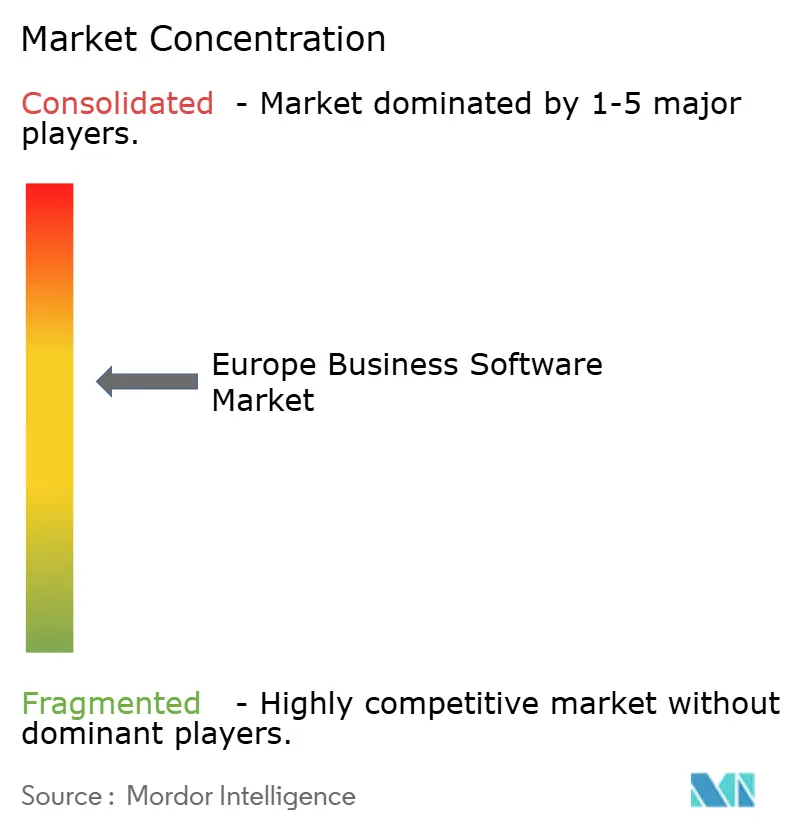
| Market Concentration | Medium |
Major Players *Disclaimer: Major Players sorted in no particular order Image © Mordor Intelligence. Reuse requires attribution under CC BY 4.0. | |
Europe Business Software Market Analysis by Mordor Intelligence
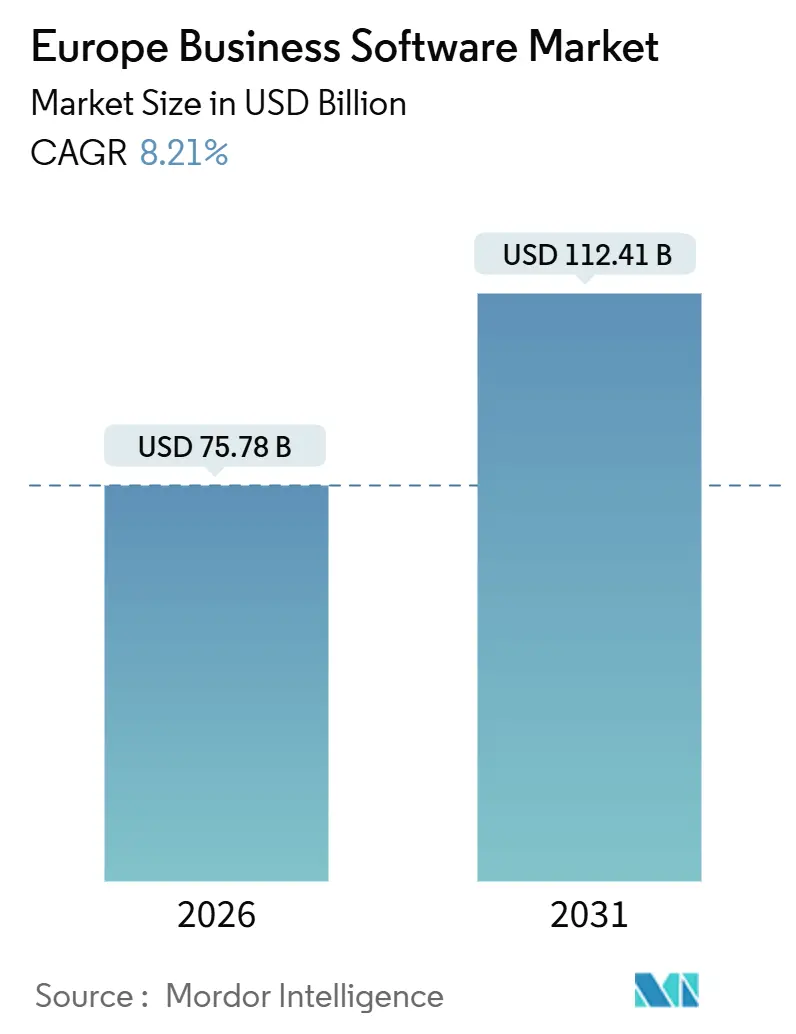
The Europe Business Software market size stood at USD 75.78 billion in 2026 and is projected to register an 8.21% CAGR, lifting revenue to USD 112.41 billion by 2031. Growth rests on three pillars: rapid migration to cloud-native architectures, regulatory mandates that embed compliance into everyday workflows, and the steady infusion of generative AI into enterprise resource planning, customer relationship management, and supply chain management applications. Cloud deployments already dominate spending, yet sovereignty rules are forcing vendors to host data inside the bloc, reshaping procurement criteria. Interoperability clauses in the EU Data Act are simultaneously lowering switching costs, while the Corporate Sustainability Reporting Directive is turning ESG reporting into a software buying trigger. Competitive intensity is rising as hyperscalers pour capital into new data centers and regional providers pitch sovereign alternatives, giving enterprises more bargaining power.
Key Report Takeaways
- By software type, enterprise resource planning accounted for 34.19% of 2025 revenue, while business intelligence and analytics platforms are forecast to grow at a 9.43% CAGR through 2031.
- By deployment model, cloud installations captured 72.34% share in 2025 and are expected to advance at a 9.85% CAGR through 2031.
- By end-user vertical, manufacturing held 18.27% of 2025 spending, whereas healthcare and life sciences are set to expand at an 8.92% CAGR over the forecast horizon.
- By enterprise size, large organizations controlled 51.94% of 2025 revenue, yet the mid-sized cohort is projected to post an 8.56% CAGR to 2031.
- By geography, Germany led with a 22.27% share in 2025, while Spain is poised for the fastest 8.84% CAGR through 2031.
Note: Market size and forecast figures in this report are generated using Mordor Intelligence’s proprietary estimation framework, updated with the latest available data and insights as of January 2026.
Europe Business Software Market Trends and Insights
Drivers Impact Analysis*
| Driver | (~) % Impact on CAGR Forecast | Geographic Relevance | Impact Timeline |
|---|---|---|---|
| Cloud-First Shift Across European Mid-Market Firms | +2.10% | Pan-European, with strongest uptake in Germany, UK, France, and Nordic countries | Medium term (2-4 years) |
| AI-Enabled Decisioning Embedded in ERP and SCM Suites | +1.80% | Global, with early adoption in manufacturing hubs (Germany, Italy) and financial centers (UK, France) | Short term (≤ 2 years) |
| Post-BREXIT Compliance Push for Multi-Entity Finance Suites | +0.60% | UK and EU27 cross-border operations, particularly financial services and retail | Medium term (2-4 years) |
| EU Data Act Spurring SaaS Analytics Modernization | +1.30% | EU27, with compliance mandates affecting all cloud service providers | Short term (≤ 2 years) |
| Green-Taxonomies Driving ESG Reporting Modules Uptake | +1.00% | EU27, with highest demand in Germany, France, Netherlands, and Nordic countries | Medium term (2-4 years) |
| Manufacturing Renaissance Funds (IPCEI) Favouring Vertical ERP | +0.90% | Germany, France, Italy, Spain, and Central European manufacturing corridors | Long term (≥ 4 years) |
| Source: Mordor Intelligence | |||
Cloud-First Shift Across European Mid-Market Firms
Recovery and Resilience Facility grants are lowering capital barriers, allowing mid-sized enterprises to decommission aging servers and adopt subscription licenses. Eurofound and Cedefop found in 2025 that 73% of small and medium-sized enterprises had reached basic digital intensity, yet regional disparities persist, especially in Southern Europe.[1]European Commission, “Data Act,” digital-strategy.ec.europa.eu United Kingdom studies suggest that a 1% productivity uplift from digital tools could add GBP 94 billion (USD 119 billion) to GDP, encouraging policymakers to underwrite CTO-as-a-service programs. PwC reported that 94% of organizations plan to redesign cloud architecture to reflect geopolitical realities.[2]PwC, “EMEA Cloud Survey 2025,” pwc.com Hyperscaler revenue is therefore climbing, yet German and French enterprises increasingly trial sovereign platforms from OVHcloud and Scaleway to keep sensitive data inside the bloc. Because only one-third of European firms have migrated more than half of their workloads, a substantial runway remains for workload re-platforming.[3]McKinsey, “Cloud’s Trillion-Dollar Prize is Up for Grabs,” mckinsey.com
AI-Enabled Decisioning Embedded in ERP and SCM Suites
Generative AI is moving from pilot to production across core business suites, trimming cycle times and reducing manual effort. SAP infused Business AI into S/4HANA, while Microsoft launched Copilot inside Dynamics 365 Supply Chain Management, claiming up to 30% forecast-error reductions.[4]Microsoft, “Dynamics 365 Supply Chain Management,” microsoft.com BCG estimates that generative models can cut ERP implementation labour by 20-40%. Oracle, Salesforce, and regional vendors are racing to match these capabilities, shifting buyer expectations so that predictive analytics becomes a baseline requirement. European manufacturers are early adopters, using AI-driven visibility tools to offset semiconductor shortages; Apollo Tyres’ European division saved GBP 9.2 million (USD 11.7 million) through route optimization. Vendors unable to release credible AI roadmaps risk commoditization as procurement teams bake intelligent automation into request-for-proposal templates.
EU Data Act Spurring SaaS Analytics Modernization
The EU Data Act obliges software providers to offer data portability and open APIs, dismantling long-standing lock-in practices. Analytics vendors are rebuilding around open standards so clients can federate queries across AWS, Azure, on-premises clusters, and sovereign clouds. Microsoft already merged Power BI with its Fabric platform and OneLake data lake, giving customers single-copy analytics in regionally compliant instances. Tableau and QlikTech are following suit, reflecting growing pressure to support data mesh topologies. The act’s liability provisions heighten financial exposure for non-compliance, encouraging risk-averse sectors such as healthcare, banking, and utilities to prioritize vendors with proven governance controls. Over time, enforced openness is expected to erode incumbent switching barriers and foster best-of-breed adoption patterns that boost demand for integration middleware.
Green-Taxonomies Driving ESG Reporting Module Uptake
The Corporate Sustainability Reporting Directive forces roughly 50,000 European companies to disclose double materiality metrics under European Sustainability Reporting Standards. PwC’s 2024 readiness survey showed 58% of firms were unprepared, signalling a sizable compliance gap. SAP, Workiva, and several niche players have released pre-built ESG modules that collect, validate, and audit carbon, water, and social data. Because ISO 14001 and ISO 26000 references are now standard in tenders, embedded sustainability functionality is shifting from nice-to-have to license-must. The EU Taxonomy Regulation compounds complexity by requiring real-time tracking of revenue, capital expenditure, and operating expenditure linked to taxonomy-eligible activities. Vendors offering automated classification and disclosure workflows can therefore command price premiums and accelerate renewals.
Restraints Impact Analysis*
| Restraint | (~) % Impact on CAGR Forecast | Geographic Relevance | Impact Timeline |
|---|---|---|---|
| Unresolved EU-Wide Skills Shortage in Low-Code Platforms | -1.20% | Pan-European, with acute shortages in Germany, UK, France, and Nordic countries | Long term (≥ 4 years) |
| Mounting Sovereignty Concerns over US-Hosted SaaS | -0.90% | EU27, with strongest sentiment in Germany, France, and Netherlands | Medium term (2-4 years) |
| Fragmented VAT Regimes Complicating Multi-Country Rollouts | -0.50% | EU27 cross-border operations, particularly retail, e-commerce, and logistics | Medium term (2-4 years) |
| Rising Total-Cost-of-Ownership for Hyperscaler Consumption | -0.70% | Global, with highest impact in cloud-intensive verticals (financial services, healthcare, SaaS providers) | Short term (≤ 2 years) |
| Source: Mordor Intelligence | |||
Unresolved EU-Wide Skills Shortage in Low-Code Platforms
The European Commission reported that 77% of enterprises struggled to hire ICT specialists in 2024, hindering low-code uptake despite the promise of citizen development. Only 54% of the population has basic digital skills, while advanced competencies such as API design and cybersecurity remain scarcer. OECD analysis of Czech SMEs showed just 16% invest in ICT training, a pattern mirrored across several Central and Eastern European markets. This talent gap bifurcates the market: large enterprises deploy low-code to accelerate backlog reduction, whereas mid-market firms remain stuck at proof-of-concept. Vendors are responding with academy programs, but progress is slow, placing a drag on license growth forecasts.
Mounting Sovereignty Concerns over US-Hosted SaaS
Schrems II and the extraterritorial reach of the US CLOUD Act amplified fears that foreign authorities could access European citizen data without due process. A 2025 KPMG survey found 58% of German companies regard sovereign cloud as non-negotiable and 98% are willing to pay a premium for it. SAP, Microsoft, and Oracle have responded with sovereign regions operated by European partners, but limited feature parity and higher pricing complicate value propositions. Meanwhile, the Important Projects of Common European Interest initiative directed EUR 1.2 billion (USD 1.3 billion) toward a federated cloud, yet production readiness is years away. Until native EU alternatives reach scale, enterprises must juggle compliance, capability, and cost, lengthening sales cycles and tempering market expansion.
*Our forecasts treat driver/restraint impacts as directional, not additive. The impact forecasts reflect baseline growth, mix effects, and variable interactions.
Segment Analysis
By Software Type: ERP Anchors Spending, Analytics Accelerates Fastest
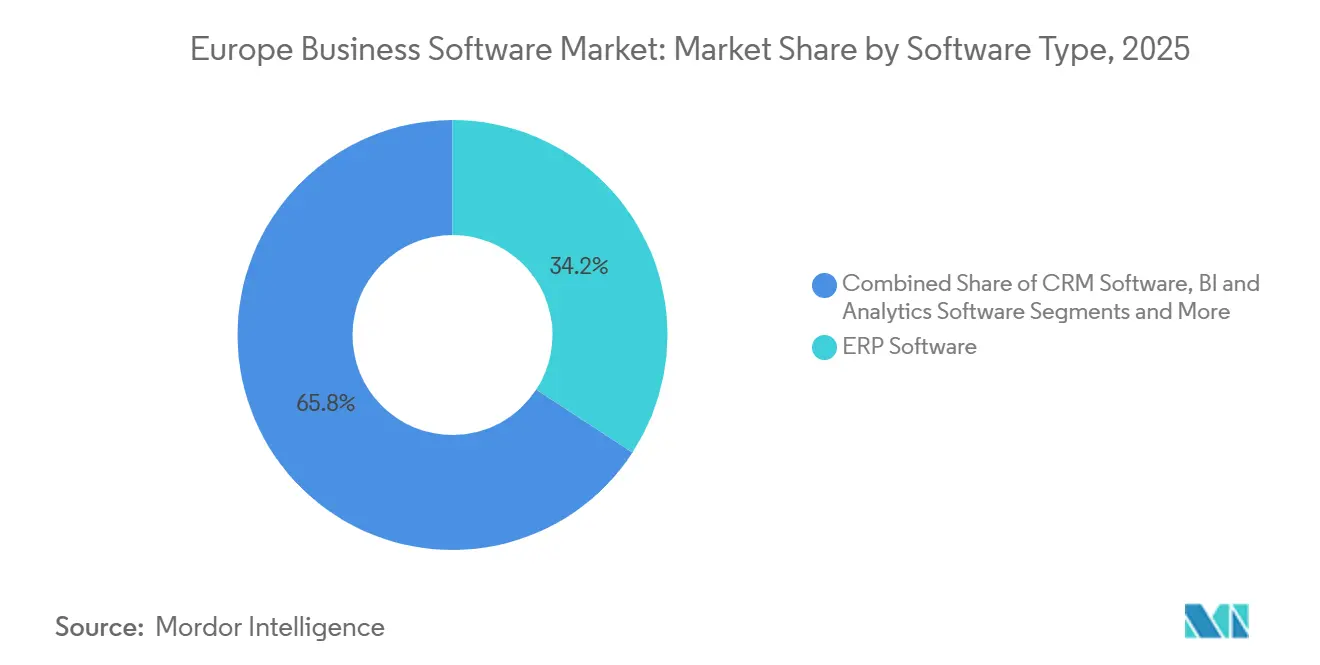
Enterprise resource planning applications accounted for 34.19% of 2025 revenue, confirming their role as the transactional backbone for finance, procurement, and human capital across Europe Business Software market deployments. Business intelligence and analytics suites are poised to record the fastest 9.43% CAGR, helped by EU Data Act mandates that require open data models and the proliferation of agent-based dashboarding. Vendors are embedding natural language interfaces and predictive logic that surface insights without manual SQL, which shortens decision loops for line-of-business managers.
In the decision stack, customer relationship management remains crucial, especially in financial services, while supply chain management gains urgency as manufacturers localize sourcing to manage geopolitical risk. The Europe Business Software market size for emerging niches such as environmental, social, and governance reporting has grown rapidly following the Corporate Sustainability Reporting Directive, giving pure-play providers an entry wedge. Competitive positioning is shifting toward composable architectures, allowing customers to assemble best-of-breed combinations from SAP, Microsoft, Salesforce, and a growing roster of mid-market specialists.



By Deployment Model: Cloud Dominance Entrenches Despite Sovereignty Frictions
Cloud installations comprised 72.34% of total revenue in 2025, and the segment is likely to outpace overall Europe Business Software market growth at a 9.85% CAGR through 2031. Hyperscalers are expanding data-center footprints from Dublin to Warsaw, ensuring sub-20-millisecond latency for most users. Yet sovereignty clauses in public tenders oblige providers to guarantee in-region processing and European legal jurisdiction, spawning a new tier of protected instances that balance compliance and innovation.
On-premises remains relevant for critical infrastructure, defense, and certain bank workloads, but even these users are adopting containerized platforms that can shift between private and public environments. Multi-cloud configurations dominate architecture roadmaps, giving enterprises flexibility to arbitrage pricing and resilience. As reserved-instance contracts proliferate, finance teams are sharpening FinOps practices to limit unbudgeted consumption, moderating the Europe Business Software market share gains of hyperscalers but solidifying cloud as the default deployment choice.
By End-User Vertical: Manufacturing Leads, Healthcare Surges on Interoperability Mandates
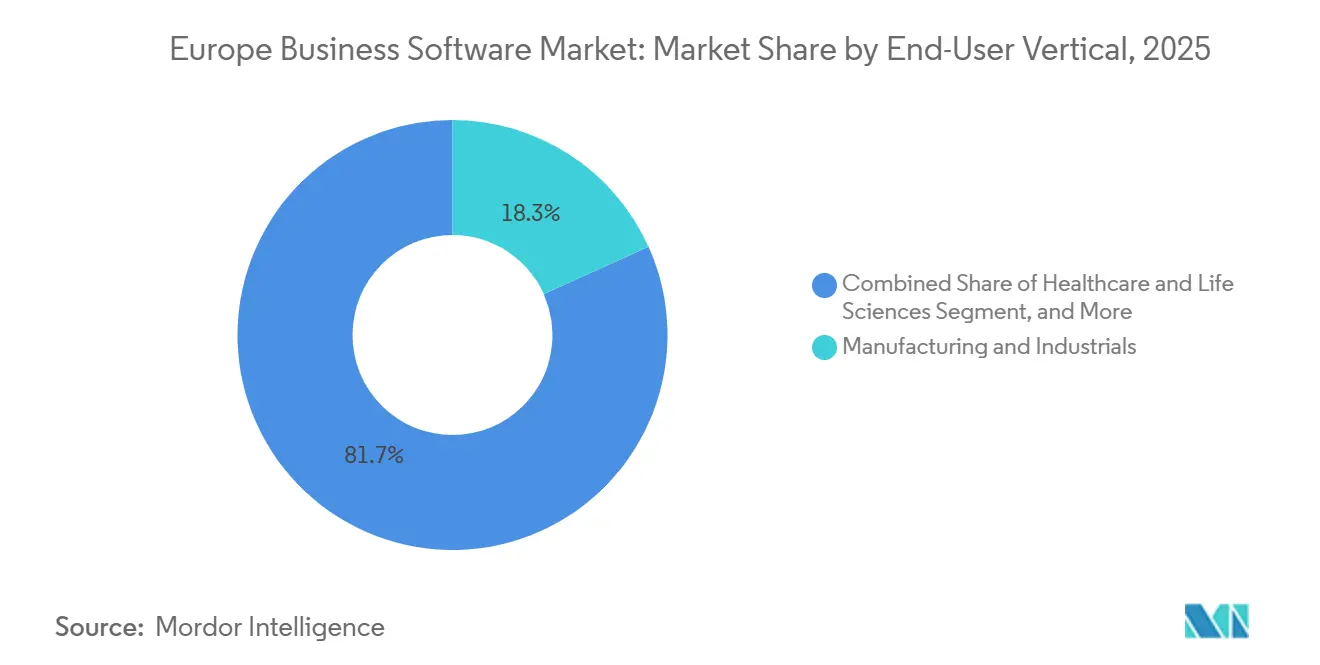
Manufacturing contributed 18.27% of 2025 spending, reflecting Germany’s automotive clusters, Italy’s machinery exports, and pan-European Industry 4.0 subsidies. Digital twins, predictive maintenance, and automated quality inspection modules are mainstreaming inside plants, creating durable demand for real-time ERP and supply chain visibility. Conversely, healthcare and life sciences are on track for the highest 8.92% CAGR, driven by European Health Data Space rules that enforce cross-border electronic health record sharing. Hospitals are moving to cloud-based EHRs and analytics to enable integrated care pathways and clinical research.
Financial services, retail, and logistics each represent sizeable slices of the Europe Business Software market, underpinned by risk management reform and omnichannel commerce imperatives. Public sector agencies are leaning on Recovery and Resilience Facility grants to upgrade legacy payroll, permitting, and tax systems. Telecom and media operators continue to deploy customer data platforms as 5G monetization strategies pivot toward subscription bundles. Each vertical’s digital road map reinforces the importance of modular compliance engines that can adapt to divergent regulations without full-scale rewrites.
By Enterprise Size: Large Firms Dominate Spending, Mid-Market Drives Growth
Large enterprises generated 51.94% of 2025 revenue, confirming their outsize influence on vendor product road maps. These organizations run multi-entity structures that require consolidated financials, automated intercompany eliminations, and global supply chain orchestration. Consequently, they purchase integrated suites and premium support, lifting average contract values across the Europe Business Software market.
Mid-sized companies will contribute the fastest 8.56% CAGR as government subsidies, freemium models, and simplified onboarding shrink adoption barriers. Vendors such as Sage, Zoho, and Odoo are tailoring pre-configured workflows that lower implementation time to weeks rather than months. Still, skills shortages persist, and many firms depend on partner networks for customization. Small businesses lag due to budget constraints and limited in-house IT capacity, yet policy targets that call for 90% digital intensity by 2030 suggest accelerated uptake later in the decade.
Geography Analysis
Germany retained a 22.27% share of the Europe Business Software market in 2025, underpinned by a strong manufacturing sector and proactive adoption of Industry 4.0 practices. KPMG surveys indicate that 62% of German enterprises now follow a cloud-first doctrine, while 58% require sovereign hosting, forcing both global and local vendors to invest in domestic data centers. The national contribution of EUR 750 million (USD 825 million) to the federated European cloud underscores Berlin’s strategic intent to future-proof industrial competitiveness.
Spain is expected to be the fastest-growing geography, registering an 8.84% CAGR through 2031. Recovery and Resilience Facility grants and the Kit Digital voucher program underpin the rapid digitization of small and medium-sized enterprises. This policy stance, together with rising venture capital inflows into Barcelona and Madrid, creates fertile ground for SaaS adoption. The post-Brexit United Kingdom remains an attractive market due to its banking and insurance concentration, although dual reporting frameworks add compliance overhead that favours modular ERP.
France leverages the Gaia-X initiative and public investment banks to foster a sovereign data ecosystem, boosting native providers such as OVHcloud. Italy channels Transizione 4.0 incentives and PNRR funds into public sector modernization, while Nordic nations lead on digital skills, accelerating adoption cycles. Central and Eastern European markets present mixed readiness; Poland and the Czech Republic continue to draw foreign direct investment into manufacturing, whereas Bulgaria and Romania lag on cloud skill metrics but show potential upside as connectivity improves.
Collectively, geographic demand patterns highlight the importance of localization, language support, and in-region compliance modules, reinforcing the Europe Business Software market’s preference for modular platforms that can be parameterized rather than heavily customized.
Regulatory Landscape
EU-wide digital regulation is tightening around embedded AI and software cybersecurity, which is increasingly shaping procurement checklists for ERP, CRM, BI and analytics, and supply-chain suites deployed across Europe. Regulation (EU) 2024/1689 (AI Act) introduces risk-based obligations for AI systems and general-purpose AI (GPAI) models. Prohibited AI practices apply from 2 February 2025, GPAI obligations from 2 August 2025, and broader application of the Act from 2 August 2026, with the European AI Office within the European Commission coordinating implementation for GPAI models.
For software suppliers, Regulation (EU) 2024/2847 (Cyber Resilience Act) sets horizontal security-by-design and vulnerability-handling requirements for products with digital elements placed on the EU market. Key compliance milestones include notification of conformity assessment bodies from 11 June 2026 and incident reporting obligations from 11 September 2026, ahead of full applicability of the Act on 11 December 2027. Alongside this, EU cybersecurity policy work continues through a 2026 proposal to revise the Cybersecurity Act framework, promoting the European Cybersecurity Certification Framework as a mechanism to streamline assurance across regulated entities, which supports demand for auditable controls and standardized compliance evidence in enterprise software deployments.
Competitive Landscape
The Europe Business Software market is moderately concentrated. SAP, Microsoft, and Oracle anchor the top tier with comprehensive ERP, database, and productivity suites, yet their hold is tempered by sovereignty stipulations and pricing scrutiny. Salesforce remains the CRM reference point, but HubSpot and Zoho are eroding share in the mid-market with lower cost of ownership. Workday is capitalizing on demand for unified human capital and financial management among large enterprises, particularly those with complex payroll and multi-GAAP reporting needs.
Regional specialists thrive in domain-specific niches. Sage and Unit4 focus on professional services, IFS dominates field service management, and Dassault Systèmes supplies manufacturing product lifecycle management. Low-code contenders such as Out Systems, Mendix, and Microsoft Power Platform are vying for developer mindshare, while ESG reporting startups position themselves as plug-ins for compliance gaps. The EU Data Act’s push for interoperability is fostering a composable mindset, encouraging best-of-breed purchasing and opening doors for challenger brands.
Strategic moves intensified in 2025. Microsoft launched Copilot across European Dynamics 365 instances, SAP promoted Business AI within its S/4HANA Cloud, and Oracle expanded German data centers to bolster sovereign propositions. Meanwhile, IFS’s acquisition of a predictive maintenance specialist and Sage’s integration with Microsoft Power Platform illustrate how vendors blend inorganic and partnership tactics to extend functionality. The race is now centered on embedding generative intelligence, ensuring data residency, and delivering out-of-the-box compliance kits.
Europe Business Software Industry Leaders
Accenture Plc
Cisco Systems Inc.
Microsoft Corporation
SAP SE
IBM Corporation
- *Disclaimer: Major Players sorted in no particular order

Market Opportunities and Future Outlook
EU digital-policy execution is creating actionable whitespace for vendors that productize compliance, interoperability, and sovereignty into standard workflows. The European Commission's State of the Digital Decade 2026 package highlights priority actions around scaling multi-country projects and accelerating digital public infrastructure, including continued work on the European Digital Identity Wallet. These initiatives are pulling enterprise and public-sector buyers toward identity-aware, API-first business applications that embed governance by default rather than through custom projects.
Capital availability and ecosystem activity are also supporting expansion of European business-software platforms and services. In June 2026, Main Capital Partners closed two funds totaling EUR 5.25 billion aimed at lower mid-market enterprise software investments, reinforcing a buy-and-build route for vertical and mid-market suite providers across Europe. At the adoption layer, 2026 EU enterprise usage levels of cloud computing (46.7%), data analytics (39.9%), and AI (20%) indicate capacity for deeper penetration of cloud-delivered ERP and SCM and embedded analytics, particularly for buyers that require EU data residency and regulated controls aligned with the AI Act and Cyber Resilience Act compliance timelines.
Recent Industry Developments
- July 2026: SAP completed its acquisition of Prior Labs in a deal reported at over EUR 1 billion to advance tabular foundation model capabilities for enterprise use cases. The acquisition strengthens SAP's generative AI roadmap inside business applications where structured data dominates, and it increases competitive pressure on suite vendors to accelerate domain-specific AI models and tooling.
- June 2026: SAP announced an investment of up to EUR 300 million in France to expand sovereign cloud and Business AI capabilities, including work toward SecNumCloud qualification with ANSSI. The commitment increases regional capacity and compliance credentials for regulated industries and public sector buyers that require France-aligned sovereignty assurances in cloud ERP and analytics deployments.
- November 2024: Accenture, Microsoft, and Avanade announced expanded capabilities to help enterprises reinvent business functions using generative AI and Copilot-related tooling. The collaboration expands implementation capacity across Europe for Copilot-enabled productivity and business-process modernization, supporting faster integration of AI features into enterprise workflows.


Research Methodology Framework and Report Scope
Market Definition and Coverage
For this study, the Europe business software market covers paid enterprise applications and suites used by organizations to run core processes, which are counted at vendor invoice value in USD across Europe. It includes cloud and on-premise deployments where the software is purchased or subscribed for business use.
Scope exclusions: We do not count basic office productivity tools or personal productivity software, and we also leave out system-level middleware and tools that are not purchased as business applications.
Segmentation Overview
- By Software Type
- ERP Software
- CRM Software
- BI and Analytics Software
- Supply-Chain Management Software
- Other Software Type
- By Deployment Model
- Cloud
- On-premise
- By End-User Vertical
- BFSI
- Healthcare and Life Sciences
- Public Sector and Institutions
- Retail and E-commerce
- Transportation and Logistics
- Manufacturing and Industrials
- Telecom and Media
- By Enterprise Size
- Large Enterprises
- Mid-sized
- Small Businesses
- By Country
- United Kingdom
- Germany
- France
- Italy
- Spain
- Rest of Europe
Data Sources, Market Sizing, and Validation
Desk Research
Desk research set the guardrails for what gets counted as business software in Europe and what should stay out, then it provided external signals to sanity-check demand. We leaned on public sources such as Eurostat for IT spend and digital adoption indicators, the European Commission and EU law portals for policy markers that can shift software buying, and OECD digital economy statistics to understand cross-country direction.
To tighten the model assumptions, we also reviewed widely available materials such as company annual reports, earnings transcripts, investor presentations, and product documentation, which helps interpret revenue mix and delivery models. Patent databases were used selectively to understand where new software capabilities are being invested in, and an import-export shipment-level database was referenced only for supporting context where physical delivery indicators still appear in certain software-enabled systems. These sources are illustrative and not exhaustive, and we referred to other public datasets and documents for data collection, validation, and clarification.
Primary Interviews and Surveys
Primary work was used to validate what desk research could not fully explain, especially how pricing is evolving, which software categories are being bundled, and what share of demand is shifting toward subscriptions. We spoke with a mix of software providers, implementation partners, and enterprise buyers across major European economies, so assumptions on adoption speed and renewal behavior could be corrected where needed.
Distribution of primary research fieldwork respondents
| Company type | Respondent position |
|---|---|
| Top tier: 32% | CXOs: 14% |
| Mid tier: 54% | Functional/Unit leaders: 28% |
| Smaller Players: 14% | Managers: 58% |
Market-Sizing & Forecasting
Our sizing starts with a top-down build where Europe-level enterprise IT software spend is reconstructed and then filtered into business software using adoption indicators and category share splits that fit the defined scope. Those totals are then corroborated with selective bottom-up approximations, such as sampling category revenues from public financials, channel checks on subscription pricing, and volume proxies tied to deployment and renewal cycles, so the final number does not rely on a single viewpoint.
A few inputs mattered most were the cloud versus on-premise mix, subscription renewal patterns, average contract value movement, implementation intensity (which affects purchase timing), and compliance-driven buying cycles that show up when regulation changes procurement behavior. Forecasts were produced using scenario analysis, where baseline growth is adjusted using interview feedback on budget expansion, price uplifts, and the pace of suite consolidation, and then reconciled back to macro IT spending expectations. When bottom-up signals were incomplete for smaller providers or niche categories, gaps were handled using conservative penetration ranges that were re-checked through buyer-side interviews.
Data Validation & Update Cycle
Validation was done by checking the model against independent demand signals, then tracing any large variance back to a specific assumption like pricing, cloud migration speed, or category boundaries. We also ran consistency checks across countries so one market did not look overstated versus its known IT spending base, followed by an internal review where another analyst reworks key steps before sign-off.
Reports are refreshed annually, and interim updates are triggered when material events affect the market, such as major policy shifts, sharp currency moves, or a meaningful change in enterprise software spending sentiment. Before delivery, we reviewed the latest public releases again so clients receive an updated view rather than an older snapshot.
Mordor Intelligence's Europe Business Software Market Size Compared With Other Published Estimates
Published market sizes for Europe business software can differ even when the titles look similar, because each estimate draws the boundary around what counts as business software in its own way. Differences in included categories, treatment of cloud subscriptions, and how currency timing is handled tend to be the biggest reasons the numbers do not match.
By tracking category scope rules, refreshing subscription pricing and cloud mix assumptions, and then validating the total against Europe IT spending signals, Mordor Intelligence reduces drift that can happen when office productivity tools, middleware, or loosely related IT services get mixed into the same bucket. A second driver is the base case posture, where some estimates lean aggressive on AI-led upgrades or assume faster suite consolidation without enough buyer-side confirmation, which can lift the near-term size and the growth curve.
Benchmark comparison
| Source | Market Size | Gaps in Research Methodology |
|---|---|---|
| Mordor Intelligence | USD 75.78 B (2026) | |
| Global Consultancy A | USD 82.60 B (2026) | Uses a wider software boundary that can fold in office productivity suites and selected middleware tools, and it often applies faster cloud subscription expansion with less explicit checks on renewal behavior. |
| Industry Association B | USD 69.90 B (2026) | Leans on member-reported revenues that can undercount non-member and cross-border sales, and it tends to apply conservative currency conversion timing and slower price progression for multi-year contracts. |
The spread across the three values mainly comes down to what is included in the software basket and how subscription economics are normalized into a single USD year. When scope is kept tight to paid business applications and assumptions are repeatedly cross-checked with spend indicators and buyer feedback, the result stays traceable to clear inputs and repeatable steps.


Key Questions Answered in the Report
How big is the Europe Business Software market in 2026?
It reached USD 75.78 billion in 2026 and is forecast to climb to USD 112.41 billion by 2031 at an 8.21% CAGR.
Which software category is expanding fastest?
Business intelligence and analytics platforms are projected to grow at a 9.43% CAGR through 2031, the highest among all categories.
Why is healthcare seeing accelerated software investment?
The European Health Data Space regulation enforces interoperability across electronic health records, driving hospitals and life-science companies to modern, cloud-based platforms.
How are sovereignty concerns affecting vendor choice?
Many enterprises require data to remain inside the bloc, leading global vendors to launch sovereign regions and boosting demand for Europe-domiciled providers.
What are the main barriers to adoption for mid-sized firms?
Skills shortages, limited IT budgets, and fragmented vendor landscapes slow implementation despite policy grants and freemium pricing.
Which geography will post the fastest growth through 2031?
Spain is set to record an 8.84% CAGR, propelled by Recovery and Resilience Facility grants and small business voucher programs.
Page last updated on:




