
Ester Gum Market Size and Share
Market Overview
| Study Period | 2021 - 2031 |
|---|---|
| Market Size (2026) | USD 348.78 Million |
| Market Size (2031) | USD 479.21 Million |
| Growth Rate (2026 - 2031) | 6.56 % |
| Fastest Growing Market | Asia Pacific |
| Largest Market | Asia Pacific |
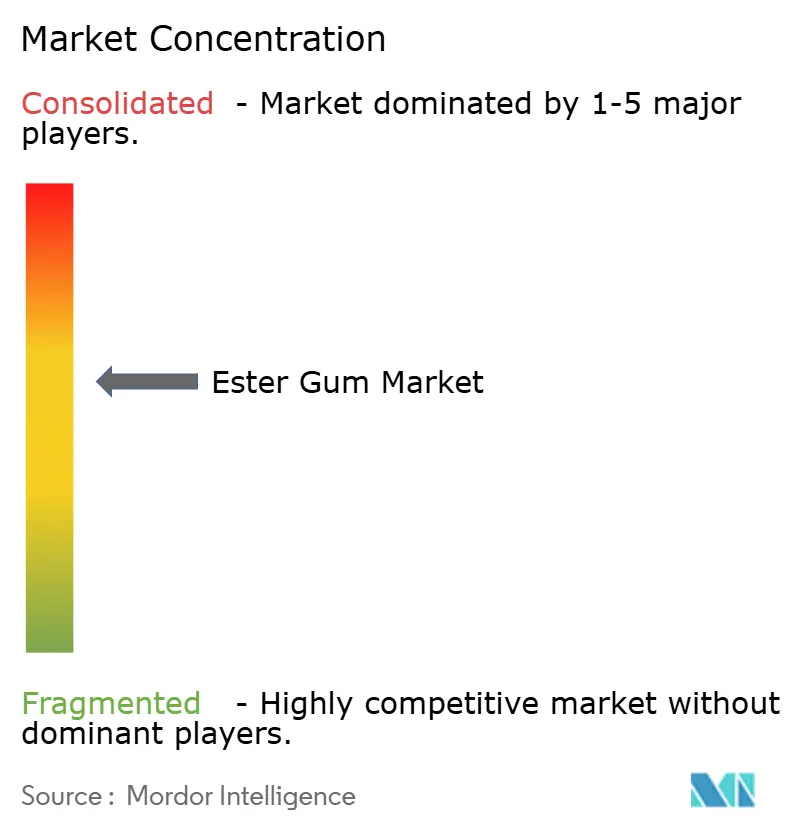
| Market Concentration | Medium |
Major Players *Disclaimer: Major Players sorted in no particular order Image © Mordor Intelligence. Reuse requires attribution under CC BY 4.0. | |
Ester Gum Market Analysis by Mordor Intelligence
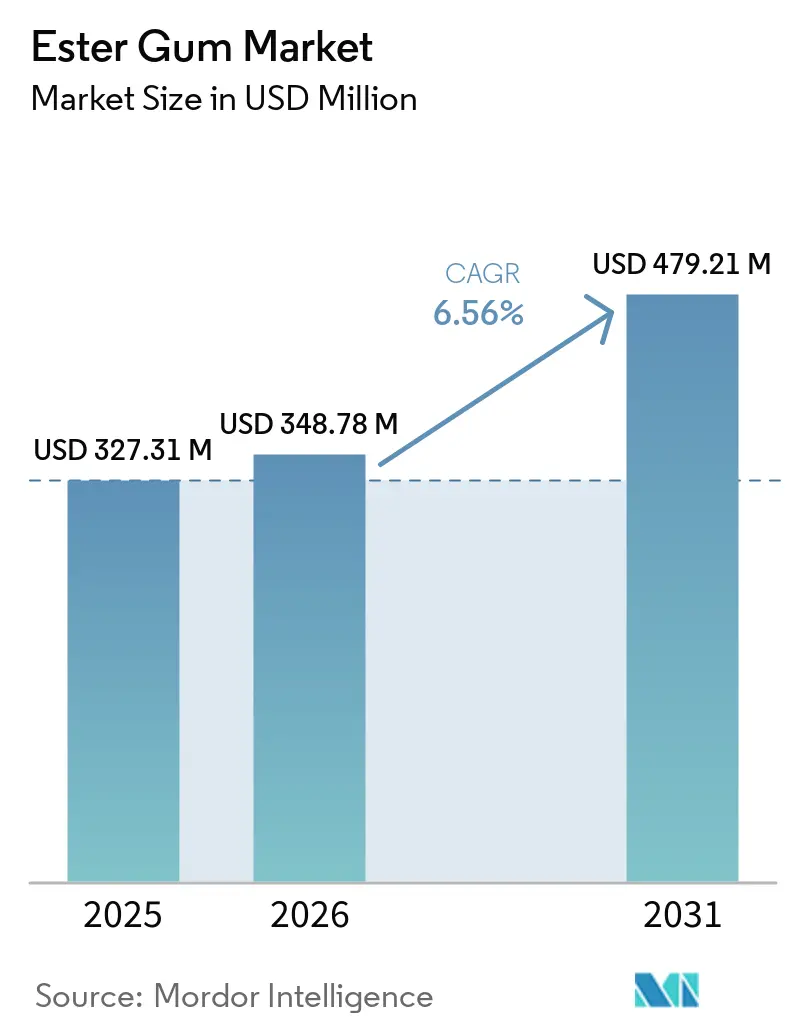
The Ester Gum Market size was valued at USD 327.31 million in 2025 and is estimated to grow from USD 348.78 million in 2026 to reach USD 479.21 million by 2031, at a CAGR of 6.56% during the forecast period (2026-2031). Growth is being propelled by the FDA’s 2024 revocation of brominated vegetable oil, the adhesives sector’s pivot toward bio-based tackifiers, and stricter VOC limits that are reshaping architectural coatings. Rising demand for cloud emulsifiers in citrus beverages, cost advantages created by biodiesel-derived glycerol, and China’s dominance in gum-rosin supply are reinforcing momentum across every major region. Competitive intensity is moderate, with the top five players holding about 66% of global sales and deploying vertical integration, rapid regulatory filing, and formulation customization to defend share. Despite periodic feedstock price swings, the ester gum market continues to benefit from a structural shift toward natural ingredients, an oversupply of low-cost glycerol, and expanding construction activity in Asia-Pacific.
Key Report Takeaways
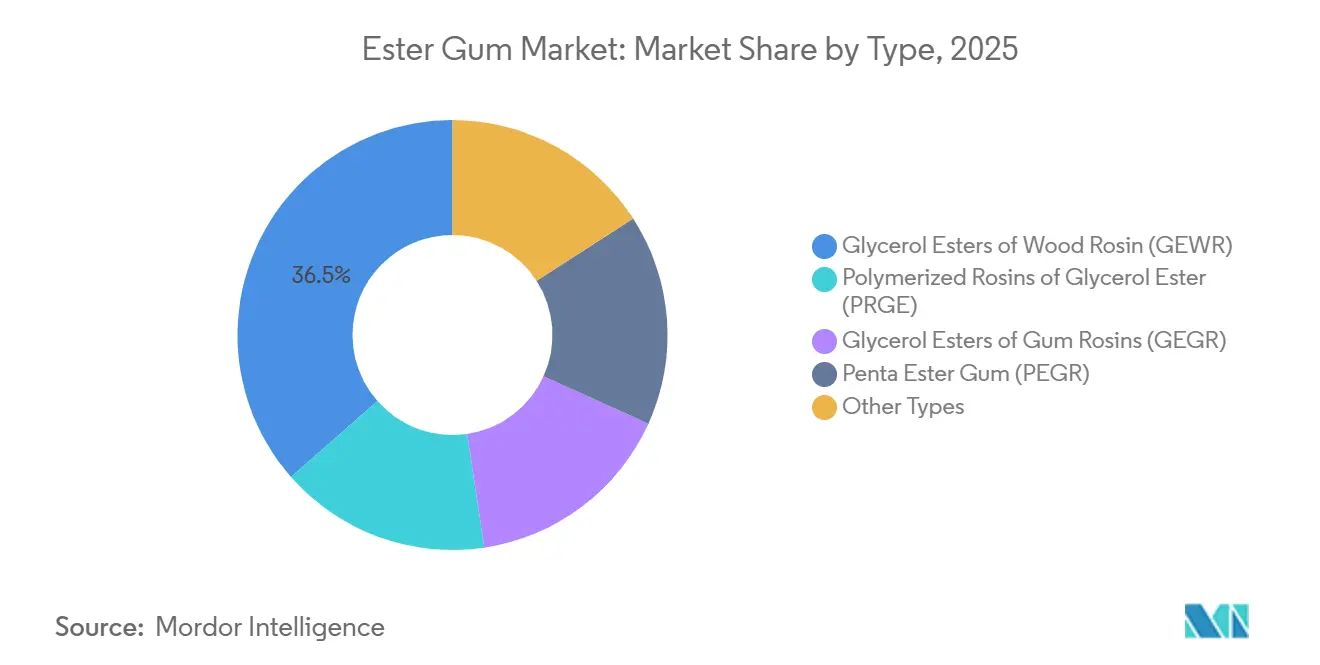
- By type, glycerol esters of wood rosin (GEWR) held 36.47% of ester gum market share in 2025, while penta ester gum (PEGR) is projected to post the fastest 6.74% CAGR through 2031.
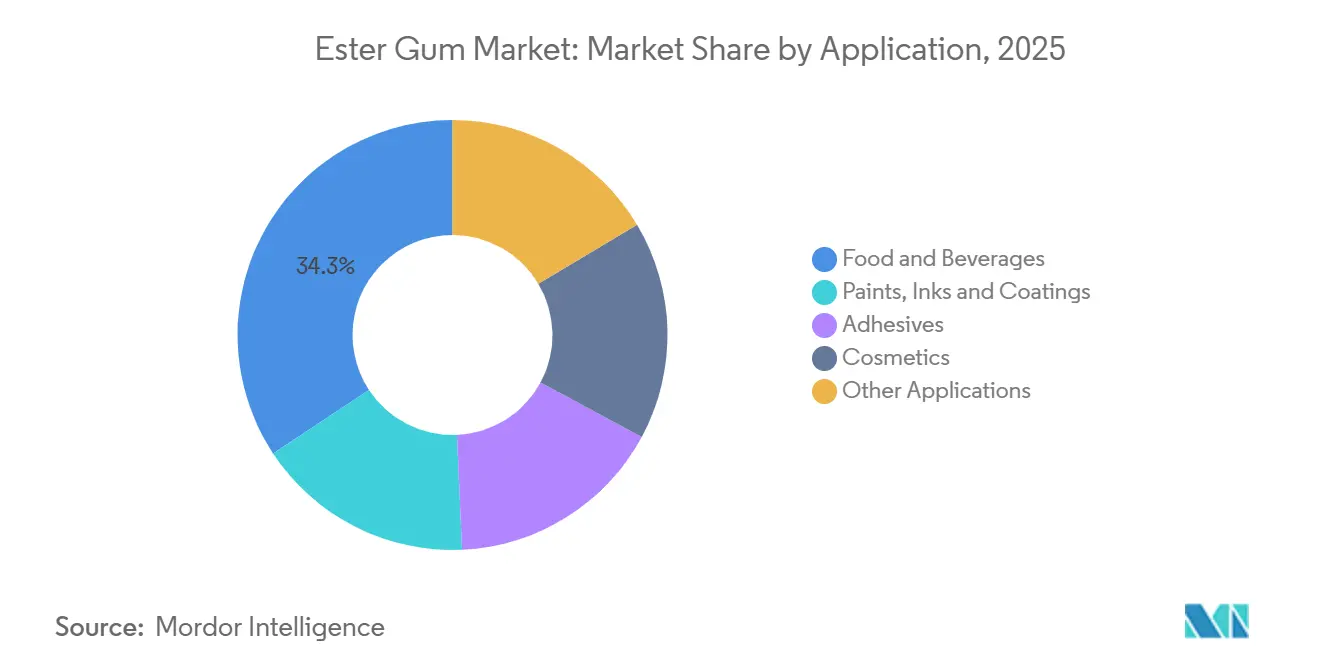
- By application, food and beverages accounted for 34.28% of ester gum market size in 2025, yet paints, inks and coatings are advancing at a 6.68% CAGR to 2031.
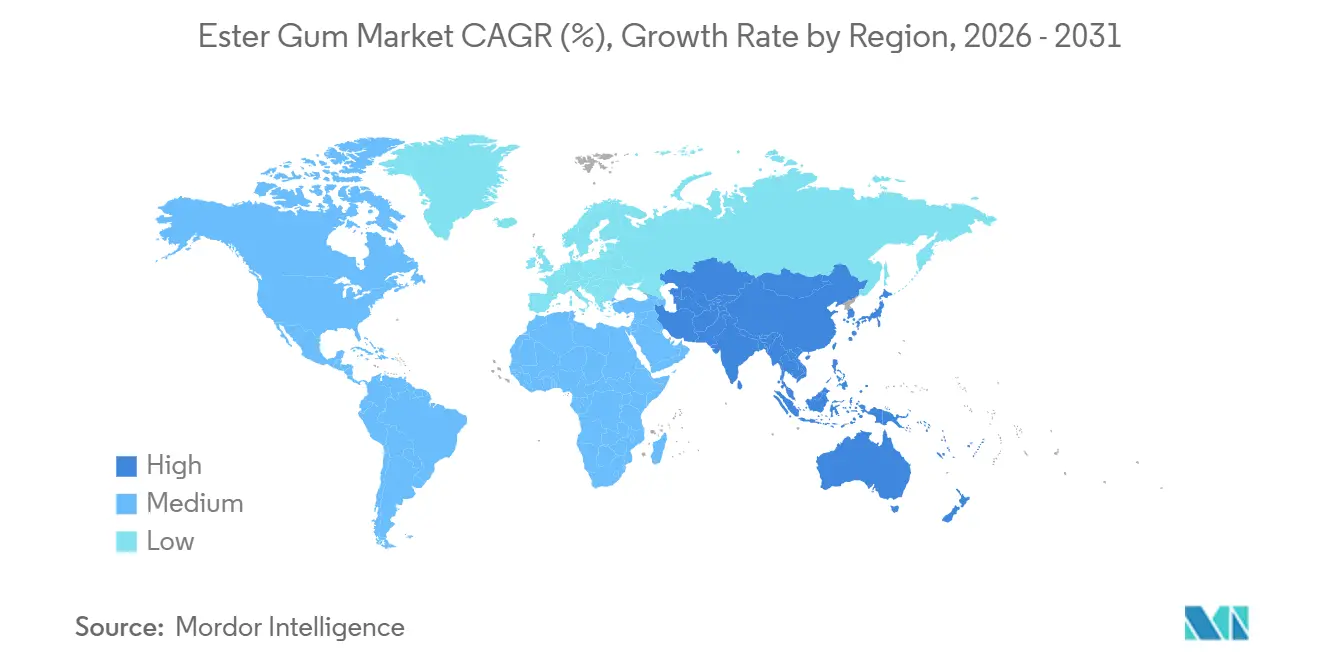
- By geography, Asia-Pacific commanded 48.36% of ester gum market share in 2025 and is set to grow at a 6.74% CAGR through 2031.
Note: Market size and forecast figures in this report are generated using Mordor Intelligence’s proprietary estimation framework, updated with the latest available data and insights as of January 2026.
Market Trends and Insights
Drivers Impact Analysis of Ester Gum Market*
| Driver | (~) % Impact on CAGR Forecast | Geographic Relevance | Impact Timeline |
|---|---|---|---|
| Demand for Bio-Based Tackifiers in Adhesives | +1.2% | Global, with APAC core and spill-over to North America | Medium term (2-4 years) |
| Growth of Sugar-Free and Functional Chewing Gum | +0.9% | North America and Europe, expanding to APAC urban centers | Medium term (2-4 years) |
| Regulatory Replacement of BVO in Beverages | +1.5% | North America (FDA mandate), Europe (EFSA compliance), Latin America following | Short term (≤ 2 years) |
| Expansion of Eco-Friendly Paints, Inks, and Coatings | +1.1% | Europe (VOC regulations), APAC (construction boom), North America (green building standards) | Long term (≥ 4 years) |
| Oversupply of Low-Cost Glycerol from Biodiesel | +0.6% | Global, concentrated in US, EU, Brazil, Argentina biodiesel hubs | Short term (≤ 2 years) |
| Source: Mordor Intelligence | |||
Demand for Bio-Based Tackifiers in Adhesives
Packaging and pressure-sensitive adhesive formulators are switching from petroleum hydrocarbon resins to glycerol esters of rosin to satisfy brand-owner sustainability mandates and mitigate crude-oil price risk. GEWR delivers comparable peel strength with 15-20% lower VOC emissions, a key benefit as the EU’s Industrial Emissions Directive tightens limits to 50 g/L for adhesive use by 2028. Arakawa Chemical’s Super Ester W-series, offering softening points of 85 °C–115 °C, is gaining traction on Asia-Pacific e-commerce packaging lines that demand rapid set and thermal stability. A 2025 USPTO filing by Eastman Chemical details a maleic-anhydride-modified glycerol-rosin ester that bonds effectively to polyethylene films, underscoring continuing R&D investment.
Growth of Sugar-Free and Functional Chewing Gum
Sugar-free and functional gum bases rely on ester gum for film formation and adhesion, with loadings of 50-85% in the finished base. In 2025, sugar-free variants captured 62% of chewing-gum sales in North America and Europe, while functional formats fortified with caffeine, vitamins, or CBD accelerated shelf rotation. Ester gum’s neutral taste and compatibility with high-intensity sweeteners allow rapid flavor release without the waxy mouthfeel of synthetic polyvinyl acetate. GRAS status under 21 CFR 172.735 permits up to 100 ppm in finished gum, reinforcing regulatory certainty in the United States.
Regulatory Replacement of BVO in Beverages
The FDA revoked brominated vegetable oil approval in July 2024, forcing citrus soft-drink and sports-beverage manufacturers to reformulate with glycerol ester of wood rosin. EFSA simultaneously confirmed a 10 mg/kg body-weight ADI for E 445, provided the rosin originates from Pinus palustris or P. elliottii, which favors traceable North American and select Asian suppliers. Beverage multinationals have locked in multi-year supply contracts that lifted spot ester gum prices by 8-12% compared with the pre-ban period.
Oversupply of Low-Cost Glycerol from Biodiesel
Renewable-fuel mandates generated about 1.2 million t of surplus glycerol in 2025, slicing spot prices to USD 300–350 per t and trimming ester gum variable costs by up to 15%[1]. Ingevity leverages agreements with biodiesel refiners in the US Southeast to capture this margin advantage and finance capacity debottlenecking projects. Although renewable diesel produces less glycerol per liter than conventional biodiesel, the present glut is expected to support margins for at least two more years.
Restraints Impact Analysis of Ester Gum Market*
| Restraint | (~) % Impact on CAGR Forecast | Geographic Relevance | Impact Timeline |
|---|---|---|---|
| Gum-Rosin Feedstock Price Volatility | -0.8% | Global, concentrated in China (Guangxi, Yunnan) and India (Odisha, Chhattisgarh) | Short term (≤ 2 years) |
| Stringent Environmental and Food-Additive Rules | -0.5% | Europe (EFSA species restrictions), North America (FDA traceability), APAC (FSSAI compliance) | Medium term (2-4 years) |
| Competition from Terpene/Hydrocarbon Resins | -0.4% | Global, with North America and Europe most exposed to synthetic-resin substitution | Long term (≥ 4 years) |
| Source: Mordor Intelligence | |||
Gum-Rosin Feedstock Price Volatility
Spot gum-rosin prices swung 18–22% during 2024-2025 because labor shortages disrupted tapping in China’s Guangxi province and erratic monsoons hurt yields in Odisha and Chhattisgarh. Non-integrated producers struggle to pass costs through, risking contract losses to vertically integrated rivals such as Arakawa Chemical, which sources more than half of its rosin from owned forestry units.
Stringent Environmental and Food-Additive Rules
EFSA’s 2023 rule limiting E 445 feedstock to two pine species raised traceability and testing costs by USD 50–80 per t[2]. Small and mid-size producers that previously blended multiple varieties must now invest in DNA testing and chain-of-custody audits, raising entry barriers. Similar scrutiny under the U.S. Food Safety Modernization Act and India’s FSSAI alignment with Codex standards compounds compliance costs, shaving off forecast CAGR through 2029.
*Our forecasts treat driver/restraint impacts as directional, not additive. The impact forecasts reflect baseline growth, mix effects, and variable interactions.
Ester Gum Market Segment Analysis
By Type:
GEWR Dominates, PEGR Gains in Specialty CoatingsGlycerol esters of wood rosin (GEWR) secured 36.47% of ester gum market share in 2025 thanks to dual food and industrial approvals that simplify global sourcing. GEWR’s cost advantage over polymerized alternatives anchors its position, while gum rosin derivatives continue to support the ester gum market size for penta ester gum (PEGR), which is projected to expand at a 6.74% CAGR as coatings formulators demand 110 °C–130 °C softening points that improve sag resistance in water-borne systems. The ester gum market size for polymerized rosins remains limited to high-temperature adhesives because the added polymerization step inflates unit cost by up to 20%. R&D investment is migrating toward hybrid rosin-terpene esters that fuse UV resistance with the tackifying strength of glycerol esters, a path highlighted by Eastman and Kraton patent filings in 2024-2025.
PRGE and GEGR together remain entrenched in automotive refinish coatings and premium gum bases, respectively. Experimental “other types,” including maleic-modified and hybrid resins, are poised for above-average growth as PSA formulators pay premiums for resins that eliminate separate UV stabilizers.

By Application:
Beverages Drive Volume, Coatings Lead GrowthFood and beverages held 34.28% of ester gum market size in 2025 after the North American BVO ban moved 8 000–10 000 t of annual demand to GEWR. Yet paints, inks and coatings are set to outpace the overall ester gum market at a 6.68% CAGR through 2031 on the back of Asia-Pacific construction expansion and Europe’s 2028 VOC limits. Adhesives represented moderate usage, propelled by e-commerce packaging volumes that grew 11-13% per year in India, Indonesia, and Vietnam. Cosmetics are advancing as clean-beauty labels adopt glyceryl rosinate, benefitting from its FDA food-contact approval and clean-label eligibility. Other applications deliver steady low-single-digit growth, supported by procurement policies that prioritize bio-based inputs.
Geography Analysis
APAC Ester Gum Market
Asia-Pacific captured 48.36% of ester gum market share in 2025 and is projected to grow at a 6.74% CAGR through 2031 as China supplies over 60% of global rosin and builds localized esterification capacity. India’s demand is accelerating due to beverage reformulation and a surge in packaging adhesives tied to booming e-commerce logistics. Japan and South Korea pay premiums for specialty low-color or high-softening-point grades, reinforcing margins for regional producers such as Arakawa Chemical. Southeast Asian joint ventures allow Chinese firms to bypass tariff risk and shorten lead times.
North America and Europe Ester Gum Market
North America’s demand is anchored by beverage reformulation and bio-based hot-melt adhesives. Eastman Chemical and Ingevity dominate through vertical integration and established customer ties. Mexico acts as a re-export platform under USMCA rules, shipping USD 27.2 million of ester gum in 2023 to the United States, Turkey, and Poland. Europe faces margin pressure from imported feedstock and stringent EFSA compliance, yet gains from leadership in low-VOC coatings that target green-building certifications.
South America and Middle East Ester Gum Market
In South America, Brazil’s biodiesel-driven glycerol surplus could enable backward integration, though limited rosin supply keeps the region a net importer. Vision 2030 infrastructure projects in Saudi Arabia and the UAE spur adhesive and coating demand, while government procurement favors bio-based inputs, helping the ester gum market penetrate new verticals.
Regulatory Landscape
Regulatory requirements for ester gum (E 445/INS 445) cover food-additive specifications, chemical-safety registrations, and application-specific labeling. In the United States, glycerol ester of gum rosin is regulated for food use under 21 CFR 172.615 and 21 CFR 172.735, and FDA listing in its food-substances database supports compliance for beverage and chewing-gum uses. U.S. food-safety controls, including FSMA-driven traceability expectations, further increase the emphasis on supplier qualification and batch documentation.
In Europe, compliance is shaped by EFSA re-evaluation and EU chemical controls. EFSA has maintained an ADI framework for E 445 tied to defined wood-rosin sources (Pinus palustris and Pinus elliottii in the report scope), which raises chain-of-custody and testing needs. The European Chemicals Agency (ECHA) manages rosin-derivative substance records under REACH (EC 1907/2006), reinforcing registration, classification, and labeling obligations across industrial uses such as adhesives, inks, and coatings. Internationally, FAO/WHO JECFA recognizes INS 445 with ADI guidance and compositional specifications, which encourages producers to tighten analytical verification of resin-acid ester profiles for global market access.
Value Chain Analysis
The ester gum value chain starts with rosin feedstocks (gum rosin, wood rosin, and tall oil rosin) and glycerol supply, then moves through esterification, purification, and downstream qualification for food and industrial applications. Rosin sourcing is a primary cost lever, accounting for roughly 50-65% of finished resin cost in typical structures, which makes integration into pine-chemicals and forestry supply (or long-term rosin procurement) a key advantage for larger suppliers. Biodiesel-linked glycerol availability also affects conversion economics when low-cost glycerol is available.
Manufacturing involves esterification at high temperatures, commonly cited in the 260-280 C range for GEWR processes, followed by application-driven purification steps such as steam stripping or steam distillation to meet taste, odor, and compositional targets for chewing gum and beverage-emulsion grades. Quality control and regulatory documentation, including food-additive specifications, low-color requirements, and traceability aligned with EFSA and FDA expectations, extend lead times. Customer qualification can take months, which limits rapid supplier switching during feedstock disruptions. Distribution typically runs from producers to regional warehouses and specialty chemical or ingredient distributors, then to formulators in beverages, gum base, adhesives, inks, coatings, and cosmetics. Performance tuning, including softening point, acid value, and color, is often completed at the producer stage to match customer formulations.
Competitive Landscape
The top five suppliers - Arakawa Chemical, Eastman Chemical, Ingevity, Kraton, and DSM-Firmenich - held an estimated 66% of global revenue in 2025, leaving room for regional specialists in China and India. Feedstock integration shields margins; Arakawa Chemical sources more than 50% of its rosin internally, while Ingevity leverages pine-chemicals operations in the US Southeast. Regulatory agility is equally decisive as early EFSA or FDA approvals secure premium beverage contracts. Formulation tailoring remains the third axis of competition, with suppliers adjusting acid value, softening point, and Gardner color to match specific adhesive or coating chemistries.
Patent filings reveal an industry shift toward hybrid rosin-terpene esters that combine tack and UV resistance. Eastman’s 2025 USPTO application describes a maleic-anhydride-modified GEWR that bonds to polyethylene, targeting flexible packaging. Kraton’s filing covers a rosin-polyterpene blend that eliminates the need for separate UV stabilizers in PSA formulas. Biodiesel refiners are exploring backward integration to monetize surplus glycerol, a potential new layer of competition that could compress margins for non-integrated players.
Ester Gum Industry Leaders
-
Eastman Chemical Company
-
Arakawa Chemical Industries,Ltd.
-
dsm-firmenich
-
Kraton Corporation
-
Ingevity Corporation
- *Disclaimer: Major Players sorted in no particular order
Ester Gum Market Companies Covered in this Report
- Arakawa Chemical Industries,Ltd.
- dsm-firmenich
- Eastman Chemical Company
- Finjetchemical Industries
- Florachem
- Foreverest Resources Ltd
- Foshan Baolin Chemical Industry Co. Ltd
- Grupo RB
- Guangdong Komo Group Co., Ltd.
- Ingevity Corporation
- Jubilant
- Kraton Corporation
- LAWTER
- Mangalam Organics Limited
- PT. INDOPICRI
- Shree Resins
- The Cary Company
- Uniform Synthetics
- Wuzhou Sun Shine Forestry & Chemicals
Market Opportunities and Future Outlook
An opportunity remains in compliant beverage reformulation and broader emulsion-stabilization demand as manufacturers replace brominated vegetable oil in citrus beverages with glycerol esters of wood rosin, strengthening pull-through for high-purity, low-odor, and low-color grades. This connects directly to the FDA revocation of BVO approval in July 2024 and EFSA positioning for E 445 tied to defined pine species, which increases the value of traceable supply and robust analytical packages. Suppliers that can provide documentation aligned with JECFA specifications and region-specific requirements (FDA and EFSA) are positioned to win premium programs, particularly where qualification cycles are long and switching costs are high.
In industrial end uses, adhesives and architectural coatings moving toward lower-VOC formulations and bio-based tackifiers create room for rosin-esters engineered for specific performance windows, including higher softening points, improved UV resistance, and compatibility with water-borne systems. The report context points to EU VOC tightening, including a 50 g/L direction for adhesive use by 2028, alongside ongoing product and IP work by established players on modified rosin esters and hybrid rosin-terpene approaches. This supports a differentiation pattern centered on formulation performance rather than pure commodity pricing. On the supply side, vertically integrated pine-chemicals footprints and investments that stabilize rosin procurement, including Southeast Asian feedstock access models, also create scope for longer-term contracts to beverage and PSA customers that need continuity amid rosin price volatility.
Recent Industry Developments in Ester Gum Market
- June 2026: Eastman announced price increases effective June 1, 2026 for several ester products (including n-Butyl Acetate, n-Propyl Acetate, and PM Acetate) in North America and Latin America. While not specific to ester gum grades, the move signaled tighter conditions and repricing across parts of the ester value chain used by coatings and adhesive customers. The increases also reinforced the importance of cost pass-through mechanisms for formulation suppliers operating under VOC and performance constraints.
- March 2026: Arakawa Chemical Industries established a joint venture in Vietnam, Arakawa Forest Technology Vietnam, with Meiwa Corporation to stabilize procurement of raw pine resin for resin development. Securing upstream pine-resin access supports continuity for rosin-derivative output and reduces exposure to feedstock disruptions. The Vietnam platform also strengthens regional supply options for Asia-Pacific customers, where localized lead times and tariff risk management are increasingly important.
- March 2024: Grupo RB acquired Pinopine, a Portuguese producer of gum rosin derivatives. The acquisition strengthened RB's position across rosin-derivative supply and broadened product coverage for customers sourcing tackifiers and related pine-chemical intermediates. Greater control over derivative capacity and portfolios can influence supplier qualification choices for European and export-oriented buyers that require consistent specs and documentation.
Ester Gum Market Report Scope and Research Methodology
Market Definition and Coverage
For this study, the ester gum market covers the value of rosin-based esterified resins sold for use as tackifiers and stabilizers in end products, counted at the point of commercial sale and reported in USD.
Scope exclusions: We exclude unmodified rosin traded without esterification and non-rosin synthetic tackifier resins that can be substituted in some formulations.
Segments Covered in This Report
- By Type
- Glycerol Esters of Wood Rosin (GEWR)
- Polymerized Rosins of Glycerol Ester (PRGE)
- Glycerol Esters of Gum Rosins (GEGR)
- Penta Ester Gum (PEGR)
- Other Types
- By Application
- Food and Beverages
- Paints, Inks and Coatings
- Adhesives
- Cosmetics
- Other Applications
- By Geography
- Asia-Pacific
- China
- India
- Japan
- South Korea
- Malaysia
- Thailand
- Indonesia
- Vietnam
- Rest of Asia-Pacific
- North America
- United States
- Canada
- Mexico
- Europe
- Germany
- United Kingdom
- France
- Italy
- Spain
- NORDIC Countries
- Rest of Europe
- South America
- Brazil
- Argentina
- Colombia
- Rest of South America
- Middle-East and Africa
- Saudi Arabia
- South Africa
- Nigeria
- Egypt
- United Arab Emirates
- Rest of Middle-East and Africa
- Asia-Pacific
Data Sources, Market Sizing, and Validation
Desk Research
Desk research was used to build the backbone of the model and to set realistic boundaries around what is counted as ester gum. Public sources such as US FDA food additive updates, USITC trade statistics, UN Comtrade, World Bank macro indicators, and national customs tariff schedules helped us map trade flows, end-use signals, and country-level demand context.
We also reviewed manufacturer technical datasheets, safety data sheets, product catalogs, investor presentations, and audited filings to understand typical product forms, use cases, and price movement patterns over time. A paid subscription for company financials and intelligence, plus an import-export shipment-level database, was used selectively to cross-check where supply is concentrated and how volumes appear to move by region. The sources listed here are illustrative, and many other public references were also used for data collection, validation, and clarification during the work.
Primary Interviews and Surveys
Primary work focused on interviews and short surveys with producers, distributors, formulators, and downstream users across food and beverage, adhesives, and inks and coatings, so assumptions could be pressure-tested in plain business terms. We used these conversations to validate the split between rosin sources, to sanity-check typical pricing bands, and to confirm whether regulation-led reformulations were already showing up in ordering patterns across key regions.
Distribution of primary research fieldwork respondents
| Company type | Respondent position | Region |
|---|---|---|
| Top tier: 29% | CXOs: 14% | APAC: 47% |
| Mid tier: 55% | Functional/Unit leaders: 29% | EMEA: 34% |
| Smaller Players: 16% | Managers: 57% | Americas: 19% |
Market-Sizing & Forecasting
Sizing starts from a top-down build where production, trade, and consumption indicators are used to reconstruct the addressable demand pool for ester gum by major region, and then values are expressed in USD using consistent timing assumptions. Once that structure is in place, results are checked using selective bottom-up approximations such as sampled supplier and distributor revenue cues, channel checks on typical order sizes, and an ASP times volume approach for a few high-visibility lanes, which then helps us adjust totals when a region looks over-stated or under-stated.
Key inputs in the model include rosin availability signals (wood rosin versus gum rosin), import-export trends for rosin-derived resins, demand markers in beverages and confectionery that use stabilizers, adhesives and sealants activity, and inks and coatings output where tackifiers are used. Because price movement can shift the value outcome quickly, we also track common pricing drivers such as feedstock rosin pricing direction, regional mix, and grade preferences shared during interviews. Forecasts were built using scenario analysis supported by expert views on substitution risk, regulation-led reformulation pace, and capacity additions, and then the yearly path was smoothed so growth is not shown as unrealistic spikes. Where bottom-up visibility is weaker in smaller countries, gaps are handled through regional proxies tied to trade intensity and downstream output, and then re-checked with primary inputs before finalizing.
Data Validation & Update Cycle
Validation is done by comparing model totals against independent signals that should move in the same direction, such as trade totals, downstream output trends, and the share of demand coming from major consuming industries. If a country-level number looks out of line, the drivers are rechecked, and we may re-contact a respondent to confirm whether the issue is pricing, scope, or timing.
Before sign-off, the model and assumptions go through multi-step analyst reviews, with variance checks at the region and global level so errors do not pass through silently. Reports are refreshed annually, and interim updates are made when there is a material event that can change demand or pricing quickly. Right before delivery, a fresh pass is completed so clients receive the latest updated view rather than an older snapshot.
Mordor Intelligence's Ester Gum Market Size Measured Against Other Published Estimates
It is normal to see different market sizes for ester gum across published sources, even when the topic name looks the same. The gaps usually come from what each publisher counts inside the product boundary, which year is treated as the reference point, and how price and volume are translated into a single USD value.
By tracking timing of price inputs and trade-linked demand signals, Mordor Intelligence keeps the 2026 value tied to rosin-derived ester gum sales only, which can look smaller than estimates that bundle adjacent tackifier resins or use a different year endpoint. A second driver is forecasting style, because some sources present a year-end projection as a current value, and some assume faster adoption in food, adhesives, or inks without rechecking the pace with industry respondents.
Benchmark comparison
| Source | Market Size | Gaps in Research Methodology |
|---|---|---|
| Mordor Intelligence | USD 348.78 M (2026) | |
| Global Consultancy A | USD 1.33 B (2025) | Uses a broader market framing that appears to include multiple rosin-based tackifier resin families beyond ester gum, which inflates the value when compared with a narrower product-only definition. The reference year is also earlier, and the pricing basis and currency timing are not clearly explained on the public summary. |
| Industry Publisher B | USD 0.80 B (2025) | Reports a higher 2025 number that likely counts a wider set of grades, forms, or distribution layers, and it presents limited detail on how regional trade and end-use demand checks were used to prevent double counting. Its growth path also starts from a different base year, which shifts the curve even when end-demand is similar. |
The comparison shows that most of the spread can be explained by scope choices and by whether the reported year is a true market value or a projected endpoint. Our approach stays traceable because the value is anchored to a defined rosin-ester product boundary, then checked against trade signals, end-use activity, and interview-based reality checks before the final total is locked.
Key Questions Answered in the Report
What is the size of the Ester Gum market?
The Ester Gum market size stands at USD 348.78 million in 2026 and is projected to reach USD 479.21 million by 2031, at a CAGR of 6.56%.
What factors drove the ester gum market size past USD 340 million in 2026?
Regulatory replacement of BVO, bio-based adhesive demand, and stricter VOC limits in coatings together lifted sales to USD 348.78 million in 2026.
How will Asia-Pacific influence future demand?
Asia-Pacific holds 48.36% share and should maintain a 6.74% CAGR because China supplies low-cost rosin while regional construction and beverage markets expand.
Why are beverages a key application despite slower growth?
The 2024 BVO ban forced nearly universal GEWR adoption in citrus drinks, making beverages the single largest volume consumer even as coatings grow faster.