
EMEA Satellite Antenna Market Size and Share
| Study Period | 2019 - 2030 |
| Forecast Data Period | 2025 - 2030 |
| Historical Data Period | 2019 - 2023 |
| Market Size (2025) | USD 1.23 Billion |
| Market Size (2030) | USD 2.07 Billion |
| CAGR (2025 - 2030) | 10.93% |
| Market Concentration | Medium |
Major Players *Disclaimer: Major Players sorted in no particular order |
EMEA Satellite Antenna Market Analysis by Mordor Intelligence
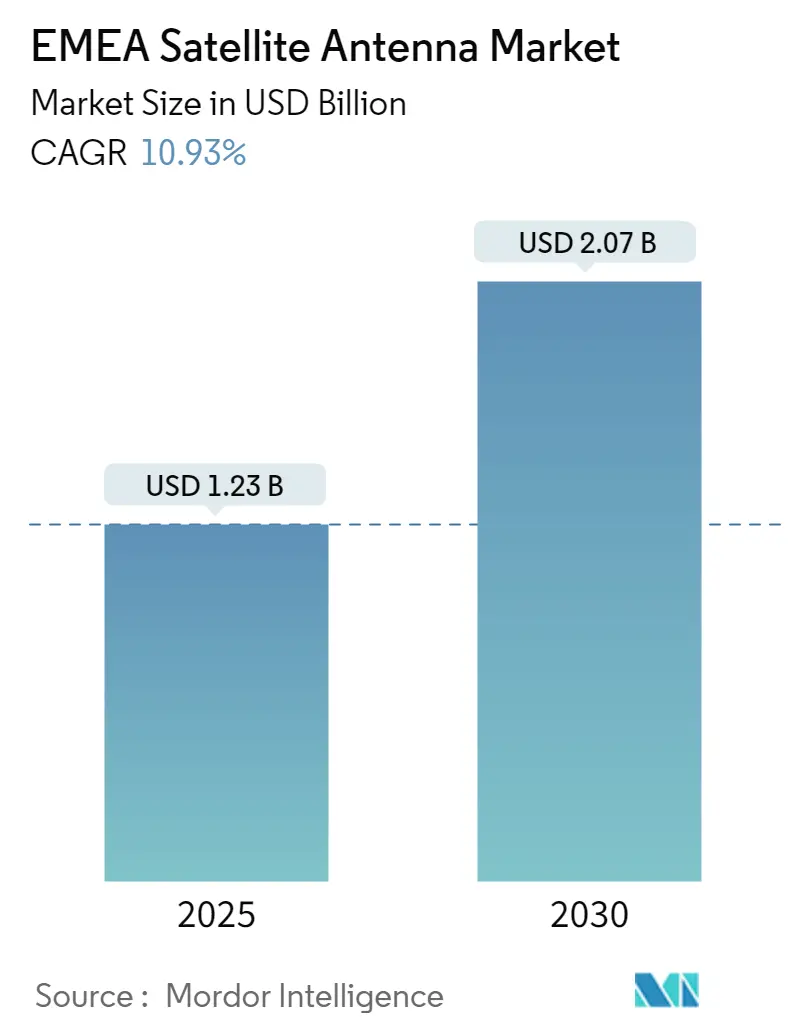
The EMEA Satellite Antenna Market size is estimated at USD 1.23 billion in 2025, and is expected to reach USD 2.07 billion by 2030, at a CAGR of 10.93% during the forecast period (2025-2030).
- The EMEA satellite antenna market is experiencing significant growth, driven by the growing demand for high-speed wireless connectivity. This demand is significantly increasing with the deployment of 5G and the anticipation of 6G networks. 5G satellite communication supports improving mobile broadband services. This technology is used in mission-critical communications that provide low latency and uninterrupted network availability for applications like autonomous vehicles, remote control of critical infrastructure, etc.
- The market is witnessing advancements like flat panels, interoperable, and mobile communication. The rising adoption of electronically steered antennas (ESA) in aerospace and defense presents lucrative growth avenues for industry participants. In March 2024, Hanwha Phasor, a UK-based satellite communications company, announced the upcoming Phasor L3300B land antenna for mobile communications. The Phasor L3300B, an active electronically steered antenna (AESA), is tailored for commercial and military applications. Its main feature is maintaining seamless communication since it facilitates dual simultaneous receive channels. This allows the antenna to establish connections with new satellites without interrupting its current link.
- According to the 5G Infrastructure Public Private Partnership (PPP), a joint initiative by the European Commission and the European ICT Industry, Europe was midway through its 5G journey in 2023. While 5G coverage reached 72% penetration, it is important to note that this figure includes non-standalone deployments. However, the full-scale commercial implementation of 5G, especially in industrial settings, is still on the horizon, promising significant revenue potential.
- As per the GSMA report 2024, many new 5G markets, primarily in developing regions such as Africa (highlighting Ethiopia and Ghana), are set to launch their networks. Moreover, 5G adoption in sub-Saharan Africa was under 1% in 2023; projections indicate a substantial rise, aiming for 17%, catering to 234 million connections by 2030.
- The market faces challenges from the high costs of phased array and electronically steered antennas, alongside regulatory hurdles limiting antenna growth. Meeting regulatory standards and obtaining licenses poses a challenge for manufacturers, particularly for companies operating across diverse regulatory landscapes. Adhering to these standards not only adds complexity but also increases costs for antenna manufacturers.
- The pandemic accelerated the shift toward remote and hybrid work, amplifying the need for reliable internet connectivity for managing work even from remote areas. Additionally, the rise of telehealth services that require robust communication networks is well supported by satellite technologies.
Worldwide, activity is shaped by contributions from multiple regions, with EMEA representing one of the more structurally developed among them. The global report on satellite antenna market by Mordor Intelligence reflects how these regional layers combine into a single system.
EMEA Satellite Antenna Market Trends and Insights
The Segment for Flat-panel Antennas is Expected to Witness the Highest CAGR
- Due to their compact size and advanced technology, there is a growing demand for flat-panel antennas in the EMEA region. They are used in marine connectivity to facilitate high-speed Internet and communication service to ships and offshore platforms. These antennas are compact and less susceptible to motion and harsh maritime environments, which ensures reliable connectivity.
- Europe's military operations increasingly rely on satellite communications (SatCom) and communication and information system services (CIS) for their communication, command, and control needs. These services facilitate the connection of EU commanders with forces in remote regions, allowing efficient mission and task management. Flat-panel antennas are pivotal, ensuring secure, high-bandwidth communications vital for tactical operations.
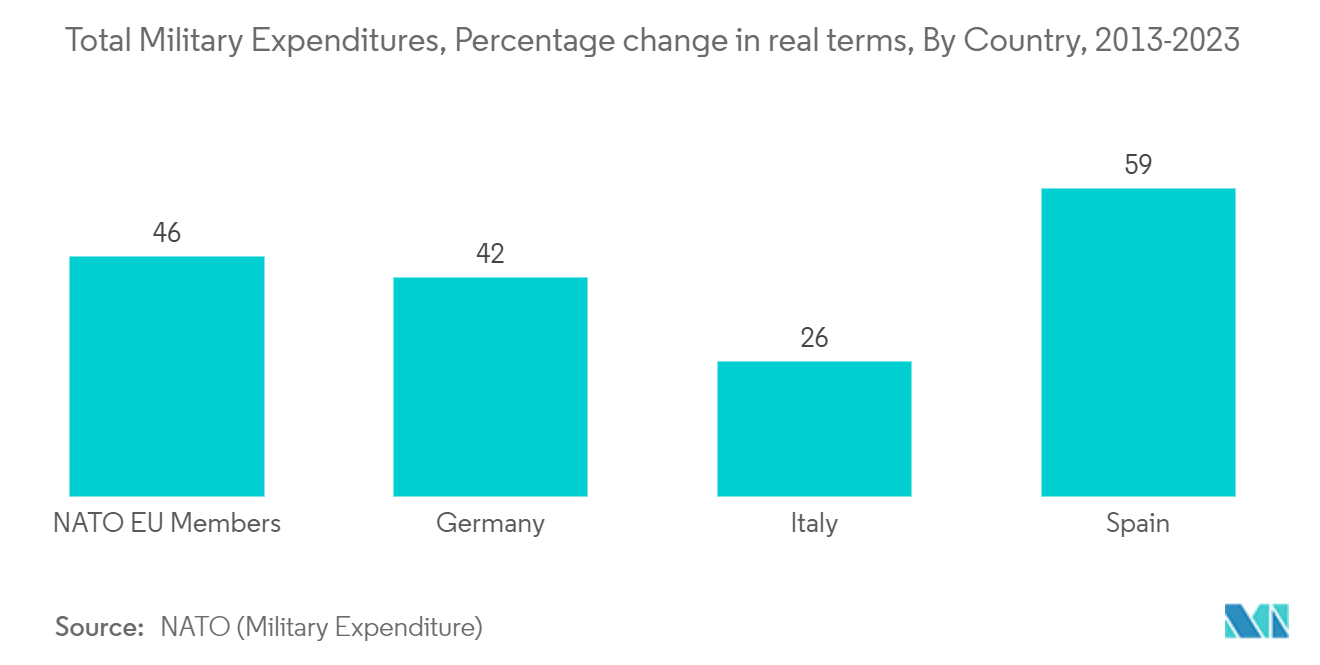
- According to NATO, military expenditures increased by 46% in EU countries during the last 10 years, four times faster than national income. Countries like Germany, Italy, and Spain witnessed increased allocation of resources to bolster their military capabilities, embrace new technologies, and enhance military-related infrastructures.
- Many market players are investing in developing solutions for improving satellite military communication. For instance, in January 2023, the Belgian Ministry of Defence announced a 15-year deal with Airbus for tactical satellite communication services. Under this agreement, the Armed Forces will leverage Airbus's UHF (Ultra High Frequency) military communication channels, which are part of a payload hosted on a commercial telecommunications satellite crafted by Airbus.
- Flat panel antennas allow extending internet connectivity to rural and underserved areas. They can provide broadband access in areas that do not support infrastructures. Many NGOs and government authorities in Africa are deploying flat panel antennas to deliver internet services to remote villages and schools. They also facilitate media companies operating in the EMEA region to take advantage of flat panel antennas, which allow live broadcasting from remote locations, such as featuring crucial news events, sports events, or outdoor productions efficiently.
- Satellite flat-panel antennas stand out for their capacity to surmount geographical obstacles, ensuring dependable connectivity in remote or demanding settings where conventional infrastructure proves unfeasible or too costly. These antennas leverage satellite communications as a crucial link for communities and industries in locales with scant terrestrial coverage, including rural zones, offshore platforms, and disaster-affected regions.
Germany Holds the Largest Market Share
- Germany has a strong aerospace and satellite communication industry. The country is supported by several manufacturers, service providers, and technology companies. This is majorly driven by the increasing demand for satellite communication services across various sectors, which include telecommunication, broadcasting, defense, and research.
- The demand for broadband communications is growing in Germany. This demand drives the need for connectivity among users on aircraft, ships, and vehicles, including first responders. These platforms necessitate uninterrupted connectivity throughout their journeys, often traversing underserved areas within major cities and sparsely populated regions. These trends are expected to bolster the market's growth prospects.
- German companies are increasingly turning to modern solutions to enhance their offerings. For instance, in July 2023, European Space Imaging (EUSI), Europe's provider of Very High Resolution (VHR) satellite imagery, made a significant investment in its ground station at the German Aerospace Center (DLR) near Munich. This upgrade not only enhanced EUSI's image delivery speed and efficiency but also cemented its reputation as a leading provider of satellite imagery technology in Europe.
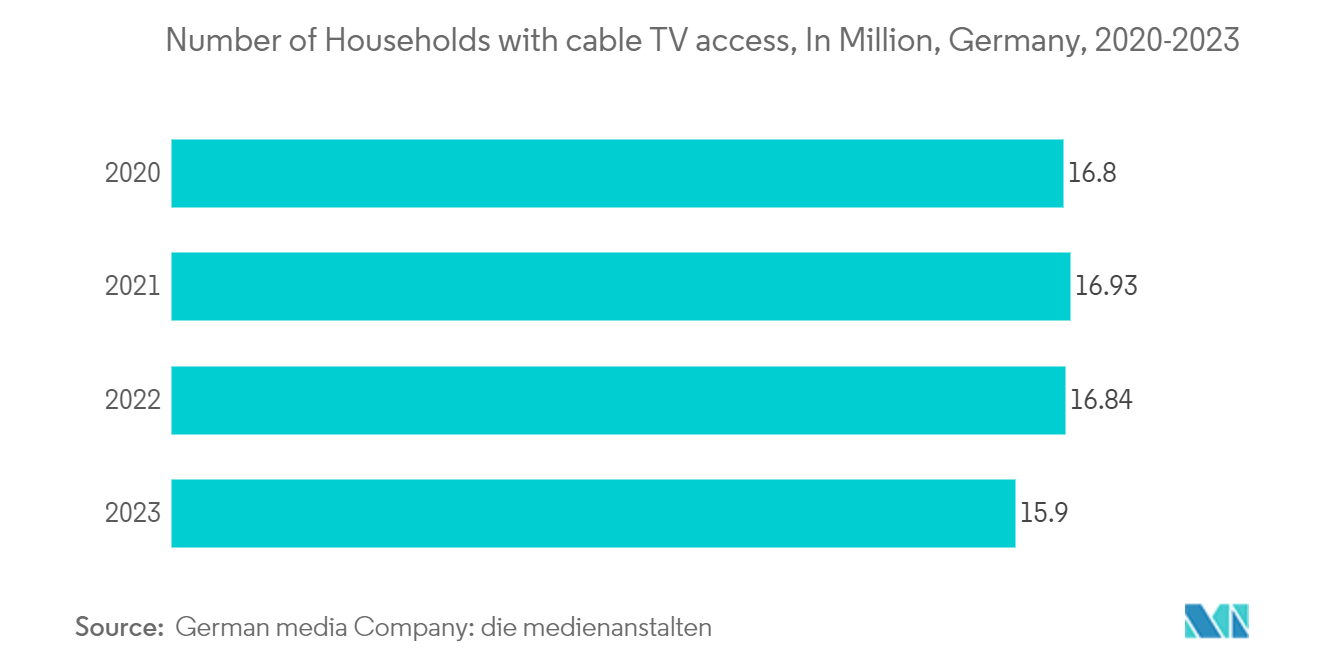
- According to Die Medienanstalten (German Media company), DTH satellite and cable TV continue to be the primary TV reception methods in Germany. DTH satellite TV service is consumed by 16.4 million households, accounting for 42% of all TV households, a marginal decrease from 43% in 2022. A cable TV subscription was used by 15.9 million households, corresponding to 41% penetration (2022: 43%), propelling the market for satellite antennas in the country.
- Additionally, companies such as HughesNet, Viasat, and other emerging LEO satellite providers like Starlink offer internet services via satellite, enabling streaming of OTT content in remote areas. As per data, TV reception via the Internet (OTT) was opted by 3.1 million households in 2023, an increase from 6% to 8% of households compared to 2022.
- Germany's Bundeswehr, the country's armed forces, announced plans for an independent multi-satellite communications system. On November 9, 2023, German Defense Minister Boris Pistorius emphasized the nation's need to mature in its security policies. In addition to its standalone system, Germany aims to align its military needs with the EU's upcoming IRIS² (Infrastructure for Resilience, Interconnection & Security by Satellites) satcom constellation, particularly leveraging its LEO (low-Earth orbit) services.
Competitive Landscape
The EMEA satellite antenna market is semiconsolidated , with local and international players having decades of experience. The vendors are incorporating a powerful competitive strategy by leveraging their expertise. Overall, the intensity of the competitive rivalry is high in the market, and it is expected to remain the same over the forecast period.
April 2024: Hughes Network Systems, LLC (HUGHES), a subsidiary of EchoStar, unveiled the Hughes HL1120W Terminal. Based on the electronically steerable antenna (ESA) technology, this terminal secured operational approval from Eutelsat OneWeb for its low Earth orbit (LEO) satellite network. This endorsement marked a significant achievement for Hughes, empowering the company to extend Eutelsat OneWeb's top-tier, high-speed connectivity to a global clientele.
January 2024: Eutelsat OneWeb, a division of the Eutelsat Group and integrated GEO-LEO satellite operator, along with STC Group, a key player in digital transformation, announced their final preparations for launching commercial services from their Tabuk ground station in Saudi Arabia. This ground station, situated in Tabuk and developed in collaboration with Albabtain LeBlanc, a prominent Saudi Arabian construction firm, boasts 15 advanced satellite tracking antenna systems. It is poised to significantly enhance communication services, particularly for Eutelsat OneWeb's low-Earth orbit (LEO) connectivity offerings in the Middle East.
EMEA Satellite Antenna Industry Leaders
-
Honeywell International Inc.
-
Communications & Power Industries (CPI) International Inc.
-
L3harris Technologies Inc.
-
Thales Group
-
Hughes Network Systems, LLC
- *Disclaimer: Major Players sorted in no particular order
.webp "EMEA Satellite Antenna Market Concentration")
Recent Industry Developments
- May 2024: Viasat and Azercosmos announced plans to bolster their satellite services, targeting the EMEA and Asian regions. Azercosmos, the satellite operator from Azerbaijan, teamed up with Viasat to enhance connectivity within Azerbaijan and extend these services to its regional partners. Their joint efforts are set to bolster satellite services, specifically tailored to bolster operations in the energy, utilities, and transport sectors across Africa, the Middle East, Europe, and Central and South Asia. This collaboration enables Azercosmos and Viasat to offer enhanced connectivity solutions, catering to a spectrum of industrial applications, allowing organizations to function more efficiently, sustainably, and securely, even in the most remote locations.
- June 2023: Kymeta unveiled an innovative flat-panel antenna tailored to OneWeb's maritime clientele. This antenna marked a significant milestone as the first company to launch a flat-panel offering to cater to OneWeb's LEO network in the maritime domain. Leveraging OneWeb's robust enterprise connectivity, this innovation ensures that all classes of large vessels, spanning from superyachts to commercial fishing and shipping vessels, allow seamless connectivity at sea.
EMEA Satellite Antenna Market Report Scope
The EMEA satellite antenna market tracks the revenue accrued from the sale of satellite antenna devices/equipment for communication purposes in various application areas offered by market vendors in Europe, the Middle East, and Africa (EMEA) region. Satellite antennas are primarily used to provide communication paths with other satellites, as well as with the earth stations. A typical satellite antenna consists of three main components: antenna structure, beam-forming network, and feed system.
The EMEA satellite antenna report is segmented by frequency band (C band, K/KU/KA band, S and L band, X band, VHF and UHF band, and other frequency bands), antenna type (flat panel antenna, parabolic reflector antenna, horn antenna, fiberglass reinforced plastic antenna, iron antenna with mold stamping, and other antenna types), application (space, land, maritime, and airborne) and country (the United Kingdom, Germany, France, Saudi Arabia, the United Arab Emirates, South Africa, and the Rest of EMEA). The market sizes and forecasts are provided in terms of value (USD) for all the above segments.
| Flat Panel Antenna |
| Parabolic Reflector Antenna |
| Horn Antenna |
| Fiberglass Reinforced Plastic Antenna |
| Iron Antenna With Mold Stamping |
| Other Antenna Types |
| Space |
| Land |
| Maritime |
| Airborne |
| United Kingdom |
| Germany |
| France |
| Saudi Arabia |
| UAE |
| South Africa |
| By Antenna Type | Flat Panel Antenna |
| Parabolic Reflector Antenna | |
| Horn Antenna | |
| Fiberglass Reinforced Plastic Antenna | |
| Iron Antenna With Mold Stamping | |
| Other Antenna Types | |
| By Application | Space |
| Land | |
| Maritime | |
| Airborne | |
| By Country | United Kingdom |
| Germany | |
| France | |
| Saudi Arabia | |
| UAE | |
| South Africa |
Key Questions Answered in the Report
How big is the EMEA Satellite Antenna Market?
The EMEA Satellite Antenna Market size is expected to reach USD 1.23 billion in 2025 and grow at a CAGR of 10.93% to reach USD 2.07 billion by 2030.
What is the current EMEA Satellite Antenna Market size?
In 2025, the EMEA Satellite Antenna Market size is expected to reach USD 1.23 billion.
Who are the key players in EMEA Satellite Antenna Market?
Honeywell International Inc., Communications & Power Industries (CPI) International Inc., L3harris Technologies Inc., Thales Group and Hughes Network Systems, LLC are the major companies operating in the EMEA Satellite Antenna Market.
What years does this EMEA Satellite Antenna Market cover, and what was the market size in 2024?
In 2024, the EMEA Satellite Antenna Market size was estimated at USD 1.10 billion. The report covers the EMEA Satellite Antenna Market historical market size for years: 2019, 2020, 2021, 2022, 2023 and 2024. The report also forecasts the EMEA Satellite Antenna Market size for years: 2025, 2026, 2027, 2028, 2029 and 2030.
EMEA Satellite Antenna Market Report
Statistics for the 2025 EMEA Satellite Antenna market share, size and revenue growth rate, created by Mordor Intelligence™ Industry Reports. EMEA Satellite Antenna analysis includes a market forecast outlook for 2025 to 2030 and historical overview. Get a sample of this industry analysis as a free report PDF download.