
Market Overview
| Study Period | 2021 - 2031 |
|---|---|
| Forecast Data Period | 2026 - 2031 |
| Base Year Market Size (2025) | USD 2.92 Billion |
| Market Size (2026) | USD 3.04 Billion |
| Market Size (2031) | USD 3.7 Billion |
| Growth Rate (2026 - 2031) | 4.05 % |
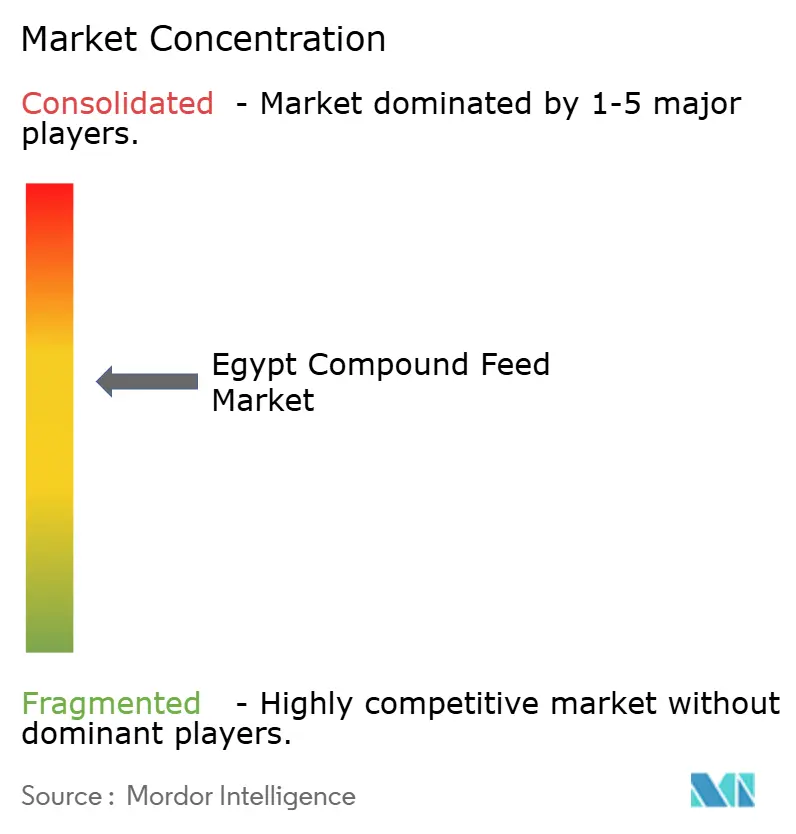
| Market Concentration | Medium |
Major Players *Disclaimer: Major Players sorted in no particular order Image © Mordor Intelligence. Reuse requires attribution under CC BY 4.0. | |
Egypt Compound Feed Market Analysis by Mordor Intelligence
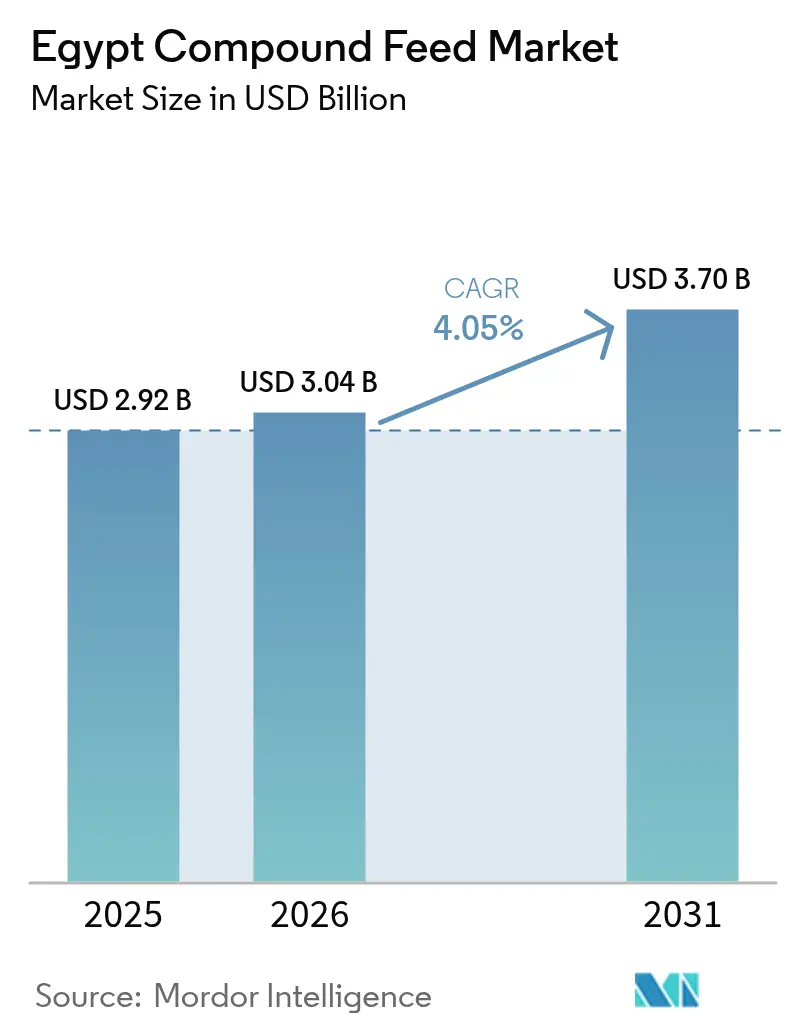
The Egypt compound feed market size is expected to grow from USD 2.92 billion in 2025 to USD 3.04 billion in 2026 and is forecast to reach USD 3.7 billion by 2031 at 4.05% CAGR over 2026-2031. Egypt's position as a major livestock center in North Africa, combined with its domestic poultry production of 2.1 million metric tons (mmt) of chicken meat (fresh and chilled) in 2023, as reported by the United Nations' Food and Agriculture Organization, drives consistent demand for specialized feed. The market benefits from desert-based mega-farms, duty-free grain imports, and increased soybean-crushing capacity. Currency fluctuations increase raw material costs, prompting manufacturers to implement hedging strategies and increase local input usage. Compound feed manufacturers are implementing technology solutions, including precision-feeding software and IoT sensors, to enhance feed-conversion ratios and maintain profitability.
Key Report Takeaways
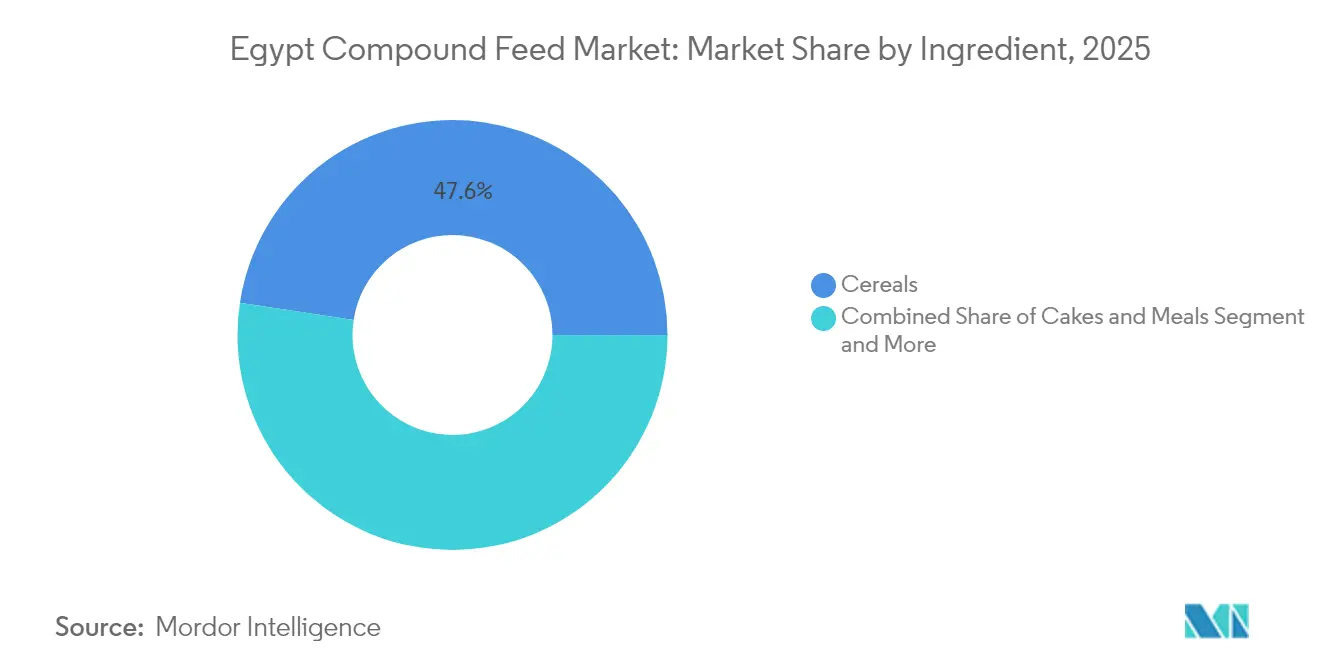
- By ingredient, cereals led with 47.60% of the Egypt compound feed market share in 2025, while supplements are poised to expand at a 6.35% CAGR through 2031.
- By animal type, poultry accounted for a 53.50% share of the Egypt compound feed market size in 2025; aquaculture is forecast to grow at a 5.24% CAGR to 2031.
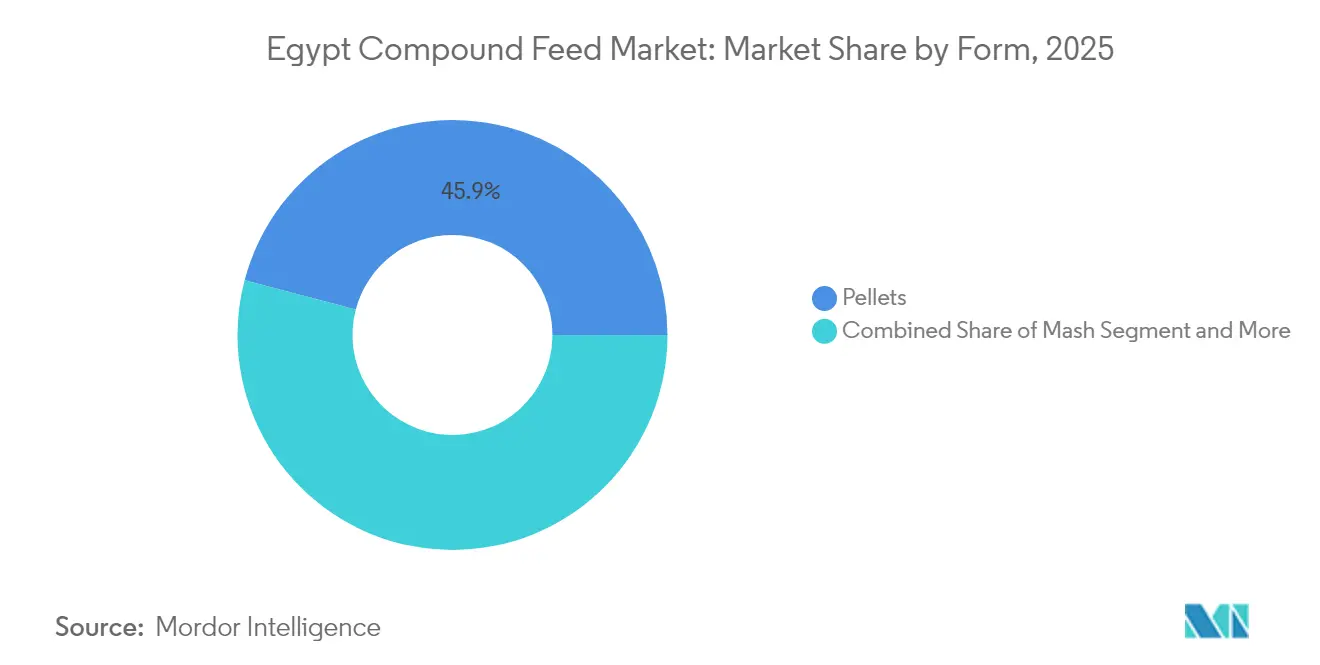
- By form, pellets held 45.90% of share of the market revenue in 2025, whereas crumbles are projected to climb at a 6.45% CAGR over the same period.
- Cargill, Incorporated, ADM (Archer Daniels Midland), Wadi Holdings SAE (Sina'at), Dakahlia Group (Dakahlia Poultry Company S.A.E.), and Nutreco N.V.( SHV Holdings N.V.) collectively hold the majority of the market share in 2025.
Note: Market size and forecast figures in this report are generated using Mordor Intelligence’s proprietary estimation framework, updated with the latest available data and insights as of 2026.
Egypt Compound Feed Market Trends and Insights
Drivers Impact Analysis*
| Driver | (~) % Impact on CAGR Forecast | Geographic Relevance | Impact Timeline |
|---|---|---|---|
| Growing investments in livestock mega-farms | +0.8% | National; New Valley and desert reclamation zones | Medium term (2-4 years) |
| Rapid build-out of integrated poultry complexes | +0.9% | National; Delta and Upper Egypt | Short term (≤2 years) |
| Government import-duty relief for key feed grains | +0.6% | National | Short term (≤2 years) |
| Adoption of precision-feeding software by large integrators | +0.4% | National; large commercial farms | Medium term (2-4 years) |
| Surge in domestic raw-material crushing capacity | +0.7% | Alexandria and Sadat City industrial zones | Medium term (2-4 years) |
| Rising consumer switches to higher-protein diets | +0.3% | Urban centers nationwide | Long term (≥4 years) |
| Source: Mordor Intelligence | |||
Growing Investments in Livestock Mega-Farms
Desert reclamation projects enable large-scale livestock operations, with SEKEM planning to reclaim 500,000 feddan through investments of EGP 270 million (USD 5.6 million) in 2023[1]Source: Amwal Al Ghad, “SEKEM to Reclaim 500,000 Feddan,” amwalalghad.com. These mega-farms concentrate livestock in controlled environments, generating consistent demand for specialized compound feeds. Desert-based operations reduce competition for arable land while enabling advanced feeding systems that improve nutrient utilization. Government support through land allocation and infrastructure development facilitates this transition, strengthening Egypt's position as a regional livestock production center. The integration of renewable energy in these facilities supports sustainable feed production and processing.
Rapid Build-Out of Integrated Poultry Complexes
Vertical integration in poultry production drives compound feed demand as producers control the entire value chain from feed manufacturing to processing. The Egyptian Ministry of Agriculture's 2024 poultry sector revival plan includes 5% interest rate financing for infrastructure upgrades and expedited licensing for compliant operations. The financing and licensing incentives enable producers to establish in-house compound feed production facilities, ensuring consistent feed formulation and supply security. These integrated facilities use automated feeding systems and monitoring technology to optimize feed conversion ratios, improve bird health, and increase demand for nutritionally balanced compound feeds designed for specific poultry breeds.
Government Import-Duty Relief for Key Feed Grains
The Egyptian government's fiscal policies support the feed industry through reduced import duties on essential ingredients like corn, soybeans, and feed additives. The government provides VAT exemptions on imported feed raw materials and additives, along with property tax exemptions for poultry farming operations[2]Source: Ministry of Agriculture, “Annual Livestock Output Statement,” masrawy.com. These measures reduce compound feed manufacturing costs, allowing manufacturers to compete effectively with informal feed mixing operations. The government has also implemented efficient port inspection procedures that maintain quality standards while ensuring smooth clearance for registered importers.
Adoption of Precision-Feeding Software by Large Integrators
Digital transformation in livestock management increases the demand for compound feeds that work with automated feeding systems. ReNile's IoT solutions in the Fayrouz aquaculture project showcase how precision feeding technology reduces feed consumption while improving fish quality. These systems adjust feed formulations in real-time by monitoring environmental conditions, growth rates, and animal health. Large livestock companies now use RFID-tagged feeding systems and computer vision technology to optimize feed timing and quantities. This technological shift creates opportunities for compound feeds specifically formulated for automated delivery systems, with precise particle sizes and nutrient densities.
Restraints Impact Analysis*
| Restraint | (~) % Impact on CAGR Forecast | Geographic Relevance | Impact Timeline |
|---|---|---|---|
| Egyptian pound volatility against international currency | -0.4% | Nationwide | Short term (≤2 years) |
| Shortage of cold-chain logistics | -0.3% | Upper Egypt | Medium term (2-4 years) |
| Limited rural credit for small animal keepers | -0.2% | Rural areas | Long term (≥4 years) |
| Competition from cheap informal on-farm feed mixing | -0.3% | Rural and peri-urban areas | Medium term (2-4 years) |
| Source: Mordor Intelligence | |||
Egyptian Pound Volatility Against International Currency
Currency fluctuations create significant cost pressures for compound feed manufacturers who rely on imported raw materials, particularly soybeans and corn. The Egyptian pound's volatility against the USD affects procurement planning and pricing strategies, requiring manufacturers to implement hedging mechanisms. Feed manufacturers must balance passing costs to customers while competing with informal mixing operations that may not adhere to quality standards. The currency volatility especially impacts the procurement of specialized ingredients and additives from international suppliers, affecting the profitability of premium compound feed segments.
Limited Rural Credit for Small Animal Keepers
Limited access to financing restricts small-scale farmers from purchasing commercial compound feeds, forcing them to rely on traditional feeding methods or informal feed mixing. While the Egyptian government provides agricultural financing, these programs primarily benefit large-scale operations, creating funding gaps for small livestock farmers. The lack of acceptable collateral and complex loan application processes prevents these farmers from accessing formal credit for feed purchases. As a result, farmers continue using lower-cost compound feed alternatives that may reduce animal productivity and product quality.
*Our forecasts treat driver/restraint impacts as directional, not additive. The impact forecasts reflect baseline growth, mix effects, and variable interactions.
Segment Analysis
By Ingredient: Cereals Anchor Volume while Supplements Accelerate Growth
Cereals account for 47.60% of Egypt's compound feed market share in 2025, with corn and wheat being essential components in commercial feed formulations. Egypt's crushing facilities and grain import infrastructure ensure a consistent maize supply, while wheat and barley fulfill ruminant fiber requirements. Domestic corn production, projected to increase in 2025-2026, supports poultry protein requirements. Grains maintain their position as core ingredients due to competitive pricing, digestibility, and broad acceptance among feed mills, despite currency fluctuations.
The supplements segment, while smaller in market share, demonstrates the highest growth rate with a 6.35% CAGR through 2031. The increasing focus on precision feeding necessitates the inclusion of trace minerals, amino acids, enzymes, and functional additives to improve feed-conversion ratios in broiler and tilapia production. DSM-Firmenich's establishment of a local premix facility in 2024 supports this growth trajectory and reduces import-related logistics costs. The segment benefits from compound feed integrators' adoption of data-driven nutritional strategies, contributing to the overall compound feed market development.



By Animal Type: Poultry Dominates and Aquaculture Gains Pace
The poultry segment accounted for 53.50% of Egypt's compound feed market size in 2025, driven by the country's 1.5 billion broiler flock. The segment's growth relies on specialized feed formulations, including starter, grower, and finisher diets designed for optimal weight gain. The increased use of corn and higher-quality soybean meal improves bird performance, maintaining consistent demand for cereals in the compound feed market. Major integrated operations, such as Dakahlia Poultry, produce feed in-house, providing steady demand for commercial feed mills.
The aquaculture segment demonstrates the highest growth rate at 5.24% CAGR, driven by the Fayrouz fish-farming mega-project and increasing consumer demand for tilapia. Companies such as Aller Aqua have increased their extrusion capacity to produce water-stable pellets customized for specific fish species. The implementation of digital monitoring systems for compound feed distribution supports the demand for high-density, specialized fish feeds, increasing aquaculture's market share in the compound feed industry.
By Form: Pellets Retain Leadership while Crumbles Secure Traction
Pellets hold 45.90% of Egypt's compound feed market share in 2025, primarily due to their ease of handling and uniform nutrient distribution in automated feeding systems. The pellet segment's dominance stems from well-established manufacturing infrastructure, with most commercial feed mills equipped for pellet production and optimized distribution systems.
Crumbles are projected to grow at a 6.45% CAGR, driven by integrators' preference for uniform particle size in young poultry and aqua fry feed. Advanced cooling systems and double-roller crumbler lines minimize fine particle production, while software-controlled crumbling enables precise particle size control for specific batches. Mash formulations remain relevant in cost-sensitive segments and specialized applications where particle size uniformity is not critical. Other forms, including cubes and powder, serve specific applications with unique handling or nutritional requirements.
Geography Analysis
Northern Egypt, encompassing the Nile Delta and Alexandria, houses over two-thirds of the milling capacity. The region's port access reduces grain import lead times. The Sadat City industrial zone, which contains OILEX's soybean crushing facility and multiple medium-sized feed mills, connects Mediterranean grain terminals to inland poultry production areas. The government's planned dry port in the zone will reduce transportation costs and facilitate future compound feed exports.
Upper Egypt faces infrastructure challenges in compound feed distribution. The region's fragmented cold-chain infrastructure and extended transportation distances increase feed delivery costs, restricting usage to basic mash rations. To address this disparity, the Ministry of Agriculture is encouraging the development of integrated poultry estates along desert highways to serve as primary customers for new regional mills. The ministry offers incentives, including reduced land lease rates and accelerated environmental permits.
The coastal governorates of Port Said and Suez leverage their maritime infrastructure to support aquaculture growth. The Fayrouz complex drives demand for floating pellets, while Alexandria's petrochemical industry provides vitamins and methionine supplies. New customs procedures implemented in January 2025 reduce clearance periods and prevent illegal imports, strengthening quality standards in Egypt compound feed market.
Regulatory Landscape
Egypts compound feed manufacturing and trade are regulated primarily by the Ministry of Agriculture and Land Reclamation (MALR), through its livestock and poultry development functions, with licensing and product registration requirements anchored in the established feed control framework (including Ministerial Decree 1498/1996). Feed mills and related facilities require operating licenses, and feed mixtures, concentrates, and additives require registration before commercial sale, supported by technical evaluation coordinated with national feed and animal production research bodies.
Regulatory activity increased in the latest reporting cycle. MALR reported licensing and product registrations, including 1,165 operating licenses issued in December 2025 (announced January 2026) and 654 feed products registered, followed by March 2026 approvals of 294 feed mixtures and the issuance of 468 operating licenses for livestock, poultry, and feed facilities. Alongside expanded use of digital licensing via the Egypt Digital Platform and tighter inspection focus, compliance expectations for formal producers are rising, creating added friction for informal mixing channels. This supports stronger traceability and quality requirements aligned with Egyptian standards, including EOS processed feed specifications and the code of practice on good animal feeding.
Competitive Landscape
Cargill, Incorporated, ADM (Archer Daniels Midland), Wadi Holdings SAE (Sina'at), Dakahlia Group (Dakahlia Poultry Company S.A.E.), and Nutreco N.V. (SHV Holdings N.V.) hold the majority of the Egypt compound feed market share in 2024, indicating moderate market concentration. International companies establish partnerships with local distributors to manage import permits, while domestic integrators use in-house mills to control compound feed formulations and reduce currency risks. Technology adoption differentiates market leaders: Cargill utilizes cloud-based feed-formulation systems for remote cost optimization, while ADM's Alexandria premix facility increases local micro-ingredient production.
Market opportunities exist in functional fish feeds, heat-stress mitigation additives, and specialized crumble lines for hatcheries. Companies such as ReNile provide data platforms that enable performance-based contracts between farmers and feed mills. The National Food Safety Authority's increased audit requirements drive market consolidation, reducing informal feed mixer participation in commercial channels.
Smaller companies maintain regional market presence by utilizing locally sourced ingredients such as bran, molasses, and cottonseed cake to minimize foreign exchange exposure. These companies form strategic partnerships with desert-farm developers to secure demand, particularly for dairy and beef cattle feed products adapted to arid-climate forage requirements.
Egypt Compound Feed Industry Leaders
Cargill, Incorporated
ADM (Archer Daniels Midland)
Wadi Holdings SAE (Sina'at)
Dakahlia Group (Dakahlia Poultry Company S.A.E.)
Nutreco N.V.( SHV Holdings N.V.)
- *Disclaimer: Major Players sorted in no particular order

Market Opportunities and Future Outlook
Capacity additions and more formal registrations are creating clearer space for scaled, compliant supply, especially in poultry and aquaculture feeds. In March 2026, MALR approved 294 feed mixture registrations and issued 468 operating licenses, which points to a larger pipeline of formal plants and registered formulations that can compete on consistent quality versus informal on-farm mixing.
A near-term commercial opportunity is the build-out of modern feed capacity in industrial zones tied to logistics corridors. This is reflected in the March 2026 agreement between New Hope Egypt and Elsewedy Industrial Development to establish a new poultry and aquaculture feed plant at Industria Asher (10th of Ramadan City) with 400,000-ton annual capacity, and in Zhengbang Egypt Agriculturals' June 2025 agreement for a USD 30 million poultry feed plant at Industria Sadat. On the input side, the market continues to reward local and regional sourcing strategies that reduce exposure to FX availability and import lead times. USDA reporting in 2026 indicates continued large soybean import needs (5.2 million tonnes forecast for 2026/27), alongside a modest rise in domestic corn production (7.0 million metric tonnes forecast for 2026/27 versus 6.7 million metric tonnes in 2025/26). That mix keeps formulation economics sensitive to grain and oilseed flows and encourages mills to expand premix, enzyme, amino acid, and functional additive usage to protect feed-conversion performance under volatile raw-material pricing. For suppliers, these conditions translate into opportunities for registered, species-specific formulations for integrated poultry complexes and for extruded, water-stable aquaculture pellets tied to mega-project demand and intensive production systems.
Recent Industry Developments
- March 2026: Egypts Ministry of Agriculture and Land Reclamation approved 294 feed mixtures (190 domestic and 104 imported) and issued 468 operating licenses for livestock, poultry, and feed facilities. The step expands the pool of registered formulations and licensed capacity, which favors compliant manufacturers and raises competitive pressure on informal mixing.
- April 2025: Egypts Suez Canal Aquaculture Company and Spains Grupo Tejedor Lazaro signed an MoU to advance fisheries, aquaculture, and compound feed production in Egypt. The collaboration links aquaculture expansion with dedicated feed capability, supporting demand for specialized aquatic formulations and industrial-scale feed processing.
- September 2024: DSM-Firmenich opened an animal nutrition and health premix and additives manufacturing plant in Sadat City, Egypt. The facility strengthens local availability of micro-ingredients for compound feed producers, reducing reliance on imported premixes and enabling more consistent, precision-oriented formulations for large livestock and poultry farms.


Research Methodology Framework and Report Scope
Market Definition and Coverage
For this study, the market covers factory-produced compound feed sold in Egypt for livestock and aquaculture feeding, valued at the point where feed is sold into the domestic channel. It includes complete feed and concentrates across the main animal groups.
Scope exclusions: We exclude on-farm feed mixing, raw grains and oilseed meals sold as single ingredients, premixes and feed additives sold separately, and non-feed pet food products.
Segmentation Overview
- By Ingredient
- Cereals
- Maize
- Wheat
- Barley
- Cakes and Meals
- Soybean Meal
- Sunflower Meal
- By-products
- Bran
- Molasses
- Supplements
- Vitamins
- Minerals
- Amino Acids
- Enzymes
- Cereals
- By Animal Type
- Ruminants
- Cattle
- Sheep and Goats
- Poultry
- Broilers
- Layers
- Aquaculture
- Tilapia
- Catfish
- Other Animal Types (Equine, Camel, etc.)
- Ruminants
- By Form
- Mash
- Pellets
- Crumbles
- Other Forms (Cubes, Powder, etc.)
Data Sources, Market Sizing, and Validation
Desk Research
Desk work was used to set the demand and supply context before interviews, so the market math stays anchored to observable signals in Egypt. We referenced public sources such as CAPMAS releases, FAOSTAT livestock and feed-related series, UN Comtrade trade flows for key feed inputs, and World Bank macro indicators that influence purchasing power and consumption.
To keep assumptions realistic, we also reviewed materials such as poultry and livestock association publications, relevant ministry or regulator updates on feed and animal health, peer-reviewed animal nutrition papers, and local press coverage on feed pricing and availability. Company annual reports, investor presentations, and a paid subscription focused on company financials and news were used to cross-check revenue direction and capacity announcements where disclosures were available. These examples are not exhaustive, and many other public sources were also reviewed for data collection, validation, and research clarification.
Primary Interviews and Surveys
Field research covers Egypt-based feed mill managers, nutrition specialists, procurement leads, farm operators, distributors, and public-sector experts. Discussions clarify volumes, prices, capacity use, product mix, and channel movement, while addressing gaps in public records. When responses conflict, the findings are rechecked and used to adjust assumptions and the final analysis.
Distribution of primary research fieldwork respondents
| Company type | Respondent position |
|---|---|
| Top tier: 28% | CXOs: 16% |
| Mid tier: 52% | Functional/Unit leaders: 34% |
| Smaller Players: 20% | Managers: 50% |
Market-Sizing & Forecasting
Sizing started with a top-down build where national livestock and aquaculture production, feed conversion norms, and the share of commercially purchased feed were combined to reconstruct compound feed consumption by major animal group. Those demand pools were then converted to value using prevailing price bands by feed type, followed by currency and inflation consistency checks.
To keep the totals practical, we corroborated the output with selective bottom-up approximations, such as rolling up a sample of manufacturer sales indications, capacity utilization ranges, and typical channel markups gathered in interviews, and then adjusting for gaps where informal supply or temporary shutdowns were reported. Key model inputs (illustrative) included broiler and layer placements, aquaculture output trends, corn and soybean meal import availability, local milling and pelletizing capacity, and the pace of retail meat and egg demand.
Forecasts were produced using scenario analysis around input cost cycles and livestock output growth, and then tuned using expert expectations on policy, imports, and farm profitability so the forward curve stays believable year by year.
Data Validation & Update Cycle
Outputs were checked through triangulation against independent signals like livestock production direction, major feed input trade movements, and plant-level utilization narratives shared in interviews. When a variance looked high, the assumptions behind feed intensity, commercial share, or price progression were re-checked, and specific respondents were re-contacted to confirm whether the change was structural or temporary.
Before sign-off, the model and narrative pass through multiple analyst reviews so unit logic, growth drivers, and year-to-year steps line up. The report is refreshed annually, with interim updates triggered by material events such as sharp feed grain price swings, import restrictions, or major capacity additions. Right before delivery, a final update sweep is done so clients receive the most current view available.
Mordor Intelligence's Egyptian Compound Feed Market Size Compared With Other Published Estimates
Published market sizes for Egypt compound feed can look different even when the topic name sounds the same, since the underlying counting rules are not always aligned. In our checks, the biggest reasons are what is included as feed versus ingredients, which year is treated as the current base, and whether the estimate follows demand signals or is built mainly from revenue narratives.
The main gap drivers in this market are whether fodder and forage are mixed into the total, how the compound feed share is set for poultry and aquaculture (especially when input prices spike), and how FX timing is handled when converting local prices to USD. Another common source of spread is refresh cadence, since corn and soybean meal costs can move quickly and can change feed prices and volumes in the same season, and this is where the exclusion of non-compound feed categories is applied consistently before finalizing the size, which is then checked through consumption and price bands by Mordor Intelligence.
Benchmark comparison
| Source | Market Size | Gaps in Research Methodology |
|---|---|---|
| Mordor Intelligence | USD 3.04 B (2026) | |
| Market Research Publisher A | USD 2.19 B (2024) | Uses an earlier base year and a slower growth path, and the write-up suggests a narrower pricing and volume refresh cycle that can miss rapid feed price resets tied to imported corn and soybean meal. |
| Industry Research Publisher B | USD 2.72 B (2025) | Covers the broader animal feed market, which can blend compound feed with fodder and forage, and this makes the scope not directly comparable to a compound-feed-only total. |
The comparison shows that the spread is mainly created by scope and timing choices rather than arithmetic. By keeping the market limited to compound feed sold through formal channels, and by linking volumes to livestock output and feeding intensity before applying price bands, the final number stays traceable to clear steps and can be repeated when inputs change.


Key Questions Answered in the Report
How large is Egypt compound feed market in 2026?
The compound feed market size is USD 3.04 billion in 2026 and is forecast to reach USD 3.7 billion by 2031 at a 4.05% CAGR.
Which ingredient segment leads the market?
Cereals lead with 47.60% Egypt compound feed market share in 2025, reflecting heavy corn and wheat inclusion.
Which animal segment is growing fastest?
Aquaculture feed demand is rising at a 5.24% CAGR on the back of large projects such as the Fayrouz fish farm.
What role do pellets play in Egyptian feed production?
Pellets remain the dominant form with 45.90% share due to handling ease and widespread mill infrastructure.
Page last updated on:


 Your data is secure and never sold or shared.


