
- Argentina
- Australia
- Bahrain
- Bangladesh
- Brazil
- Cambodia
- Canada
- Chile
- China
- Colombia
- France
- Germany
- Hong Kong
- India
- Indonesia
- Iran
- Israel
- Italy
- Japan
- Kuwait
- Malaysia
- Mexico
- Middle East and Africa
- Myanmar
- Nepal
- New Zealand
- Nigeria
- Oman
- Pakistan
- Philippines
- Poland
- Qatar
- Saudi Arabia
- Singapore
- South Africa
- South Korea
- Spain
- Sri Lanka
- Thailand
- Turkey
- United Arab Emirates
- United Kingdom
- United States
- Vietnam
Egypt Telecom MNO Market Analysis by Mordor Intelligence
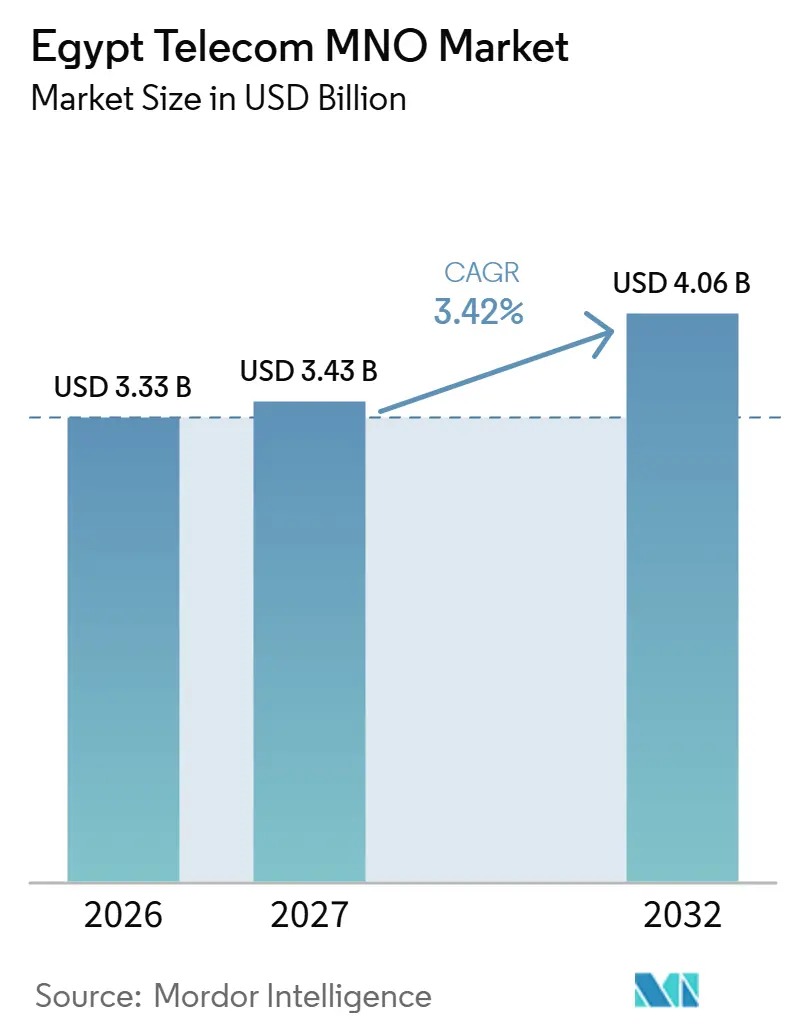
The Egypt Telecom MNO market size is estimated at USD 3.33 billion in 2026 and is projected to be USD 3.43 billion in 2027, reaching USD 4.06 billion by 2032, growing at a CAGR of 3.42% from 2027 to 2032.
Digital payments and public-service adoption in Egypt strengthen the usefulness of a dependable mobile broadband connection. Egypt's mobile spectrum expansion, initiated through NTRA allocation agreements in February 2026, gives operators a route to additional capacity. Delivering usable connectivity requires tying radio upgrades to international transport and domestic network systems. Currency-related costs and revenue-linked license charges constrain how much service growth can finance further investment. Earning payment and public-service traffic on existing sites can preserve more incremental revenue for equipment upgrades, although revenue-linked fees still rise with licensed-service income.
Key Report Takeaways
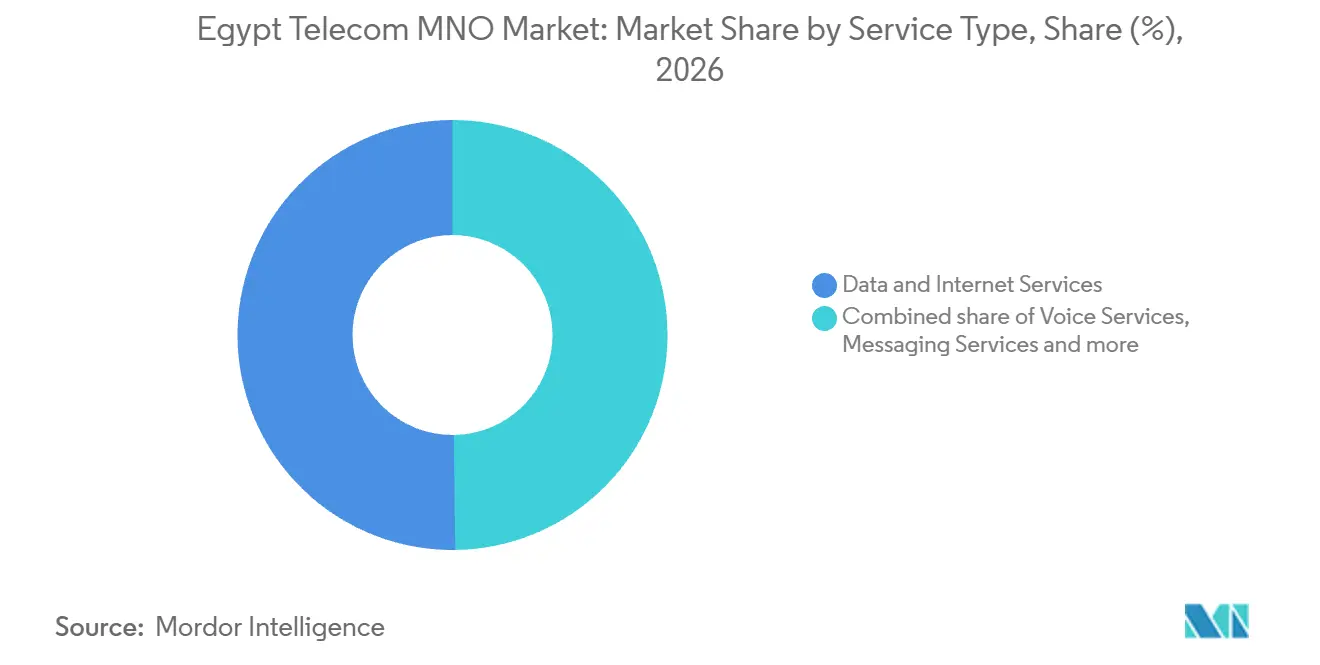
- By service type, data and internet services held a 50.21% Egypt Telecom MNO market share in 2026, while IoT and M2M services are forecast to grow fastest at a CAGR of 3.8% from 2027 to 2032.
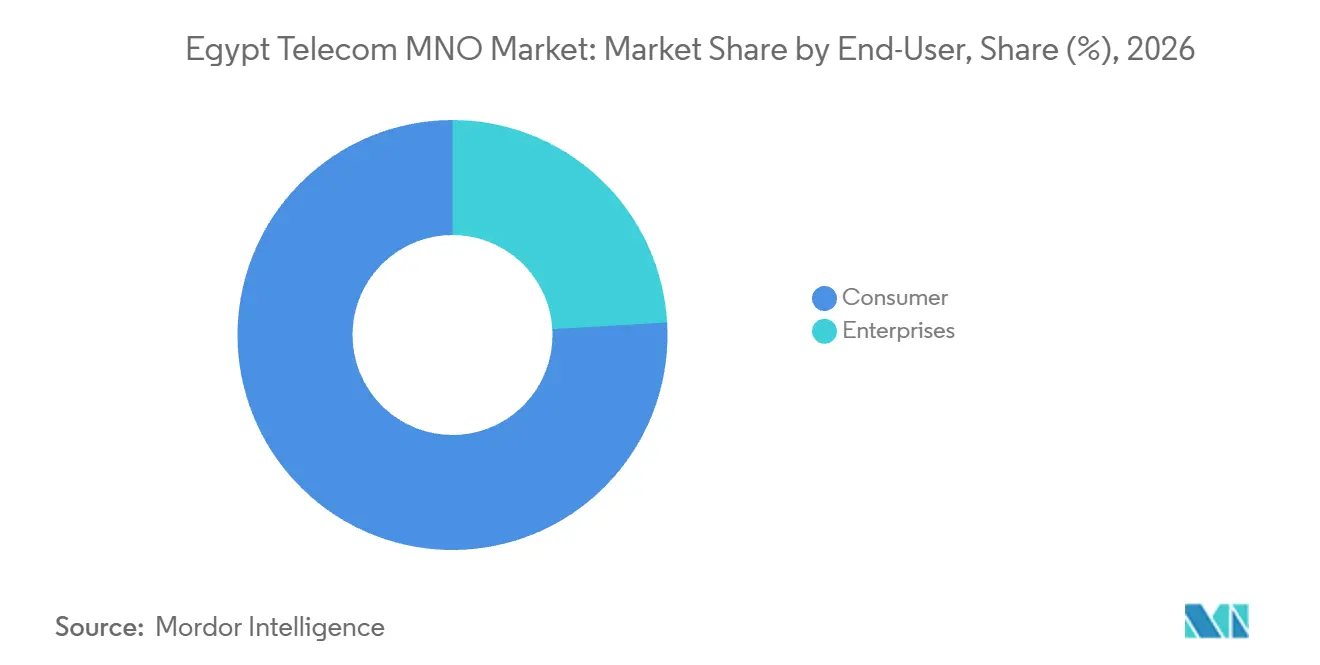
- Among end users, consumers held a 75.93% share of the Egypt Telecom MNO market size in 2026, and enterprises are projected to be the fastest-growing segment with a CAGR of 3.8% from 2027 to 2032.
Note: Market numbers in this report are based on Mordor Intelligence's proprietary estimation framework, which combines nine months of actuals with Q4 projections for base year 2026.
Market Trends and Insights
Drivers Impact Analysis of Egypt Telecom MNO Market*
| Driver | (~) % Impact on CAGR Forecast | Geographic Relevance | Impact Timeline |
|---|---|---|---|
| Explosion of mobile data traffic and 4G/5G upgrades | +2% | Nationwide | Medium term (2-4 years) |
| Fast-growing demand from fintech and super-apps for bundled data | +1.2% | Nationwide | Short term (≤ 2 years) |
| Government-backed digital-nation projects (Digital Egypt, Egypt Vision 2030) | +1% | Nationwide | Medium term (2-4 years) |
| Rapid expansion of subsea cable landings boosting international bandwidth | +0.8% | Port Said and Ras Ghareb | Long term (≥ 4 years) |
| Growth in enterprise cloud / data-center outsourcing | +0.5% | Nationwide | Medium term (2-4 years) |
| Untapped rural consumer base addressable by FWA and satellite backhaul | +0.3% | Nationwide | Long term (≥ 4 years) |
| Source: Mordor Intelligence | |||
Explosion of mobile data traffic and 4G/5G upgrades
Rising mobile internet use gives network upgrades a demand base, while the location of added capacity determines their commercial usefulness. NTRA reported 12% higher mobile internet service use in Egypt in a one-day 2026 comparison with the same day in 2025. That comparison also recorded 7.9 million additional mobile internet users. Orange Egypt launched 5G on June 3, 2025, initially covering selected high-traffic areas across all governorates. Concentrating upgraded capacity in busy locations can support additional use while giving customers a practical reason to value service performance. Prioritizing those zones can increase the use carried by each upgraded site, strengthening the revenue case for expansion beyond the initial footprint.
Fast-growing demand from fintech and super-apps for bundled data
Wallet-based recharge gives operators a route from financial-service activity to repeat connectivity purchases through the same payment channel. NTRA counted 57.01 million telecom-operator mobile wallets in Egypt in H1 2026, up 23% from H1 2025. Transactions through those wallets rose 62% to 2.22 billion over the same comparison period. Mobile and internet top-ups accounted for 25% of transaction counts through telecom-operator mobile wallets in Egypt in H1 2026.[1] That recharge activity gives data-bundle distribution a practical entry point within an established financial-service channel, alongside other mobile and internet purchases. Operators can place bundle renewal prompts inside the wallet flow customers already use for mobile and internet top-ups.
Government-backed digital-nation projects (Digital Egypt, Egypt Vision 2030)
Government services give connectivity a practical purpose that extends beyond discretionary media consumption and creates opportunities for dependable mobile access. Digital Egypt platform users rose 32.1% to about 10.7 million in 2025 from 8.1 million in 2024. The platform recorded more than 25 million transactions and inquiries in 2025, compared with about 7.8 million in 2024. Wider participation and greater transaction activity create different requirements, combining accessible connections with sufficient reliability to complete government-service interactions. For mobile operators, the commercial opening is to support those interactions through usable data services rather than depend solely on entertainment traffic. Completing a government-service session becomes the test of whether a mobile offer supports this use case, beyond the amount of data included in the allowance.
Rapid expansion of subsea cable landings boosting international bandwidth
International transport expansion can support mobile data services by strengthening the upstream connections on which access networks depend. Telecom Egypt activated a 2Africa Mediterranean link on January 23, 2025, connecting Port Said with Marseille via Genoa.[2] In July 2025, Telecom Egypt and cable supplier SubCom completed SEA-ME-WE-6 landings at Port Said and Ras Ghareb, connected by terrestrial crossing routes. The activated link provides an operating connection, while the completed landings establish infrastructure for the separate system's eventual service. For mobile operators, additional international paths create upstream options that can complement investment in radio-network capacity. The Mediterranean and Red Sea landings, joined by terrestrial routes Telecom Egypt described as diverse and resilient, give the system 2 coastal entry points into Egypt.
Restraints Impact Analysis of Egypt Telecom MNO Market*
| Restraint | (~) % Impact on CAGR Forecast | Geographic Relevance | Impact Timeline |
|---|---|---|---|
| EGP depreciation pressuring CAPEX and imported equipment costs | -1.1% | Nationwide | Short term (≤ 2 years) |
| High sector-specific taxes and revenue-share levies eroding margins | -0.8% | Nationwide | Long term (≥ 4 years) |
| Fiber roll-out delays due to complex right-of-way approvals | -0.3% | Nationwide | Medium term (2-4 years) |
| Persistent SIM-box fraud and gray-route voice termination | -0.2% | Nationwide | Short term (≤ 2 years) |
| Source: Mordor Intelligence | |||
EGP depreciation pressuring CAPEX and imported equipment costs
Network expansion faces a financing constraint when service delivery and the equipment needed for added capacity both become more expensive. In May 2026, NTRA said exchange-rate changes directly affected the cost of providing telecom services in Egypt. It also identified higher network expansion and modernization costs associated with shipping, supply-chain disruption and electronic-chip prices. Those separate pressures mean that a currency response alone cannot address every component of the investment burden. For operators assessing additional capacity, expected service receipts must cover a higher construction and operating hurdle before expansion becomes commercially attractive. An expansion project must absorb both equipment and service-delivery cost pressures, narrowing the room to recover investment through affordable additional connections.
High sector-specific taxes and revenue-share levies eroding margins
Revenue-based license charges reduce the portion of service receipts available to fund mobile operations and network expansion. NTRA's November 2023 schedule specified annual service fees of 6% of adjusted licensed-service revenue, plus R&D and universal-service fees of 0.5% each. It left concession, renewal, annual NTRA works and spectrum fees to separate NTRA Board decisions. This structure ties part of the regulatory burden to service revenue while leaving additional obligations outside those stated percentages. Higher sales under such terms therefore do not translate fully into funds retained for equipment and coverage. Recovering a cost increase through tariffs would also enlarge the revenue-linked charge base, raising the gross receipts needed to restore available cash.
*Our forecasts treat driver/restraint impacts as directional, not additive. The impact forecasts reflect baseline growth, mix effects, and variable interactions.
Egypt Telecom MNO Market Segment Analysis
By Overall Telecom Revenue and ARPU:
Account Yield Supports MonetizationVodafone Egypt's service revenue grew 36.2% in local currency in the year ended March 31, 2026, while fourth-quarter growth moderated to 23.6% as it lapped price increases. Growth was 32.8% in local currency in the quarter ended June 30, 2026. The later quarter grew faster than the preceding fourth quarter, so the pricing-related moderation was followed by stronger local-currency growth. In May 2026, NTRA approved tax-inclusive increases of 9% to 15% for selected telecom packages, leaving fixed-line and mobile voice minutes, prepaid cards and e-wallet services unchanged.
Vodafone Egypt's ARPU grew 28.9% in FY2026, the year ended March 31, 2026. Vodacom linked that increase to commercial traction using big data analytics. The same FY2026 results put Vodafone Egypt's customer base at 52.5 million, up 8.8%, so ARPU growth of 28.9% ran more than 3 times ahead of customer growth. Yield per customer grew faster than the customer base, making monetization of each account the stronger contributor to the operator's revenue expansion.
By Service Type:
Mass Connectivity and Specialized ApplicationsData and internet services accounted for a 50.21% share of the Egypt Telecom MNO market size in 2026. MCIT data reported by Al-Nahar put active voice-and-data mobile internet subscriptions at about 97.68 million in June 2026, compared with 88.51 million in June 2025. That broad subscription base gives the largest segment a substantial population of service relationships across which operators can develop their internet propositions. The base grew by about 9.17 million subscriptions in a year, widening the pool of connections on which operators can earn usage and upgrade revenue.
IoT and M2M services are the fastest-growing segment, with a forecast CAGR of 3.8% from 2027 to 2032. Vodafone Egypt's fleet-management system, delivered in partnership with Egyptian Company for Tracking and IT Services, served 83,000 vehicles in FY2026.[3] This application links connectivity to asset visibility and tracking within a vehicle fleet. For IoT providers, connecting additional fleet assets to a tracking application offers an expansion path beyond higher data use per handset. Voice services show a separate pressure at WE, where NTRA recorded poor voice-quality indicators in an average of 15 of 119 tested areas in Q2 2026, up from 10 in Q1.



By End-User:
Consumer Reach and Enterprise ContractingThe consumer segment represented a 75.93% Egypt Telecom MNO market share in 2026. On May 6, 2026, NTRA directed telecom operators to provide a new mobile-phone package aimed at promoting digital inclusion. The package introduced a lower-priced entry option for mobile service. Separating that entry tier from heavier-use offers lets operators pursue broader access without making a larger service commitment the condition for getting connected.
Enterprises are the fastest-growing segment, forecast to expand at a CAGR of 3.8% from 2027 to 2032. Orange Egypt and Circle K Egypt signed a partnership on April 22, 2026, for high-speed internet and secure interbranch connectivity across the retailer's more than 200 branches. The announcement reported that Orange Egypt had implemented SD-WAN technology for the branch connectivity. Serving a distributed retail network links connectivity sales to coordination across business locations, creating a managed-service opportunity beyond supplying an individual connection.

Geography Analysis
Affected measurement areas within Cairo, Giza and Alexandria create a geographically specific service-quality priority. In June 2026, NTRA's mobile voice-quality report identified affected measurement areas in Cairo, Giza and Alexandria. For operators, that localization makes the condition of particular service areas commercially relevant when deciding which improvements would most directly address the measured quality indicators. Service-quality commitments can consequently be tied to the affected operator-area pair, giving an improvement a location-specific commercial target.
In Sinai, Telecom Egypt signed an agreement on September 3, 2026, for a roughly 200-kilometer subsea cable from Sharm El Sheikh to Taba. The Sinai route has a design capacity of about 5 petabits per second and is expected to enter service in Q4 2027. Power Sub Link is to implement the Sinai cable, which is intended to offer route diversity to international carriers and network operators. For this corridor, the signed agreement concerns international transport whose commercial development depends on delivery of the contracted system. Carriers will need an operating route before route diversity can become a usable service option, making project delivery the next commercial milestone.
Mansoura appears in NTRA's Q2 2026 list of areas with mobile voice-service quality indicator breaches. NTRA's table counts breached indicators for each operator within each area, making the result specific to the measured network and location. In the same quarter, NTRA completed mobile-service quality measurements on coastal roads used by summer visitors, North Coast tourist villages, New Alamein and event areas. Those coastal checks aimed to assess service quality and readiness for higher summer traffic. For operators serving these coastal locations, capacity planning needs to follow travel routes and seasonal destinations as well as settled residential coverage.
Regulatory Framework and Outlook
Selected jurisdictions are compared from a licensed mobile operator's perspective, covering Egypt's network-access framework and Cairo's general building-permit administration. Egypt's Telecom Regulation Law requires NTRA licenses to operate telecommunications networks or provide services. The law exempts private telecommunications networks that do not use radio systems, while its national controls also assign consultation duties to building-licensing authorities.
Regulatory Table of Egypt Telecom MNO Market
| Decision factor | Egypt | Cairo |
|---|---|---|
| Primary authority | National Telecom Regulatory Authority | Local administrative units' technology centers and planning-and-organization departments |
| Key instruments or direction | Telecom Regulation Law No. 10 of 2003; national spectrum roadmap | General building permits under Law No. 119 of 2008; national NTRA consultation for buildings over 50 meters |
| Commercial effect | National licensing and spectrum access condition network operation | Local building approvals interact with national telecom consultation duties |
| Current policy attractiveness | Medium | Medium |
| Future direction of policy attractiveness | Easing | No change |
| Source: Mordor Intelligence | ||
Egypt's Medium rating reflects the need for licensed access alongside a published route to additional spectrum resources. Easing reflects phased assignments scheduled from 2026 to 2030, with those assignments stated to last through 2039, giving operators a longer planning horizon. Cairo's Medium rating balances local permit processing with the national requirement to consult and notify NTRA for covered building work above 50 meters. No change treats the Ministry of Local Development's return to Law No. 119 of 2008, reversing new building conditions and cutting permit steps from 15 to 8, as the operative baseline.
Value Chain Stages
The value chain compares network modernization, wholesale connectivity and retail mobile operation as linked sources of supplier earnings. Ericsson supplies network technology and services to e& Egypt, which owns and operates the mobile network. Separating those roles shows how a technology supplier can capture integration revenue while the operator retains responsibility for converting network capability into paid services.
Value Chain Analysis Table of Egypt Telecom MNO Market
| Primary activity | Key participants | Value capture | Bottleneck | Resilience response |
|---|---|---|---|---|
| Core network modernization | Network technology suppliers such as Ericsson | Network modernization contract revenue | Coordinating core applications, infrastructure and IT changes | Stage upgrades around cross-system dependencies |
| Transmission and mobile-site connection | Wholesale connectivity providers such as Telecom Egypt | Transmission and site-connection service revenue | Aligning transport delivery with mobile-site requirements | Coordinate connection milestones with radio upgrades |
| Retail mobile operation | Mobile network operators such as Orange Egypt, e& Egypt and WE (Telecom Egypt) | Mobile voice and data service receipts | Converting deployed capacity into sustained paid use | Match service expansion to usable network capacity |
| Source: Mordor Intelligence | ||||
In 2025, e& Egypt and Ericsson agreed a 4-year program to modernize and expand core network applications, infrastructure and IT systems. Changes to core functions and IT must work together, so an isolated component upgrade may leave other parts of the service path unchanged. The 4-year term lets the program be sequenced across the core applications, infrastructure and IT systems that the agreement names together.
Competitive Landscape
Market Concentration
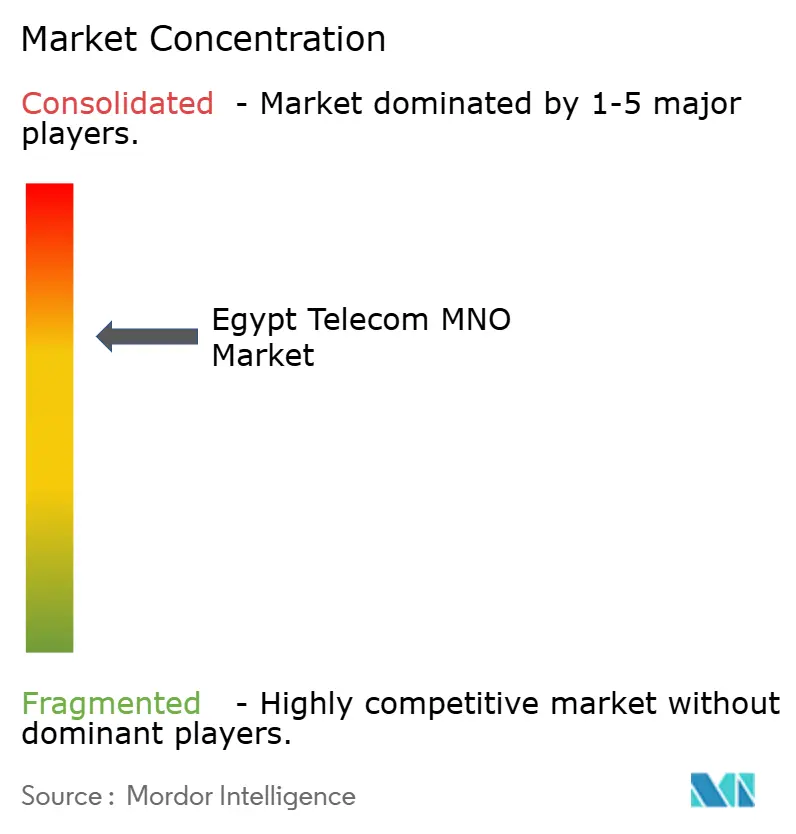
Competition is concentrated among Vodafone Egypt, Orange Egypt, e& Egypt and WE (Telecom Egypt), the 4 national mobile network operators. Vodafone Egypt reported 4,009 5G sites in FY2026, the year ended March 31, 2026, providing a concrete measure of its network deployment. Such infrastructure creates a substantial platform for service delivery, while requiring resources that a prospective network competitor would need to assemble before offering comparable access. In 2025, e& Egypt commercially launched 5G, giving buyers another operator to consider for the technology and limiting the differentiating value of 5G availability alone.
Device distribution adds another competitive dimension, with Vodafone Egypt stating in its FY2026 snapshot that it was the only operator carrying the OPPO A5i Pro. WE (Telecom Egypt) separately reported 4% year-over-year growth in its mobile customer base in H1 2026. Vodafone Egypt paired the handset with installment plans in its FY2026 affordable-5G-device offer. Spreading the handset cost over installments made payment terms part of that operator-channel differentiation.
Egypt's mobile spectrum expansion began through NTRA allocation agreements with the 4 operators in February 2026. The agreements covered 410 MHz of new frequencies valued at nearly USD 3.5 billion in total across those operators. Access through the regulator gives licensed operators a common route to additional spectrum while preserving a substantial capital requirement for expanding network capability. NTRA's roadmap schedules allocations to the 4 operators in phases during 2026 to 2030. Because access is shared but allocation is phased, the competitive test is when each operator can offer service using its additional bands in the locations buyers need.
Egypt Telecom MNO Industry Leaders
-
Vodafone Egypt
-
Orange Egypt
-
e& Egypt
-
WE (Telecom Egypt)
- *Disclaimer: Major Players sorted in no particular order
Egypt Telecom MNO Market Companies Covered in this Report
- Vodafone Egypt
- Orange Egypt
- e& Egypt
- WE (Telecom Egypt)
Key Opportunities for Market Participants
Corporate primary access, backup connectivity and capacity implementation offer different ways to commercialize network expansion. NTRA approved 799 new mobile coverage stations in Egypt in Q2 2026. Orange Egypt describes corporate wireless connectivity for locations that cannot accommodate fixed solutions, with main and backup internet uses.
Market Opportunities Table of Egypt Telecom MNO Market
| Opportunity | Why now | Buyer / lead segment | Recommended play | Main barrier | Likely beneficiaries |
|---|---|---|---|---|---|
| Corporate primary wireless access | Commercial wireless option for sites unable to accommodate fixed solutions | Enterprises at suitable constrained locations | Qualify each site and define primary-link acceptance criteria | Proving reliability for the site's main connection | Orange Egypt and qualifying corporate customers |
| Corporate wireless backup | Existing wireless service supports a backup role | Enterprises seeking an alternative connection | Design and test failover around the main service | Establishing usable backup when the primary link fails | Orange Egypt and corporate continuity users |
| Capacity implementation for licensed operators | Additional spectrum supports network development | Licensed mobile operators | Coordinate capacity milestones with service readiness | Turning spectrum access into deployable network capability | Vodafone Egypt, Orange Egypt, e& Egypt and WE (Telecom Egypt) |
| Source: Mordor Intelligence | |||||
At each candidate corporate location, usable wireless coverage is the commercial test. Main-link and backup uses require different acceptance tests, because failure of the primary connection and failure to activate a backup leave different service gaps. The central opening is site qualification that proves the intended operating role before the supplier commits to delivering the wireless service.
Recent Industry Developments in Egypt Telecom MNO Market
- Sep 2026: Telecom Egypt signed a subsea cable agreement for the Sharm El Sheikh to Taba route in Sinai. Power Sub Link is to implement the roughly 200-kilometer link, designed for about 5 petabits per second with expected service in Q4 2027.
- May 2026: NTRA approved price increases of 9% to 15%, including taxes, for some telecom packages, while keeping fixed-line and mobile voice minutes, prepaid cards and e-wallet services unchanged.
- Feb 2026: NTRA signed spectrum-allocation agreements with Egypt's 4 mobile operators for an additional 410 MHz, valued at nearly USD 3.5 billion in total.
Egypt Telecom MNO Market Report Scope and Research Methodology
Market Definition and Coverage
The Egypt telecom MNO market measures annual revenue from telecom services provided by mobile network operators to customers in Egypt. It covers consumer and enterprise spending on mobile communications and related operator services.
Scope exclusions: Handset and device sales, pure network equipment spending, and standalone ICT services not billed as operator telecom services are excluded.
Segments Covered in This Report
- By Overall Telecom Revenue and ARPU
- By Service Type
- Voice Services
- Data and Internet Services
- Messaging Services
- IoT and M2M Services
- OTT and PayTV Services
- Other Services (VAS, Roaming and International Services, Enterprise and Wholesale Services, etc.)
- By End-User
- Enterprises
- Consumer
Data Sources, Market Sizing, and Validation
Desk Research
Public sources such as the National Telecommunications Regulatory Authority (NTRA) Q4 mobile network quality report and customer satisfaction survey, its mobile wallet indicators, and Telecom Egypt investor presentations help analysts assess service performance, customer experience, digital-service use, and operator retail and wholesale trends in Egypt. NTRA regulatory and market material also helps establish the local service context. To distinguish service activity from recognized service revenue, analysts compare these operating indicators with operator disclosures.
Company annual reports, financial filings, investor materials, and reputable Egyptian business press can supplement the regulator and operator evidence by clarifying revenue definitions, pricing changes, network investment, and reported customer trends. The named sources are illustrative rather than exhaustive, and further sources inform collection, validation and clarification.
Primary Interviews and Surveys
Interviews and structured surveys with Egypt-based mobile operator commercial, network, finance, and enterprise-service personnel can test how published revenue categories, service use, pricing, and network changes translate into MNO service receipts. Respondents can clarify gaps in public disclosures and check the assumptions behind service and end-user shares, with findings compared against regulator releases, operator filings, and other independent indicators before they inform the estimate.
Distribution of primary research fieldwork respondents
| Company type | Respondent position | Region |
|---|---|---|
| Top tier: 30% | CXOs: 20% | |
| Mid tier: 45% | Functional/Unit leaders: 35% | |
| Smaller Players: 25% | Managers: 45% |
Market-Sizing & Forecasting
A top-down estimate starts with Egypt's reported MNO service revenue and tests the total against operator disclosures, then selective bottom-up checks compare sampled operator revenue or subscriber counts multiplied by average revenue per user (ARPU). Subscriber connections, ARPU, data use per connection, service quality and network upgrades, and tariff changes provide practical indicators. Together they show the reachable customer base, revenue yield, demand intensity, delivery capacity, and pricing contribution. Service and end-user shares are built from disclosed revenue mixes where available and checked against these demand and operating indicators, with enterprise service evidence distinguished from consumer use. Exponential smoothing of historical revenue can provide the central forecast, while scenario analysis tests alternative paths for pricing, customer use, and network rollout. Egypt-based operator experts can review variable-level assumptions, and conflicting or missing inputs are reconciled against regulator and company disclosures or retained as ranges until evidence supports a point estimate.
Data Validation & Update Cycle
Analysts triangulate operator revenue disclosures with regulator indicators, customer-use evidence, and independent market signals, then check totals, segment shares, units, and year-to-year movements for breaks or unexplained variance. A second review traces unusual movements to source definitions or changed service conditions, with re-contact triggered when a material gap, revised filing, or unclear revenue treatment could alter the estimate. The model is refreshed annually, reviewed between cycles when a material regulatory, currency, pricing, or network event changes market direction, and checked again against current evidence immediately before delivery.
Mordor Intelligence's Egypt Telecom Market Size Measured Against Other Published Estimates
Published estimates can differ in the transactions and products they count and the inputs used to model demand. The Egypt telecom MNO market measures annual revenue from telecom services provided by mobile network operators to customers in Egypt.
Key Gap Drivers include the study's defined coverage and market-specific modeling choices. Subscriber connections, ARPU, data use per connection, service quality and network upgrades, and tariff changes provide practical indicators.
Benchmark comparison
| Source | Market Size | Gaps in Research Methodology |
|---|---|---|
| Mordor Intelligence | USD 3.43 B (2027) | |
| Global Consultancy A | USD 3.9 B (2025) | At its 2025 base, this estimate is 13.7% above this report's 2027 value of USD 3.43 B, 2 years later. The published service taxonomy includes wired as well as wireless voice, extending beyond mobile network operator revenue. |
| Industry Research Firm B | USD 6.2 B (2024) | At its 2024 base, this estimate is 80.8% above this report's 2027 value of USD 3.43 B, 3 years later. The estimate covers electronic communication infrastructure and fixed-line services as well as mobile services, broadening the total beyond MNO service receipts. |
Mordor Intelligence's analysts triangulate operator revenue disclosures with regulator indicators, customer-use evidence, and independent market signals, then check totals, segment shares, units, and year-to-year movements for breaks or unexplained variance.
Key Questions Answered in the Report
What is the Egypt Telecom MNO market size and growth outlook?
The size is estimated at USD 3.33 billion in 2026 and projected at USD 3.43 billion in 2027, reaching USD 4.06 billion by 2032 at a CAGR of 3.42% from 2027 to 2032.
What supports demand for Egyptian mobile services?
Digital Egypt reached about 10.7 million platform users in 2025, and telecom-operator mobile wallets reached 57.01 million in H1 2026, supporting everyday digital-service activity.
Which service category leads Egypt's MNO revenue mix?
Data and internet services held a 50.21% share in 2026. IoT and M2M services are forecast to grow fastest at a CAGR of 3.8% from 2027 to 2032.
Which companies compete in Egypt's mobile network sector?
Vodafone Egypt, Orange Egypt, e& Egypt and WE (Telecom Egypt) operate the 4 national mobile networks.
What could constrain mobile network expansion in Egypt?
NTRA reported exchange-rate effects and higher network modernization costs in May 2026, raising the funding hurdle for additional capacity.
How do Egypt's regional mobile infrastructure priorities differ?
Named areas within Cairo, Giza and Alexandria had affected voice-quality indicators in June 2026. The contracted Sharm El Sheikh to Taba subsea route in Sinai is expected to enter service in Q4 2027.