
Egypt E-commerce Market Analysis by Mordor Intelligence
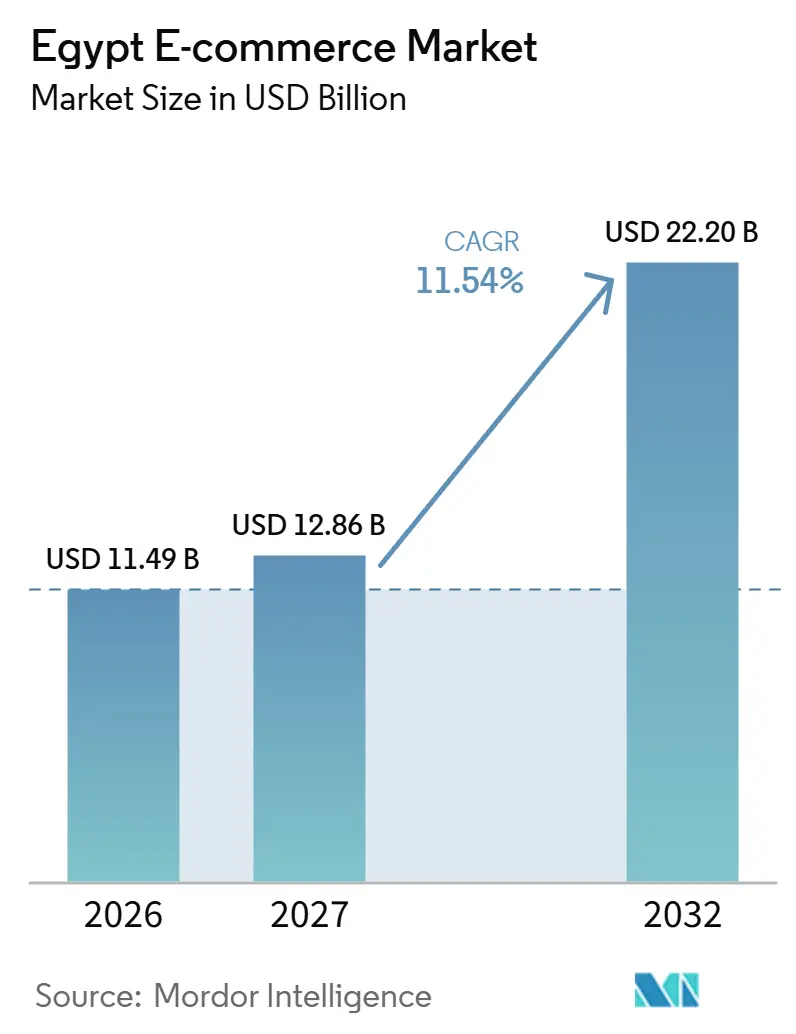
The Egypt e-commerce market size is estimated at USD 11.49 billion in 2026 and is projected to be USD 12.86 billion in 2027, reaching USD 22.2 billion by 2032, growing at a CAGR of 11.54% from 2027 to 2032.
Growth in Egypt depends on connecting mobile access and digital payment accounts with retail services that can execute the order. Local grocery fulfillment can bring purchases within a practical service area, while dispersed delivery routes can make the same promise costly. Platforms and direct retailers can respond through different combinations of assortment, ordering interfaces, and physical presence. A weaker pound can raise replacement costs for imported goods, leaving import-dependent sellers less room to expand their assortments without raising prices or accepting lower margins.
Key Report Takeaways
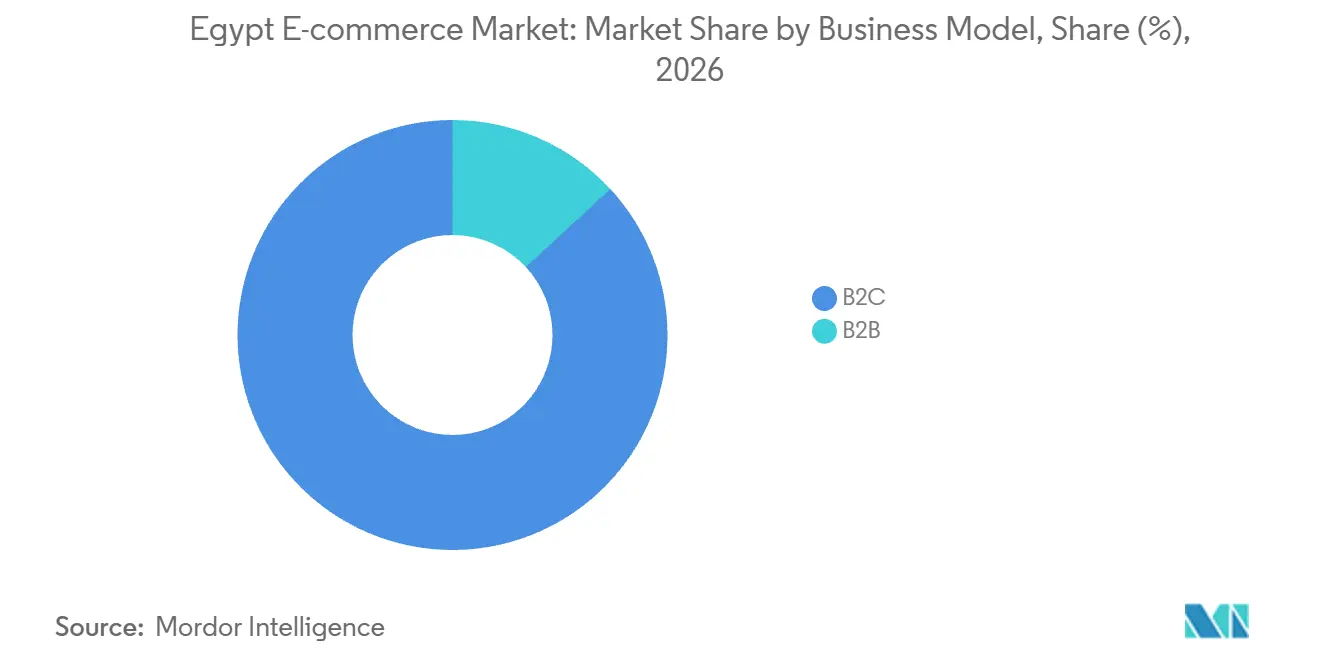
- By business model, B2C held an 86.89% Egypt e-commerce market share in 2026, while B2B is the fastest-growing segment, with a 15% CAGR from 2027 to 2032.
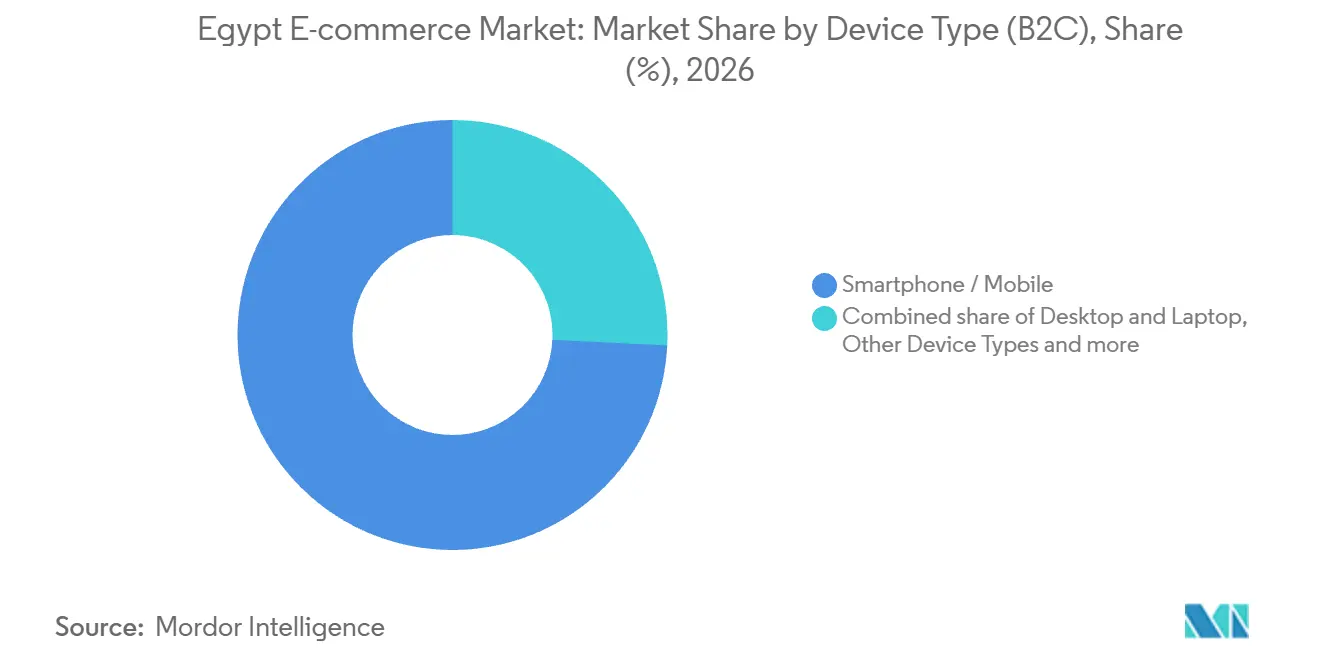
- By device type, smartphone/mobile led B2C e-commerce spending with a 74.23% share in 2026 and is also the fastest-growing segment, with a 14% CAGR from 2027 to 2032.
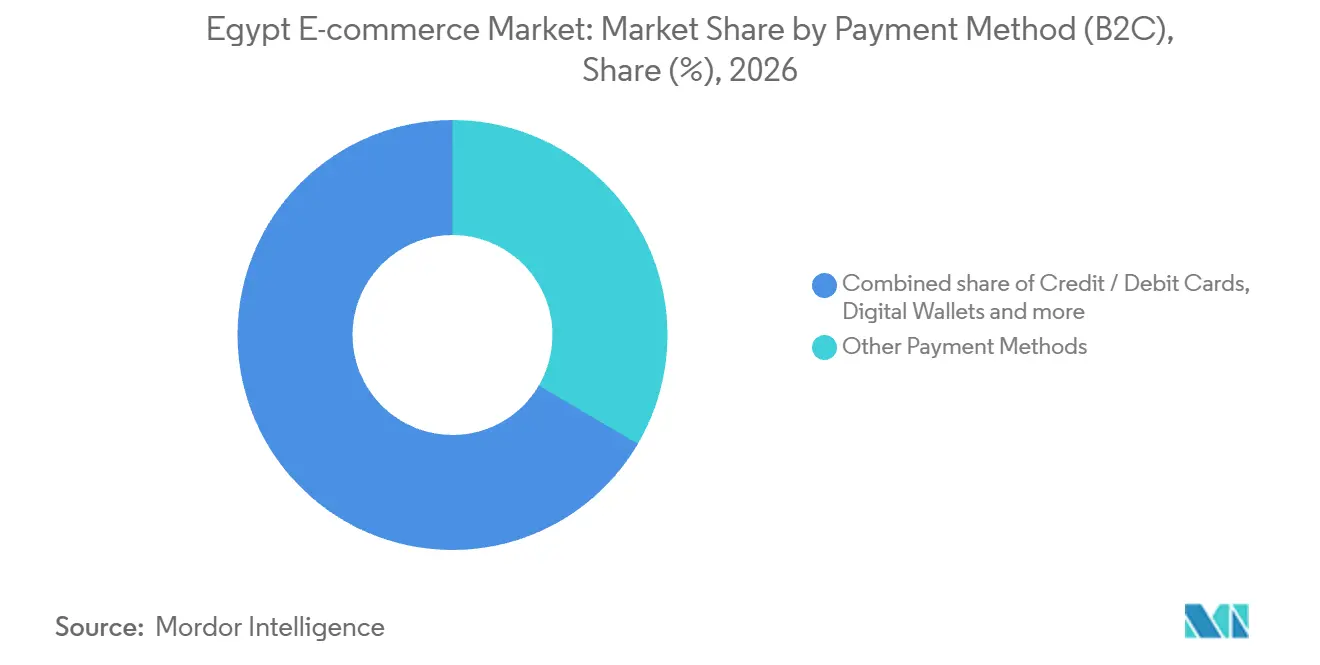
- For payment choice, other payment methods held 33.45% of B2C e-commerce spending in 2026, while digital wallets form the fastest-growing segment, with a 14.8% CAGR from 2027 to 2032.
- Across product categories, consumer electronics accounted for a 21.59% share of B2C e-commerce spending in 2026, and food and beverages form the fastest-growing segment, with a 15.9% CAGR from 2027 to 2032.
- Geographically, Greater Cairo holds the largest share of e-commerce transaction value in Egypt, with consumer density supporting local delivery scale.
Note: Market numbers in this report are based on Mordor Intelligence's proprietary estimation framework, which combines nine months of actuals with Q4 projections for base year 2026.
Market Trends and Insights
Drivers Impact Analysis of Egypt E-commerce Market*
| Driver | (~) % Impact on CAGR Forecast | Geographic Relevance | Impact Timeline |
|---|---|---|---|
| Mobile-Wallet Adoption Driven by Egypt's Less Cash Transformation Framework | +4.5% | Nationwide | Short term (≤ 2 years) |
| Gen-Z Social-Commerce Surge via TikTok and Instagram | +3% | Nationwide | Short term (≤ 2 years) |
| Expansion of Dark-Stores and Q-commerce in Cairo and Alexandria | +2.8% | Cairo, Alexandria, Giza, and Mansoura | Short term (≤ 2 years) |
| Government Export-Oriented Logistics Parks Boosting Cross-Border Fulfillment | +2% | KEZAD East Port Said | Long term (≥ 4 years) |
| National Digital Financial Identity Platform Expected to Lower KYC Friction | +0.5% | Nationwide | Medium term (2-4 years) |
| Widening 4G/5G Coverage Enhancing Rural Delivery Feasibility | +1% | Nationwide | Medium term (2-4 years) |
| Source: Mordor Intelligence | |||
Mobile-Wallet Adoption Driven by Egypt's Less Cash Transformation Framework
Mobile-wallet adoption expands the pool of payment accounts that online retailers can serve through an integrated checkout. The National Telecom Regulatory Authority (NTRA) reported that telecom-company mobile wallets in Egypt rose 23% to 57.01 million in H1 2026 versus H1 2025.[1] Financial transactions through those wallets increased 62% to 2.22 billion over the same comparison period. The transaction count grew faster than the account base, making use of existing wallets commercially relevant alongside the acquisition of additional accounts. Retail checkout can become an additional use for these accounts when merchants support wallet acceptance. For providers, merchant integration connects telecom-wallet distribution to retail demand, allowing account holders to pay through an existing financial service.
Gen-Z Social-Commerce Surge via TikTok and Instagram
Social-commerce demand depends on how easily a young buyer can move from encountering a product to placing a complete order. For a seller reaching Gen Z through TikTok or Instagram, the commercial task is to preserve product, price, and delivery details as that interest becomes a transaction. If those details must be reconstructed in a separate conversation, the buyer and seller have more work to complete before an order can be confirmed. A clear handoff can carry the chosen item and agreed terms into payment and fulfillment, making the social channel usable for direct selling. A retailer can then handle more social inquiries through the same ordering steps, limiting the work needed to establish the terms of each sale.
Expansion of Dark-Stores and Q-commerce in Cairo and Alexandria
Fast grocery delivery depends on placing stock within practical reach of the households making the order. In its December 2025 review, the International Finance Corporation (IFC) described Breadfast as operating 49 dark-store fulfillment points across Cairo, Alexandria, Giza, and Mansoura.[2] Its app-based grocery service offered delivery in under 60 minutes. Breadfast operated the platform and fulfillment points while outsourcing logistics and its delivery fleet, mainly using third-party vehicles. This configuration separates control of local product availability from ownership of the vehicles completing the journey. Grocery replenishment can consequently become an online purchasing occasion within the service area, making fulfillment-point placement central to where a short delivery promise is commercially feasible.
Government Export-Oriented Logistics Parks Boosting Cross-Border Fulfillment
Cross-border fulfillment depends on usable logistics infrastructure, so preparatory works matter through the capacity they may eventually support. AD Ports Group reported in its 2025 annual report that preparatory works began at KEZAD East Port Said under an agreement with the Suez Canal Economic Zone authority. The industrial and logistics zone plan comprised 20 square kilometers and a 2.8-square-kilometer first phase, which AD Ports described as scheduled to enter development. The report identified infrastructure delivery, anchor-tenant engagement, and phased land release as the planned focus for 2026. Phased land release makes the first parcel's development schedule the basis for assessing the timing and scale of initial additions to goods-handling capacity.
Restraints Impact Analysis of Egypt E-commerce Market*
| Restraint | (~) % Impact on CAGR Forecast | Geographic Relevance | Impact Timeline |
|---|---|---|---|
| FX Volatility Inflating Import Costs for Online Retailers | -1.3% | Nationwide | Short term (≤ 2 years) |
| Fragmented Last-Mile Networks Outside Tier-1 Cities | -0.7% | North Coast compounds | Medium term (2-4 years) |
| Persistent Consumer Trust Gap Around Online Fraud and Returns | -0.3% | Nationwide | Medium term (2-4 years) |
| Customs Clearance Delays on Small Parcels | -0.2% | Nationwide | Short term (≤ 2 years) |
| Source: Mordor Intelligence | |||
FX Volatility Inflating Import Costs for Online Retailers
Import-dependent online retailers face a currency mismatch when suppliers invoice in foreign currency and customers pay in Egyptian pounds. A weaker pound then raises the local-currency amount needed to replace the same merchandise, even if the foreign supplier leaves its price unchanged. Passing that increase through makes the next order more expensive for the buyer, while absorbing it reduces what the retailer retains from the sale. The timing matters because merchandise sold before a currency move may have to be replaced afterward at a higher pound cost. That exposure can constrain the breadth of imported offers a retailer can replenish without raising prices, leaving availability and affordability tied to replacement cost.
Fragmented Last-Mile Networks Outside Tier-1 Cities
Outside dense urban routes, distance between stops can make delivery coverage commercially difficult even when customers want online orders. In July 2026, former Jumia Egypt CEO Abdellatif Olama said long distances between North Coast compounds and low delivery density made last-mile delivery less viable than in Greater Cairo. Time spent traveling between customers leaves fewer opportunities to spread a rider's operating cost across completed deliveries. That weakens the economics of offering the same delivery promise across dense neighborhoods and dispersed coastal compounds. Amazon Egypt operated seasonal North Coast micro-fulfillment centers in summer 2026, positioning inventory near customers instead of fulfilling from Cairo. Local stock can shorten the approach journey, while dispersed final stops impose a separate cost on each delivery.
*Our forecasts treat driver/restraint impacts as directional, not additive. The impact forecasts reflect baseline growth, mix effects, and variable interactions.
Egypt E-commerce Market Segment Analysis
By Business Model:
Consumer Reach and Business ProcurementB2C was the largest segment, accounting for 86.89% of e-commerce spending in 2026. Visa's January to February 2026 study found that 85% of surveyed consumers in Egypt had purchased products directly through social media platforms.[3] That participation places consumer demand in a channel where product discovery and the purchase itself can occur together. For a retailer, social transactions can extend customer access beyond a dedicated store website while preserving a direct route to a sale. Sellers that link a social conversation to a card or wallet checkout can turn that participation into trackable orders instead of informal exchanges.
B2B is the fastest-growing segment, with a forecast CAGR of 15% from 2027 to 2032. In 2025, EFG Finance transferred its ownership in Fatura, an Egypt-based B2B e-commerce marketplace, to MaxAB-Wasoko. The buyer operates an e-commerce and supply-chain platform, placing the marketplace within an organization spanning commercial transactions and goods movement. For business purchasers, the potential benefit is a closer connection between placing an order and arranging its supply, provided the services are operationally coordinated. The acquisition makes execution across those functions a relevant way to compete for business demand, beyond access to an electronic product catalog.

By Device Type (B2C):
Mobile Access Shapes Digital RetailThe smartphone/mobile segment represented a 74.23% share of B2C e-commerce spending in 2026 and is forecast to be the fastest-growing segment, with a 14% CAGR from 2027 to 2032. NTRA reported 7.9 million additional users of Egypt's mobile-internet services and 12% higher mobile-internet use in a 24-hour comparison in 2026 with the same day in 2025. For retailers, the increasing mobile-access base creates more potential points of contact through which a shopper can reach an online storefront. Retailers can therefore compete for a purchasing role in that wider mobile activity, with usability becoming part of how connectivity is commercialized.
NTRA reported agreements signed on February 7, 2026, to allocate 410 MHz of new radio spectrum to Egypt's 4 mobile operators, in a deal valued at nearly USD 3.5 billion. Those allocation agreements create room for operators to develop mobile-network capacity, adding a technology investment dimension to the access base. For mobile-first retailers, the 410 MHz allocation matters once operators bring the new bands into service, because browsing and ordering sessions on those networks then have more capacity.
By Payment Method (B2C):
Cash Collection and Multipurpose WalletsOther payment methods were the largest segment, accounting for 33.45% of B2C e-commerce spending in 2026. In April 2026, AJ Market Egypt offered cash on delivery through its courier Bosta across its Egypt delivery zones, with a collection fee charged by Bosta. The operating mechanism connects payment to the physical handover of the parcel, giving the courier a role in completing the transaction. For shoppers using that option, a collection charge can become part of the cost of receiving an order. In this model, payment choice includes a delivery-linked service cost, making cash acceptance and courier collection parts of one retail offer.
Digital wallets form the fastest-growing segment, with a forecast CAGR of 14.8% from 2027 to 2032. NTRA reported that payments for donations, utility bills, shopping, and similar items accounted for 4% of transaction count on Egypt's telecom-company mobile wallets in H1 2026. Merchant acceptance could let a customer use the same payment instrument for an order and for those other financial purposes. The commercial task is to secure that checkout choice, since a multipurpose account alone does not establish demand for an online purchase.
By Product Category (B2C):
Electronics Supply and Food SelectionConsumer electronics accounted for a 21.59% share of B2C e-commerce spending in 2026. Samsung's Beni Suef plant produced approximately 2.2 million mobile phones and 600,000 tablets for Egypt's local market in 2025. That output establishes a domestic product base around which retailers can build their consumer-electronics offers. For an online seller, the opportunity is to connect specific device specifications with the model the buyer expects to receive, using product information to make comparison practical. Production and the route to the buyer are separate commercial functions, allowing online sellers to compete through presentation and execution around locally made devices.
Food and beverages form the fastest-growing segment, with a forecast CAGR of 15.9% from 2027 to 2032. The US Department of Agriculture's Foreign Agricultural Service said in its 2025 Egypt retail-food report that services such as Talabat, Breadfast, and Rabbit gave consumers access to hundreds of food options, including international cuisine. Delivery can let a buyer reach a wider food assortment through an ordering service, making variety part of the commercial offer. Providers can compete by connecting distinctive food options with a delivery promise that fits the purchase occasion. The resulting opening is a food-retail relationship built around selection and access, with fulfillment supporting the range a buyer can reach.
Geography Analysis
Greater Cairo E-commerce Market
Greater Cairo accounts for the largest share of e-commerce transaction value in Egypt. In July 2026, former Jumia Egypt CEO Abdellatif Olama described Greater Cairo's density as a source of critical mass for e-commerce delivery. Olama put Greater Cairo's population at 22 million, indicating a very large customer base within a dense delivery catchment. Additional orders within existing coverage can therefore raise the return on delivery capacity without requiring a wider service footprint.
Alexandria's demand pattern includes a seasonal opportunity that calls for a different capacity decision from a permanent increase in coverage. Alexandria experienced a summer consumer-activity spike as many consumers relocated there in 2026, according to EnterpriseAM's reporting of a Platformance finding. For retailers serving that influx, temporary concentration of orders would make adjustable local stock and delivery capacity more useful than commitments based on a year-round demand assumption. That favors seasonal capacity commitments in Alexandria, where a demand peak can improve access to summer customers without justifying the same fixed cost throughout the year.
Regional online retail can also develop through a store operator's own digital channel, as illustrated by a completed Mansoura expansion. Spinneys Egypt opened its first Dakahlia branch in Mansoura on May 6, 2025, offering online orders through its website and mobile app. This combination gives buyers a local retail presence alongside a direct way to submit orders from a distance. The operator can organize that relationship around its own assortment and customer communication, without having to rely exclusively on an independent marketplace. A regional store operator can thus extend its retail relationship online, making the local branch a customer-access asset as well as a place to buy.
Regulatory Framework and Outlook
The comparison of selected jurisdictions evaluates national consumer duties and regulated signature services alongside Cairo Governorate's shop licensing from the perspective of online retailers operating physical shops. Egypt's Consumer Protection Law requires essential product information and clear Arabic customer documents. The Information Technology Industry Development Agency (ITIDA) licenses digital-signature and electronic-seal providers under Law No. 15 of 2004. These frameworks make customer communication and the choice of regulated services distinct parts of organizing an online retail business.
Regulatory Table of Egypt E-commerce Market
| Decision factor | Egypt | Cairo Governorate |
|---|---|---|
| Primary authority | Consumer Protection Agency for consumer sales; ITIDA for signature services | Cairo Governorate and neighborhood licensing centers |
| Key instruments or direction | Consumer Protection Law No. 181 of 2018; digital-signature Law No. 15 of 2004 | National public-shop Law No. 154 of 2019 and its executive regulations, administered locally |
| Commercial effect | Product information and Arabic documents; written remote-contract notices subject to Consumer Protection Agency board exceptions | Local licensing for applicable public shops |
| Current policy attractiveness | Medium | Medium |
| Future direction of policy attractiveness | No change | No change |
| Source: Mordor Intelligence | ||
National attractiveness is Medium because defined consumer duties and regulated signature services provide a stable basis for organizing online sales. The No change outlook rests on those continuing information and contracting requirements, which keep communication work part of retail operations. Cairo's Medium rating reflects the additional premises-licensing process for applicable public shops, administered through neighborhood centers. Its No change outlook follows the underlying licensing requirement, while the August 2026 online-application discussion concerned how applications could be submitted.
Value Chain Stages
Value capture differs across marketplace access, payment processing, and physical fulfillment. Amazon charges category-based referral fees, while Jumia charges sellers commissions on successful sales. Participating sellers store products in Amazon facilities, where Amazon picks, packs, ships, and provides customer service. These models distribute supplier earnings between access to a transaction and handling the goods, making fulfillment depth a separate commercial choice.
Value Chain Analysis Table of Egypt E-commerce Market
| Primary activity | Key participants | Value capture | Bottleneck | Resilience response |
|---|---|---|---|---|
| Marketplace listing and order capture | Marketplace operators such as Amazon Egypt and Jumia Egypt | Category-based referral fees for Amazon; successful-sale commissions for Jumia | Aligning category fees with product economics | Assess listings by net proceeds after category fees |
| Payment processing and settlement | Payment-gateway providers such as Paymob | Transaction fees with percentage and fixed components, without monthly or subscription fees | Time between payment and weekly bank settlement | Reconcile order records to payouts and align payment commitments with settlement |
| Storage, packing, and dispatch | Fulfillment operators such as Amazon Egypt | Per-unit fulfillment fees varying by size; monthly storage fees based on daily average stored volume | Stored goods accumulate volume-based charges before dispatch | Replenish against order velocity to limit storage dwell time |
| Source: Mordor Intelligence | ||||
A commission-only comparison can miss the combined cost of payment processing and goods waiting in storage. Sellers benefit from matching order confirmation, dispatch, and expected cash receipt across these stages, particularly when different providers perform them. The strongest integration opening is the handoff between a paid order and a released parcel, where coordinated records can reduce manual reconciliation.
Competitive Landscape
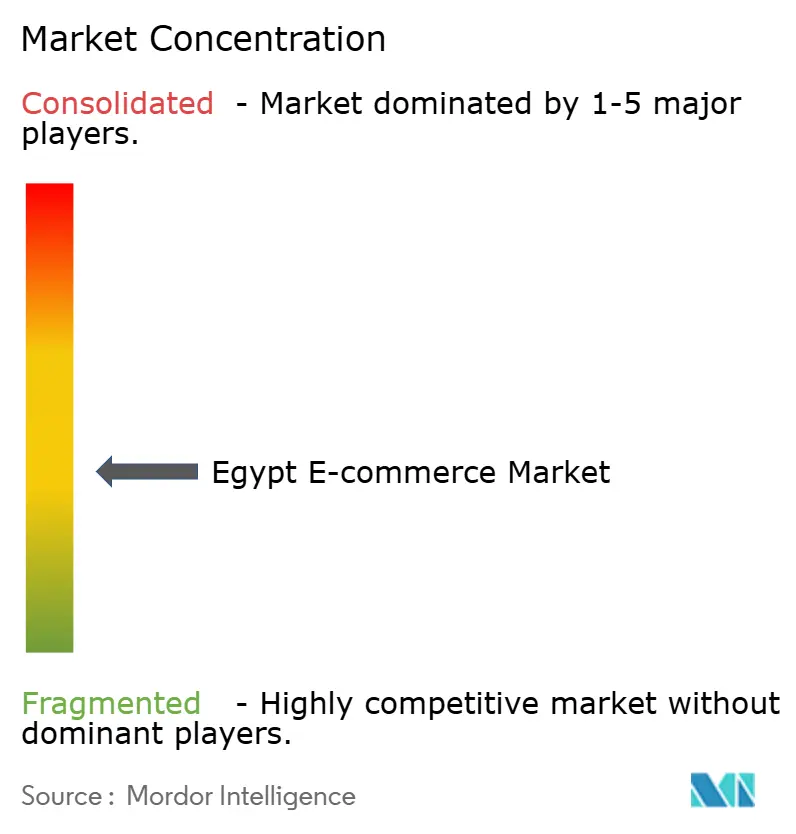
Competition combines broad marketplaces and specialist retail channels, with participants including Amazon.com Inc., LC Waikiki Mağazacılık Hizmetleri Ticaret A.Ş., Watches Prime Egypt for Trading LLC, Jumia Technologies AG, and El Araby Co. for Trading & Manufacturing (S.A.E.). Amazon offers Fulfillment by Amazon (FBA), Easy Ship, and self-shipping options to Egyptian sellers. Amazon announced referral-fee changes in 15 Egypt product categories and higher FBA, Seller Flex, and Easy Ship fulfillment fees effective May 1, 2025. That range of selling and fulfillment choices makes seller unit economics a source of competition alongside customer reach.
Watches Prime sells watches and related accessories through its Egyptian online store, illustrating a specialist model that can focus discovery on a product family. On July 16, 2025, Jumia Egypt launched Egyptian-dialect voice ordering with Arabic-language technology provider Intella's Ziila assistant, allowing users to browse and order products using spoken commands in place of typing and manual search. Specialists can narrow the buyer's search through category focus, while a marketplace can make its assortment more accessible through an additional ordering interface. Jumia reported company-wide GMV growth of 38% year over year in fourth-quarter 2025, partly offset by lower corporate sales in Egypt as it deprioritized that segment. Jumia's decision to deprioritize Egyptian corporate sales while adding spoken ordering for consumers points its Egypt effort toward consumer marketplace buyers.
Consumer protection rules set a common baseline for how orders are handled after acceptance. Egypt's Consumer Protection Law 181 of 2018 requires confirmed consent for distance contracts. Article 38 gives consumers 7 working days from acceptance to correct or modify an accepted order, unless the parties agree to more time, in the manner specified by the Executive Regulations. Retailers can connect these rights to practical execution by preserving accepted instructions and passing requested changes to the team handling the goods. Because these duties bind every supplier, marketplaces and specialists meet the same order-amendment standard, leaving assortment, fees, and delivery as competitive choices around that common right.
Egypt E-commerce Industry Leaders
-
Amazon.com Inc.
-
LC Waikiki Mağazacılık Hizmetleri Ticaret A.Ş.
-
Watches Prime Egypt for Trading LLC
-
Jumia Technologies AG
-
El Araby Co. for Trading & Manufacturing (S.A.E.)
- *Disclaimer: Major Players sorted in no particular order
Egypt E-commerce Market Companies Covered in this Report
- Amazon.com Inc.
- Jumia Technologies AG
- LC Waikiki Mağazacılık Hizmetleri Ticaret A.Ş.
- Watches Prime Egypt for Trading LLC
- El Araby Co. for Trading & Manufacturing (S.A.E.)
- MaxAB for Trade & Distribution LLC
- Homzmart Commerce Technologies LLC
- Delivery Hero Egypt S.A.E.
- Fawry for Banking & Payment Technology Services S.A.E.
- Noon AD Holdings Ltd.
- B.TECH Trading and Distribution
- Carrefour Egypt (Majid Al Futtaim Hypermarkets Egypt LLC)
- Hanimex Household Appliances Co. S.A.E.
- ED Furniture & Homeware Trading LLC
- Okhtein for Manufacturing Bags & Accessories LLC
- Manzzeli for E-Commerce Services LLC
- Trade Line Stores Co. S.A.E.
- CairoCart Electronics & Appliances Trading LLC
- SHEIN Group Ltd.
- Dubizzle Egypt for E-Commerce Services LLC
- Jumia Electronic Payment Services S.A.E.
Key Opportunities for Market Participants
The opportunities compare assistance with product choice, occasion-based recommendations, and buyer-controlled checkout. Visa's January to February 2026 study found that 91% of surveyed consumers in Egypt had used artificial intelligence (AI) tools to assist shopping. The same study found that 38% would trust AI agents to complete checkout on their behalf. These findings favor services that help users decide while leaving payment authorization within their control.
Market Opportunities Table of Egypt E-commerce Market
| Opportunity | Why now | Buyer / lead segment | Recommended play | Main barrier | Likely beneficiaries |
|---|---|---|---|---|---|
| Assisted product comparison | Surveyed shoppers used AI to compare prices | Online buyers comparing alternative products | Present comparable product information and link the selected item to merchant checkout | Maintaining accurate comparisons across changing offers | Online retailers and commerce-software providers |
| Occasion-based gift recommendations | Gift ideas were among surveyed uses of shopping assistance | Buyers choosing gifts online | Recommend a focused assortment with visible merchant, product details, and delivery terms | Matching the suggestion to the recipient's preferences | Specialist online retailers and recommendation providers |
| Buyer-controlled assisted checkout | Surveyed consumers used AI to assist shopping | Shoppers willing to use assistance while retaining payment control | Require explicit confirmation of the item, merchant, and final amount before payment | Limited stated trust in agent-led checkout | Online merchants and checkout-service providers |
| Source: Mordor Intelligence | |||||
The nearer-term opening is comparison and gift selection, where surveyed shoppers had used AI, while agent-completed checkout depends on trust that fewer than half expressed in Visa's January to February 2026 study. A retailer can let an assistant narrow the choices and present the final transaction details, then request the customer's confirmation. That structure gives the merchant a clearer boundary between influencing a purchase and receiving permission to execute it.
Recent Industry Developments in Egypt E-commerce Market
- Aug 2026: The Central Bank of Egypt approved regulations for a digital financial identity platform intended to let customers open bank accounts and access banking services through digital channels without visiting branches.
- Feb 2026: Mubadala joined Breadfast's USD 50 million pre-Series C round, investing alongside other participants in the Egyptian e-grocery and delivery platform.
- Dec 2025: The Egyptian Customs Authority and Korea Customs Service signed an MOU for Korean support with automating Egypt's express-cargo logistics and modernizing customs systems.
Egypt E-commerce Market Report Scope and Research Methodology
Market Definition and Coverage
The Egypt e-commerce market measures annual gross order value in USD for goods and digitally delivered services ordered online by buyers in Egypt, across business-to-consumer and business-to-business transactions. B2C orders are classified by ordering device, payment method, and product category.
Scope exclusions: Offline-only orders, informal consumer-to-consumer trades arranged through social media or classified listings without an electronic payment trail, online orders by buyers outside Egypt, and separately billed marketplace, payment-processing, and courier-service revenues are excluded.
Segments Covered in This Report
- By Business Model
- B2C
- B2B
- By Device Type (B2C)
- Smartphone / Mobile
- Desktop and Laptop
- Other Device Types
- By Payment Method (B2C)
- Credit / Debit Cards
- Digital Wallets
- BNPL
- Other Payment Methods
- By Product Category (B2C)
- Beauty and Personal Care
- Consumer Electronics
- Fashion and Apparel
- Food and Beverages
- Furniture and Home
- Toys, DIY and Media
- Other Product Categories
Data Sources, Market Sizing, and Validation
Desk Research
Public indicators from the National Telecommunications Regulatory Authority and Central Bank of Egypt, such as mobile-wallet use and financial inclusion measures, help track the payment environment. World Bank Development Indicators provide Egypt-specific GDP, inflation, and internet-use series for demand context. International Finance Corporation disclosures, for example, describe Egypt's online grocery and fulfillment operations, which help contextualize order execution and delivery coverage.
Company filings, investor materials, official registries, customs and regulatory notices, and reputable Egyptian business press can corroborate platform activity, seller economics, cross-border trade, and logistics changes. These sources are illustrative rather than exhaustive, and further sources inform collection, validation and clarification.
Primary Interviews and Surveys
Structured interviews and a targeted survey can include marketplace and direct-retail executives, B2B procurement platforms, payment providers, fulfillment operators, and category specialists working in Egypt. Their evidence can test secondary findings about transaction values, online ordering, payment mix, category shares, and delivery reach, while follow-up questions clarify differences in definitions or measurement periods. Where a data point remains unavailable, the analyst can triangulate published order indicators with respondent explanations and selective seller or channel checks, keeping estimates within the defined Egypt buyer boundary.
Distribution of primary research fieldwork respondents
| Company type | Respondent position | Region |
|---|---|---|
| Top tier: 35% | CXOs: 20% | |
| Mid tier: 45% | Functional/Unit leaders: 35% | |
| Smaller Players: 20% | Managers: 45% |
Market-Sizing & Forecasting
The model starts with a top-down estimate of Egypt's annual gross value of online orders, separating B2C and B2B transactions and keeping the unit in USD. Useful indicators include internet use and population to frame the reachable buyer base, household consumption and GDP to track spending capacity, mobile-wallet activity to gauge digital payment readiness, and exchange rates and consumer prices to interpret changes in nominal order value. Historical demand indicators can be extended with time-series trend methods, while scenario analysis tests how shifts in currency, online access, and delivery capacity could alter the 2027-2032 path.
Segment shares are derived from evidence on order value by business model and, within B2C, ordering device, payment method, and product category, with each split reconciled to its parent total. Selective bottom-up checks can multiply sampled average order values by order volumes for chosen sellers or channels and roll up the results as a reasonableness check, not as a complete bottom-up market build. When order volume or average order value is missing, the analyst can use the closest Egypt-specific public indicator and explain the proxy internally, then check its direction with interview evidence and independent source series. Separately billed platform, payment, and courier fees remain outside order value.
Data Validation & Update Cycle
Analysts triangulate the market estimate and segment shares across independent public series, company disclosures, channel evidence, and primary responses, then investigate material variances in year, unit, currency, and transaction boundary before sign-off. A second analyst reviews source traceability, arithmetic, and outliers, with re-contact triggered by unexplained conflicts, unclear respondent definitions, or material changes in order or payment patterns. The model is refreshed annually, revisited sooner after material regulatory, currency, or infrastructure events, and receives a fresh pre-delivery source and calculation review.
Mordor Intelligence's Egypt Ecommerce Market Size Compared Against Other Published Estimates
Published estimates can differ in the transactions and products they count and the inputs used to model demand. The Egypt e-commerce market measures annual gross order value in USD for goods and digitally delivered services ordered online by buyers in Egypt, across business-to-consumer and business-to-business transactions.
Key Gap Drivers include the study's defined coverage and market-specific modeling choices. Useful indicators include internet use and population to frame the reachable buyer base, household consumption and GDP to track spending capacity, mobile-wallet activity to gauge digital payment readiness, and exchange rates and consumer prices to interpret changes in nominal order value.
Benchmark comparison
| Source | Market Size | Gaps in Research Methodology |
|---|---|---|
| Mordor Intelligence | USD 12.86 B (2027) | |
| Regional Consultancy A | USD 10.39 B (2025) | At its 2025 base, this estimate is 19.2% below this report's 2027 value of USD 12.86 B, 2 years later. The 2025 base predates the comparison year, and the publisher's forecast continues to rise through 2030. |
| Global Consultancy B | USD 14.9 B (2028) | At its 2028 base, this estimate is 15.9% above this report's 2027 value of USD 12.86 B, 1 year earlier. The later GMV forecast year and coverage of travel, hospitality, online food, media, healthcare, and technology verticals extend beyond the report's order-value pool. |
Mordor Intelligence's analysts triangulate the market estimate and segment shares across independent public series, company disclosures, channel evidence, and primary responses, then investigate material variances in year, unit, currency, and transaction boundary before sign-off.
Key Questions Answered in the Report
What is the Egypt e-commerce market size and growth outlook?
The size is projected at USD 12.86 billion in 2027 and USD 22.2 billion by 2032, growing at a CAGR of 11.54% from 2027 to 2032.
What drives growth in Egyptian online retail?
Egypt's telecom-company wallets reached 57.01 million in H1 2026, expanding the potential payment base for retailers, while local grocery fulfillment can make online orders practical.
Which business model leads Egyptian online sales?
B2C led with 86.89% of e-commerce spending in 2026, and B2B is forecast to grow fastest at a CAGR of 15% from 2027 to 2032.
Which companies compete in Egyptian online retail?
Amazon and Jumia operate marketplaces, while Watches Prime sells watches and related accessories online.
What limits delivery-led growth for Egyptian online retailers?
Long distances between North Coast compounds and low delivery density weakened route economics, as former Jumia Egypt CEO Abdellatif Olama explained in July 2026. Local fulfillment can shorten the approach journey, while dispersed final stops add cost.
Which location leads Egyptian e-commerce transaction value?
Greater Cairo holds the largest share of transaction value. Alexandria's summer 2026 consumer influx illustrates a different seasonal opportunity.