
Egg Freezing And Embryo Banking Market Size and Share
Market Overview
| Study Period | 2019 - 2030 |
|---|---|
| Market Size (2025) | USD 5.51 Billion |
| Market Size (2030) | USD 10.80 Billion |
| Growth Rate (2025 - 2030) | 15.30 % |
| Fastest Growing Market | Asia Pacific |
| Largest Market | North America |
| Market Concentration | Medium |
Major Players *Disclaimer: Major Players sorted in no particular order Image © Mordor Intelligence. Reuse requires attribution under CC BY 4.0. | |
Egg Freezing And Embryo Banking Market Analysis by Mordor Intelligence
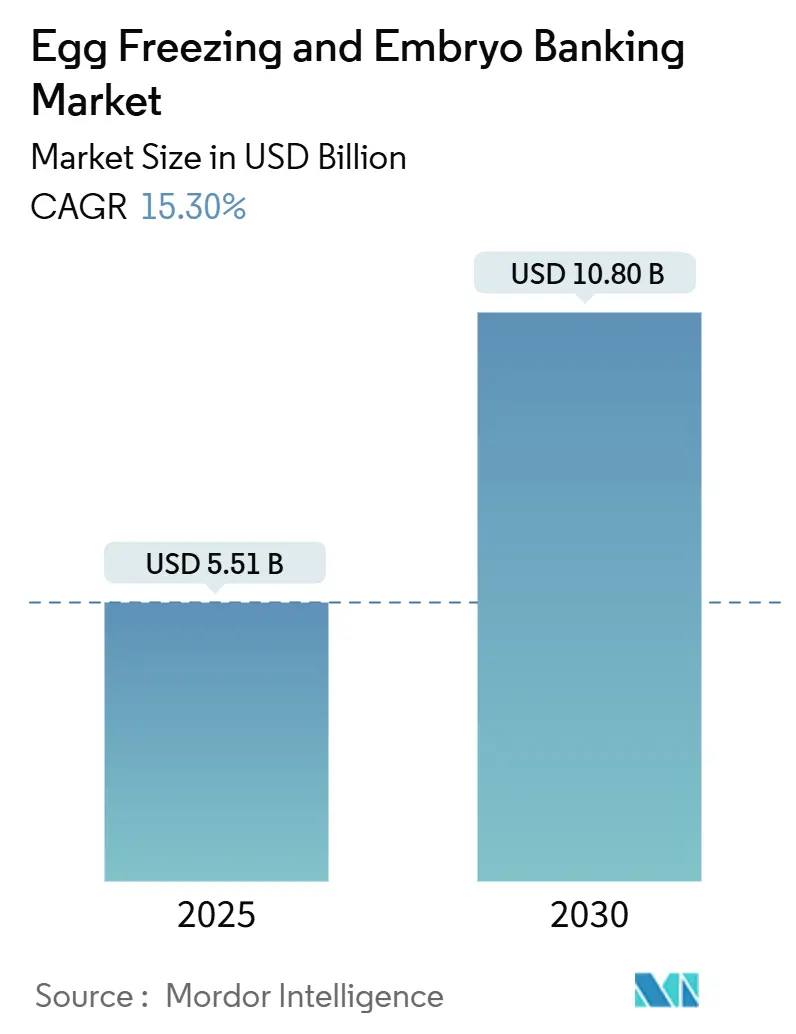
The egg freezing and embryo banking market size reached USD 5.51 billion in 2025 and is forecast to climb to USD 10.8 billion by 2030, advancing at a 15.3% CAGR. Momentum in the egg freezing and embryo banking market is propelled by delayed parenthood among millennials, the rapid adoption of vitrification protocols that limit ice-crystal damage, and insurance mandates now active in 16 U.S. states. Growing private-equity activity, exemplified by KKR’s multi-billion-dollar roll-ups, signals confidence in recurring revenue streams, while robotics and AI-based embryo scoring are raising laboratory throughput and success rates. On the demand side, 1 in 6 adults worldwide struggle with infertility, creating a sizable treatment gap that is particularly acute in Asia Pacific.
Key Report Takeaways
- By preservation type, embryo freezing led with 73.5% egg freezing and embryo banking market share in 2024; egg freezing is projected to expand at an 18.6% CAGR to 2030.
- By preservation method, vitrification captured 84.8% of the egg freezing and embryo banking market size in 2024 and is advancing at a 17.8% CAGR through 2030.
- By end user, IVF clinics commanded 66.7% share of the egg freezing and embryo banking market size in 2024, while cryobanks and biobanks record the highest projected CAGR at 15.9% through 2030.
- By patient age, individuals over 35 years held 45.6% share in 2024, but the under-35 group is set to grow at a 20.5% CAGR through 2030.
- By donor status, non-donor cycles represented 55.9% of the egg freezing and embryo banking market size in 2024, whereas donor cycles are forecast to rise at a 16.4% CAGR to 2030.
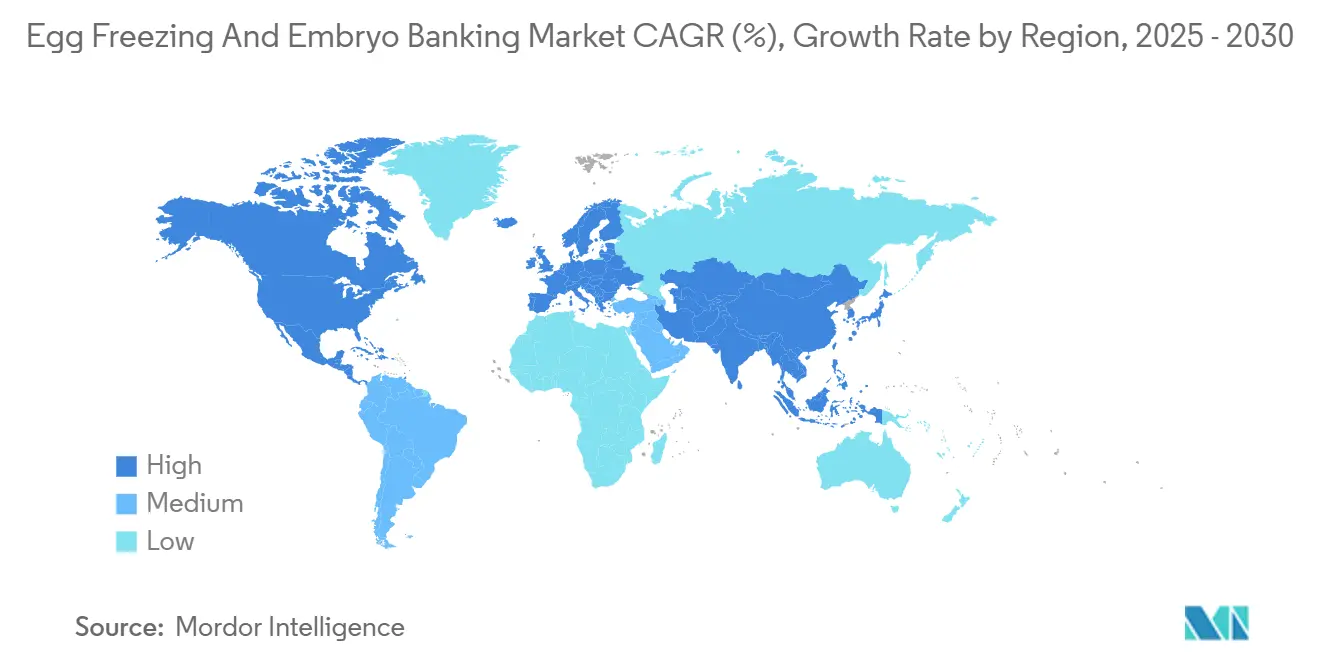
- By geography, North America accounted for 36.2% of the egg freezing and embryo banking market share in 2024; Asia Pacific is the fastest-growing region with a 16.8% CAGR to 2030.
Note: Market size and forecast figures in this report are generated using Mordor Intelligence’s proprietary estimation framework, updated with the latest available data and insights as of January 2026.
Market Trends and Insights
Drivers Impact Analysis of Egg Freezing And Embryo Banking Market*
| Driver | (~) % Impact on CAGR Forecast | Geographic Relevance | Impact Timeline |
|---|---|---|---|
| Elective Egg Freezing and Embryo Banking Surge | +4.20% | Global, with concentration in North America & Europe | Medium term (2-4 years) |
| Advances In Vitrification Techniques | +3.80% | Global, led by developed markets | Long term (≥ 4 years) |
| Rising Infertility Prevalence & IVF Cycles | +3.10% | Global, particularly APAC and North America | Long term (≥ 4 years) |
| Employer/Insurance Coverage Expansion | +2.90% | North America & EU, expanding to APAC | Medium term (2-4 years) |
| Blockchain-Secured Cryostorage Adoption | +1.00% | North America, early adoption in EU | Long term (≥ 4 years) |
| Cross-Border Fertility Tourism Clusters | +0.30% | Global, concentrated in Europe-Asia corridors | Short term (≤ 2 years) |
| Source: Mordor Intelligence | |||
Elective Egg Freezing and Embryo Banking Surge
Corporate benefit programs are reshaping fertility planning as 88% of U.S. employees say they would switch jobs for better coverage, up from 30% employer adoption in 2020 to 40% today.[1]Securian Financial, “Snapshot: August 2024,” Securian Financial, securian.com Mainstream acceptance of social egg freezing gained pace after the pandemic, with France and Singapore legalizing age-bound elective procedures that underscore reproductive autonomy. Large retailers, technology firms, and media companies have integrated fertility credits, prompting parallel legislative support across several U.S. states. The knock-on effect is a steep rise in the number of preservation cycles, feeding sustained demand in the egg freezing and embryo banking market.
Advances in Vitrification Techniques
Universal warming media now reach 94% post-thaw survival across clinics, standardizing outcomes and trimming warming time by up to 90% compared with legacy methods.[2]Paula Troncoso-Perez et al., “Application of a Single ‘Universal Warming Protocol’ for Vitrified Donor Oocytes: A Multicenter Study,” Journal of Assisted Reproduction and Genetics, springer.com Closed-system MicroSecure Vitrification yields >95% embryo viability while eliminating cross-contamination risk. Mayo Clinic data confirm superior stromal preservation over slow freezing, prompting widespread protocol shifts. Smart cryotanks equipped with RFID provide real-time monitoring, further boosting confidence in the egg freezing and embryo banking market.
Rising Infertility Prevalence & IVF Cycles
The World Health Organization estimates that 1 in 6 adults experience infertility, yet IVF still accounts for <1% of global births.[3]World Health Organization, “Infertility,” WHO Fact Sheet, who.int Asia Pacific illustrates unmet demand, with its IVF sector projected to double value between 2020 and 2028. AI-assisted embryo selection now hits 93% predictive accuracy, accelerating adoption across high-volume centers. Cross-border fertility tourism adds 24,000–30,000 European treatment cycles per year, further channeling patients into the egg freezing and embryo banking market.
Employer/Insurance Coverage Expansion
California’s SB 729 mandates coverage for three oocyte retrieval cycles plus unlimited embryo transfers starting July 2025. Massachusetts and New York have likewise specified fertility-preservation benefits, while U.S. federal employee plans began reimbursing standard cryopreservation in 2023. Commercial insurers are responding: Aetna enlarged its fertile-care formulary, and Cigna refined access to family-building benefits. As more states replicate these mandates, added volumes are likely to reinforce revenue visibility for providers in the egg freezing and embryo banking market.
Restraints Impact Analysis of Egg Freezing And Embryo Banking Market*
| Restraint | (~) % Impact on CAGR Forecast | Geographic Relevance | Impact Timeline |
|---|---|---|---|
| High Procedural & Storage Costs | -2.80% | Global, particularly acute in developing markets | Medium term (2-4 years) |
| Variable Success Rates & Policy Uncertainty | -1.90% | Global, regulatory disparities across regions | Long term (≥ 4 years) |
| Embryo-Ownership Legal/Ethical Disputes | -0.80% | North America & EU, emerging in APAC | Medium term (2-4 years) |
| Liquid-Nitrogen Supply Regulation Impact | -0.60% | Global, supply chain concentrated regions | Short term (≤ 2 years) |
| Source: Mordor Intelligence | |||
High Procedural & Storage Costs
Average U.S. egg-freezing fees run USD 10,000-15,000 per cycle, and IVF ranges USD 15,000-20,000, limiting accessibility amid uneven reimbursement. International patients often travel to lower-cost jurisdictions, yet logistics, visas, and post-treatment follow-ups add complexity. Long-term storage fees remain opaque, forcing some insurers to cap lifetime fertility benefits at USD 25,000 per member. Equipment failures add further cost burden, as shown by the USD 305.6 million settlement reserve tied to a cryotank malfunction that destroyed 4,000 specimens.
Variable Success Rates & Policy Uncertainty
Clinical outcomes fluctuate by patient age and clinic proficiency; despite AI tools, standardization remains elusive. Regulatory divergence complicates planning—while 39 European countries have assisted-reproduction laws, funding and eligibility differ widely. Quality lapses, such as faulty freezing media that prompted U.K. investigations, raise liability fears and may slow adoption. Heightened FDA inspections, including warning letters for inadequate donor screening, increase compliance costs that can compress margins.
*Our forecasts treat driver/restraint impacts as directional, not additive. The impact forecasts reflect baseline growth, mix effects, and variable interactions.
Egg Freezing And Embryo Banking Market Segment Analysis
By Preservation Type:
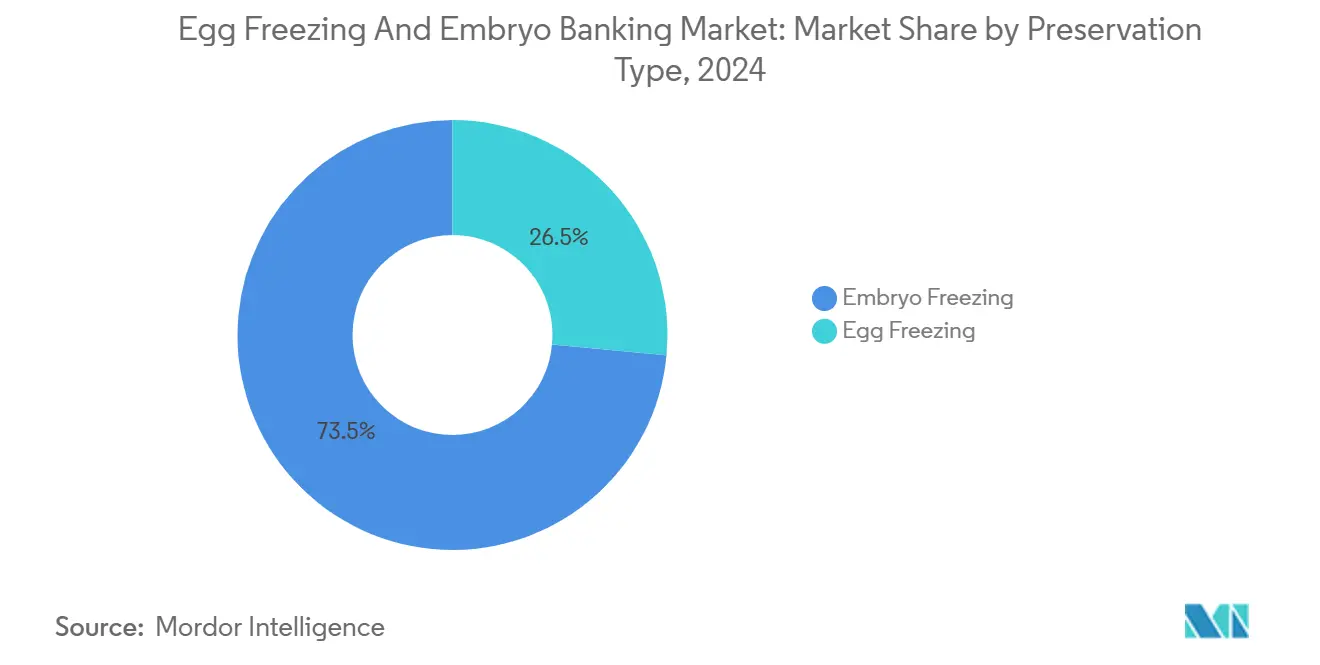
Embryo Banking Dominance Faces Egg Freezing DisruptionEmbryo freezing accounted for 73.5% of the egg freezing and embryo banking market share in 2024, reflecting its long-standing clinical success rates. Yet egg freezing is the growth pacesetter, registering an 18.6% CAGR on the back of professional women electing earlier preservation. Demand climbed fifteenfold in the United States within a decade, underlining social acceptance of proactive reproductive planning.
Improved AI-driven oocyte grading promises higher live-birth outcomes, narrowing the historical gap with embryos and reinforcing uptake in the egg freezing and embryo banking market. Regulators have broadened eligibility: France now allows voluntary egg freezing for women aged 29–37, and U.K. storage terms stretch to 55 years, obliging clinics to upgrade high-capacity dewars. Cross-border flows intensify as jurisdictions with restrictive embryo laws steer patients toward oocyte banking overseas, widening the customer base for the egg freezing and embryo banking market.



By Preservation Method:
Vitrification Supremacy Accelerates InnovationVitrification captured 84.8% of 2024 revenue, underscoring its effectiveness at preventing ice-crystal damage. With a 17.8% CAGR ahead, the method is scaling further due to rapid warming protocols that cut handling time by up to 90%.
Slow freezing retains niche roles in ovarian-tissue banking but loses share as universal warming media prove compatibility across multiple vitrification devices. Meanwhile, IoT-enabled cryostorage units alert staff to deviations in real-time, reducing error rates by 94% in pilot installations, a factor that strengthens confidence in the egg freezing and embryo banking market.
By End User:
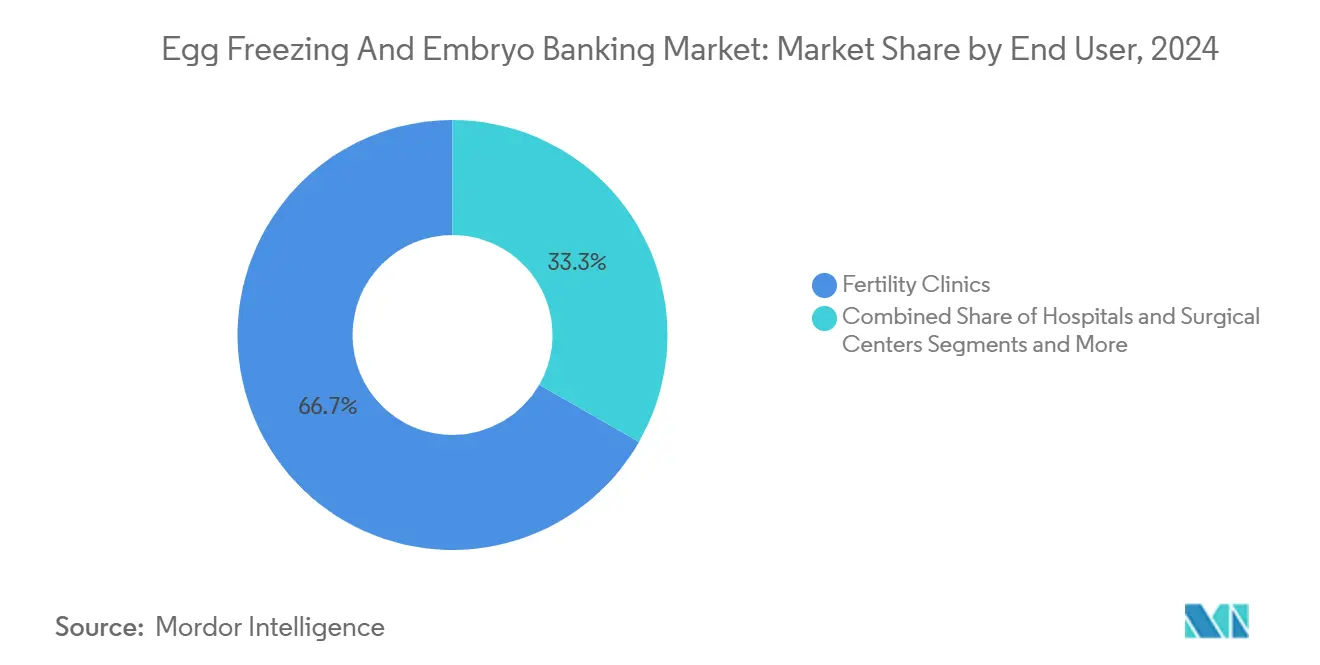
IVF Clinics Lead While Specialized Storage EmergesFertility clinics held 66.7% of the egg freezing and embryo banking market size in 2024, thanks to integrated retrieval-to-transfer services. Yet growth is stronger at cryobanks and biobanks, projected at 15.9% CAGR as clinics outsource storage to mitigate liability and space constraints.
Automated cryorobotics from TMRW Life Sciences now manage 25% of U.S. specimen loads, highlighting a shift toward dedicated repositories. Hospitals broaden oncofertility programs, funding fast-track oocyte retrieval for cancer patients before gonadotoxic therapy, a trend likely to propel incremental cycles into the egg freezing and embryo banking market.
By Patient Age Group:
Younger Demographics Drive Proactive PlanningPatients older than 35 years contributed 45.6% of 2024 revenue, reflecting traditional timing for fertility preservation. Nonetheless, the under-35 cohort is projected to grow at a 20.5% CAGR through 2030 as education and corporate sponsorship incentivize earlier action. Early intervention supports higher oocyte yield and better post-thaw survival, improving cumulative live-birth odds.
Insurers are updating age-based reimbursement; revised guidelines allow prophylactic freezing for women judged likely to experience infertility within 12 months, thereby channeling younger candidates into the egg freezing and embryo banking market.
By Donor Type:
Non-Donor Cycles Dominate Amid Donor GrowthAutologous (non-donor) cycles represented 55.9% of revenue in 2024 as patients prefer genetic continuity and fewer regulatory hurdles. Donor cycles, however, are expanding at 16.4% CAGR, driven by rising LGBTQ+ family building and cases of diminished ovarian reserve among older mothers. Strict FDA pathogen screening and EU traceability directives raise operational costs but also deter inexperienced entrants, indirectly favoring established players in the egg freezing and embryo banking market.
Spain and the Czech Republic dominate international donor programs due to liberal laws and cost-effective services, attracting European patients and bolstering transnational logistics providers that maintain cryogenic temperature control during shipment.
Geography Analysis
North America Egg Freezing and Embryo Banking Market
North America generated 36.2% of global revenue in 2024, powered by broad insurance mandates and federal employee plan coverage. Private-equity financing, such as KKR’s USD 3.25 billion IVIRMA acquisition, continues to consolidate fragmented practices, conferring scale efficiencies and nationwide branding. Automated cryostorage has been widely adopted, with 70+ U.S. clinics installing RFID-enabled smart tanks that cut specimen-mix-up risk in the egg freezing and embryo banking market.
APAC Egg Freezing and Embryo Banking Market
Asia Pacific is the fastest-growing territory, forecast at 16.8% CAGR through 2030, as fertility rates in China, Japan, and Singapore fall below replacement levels. Government-subsidized IVF cycles, combined with private clinics adopting AI-guided embryo scoring, are driving double-digit annual cycle growth. Cross-border surrogacy and lower treatment prices make India and Thailand hubs for medical tourists, deepening regional revenue pools for the egg freezing and embryo banking market.
Europe Egg Freezing and Embryo Banking Market
Europe retains a balanced but regulation-heavy environment. Forty-three nations have ART statutes, yet financing varies; some reimburse full IVF cycles while others cap funding to limited procedures. Liberal donor rules in Spain and the Czech Republic funnel cross-border patients, whereas Germany’s tighter laws suppress local demand. United Kingdom rule changes allowing 55-year storage have triggered infrastructure upgrades across clinics, reinforcing demand for long-term biobanking solutions within the egg freezing and embryo banking market.

Competitive Landscape
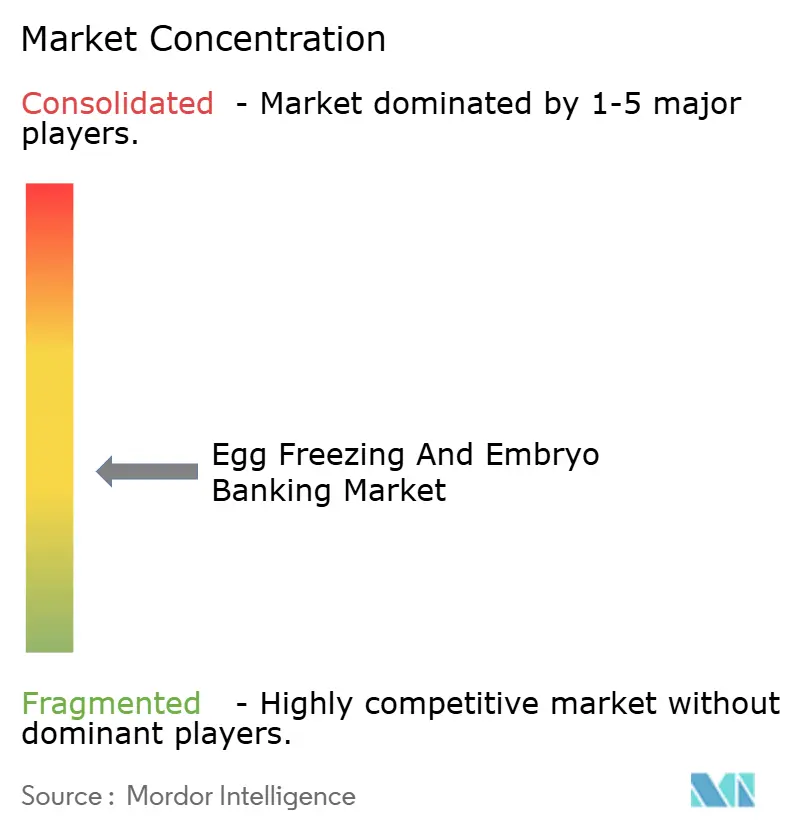
The egg freezing and embryo banking market is moderately consolidated. The top five groups control nearly 55% of U.S. retrieval volume following a string of private-equity-backed mergers, including the 2024 union of US Fertility and Ovation that created a 90-clinic platform. KKR’s global acquisitions of IVIRMA and Eugin delivered a combined 120+ clinics across 15 countries, exemplifying financial sponsors’ conviction in the recurring-revenue profile of the egg freezing and embryo banking market.
Technology differentiation is a core battleground: TMRW Life Sciences’ RFID-enabled tanks slash error rates, while Conceivable Life Sciences reported the first birth following fully automated ICSI—a potential inflection point for lab automation. Regulatory scrutiny remains intense; FDA warning letters citing inadequate donor screening have prompted clinics to reinforce compliance infrastructures, inadvertently raising entry barriers and consolidating market power among established providers.
Supply-chain resilience is a rising differentiator after high-profile storage failures; vendors now integrate IoT sensors, redundant alarms, and predictive-maintenance analytics to secure specimens, thereby enhancing reputational capital in the egg freezing and embryo banking market.
Egg Freezing And Embryo Banking Industry Leaders
CooperSurgical (Origio & Fertility Solutions)
Vitrolife AB
Cook Medical (Reproductive Health)
Prelude-CCRM Fertility Network
Shady Grove Fertility
- *Disclaimer: Major Players sorted in no particular order
Egg Freezing And Embryo Banking Market Companies Covered in this Report
- The Cooper Companies
- Vitrolife
- Cook Group
- Extend Fertility
- Cryo-Cell International
- Reproductive Medicine Associates (RMA)
- Shady Grove Fertility
- Kindbody
- Prelude Fertility/CCRM
- Inception Fertility
- Trellis
- CHA Medical Group
- Mayo Clinic
- Cleveland Clinic
- TMRW Life Sciences
- Kitazato
- FUJIFILM
- Genea Biomedx
- Vitrolife Cryogatt
- Thermo Fisher Scientific

Recent Industry Developments in Egg Freezing And Embryo Banking Market
- March 2025: TMRW Life Sciences has launched the TMRW Vault, a liquid-nitrogen tank that makes storing frozen eggs and embryos safer and more efficient. Each straw is tagged with RFID chips, enabling real-time data updates in clinic medical-record systems while ensuring both automation and manual access options are available.
- March 2025: KKR, a leading player in private equity, has sealed a deal worth EUR 525 million for Eugin Group, adding 69 clinics across 11 countries to its growing portfolio of IVF providers and reflecting its belief in the enduring demand for fertility services.
- March 2024: Spermosens AB, a Swedish start-up, secured SEK 10.8 million to expedite the clinical validation of its JUNO-Checked test, aiming to bring hope to couples facing fertility challenges by identifying sperm-egg binding issues directly at the lab bench. The management team envisions licensing this technology to IVF centers by 2026, offering clinicians a swifter assessment of fertilization prospects.


Global Egg Freezing And Embryo Banking Market Report Scope
| Egg Freezing |
| Embryo Banking |
| Slow Freezing |
| Vitrification |
| Fertility Clinics |
| Hospitals & Surgical Centers |
| Cryobanks & Biobanks |
| Below 35 Years |
| 35-37 Years |
| 38-40 Years |
| Above 40 Years |
| Non-Donor Cycles |
| Donor Cycles |
| North America | United States |
| Canada | |
| Mexico | |
| Europe | Germany |
| United Kingdom | |
| France | |
| Italy | |
| Spain | |
| Rest of Europe | |
| Asia Pacific | China |
| Japan | |
| India | |
| South Korea | |
| Australia | |
| Rest of Asia Pacific | |
| Middle East & Africa | GCC |
| South Africa | |
| Rest of Middle East & Africa | |
| South America | Brazil |
| Argentina | |
| Rest of South America |
| By Preservation Type | Egg Freezing | |
| Embryo Banking | ||
| By Preservation Method | Slow Freezing | |
| Vitrification | ||
| By End User | Fertility Clinics | |
| Hospitals & Surgical Centers | ||
| Cryobanks & Biobanks | ||
| By Patient Age Group | Below 35 Years | |
| 35-37 Years | ||
| 38-40 Years | ||
| Above 40 Years | ||
| By Donor Type | Non-Donor Cycles | |
| Donor Cycles | ||
| By Geography | North America | United States |
| Canada | ||
| Mexico | ||
| Europe | Germany | |
| United Kingdom | ||
| France | ||
| Italy | ||
| Spain | ||
| Rest of Europe | ||
| Asia Pacific | China | |
| Japan | ||
| India | ||
| South Korea | ||
| Australia | ||
| Rest of Asia Pacific | ||
| Middle East & Africa | GCC | |
| South Africa | ||
| Rest of Middle East & Africa | ||
| South America | Brazil | |
| Argentina | ||
| Rest of South America | ||


Key Questions Answered in the Report
How large is the egg freezing and embryo banking market in 2025?
The egg freezing and embryo banking market size stands at USD 5.5 billion in 2025.
What is the expected growth rate through 2030?
Market revenue is projected to rise at a 15.3% CAGR to reach USD 10.8 billion by 2030.
Which preservation method dominates current revenue?
Vitrification accounts for 84.8% of 2024 revenue thanks to superior survival rates.
Which region offers the fastest growth opportunity?
Asia Pacific is forecast to expand at a 16.8% CAGR, fueled by ultra-low fertility rates and supportive policies.
How are insurance mandates influencing demand?
Coverage laws in 16 U.S. states and multiple EU countries are spurring higher procedure volumes and lowering out-of-pocket costs.
What technologies are reshaping laboratory workflows?
RFID-enabled cryostorage, AI-driven embryo scoring, and automated ICSI systems are improving accuracy and efficiency.
Page last updated on:


 Your data is secure and never sold or shared.


