
Dolomite Market Size and Share
Market Overview
| Study Period | 2020 - 2031 |
|---|---|
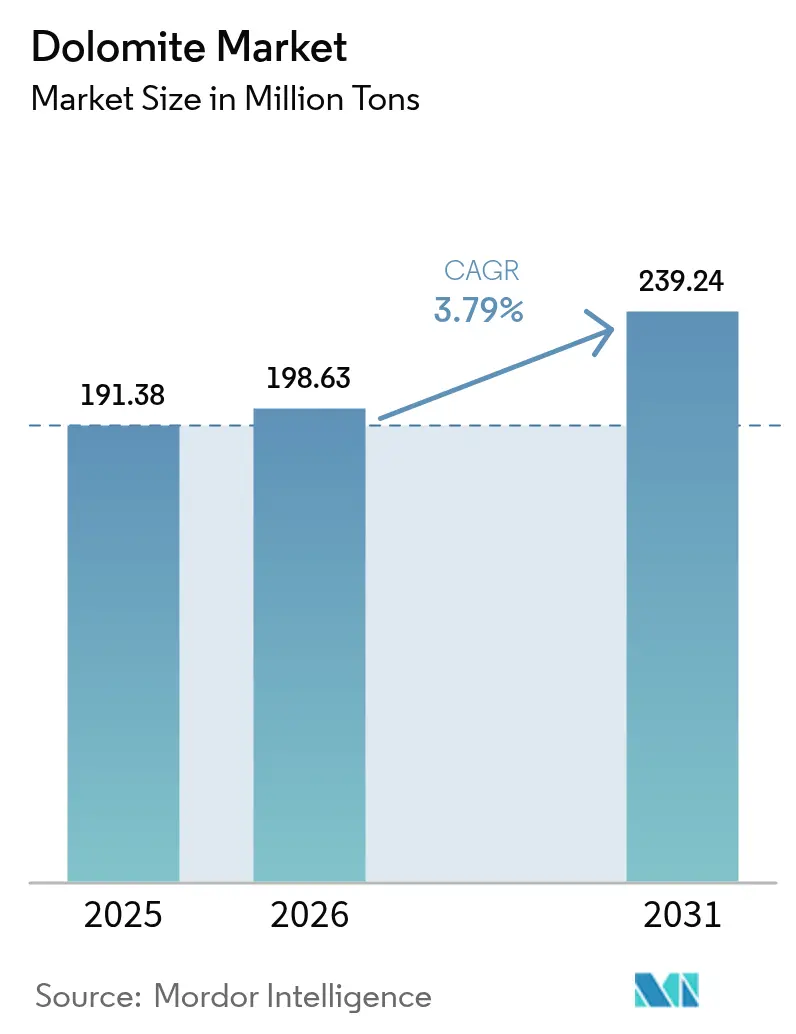
| Market Volume (2026) | 198.63 Million tons |
| Market Volume (2031) | 239.24 Million tons |
| Growth Rate (2026 - 2031) | 3.79 % |
| Fastest Growing Market | Asia Pacific |
| Largest Market | Asia Pacific |
| Market Concentration | Medium |
Major Players *Disclaimer: Major Players sorted in no particular order Image © Mordor Intelligence. Reuse requires attribution under CC BY 4.0. | |
Dolomite Market Analysis by Mordor Intelligence
Dolomite market size in 2026 is estimated at 198.63 Million tons, growing from 2025 value of 191.38 Million tons with 2031 projections showing 239.24 Million tons, growing at 3.79% CAGR over 2026-2031. The expansion underscores the mineral’s entrenched role as a dual-oxide material that supplies calcium and magnesium for steelmaking fluxes, construction aggregates, and next-generation water treatment media. Asia-Pacific continues to set the consumption tone, helped by China’s large crude steel output, India’s infrastructure build-out, and ASEAN’s multitrillion-dollar financing gap for roads, ports, and power plants. Industrial users favor dolomite when high-temperature resilience, slag-forming efficiency, or pH buffering are essential, giving the material cost and performance advantages over single-oxide substitutes. Ongoing decarbonization across glass, cement, and hydrogen-ready steel operations adds another structural layer of demand by calling for refractory formulations and flux chemistries that withstand harsher thermal cycles.
Key Report Takeaways
- By mineral type, calcined dolomite led with 46.21% of dolomite market share in 2025, while sintered dolomite is projected to grow at the fastest 4.53% CAGR through 2031.
- By end-user industry, mining and metallurgy accounted for 34.87% of the dolomite market size in 2025, while water treatment is expected to post the highest 4.29% CAGR between 2026 and 2031.
- By geography, Asia-Pacific commanded 53.39% of overall volume in 2025 and is forecast to expand at a 4.62% CAGR through 2031, outpacing all other regions.
Note: Market size and forecast figures in this report are generated using Mordor Intelligence’s proprietary estimation framework, updated with the latest available data and insights as of 2026.
Market Trends and Insights
Drivers Impact Analysis of Dolomite Market*
| Driver | (~) % Impact on CAGR Forecast | Geographic Relevance | Impact Timeline |
|---|---|---|---|
| Growing Construction Spending in Asia-Pacific | +1.2% | Asia-Pacific core, spill-over to MEA | Medium term (2-4 years) |
| Expanding Global Steel and Iron Production | +0.9% | Global, concentrated in China, India, ASEAN | Long term (≥ 4 years) |
| Environmental Regulations Boosting Soil Conditioning Demand | +0.7% | North America and EU, expanding to Asia-Pacific | Medium term (2-4 years) |
| Rising Glass and Ceramics Capacity Expansions | +0.5% | Global, emphasis on Asia-Pacific and Europe | Short term (≤ 2 years) |
| Waste-Water PFAS Removal Pilots Using Dolomite Adsorbents | +0.4% | North America and EU regulatory focus | Long term (≥ 4 years) |
| Source: Mordor Intelligence | |||
Growing Construction Spending in Asia-Pacific
Asia-Pacific’s infrastructure investment pipeline requires USD 26 trillion through 2030, driving sustained consumption of dolomite-derived cement additives and construction aggregates[1]. China’s urban redevelopment programs and India’s National Infrastructure Pipeline widen the market for flux-grade dolomite in clinker production, where magnesium oxide improves concrete durability. Logistics advantages encourage contractors in ASEAN’s archipelagic settings to substitute locally quarried dolomite for imported limestone, tightening regional supply and lifting prices. Producers with quarry proximity to coastal megacities gain higher margins thanks to shorter hauling distances. Sustainability certification programs that promote low-carbon, locally sourced inputs further entrench regional suppliers.
Expanding Global Steel and Iron Production
Electric arc furnace investments in India and Southeast Asia continue to raise demand for calcined dolomite, which combines with silica to form low-viscosity slag. The growth path is reinforced by hydrogen-based steel trials that run at higher operating temperatures and need refractory linings enriched with sintered dolomite grains. Dual-oxide composition trims raw-material inventories because a single feedstock supplies both CaO and MgO. As mini-mills proliferate near scrap sources, their operators prefer fluxes that arrive pre-calcined and quality-certified, creating premium niches for integrated miners that also own rotary kilns.
Environmental Regulations Boosting Soil Conditioning Demand
U.S. EPA soil-health guidance and the European Union’s Farm-to-Fork strategy elevate the place of dolomite in precision agriculture, especially for magnesium-deficient soils. Regulators stipulate tighter tolerance bands for pH and nutrient release, nudging growers toward higher-purity, low-impurity products. The same rulebooks raise red flags about microplastic fragments in bulk lime, prompting audits that favor operators with traceable supply chains and covered storage systems. Premium certification unlocks price differentials and encourages continued process investments at grind-and-screen plants.
Rising Glass and Ceramics Capacity Expansions
Technical glass producers in Asia and Europe have proven that dolomite lowers melt viscosity and cuts furnace energy inputs, aligning with net-zero roadmaps that seek double-digit reductions in CO₂ per ton of product. Meanwhile, advanced ceramics makers use fine-grind dolomite as a magnesium source that enhances thermal shock resistance in substrates for automotive exhaust sensors and consumer electronics. Oxy-fuel furnace retrofits favor dolomite-infused refractory bricks because they resist accelerated oxidation in high-oxygen atmospheres. Producers positioned in regions with strong renewables penetration can promote the low-carbon story further by citing greener electricity mixes at their calcination sites.
Restraints Impact Analysis of Dolomite Market*
| Restraint | (~) % Impact on CAGR Forecast | Geographic Relevance | Impact Timeline |
|---|---|---|---|
| Substitution With Cheaper Igneous Rock Fillers | -0.8% | Global, particularly cost-sensitive applications | Short term (≤ 2 years) |
| Stricter Land-Use and Mining Permitting Hurdles | -0.6% | North America and EU, expanding globally | Medium term (2-4 years) |
| Agricultural Liming Scrutiny Over Micro-Plastic Contamination | -0.3% | EU and North America regulatory focus | Long term (≥ 4 years) |
| Source: Mordor Intelligence | |||
Substitution With Cheaper Igneous Rock Fillers
Price-sensitive users in aggregate and low-spec refractory markets often switch to olivine or basalt when dolomite premiums widen. Olivine’s higher magnesium content and its availability from coastal Norway and Turkey add competitive tension in Europe. Growth of recycled concrete aggregates in public works further caps virgin dolomite demand. Suppliers respond by differentiating on chemical consistency and by bundling technical support that documents slag-forming efficiency.
Agricultural Liming Scrutiny Over Micro-Plastic Contamination
The European Food Safety Authority is reviewing pathways for microplastics in soil-amendment products, including dolomite lime[2]. New lab testing protocols could disqualify lower-grade material containing polymer fragments from conveyor belting or packaging. High-purity producers that already operate enclosed crushing lines gain a first-mover advantage and can capture premium market share.
*Our forecasts treat driver/restraint impacts as directional, not additive. The impact forecasts reflect baseline growth, mix effects, and variable interactions.
Dolomite Market Segment Analysis
By Mineral Type:
Calcined Grades Anchor Steel and Refractory DemandCalcined variants captured 46.21% of dolomite market share in 2025 as steelmakers demanded reactive oxides to bind silica and alumina at 1,700 °C furnace temperatures. The dolomite market size for calcined grades is forecast to expand in step with EAF capacity additions and decarbonization retrofits that rely on slag-forming efficiency. Sintered forms are set to outpace other products at a 4.53% CAGR because hydrogen-ready furnaces require bricks that endure higher heat fluxes. In that context, the dolomite market creates pricing tiers linked to bulk density and residual CO₂ levels.
Technological strides such as vertical shaft kilns with oxygen-enriched combustion improve calcination yield while trimming fuel intensity. Producers also accelerate roll-outs of automated optical sorters to guarantee low-silica feed. Agglomerated pellets remain niche yet strategic in water treatment where controlled dissolution prevents overdosing. As municipalities standardize on PFAS remediation systems, pellet suppliers can quote higher prices than for raw fines, enhancing margin profiles.


By End-User Industry:
Water Treatment Breaks Away From Traditional CoreMining and metallurgy retained 34.87% of volume in 2025, supported by steady molten-steel flux demand and refractory consumption. However, the dolomite market size allocated to water treatment is projected to grow fastest at 4.29% CAGR, reflecting regulatory urgency to tackle legacy contaminants. Utilities appreciate dolomite’s dual-function chemistry—adsorption plus pH buffering—over single-purpose media. Pilot adoption has already shifted purchasing from occasional spot loads to multiyear offtake commitments.
Agriculture remains a resilient baseline, yet future growth rests on value-added micronized powders with certified low contamination. The cement sector benefits from clinker optimization that uses dolomite to balance MgO and reduce CO₂ intensity, dovetailing with carbon-capture retrofits at integrated plants. Meanwhile, glass and ceramics customers request tighter particle-size distributions to ensure melting homogeneity in advanced technical products, sustaining a reliable mid-single-digit demand uptick through 2030.

Geography Analysis
APAC Dolomite Market
Asia-Pacific commanded 53.39% of global volume in 2025 and will add capacity at a 4.62% CAGR as mega-projects such as India’s high-speed rail corridors and Indonesia’s new capital city consume flux-grade aggregates. Chinese consolidation across upstream magnesite and dolomite mines stabilizes supply quality, enabling refractory firms to meet hydrogen furnace specifications without importing European feedstock. Japan’s leading steelmakers test higher-purity dolomite bricks in pilot hydrogen direct-reduction modules, reinforcing the region’s technological gravity.
North America Dolomite Market
North America shows balanced dynamics: legacy demand from integrated steelworks in the Great Lakes coexists with new opportunities in PFAS removal systems mandated by the U.S. EPA. Canadian miners leverage rail links to ship premium sintered material to U.S. Midwest mini-mills, while Mexico’s automotive growth spurs ceramic substrate production that requires finely milled dolomite.
Europe Dolomite Market
Europe maintains steady pull from glass decarbonization and organic farming regulations. German furnace rebuilds favor low-CO₂ dolomite flux, whereas France and Italy continue to value soil conditioners that release magnesium slowly. Nordic smelters turn to high-density sintered bricks sourced from domestic quarries, reducing import reliance and shortening lead times.

Regulatory Landscape
Dolomite extraction and processing operate within layered mining, land-use, and environmental compliance regimes that can affect both permitting timelines and operating costs. In the United States, state-level oversight such as Florida Department of Environmental Protection mining and mitigation requirements and New York State Department of Environmental Conservation mined land reclamation and water quality certifications shapes quarry expansion approvals, reclamation bonding, and water management obligations. In the United Kingdom, mineral planning authorities require planning applications to be supported by environmental documentation (including Environmental Statements where applicable), which keeps scrutiny on dust, noise, traffic, and restoration plans.
Product stewardship requirements also shape downstream acceptance. In Europe, substances supplied into the market must align with REACH (EC 1907/2006) registration and reporting expectations where applicable, while construction-facing customers increasingly point to ISO 14025 and EN 15804-aligned Environmental Product Declarations (EPDs) to document lifecycle impacts. For cross-border trade classification, dolomite is commonly captured under HS 2518, with 2026 tariff schedules distinguishing raw dolomite (HS 2518.10.00, commonly duty-free under MFN in the United States) from calcined or sintered dolomite (HS 2518.20.00, listed at a 3% general MFN duty rate). That makes accurate product form declaration important for landed-cost control.
Value Chain Analysis
The dolomite value chain starts with exploration and quarry development, followed by drilling, blasting, primary crushing, and beneficiation steps (screening, washing, and sorting) to meet chemistry and size specifications. Processing then diverges by end use: construction and agriculture typically rely on crushed and graded material or fine grinding, while steel, glass, and refractories use thermal processing (calcination and sintering) in kilns that are energy-intensive and sensitive to fuel availability and emissions controls. Tariff schedules implemented in 2026 distinguish raw dolomite (HS 2518.10.00) from calcined dolomite (HS 2518.20.00) under MFN regimes, influencing landed-cost control and supplier-qualification criteria.
Distribution generally relies on bulk trucking and rail for inland steel and cement corridors, with coastal shipping covering export-oriented flows into industrial hubs, where delivered cost is frequently dominated by freight and handling. Key constraints in the chain include high energy costs for calcination, permitting and environmental compliance lead times for new pits or expansions, and vulnerability to route disruptions for seaborne trade, which supports more local sourcing arrangements. Recent activity across the broader lime and dolime ecosystem also indicates deeper integration between mineral suppliers and industrial consumers, including targeted acquisitions that expand specialty mineral processing capabilities relevant to refractory and high-purity applications.
Competitive Landscape
The global dolomite market hosts a moderately fragmented lineup in which the top five players hold an estimated 45-55% combined share. Carmeuse and Lhoist capitalize on extensive quarry networks and captive kilns to supply both lump flux and milled powders across continents. Imerys pursues higher-margin niches such as technical ceramics by integrating customer laboratories within its R&D centers. Nordkalk leverages Baltic Sea shipping lanes to deliver consistent chemistry to Northern European steel plants, lowering delivered cost compared with inland rivals.
Strategic activity centers on energy-efficient calcination, digital mine scheduling, and downstream granulation lines that target fertilizer and filtration customers. Omya’s 2024 expansion of specialty fertilizer granulation in Kansas typifies moves into agriculture that fetch premium pricing. RHI Magnesita’s July 2025 cost-containment plan underscores vulnerability to cyclical steel demand yet also spotlights the upside of proprietary refractory grades for hydrogen furnaces. Smaller regional operators defend share by offering just-in-time delivery within 200 km radii, mitigating freight costs that often exceed run-of-quarry ore value.
Dolomite Industry Leaders
-
Calcinor
-
Lhoist
-
Carmeuse
-
Imerys
-
Omya AG
- *Disclaimer: Major Players sorted in no particular order

Dolomite Market Companies Covered in this Report
- Calcinor
- Carmeuse
- Dillon
- Graymont
- Imerys
- JFE Mineral & Alloy Company, Ltd.
- Lhoist
- Nordkalk
- Omya AG
- Raw Edge
- RHI Magnesita
- Sibelco
- Tata Ferro Alloys and Minerals Division
- United States Lime & Minerals, Inc.
Market Opportunities and Future Outlook
White-space is developing where buyers require tighter traceability, higher purity, and documented environmental performance rather than run-of-quarry material. Infrastructure and industrial procurement increasingly reference lifecycle disclosures, and ISO 14025 and EN 15804-aligned EPD practices create a pathway for producers that can document quarry-to-customer impacts while maintaining contamination controls, which is particularly relevant for agriculture and water treatment grades facing tighter scrutiny on impurities. The market also shows room for differentiated water treatment offerings, where dolomite can support dual roles (pH buffering and adsorption) and where pilots for PFAS and other contaminant removal are moving into more structured sourcing requirements.
Downstream processing investment is another visible opportunity lever, especially in regions building domestic mineral value chains. In May 2026, Algeria inaugurated a new dolomite processing unit in Tioult (Oum El Bouaghi) with 100,000 tonnes per year capacity for micronized and calcined dolomite, pointing to value-added products rather than raw exports. In North America, consolidation and portfolio integration are also reshaping route-to-market for dolomitic lime and related mineral solutions. The June 2026 agreement to combine Lhoist North America with Martin Marietta is designed to create a larger platform across mineral reserves, processing, and distribution, which can support standardized grades across steel, construction, and environmental applications.
Recent Industry Developments in Dolomite Market
- June 2026: Lhoist North America and Martin Marietta announced a definitive agreement to combine their North American dolomitic lime and mineral solutions platforms, creating a larger footprint across reserves, processing, and distribution. The deal tightens integration and shifts competitive dynamics for industrial minerals supply contracts tied to infrastructure and re-industrialization projects in North America.
- April 2026: Imerys announced a binding agreement to acquire Great Lakes Minerals, a United States-based processor and distributor serving refractory and abrasive mineral applications. The acquisition expands Imerys presence in specialty mineral processing and distribution channels that overlap with high-temperature industries where dolomite-based materials are relevant.
- January 2026: Carmeuse Majan, majority owned by Carmeuse Group, completed the acquisition of Al Namariq, a lime production facility in Salalah, Oman. The acquisition adds regional production capacity and supports export-oriented supply into Middle East industrial and infrastructure end markets.
Dolomite Market Report Scope and Research Methodology
Market Definition and Coverage
This market covers demand for dolomite sold for industrial and commercial use, tracked as physical consumption and supply movement across key end uses such as metals, construction materials, and process industries, and then consolidated at regional and global levels.
Scope exclusions: We exclude internal quarry overburden and waste rock, and we also exclude downstream finished goods where dolomite is only a minor ingredient and is not priced or traded as dolomite.
Segments Covered in This Report
- By Mineral Type
- Calcined
- Agglomerated
- Sintered
- By End-user Industry
- Mining and Metallurgy
- Agriculture
- Cement
- Ceramics and Glass
- Water Treatment
- Pharmaceuticals
- Other End-user Industries
- By Geography
- Asia-Pacific
- China
- India
- Japan
- South Korea
- ASEAN Countries
- Rest of Asia-Pacific
- North America
- United States
- Canada
- Mexico
- Europe
- Germany
- United Kingdom
- France
- Italy
- Russia
- NORDIC Countries
- Rest of Europe
- South America
- Brazil
- Argentina
- Rest of South America
- Middle East and Africa
- Saudi Arabia
- South Africa
- Rest of Middle East and Africa
- Asia-Pacific
Data Sources, Market Sizing, and Validation
Desk Research
Desk work starts by mapping where dolomite is mined, traded, and consumed, and then tying those flows to the end uses that typically drive demand. We rely on public series and documents such as the USGS mineral statistics and minerals yearbooks, national geological surveys, government customs statistics and UN Comtrade style trade tables, and industrial output releases from bodies such as the World Steel Association and similar cement associations.
To make the model usable by year and by region, we also review company annual reports, investor presentations, and plant level announcements that indicate capacity changes, kiln additions, and shutdowns. Pricing context is built from a mix of public tender disclosures where available, import unit values, and paid company financials and intelligence subscriptions that help standardize revenue and segment disclosure where reporting is uneven. These desk sources are not exhaustive, and we referenced additional public documents and datasets to fill gaps, validate assumptions, and clarify conflicting datapoints.
Primary Interviews and Surveys
Primary work is used to pressure test the desk assumptions on where dolomite is actually consumed, how much substitution is happening, and how pricing moves by product form and contract type. We spoke with producers, distributors, and large end users across major consuming regions, so regional demand patterns, trade frictions, and end use intensity factors could be confirmed and adjusted before finalizing the model.
Distribution of primary research fieldwork respondents
| Company type | Respondent position | Region |
|---|---|---|
| Top tier: 36% | CXOs: 15% | APAC: 44% |
| Mid tier: 47% | Functional/Unit leaders: 25% | EMEA: 36% |
| Smaller Players: 17% | Managers: 60% | Americas: 20% |
Market-Sizing & Forecasting
Our core sizing is built as a demand pool in volume, where production and trade data reconstruct apparent consumption by region and are then allocated into key end uses based on verified usage patterns. For each region, the model uses practical inputs such as crude steel output and refractory consumption intensity, cement and glass production indicators, infrastructure activity proxies, import and export balances for dolomite and related carbonate minerals, and observed capacity utilization in mining and calcination assets.
Once regional demand totals are formed, we apply selective bottom-up checks to keep the numbers realistic, including sampled capacity rollups for major dolomite operations, channel checks on typical shipment sizes, and spot checks of volume-to-revenue implied pricing to catch outliers. When data is missing in smaller consuming countries, we bridge gaps using per ton consumption ratios linked to steel and cement production, which are then rechecked through interviews.
Forecasts are primarily built using scenario analysis, because steel production cycles, construction spending, and energy costs can move differently by region and year. Growth rates are subsequently adjusted based on what suppliers and buyers expect for expansion projects, trade policy shifts, and the share of calcined and sintered material in refractory demand.
Data Validation & Update Cycle
We validate outputs by cross-checking modeled demand against independent signals such as regional steel output trends, import unit values, and announced mining and calcination capacity changes. Any large variance triggers a step back to review conversion factors, allocation keys by end use, and the implied per ton consumption levels before totals are locked.
A multi-step review is followed, where assumptions are reviewed by a second analyst and then rechecked with selected interviewees when variance cannot be explained through public data. Reports are refreshed annually, with interim updates when major plant expansions, trade restrictions, or sharp energy and freight swings materially change pricing or volumes. Before delivery, we do a final pass to confirm that the latest public production and trade releases have been reflected.
Mordor Intelligence's Dolomite Market Size Versus Other Published Estimates
Published market sizes for dolomite can look far apart even when they talk about the same mineral, mainly because the unit of measure, pricing timing, and the cut between raw ore and processed material are not treated the same way. Some sources anchor on revenue with broad product baskets, while others stay closer to mining and industrial consumption volumes.
The key gap drivers are usually the price layer and the refresh point used for currency and cost changes, followed by how calcined and sintered material is counted versus raw dolomite. When exchange rates and energy costs swing, the month used for average selling price updates and currency conversion can move a value estimate even if tons are stable, and these refresh checks are the reason the model outputs differ for Mordor Intelligence.
Benchmark comparison
| Source | Market Size | Gaps in Research Methodology |
|---|---|---|
| Mordor Intelligence | USD 198.63 M (2026) | |
| Industry Publisher A | USD 2.80 B (2024) | This estimate is value-based and typically blends a wider set of dolomite products and downstream processing, and it also applies an earlier base year where energy and freight driven ASP shifts are treated differently. |
| Press Release B | USD 3.57 B (2023) | The figure is derived from a revenue view that can bundle adjacent carbonate materials and uses a single global pricing assumption, which may not align with regional contract pricing and currency timing used in operational buying cycles. |
The spread in published numbers is largely explained by whether the market is expressed in tons or in revenue, and then by how pricing and currency timing are refreshed when costs move. By keeping the steps visible, tying assumptions to repeatable production and trade signals, and using interviews to recheck the price layer, we arrive at a balanced view that can be traced back to clear variables.
Key Questions Answered in the Report
What is the current size of dolomite market?
The dolomite market is estimated at 198.63 million tons in 2026 and forecast to reach 239.24 million tons by 2031.
Which region leads global consumption?
Asia-Pacific holds the top position with 53.39% share in 2025 and the fastest 4.62% CAGR outlook.
Which end-use industry is growing fastest?
Water treatment industry is expected to post the highest 4.29% CAGR through 2031.
Why are sintered dolomite grades gaining attention?
Hydrogen-ready steel furnaces and advanced ceramics need sintered products for enhanced thermal shock resistance.