
Market Overview
| Study Period | 2022 - 2032 |
|---|---|
| Base Year Market Size (2026) | USD 307.66 Million |
| Market Size (2027) | USD 329.82 Million |
| Market Size (2032) | USD 466.92 Million |
| Growth Rate (2027 - 2032) | 7.20 % |
| Fastest Growing Market | Middle East |
| Largest Market | Africa |
Major Players *Disclaimer: Major Players sorted in no particular order Image © Mordor Intelligence. Reuse requires attribution under CC BY 4.0. | |
Middle East and Africa Biopesticides Market Analysis by Mordor Intelligence
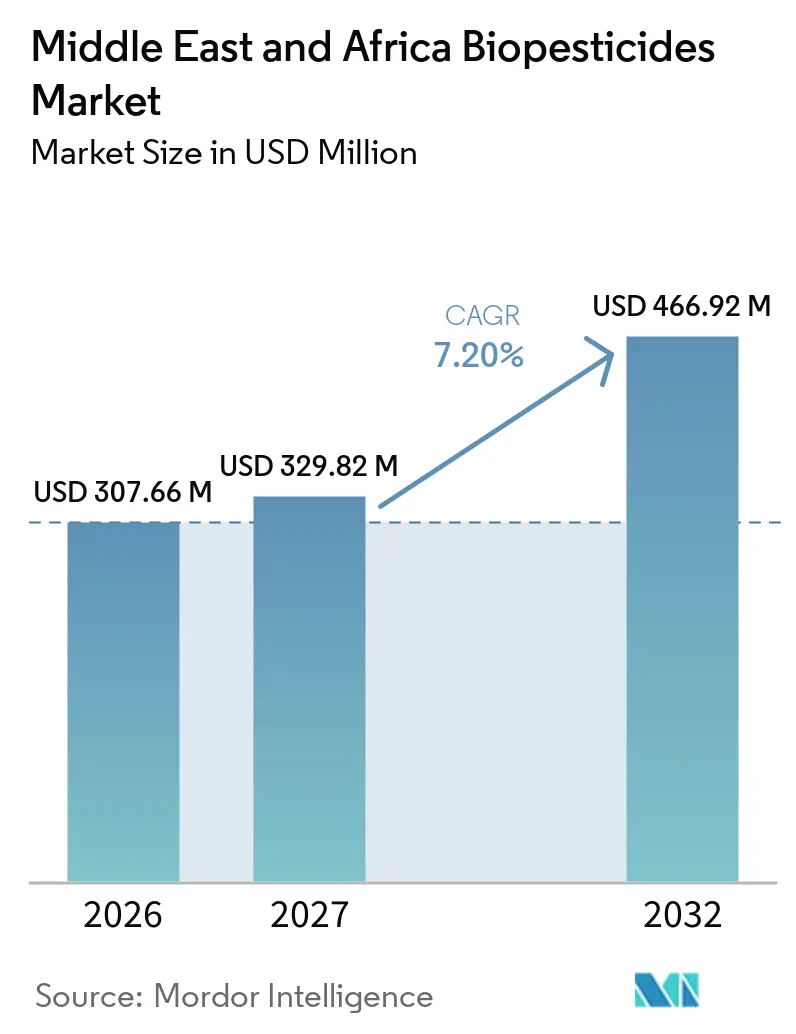
The Middle East and Africa biopesticides market size was valued at USD 307.66 million in 2026 and is forecast to grow from USD 329.82 million in 2027 to USD 466.92 million by 2032, at a CAGR of 7.20% from 2027 to 2032. This growth is driven by stricter pesticide regulations, increasing organic farming area, and continuous sovereign-fund investments in desert-adapted biological research. Africa maintains market leadership, while the Middle East is forecast to record the fastest growth, supported by investments in agricultural modernization and biological crop-protection solutions. Industry developments focus on heat-stable encapsulation technology, drone-compatible liquid formulations, and strategic acquisitions to expand microbial collections for future product development. Market potential exists in improving farmer education, reducing per-hectare costs, and developing climate-resistant formulations for smallholder farmers, particularly in regions where conventional pesticides have lost effectiveness due to pest resistance.
Key Report Takeaways
- By product type, bioinsecticides led with 28.6% of the Middle East and Africa biopesticides market share in 2026, while bioherbicides are forecast to grow at the fastest CAGR of 9.2% from 2027 to 2032.
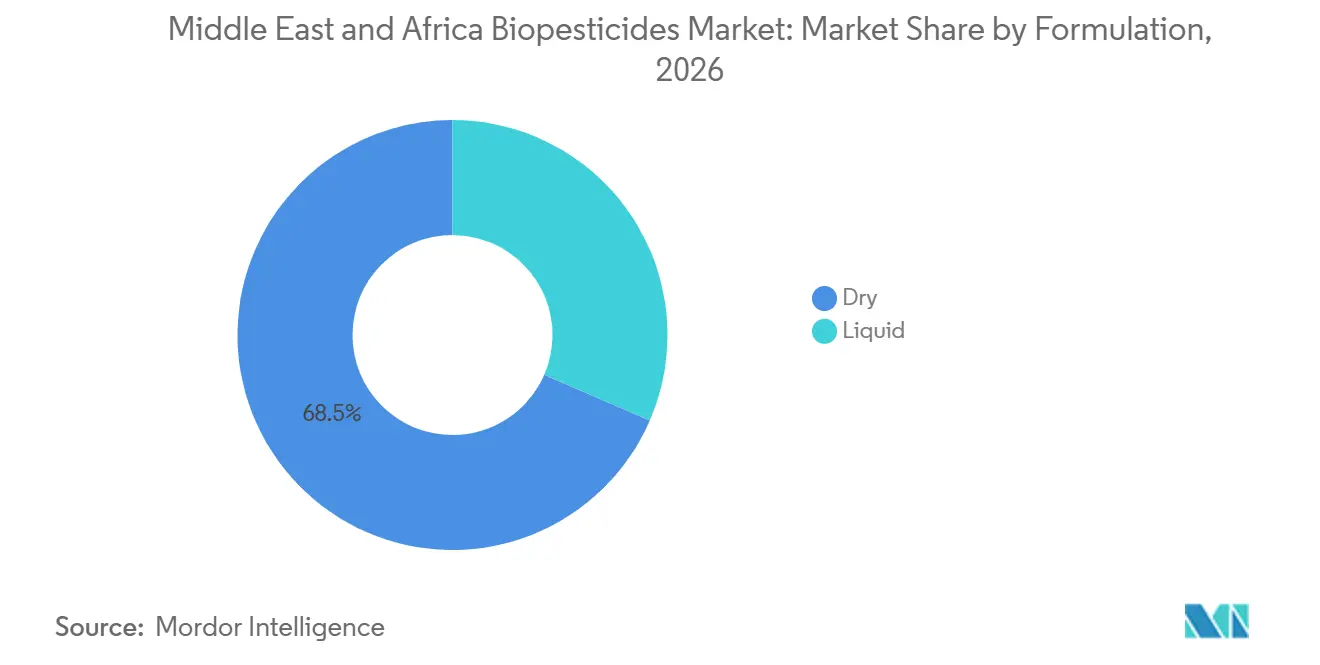
- By formulation, dry products accounted for 68.5% of the Middle East and Africa biopesticides market size in 2026, while liquid products are forecast to grow at the fastest CAGR of 8.6% from 2027 to 2032.
- By mode of application, foliar spray accounted for 32.3% of the market in 2026, while seed treatment is forecast to grow at the fastest CAGR, 9.5%, from 2027 to 2032.
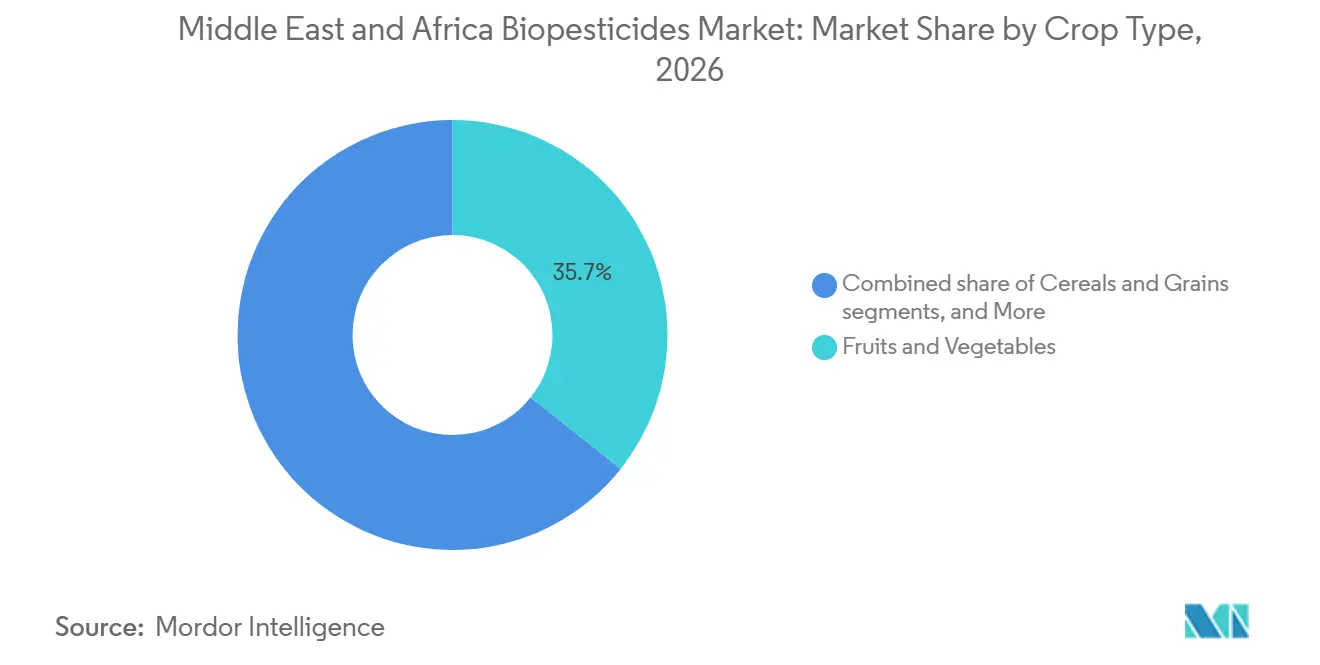
- By crop type, fruits and vegetables captured 35.7% of the market in 2026, while oilseeds and pulses are forecast to grow at the fastest CAGR of 8.8% from 2027 to 2032.
- By geography, Africa accounted for 58.8% of the Middle East and Africa biopesticides market in 2026, while the Middle East is forecast to grow at the fastest CAGR of 7.9% from 2027 to 2032.
Note: Market numbers in this report are based on Mordor Intelligence's proprietary estimation framework, which combines nine months of actuals with Q4 projections for base year 2026.
Market Trends and Insights
Drivers Impact Analysis of Middle East and Africa Biopesticides Market*
| Driver | (~) % Impact on CAGR Forecast | Geographic Relevance | Impact Timeline |
|---|---|---|---|
| Regulatory Bans on Key Synthetic Actives | +1.8% | Middle East core, expanding to North Africa | Medium term (2-4 years) |
| Fast-Track Approvals for Microbial Products | +1.2% | UAE, Saudi Arabia, with spillover to Egypt | Short term (≤ 2 years) |
| Expansion of Certified Organic Farmland | +1.5% | Africa-wide, particularly East Africa export corridors | Long term (≥ 4 years) |
| Rising Pest Resistance to Chemical Pesticides | +2.1% | Global, with acute pressure in cotton and date palm regions | Short term (≤ 2 years) |
| Adoption of Drone-Enabled Precision Bio-Spraying | +0.8% | GCC countries, expanding to commercial farms across Middle East & Africa | Medium term (2-4 years) |
| Gulf Cooperation Council (GCC) Sovereign-Fund Investments in Desert-Adapted Biocontrol R&D | +0.6% | UAE, Saudi Arabia, with technology transfer potential | Long term (≥ 4 years) |
| Source: Mordor Intelligence | |||
Regulatory Bans on Key Synthetic Actives
Authorities across the region have curtailed dozens of high-hazard chemistries since 2024, triggering a compliance-led pivot toward microbial options. The UAE outlawed several organophosphates and presented a unified digital registry that filters unapproved products. Tunisia subsidizes up to 50% of organic certification costs, making on-farm biology more viable[1]. This regulatory tightening extends beyond household pesticides to agricultural applications, where concerns about groundwater contamination and food safety residues are driving policy changes. Exporters have responded quickly because residue compliance now decides border clearance. This stringency shortens product lifecycles for older actives and accelerates rerouting of R&D budgets to biological control firms.
Fast-Track Approvals for Microbial Products
The UAE’s biotechnology blueprint prioritizes 120-day review windows for bio-inputs, versus the standard multi-year docket for synthetics. Saudi Arabia’s Vision 2030 funds validation trials at King Abdulaziz City for Science and Technology further trim regulatory friction. Multinationals seize the advantage via regional hubs that cluster research, pilot production, and regulatory affairs staff. Faster clearances slash carrying costs, unlock earlier revenue, and lure venture dollars toward niche microbial startups. This regulatory efficiency advantage is attracting international biocontrol companies to establish regional headquarters and manufacturing facilities in the GCC, creating a competitive advantage that extends throughout the broader Middle East & Africa market.
Expansion of Certified Organic Farmland
The price premiums for certified produce increase farmer income and offset the higher costs of advanced biopesticides. These premiums typically range from 20-30% above conventional crop prices, providing significant financial incentives for farmers. Market demand, rather than regulations, drives growth in the Middle East and Africa biopesticides market, with increasing consumer preference for organic products and sustainable farming practices. The organic certification process, while rigorous, enables farmers to access premium markets and establish long-term buyer relationships. The growing awareness of environmental sustainability and food safety among consumers further reinforces this market stability.
Rising Pest Resistance to Chemical Pesticides
Cotton bollworm populations shrug off multiple pyrethroids across West and Central Africa, and Omani date producers battle dubas bug strains immune to neonicotinoids. Researchers log resistance to new chemistries within three seasons, compelling growers to rotate with multi-mode biologicals that slow adaptation. Farmer demand peaks in crops where export premiums or pest devastation alter the income calculus quickly. This resistance pressure creates a compelling value proposition for biopesticides, which typically employ multiple modes of action and are less prone to resistance development due to their complex biological mechanisms.
Restraints Impact Analysis of Middle East and Africa Biopesticides Market*
| Restraint | (~) % Impact on CAGR Forecast | Geographic Relevance | Impact Timeline |
|---|---|---|---|
| Short Shelf Life in Hot Climates | -1.4% | Region-wide, particularly acute in desert areas | Short term (≤ 2 years) |
| Higher Per-Hectare Cost vs. Generics | -1.1% | Price-sensitive smallholder segments across Africa | Medium term (2-4 years) |
| Farmer Awareness and Training Gaps | -0.9% | Rural areas across Middle East & Africa, particularly in traditional farming regions | Long term (≥ 4 years) |
| Illicit Gray-Market Imports of Counterfeit Biopesticides | -0.7% | Border regions and informal distribution channels | Medium term (2-4 years) |
| Source: Mordor Intelligence | |||
Short Shelf Life in Hot Climates
Ambient warehouse temperatures top 45 °C in peak season, slashing microbial viability well before sale. Cold-chain coverage remains limited outside major cities. Though encapsulation advances bolster survival, unit costs rise, restricting access for budget-constrained buyers. Seasonal ordering patterns worsen wastage, especially for small dealers that lack turnover speed. Companies are investing heavily in heat-stable formulation technologies, including encapsulation systems and UV-resistant carriers, but these advanced formulations typically carry premium pricing that limits accessibility. The shelf life constraint creates particular challenges for seasonal demand patterns, where products must remain viable through extended storage periods between planting seasons.
Higher Per-Hectare Cost vs. Generics
Generic insecticides, priced 30-50% lower per hectare, remain prevalent on farms with limited cash flow. The required frequent reapplication of biological products widens this cost difference. Limited access to credit prevents farmers from transitioning to biologicals unless processors or exporters share the expenses. The higher number of applications needed for certain biopesticides increases seasonal costs. The price difference between synthetic and biological pesticides is decreasing as synthetic pesticide prices rise due to raw material inflation and regulatory compliance costs, while improved manufacturing scale enhances biopesticide production efficiency.
*Our forecasts treat driver/restraint impacts as directional, not additive. The impact forecasts reflect baseline growth, mix effects, and variable interactions.
Middle East and Africa Biopesticides Market Segment Analysis
By Product Type:
Bioinsecticides remain dominant amid resistance pressureThe bioinsecticides segment held 28.6% of the Middle East and Africa biopesticides market share in 2026 as growers confronted aggressive outbreaks of bollworm, leaf miner, and dubas bug. Bacillus thuringiensis and Beauveria bassiana products retain farmer trust because replicated trials prove rapid knockdown.
Bioherbicides are forecast to grow at the fastest CAGR of 9.2% from 2027 to 2032, as herbicide-resistant pigweed and ryegrass spread through cereal basins. R&D targets allelopathic fungi that suppress seed viability under arid conditions. Bionematicides scale up more slowly yet remain vital in protected horticulture, while biofungicides secure citrus post-harvest quality as synthetic fungicide limits tighten. Widespread pest mutation keeps substitution barriers low. Multinationals co-formulate insect proteins with botanical oils for an extended spectrum. Startups license gene-editing technologies to silence insect detox pathways, aligning product pipelines with upcoming resistance-management guidelines.
By Formulation:
Dry products command scale while liquids accelerateDry formulations command the largest market share at 68.5% in 2026, primarily due to their superior stability and shelf-life performance under the challenging climatic conditions in the Middle East & Africa. Granular and powder formulations can withstand high temperatures and humidity fluctuations that would rapidly degrade liquid products, making them particularly suitable for distribution networks that lack cold chain infrastructure. The dry formulation advantage is most pronounced in remote agricultural areas where storage conditions are suboptimal, and product turnover is slow. Water-dispersible granules and wettable powders have gained particular traction among commercial growers who value consistent performance and extended storage capability.
Liquid formulations are forecast to grow at the fastest CAGR, 8.6%, from 2027 to 2032, driven by advances in stabilization technologies and the superior application characteristics that liquids offer for precision agriculture systems. Companies are developing heat-stable liquid formulations using advanced encapsulation technologies and UV-resistant carriers that address the region's climatic challenges. In November 2023, FMC Ventures' investment in AgroSpheres' biodegradable encapsulation technologies exemplifies the industry's focus on developing liquid formulations that can perform reliably in extreme conditions[2].

By Mode of Application:
Foliar spray leads, seed treatment surgesFoliar spray applications maintain the dominant position with 32.3% market share in 2026, reflecting the method's versatility and compatibility with existing farmer practices and equipment across the Middle East & Africa region. The foliar application method provides direct pest contact and rapid establishment of biological agents, making it particularly effective for bioinsecticides and biofungicides targeting above-ground pest and disease pressure. The segment benefits from the availability of established spray equipment and farmers' familiarity, reducing adoption barriers compared with specialized application methods.
Seed treatment is forecast to grow at the fastest CAGR of 9.5% from 2027 to 2032, driven by its efficiency and early-season protection benefits. The growth reflects increasing adoption of biological seed treatments for soil-borne pest and disease control, particularly in cereal and oilseed crops where early establishment protection is critical. Seed treatment applications offer several advantages, including precise dosing, reduced environmental exposure, and protection during the vulnerable seedling stage.
By Crop Type:
Fruits and vegetables dominate while oilseeds gainFruits and vegetables command the largest market share, at 35.7% in 2026, reflecting the high value of these crops and their sensitivity to pesticide residues in export markets. The segment's dominance is driven by stringent maximum residue limits in international markets and consumer preferences for residue-free produce, creating strong economic incentives to adopt biological pest control. Protected agriculture systems, which are expanding rapidly in the GCC countries, rely heavily on biological control agents to maintain effective pest management while meeting food safety standards. In January 2025, the UAE's AeroFarms AgX facility and similar vertical farming initiatives demonstrate the integration of biological pest control in controlled-environment agriculture.
Oilseeds and pulses are forecast to grow at the fastest CAGR of 8.8% from 2027 to 2032, driven by expanding production areas and increasing adoption of integrated pest management practices. The growth is particularly strong in countries like Ethiopia and Kenya, where export-oriented pulse production requires compliance with international organic and residue standards. Cereals and grains maintain a substantial market position due to their large cultivation areas, though adoption rates are lower due to price sensitivity and traditional farming practices.
Geography Analysis
Africa accounted for 58.8% of the Middle East and Africa biopesticides market in 2026, making it the largest geographic segment, while the Middle East is forecast to grow at the fastest CAGR of 7.9% from 2027 to 2032. Africa's market leadership is supported by its extensive agricultural base and demand for biological crop-protection solutions across major crop-producing markets. Meanwhile, growth in the Middle East is supported by agricultural modernization, investments in controlled-environment and desert agriculture, and increasing adoption of biological crop-protection solutions.
African demand, though smaller today, expands at a double-digit pace. Kenya, Uganda, and Tanzania collectively surpass 1 million hectares of certified organic land, ensuring consistent demand for Bacillus and Trichoderma products for export vegetables. The Middle East and Africa biopesticides market remains fragmented across francophone and anglophone distribution channels, demanding localized labeling and training materials. The regional growth trajectory is supported by increasing international development funding for sustainable agriculture and growing recognition of biological pest control as essential for long-term agricultural productivity.
Egypt connects the two subregions through its significant export sector and the increasing challenges of pest resistance in cotton and tomato crops. The country's shift toward organic and biodynamic farming practices, supported by organizations such as SEKEM and the Egyptian Biodynamic Association, creates structured demand for biological pest control solutions[3]. The government eyes carbon-credit revenue tied to reduced chemical use, further incentivizing microbial replacements. Government initiatives supporting sustainable agriculture, combined with international partnerships and carbon market opportunities, create multiple incentives for biological pest control adoption that extend beyond immediate pest management needs.
Competitive Landscape
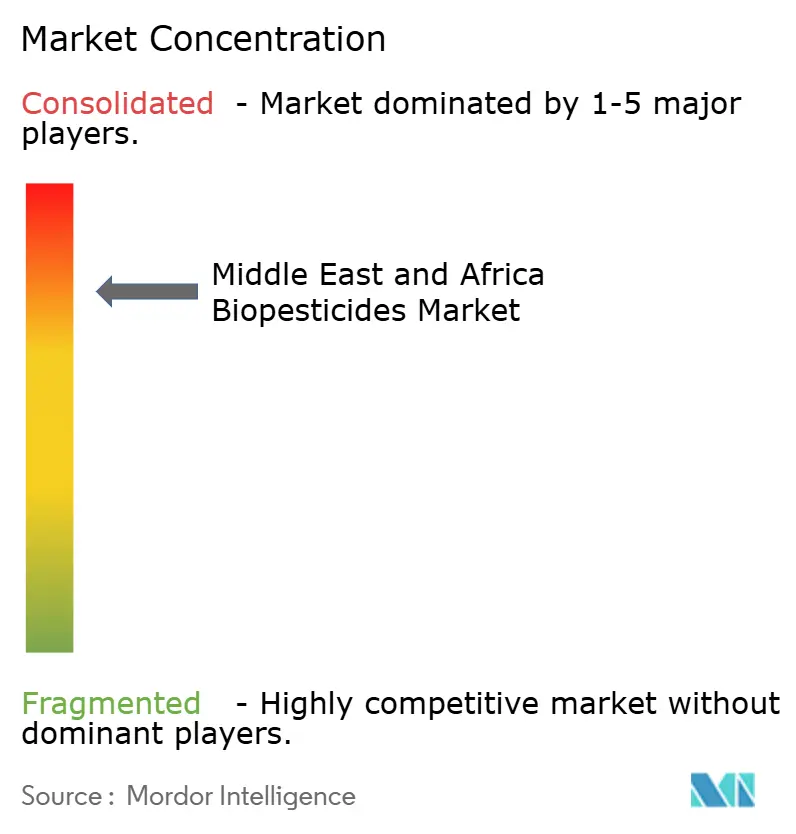
In 2026, the Middle East and Africa biopesticides market exhibits high concentration, with increasing consolidation driven by strategic acquisitions and partnerships among multinational agrochemical companies and specialized biocontrol firms. Market concentration is evolving as established players such as Bayer AG, BASF SE, and Syngenta Group expand their biological portfolios through internal development and external partnerships, while pure-play biological companies such as Koppert Biological Systems and Certis Biologicals establish regional distribution networks.
Acquisition strategy shapes growth. Certis Biologicals acquired select AgBiome assets and, in August 2024, licensed RNA interference patents from Renaissance BioScience. Ginkgo Bioworks purchased a 115,000-isolate microbial library to shorten discovery timelines. The competitive dynamics reflect the industry's transition from niche biological solutions to mainstream integrated pest management offerings, with companies investing heavily in climate-adapted formulations and precision application technologies suited to desert agriculture conditions.
Firms that pair microbial strains with digital farm-management platforms establish data loops that demonstrate return on investment for skeptical growers. Niche local players carve space by isolating endemic microbes already adapted to desert soils, then contracting toll manufacturing to serve neighborhood distributors. The competitive landscape is increasingly shaped by regulatory compliance capabilities and the ability to navigate diverse approval processes across Middle East & Africa countries, creating advantages for companies with established regulatory expertise and local market knowledge.
Middle East and Africa Biopesticides Industry Leaders
-
BASF SE
-
FMC Corporation
-
Sumitomo Chemical Co. Ltd
-
Koppert Biological Systems (Koppert B.V.)
-
Bayer AG
- *Disclaimer: Major Players sorted in no particular order
Middle East and Africa Biopesticides Market Companies Covered in this Report
- Bayer AG
- BASF SE
- Syngenta Group
- Sumitomo Chemical Co. Ltd
- FMC Corporation
- UPL Ltd
- Novonesis A/S
- Koppert Biological Systems (Koppert B.V.)
- Isagro SpA (Gowan Company)
- Nufarm Ltd
- Certis Biologicals (Mitsui & Co., Ltd.)
- SEIPASA S.A.
- Andermatt Group AG
- T. Stanes & Company (Amalgamations Group)
Read Analysis of Middle East and Africa Biopesticides Companies
Recent Industry Developments in Middle East and Africa Biopesticides Market
- December 2024: Silal and Bayer signed an MoU at the World Agri-Tech Innovation Summit. The agreement extends their partnership and focuses on developing sustainable desert agriculture, which is anticipated to drive the adoption of biopesticides in the Middle East and Africa region. The collaboration includes implementing digital farming solutions and conducting vegetable seed trials suited to Middle East and African conditions, potentially increasing the demand for biological crop protection solutions in the region.
- August 2024: IPL Biologicals announced a partnership with Spain-based Azufrera y Fertilizantes Pallarés, S.A.U. (AFEPASA) for global joint registration of microbial biopesticides with a specific focus on the Middle East and Africa market entry, supported by planned USD 48 million Gujarat facility investment to serve regional export markets.
- May 2024: Andermatt Group and Novonesis introduced soy inoculant products in African markets, strengthening the biopesticides market in the Middle East and Africa by enhancing nitrogen fixation and improving soil health in legume cultivation systems.
Middle East and Africa Biopesticides Market Report Scope
Biopesticides are pest management agents derived from natural sources, including microorganisms such as bacteria, fungi, and viruses. Unlike synthetic chemicals, they are typically biodegradable, target-specific, and pose minimal risks to non-target organisms and humans. These characteristics make biopesticides integral to sustainable agriculture and integrated pest management (IPM) practices.
The report covers the Middle East and Africa biopesticides market and is segmented by product type (bioinsecticide, biofungicide, bioherbicide, and bionematicide), formulation (liquid and dry), mode of application (soil treatment, seed treatment, foliar spray, and other modes of application), crop type (cereals and grains, fruits and vegetables, oilseeds and pulses, and turf and ornamentals), and geography (Africa and Middle East). The report provides market size and forecasts in terms of value (USD) for all the above segments.
Segmentation Overview
By Product Type
| Bioinsecticide |
| Biofungicide |
| Bioherbicide |
| Bionematicide |
By Formulation
| Liquid |
| Dry |
By Mode of Application
| Soil Treatment |
| Seed Treatment |
| Foliar Spray |
| Other Modes of Application |
By Crop Type
| Cereals and Grains |
| Fruits and Vegetables |
| Oilseeds and Pulses |
| Turf and Ornamentals |
By Geography
| Africa | South Africa |
| Kenya | |
| Uganda | |
| Tanzania | |
| Nigeria | |
| Rest of Africa | |
| Middle East | United Arab Emirates |
| Saudi Arabia | |
| Turkey | |
| Egypt | |
| Rest of Middle East |
| By Product Type | Bioinsecticide | |
| Biofungicide | ||
| Bioherbicide | ||
| Bionematicide | ||
| By Formulation | Liquid | |
| Dry | ||
| By Mode of Application | Soil Treatment | |
| Seed Treatment | ||
| Foliar Spray | ||
| Other Modes of Application | ||
| By Crop Type | Cereals and Grains | |
| Fruits and Vegetables | ||
| Oilseeds and Pulses | ||
| Turf and Ornamentals | ||
| By Geography | Africa | South Africa |
| Kenya | ||
| Uganda | ||
| Tanzania | ||
| Nigeria | ||
| Rest of Africa | ||
| Middle East | United Arab Emirates | |
| Saudi Arabia | ||
| Turkey | ||
| Egypt | ||
| Rest of Middle East | ||
Key Questions Answered in the Report
What is the current value of the Middle East and Africa biopesticides market, and how fast is regional demand projected to grow?
The Middle East and Africa biopesticides market was valued at USD 307.66 million in 2026 and is forecast to grow from USD 329.82 million in 2027 to USD 466.92 million by 2032, at a CAGR of 7.20% from 2027 to 2032.
Which product category holds the largest share?
Bioinsecticides led the market with a 28.6% share in 2026.
Why are liquid formulations gaining traction?
Liquid formulations are gaining traction due to advances in stabilization technologies and their suitability for precision application systems. The segment is forecast to grow at a CAGR of 8.6% from 2027 to 2032.
Which crops generate the highest spending on biological control?
Fruits and vegetables accounted for 35.7% of the market in 2026, supported by the high-value nature of these crops and the importance of managing pesticide residues in export markets.