
Digital MRO Market Size and Share
Market Overview
| Study Period | 2019 - 2031 |
|---|---|
| Market Size (2026) | USD 1.34 Billion |
| Market Size (2031) | USD 2.64 Billion |
| Growth Rate (2026 - 2031) | 14.52 % |
| Fastest Growing Market | Asia-Pacific |
| Largest Market | North America |
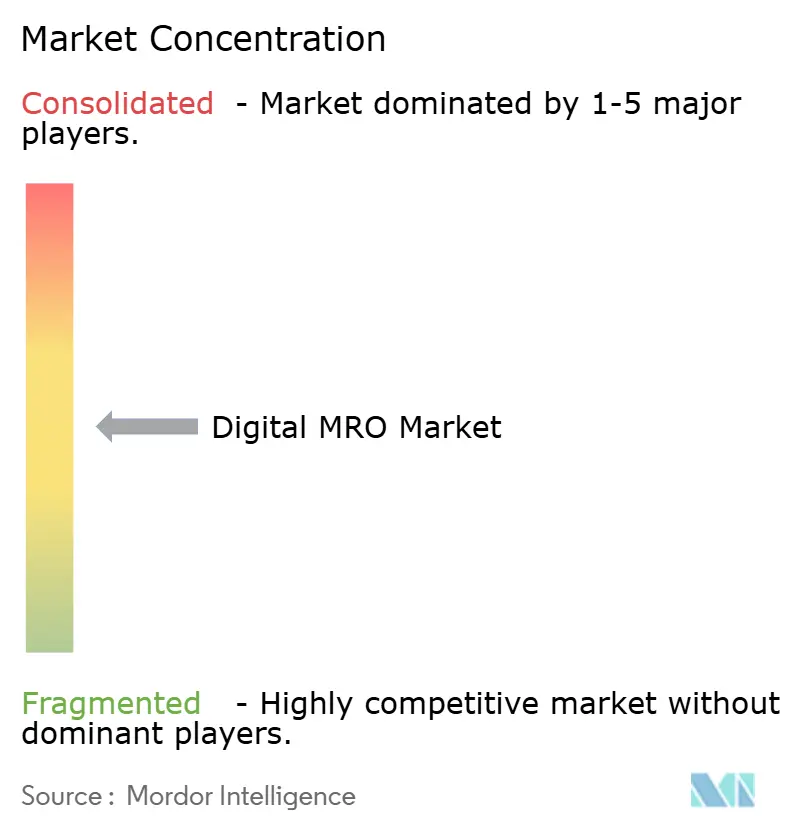
| Market Concentration | Medium |
Major Players *Disclaimer: Major Players sorted in no particular order Image © Mordor Intelligence. Reuse requires attribution under CC BY 4.0. | |
Digital MRO Market Analysis by Mordor Intelligence
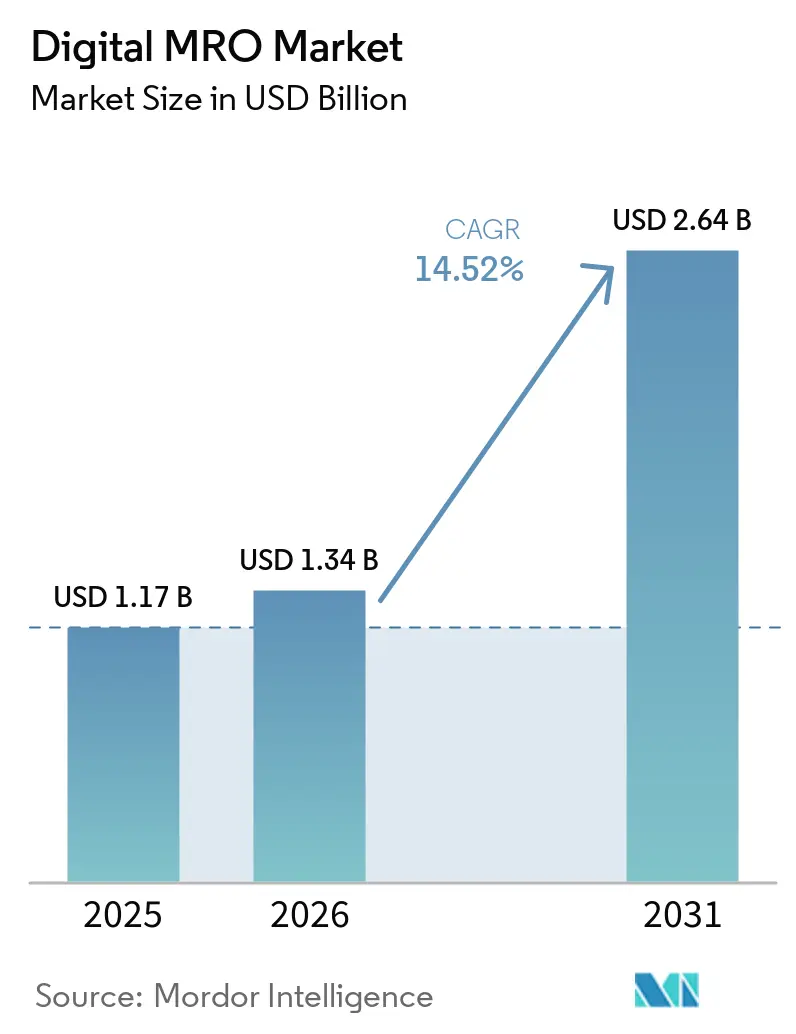
The digital MRO market size was valued at USD 1.17 billion in 2025 and estimated to grow from USD 1.34 billion in 2026 to reach USD 2.64 billion by 2031, at a CAGR of 14.52% during the forecast period (2026-2031). The digital MRO market is expanding as carriers extend the useful life of aircraft and need more reliable maintenance planning. Airlines have fewer alternatives to the continued use of existing assets when aircraft deliveries remain constrained. Digital tools help maintenance teams use operating data to schedule work before an aircraft is removed from service. The digital MRO market also benefits when OEMs include software, monitoring, and analytics within their service relationships. Competition is moving toward platforms that connect aircraft data, maintenance records, and operational decisions, while smaller providers seek demand for modular systems.
Key Report Takeaways
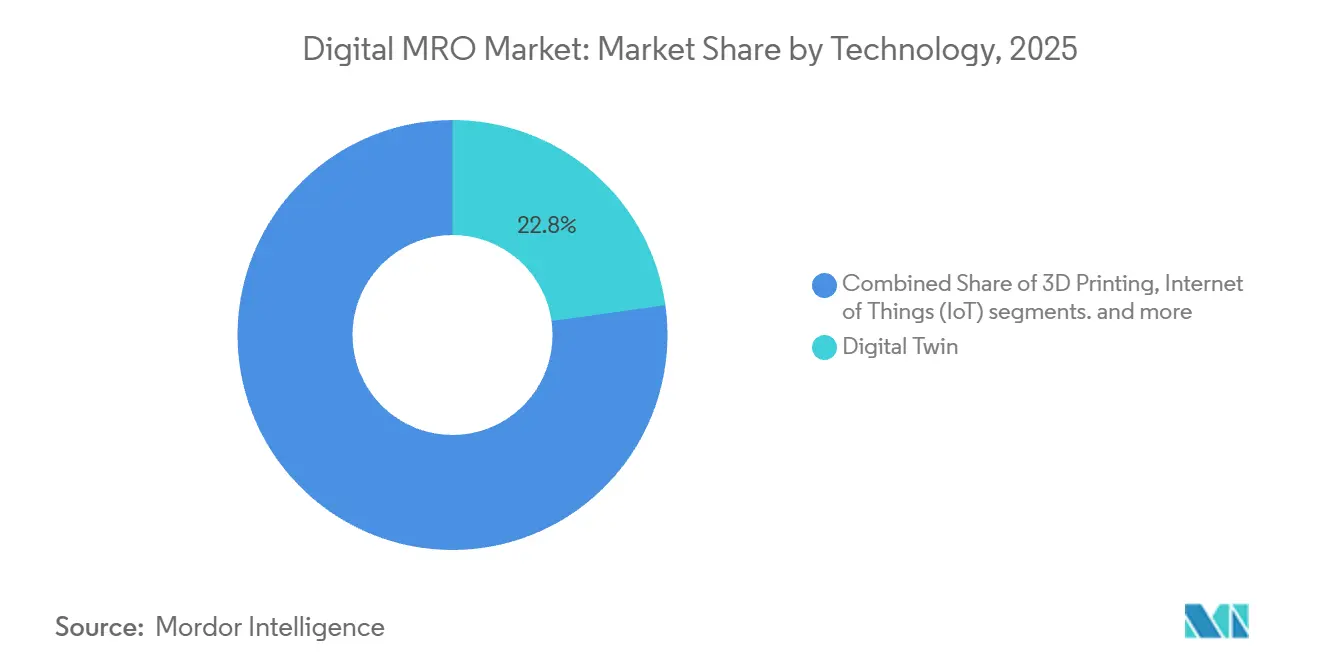
- By technology, digital twin solutions held 22.78% of the digital MRO market share in 2025 and are forecast to grow at an 18.73% CAGR through 2031.
- By application, inspection and damage assessment accounted for 25.53% of the digital MRO market size in 2025, while predictive analytics are forecast to grow at a 15.95% CAGR through 2031.
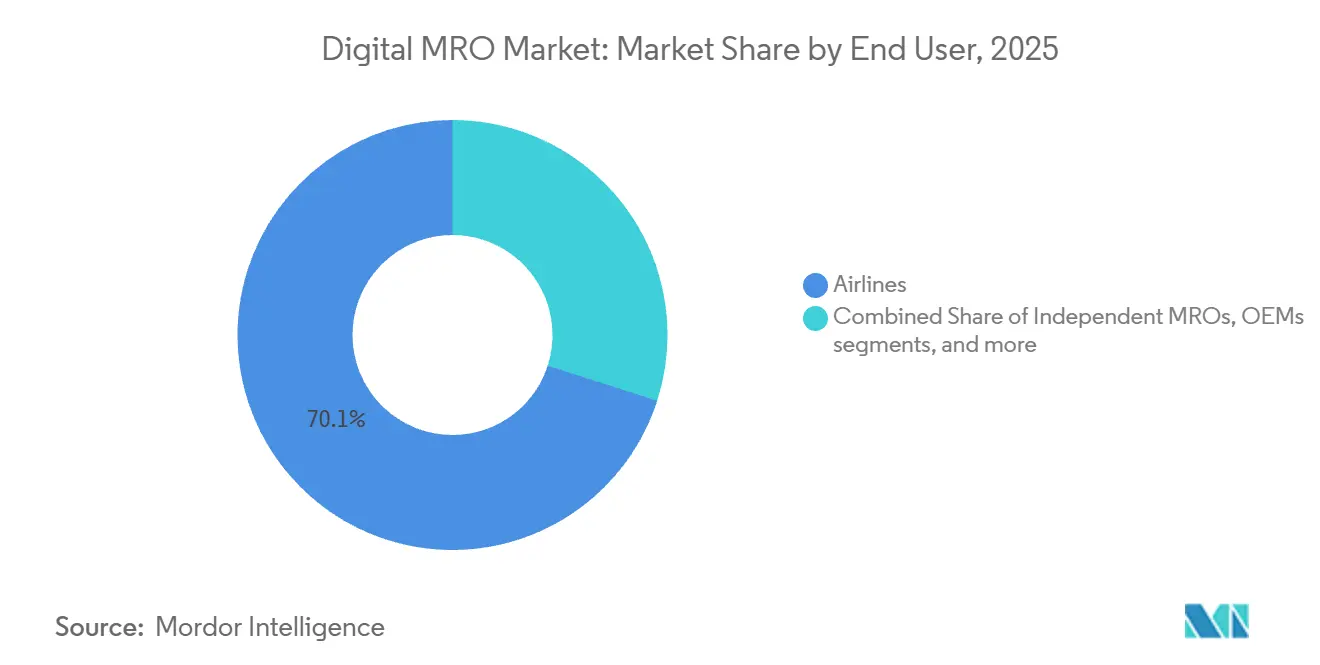
- By end user, airlines held 70.05% of the digital MRO market share in 2025, while aircraft lessors are projected to grow at a 16.11% CAGR through 2031.
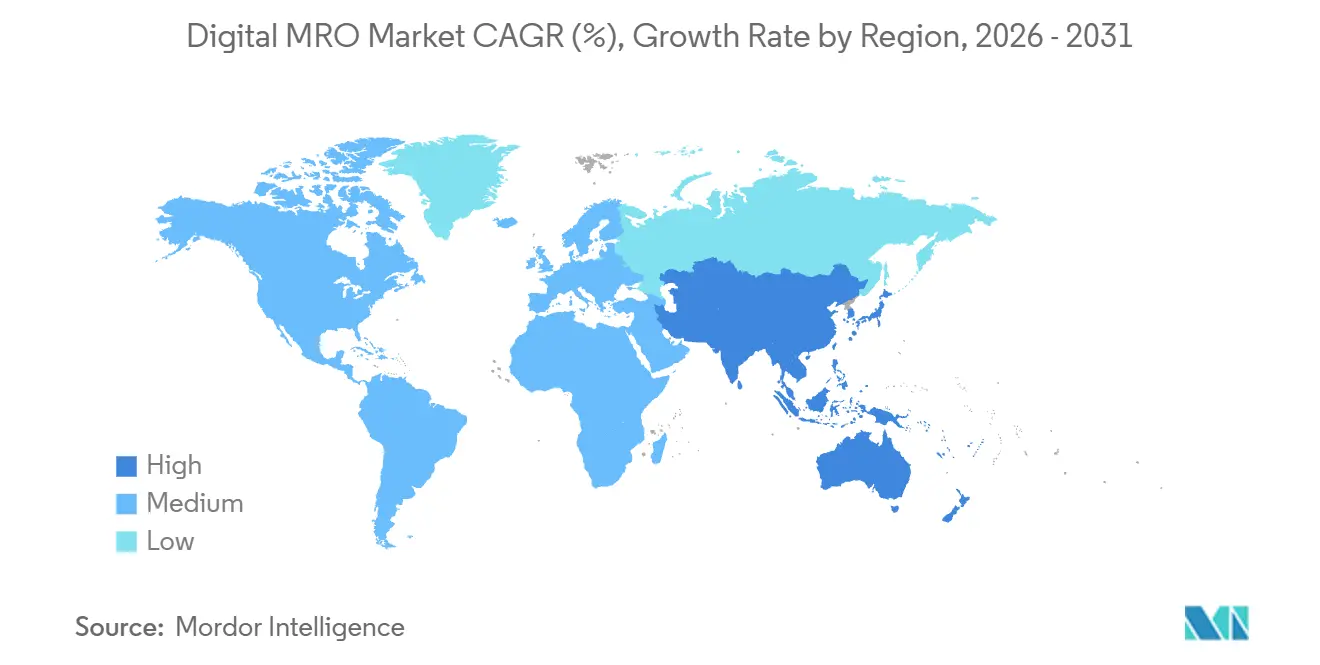
- By geography, North America accounted for 33.67% share of the digital MRO market in 2025, while Asia-Pacific is forecast to grow at a 17.45% CAGR through 2031.
Note: Market size and forecast figures in this report are generated using Mordor Intelligence’s proprietary estimation framework, updated with the latest available data and insights as of January 2026.
Global Digital MRO Market Trends and Insights
Drivers Impact Analysis*
| Driver | (~) % Impact on CAGR Forecast | Geographic Relevance | Impact Timeline |
|---|---|---|---|
| Accelerated adoption of predictive maintenance solutions | +2.5% | Global | Medium term (2-4 years) |
| OEM-led initiatives to digitize aftermarket operations | +2.0% | Global OEM network | Long term (≥ 4 years) |
| Growth of connected aircraft data lake ecosystems | +1.8% | North America and Europe, expanding to Asia-Pacific | Medium term (2-4 years) |
| Deployment of mobile XR-enabled maintenance workstations | +1.4% | North America and Europe | Short term (≤ 2 years) |
| Leasing-sector adoption of digital twin models for asset remarketing | +1.2% | Global leasing centers in Ireland, the US, and the UAE | Medium term (2-4 years) |
| Integration of real-time carbon tracking tools for ESG compliance audits | +0.9% | Europe, expanding globally | Short term (≤ 2 years) |
| Source: Mordor Intelligence | |||
Accelerated Adoption of Predictive Maintenance Solutions
Predictive maintenance is central to procurement decisions for digital MRO platforms because it links component condition with maintenance planning. It can help maintenance teams align component health information with inventory positioning and planned work. Condition-based maintenance can help teams place parts and schedule work before a planned removal becomes an unscheduled event. Aging fleets and shorter repair intervals support demand for systems that identify component condition earlier in the maintenance cycle. The digital MRO market, therefore, supports airlines that need to replace calendar-based checks with planned maintenance windows.
Growth of Connected Aircraft Data Lake Ecosystems
Connected data environments provide the aircraft information that predictive analysis needs to function. GE Aerospace announced a USD 300 million investment in Singapore in 2025 to expand engine repair capabilities, including an AI Center of Excellence for MRO, automated digital inspection, and predictive maintenance applications.[1]Source: GE Aerospace, “USD 300M To Bolster GE Aerospace’s Engine Repair Capabilities In Singapore,” GE Aerospace, geaviation.com Rolls-Royce’s digital services work connected Trax eMRO and Rolls-Royce service systems through its Blue Data Thread, allowing Trent engine operators to exchange information without a bespoke project. A peer-reviewed study described a unified aviation maintenance ecosystem that brings together sensor, maintenance, flight, and weather data to improve anomaly detection and maintenance planning. The digital MRO market increasingly depends on continuous, usable data rather than isolated software functions. Operators that enroll more aircraft and data sources within a single environment may face higher switching costs over time.
OEM-Led Initiatives to Digitize Aftermarket Operations
OEMs are adding digital services to aftermarket offerings that previously centered on parts and shop visits. Airbus combined Navblue and Skywise in April 2026 to create one entity for flight operations and maintenance analytics.[2]Source: Airbus, “With Skywise, Airbus Is Re-imagining The Digital Sky,” Airbus, airbus.com Airbus also signed a Skywise Fleet Performance+ agreement with JetBlue in April 2026 for its A320 Family and A220 fleets, covering real-time monitoring and predictive analytics. These arrangements combine operational data, software, and ongoing service support over the course of a longer customer relationship. Independent MRO providers may need third-party platforms when they cannot access OEM data streams. The digital MRO market allows OEMs to support recurring software activity alongside traditional maintenance work.
Deployment of Mobile XR-Enabled Maintenance Workstations
Mobile extended reality tools can present repair instructions, inspection information, and aircraft data at the work location. Scope AR and FTAI Aviation presented AR-guided engine inspection and assembly instructions at MRO Americas 2025. A paper presented at ECNDT 2026 used HoloLens 2 for aircraft dent inspection and overlaid ultrasonic measurement data on the aircraft surface.[3]Source: T. Versmeren et al., “Augmented Reality In Aircraft Maintenance,” ECNDT 2026, ndt.net These tools can reduce uncertainty in procedures that would otherwise depend heavily on experienced technicians. It can also help teams transfer instructions and inspection criteria to less-experienced personnel. The digital MRO market can benefit when mobile workstations support training, inspection, and guided execution within a single workflow.
Restraints Impact Analysis*
| Restraint | (~) % Impact on CAGR Forecast | Geographic Relevance | Impact Timeline |
|---|---|---|---|
| Cybersecurity vulnerabilities and intellectual property ownership concerns | -1.2% | Global, with stronger compliance pressure in Europe | Short term (≤ 2 years) |
| High capital investment required for legacy system digitization | -1.0% | Developing markets in Asia-Pacific, Middle East and Africa, and Latin America | Medium term (2-4 years) |
| Shortage of skilled, data-proficient maintenance technicians | -0.8% | North America, Europe, and Asia-Pacific | Medium term (2-4 years) |
| Data sovereignty conflicts between airlines and OEMs | -0.6% | Global, with greater relevance in Europe and Asia-Pacific | Long term (≥ 4 years) |
| Source: Mordor Intelligence | |||
Cybersecurity Vulnerabilities and Intellectual Property Ownership Concerns
Greater connectivity in maintenance operations creates more systems that require information security controls. EASA’s Part-IS requirements applied to Part-145 organizations in February 2026 and require an information security management system that supports aviation safety objectives. Maintenance data also raises commercial questions about whether airlines, MROs, or OEMs can use data created through aircraft sensors. Those questions can slow data-sharing agreements, particularly where data may improve a competing service offering. Compliance investment may take resources that would otherwise support productivity applications. The digital MRO market continues to attract investment, but implementation can be slower when security and data rights remain unresolved.
High Capital Investment Required for Legacy System Digitization
Legacy digitalization requires more than new software; maintenance organizations must replace paper-based processes, integrate disparate information sources, and train staff. Smaller independent MROs and military operators may find that hardware, software, integration, and training costs exceed their available operating budgets. This can create a division between large operators with integrated systems and smaller operators that retain manual workflows. Modular deployment models can reduce the initial barrier, but the supplied material does not provide evidence of broad financing programs. The digital MRO market may therefore show uneven adoption across operator size and regional infrastructure.
*Our forecasts treat driver/restraint impacts as directional, not additive. The impact forecasts reflect baseline growth, mix effects, and variable interactions.
Segment Analysis
By Technology: Digital Twin Anchors the Analytics Infrastructure
Digital twin solutions accounted for 22.78% of the technology segment in 2025, making them the largest technology category, and are expected to show the fastest growth, with a CAGR of 18.73% during the forecast period. Digital twin platforms create persistent virtual representations of engines, airframes, and components. These records support more asset-specific analysis than approaches that rely solely on fleet averages. Digital twin infrastructure also provides data for predictive scheduling, AI analysis, and training uses.
AR and VR support inspection, training, and guided repair, where spatial information can reduce procedural errors. Three-dimensional printing enables on-demand production of parts that are difficult to source for older fleet types. IoT provides the sensor layer used by digital twins and predictive models. AI and big data analytics identify patterns in data generated by twins and connected devices. Blockchain supports traceability and provenance for critical parts. Together, these technology layers form a connected stack, and investment in one layer can increase the value of another. The digital MRO industry includes these technologies because maintenance teams need both a data layer and tools that use it.



By Application: Predictive Analysis Reshapes Maintenance Economics
Inspection and damage assessment held 25.53% of the application segment in 2025, making it the largest application category. Digital inspection capabilities provide the condition information organizations need to use predictive models. Predictive analysis is forecast to expand at a 15.95% CAGR through 2031, the highest rate among applications. The digital MRO market size for predictive analysis is supported by the need to convert unscheduled maintenance events into planned shop visits. The supplied material stated that an aircraft-on-ground event can cost USD 10,000 to USD 150,000 per hour, depending on aircraft type and route. Better component forecasts can help teams position inventory before a maintenance event.
Performance monitoring collects engine and systems data for predictive models and fleet benchmarking. Inventory and part replacement functions use forecasts to position parts before an aircraft needs them. Mobility tools give technicians access to work orders, manuals, and sensor information at the ramp or hangar. Training and remote assistance can allow experienced technicians to guide junior colleagues and retain operational knowledge. Documentation and compliance tools create maintenance records that support airworthiness requirements and reduce paper-based audit work. These functions are linked because each depends on the availability and use of maintenance data. The digital MRO market supports a workflow that begins with inspection and continues through planning, execution, and recordkeeping.
By End User: Airlines Lead; Lessors Emerge as the Fastest-Growing Cohort
Airlines accounted for 70.05% of end-user spending in 2025, making them the main buyers of digital MRO capabilities. Large carriers manage complex fleets and need to reduce the cost of unscheduled maintenance events. Fleet scale makes small improvements in maintenance scheduling relevant to annual operating costs. Digitally recorded and verifiable maintenance histories can also support aircraft residual values and leasing decisions. Aircraft lessors were the fastest-growing end-user with a CAGR of 16.11% through 2031 in the supplied analysis. Digital twin-supported remarketing reports can present component condition and projected maintenance reserves during asset transitions.
Independent MROs face pressure when OEM platforms include analytics within power-by-the-hour service arrangements. These providers are using proprietary analytics and third-party platforms to retain customer relationships. Ramco Systems and IFS provide software used in many such programs. OEMs use their own systems to improve shop throughput, extend on-wing intervals, and support long-term service contracts. Military and defense operators have separate requirements for data classification, sovereign hosting, and certification. Their adoption is slower because commercial tools need substantial customization for their aircraft and operating rules. The digital MRO market serves different end users, but each requires dependable maintenance data and suitable access controls.
Geography Analysis
North America was the largest digital MRO market, with a 33.67% share in 2025, owing to its integration of OEM engineering operations, independent MRO sites, and an established aftermarket software environment. The region has a substantial workforce transition challenge as many certified mechanics approach retirement age. The supplied analysis identified Boeing Global Services and GE Aerospace as major digital platform providers in the region. Ramco Systems, IFS, and SAP also support independent operators. North American airlines have used predictive maintenance pilots for years. This experience supports more advanced applications, including autonomous diagnostics and AI-guided repair path selection.
Europe held a smaller absolute digital MRO market share than North America, but exhibited a distinct compliance-driven adoption pattern. EASA Part-IS applied to Part-145 organizations in February 2026 and added information security requirements for maintenance systems. Lufthansa Technik approved investments exceeding EUR 2 billion (USD 2.31 billion) across the Americas, Asia-Pacific, and Europe, the Middle East, and Africa as part of its development plans.[4]Source: Lufthansa Technik, “Lufthansa Technik Approves Billion-Euro Investments,” Lufthansa Technik, lufthansa-technik.com France, Germany, and the UK support the regional supply base.
Asia-Pacific is forecast to grow at a 17.45% CAGR through 2031, making it the fastest-growing regional digital MRO market. Fleet growth in China, India, Japan, and Southeast Asia supports demand for maintenance capacity and digital tools. China’s domestic aviation expansion is creating local demand for integrated MRO platforms. India’s digital maintenance record requirements create a compliance-led move away from paper documentation. South America, the Middle East, and Africa remain smaller in absolute size. Gulf aviation hubs, especially in the UAE and Saudi Arabia, are investing in digital MRO infrastructure as part of aviation modernization programs.

Competitive Landscape
The digital MRO market has a medium concentration, with leading firms holding significant positions, but no participant controls all technologies, operator types, or regions. OEMs use aircraft systems and data access to integrate analytics with long-term service agreements. Lufthansa Technik's Digital Tech Ops Ecosystem combines maintenance expertise with an expanding data network. Ramco Systems, IFS, SAP SE, and Swiss AviationSoftware compete on breadth of integration and deployment flexibility, especially for operators consolidating OEM and third-party information. Cross-fleet data interoperability remains unmet, as no platform fully normalizes aircraft and operator data for enterprise benchmarking. This gap sustains competition among digital MRO platform providers.
Emerging providers use agentic AI to automate damage detection, repair pathway selection, compliance checks, and supplier coordination. Also, larger installed bases still matter because they provide operational information and customer relationships. Specialized providers also offer point solutions where full enterprise integration is impractical. Competitive outcomes will depend on data access, integration performance, and workflow fit.
Digital MRO Industry Leaders
The Boeing Company
Lufthansa Technik AG
Airbus SE
Honeywell International Inc.
Ramco Systems Ltd.
- *Disclaimer: Major Players sorted in no particular order

Recent Industry Developments
- July 2026: CFM International announced five-year investment commitments exceeding USD 1 billion by GE Aerospace and more than EUR 1 billion (approximately USD 1.15 billion) by Safran Aircraft Engines to expand its LEAP engine MRO ecosystem. The new facilities were inaugurated in Belgium, India, Mexico, Poland, and Fort Worth, Texas, significantly increasing global LEAP overhaul capacity ahead of projected shop visit ramp-ups.
- July 2026: Ramco Systems was selected by CFS Aero, a UK-based aerospace engineering company and type certificate holder for the Honeywell ALF502 and LF507 engines, to implement its aviation software platform supporting engine and APU MRO operations.
- June 2026: Airbus SE inaugurated its Digital Campus in Albacete, Spain, integrating digital design, manufacturing, AI, data analytics, and cybersecurity capabilities for aerospace operations, with plans to accommodate approximately 200 employees by 2029.
- March 2025: GE Aerospace and Lufthansa Technik AG established XEOS, a maintenance facility in Poland, focusing on CFM LEAP‑1A and ‑1B engine repair and overhaul. The facility enhances regional maintenance capabilities through lean operations, training programs, and expanded test infrastructure.


Global Digital MRO Market Report Scope
Digital MRO replaces traditional, paper-intensive aviation maintenance with connected, data-driven systems. It uses cloud software, IoT sensors, and predictive AI to monitor asset health, optimize parts supply chains, and reduce aircraft-on-ground (AOG) time.
The digital MRO market is segmented by technology, application, end user, and geography. By technology, the market is segmented into digital twin, augmented reality/virtual reality (AR/VR), 3D printing, Internet of Things (IoT), artificial intelligence and big data analytics, and blockchain. By application, the market is segmented into inspection and damage assessment, performance monitoring, predictive analysis, inventory and parts replacement, mobility and functionality, training and remote assistance, and documentation and compliance. By end user, the market is segmented into airlines, independent MROs, OEMs, aircraft lessors, and military and defense operators. The report also covers the market sizes and forecasts for the digital MRO market in major countries across different regions. For each segment, the market size is provided in terms of value (USD).
| Digital Twin |
| Augmented Reality/ Virtual Reality (AR/VR) |
| 3D Printing |
| Internet of Things (IoT) |
| Artificial Intelligence (AI) and Big-Data Analytics |
| Blockchain |
| Inspection and Damage Assessment |
| Performance Monitoring |
| Predictive Analysis |
| Inventory and Part Replacement |
| Mobility and Functionality |
| Training and Remote Assistance |
| Documentation and Compliance |
| Airlines |
| Independent MROs |
| OEMs |
| Aircraft Lessors |
| Military and Defense Operators |
| North America | United States | |
| Canada | ||
| Mexico | ||
| Europe | United Kingdom | |
| France | ||
| Germany | ||
| Italy | ||
| Spain | ||
| Rest of Europe | ||
| Asia-Pacific | China | |
| India | ||
| Japan | ||
| South Korea | ||
| Australia | ||
| Rest of Asia-Pacific | ||
| South America | Brazil | |
| Rest of South America | ||
| Middle East and Africa | Middle East | United Arab Emirates |
| Saudi Arabia | ||
| Rest of Middle East | ||
| Africa | South Africa | |
| Rest of Africa | ||
| By Technology | Digital Twin | ||
| Augmented Reality/ Virtual Reality (AR/VR) | |||
| 3D Printing | |||
| Internet of Things (IoT) | |||
| Artificial Intelligence (AI) and Big-Data Analytics | |||
| Blockchain | |||
| By Application | Inspection and Damage Assessment | ||
| Performance Monitoring | |||
| Predictive Analysis | |||
| Inventory and Part Replacement | |||
| Mobility and Functionality | |||
| Training and Remote Assistance | |||
| Documentation and Compliance | |||
| By End User | Airlines | ||
| Independent MROs | |||
| OEMs | |||
| Aircraft Lessors | |||
| Military and Defense Operators | |||
| By Geography | North America | United States | |
| Canada | |||
| Mexico | |||
| Europe | United Kingdom | ||
| France | |||
| Germany | |||
| Italy | |||
| Spain | |||
| Rest of Europe | |||
| Asia-Pacific | China | ||
| India | |||
| Japan | |||
| South Korea | |||
| Australia | |||
| Rest of Asia-Pacific | |||
| South America | Brazil | ||
| Rest of South America | |||
| Middle East and Africa | Middle East | United Arab Emirates | |
| Saudi Arabia | |||
| Rest of Middle East | |||
| Africa | South Africa | ||
| Rest of Africa | |||


Key Questions Answered in the Report
What is the projected growth rate for digital MRO through 2031?
The digital MRO market is forecast to reach USD 2.64 billion by 2031, with a 14.52% CAGR over 2026-2031.
Which technology leads digital MRO adoption?
Digital twin solutions were the leading technology category, with 22.78% share in 2025.
Which digital MRO application is growing fastest?
Predictive analysis is forecast to grow at a 15.95% CAGR through 2031.
Why do airlines invest in digital maintenance platforms?
Airlines accounted for 70.05% of end-user spending in 2025 and use these platforms to plan maintenance, improve data access, and reduce unplanned events.
Which region is expanding fastest for digital maintenance tools?
Asia-Pacific is projected to record a 17.45% CAGR through 2031, supported by fleet growth and digital adoption.
What limits deployment of digital MRO systems?
Cybersecurity controls, data rights, legacy integration costs, and shortages of data-proficient technicians can slow implementation.
Page last updated on:


 Your data is secure and never sold or shared.


