
Market Overview
| Study Period | 2020 - 2031 |
|---|---|
| Forecast Data Period | 2026 - 2031 |
| Historical Data Period | 2020 - 2024 |
| Market Size (2026) | USD 23.70 Billion |
| Market Size (2031) | USD 30.29 Billion |
| Growth Rate (2026 - 2031) | 5.03 % |
| Market Concentration | Medium |
Major Players *Disclaimer: Major Players sorted in no particular order Image © Mordor Intelligence. Reuse requires attribution under CC BY 4.0. | |
Asia-Pacific Aircraft MRO Market Analysis by Mordor Intelligence
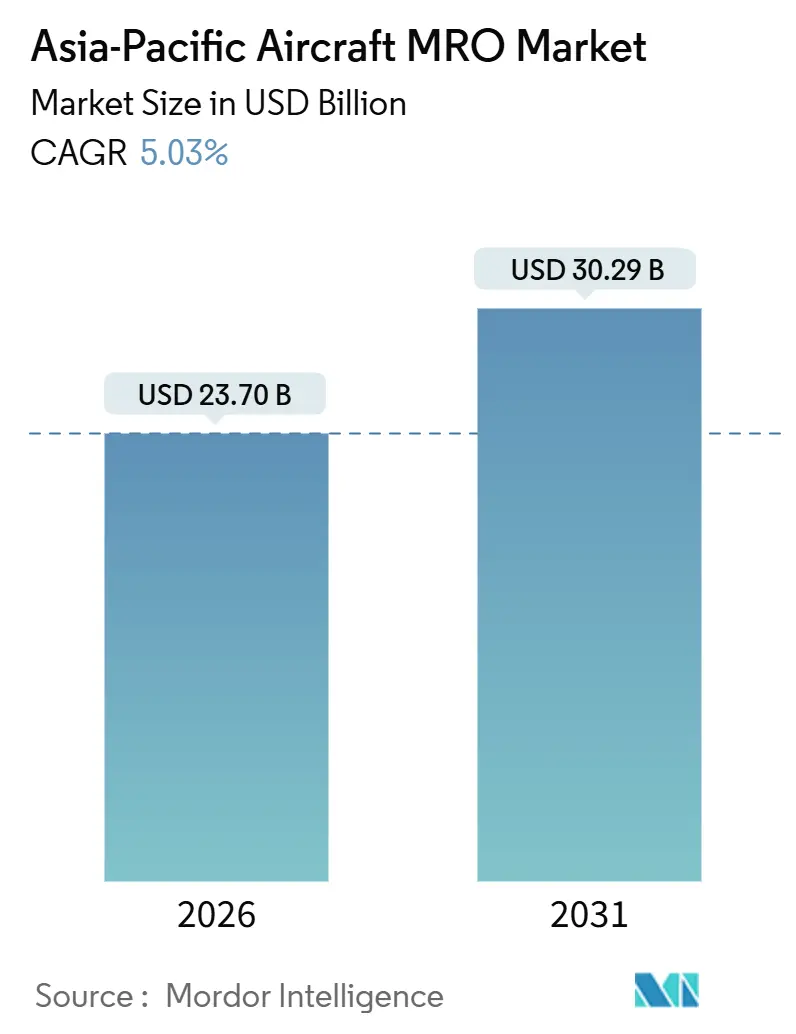
The Asia-Pacific aircraft MRO market was valued at USD 23.70 billion in 2026 and is expected to reach USD 30.29 billion by 2031, growing at a CAGR of 5.03%. Key factors driving this growth include increased deliveries of single-aisle aircraft, maintenance demands for aging in-service fleets, and extended engine shop visits associated with the Pratt & Whitney GTF recall. OEM-airline joint ventures are altering the competitive landscape by redirecting high-margin work from independent providers. However, the market faces challenges, including a 15-20% rise in labor, parts, and logistics costs, as well as shortages of titanium and semiconductors, which are impacting profit margins. Facilities capable of ensuring turnaround times are commanding a higher price premium. Additionally, sustainability regulations, such as Singapore’s 1% SAF blend requirement starting in 2026, are driving demand for retrofit packages that combine fuel-system checks with cabin reconfigurations, boosting the modifications sub-segment. Independent providers are responding by expanding predictive-maintenance platforms, which can reduce unscheduled events by up to 30%. This shift in focus is moving the competitive landscape from labor-cost advantages to data-driven availability solutions.
Key Report Takeaways
- Engine MRO accounted for 43.24% of the Asia-Pacific aircraft MRO market share in 2025, while the modifications and upgrades segment is projected to grow at the fastest rate, with a CAGR of 7.59% through 2031.
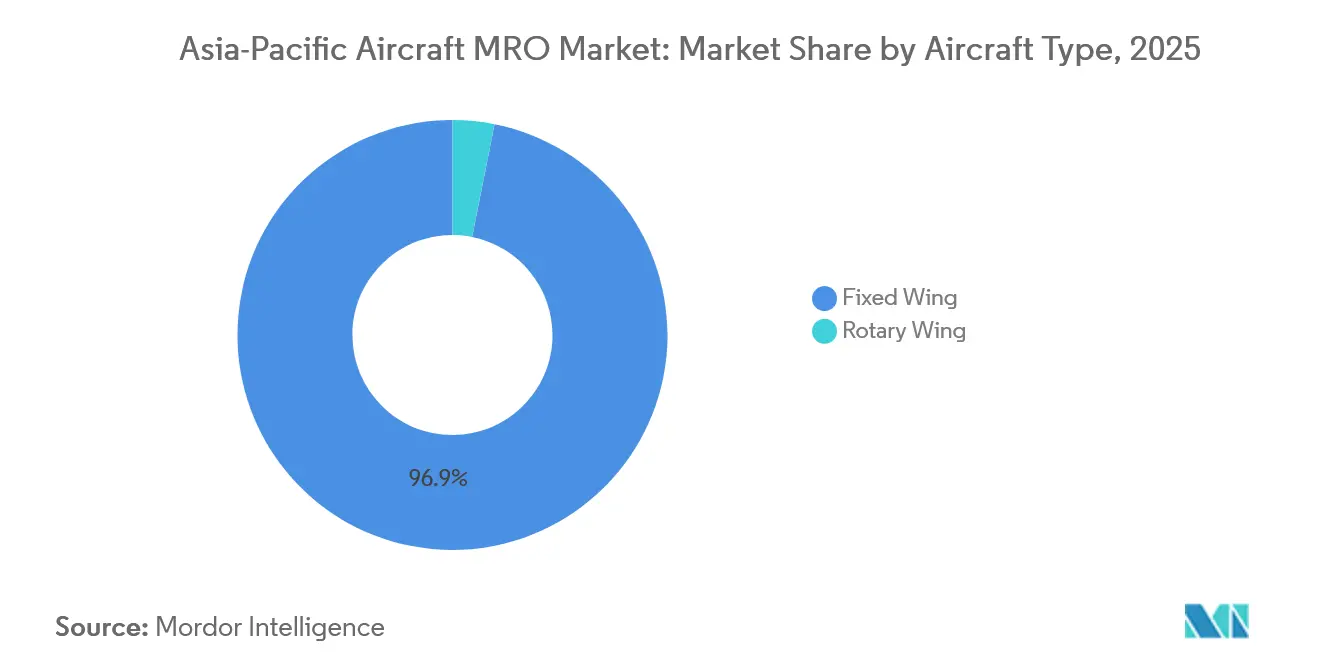
- Fixed-wing aircraft represented 96.87% of the spending in 2025; however, rotary-wing maintenance is expected to grow at a CAGR of 6.01%, driven by increased utilization of offshore and EMS helicopters.
- Passenger aircraft contributed 57.89% of the market value in 2025, while maintenance for cargo and freighter aircraft is anticipated to grow at a CAGR of 6.7%, supported by the expansion of e-commerce logistics.
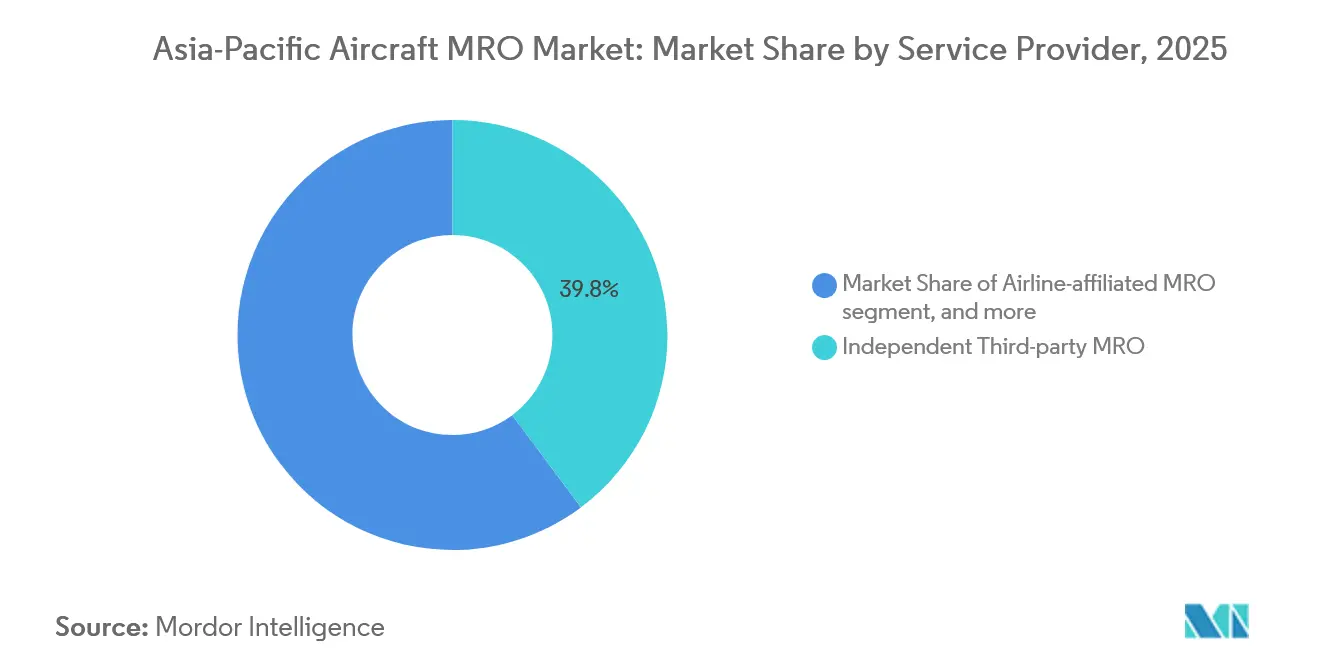
- Independent third-party providers held 39.8% of the revenue share in 2025 and are forecast to grow at a CAGR of 5.4%, surpassing the growth rates of airline-affiliated shops and OEM-captive providers.
- China dominated the Asia-Pacific aircraft MRO market with a 33.51% share in 2025, while India is the fastest-growing market, with a projected CAGR of 7.9%, driven by record fleet orders and supportive policy incentives.
Note: Market size and forecast figures in this report are generated using Mordor Intelligence’s proprietary estimation framework, updated with the latest available data and insights as of January 2026.
Market Trends and Insights
Drivers Impact Analysis of Asia-Pacific Aircraft MRO Market*
| Driver | (%) Impact on CAGR Forecast | Geographic Relevance | Impact Timeline |
|---|---|---|---|
| Fleet expansion of narrow-body and LCC fleets | +1.80% | Asia-Pacific core, strongest in India, Southeast Asia, China | Medium term (2–4 years) |
| Aging aircraft creating heavy-check backlog | +1.10% | Global, acute in Australia, Japan, mature Asia-Pacific markets | Short term (≤ 2 years) |
| OEM-airline JVs accelerating aftermarket capture | +0.90% | China, India, Thailand; spill-over to Southeast Asia | Long term (≥ 4 years) |
| Sustainability retrofits and SAF-ready conversions | +0.50% | Singapore, Japan, China; regulatory-driven adoption | Medium term (2–4 years) |
| AI-driven predictive maintenance and digital twins | +0.60% | Singapore, India, China; early adopters in premium carriers | Medium term (2–4 years) |
| On-shoring to hedge supply-chain/geopolitical risk | +0.40% | China, India; spill-over to Southeast Asia | Long term (≥ 4 years) |
| Source: Mordor Intelligence | |||
Fleet Expansion of Narrow-Body and LCC Fleets Drives Baseline Demand
Airbus projects 19,500 aircraft deliveries to Asia-Pacific operators between 2024 and 2043, with 75% being single-aisle jets. These aircraft typically perform 10-12 flights daily, leading to compressed maintenance intervals. IndiGo’s fleet, currently at 350 aircraft, is expected to exceed 500 aircraft by 2027. By 2027-28, IndiGo plans to add 12 bays at Bangalore Airport for MRO, aiming to triple its total available simultaneous aircraft MRO bays. Despite this expansion, the airline will remain dependent on MRO capacities outside India for another decade, until its new facility becomes fully operational.
Similar capacity constraints are observed with VietJet, AirAsia, and Cebu Pacific, which keep line-maintenance slots limited and favor providers with EASA Part-145 approvals. Meanwhile, China Eastern’s new twelve-widebody mega-hangar in Shanghai highlights efforts to expand infrastructure and shift maintenance work to lower-cost domestic bases. These developments contribute to sustained baseline growth in the Asia-Pacific aircraft MRO market, further supported by delivery delays that extend the service life of older jets.
Aging Aircraft Creating Heavy-Check Backlog Elevates Demand
Delays in aircraft deliveries from Boeing and Airbus are expected to increase the average fleet age in the Asia-Pacific region to 11.4 years by 2026. This aging fleet will require more frequent D-checks, costing USD 3-5 million each and consuming up to 50,000 labor hours. Qantas has reported unscheduled corrosion repairs that sidelined 737-800s for six weeks, reflecting a broader backlog affecting maintenance facilities in Bangkok, Kuala Lumpur, and Jakarta. ST Engineering’s airframe slots in Singapore are fully booked until mid-2027, with overflow routed to Jinan. Providers are prioritizing higher-margin engine work, leaving a gap in heavy-check capacity. Additionally, landing-gear overhauls face 18-month queues due to the limited number of authorized stations in the region, driving premium pricing for incumbents.[1] Mandatory inspections under CAAC CCAR-145 and JCAB regulations ensure continued demand for structural maintenance in the Asia-Pacific aircraft MRO market.
OEM-Airline Joint Ventures Redefine Aftermarket Capture
Joint ventures between OEMs and airlines are reshaping the aftermarket landscape. Examples include Rolls-Royce and Air China’s USD 315 million overhaul facility in Beijing, Airbus-Thai Airways’ component venture in Bangkok, and GE’s expanded engine cell in Singapore. These partnerships aim to secure lifecycle margins traditionally captured by independent providers. Total-care contracts offer airlines predictable costs while limiting third-party access to maintenance work. Safran’s ventures in Suzhou and Xian integrate proprietary repairs within joint-venture frameworks, adhering to ITAR restrictions. Independent providers are responding by scaling predictive analytics, as seen with Lufthansa Technik’s AVIATAR platform, which reduces AOG events by 25%. The Asia-Pacific aircraft MRO market is evolving into a hybrid structure, with OEM-captive facilities focusing on new-technology engines and independent specialists catering to legacy fleets.
AI-Driven Predictive Maintenance and Digital Twins
Air India’s USD 200 million agreement with GE Digital aims to reduce unscheduled maintenance events by 30% through the use of sensor analytics and digital twins. Singapore Airlines is deploying digital twins for its A350 and 787 fleets to extend engine time-on-wing and defer costly shop visits. Lufthansa Technik and ST Engineering report 20-40% reductions in diagnostic time using AI to identify failure precursors, allowing technicians to focus on revenue-generating tasks.[2] However, smaller maintenance providers in Southeast Asia lack the capital to adopt such technologies, widening the competitive gap in turnaround guarantees. As OEM health-monitoring platforms remain exclusive to in-network facilities, digital adoption is further polarizing the Asia-Pacific aircraft MRO market, creating clear distinctions between leaders and laggards.
Restraints Impact Analysis of Asia-Pacific Aircraft MRO Market*
| Restraint | (%) Impact on CAGR Forecast | Geographic Relevance | Impact Timeline |
|---|---|---|---|
| Licensed-technician talent crunch | -1.00% | Global, acute in China, India, Southeast Asia | Long term (≥ 4 years) |
| Global parts and materials shortages | -0.70% | Global, severe in component and engine segments | Medium term (2–4 years) |
| GTF and LEAP reliability issues stretch TATs | -0.50% | India, Southeast Asia; spill-over to China, Australia | Short term (≤ 2 years) |
| Inflation and FX volatility pressuring costs | -0.60% | Japan, India, Southeast Asia; currency-dependent markets | Medium term (2–4 years) |
| Source: Mordor Intelligence | |||
Licensed-Technician Talent Crunch Constrains Capacity Expansion
IATA estimates that the Asia-Pacific region will require 189,000 licensed technicians by 2032, but is projected to produce only 127,000, resulting in a 33% shortfall. China alone will need 121,900 additional technicians, while India requires 45,000 by 2027. However, DGCA-approved schools in India graduate fewer than 2,000 engineers annually. Salaries in Manila and Bangkok have risen by 8-12% annually as Gulf carriers attract experienced staff with 30-40% higher tax-free pay, squeezing MRO margins tied to fixed-price contracts. Automation helps Air India reduce manual inspection hours by 25%, but the high capital investment required sidelines smaller providers. Certification timelines under EASA Part-66 and FAA Part 65 remain rigid, limiting the ability to address labor shortages despite physical hangar expansions, thereby constraining the growth of the Asia-Pacific aircraft MRO market.
GTF and LEAP Reliability Issues Stretch Turnaround Times
Pratt & Whitney has identified powder-metal contamination in 1,400 GTF engines, doubling shop visit durations to 250-300 days and grounding over 70 IndiGo jets. This has forced IndiGo to lease replacement aircraft at rates 40% higher than those in 2019.[3] Go First’s collapse, attributed to similar grounding incidents, underscores the financial risks associated with idle assets. CFM LEAP engine parts shortages have extended maintenance durations by 30-50 days, pushing engine shop utilization to 95-100% across facilities in Singapore, Zhuhai, and Hyderabad. While ST Engineering is expanding GTF capacity, Pratt & Whitney does not anticipate full resolution until late 2026. These prolonged turnaround times and increased spare-engine leasing costs are expected to continue restraining schedules, profitability, and overall growth in the Asia-Pacific aircraft MRO market.
*Our forecasts treat driver/restraint impacts as directional, not additive. The impact forecasts reflect baseline growth, mix effects, and variable interactions.
Asia-Pacific Aircraft MRO Market Segment Analysis
By MRO Type:
Engine Overhauls Anchor Revenue, Modifications AccelerateEngine services accounted for 43.24% of the 2025 market value, driven by USD 3-5 million shop visits and the intensive OEM tooling requirements that few independent providers can meet. Prolonged GTF and LEAP engine events have increased parts consumption, pushing segment revenues higher despite reduced throughput. Consequently, the Asia-Pacific aircraft MRO engine market is growing faster than flight hours, underscoring the need for additional test cells in locations such as Singapore and Zhuhai.
Modifications and upgrades represent the fastest-growing segment, with a 7.59% CAGR, as airlines retrofit cabins, install winglets, and certify systems for 1-5% SAF blends under CAAS regulations. Airlines often combine these projects with heavy maintenance checks to optimize downtime, generating incremental revenue of approximately USD 1 million per aircraft. ST Engineering reported a 40% increase in retrofit inquiries in 2025, reflecting demand from operators seeking immediate fuel-efficiency improvements. This trend positions modifications as a strategic buffer for providers against fluctuations in airframe maintenance workloads within the Asia-Pacific aircraft MRO market.
By Aircraft Type:
Fixed-Wing Dominance Masks Rotary-Wing AccelerationFixed-wing aircraft accounted for 96.87% of 2025 expenditures, led by A320 and 737 families, which log 3,500-4,500 flight hours annually and require A-checks every 500-750 hours. Widebody D-checks, which can cost up to USD 7 million and require 60,000 labor hours, have made Singapore, Hong Kong, and Shanghai critical hubs. The Asia-Pacific aircraft MRO market for fixed-wing services remains stable, driven by mandated inspections, despite fluctuations in traffic.
Helicopter maintenance, which accounts for only 3.13% of spending, is growing at an annual rate of 6.01%. This growth is driven by offshore energy, EMS, and tourism operators in Australia, Indonesia, and Thailand, who are refreshing AW139, H225, and Bell 412 fleets. Extended lead times of 12-18 months for dynamic components, combined with limited authorized repair shops, have created pricing power for providers. Expanding rotary-wing maintenance capabilities allows providers to diversify revenue streams and mitigate seasonal demand fluctuations in the Asia-Pacific aircraft MRO market.
By Application:
Passenger Segment Leads, Cargo Surges on E-Commerce LogisticsPassenger operations contributed 57.89% of the 2025 market value, as full-service carriers operate complex wide-body fleets and low-cost carriers (LCCs) drive high-cycle, narrow-body utilization. IndiGo, for instance, conducts over 1,000 line-maintenance events daily, highlighting the revenue model driven by frequency. Consequently, the Asia-Pacific aircraft MRO market is closely tied to passenger operations, scaling in line with both flight hours and cycles.
Cargo and freighter maintenance is expanding at a 6.7% annual growth rate, fueled by operators such as SF Airlines, Cainiao, and DHL, whose intra-Asia networks rely on dependable 737BCF and 757F fleets. Passenger-to-freighter conversions, costing USD 6-8 million, extend the economic life of aircraft by 15-20 years, keeping ST Engineering’s conversion lines fully booked through 2027. This trend has increased demand for structural modifications and cargo door kits, thereby diversifying revenue streams within the Asia-Pacific aircraft MRO market.
By Service Provider:
Independent Third-Parties Lead, OEM-Captives GainIndependent service providers accounted for 39.8% of the 2025 market revenue and are projected to grow at 5.4% annually, benefiting from multi-airline portfolios and geographic reach. ST Engineering’s 2025 acquisition of StandardAero doubled its engine capacity and added business-jet capabilities, underscoring the impact of consolidation. However, the market share of independents faces pressure from OEM vertical integration.
OEM-captive providers and joint ventures are increasingly capturing warranty and long-term care contracts for new-technology engines, diverting work from airline-affiliated shops that face capital-constrained budgets. Investments such as GE’s USD 75 million test-cell upgrade in Singapore and Rolls-Royce’s Beijing joint venture highlight a shift toward OEM dominance. Independent providers are expected to focus on legacy fleets, landing gear, and avionics to remain competitive in the Asia-Pacific aircraft MRO market.
Geography Analysis
China Aircraft MRO Market
China accounted for 33.51% of the Asia-Pacific aircraft MRO market share in 2025, supported by major players such as AMECO, GAMECO, and HAECO, which handle wide-body heavy checks that were previously outsourced to Hong Kong or Singapore. Shanghai’s new twelve-widebody hangar and Hainan’s duty-free zone have reduced logistics costs by up to 20%, aligning with Beijing’s efforts to localize value. Joint ventures such as MTU Maintenance Zhuhai, which focuses on CFM56 and V2500 engines, are operating at 95% capacity, indicating strong demand for additional facilities.
India Aircraft MRO Market
India is the fastest-growing market, with a 7.9% CAGR, driven by fleet expansions from IndiGo and Air India, as well as a reduction in the GST rate on MRO services from 18% to 5%. Air India’s planned USD 500 million mega-facility in Delhi will enable domestic widebody D-checks, while Air Works and Lufthansa Technik are scaling component shops under the “Make in India” initiative. However, challenges such as technician shortages and limited widebody maintenance bays persist. Despite these issues, favorable policies are attracting new investments, boosting India’s contribution to the Asia-Pacific aircraft MRO market.
Japan, South Korea, Australia and ASEAN Aircraft MRO Market
Japan, South Korea, and Australia maintain mature, high-skill ecosystems. JAL Engineering derived 22% of its 2024 revenue from third-party customers, while Korea Aerospace Industries secured USD 1.2 billion for F-16 upgrades, strengthening its defense workload. Australia’s F-35 sustainment hub at RAAF Williamtown is projected to generate AUD 1.5 billion (USD 1.01 billion) annually by 2028, anchoring high-complexity work in the region. Southeast Asian hubs such as Singapore, Malaysia, and Thailand continue to benefit from competitive labor costs but face challenges with technician attrition to Gulf carriers, prompting investments in training and retention programs.
Regulatory Landscape
Asia-Pacific aircraft MRO activity is governed by national aviation authorities that license maintenance organizations (Part-145 style approvals), enforce continuing airworthiness, and manage cross-border acceptance of maintenance releases. In 2025-2026, regulatory updates point to continued alignment with ICAO frameworks, alongside a stronger focus on standardized operator maintenance programs and equipment-list governance. A case in point is the Civil Aviation Authority of the Philippines (CAAP) proposal in April 2026 to amend PCAR Parts 5 and 9 covering airworthiness certification, special flight permits, minimum equipment list basis, and operator maintenance program requirements.
Regional coordination is also being tightened to reduce duplication in oversight for organizations operating across nearby jurisdictions. The Civil Aviation Authority of Macao (AACM), together with the Civil Aviation Administration of China (CAAC) and Hong Kong CAD, implemented a revised Cooperation Arrangement effective April 30, 2026, removing location limitations for maintenance and maintenance training organizations. Further implementation guidance was issued effective June 1, 2026 through Aeronautical Circular AC-AW-035-R01. In Singapore, CAAS updated guidance for SAR-145, including use of the eSOMS digital platform for applications and compliance with service standards (IC 6/2025), reinforcing process digitization and auditability for MRO approvals.
Value Chain Analysis
The Asia-Pacific aircraft MRO value chain begins with operators (airlines, cargo carriers, business aviation, and military users) defining maintenance events, then moves into planning and engineering (maintenance programs, work-scoping, technical records, and airworthiness management). Execution follows across line maintenance, airframe base maintenance, component repair and overhaul, engine shop visits, and modifications. OEM data and licensing drive many of the inputs, with parts distribution and pooling, rotable exchange programs, and repair-development capabilities also shaping execution, while test cells, tooling, and certified labor remain key gating resources for engine and advanced component work.
Capacity and capability are being localized across hubs and emerging sites, tightening linkages between airframe bases, component shops, and engine MRO. Singapore remains a core node for engine and component ecosystems, supported by Tier-1 and OEM-led upgrades, including GE Aerospace committing USD 300 million (2025-2029) to its Singapore engine repair facilities, and Safran Landing Systems Services expanding its Loyang landing systems MRO site. Value-chain expansion in 2026 also includes Boeing Shanghai opening a new MRO hangar at Shanghai Pudong sized to service up to six aircraft, Collins Aerospace expanding its Subang, Malaysia MRO footprint with a USD 63 million project, and a multi-party commitment to build a Vietnam maintenance hub at Van Don International Airport. Together, these steps point to a broader shift toward integrated, in-region heavy maintenance and component or engine repair, aiming to reduce exposure to turnaround time disruption from logistics and parts bottlenecks.
Competitive Landscape
The top five providers, ST Engineering, Lufthansa Technik, HAECO, SIA Engineering, and AAR, accounted for approximately 38% of the projected 2025 revenue, leaving a significant portion of the market to specialized providers in line maintenance and component repair. ST Engineering’s acquisition of StandardAero and GE’s expansion in Singapore demonstrate ongoing consolidation and increased vertical integration by OEMs. Lufthansa Technik’s AVIATAR platform, now utilized by 300 airlines, reflects a shift toward data-driven services that prioritize availability over cost, altering the pricing dynamics in the Asia-Pacific aircraft MRO market.
Growth opportunities are concentrated in areas such as modifications, component overhauls, and rotary-wing support, where existing capability gaps allow for premium pricing. Safran Landing Systems reported an 18% year-on-year increase in landing-gear overhaul volumes in the Asia-Pacific region. However, with only six authorized stations, lead times have extended to 18 months. Meanwhile, digital-native startups offering parts-procurement algorithms are collaborating with traditional MRO providers, reducing quote cycles from days to hours and attracting venture capital focused on improving operational efficiency.
Capacity expansions in China and India are challenging established hubs in Singapore and Hong Kong, compelling incumbents to differentiate through faster turnaround times, SAF-ready conversions, and substantial regulatory compliance. Adherence to ISO 9001 and EASA Part-145 standards remains essential for cross-border operations, with recent audits in India and China highlighting regulatory efforts to oversee the growing number of new facilities. As a result, competition in the Asia-Pacific aircraft MRO market is shifting from labor-cost advantages to proprietary data, OEM collaborations, and comprehensive lifecycle service offerings.
Asia-Pacific Aircraft MRO Industry Leaders
-
Singapore Technologies Engineering Ltd.
-
Lufthansa Technik AG
-
Hong Kong Aircraft Engineering Company Limited
-
SIA Engineering Company
-
AAR CORP.
- *Disclaimer: Major Players sorted in no particular order

Asia-Pacific Aircraft MRO Market Companies Covered in this Report
- Hong Kong Aircraft Engineering Company Limited
- Singapore Technologies Engineering Ltd.
- Lufthansa Technik AG
- AAR CORP.
- SIA Engineering Company
- Air Works India (Engineering) Private Limited
- Guangzhou Aircraft Maintenance Engineering Company Limited (GAMECO)
- Lockheed Martin Corporation
- The Boeing Company
- ExecuJet MRO Services (Dassault Aviation)
- General Electric Company
- Safran SA
- GMF AeroAsia
- Rolls-Royce Holdings plc
- Avia Solutions Group PLC
- Sepang Aircraft Engineering Sdn Bhd (Airbus SE)
- AIRCRAFT MAINTENANCE AND ENGINEERING CORPORATION, BEIJING (AMECO)
- MTU Maintenance Zhuhai Co. Ltd.
- Thai Airways International Public Company Ltd. (THAI)
- KOREA AEROSPACE INDUSTRIES, LTD.
Market Opportunities and Future Outlook
White space is most evident where demand is constrained by certified capacity rather than flight-hour growth, particularly heavy-check slots, next-generation engine capability, and high-value component and landing-gear throughput. Current booking pressure and long queues in the region raise the value of incremental bays, test cells, and repair-development authority, which shows up in 2026 capacity announcements and builds. Boeing Shanghai opening a Pudong maintenance facility sized for up to six aircraft simultaneously supports this focus, and Lufthansa Technik’s announcement of a three-digit million-dollar investment in a second base maintenance facility at Clark International Airport in the Philippines, with capacity for nine widebody bays, targets widebody base-maintenance bottlenecks.
Opportunity is also tied to the shift of work toward advanced components and new engine platforms through OEM-airline and OEM-MRO joint ventures, which affects where capability sits and how independents position their offerings. In 2026, SIA Engineering and Safran Aircraft Engines signed a joint venture agreement to establish a dedicated CFM LEAP engine MRO facility in Singapore, while Collins Aerospace expanded its Subang, Malaysia site to focus on advanced component MRO. Parallel to capability build-out, regulatory and administrative streamlining, including Assam releasing an MRO policy in November 2025 with an MRO facilitation cell to coordinate infrastructure and DGCA certification approvals, supports new site development and localization. For providers, this creates openings to combine approvals, digital planning, and parts access to deliver dependable turnaround times amid ongoing parts and labor constraints.
Recent Industry Developments in Asia-Pacific Aircraft MRO Market
- June 2026: HAECO announced it would form a joint venture with Sun Group, Toyota Tsusho, and Japan Airlines to establish a USD 360 million aircraft maintenance facility at Van Don International Airport in Vietnam. The project adds a new Southeast Asian base-maintenance node and strengthens competitive pressure on established hubs by anchoring long-term capacity closer to fast-growing airline fleets.
- October 2025: ST Engineering finalized the USD 1.1 billion acquisition of StandardAero's engine MRO business, expanding its engine overhaul scale and adding capabilities such as Pratt & Whitney PT6 and Rolls-Royce BR725 support. The deal reinforced consolidation among leading independent providers and broadened service coverage across commercial and business aviation engines.
- September 2024: Pratt & Whitney disclosed progress updates on inspections related to powder-metal contamination affecting the GTF fleet, a disruption that extended shop-visit durations and tightened regional engine-shop capacity. The ongoing remediation cycle increased the premium on available engine slots and parts access, pushing operators to secure maintenance capacity and spares earlier in their planning windows.
Asia-Pacific Aircraft MRO Market Report Scope and Research Methodology
Market Definition and Coverage
This market is counted as the value of maintenance, repair, and overhaul work carried out on aircraft operated in Asia Pacific, including line checks, base maintenance, engine shop visits, component repairs, and modification programs across commercial, military, and general aviation.
Scope exclusions: We exclude new aircraft manufacturing and the original sale of parts that are not tied to an MRO event.
Segments Covered in This Report
- By MRO Type
- Engine
- Airframe Heavy Maintenance
- Component
- Line and Routine Checks
- Modifications and Upgrades
- By Aircraft Type
- Fixed Wing
- Rotary Wing
- By Application
- Commercial Aviation
- Passenger
- Cargo/Freighter
- Military Aviation
- General Aviation
- Commercial Aviation
- By Service Provider
- Airline-affiliated MRO
- Independent Third-party MRO
- OEM-Captive MRO
- Military Depots
- By Country
- China
- India
- South Korea
- Japan
- Singapore
- Malaysia
- Indonesia
- Rest of Asia-Pacific
Data Sources, Market Sizing, and Validation
Desk Research
Desk work started with building a clean demand picture using public fleet and traffic indicators, then mapping them to maintenance intensity. Public and official sources used for this included ICAO traffic and safety publications, national civil aviation authority releases (such as CAAC, DGCA India, JCAB, and MOLIT South Korea), airport authority traffic and movement statistics, and defense ministry budget papers and readiness updates that help indicate flying activity.
To ground cost and cycle assumptions, we also reviewed public financial filings and investor presentations from listed airlines and aviation service providers, along with trade association materials such as IATA and regional aerospace bodies that discuss check intervals and outsourcing patterns. A paid aerospace and aviation database supported aircraft and engine fleet counts and age profiles, and a patent database helped us track repair process themes that can shift work scopes over time. These examples are not exhaustive, and many other public and paid sources were reviewed to collect data, validate assumptions, and clarify open points.
Primary Interviews and Surveys
Primary discussions were used to pressure test utilization assumptions, shop visit timing, and the split of work across airline-affiliated, independent, OEM-captive, and military depot providers. We also checked how pricing tends to move for heavy checks, engine work scopes, and component repair in key markets such as China, India, Japan, and South Korea, and then reconciled gaps with follow-up calls when inputs did not line up.
Distribution of primary research fieldwork respondents
| Company type | Respondent position |
|---|---|
| Top tier: 31% | CXOs: 18% |
| Mid tier: 47% | Functional/Unit leaders: 35% |
| Smaller Players: 22% | Managers: 47% |
Market-Sizing & Forecasting
We sized the market first by rebuilding the serviceable demand pool from fleet in operation and expected utilization, then translating that into maintenance events and spend. A top-down and bottom-up approach was used, where fleet counts, aircraft age mix, flight cycles and hours, and typical check intervals were converted into expected line checks, heavy airframe visits, engine shop visits, and component repair volumes, which are then valued using observed price bands by work scope.
The totals were corroborated using selective bottom-up approximations, like rolling up sampled MRO revenues for key provider groups, plus channel checks on heavy check slots and engine shop capacity utilization so the model stayed close to what facilities can actually deliver. Inputs that mattered most included widebody versus narrowbody mix, average aircraft utilization recovery, engine type prevalence, scheduled versus unscheduled maintenance share, and the degree of in-region work retention versus overseas routing. For forecasting, we leaned on scenario analysis tied to fleet delivery schedules, retirements, and utilization, with expert views used to moderate pricing and labor capacity assumptions so the curve remained realistic. Where coverage was thin for smaller countries, gaps were filled using aircraft counts and activity proxies, and then the implied spend per aircraft was checked against interview ranges.
Data Validation & Update Cycle
Checks were run in layers so the final number stayed traceable to real operating signals. We compared implied MRO spend per aircraft and per flight hour against independent benchmarks, then reviewed outliers by country, aircraft type, and MRO category before sign-off. When a variance looked large, the assumption was rechecked and, when needed, interviewees were re-contacted to confirm whether the change was real or model driven.
The report is refreshed annually, and interim updates are triggered when material events occur, such as major fleet groundings, sharp utilization shifts, or capacity additions that can affect pricing. Before delivery, an analyst performs a fresh pass across key inputs so clients receive an updated view aligned with the latest public signals.
Mordor Intelligence's Asia Pacific Aircraft MRO Market Size Compared Against Other Published Estimates
Published market values for aircraft MRO in Asia Pacific can look far apart because the service basket is not always consistent, and the base year and currency timing can also differ. Some estimates emphasize commercial fleets only, while others mix in defense and general aviation, which changes the spend profile right away.
Cabin retrofit and modification programs sit inside Mordor Intelligence's scope for Asia Pacific aircraft MRO, and this is a common reason totals move versus figures that keep only core checks and engine shop work, or versus figures that add unrelated parts turnover not linked to an MRO event.
Benchmark comparison
| Source | Market Size | Gaps in Research Methodology |
|---|---|---|
| Mordor Intelligence | USD 23.70 B (2026) | |
| Global Consultancy A | USD 21.10 B (2026) | Often limits coverage to commercial fixed-wing activity and removes most modification workload, which reduces the counted event volumes and the blended value per visit. |
| Industry Association B | USD 26.40 B (2026) | Sometimes folds in broader aftermarket parts turnover and applies a faster utilization rebound, which can raise spend that is not consistently tied to MRO work scopes in-region. |
Taken together, the spread is mainly explained by what is counted as MRO spend and how utilization and pricing are timed for the same year. By tying event volumes to fleet, age, and check interval math, and then cross-checking with provider revenue signals, the output stays easier to reproduce across countries and update when conditions shift.
Key Questions Answered in the Report
How big is the Asia-Pacific aircraft MRO market in 2026?
The Asia-Pacific aircraft MRO market size reached USD 23.70 billion in 2026 and is on track for USD 30.29 billion by 2031.
Which MRO segment dominates spending?
Engine services dominate, holding 43.24% of 2025 value owing to capital-intensive overhauls and longer shop visits during the GTF recall.
Why is India the fastest-growing geography?
Fleet orders from IndiGo and Air India, GST cuts from 18% to 5%, and a USD 500 million widebody facility near Delhi are propelling a 7.9% CAGR.
What is driving demand for modifications and upgrades?
Airlines are bundling cabin reconfigurations, winglets, and SAF-readiness checks with heavy maintenance, pushing this sub-segment to a 7.59% CAGR.
How are OEMs reshaping the competitive landscape?
OEM-airline joint ventures and captive shops in Beijing, Bangkok, and Singapore secure lifecycle revenue, pressuring independents to specialize.
What talent challenges face Asia-Pacific MROs?
The region will be 33% short of licensed technicians by 2032, pushing wages up 8-12% annually and limiting effective capacity despite new hangars.