
Digital Detector Arrays For Industrial Radiography Market Size and Share
Market Overview
| Study Period | 2020 - 2031 |
|---|---|
| Market Size (2026) | USD 329.81 Million |
| Market Size (2031) | USD 582.08 Million |
| Growth Rate (2026 - 2031) | 12.03 % |
| Fastest Growing Market | Asia-Pacific |
| Largest Market | North America |
| Market Concentration | Medium |
Major Players *Disclaimer: Major Players sorted in no particular order Image © Mordor Intelligence. Reuse requires attribution under CC BY 4.0. | |
Digital Detector Arrays For Industrial Radiography Market Analysis by Mordor Intelligence
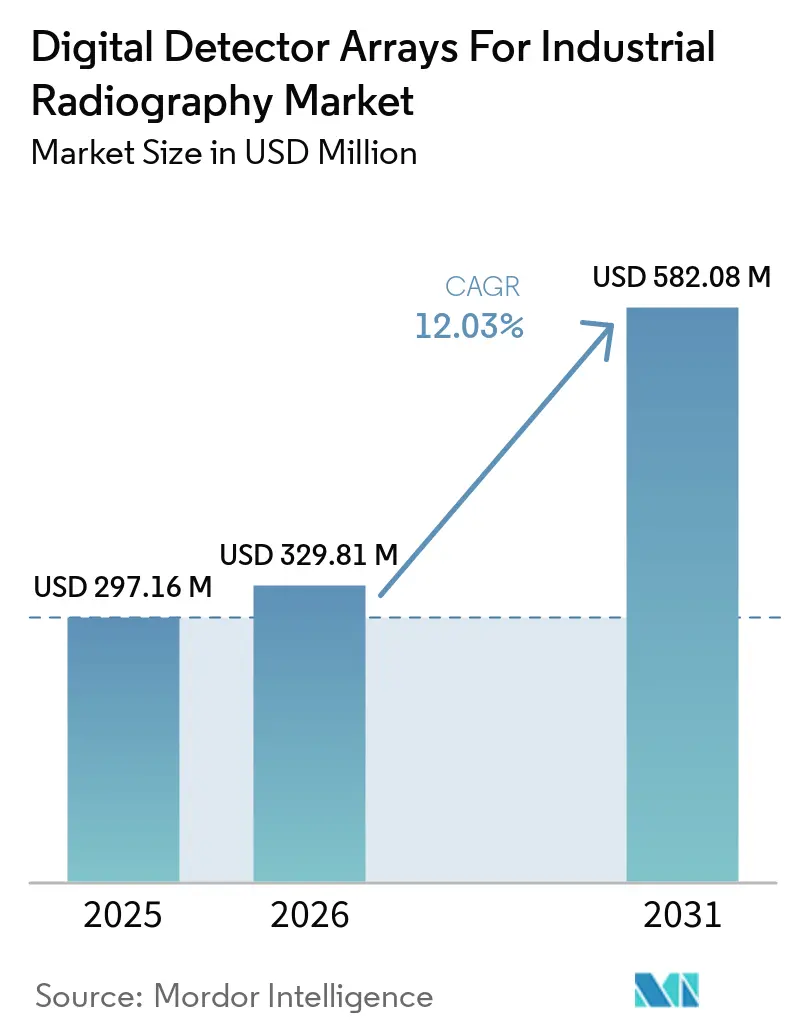
The Digital Detector Arrays for Industrial Radiography Market size is projected to expand from USD 297.16 million in 2025 to USD 329.81 million in 2026, and to USD 582.08 million by 2031, registering a CAGR of 12.03% between 2026 and 2031. The shift from film is supported by inspection rules that require consistent image quality, traceable records, and repeatable testing methods. Requirements for bendable and curved digital detector arrays make difficult pipe and vessel inspections more suitable for digital equipment. Manufacturers are also responding to faster production lines in batteries and electronics, where inspection speed can matter as much as image detail. Portable wireless systems and automated inspection cells broaden the range of field and factory applications of digital detector arrays in the industrial radiography market. High equipment costs and a limited supply of qualified radiographers remain material barriers, while integrated hardware, software, and review tools can strengthen supplier positions.
Key Report Takeaways
- By detector technology, amorphous silicon accounted for 42.83% of digital detector arrays in the industrial radiography market in 2025, while CMOS is projected to expand at a 13.03% CAGR through 2031.
- By detector format, flat-panel arrays held 71.63% of revenue in 2025, while curved and custom-geometry arrays are projected to expand at a 12.59% CAGR through 2031.
- By application, weld inspection held 31.47% of revenue in 2025, while inline and in-process inspection is projected to expand at a 13.21% CAGR through 2031.
- By end-user industry, oil and gas held 24.73% of revenue in 2025, while electronics and battery manufacturing are projected to expand at a 13.66% CAGR through 2031.
- By geography, North America accounted for 34.86% of digital detector array revenue in the industrial radiography market in 2025, while Asia-Pacific is projected to expand at a 13.01% CAGR through 2031.
Key Report Takeaways
| Segmentation | Segment | Metric | Year | Value |
|---|---|---|---|---|
| By Detector Technology | Amorphous Silicon | Market Share | 2025 | 42.83% |
| By Detector Technology | CMOS | CAGR | 2031 | 13.03% |
| By Detector Format | Flat-Panel Arrays | Market Share | 2025 | 71.63% |
| By Detector Format | Curved and Custom-Geometry Arrays | CAGR | 2031 | 12.59% |
| By Application | Weld Inspection | Market Share | 2025 | 31.47% |
| By Application | Inline and In-Process Inspection | CAGR | 2031 | 13.21% |
| By End-User Industry | Oil and Gas | Market Share | 2025 | 24.73% |
| By End-User Industry | Electronics and Battery Manufacturing | CAGR | 2031 | 13.66% |
| By Geography | North America | Market Share | 2025 | 34.86% |
| By Geography | Asia-Pacific | CAGR | 2031 | 13.01% |
| Source: Mordor Intelligence | ||||
Note: Market size and forecast figures in this report are generated using Mordor Intelligence’s proprietary estimation framework, updated with the latest available data and insights as of January 2026.
Global Digital Detector Arrays For Industrial Radiography Market Trends and Insights
Drivers Impact Analysis*
| Driver | (~) % Impact on CAGR Forecast | Geographic Relevance | Impact Timeline |
|---|---|---|---|
| Film-to-Digital Workflow Conversion in Regulated NDT | +2.8% | Global, concentrated in North America and Europe | Long term (≥ 4 years) |
| Real-Time Inspection Demand in High-Throughput Manufacturing | +2.2% | Asia-Pacific core, including China, South Korea, and Japan, with spillover to North America | Medium term (2-4 years) |
| Mainstream Adoption of Portable Wireless Detector Bundles | +1.8% | Global, with strongest uptake in North American and Middle Eastern oil and gas areas | Short term (≤ 2 years) |
| Expansion of Automated and Robotic Radiography | +1.5% | North America, Europe, and Asia-Pacific advanced manufacturing hubs | Medium term (2-4 years) |
| AI-Assisted Defect Recognition and Image Enhancement | +1% | Global, concentrated in aerospace and energy | Medium term (2-4 years) |
| Bendable Detector Deployment for Circumferential Welds | +0.6% | Global oil and gas and power generation sites using ASME and ISO requirements | Short ter |
| Source: Mordor Intelligence | |||
Film-to-Digital Workflow Conversion in Regulated NDT
Regulatory requirements are making the move from film to digital radiography more urgent for many inspection programs. ASME BPVC Section V, Article 2 requires DDA characterization to ASTM E-2597M and specifies a normalized signal-to-noise ratio of at least 130 in Mandatory Appendix VIII. This requirement favors systems that can consistently document image quality. The 2026 ASME update added requirements for bendable and curved DDAs, which address single-wall coverage on small-bore piping. Japan's JIS Z3110:2017 adapts ISO 17636-2 for digital detector use and supports DDA procurement in shipbuilding and chemical plant inspection. ASNT's 2026 adoption of the 2024 TC-1A and CP-189 editions also makes digital records and trained personnel more important in audited inspection workflows.[1]
The digital detector arrays for the industrial radiography market benefit from code-driven inspection spending, which is more regular than discretionary purchases. Pressure vessels, structural welds, and pipeline joints require evidence that the inspection methods met the stated requirements. Digital files can be stored, reviewed, and retrieved more easily than film records when asset owners need an audit trail. The standards also allow equipment makers to distinguish products through qualification evidence rather than only detector specifications. Contractors operating across multiple jurisdictions have an incentive to use platforms that align with widely used ASME, ASTM, and ISO procedures. This makes compliance documentation part of the practical value of a detector system.
Real-Time Inspection Demand in High-Throughput Manufacturing
Battery and electronics production lines are raising demand for radiography that works at production speed. Fraunhofer EZRT presented a high-speed CT method at ECNDT 2026 that uses a microfocus liquid-metal-target source and a photon-counting detector to complete cylindrical battery cell scans within seconds. The approach shows why long image capture cycles can be unsuitable for inline quality gates. GÖPEL electronic introduced its Multi Line AXI system in September 2026 for 2D, 2.5D, and 3D PCB inspection across an 810 × 535 mm area. Its manufacturing execution system integration indicates that equipment buyers expect radiographic data to integrate with production control systems. These conditions shift purchasing attention toward frame rate, spatial resolution, and reliable software connections.
The digital detector arrays for the industrial radiography market are therefore increasingly tied to production quality requirements rather than periodic inspections alone. Battery makers need ways to identify internal cell and module issues without slowing the line. Electronics producers also need systems that cover larger boards and can pass inspection results into factory management tools. CMOS detectors can be attractive in these settings because high frame rates have direct operational value. The change does not remove demand for mature detector technologies, but it creates a clear use case for faster systems. It also supports investment in enclosed radiography cells designed for occupied manufacturing areas.
Mainstream Adoption of Portable Wireless Detector Bundles
Wireless, battery-operated detector packages reduce setup work in remote and offshore radiography. DÜRR NDT's D-DR 1025B and D-DR 1043B platforms include wireless access points, IP67 enclosures, hot-swap batteries, and 1-meter drop-test certification. The products operate from -20°C to +50°C, which is suitable for harsh oil and gas environments. Varex Imaging's XRpad2 HWx-i is characterized in accordance with ASTM E-2597M and provides 9 fps continuous imaging with iridium-192 and selenium-75 source compatibility. A single portable platform can therefore serve several field radiography needs. This reduces the need to assemble separate cable, power, and imaging components at the inspection location.
For the digital detector arrays market in industrial radiography, portable bundles can reduce operational friction even when the equipment remains a significant capital purchase. Field teams can avoid cable management and some power logistics that previously added 2-4 personnel-hours per shift. Suppliers are increasingly packaging hardware, software, and connectivity as a pre-qualified bundle for specific standards. That approach can shorten vendor review cycles for buyers who must prove compliance. It can also increase switching costs after a contractor has established a certified workflow. Portable systems are especially relevant where film processing is difficult or impractical at the asset location.
Expansion of Automated and Robotic Radiography
Automated radiography is extending digital imaging into inspection tasks with complex geometry and high documentation needs. Fraunhofer EZRT's RoboCT platform uses 2 robots, with 1 carrying an X-ray source and the other carrying a detector. This arrangement supports region-of-interest trajectories for parts that conventional CT gantries cannot readily access. The same work describes DICONDE archiving and OPC UA test-order integration for unattended NDE 4.0 workflows. MISTRAS Group's ART Crawler screens insulated piping while the product remains in service. Its service description states that the method can provide full examination coverage in the time it takes conventional methods to inspect 5-10% of the surface.
The digital detector arrays for the industrial radiography market gain from automation because detector requirements become more specialized. Systems used on robots need appropriate shock and vibration performance, synchronization interfaces, and predictable data handling. Coverage planning for 6-axis robotic systems can support full-surface inspection of large aerospace parts. Automated cells also make repeatable imaging procedures easier to apply across a production program. Established suppliers can benefit when their detectors already have the qualification record needed for these settings. Buyers may favor complete systems when integration risk is more important than a lower component price.
Restraints Impact Analysis*
| Restraint | (~) % Impact on CAGR Forecast | Geographic Relevance | Impact Timeline |
|---|---|---|---|
| High Upfront Cost of Digital Radiography Equipment | -2.2% | Global, highest in price-sensitive emerging markets across South and Southeast Asia and Africa | Short term (≤ 2 years) |
| Shortage of Qualified Radiographic Testing Personnel | -1.3% | Global, acute in North America, the Middle East, and sub-Saharan Africa | Medium term (2-4 years) |
| Radiation-Hardening and Detector Replacement Costs | -0.8% | Global nuclear, high-energy industrial, and offshore applications | Medium term (2-4 years) |
| Cybersecurity and Data-Integrity Exposure in Connected Inspection | -0.4% | Global, concentrated in regulated critical infrastructure | Long term (≥ 4 years) |
| Source: Mordor Intelligence | |||
High Upfront Cost of Digital Radiography Equipment
High capital requirements can delay the adoption of DDAs among smaller NDT contractors. Complete field-deployable configurations require substantial investment, while film-based processes can operate with significantly lower equipment costs. Film workflows also involve recurring annual consumable expenses. Radiation hardening introduces an additional cost because amorphous silicon panels can degrade from accumulated dose and need replacement based on source energy. These costs can weigh more heavily in price-sensitive markets and on contractors with uneven project pipelines. The financial case depends on the value assigned to faster setup, reduced retakes, and digital documentation.
The digital detector arrays for the industrial radiography market are responding with financing, service subscriptions, and panel-replacement programs. These models shift part of the purchase burden from capital expenditure to operating expenditure. They can help contractors budget for multi-year pipeline integrity work with more predictable costs. Suppliers that retain responsibility for replacement panels can create recurring revenue across the detector lifecycle. The approach also gives buyers a way to adopt newer technology without committing all funds at the initial purchase. It does not remove the economic constraint, but it changes the timing and structure of the decision.
Shortage of Qualified Radiographic Testing Personnel
A shortage of Level II and Level III radiographers can limit inspection throughput even after equipment is installed. DDA workflows require personnel to understand normalized signal-to-noise ratios, basic spatial resolution, and contrast sensitivity in accordance with ASME BPVC Mandatory Appendix VIII. Existing paths under ASNT SNT-TC-1A, ISO 9712, and NAS 410 have not scaled at the same pace as demand for digital capability. Many experienced Level III film radiographers are approaching retirement. The transition to DDA may require recertification rather than incremental training alone. ASNT's 2026 update to TC-1A and CP-189 raises certification expectations even as training capacity continues to develop.
The digital detector arrays for the industrial radiography market can partially address staffing constraints through automated defect recognition and image enhancement. These tools can reduce review time and allow qualified reviewers to process more radiographs. Their use still depends on validation against applicable ASME, API, and ISO procedures. Software can support reviewer capacity, but it does not replace personnel who hold the required certification. Providers with training, workflow software, and detector hardware may be better placed to support customers facing this constraint. Workforce availability will remain a practical factor in how quickly inspection capacity can expand.
*Our forecasts treat driver/restraint impacts as directional, not additive. The impact forecasts reflect baseline growth, mix effects, and variable interactions.
Segment Analysis
By Detector Technology: Amorphous Silicon Retains a Broad Installed Base
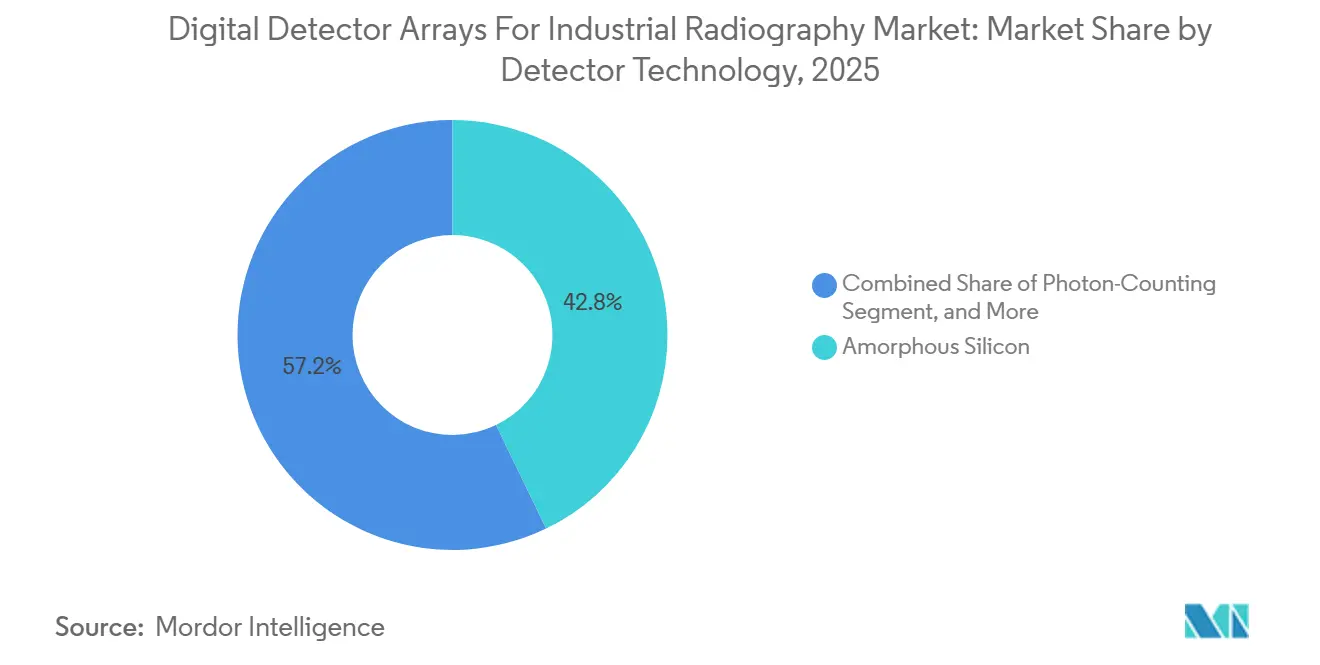
Amorphous silicon accounted for 42.83% of the digital detector array market share in the industrial radiography market in 2025. Its position reflects established large-area deposition processes and use in field radiography and high-dose industrial work. These characteristics keep the technology relevant where proven detector performance is important. IGZO occupies a middle position because it offers higher charge carrier mobility than amorphous silicon while maintaining comparable radiation tolerance. It is gaining attention among users who need higher frame rates without moving directly to another technology. Photon-counting detectors are entering industrial CT applications through Varex Imaging's TrueSpectrum approach. TrueSpectrum provides dual-energy information from 1 acquisition without physical filtration.
CMOS is projected to expand at a 13.03% CAGR through 2031, the fastest rate among detector technologies. CMOS is well-suited to applications that value faster image capture and integration with modern digital workflows. ASTM E-2597M uses a technology-neutral characterization framework, allowing CMOS systems to follow existing compliance routes. This reduces a barrier that had slowed movement from laboratory use to field deployment. The digital detector arrays for industrial radiography market is therefore separating into use cases that value rugged radiation tolerance and those that value fast image capture. Suppliers can address both needs through differentiated detector portfolios rather than a single technical approach.

By Detector Format: Flat-Panel Arrays Remain the Standard Configuration
Flat-panel arrays accounted for 71.63% of digital detector arrays in the industrial radiography market in 2025. Their lead reflects flexibility across weld inspection, wall-thickness mapping, castings, and structural composites. Standard 36 × 43 cm panels can capture a weld seam or pressure-vessel area in a single exposure. This avoids multiple exposures that smaller formats may require. DÜRR NDT's DRC 3643 supports wireless use for corrosion and erosion inspections. The format fits fieldwork where broad-area coverage and practical handling are important.
Line-scan arrays serve continuous inspection tasks where area capture could create motion blur. Varex Imaging's DC-TDI photon-counting line-scan platform has a 100 µm pixel pitch and supports line speeds up to 9 meters per second. It targets battery and recycling processes where material throughput is a central operating constraint. Curved and custom-geometry arrays are projected to expand at a 12.59% CAGR through 2031. Carestream's INDUSTREX HPX-ARC 1043 PH, introduced in October 2025, has a 98 µm pixel pitch, a 10 × 43 cm capture area, and a 4-inch bend capability. Bendable formats reduce the need for a separate exposure for inside-diameter double-wall coverage and support the curved-surface requirement in ASME BPVC Paragraph T-271.
By Application: Weld Inspection Provides the Established Demand Base
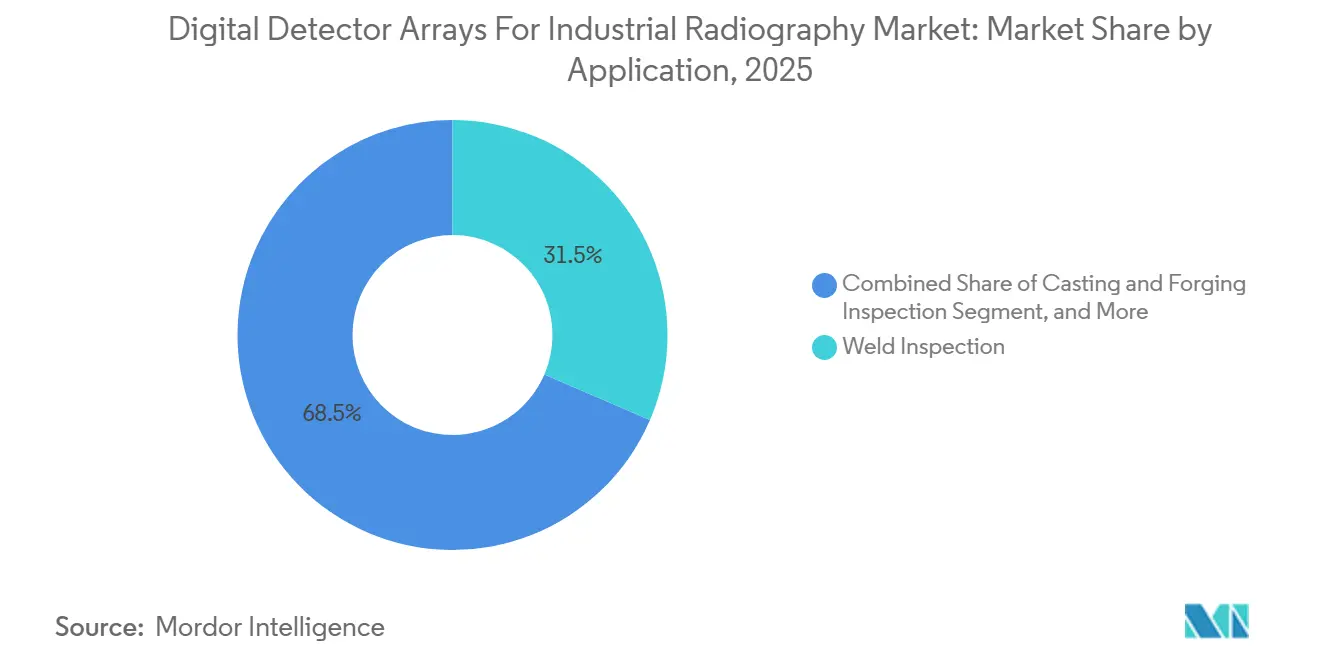
Weld inspection held 31.47% of application revenue in 2025. The digital detector arrays for the industrial radiography market size for this application are supported by inspection requirements in ASME BPVC, ASME B31.1, ASME B31.3, ISO 17636-2, and AWS D1.1. These rules apply to pressurized, structural, and safety-critical joints across many industries. DDA systems can support clear image records for acceptance decisions and subsequent review. Automated defect recognition can identify porosity, slag inclusions, and lack of fusion in image review workflows. The underlying inspection need remains broad because welding is present in energy, manufacturing, and infrastructure assets.
Corrosion and wall-thickness inspections use many of the same portable wireless platforms. MISTRAS Group's ART Crawler enables in-service screening of insulated piping, allowing inspection without stopping product flow. Structural and composite inspection also extends radiography into bridges, rail systems, and wind blades. Inline and in-process inspection is projected to expand at a 13.21% CAGR through 2031 as battery and electronics manufacturers move toward 100% X-ray coverage. Toptec and INNER BV signed a 2025 co-development agreement for an inline EV battery module CT scanner planned for commercial deployment by the end of 2026. The digital detector arrays for the industrial radiography market will need enclosed, lead-shielded designs for inline systems operating in occupied manufacturing facilities, in accordance with IEC 61331-1.
By End-User Industry: Oil and Gas Holds the Largest Revenue Position
Oil and gas accounted for 24.73% of digital detector arrays in the industrial radiography market in 2025. API 570, ASME B31.8, and CSA Z662 integrity requirements support ongoing NDT spending that is linked to asset condition and age. Offshore locations have a particularly strong need for digital radiography because film processing at sea is difficult. Portable and rugged detector systems suit subsea and floating production environments. Automated crawlers can also support corrosion screening while assets remain in service. These conditions maintain a stable revenue base for detector suppliers with equipment qualified for energy assets.
Electronics and battery manufacturing are projected to expand at a 13.66% CAGR through 2031, the fastest rate among end-user groups. Electrode misalignment and anode overhang are linked to thermal runaway risk, thereby increasing the value of internal inspection. Fraunhofer EMI presented a 1,000-image-per-second in-operando battery cell X-ray system in August 2026. The technology extends radiography from routine quality control to failure-mode analysis. Battery applications prioritize frame rate and photon-counting sensitivity, while oil and gas applications prioritize radiation hardness and rugged construction. Aerospace, defense, power generation, general manufacturing, and automotive also support demand through scheduled maintenance and production quality programs.
Geography Analysis
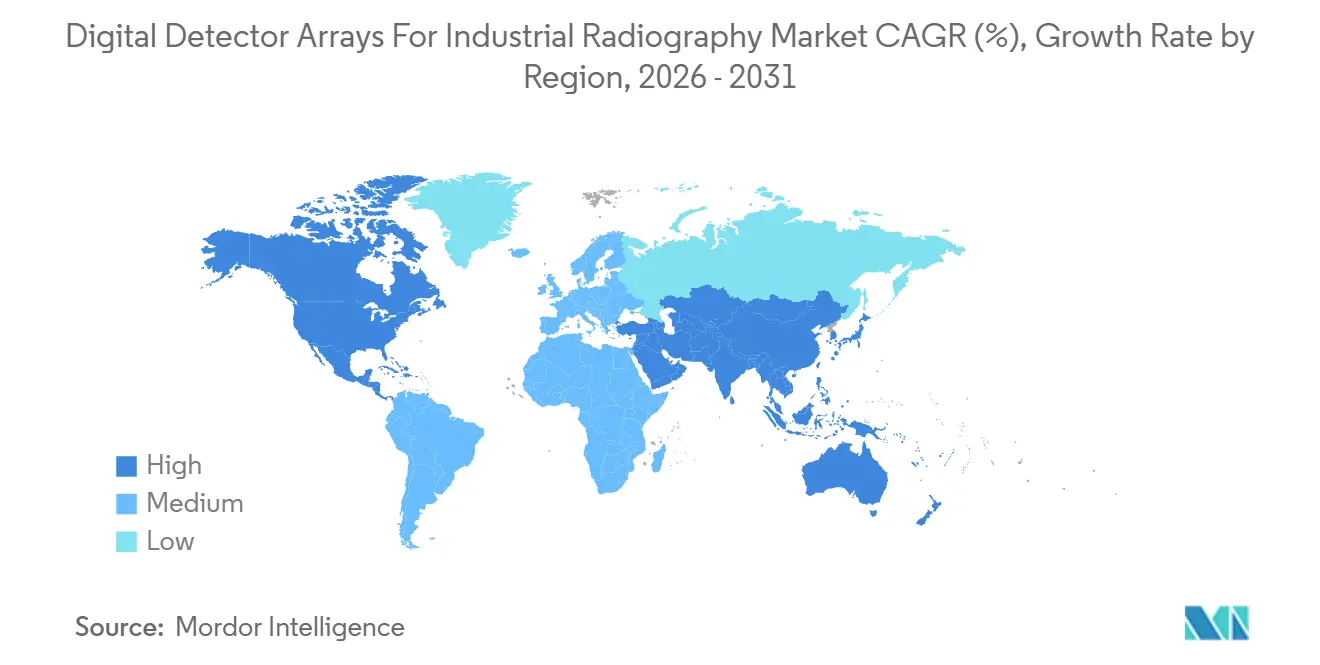
North America accounted for 34.86% of the digital detector arrays market share in the industrial radiography market in 2025. API 570, ASME B31.1, ASME B31.3, and Section III requirements support recurring inspection spending across petrochemical, power, and industrial asset sites. The region has a dense base of assets that operate under ASME-related codes. Teledyne Technologies announced its agreement to acquire Varex Imaging in August 2026 for USD 1.1 billion. If the transaction closes in early 2027, it will combine X-ray sources and detectors under 1 supplier for North American system integrators. Canada's LNG expansion and Mexico's energy modernization also add regional demand.[2]
Europe follows North America, with Germany, the United Kingdom, France, Italy, and Spain serving as key demand centers. EASA digital airworthiness provisions support DDA replacement in aerospace manufacturing hubs. EN 12681 and ISO 17636-2 guide procurement in the automotive and energy manufacturing sectors. German facilities are integrating digital radiography into NDE 4.0 systems using OPC UA-compliant DICONDE data pipelines. This extends investment beyond hardware to software and data management. The digital detector arrays for the industrial radiography market in Europe are shaped by the need to link inspection evidence to controlled production processes.
Asia-Pacific is projected to expand at a 13.01% CAGR through 2031. Japan's JIS Z3110:2017 supports digital weld radiography for metallic joints in shipbuilding and chemical plants. Domestic contractors use DDA systems for real-time mass inspection and remote image review. South Korea's shipbuilding sector, India's aerospace offset programs, and ASEAN petrochemical development broaden the regional demand base. The Middle East has concentrated inspection spending linked to Saudi Arabia's Aramco SAEP-1112 turnaround scope and ADNOC integrity programs. South America and Africa remain developing areas, with Petrobras FPSO programs in Brazil and South Africa's petrochemical sector providing initial entry points.
Competitive Landscape
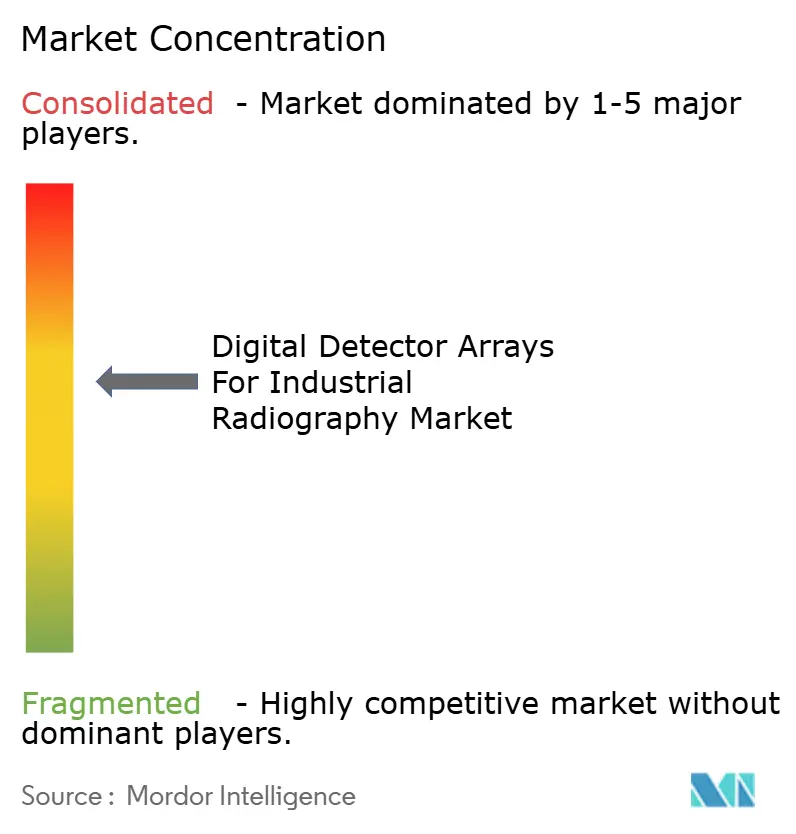
The digital detector arrays for the industrial radiography market are moderately concentrated. Vertically integrated imaging companies compete with specialized detector manufacturers, systems integrators, and an expanding group of Asian suppliers. Compliance with ASTM E-2597M, ISO 17636-2, and NAS 410 is a practical route to market access. Certification can favor suppliers with the resources to document performance under multiple inspection conditions. Teledyne Technologies agreed in August 2026 to acquire Varex Imaging for USD 18.90 per share, for a total of USD 1.1 billion. The planned transaction would combine X-ray tubes, flat-panel detectors, photon-counting sensors, and CMOS components in an integrated supplier platform.
Companies in the digital detector arrays for industrial radiography market are differentiating through workflow integration, detector form factors, and embedded image processing. Suppliers are co-certifying hardware, software, and wireless connectivity against ASME and ISO standards. This can reduce implementation work for users who need a complete inspection workflow. Carestream NDT introduced the bendable INDUSTREX HPX-ARC 1043 PH in October 2025 for curved-surface and circumferential weld work. DÜRR NDT released bendable wireless flat-panel detectors in 2025 with IP67 enclosures and defined bending diameters. These moves show how portable field requirements are becoming a focus of product development.
Patent activity in digital imaging algorithms, photon-counting detectors, and AI-assisted defect recognition has increased since 2024. This points to technology areas where differentiation is likely to concentrate. Varex Imaging presented TrueSpectrum at ECNDT 2026 to obtain dual-energy information from a single photon-counting acquisition without physical beam filtration. The digital detector arrays for the industrial radiography market also have opportunities in radiation-hardened systems above 1 MeV, lower-cost bundles for South and Southeast Asia, and multi-energy imaging for batteries and semiconductors. International incumbents retain advantages in certification depth and data management integration. Chinese suppliers are building positions in mid-tier specifications by prioritizing domestic procurement.[3]
Digital Detector Arrays For Industrial Radiography Industry Leaders
-
Varex Imaging Corporation
-
Teledyne Technologies Incorporated
-
DÜRR NDT GmbH & Co. KG
-
Fujifilm Corporation
-
Detection Technology Plc
- *Disclaimer: Major Players sorted in no particular order
Recent Industry Developments
- September 2026: GÖPEL electronic introduced the Multi Line AXI X-ray inspection system featuring an 810 × 535 mm area, 2D/2.5D/3D PCB inspection capability, and MES integration across inline, at-line, and stand-alone configurations for electronics and battery manufacturing.
- August 2026: Fraunhofer EMI unveiled a high-speed X-ray system recording 1,000 images per second inside operating battery cells, directly visualizing gas formation, material displacement, and crack propagation. Scalable across cylindrical, pouch, and prismatic cell formats, the system is planned for installation at PowerCo's Salzgitter site by 2028.
- August 2026: Teledyne Technologies agreed to acquire Varex Imaging at USD 18.90 per share, approximately USD 1.1 billion total, combining X-ray tube, flat-panel, and photon-counting detector supply under Teledyne's Digital Imaging segment. Closing is anticipated in early 2027.
- June 2026: Varex Imaging presented TrueSpectrum at ECNDT 2026 in Verona, delivering dual-energy data for both interior-volume and surface-quality from a single photon-counting acquisition without physical beam filtration, eliminating beam-hardening artifacts in multi-material industrial CT.
Global Digital Detector Arrays For Industrial Radiography Market Report Scope
The Digital Detector Arrays for Industrial Radiography Market comprises the revenues generated from the development, manufacture, and sale of digital detector array systems specifically designed to capture and convert X-ray or gamma-ray radiation into digital images for non-destructive testing (NDT) and industrial radiographic inspection. These detector arrays replace or complement conventional radiographic film and other imaging methods by enabling the digital acquisition, processing, storage, and analysis of radiographic images.
The Digital Detector Arrays for Industrial Radiography Market Report is Segmented by Detector Technology (Amorphous Silicon, CMOS, IGZO, Photon-Counting, and Other Detector Technologies), Detector Format (Flat-Panel Detector Arrays, Line-Scan Detector Arrays, and Curved and Custom-Geometry Detector Arrays), Application (Weld Inspection, Corrosion and Wall-Thickness Inspection, Casting and Forging Inspection, Pipe and Pipeline Inspection, Structural and Composite Inspection, and Other Applications), End-User Industry (Aerospace and Defense, Automotive and Electric Vehicles, Oil and Gas, Power Generation, General Manufacturing and Metals, Electronics and Battery Manufacturing, Construction, Infrastructure, and Rail, and Other End-User Industries), and Geography (North America, South America, Europe, Asia-Pacific, and Middle East and Africa). The Market Forecasts are Provided in Terms of Value (USD).
| Amorphous Silicon |
| CMOS |
| IGZO |
| Photon-Counting |
| Other Detector Technologies |
| Flat-Panel Detector Arrays |
| Line-Scan Detector Arrays |
| Curved and Custom-Geometry Detector Arrays |
| Weld Inspection |
| Corrosion and Wall-Thickness Inspection |
| Casting and Forging Inspection |
| Pipe and Pipeline Inspection |
| Structural and Composite Inspection |
| Other Applications |
| Aerospace and Defense |
| Automotive and Electric Vehicles |
| Oil and Gas |
| Power Generation |
| General Manufacturing and Metals |
| Electronics and Battery Manufacturing |
| Construction, Infrastructure, and Rail |
| Other End-User Industries |
| North America | United States | |
| Canada | ||
| Mexico | ||
| South America | Brazil | |
| Argentina | ||
| Rest of South America | ||
| Europe | Germany | |
| United Kingdom | ||
| France | ||
| Italy | ||
| Spain | ||
| Rest of Europe | ||
| Asia-Pacific | China | |
| Japan | ||
| India | ||
| South Korea | ||
| ASEAN | ||
| Rest of Asia-Pacific | ||
| Middle East and Africa | Middle East | Saudi Arabia |
| United Arab Emirates | ||
| Turkey | ||
| Rest of the Middle East | ||
| Africa | South Africa | |
| Nigeria | ||
| Rest of Africa | ||
| By Detector Technology | Amorphous Silicon | ||
| CMOS | |||
| IGZO | |||
| Photon-Counting | |||
| Other Detector Technologies | |||
| By Detector Format | Flat-Panel Detector Arrays | ||
| Line-Scan Detector Arrays | |||
| Curved and Custom-Geometry Detector Arrays | |||
| By Application | Weld Inspection | ||
| Corrosion and Wall-Thickness Inspection | |||
| Casting and Forging Inspection | |||
| Pipe and Pipeline Inspection | |||
| Structural and Composite Inspection | |||
| Other Applications | |||
| By End-User Industry | Aerospace and Defense | ||
| Automotive and Electric Vehicles | |||
| Oil and Gas | |||
| Power Generation | |||
| General Manufacturing and Metals | |||
| Electronics and Battery Manufacturing | |||
| Construction, Infrastructure, and Rail | |||
| Other End-User Industries | |||
| By Geography | North America | United States | |
| Canada | |||
| Mexico | |||
| South America | Brazil | ||
| Argentina | |||
| Rest of South America | |||
| Europe | Germany | ||
| United Kingdom | |||
| France | |||
| Italy | |||
| Spain | |||
| Rest of Europe | |||
| Asia-Pacific | China | ||
| Japan | |||
| India | |||
| South Korea | |||
| ASEAN | |||
| Rest of Asia-Pacific | |||
| Middle East and Africa | Middle East | Saudi Arabia | |
| United Arab Emirates | |||
| Turkey | |||
| Rest of the Middle East | |||
| Africa | South Africa | ||
| Nigeria | |||
| Rest of Africa | |||
Key Questions Answered in the Report
What is the digital detector arrays for industrial radiography market size?
The digital detector arrays for industrial radiography market was valued at USD 329.81 million in 2026 and is projected to reach USD 582.08 million by 2031 at a 12.03% CAGR.
What is driving demand for digital detector arrays in industrial radiography?
Code-driven inspection, high-throughput battery production, portable wireless systems, and robotic radiography are supporting adoption.
Which detector technology has the largest revenue share?
Amorphous silicon held 42.83% of detector technology revenue in 2025, supported by established radiation hardness and large-area use.
Which application is projected to expand fastest through 2031?
Inline and in-process inspection is projected to expand at a 13.21% CAGR through 2031 as battery and electronics producers seek full X-ray coverage.
Which end-user group is projected to expand fastest?
Electronics and battery manufacturing is projected to expand at a 13.66% CAGR through 2031, supported by the need to inspect internal cell and module features.
Which region leads demand for these detector systems?
North America held 34.86% of revenue in 2025, while Asia-Pacific is projected to expand at a 13.01% CAGR through 2031.