
Photon-Counting X-Ray Inspection Systems Market Size and Share
Market Overview
| Study Period | 2020 - 2031 |
|---|---|
| Market Size (2026) | USD 184.77 Million |
| Market Size (2031) | USD 455.82 Million |
| Growth Rate (2026 - 2031) | 19.79 % |
| Fastest Growing Market | Asia-Pacific |
| Largest Market | Asia-Pacific |
| Market Concentration | Medium |
Major Players *Disclaimer: Major Players sorted in no particular order Image © Mordor Intelligence. Reuse requires attribution under CC BY 4.0. | |
Photon-Counting X-Ray Inspection Systems Market Analysis by Mordor Intelligence
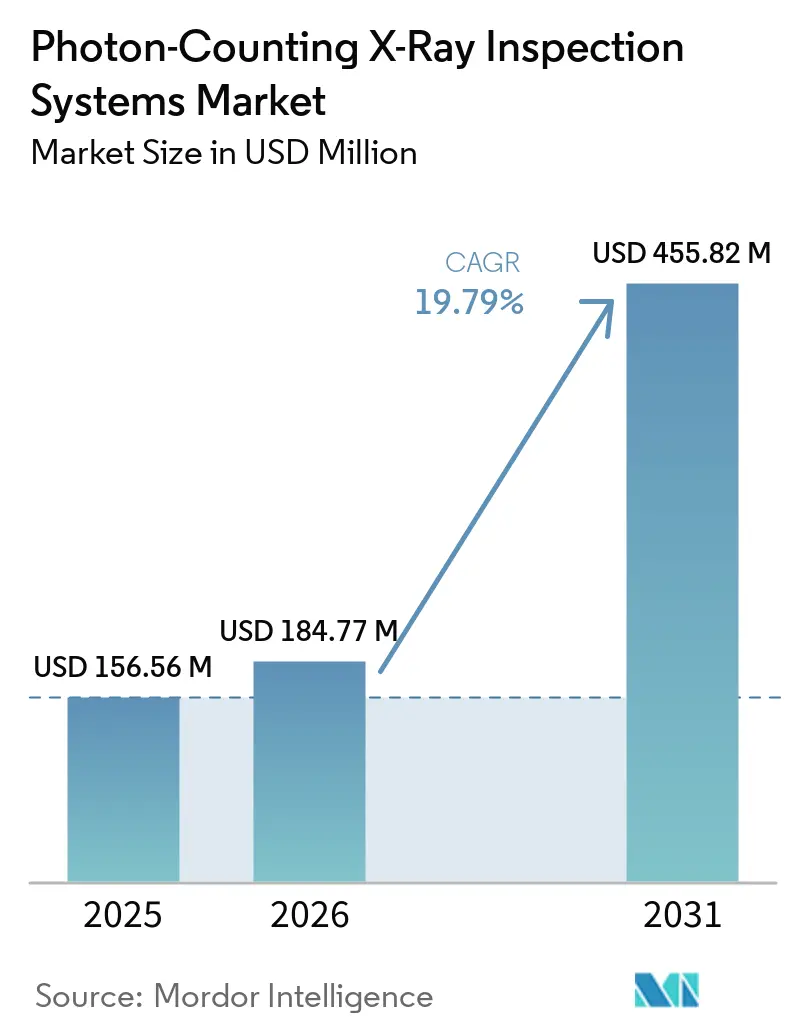
The Photon-Counting X-Ray Inspection Systems Market size is projected to expand from USD 156.56 million in 2025 and USD 184.77 million in 2026 to USD 455.82 million by 2031, registering a CAGR of 19.79% between 2026 and 2031. The Photon-Counting X-Ray Inspection Systems Market is supported by manufacturers that need reliable material discrimination at production-line speeds. Direct-conversion detectors based on cadmium telluride (CdTe) and cadmium zinc telluride (CdZnTe) count individual X-ray photons and reduce electronic noise. This capability supports the detection of internal anomalies and differentiation among materials in food, pharmaceuticals, electronics, and battery production. Product recall exposure is increasing the value placed on inspection systems that support yield improvement and traceable quality records. Competition is moving toward validated software, material analysis, and service capability rather than detector sensitivity alone.
Key Report Takeaways
- By detector technology, dual-energy systems held 38.81% of the Photon-Counting X-Ray Inspection Systems Market in 2025, while multi-energy or spectral systems are projected to expand at a 24.41% CAGR through 2031.
- By system configuration, line-scan systems held 48.61% of the 2025 total, while computed tomography systems are projected to expand at a 25.51% CAGR through 2031.
- By application, foreign-object detection accounted for 32.41% in 2025, while material decomposition and sorting are projected to expand at a 22.56% CAGR through 2031.
- By end-user industry, food and beverage manufacturers accounted for 35.58% in 2025, while electronics and semiconductors are projected to expand at a 24.91% CAGR through 2031.
- By geography, Asia-Pacific held 29.11% of the global Photon-Counting X-Ray Inspection Systems Market in 2025 and is projected to expand at a 22.61% CAGR through 2031.
Note: Market size and forecast figures in this report are generated using Mordor Intelligence’s proprietary estimation framework, updated with the latest available data and insights as of January 2026.
Market Trends and Insights
Drivers Impact Analysis of Photon-Counting X-Ray Inspection Systems Market*
| Driver | (~) % Impact on CAGR Forecast | Geographic Relevance | Impact Timeline |
|---|---|---|---|
| High-Reliability Manufacturing Traceability | +4.8% | Global, with early concentration in North America and Europe | Medium term (2-4 years) |
| Automated Food and Pharmaceutical Inspection | +4.2% | Global, led by North America, Europe, and Asia-Pacific | Short term (≤ 2 years) |
| High-Speed In-Line Computed Tomography Demand | +3.5% | Asia-Pacific core, with spillover to North America and Europe | Medium term (2-4 years) |
| Semiconductor, Battery, and Advanced-Packaging Output | +3.2% | Asia-Pacific core, with secondary demand in North America and Europe | Medium term (2-4 years) |
| Multi-Energy Photon-Counting Material Decomposition | +2.3% | Global, concentrated in advanced manufacturing hubs | Long term (≥ 4 years) |
| Lower False-Reject Costs for Complex Food Products | +1.6% | North America and Europe, with spillover to Asia-Pacific | Short term (≤ 2 years) |
| Source: Mordor Intelligence | |||
Tightening Traceability Requirements for High-Reliability Manufacturing
Traceability requirements now extend beyond food lots and pharmaceutical serialization. Aerospace, automotive, and electronics suppliers increasingly need documented inspection records for individual components. The Photon-Counting X-Ray Inspection Systems Market can generate machine-readable evidence at the point of manufacture. The U.S. Food and Drug Administration identifies preventive controls for human food under 21 CFR Part 117, which strengthens the need for documented food-safety controls. These records can connect inspection activity with quality management and manufacturing execution systems. The resulting software and data integration can make a supplier relationship more durable after installation.
Expansion of Automated Food and Pharmaceutical Inspection Lines
The Photon-Counting X-Ray Inspection Systems Market serves food producers updating inspection lines to handle a wider range of products and more demanding package formats. The Photon-Counting X-Ray Inspection Systems Market benefits when a dual-energy system replaces separate inspection stages. Material contrast can improve the detection of low-density contaminants, including soft plastics, rubber gaskets, and fish bones. Eagle Product Inspection expanded its PXT photon-counting capabilities across its advanced inspection range in April 2026. The update focused on material discrimination and validated performance for food processors operating under FSIS verification programs. Retailer audits also continue to reinforce demand for dependable inspection of premium food and personal care products.[1]
Rising Demand for High-Speed In-Line Computed Tomography
The Photon-Counting X-Ray Inspection Systems Market supports battery manufacturing that requires inspection of anode overhang, metallic particles, and electrode winding at line speed. Computed tomography provides volumetric information that a 2D image cannot provide. A 2025 study found that a high-brightness MetalJet E1+ source and a dual-threshold photon-counting detector completed prismatic battery-cell CT scans within 1 second. ECNDT 2026 research also documented cylindrical-cell CT systems with 2-second scan cycles. Comet Yxlon's 2025 High-Density Power target increased X-ray power density by 2x at the same form factor. These developments make faster CT workflows more practical for battery, semiconductor, and automotive inspection.[2]
Growth of Semiconductor, Battery, and Advanced-Packaging Manufacturing
The Photon-Counting X-Ray Inspection Systems Market is affected by advanced packages that include chiplets, high-bandwidth memory, and 2.5D and 3D structures. These designs require inspection of voids and delamination below the surface. Conventional 2D X-ray methods may have limitations in high-volume production for these tasks. Nordson Test and Inspection reported that its Dynamic Planar CT software achieved image acquisition 2x faster than classical Planar CT for flip-chip micro-bump inspection. Battery and chip manufacturers are therefore shifting from sampling checks to inspecting every unit. This requirement raises the operational importance of fast readout, stable calibration, and application engineering.[3]
Restraints Impact Analysis of Photon-Counting X-Ray Inspection Systems Market*
| Restraint | (~) % Impact on CAGR Forecast | Geographic Relevance | Impact Timeline |
|---|---|---|---|
| High System and Shielding Costs | -3.5% | Global, most pronounced in South America, Middle East and Africa, and smaller Asia-Pacific markets | Long term (≥ 4 years) |
| Radiation-Safety and Validation Complexity | -2.4% | Global, most acute in Europe and North America | Medium term (2-4 years) |
| Pixel-Pile-Up and High-Flux Calibration Challenges | -1.7% | Global | Medium term (2-4 years) |
| Limited Integrator and Application-Engineering Capacity | -1.2% | Emerging markets, with secondary impact in developed markets | Short term (≤ 2 years) |
| Source: Mordor Intelligence | |||
High System and Shielding Costs
Photon-counting X-ray systems can cost 1.5x to 3x as much as comparable scintillator-based units. Detector area, energy resolution, and throughput requirements affect the difference. Site investment can also include shielding, structural work, and lead-equivalent enclosures. Smaller food and beverage producers often face capital approval cycles of 12-24 months. Multi-energy systems are particularly costly and remain best suited for battery, semiconductor, and aerospace applications. Import duties and limited financing can further restrict adoption in South America, the Middle East and Africa, and smaller Asia-Pacific markets.[4]
Radiation-Safety and Validation Complexity
Regulated manufacturing sites must document design, installation, operational, and performance qualification. These activities add work before a system can enter production. Radiation controls can require engineering safeguards, periodic surveys, and operator training. The commissioning period may be extended by 3-9 months under applicable U.S. and national requirements. Smaller pharmaceutical contractors and specialist food processors may lack access to validation resources. Longer commissioning periods can delay vendor revenue recognition even when a customer has selected a system.
*Our forecasts treat driver/restraint impacts as directional, not additive. The impact forecasts reflect baseline growth, mix effects, and variable interactions.
Photon-Counting X-Ray Inspection Systems Market Segment Analysis
By Detector Technology:
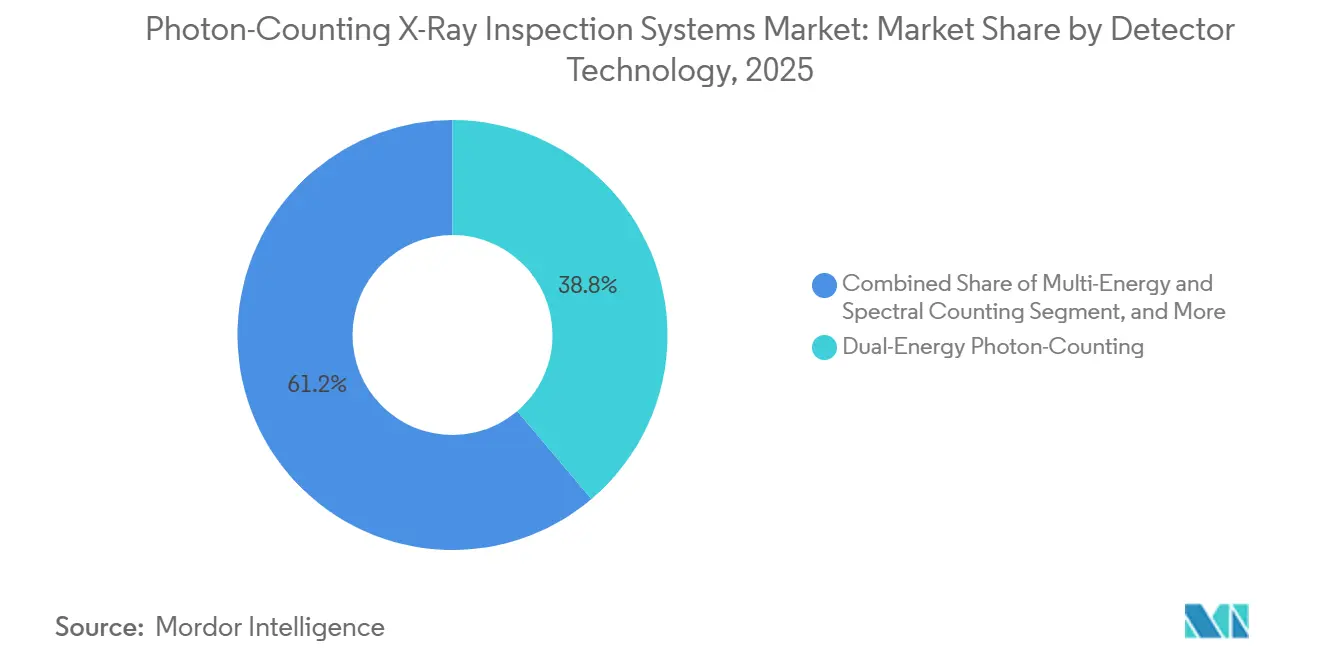
Dual-Energy Systems Retain the Lead as Spectral Demand BuildsDual-energy systems held 38.81% of the Photon-Counting X-Ray Inspection Systems Market share in 2025. Their lead reflects established use in food and pharmaceuticals, where two-material discrimination is validated and commercially supported. Retailer audit processes and traceability systems also fit this mature technology. Single-energy systems remain relevant for entry-level food inspection and high-energy industrial radiography. Energy-threshold and energy-resolving systems serve selected blister and vial inspection needs.
Multi-energy or spectral systems are projected to expand at a 24.41% CAGR through 2031. The Photon-Counting X-Ray Inspection Systems Market is seeing battery and semiconductor lines that require several material classes to be distinguished in a single CT acquisition. These materials can include electrodes, binder coatings, and metallic current collectors. Sony Semiconductor Solutions announced planned mass production of the IMX711 direct-conversion X-ray CMOS sensor in June 2026, with a maximum frame rate of 26,100 fps. ADVACAM's CdTe-based WidePIX cameras use 55 µm pixel pitch and adjustable energy thresholds for CT inspection.

By System Configuration:
Line-Scan Systems Have an Installed Base While CT Gains GroundLine-scan systems accounted for 48.61% of the Photon-Counting X-Ray Inspection Systems Market size in 2025. The Photon-Counting X-Ray Inspection Systems Market serves food and beverage plants that use them across continuous belt-fed production lines. Their installed base supports data sets for calibration, algorithms, and audit documentation. These data sets can create switching costs beyond those tied to detector performance. Area-scan and laminography systems serve stationary parts and specialized micro-bump geometries.
Computed tomography systems are projected to expand at a 25.51% CAGR through 2031. Their use is increasing where batteries need volumetric checks and packages contain buried connections. Comet Yxlon introduced a 160 kV nanofocus tube option for the FF35 CT in June 2026. Nordson's Dynamic Planar CT software supports faster image acquisition for flip-chip inspection. Hardware and software updates can reduce the barrier to CT workflows.
By Application:
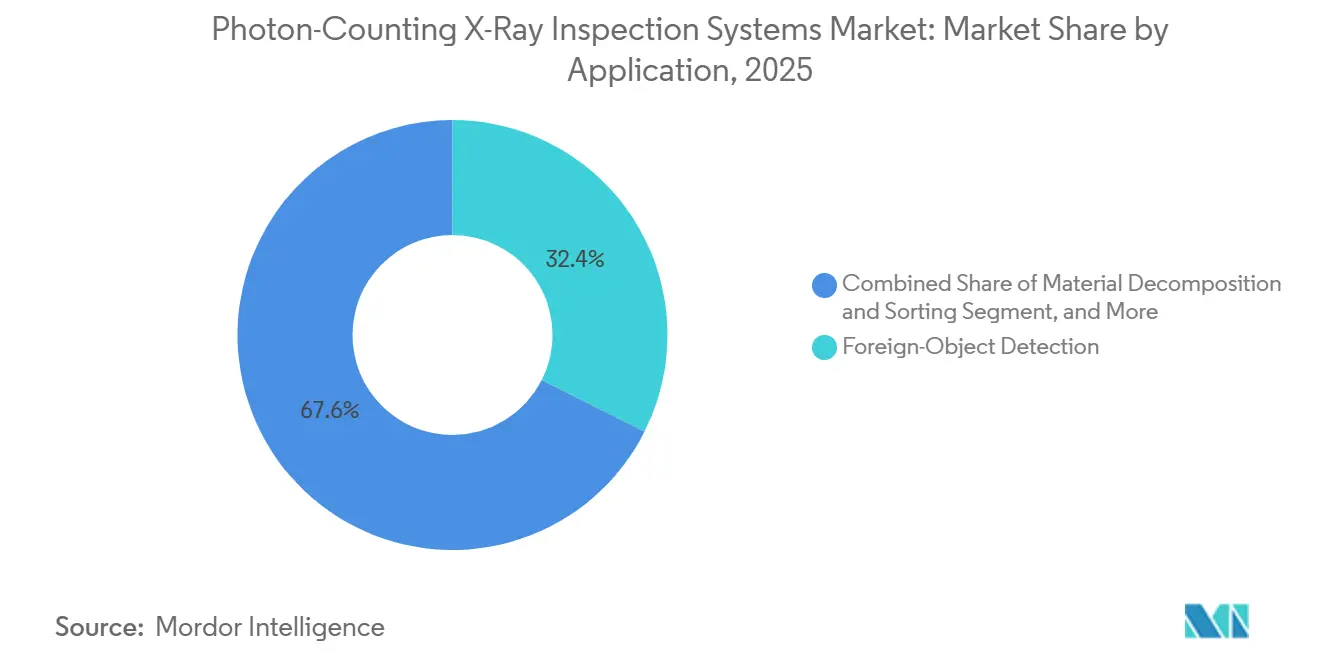
Foreign-Object Detection Leads While Material Analysis ExpandsForeign-object detection accounted for 32.41% of the total in 2025. The Photon-Counting X-Ray Inspection Systems Market serves food, pharmaceutical, and consumer goods producers that use it to manage physical contamination risks. Retailer and regulatory expectations treat such contamination as a serious defect category. Defect and void inspection also supports electronics, automotive casting, and additive manufacturing. Dimensional metrology and weight estimation can assist food inspection of irregular products.
Material decomposition and sorting are projected to expand at a 22.56% CAGR through 2031. The Photon-Counting X-Ray Inspection Systems Market serves battery manufacturers who use this function to assess electrode distributions and metallic inclusions in a single non-destructive pass. A 2026 Journal of Instrumentation study reported root-mean-square error below 2.5 g/m² for LiFePO₄ and NMC electrode measurements. This precision is relevant to electrode-coating quality controls. ECNDT research also indicates continued development of photon-counting detector models for industrial radiography.
By End-User Industry:
Food and Beverage Provides Scale While Electronics AccelerateFood and beverage manufacturers accounted for 35.58% of the total in 2025. The segment has many inspection points, although system prices are often lower than in semiconductor and aerospace applications. This installed volume supports the Photon-Counting X-Ray Inspection Systems Industry across processors and package formats. Pharmaceutical and personal care sites require inspection of finished dosage units. Automotive and electric vehicle makers use volumetric inspection for battery packs and structural adhesive joints.
Electronics and semiconductors are projected to expand at a 24.91% CAGR through 2031. Dense 3D interconnects and chiplet designs require non-destructive volumetric inspection. This inspection is becoming part of production control rather than an optional quality assurance step. Aerospace and defense remain smaller-volume users with strict NDT documentation and high system values. This end-user mix is bringing metrology specialists into the Photon-Counting X-Ray Inspection Systems Market.
Geography Analysis
North America Photon-Counting X-Ray Inspection Systems Market
North America has a developed base for photon-counting X-ray inspection. The Photon-Counting X-Ray Inspection Systems Market in North America is supported by food safety enforcement and automation investment, and pharmaceutical fill-and-finish upgrades support demand. The U.S. FDA extended the Food Traceability Final Rule compliance date to July 2028, aligning procurement activity with the 2026-2028 period. Eagle Product Inspection demonstrated 3 advanced X-ray systems at IPPE 2026 in January. Canada and Mexico are smaller markets tied to North American supply chains.
Europe Photon-Counting X-Ray Inspection Systems Market
Europe is the second-largest geographic area in the Photon-Counting X-Ray Inspection Systems Market. Food-control and pharmaceutical frameworks support demand for replacement and upgrades. Germany, the United Kingdom, and France have deep automation infrastructure and active pharmaceutical and automotive bases. BRCGS food-safety standards contribute to audit and validation requirements. Italy, Spain, and Eastern Europe add demand for food, pharmaceuticals, automotive, and electronics.
APAC, MEA and South America Photon-Counting X-Ray Inspection Systems Market
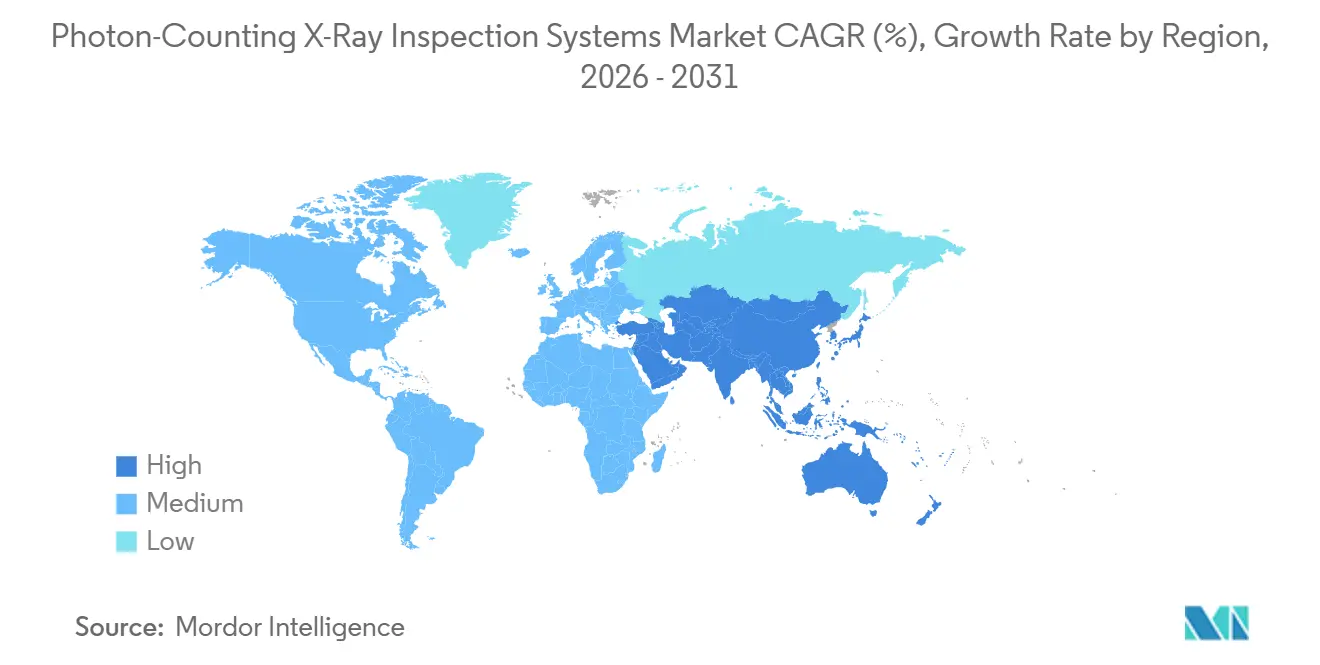
Asia-Pacific held 29.11% of the Photon-Counting X-Ray Inspection Systems Market share in 2025 and is projected to expand at a 22.61% CAGR through 2031. The Photon-Counting X-Ray Inspection Systems Market has a key source of demand in China because of battery-cell manufacturing. Japan, South Korea, and ASEAN add semiconductor, display, and electronics requirements. South America, the Middle East, and Africa remain earlier-stage areas because import costs, infrastructure gaps, and limited application engineering restrict adoption.
Competitive Landscape
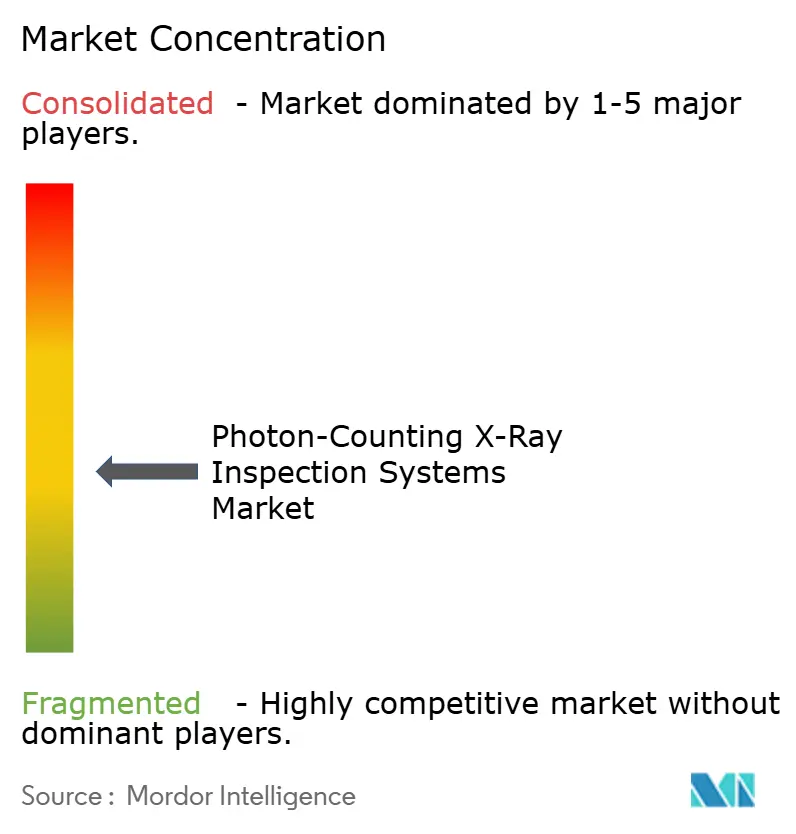
The Photon-Counting X-Ray Inspection Systems Market is moderately fragmented among system integrators and fragmented among detector-component suppliers. Mettler-Toledo, through Eagle Product Inspection, Comet Yxlon, Nordson Test and Inspection, and Rigaku, competes in system applications. Varex Imaging and ADVACAM are component suppliers. Integrated vendors compete through validation, software, service coverage, and application support. Component specialists focus on frame rate, pixel pitch, and energy resolution.
Teledyne Technologies and Varex Imaging announced a definitive agreement in August 2026 for Teledyne to acquire Varex for USD 1.1 billion, subject to approvals and a planned early-2027 close. Within the Photon-Counting X-Ray Inspection Systems Market, Varex also presented its TrueSpectrum dual-energy CT approach at ECNDT 2026. Comet Yxlon upgraded the FF35 CT platform with its High-Density Power target in late 2025. Eagle Product Inspection expanded PXT photon-counting capabilities in April 2026. These moves show investment in detector performance and food-processing validation.
In the Photon-Counting X-Ray Inspection Systems Market, modular detector upgrades and service-based inspection models could address the affordability gap for smaller processors. Software-defined inspection and AI-supported material analysis can extend hardware life. Nordson's Dynamic Planar CT improves throughput without a complete hardware replacement. ADVACAM, VisiConsult, and Deep Detection pursue focused roles in spectral CT and application-specific NDT.
Photon-Counting X-Ray Inspection Systems Industry Leaders
-
Eagle Product Inspection
-
Varex Imaging Corporation
-
ADVACAM s.r.o.
-
Deep Detection
-
Rigaku Holdings Corporation
- *Disclaimer: Major Players sorted in no particular order
Photon-Counting X-Ray Inspection Systems Market Companies Covered in this Report
- Eagle Product Inspection
- Varex Imaging Corporation
- ADVACAM s.r.o.
- Deep Detection
- Rigaku Holdings Corporation
- Nikon Metrology NV
- Nordson Corporation
- YXLON International GmbH
- VJ Technologies, Inc.
- Mettler-Toledo International Inc.
- Anritsu Corporation
- Smiths Detection Group Limited
- Viscom AG
- VITROX CORPORATION BERHAD
- Test Research, Inc.
- Ishida Co., Ltd.
- Sesotec GmbH
- Waygate Technologies GmbH
- VisiConsult X-ray Systems and Solutions GmbH
- North Star Imaging, Inc.
Recent Industry Developments in Photon-Counting X-Ray Inspection Systems Market
- August 2026: eledyne Technologies and Varex Imaging announced a definitive acquisition agreement under which Teledyne will acquire all outstanding Varex common shares for USD 1.1 billion, including equity awards and net debt. The transaction is anticipated to close in early 2027 subject to regulatory approvals and Varex stockholder approval. Varex's photon-counting detector portfolio, including the high-frame-rate XC-Thor detector deployed in inline battery CT applications, would consolidate under Teledyne's industrial imaging umbrella.
- August 2026: Nordson Test and Inspection opened a Centre of Excellence in Phoenix, Arizona, housing X-ray, optical, acoustic, and semiconductor metrology systems. The facility offers technology demonstrations and evaluation capability for advanced packaging and electronics manufacturing customers. The company positioned the facility as part of its approach to expand customer access to inspection technology before purchase commitment.
- August 2026: Rigaku and Tohoku University established the Rigaku-Tohoku University Co-Creation Research Institute for X-ray Metrology. The 3-year program targets soft X-ray characterization and data-science-enabled metrology for sub-2 nm semiconductor logic nodes. It uses NanoTerasu synchrotron capabilities.
- June 2026: Sony Semiconductor Solutions announced the upcoming mass-production shipment of the IMX711 direct-conversion X-ray CMOS image sensor, developed in collaboration with RIKEN. The sensor achieves an industry-fastest 26,100 fps maximum frame rate with photon-level energy discrimination on a single sensor, targeting higher-precision and higher-throughput inline inspection of batteries and semiconductor devices.
Global Photon-Counting X-Ray Inspection Systems Market Report Scope
Photon-Counting X-Ray Inspection Systems are advanced non-destructive testing solutions that use direct-conversion detectors to count individual X-ray photons and measure their energy, providing superior image contrast, material discrimination, and high-resolution defect detection for quality control and safety compliance in critical industrial applications.
The Photon-Counting X-Ray Inspection Systems Market Report is Segmented by Detector Technology (Single-Energy Photon-Counting, Dual-Energy Photon-Counting, Multi-Energy and Spectral Photon-Counting, Energy-Threshold and Energy-Resolving Photon Counting, and Other Photon-Counting Technologies), System Configuration (Line-Scan Systems, Area-Scan Systems, Computed Tomography (CT) Systems, 3D and Laminography Systems, and Other System Configurations), Application (Foreign-Object Detection, Defect and Void Inspection, Dimensional Metrology and Weight Estimation, Material Decomposition and Sorting, Weld, Composite, and Additive-Manufacturing Inspection, and Other Applications), End-User Industry (Food and Beverage, Pharmaceuticals and Personal Care, Electronics and Semiconductors, Automotive and Electric Vehicles, Aerospace and Defense, and Other End-User Industries), and Geography (North America, South America, Europe, Asia-Pacific, Middle East and Africa). The Market Forecasts are Provided in Terms of Value (USD).
Segmentation Overview
| Single-Energy Photon-Counting |
| Dual-Energy Photon-Counting |
| Multi-Energy and Spectral Photon-Counting |
| Energy-Threshold and Energy-Resolving Photon Counting |
| Other Photon-Counting Technologies |
| Line-Scan Systems |
| Area-Scan Systems |
| Computed Tomography (CT) Systems |
| 3D and Laminography Systems |
| Other System Configurations |
| Foreign-Object Detection |
| Defect and Void Inspection |
| Dimensional Metrology and Weight Estimation |
| Material Decomposition and Sorting |
| Weld, Composite, and Additive-Manufacturing Inspection |
| Other Applications |
| Food and Beverage |
| Pharmaceuticals and Personal Care |
| Electronics and Semiconductors |
| Automotive and Electric Vehicles |
| Aerospace and Defense |
| Other End-User Industries |
| North America | United States | |
| Canada | ||
| Mexico | ||
| South America | Brazil | |
| Argentina | ||
| Rest of South America | ||
| Europe | Germany | |
| United Kingdom | ||
| France | ||
| Italy | ||
| Spain | ||
| Rest of Europe | ||
| Asia-Pacific | China | |
| Japan | ||
| India | ||
| South Korea | ||
| Rest of Asia-Pacific | ||
| Middle East and Africa | Middle East | Saudi Arabia |
| Turkey | ||
| United Arab Emirates | ||
| Rest of the Middle East | ||
| Africa | South Africa | |
| Kenya | ||
| Rest of Africa | ||
| By Detector Technology | Single-Energy Photon-Counting | ||
| Dual-Energy Photon-Counting | |||
| Multi-Energy and Spectral Photon-Counting | |||
| Energy-Threshold and Energy-Resolving Photon Counting | |||
| Other Photon-Counting Technologies | |||
| By System Configuration | Line-Scan Systems | ||
| Area-Scan Systems | |||
| Computed Tomography (CT) Systems | |||
| 3D and Laminography Systems | |||
| Other System Configurations | |||
| By Application | Foreign-Object Detection | ||
| Defect and Void Inspection | |||
| Dimensional Metrology and Weight Estimation | |||
| Material Decomposition and Sorting | |||
| Weld, Composite, and Additive-Manufacturing Inspection | |||
| Other Applications | |||
| By End-User Industry | Food and Beverage | ||
| Pharmaceuticals and Personal Care | |||
| Electronics and Semiconductors | |||
| Automotive and Electric Vehicles | |||
| Aerospace and Defense | |||
| Other End-User Industries | |||
| By Geography | North America | United States | |
| Canada | |||
| Mexico | |||
| South America | Brazil | ||
| Argentina | |||
| Rest of South America | |||
| Europe | Germany | ||
| United Kingdom | |||
| France | |||
| Italy | |||
| Spain | |||
| Rest of Europe | |||
| Asia-Pacific | China | ||
| Japan | |||
| India | |||
| South Korea | |||
| Rest of Asia-Pacific | |||
| Middle East and Africa | Middle East | Saudi Arabia | |
| Turkey | |||
| United Arab Emirates | |||
| Rest of the Middle East | |||
| Africa | South Africa | ||
| Kenya | |||
| Rest of Africa | |||
Key Questions Answered in the Report
What is the Photon-Counting X-Ray Inspection Systems Market size?
The market is projected to expand from USD 184.77 million in 2026 to USD 455.82 million by 2031, at a 19.79% CAGR.
Which detector technology leads photon-counting X-ray inspection?
Dual-energy systems held 38.81% in 2025 because they are established in food and pharmaceutical production lines.
Why are computed tomography systems gaining adoption?
CT systems provide volumetric inspection for battery cells and semiconductor packages and are projected to expand at a 25.51% CAGR through 2031.
Which application has the largest use of photon-counting X-ray inspection?
Foreign-object detection accounted for 32.41% in 2025, driven by food, pharmaceutical, and consumer goods quality requirements.
Which end-user category is expanding fastest?
Electronics and semiconductors are projected to expand at a 24.91% CAGR through 2031 as advanced packages need volumetric inspection.
Which region is expanding fastest for these systems?
Asia-Pacific held 29.11% in 2025 and is projected to expand at a 22.61% CAGR through 2031, supported by batteries and semiconductors.