
Market Overview
| Study Period | 2021 - 2031 |
|---|---|
| Forecast Data Period | 2026 - 2031 |
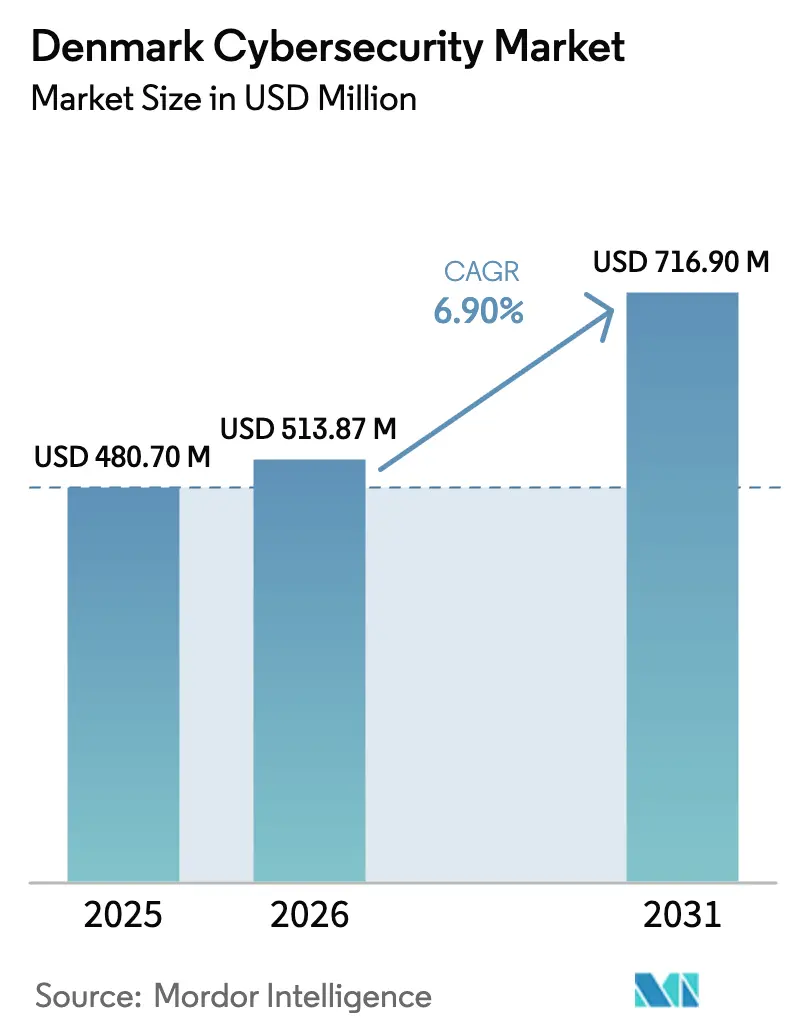
| Base Year Market Size (2025) | USD 480.7 Million |
| Market Size (2026) | USD 513.87 Million |
| Market Size (2031) | USD 716.9 Million |
| Growth Rate (2026 - 2031) | 6.90 % |
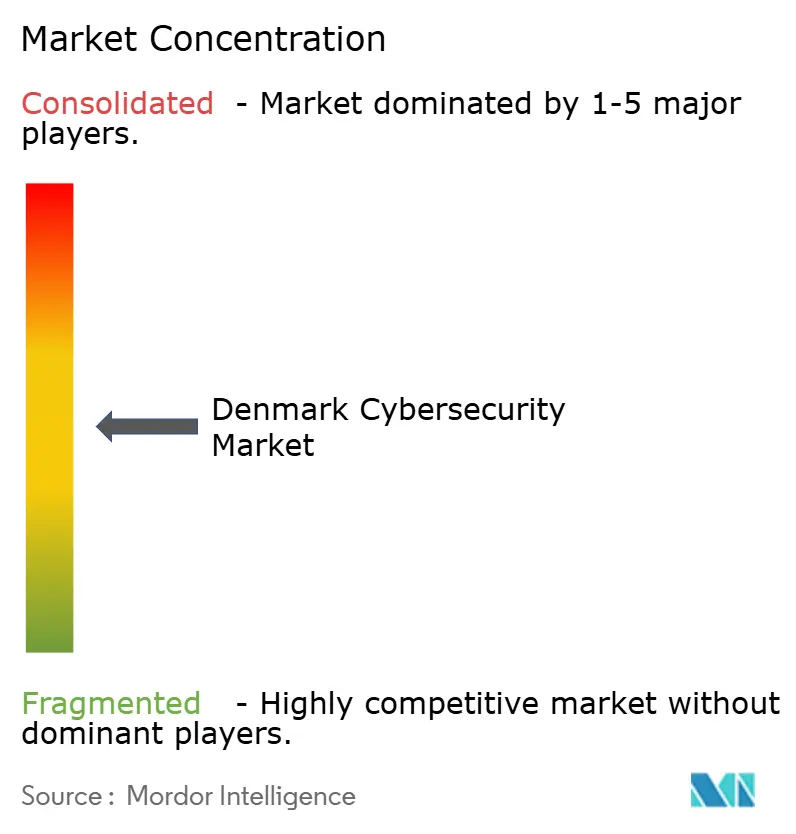
| Market Concentration | Medium |
Major Players *Disclaimer: Major Players sorted in no particular order Image © Mordor Intelligence. Reuse requires attribution under CC BY 4.0. | |
Denmark Cybersecurity Market Analysis by Mordor Intelligence
The Denmark cybersecurity market size is expected to grow from USD 480.7 million in 2025 to USD 513.87 million in 2026 and is forecast to reach USD 716.9 million by 2031 at 6.90% CAGR over 2026-2031. Mandatory compliance with the NIS2 directive, a cloud-first public-sector strategy, and rapid digital-payment adoption are intensifying demand across identity, network, and managed-security layers. The Center for Cybersecurity continues to rate the national threat level as “very high,” keeping executive focus on cyber-resilience spending. Regulatory penalties of up to EUR 10 million or 2% of global turnover for non-conformance have pushed security from an IT discussion to a boardroom priority. At the same time, a projected shortfall of 19,000 Danish-speaking security professionals by 2030 is steering organizations toward managed and professional services, further buoying the Denmark cybersecurity market.
Key Report Takeaways
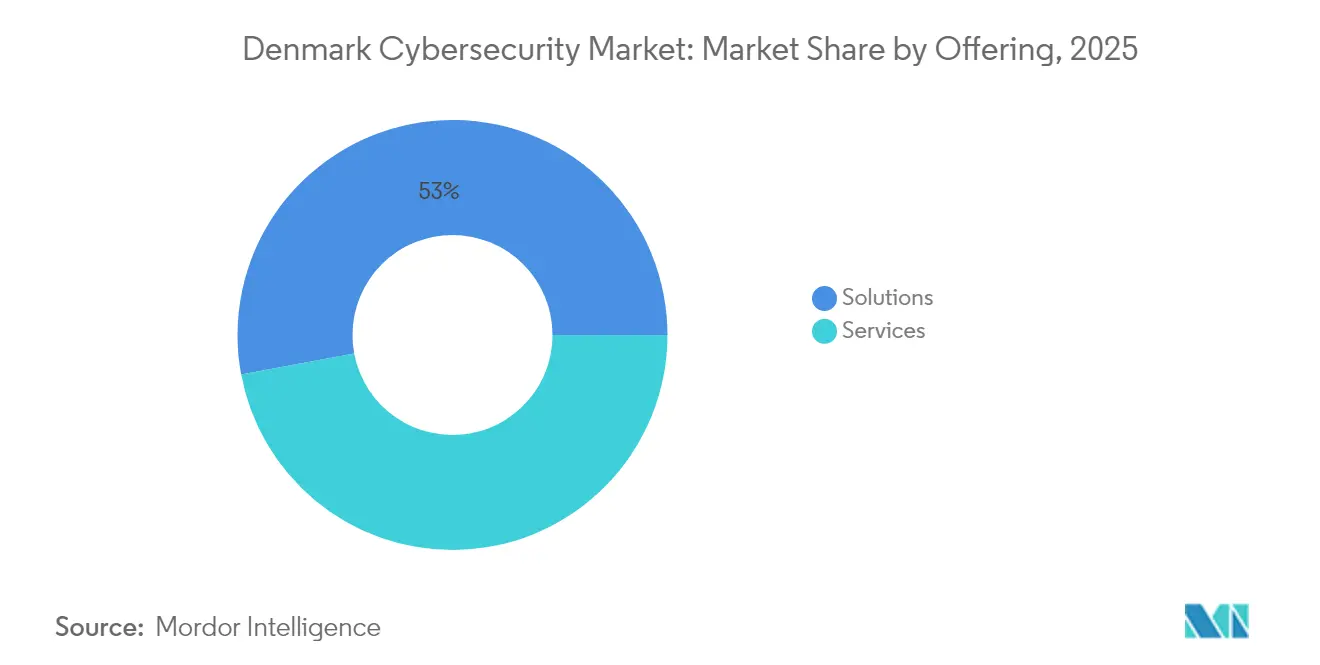
- By offering, solutions commanded 52.95% of Denmark cybersecurity market share in 2025; services outpace solutions with an 8.38% CAGR forecast for 2026-2031.
- By deployment mode, cloud deployments commanded 60.74% of Denmark cybersecurity market share in 2025 and are advancing at 9.66% CAGR.
- By end-user industry, consumer-facing BFSI led with 26.85% revenue share in 2025, whereas healthcare is forecast to expand at an 11.32% CAGR through 2031.
- By enterprise size, large organizations held 69.10% of Denmark cybersecurity market share in 2025, while SMEs are poised to grow at a 10.44% CAGR as regulation now covers roughly one-third of smaller firms.
Note: Market size and forecast figures in this report are generated using Mordor Intelligence’s proprietary estimation framework, updated with the latest available data and insights as of 2026.
Denmark Cybersecurity Market Trends and Insights
Drivers Impact Analysis*
| Driver | (~) % Impact on CAGR Forecast | Geographic Relevance | Impact Timeline |
|---|---|---|---|
| Mandatory Pen-Testing Under Danish NIS2 Directive Fueling Spend | +2.1% | National, with concentration in Copenhagen and Aarhus | Medium term (2-4 years) |
| Cloud-First Strategy Across Public Sector Agencies | +1.8% | National, with early adoption in central government | Short term (≤ 2 years) |
| Cashless-Payments Boom Expanding Attack Surface | +1.4% | National, with higher impact in urban areas | Long term (≥ 4 years) |
| 5G Roll-out Driving Telecom Security Upgrades | +1.2% | National, with priority in major cities | Medium term (2-4 years) |
| ESG-Linked Cyber Requirements for Wind OEMs | +0.9% | National, with focus on offshore wind regions | Long term (≥ 4 years) |
| AI-driven threat-detection adoption | +0.7% | Nationwide across managed-service providers | Short term (≤ 2 years) |
| Source: Mordor Intelligence | |||
Mandatory Pen-Testing Under Danish NIS2 Directive Fueling Spend
Effective 1 July 2025, the Danish transposition of NIS2 obliges roughly 1,500 entities to perform regular penetration tests, maintain incident-response playbooks, and prove continuous monitoring. Non-compliance fines elevate cyber-risk to a financial risk, unlocking sustained budget allocation for consultative and managed services. Danish firms anticipate head-count additions to satisfy audit-readiness requirements, yet domestic language constraints keep outsourcing levels high, benefiting local providers that bundle Danish-language advisory with technical execution.
Cloud-First Strategy Across Public Sector Agencies
Denmark’s Joint Government Digital Strategy 2022-2025 earmarks DKK 800 million (USD 125.2 million) for cloud infrastructure and associated security tooling [1]. Ministries now require identity-governance, encryption-as-a-service and zero-trust network architectures to preserve data-sovereignty while delivering online citizen services. Investment rounds into Copenhagen-based Omada illustrate the alignment of venture capital with this cloud push, stimulating local innovation in AI-enabled identity access management.
Cashless-Payments Boom Expanding Attack Surface
Digital transactions already comprise more than 92% of consumer payments, but the associated fraud bill climbed to DKK 627 (USD 98.3) million in 2023, split between card-not-present and credit-transfer attacks [2]. Criminals increasingly bypass two-factor authentication by manipulating users, prompting banks and fintechs to deploy behavioral analytics and machine-learning models. Government-approved SMS-filtering by telecom operators further underscores the systemic effort to protect Denmark’s cash-free economy.
5G Roll-out Driving Telecom Security Upgrades
The national 5G action plan channels DKK 800 million (USD 125.2 million) into network build-outs, but also heightens espionage risk, now rated “high” for telecom operators by the Civil Protection Authority. Danish carriers such as Nuuday have embarked on their largest ever IT-overhauls, selecting cloud-native BSS/OSS stacks that necessitate end-to-end encryption, supply-chain vetting and dynamic policy orchestration. Enterprise-grade private-5G offerings from Telenor further broaden the Denmark cybersecurity market by introducing slice-isolation and edge-security requirements.
Restraints Impact Analysis*
| Restraint | (~) % Impact on CAGR Forecast | Geographic Relevance | Impact Timeline |
|---|---|---|---|
| Shortage of Danish-Speaking Cyber Talent | -1.7% | National, with acute impact in Copenhagen and Aarhus | Long term (≥ 4 years) |
| Compliance Cost Burden on SMEs | -1.3% | National, with higher impact in rural areas | Medium term (2-4 years) |
| Legacy OT in Maritime Sector Limits Upgrades | -0.8% | Coastal regions, with concentration in major ports | Long term (≥ 4 years) |
| Fragmented security procurement among municipalities | -0.6% | Nationwide, 98 local governments | Medium term (2-4 years) |
| Source: Mordor Intelligence | |||
Shortage of Danish-Speaking Cyber Talent
Denmark expects a gap of 19,000 IT specialists by 2030, and language proficiency narrows the security talent funnel even further. Organizations therefore pivot to managed-security contracts or international consultants, inflating project costs and marginally dampening Denmark cybersecurity market CAGR.
Compliance-Cost Burden on SMEs
Nearly one-third of entities falling under NIS2 are SMEs. Although firms allocate 9% of IT budgets to security on average, the directive’s ten mandatory controls can lift that share into double digits for small organizations. Absent economies of scale, many rural businesses delay upgrades, slowing market adoption until simplified, subscription-based offerings gain traction.
*Our forecasts treat driver/restraint impacts as directional, not additive. The impact forecasts reflect baseline growth, mix effects, and variable interactions.
Segment Analysis
By Offering: Services Segment Accelerates Growth
Solutions held 52.95% Denmark cybersecurity market share in 2025, yet services are forecast to grow at 8.38% CAGR during 2026-2031. Demand concentrates in penetration-testing, incident-response retainers and managed detection and response (MDR), as boards race to demonstrate NIS2 compliance. The exodus toward cloud reduces licensing emphasis on hardware-centric firewalls, shifting value to integration and monitoring.
Services momentum reflects the acute labour shortage; enterprises prefer outsourcing to Danish-language SOC operators rather than recruiting internally. Consulting also gains from the influx of roughly USD 226 million in state cybersecurity allocations, where public bodies often contract external specialists for risk assessments and governance frameworks.

By Deployment Mode: Cloud Dominance Accelerates
Cloud accounted for 60.74% Denmark's cybersecurity market share in 2025 and is projected to record a 9.66% CAGR through 2031, far outpacing on-premise deployments. The public sector alone drives large subscription volume as ministries migrate workloads under the cloud-first mandate. Sector-agnostic SaaS adoption simplifies patching cycles, making cloud-delivered security controls the default for new projects.
Legacy OT in maritime, energy, and certain manufacturing plants anchors residual on-premise demand. The Danish Maritime Authority has established a dedicated cyber unit to shield vessels whose latency-sensitive control systems preclude cloud offloading . Nonetheless, rising health-IT investment—forecast near USD 3 billion by 2025—favours cloud-native encryption, back-up and compliance automation, enabling vendors such as Keepit to scale rapidly with Danish and EU data-residency guarantees.
By End-user Industry: Healthcare Emerges as Growth Leader
BFSI led all verticals with a 26.85% Denmark cybersecurity market share in 2025, mirroring the country’s near-cashless economy. Fraud cost have forced banks to harden payment channels with AI-driven anomaly detection. Healthcare, however, is projected to expand fastest at 11.32% CAGR between 2026 and 2031 as electronic-health-record rollouts and telemedicine uptake surge.
Start-ups raised USD 835 million in healthtech capital during 2023, intensifying the need to protect patient data across cloud platforms . Simultaneously, ransomware remained “very high” for manufacturing, prompting discrete investments in OT segmentation. Energy-utilities spending gained urgency after a 22-company breach in 2023, leading to real-time threat-sharing via SektorCERT’s national SOC .

By End-user Enterprise Size: SME Segment Drives Growth
Large enterprises commanded 69.10% Denmark cybersecurity market share in 2025, buoyed by multi-million-krone security budgets and in-house expertise. While absolute spending remains highest among corporates, SMEs will experience a 10.44% CAGR to 2031 as NIS2 brings them under regulatory scrutiny. Vendors increasingly tailor “lite” MDR bundles and subscription-based governance packages to reduce entry costs.
Academic studies show 22% of Danish SMEs still lack even basic firewalls, underscoring latent demand. Government upskilling grants and shared-municipality SOC initiatives aim to bridge knowledge gaps. Once awareness improves, uptake of standardized, pay-as-you-grow services is expected to drive incremental Denmark cybersecurity market size gains in the long tail of smaller enterprises.
Regulatory Landscape
Denmark’s cybersecurity compliance baseline is anchored by the NIS 2 Act (Law on Measures to Ensure a High Level of Cybersecurity), which entered into force on 1 July 2025 and expands mandatory risk management, incident handling, and security testing requirements across covered sectors. The report context also cites potential penalties of up to EUR 10 million or 2% of global turnover, which shifts controls such as continuous monitoring and incident-response preparedness from an IT topic to a board-level accountability issue.
Oversight follows a multi-sector model coordinated by Styrelsen for Samfundssikkerhed (Danish Civil Contingency Agency), working with sector-specific competent authorities. The Centre for Cyber Security (CFCS) under the Danish Defence Intelligence Service (FE) operates as the national CSIRT, providing threat intelligence and technical guidance. In early 2026, Denmark agreed a National Cyber and Information Security Strategy for 2026-2029, extending attention beyond NIS2-covered entities and supporting broader resilience initiatives alongside regulated compliance.
Value Chain Analysis
Denmark’s cybersecurity value chain starts with global platform and product vendors supplying core controls across network, endpoint, and cloud security (for example IBM, Check Point, Fortinet, and Cisco). It is complemented by Danish and Nordic specialists that localize delivery for Danish-language requirements and regulated sectors, including NNIT A/S, CSIS Security Group, and LogPoint. As cloud adoption and NIS2 audit-readiness requirements intensify, value shifts toward integration, identity governance, testing, and managed services, where local providers differentiate through compliance documentation, incident-response retainers, and SOC operations aligned to Danish supervisory expectations.
Channel and delivery are shaped by public-private coordination mechanisms and national infrastructure touchpoints. SAMSIK functions as the central registration portal for regulated entities under the NIS2 setup, while CFCS engagement and business-oriented collaboration forums support threat-information flows and operational guidance for critical entities. Upstream capability development is also supported by research and defense-technology ecosystems such as the Nationalt Forsvarsteknologisk Center, which can feed tools and methods into Danish security services, OT protection, and security validation offerings.
Competitive Landscape
Copenhagen anchors more than half of Denmark cybersecurity market demand, driven by a dense concentration of national ministries, financial headquarters and a vibrant fintech scene. High average salaries and venture funding pools attract both talent and start-ups, reinforcing the capital’s status as a security innovation hub. Government allocations of EUR 100 (USD 116.8) million for nation-wide digitalisation chiefly flow through agencies headquartered in Copenhagen, deepening the city’s spending weight [4].
Aarhus and Odense form secondary clusters where healthcare digitalisation and advanced manufacturing fuel local security contracts. Ransomware incidents in 2024 targeting regional factories compelled industrial players to deploy OT-specific intrusion-detection and backup solutions. Municipal alliances such as KommuneCERT now share threat-intel and procurement frameworks, ensuring smaller cities obtain consistent protection levels while preserving local budgets.
Along the coasts, Denmark’s sizeable maritime economy adds distinct requirements. Vessel control systems still rely on decades-old protocols, challenging conventional patch-management cycles. The Danish Maritime Authority’s cyber unit and industry co-operation with port operators aim to implement network segmentation and continuous monitoring without interrupting logistics. Simultaneously, offshore wind farms integrate ESG-linked cyber provisions into turbine maintenance contracts, broadening regional service opportunities for the Denmark cybersecurity market.
Denmark Cybersecurity Industry Leaders
-
IBM Corporation
-
Check Point Software Technologies Ltd.
-
NNIT A/S
-
Fortinet Inc.
-
Cisco Systems Inc.
- *Disclaimer: Major Players sorted in no particular order
Market Opportunities and Future Outlook
A clear whitespace is emerging in broad-based cyber uplift for citizens and SMEs that fall outside direct NIS2 scoping, or that lack the scale to implement the directive’s controls without packaged services. The government’s 2026-2029 cyber and information security strategy includes a 211 million DKK allocation for strengthening protection for groups not directly covered by NIS2. That allocation supports demand for standardized, subscription-based offerings such as MDR bundles, security awareness tooling, and compliance automation that reduces advisory effort per customer.
Enterprise spending also creates room for advanced architectures and assurance tooling as Denmark’s digitalization expands the attack surface. Public-sector cloud-first programs, cashless payments, and 5G build-outs concentrate opportunities in identity governance, zero-trust network access, and AI-assisted detection and response, while regulated operators push for testable security outcomes. Supply-chain security is another actionable gap, as Danish logistics, manufacturing, and technology providers extend vendor ecosystems, increasing the need for vendor risk management and software composition analysis to document control over third-party code and services under heightened supervisory scrutiny.
Recent Industry Developments
- April 2026: Check Point Software Technologies Ltd. announced a launch partnership with Google Cloud to integrate its AI Defense Plane with Google Cloud's Gemini Enterprise Agent Platform, providing centralized security, discovery, and governance for AI agents. The collaboration expands Check Point's AI driven security reach into cloud environments and strengthens governance across AI workloads. The deal positions the company to capitalize on rising demand for managed AI security in Denmark's accelerated cloud adoption.
- January 2026: IT-Branchen and Industriens Fond launched the 'Cybersikker virksomhed' initiative with a total investment of DKK 76.5 million to improve cybersecurity for small and medium sized enterprises, including the establishment of a POB Lab for market maturation and technical testing. The program helps SMEs uplift their security posture and accelerates market-ready cyber capabilities across the Danish SME ecosystem.
- December 2025: NNIT A/S was selected by the Danish Health Data Authority, in partnership with Edora, for a multi year program to develop national health data infrastructure, including high data security and AI supported analytics. The initiative strengthens national health data capabilities and supports secure analytics for policy making and clinical use cases.
Research Methodology Framework and Report Scope
Market Definition and Coverage
For this methodology, the Denmark cybersecurity market covers spending by Denmark-based public and private organizations on technologies and services that protect systems, networks, applications, endpoints, identities, cloud workloads, and data from cyber threats.
Scope exclusions: Consumer-focused security purchases and purely physical security (for example, guards and cameras) are excluded unless they are packaged as cybersecurity services.
Segmentation Overview
- By Offering
- Solutions
- Application Security
- Cloud Security
- Data Security
- Identity and Access Management
- Infrastructure Protection
- Integrated Risk Management
- Network Security
- End-point Security
- Services
- Professional Services
- Managed Services
- Solutions
- By Deployment Mode
- Cloud
- On-Premise
- By End-user Industry
- BFSI
- Healthcare
- IT and Telecom
- Industrial and Defense
- Retail and E-commerce
- Energy and Utilities
- Manufacturing
- Others
- By End-user Enterprise Size
- Large Enterprises
- Small and Medium Enterprises (SMEs)
Data Sources, Market Sizing, and Validation
Desk Research
Desk research starts with building a clear picture of Denmark's digital footprint and the rules that shape security spending. We reference public sources such as Statistics Denmark for ICT and enterprise structure indicators, the Danish Center for Cyber Security for threat landscape context, ENISA and the European Commission for EU cyber requirements, and OECD and Eurostat for comparable macro and digital economy series.
To convert those signals into a market model, we also review company filings and annual reports, audited notes on IT and security investments, and reputable press coverage on incidents and compliance timelines. Where needed, paid subscriptions are used only to standardize company financials, track patents and technology activity, and cross-check import and export patterns for selected security hardware categories. The desk sources listed here are illustrative, and many other public references were consulted to verify inputs and clarify assumptions.
Primary Interviews and Surveys
We conduct expert interviews and surveys with cybersecurity decision-makers, functional leaders, and managers in Denmark. Their input helps test secondary indicators, clarify service adoption and pricing assumptions, and explain differences between internal security work and purchased software or services before the final market model is reviewed.
Distribution of primary research fieldwork respondents
| Company type | Respondent position |
|---|---|
| Top tier: 30% | CXOs: 15% |
| Mid tier: 50% | Functional/Unit leaders: 30% |
| Smaller Players: 20% | Managers: 55% |
Market-Sizing & Forecasting
Sizing starts from a top-down demand reconstruction that links Denmark's enterprise base and sector activity to realistic cybersecurity spending patterns, which are then split into solution and service pools. We then corroborate totals using selective bottom-up checks like sampled price-per-user or price-per-device benchmarks, channel conversations on renewal behavior, and service revenue run-rates, and gaps are adjusted when the two views drift.
Key model inputs include the pace of cloud adoption versus on-premise footprints, regulatory compliance timelines (including EU-driven security requirements), reported incident pressure and response readiness, outsourcing propensity for managed security due to talent constraints, and the mix of large enterprises versus SMEs that changes buying behavior. Forecasts are built using scenario analysis, where the base case is anchored to macro growth and IT budget signals, and then shifted using interview-backed expectations on pricing, renewal rates, and the timing of compliance-driven projects.
Data Validation & Update Cycle
Validation is done through multiple checks so the final outputs stay practical and explainable. We compare derived market totals with independent signals like enterprise counts, sector ICT intensity, and reported cybersecurity program activity, and then we run variance checks across years to catch sudden jumps that do not match known drivers.
Before sign-off, another analyst reviews assumptions, calculations, and the consistency of splits across offerings and industries, followed by targeted re-contacts if any input looks stretched. Reports are refreshed annually, and interim updates are triggered when a material policy change, major incident pattern shift, or macro shock could change spending behavior. Right before delivery, a final pass is completed so clients receive the most up-to-date view.
Mordor Intelligence's Denmark Cybersecurity Market Size Compared Against Other Published Estimates
Published market sizes for Denmark cybersecurity can differ even when they sound like they measure the same thing, because the underlying scope and counting logic often changes. The biggest differences usually come from whether managed services and professional services are fully counted, how cloud security is treated, and what year's currency timing and pricing assumptions are applied.
In our checks, the spread is mainly driven by whether adjacent IT operations spend is blended into cybersecurity, and whether multi-country Nordic totals are partly allocated to Denmark without a clear buyer base. A tighter rule on what qualifies as cybersecurity revenue, plus validation using offering-level pricing and adoption inputs, is what keeps the estimate centered on Denmark-only demand in the model used by Mordor Intelligence.
Benchmark comparison
| Source | Market Size | Gaps in Research Methodology |
|---|---|---|
| Mordor Intelligence | USD 480.70 M (2025) | |
| Industry Association A | USD 520.00 M (2025) | Often bundles broader IT risk, governance, and compliance program spend into cybersecurity, which can lift totals when consulting and audit work is fully included. |
| Regional Consultancy B | USD 430.00 M (2025) | Tends to focus on core security software and select hardware, with limited coverage of managed services and incident response retainers, which reduces the measured spend pool. |
The comparison shows that the number moves most when service scope and classification rules change. By keeping the spend pool tied to clearly defined security offerings, and then checking it against adoption and pricing signals discussed in interviews, the final figure stays traceable and repeatable for users who need a practical planning baseline from year to year.
Key Questions Answered in the Report
What is the current size of the Denmark cybersecurity market?
The Denmark cybersecurity market size reached USD 513.87 million in 2026 and is projected to expand to USD 716.9 million by 2031.
Which segment is growing fastest?
Healthcare security is the fastest-growing end-user segment, forecast to post an 11.32% CAGR between 2026 and 2031 as electronic health-record rollouts accelerate.
How dominant is cloud deployment in Denmark?
Cloud solutions already account for 60.74% Denmark cybersecurity market share and are forecast to grow at a 9.66% CAGR through 2031.
Why does NIS2 matter for Danish companies?
NIS2 introduces compulsory controls and potential fines up to EUR 10 million, leading approximately 1,500 Danish organizations to increase cyber-spending on testing, monitoring and compliance services.