
Data Center Memory Market Size and Share
Market Overview
| Study Period | 2020 - 2031 |
|---|---|
| Market Size (2026) | USD 28.80 Billion |
| Market Size (2031) | USD 66.90 Billion |
| Growth Rate (2026 - 2031) | 18.36 % |
| Fastest Growing Market | Asia-Pacific |
| Largest Market | North America |
| Market Concentration | High |
Major Players *Disclaimer: Major Players sorted in no particular order Image © Mordor Intelligence. Reuse requires attribution under CC BY 4.0. | |
Data Center Memory Market Analysis by Mordor Intelligence
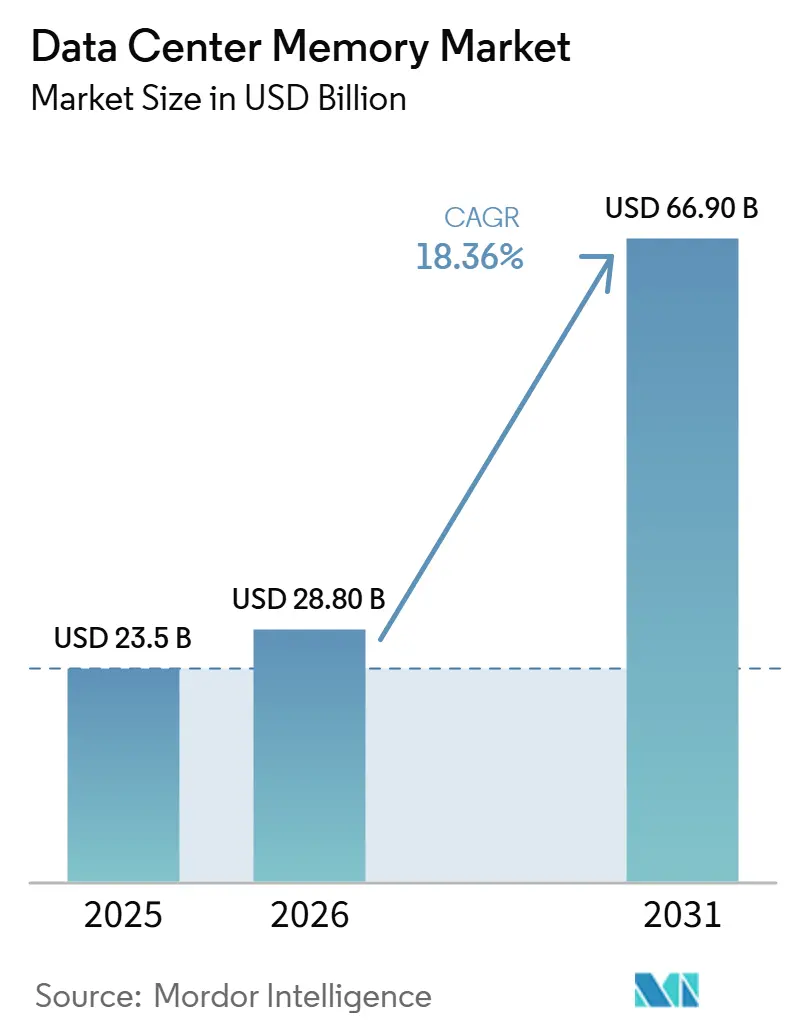
The data center memory market size is projected to be USD 23.50 billion in 2025, USD 28.80 billion in 2026, and reach USD 66.90 billion by 2031, growing at a CAGR of 18.36% from 2026 to 2031. The 2026 base reflects a market that has moved beyond short memory cycles, because leading buyers now treat memory supply as a strategic input tied to future AI infrastructure plans rather than a routine server component. Demand is rising through two linked channels: higher memory content per server on one side and new memory expansion architectures on the other, giving the data center memory market a broader growth base than server shipment growth alone. Hyperscale cloud operators still set the pace of adoption, yet sovereign AI programs are also expanding the demand pool and pushing large procurement programs beyond traditional enterprise server timelines. Power efficiency has become a more visible purchase criterion for new AI clusters, which is driving interest in bandwidth-per-watt improvements, dense module formats, and system designs that support sustained inference workloads within fixed rack limits. The competitive structure remains tight at the manufacturing tier, and the ongoing pull on HBM production keeps conventional server DRAM availability and pricing central to how the data center memory market develops through the forecast period.
Key Report Takeaways
- By memory type, DRAM led with a 74.87% revenue share in 2025, while High Bandwidth Memory is projected to expand at an 18.97% CAGR through 2031 in the data center memory market.
- By module and form factor, RDIMMs held 62.39% of revenue share in the data center memory market in 2025, while MRDIMMs are expected to record the highest projected CAGR of 19.18% through 2031.
- By capacity, the 64 GB-128 GB range accounted for 44.13% of revenue in 2025, while the Above 128 GB segment is projected to advance at a 19.11% CAGR through 2031 in data center memory market.
- By data rate, the Up to 5600 MT/s category captured 58.21% of revenue in the data center memory market in 2025, while 7200 MT/s and Above is expected to expand at an 18.99% CAGR through 2031.
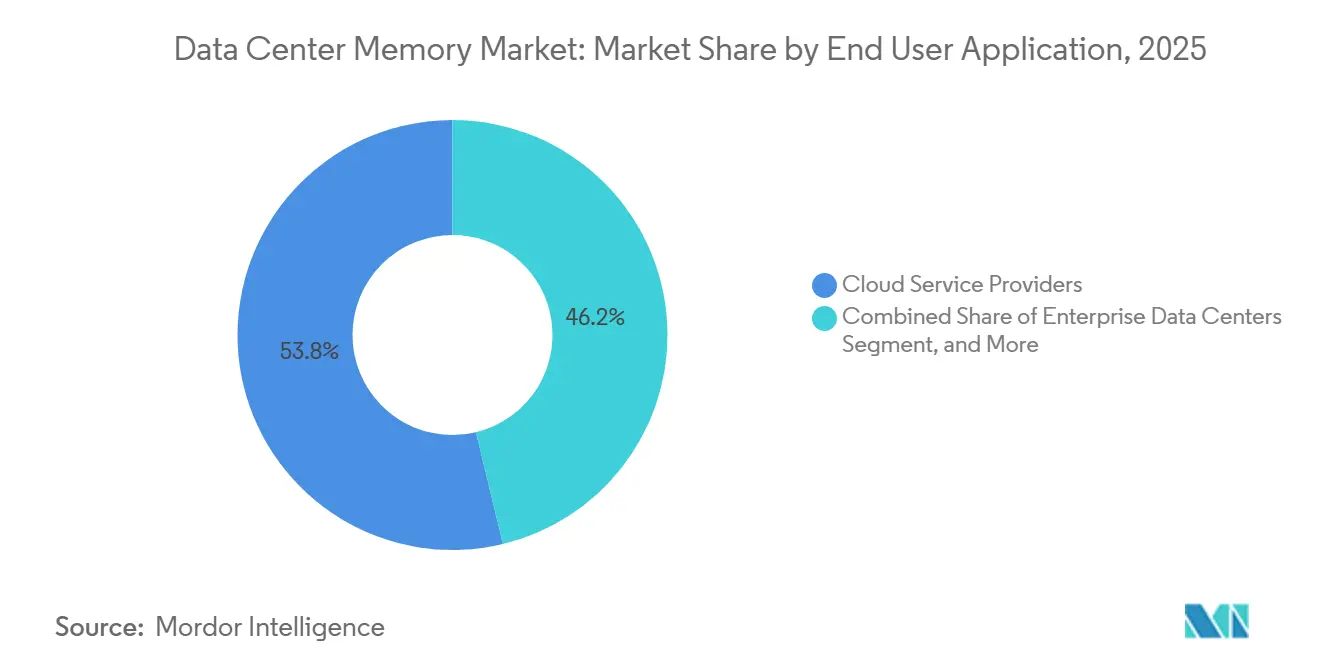
- By end-use application, Cloud Service Providers held 53.77% share of the data center memory market size in 2025 and remained the fastest-growing application segment through 2031 in the data center memory market.
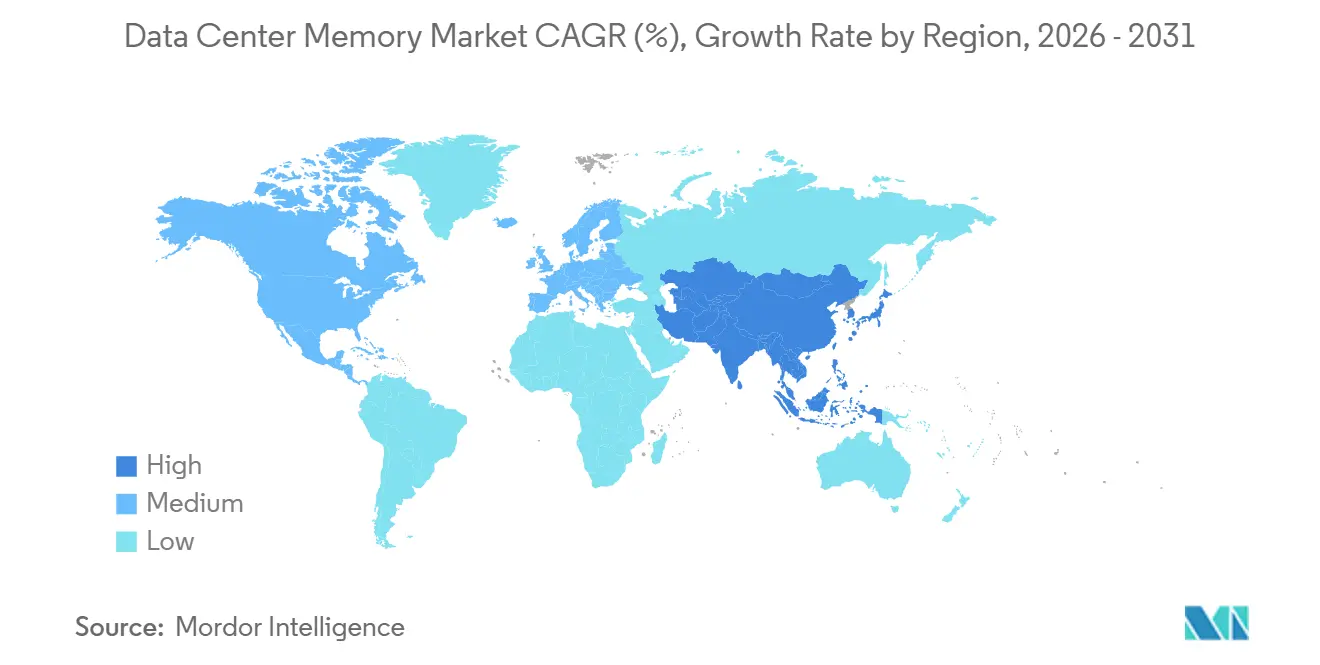
- By geography, North America held 46.28% share of the data center memory market in 2025, while Asia-Pacific is projected to grow at a 19.28% CAGR through 2031.
Note: Market size and forecast figures in this report are generated using Mordor Intelligence’s proprietary estimation framework, updated with the latest available data and insights as of January 2026.
Market Trends and Insights
Drivers Impact Analysis of Data Center Memory Market*
| Driver | (~) % Impact on CAGR Forecast | Geographic Relevance | Impact Timeline |
|---|---|---|---|
| AI Server Memory Density Scaling | +5.8% | Global, concentrated in North America and APAC | Short term (≤ 2 years) |
| DDR5-Only Server CPU Transition | +3.6% | Global, led by North America and Europe | Short term (≤ 2 years) |
| CXL-Attached Memory Expansion | +3.2% | Global, with early gains in North America and South Korea | Medium term (2-4 years) |
| Bandwidth-Per-Watt Gains for Power-Constrained Data Centers | +2.4% | Global, critical in Europe and North America with power grid constraints | Medium term (2-4 years) |
| Sovereign AI and Hyperscale Buildout | +1.8% | APAC core, spill-over to Middle East and Africa and Europe | Medium term (2-4 years) |
| Memory Refresh Cycles Driven by High-Capacity Server Platforms | +1.2% | Global | Short term (≤ 2 years) |
| Source: Mordor Intelligence | |||
AI Server Memory Density Scaling Drives Structural Demand
The data center memory market is moving higher because AI systems now need more memory per accelerator, more memory per host server, and more sustained bandwidth during inference rather than only during training. Memory has become a limiting factor in inference-heavy deployments, shifting buyer attention away from simple capacity counts toward usable bandwidth and efficiency each server can sustain under live workloads. Suppliers are responding by raising stack density, input and output counts, and power efficiency, indicating that product roadmaps are being built around structural AI demand rather than short replacement cycles. Samsung’s first commercial HBM4 shipments in 2026 also indicate that buyers are accepting faster product transitions when the performance gain supports AI cluster economics, thereby shortening the time between one generation and the next in the data center memory market. As model context lengths increase and inference moves into continuous production settings, the demand baseline keeps resetting upward, which is why the data center memory market is behaving more like a strategic capacity market than a traditional component market.
DDR5-Only Server CPU Transition Accelerates Platform Refresh
The data center memory market is also being boosted by the server CPU transition to DDR5-only platforms, as new server purchases now require a system-level memory upgrade rather than a module-level upgrade alone. Intel’s June 2026 server announcements reinforced this direction with Xeon 6+ support built around high-channel DDR5 server memory configurations for AI and networking workloads.[1] The shift matters beyond AI clusters because enterprise buyers replacing aging DDR4 infrastructure are moving to a platform generation that standardizes higher bandwidth and higher baseline capacity, which raises the value mix of the data center memory market across general-purpose servers. JEDEC’s MRDIMM roadmap adds another upgrade layer, pushing DDR5 performance higher and extending the commercial runway of the same platform family through more advanced module architectures. This makes the data center memory market more closely tied to server capital spending cycles, motherboard refreshes, and power-delivery changes, keeping memory growth linked to full infrastructure modernization rather than isolated module replacement.
CXL-Attached Memory Expansion Unlocks A New Addressable Surface
The data center memory market is gaining a second growth cycle through CXL, as memory expansion is moving beyond the limits of fixed DIMM slots in individual servers. Marvell’s Structera S 30260 switch launch in March 2026 showed that the ecosystem is moving from concept validation toward hardware that supports rack-level pooling and disaggregated memory deployment at scale.[2] Montage Technology’s CXL 3.1 memory expander controller adds to that direction by supporting high-bandwidth, low-latency expansion and pooling for next-generation server environments. This matters for the data center memory market because it creates room for new controller, switch, and module combinations, while also allowing operators to build memory tiers that better match workload behavior and capital budgets. The wider point is that CXL changes how buyers think about addressable memory capacity, since future purchases can be shaped by pooled and expandable designs rather than by local DRAM attached to each host.
Bandwidth-Per-Watt Gains Redefine Purchase Priorities
The data center memory market is also being shaped by power constraints, because memory efficiency now affects how much useful AI throughput a rack can deliver within fixed cooling and electricity limits. Micron has stated that low-power memory designs can materially improve bandwidth and reduce space requirements in data center systems, making memory efficiency a direct procurement factor rather than a secondary engineering metric. NVIDIA has also emphasized the role of high-bandwidth, efficient CPU memory subsystems in modern data centers, and that keeps system memory decisions closely tied to rack-level performance economics. Academic work on MRDIMM-based production servers further supports the idea that higher bandwidth can deliver measurable energy benefits in memory-bound workloads, helping advanced modules compete on operating costs as well as raw performance. As data centers push dense inference clusters into tighter power envelopes, the data center memory market is likely to reward architectures that balance bandwidth, density, and power efficiency.
Restraints Impact Analysis of Data Center Memory Market*
| Restraint | (~) % Impact on CAGR Forecast | Geographic Relevance | Impact Timeline |
|---|---|---|---|
| HBM Capacity Pull Constraining Conventional DDR5 Supply | -2.8% | Global | Short term (≤ 2 years) |
| EUV Yield and Ramp Challenges on High-Density Dies | -2.2% | Global, concentrated in South Korea and Taiwan | Medium term (2-4 years) |
| Export-Control and China-Localization Bifurcation | -1.6% | APAC core, spill-over to Middle East and Africa and global supply chains | Medium term (2-4 years) |
| Qualification Complexity Across Emerging Module Standards | -1.0% | Global | Medium term (2-4 years) |
| Source: Mordor Intelligence | |||
HBM Capacity Pull Constraining Conventional DDR5 Supply Limits Broad Access
The strongest near-term restraint in the data center memory market is the capacity pull from HBM, as leading manufacturers prioritize premium AI memory lines that offer stronger strategic and financial returns. The same manufacturers also sit at the core of advanced DRAM supply, so every shift toward HBM production tightens the availability of conventional server DDR5 for the broader market. Customer behavior shows how serious that constraint has become, with large technology buyers moving beyond standard procurement and providing direct funding for future fab equipment and production lines. That raises lead times and cost pressures for enterprise data centers and colocation providers that lack the same purchasing leverage, and it can delay capacity additions even as their own workload demand rises. The result is that the data center memory market can expand strongly at the high end while still leaving parts of the wider server market exposed to tight supply and elevated budgets.
EUV Yield And Ramp Challenges Slow Practical Capacity Expansion
Another restraint on the data center memory market is the slow, capital-intensive process of scaling advanced DRAM output through EUV-based manufacturing. Reporting tied to ASML’s 2026 outlook indicates that low-NA EUV system supply is already heavily committed, which leaves little near-term room for a faster industrywide capacity response. Even when new tools are available, yield improvement on dense memory dies takes time, and that means announced capacity does not convert into commercial bit output as quickly as demand growth might suggest. The barrier is compounded by the very high cost of advanced tools and the strict defect tolerance requirements in memory arrays, which make rapid output scaling harder than simple fab announcements imply. This keeps the data center memory market exposed to a period where demand visibility is strong, yet practical supply relief remains slower and more selective.
*Our forecasts treat driver/restraint impacts as directional, not additive. The impact forecasts reflect baseline growth, mix effects, and variable interactions.
Data Center Memory Market Segment Analysis
By Memory Type:
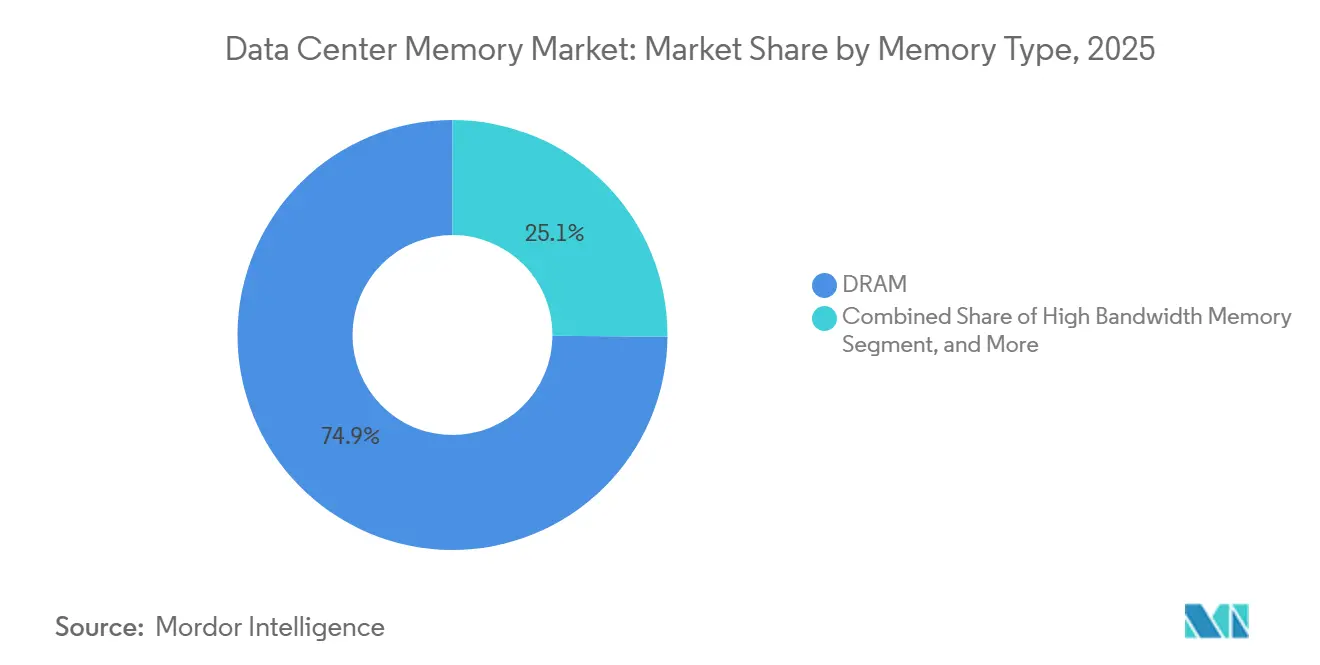
DRAM And HBM Continue To Shape The Core Revenue MixDRAM held 74.87% of the data center memory market share in 2025, and that leadership came from its universal role in CPU-attached server memory across hyperscale, enterprise, colocation, and research deployments. The category benefited from the broad move toward DDR5 server platforms, because new systems from major OEMs are aligning around higher bandwidth and larger baseline capacities that support both AI and general-purpose workloads. Persistent and storage-class memory remained the smallest segment, with its use limited by higher per-bit costs and longer qualification paths in comparison with mainstream DRAM modules. This kept DRAM at the center of the data center memory market, especially in environments where predictable volume availability and broad platform support mattered more than premium accelerator-tier bandwidth.
High Bandwidth Memory is projected to expand at an 18.97% CAGR from 2026 to 2031, and its rise reflects the fact that AI accelerator buyers increasingly value delivered bandwidth and power efficiency over simple capacity comparisons. SK hynix completed the world-first HBM4 development and positioned the product for mass production, while Samsung began commercial HBM4 shipments in 2026, confirming that the top end of the memory stack is moving toward faster qualification and launch cycles.[3] HBM also sits in a separate pricing and performance tier, which lifts its revenue importance even though conventional DRAM still serves the larger installed server base. That balance means the data center memory market will continue to rely on DRAM for scale, while HBM captures an outsized share of value growth in AI accelerator platforms.

By Module And Form Factor:
RDIMMs Lead Today While MRDIMMs Open The Next Bandwidth TierRDIMMs held a 62.39% revenue share in 2025, reflecting their entrenched use as the default server memory module across most enterprise and cloud platforms. Their advantage came from a mature qualification base, wide OEM support, and strong compatibility with the first large wave of DDR5 server deployments, which kept them central to the data center memory market through 2025. LRDIMMs continued to serve selected high-capacity systems, yet their addressable role narrowed as RDIMM densities improved and broader server designs absorbed more capacity without moving into specialized formats. Other server memory modules, including newer low-power and CXL-linked options, remained small but became more visible as inference-focused system designs started to look beyond standard DIMM assumptions.
MRDIMMs are projected to record a 19.18% CAGR from 2026 to 2031, and that outlook is closely tied to the next step in server performance within the DDR5 generation. JEDEC’s April 2026 MRDIMM updates and Intel’s Diamond Rapids support path show that this format is moving into a clearer commercial adoption cycle rather than staying in a narrow experimental niche. Academic testing on production MRDIMM servers also showed meaningful bandwidth gains and energy savings, providing operators with a case for module-level upgrades where full platform replacement is not yet necessary. This makes MRDIMMs important to the data center memory market because they can extend the value of DDR5 infrastructure while still delivering a new performance tier for memory-bound server workloads.
By Capacity:
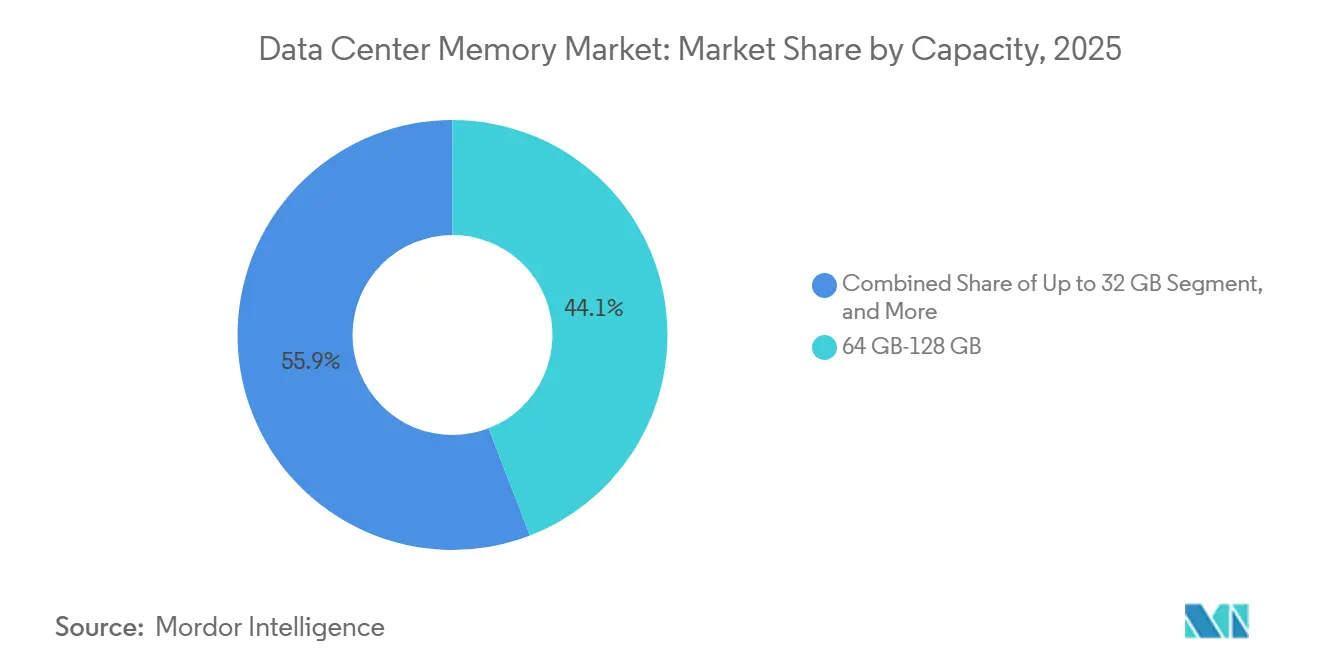
High-Density Modules Gain Priority As AI Workloads ExpandThe 64 GB-128 GB range accounted for 44.13% of revenue in 2025, making it the largest capacity band in the data center memory market during the first broad DDR5 server upgrade wave. That range fits a wide set of needs, including cloud database nodes, AI inference servers, and general enterprise systems that need stronger baseline capacity without moving into the highest-priced module tier. The 32 GB-64 GB layer remained relevant for cost-sensitive deployments, but it no longer represented the preferred starting point for many new AI-ready server builds. Modules below 32 GB continued to lose importance in new deployments, because current server purchasing is increasingly shaped by future workload headroom rather than by minimum entry cost alone.
Above 128 GB is projected to grow at a 19.11% CAGR from 2026 to 2031, reflecting both higher memory density requirements in GPU server platforms and larger host memory pools for large language model inference. Micron has highlighted the role of dense, low-power modular memory in supporting these next-phase server requirements, indicating that the top end of the capacity curve is moving into mainstream product roadmaps rather than remaining in limited custom designs.[4] Large buyers are also using longer-term supply structures to secure future access to memory, which strengthens the revenue mix for maximum-density modules across the data center memory market. As memory-rich AI clusters scale further, the transition from 128 GB class configurations toward 192 GB and higher solutions is likely to become a more regular volume pattern instead of a narrow premium exception.
By Data Rate:
Higher-Speed DDR5 And MRDIMM Standards Raise The Performance CeilingThe Up to 5600 MT/s category commanded a 58.21% revenue share in 2025 and formed the installed base for early DDR5 server rollouts across enterprise and cloud environments. This band benefited from broad qualification, balanced pricing, and a strong fit with first-generation DDR5-enabled server platforms, making it the near-term backbone of the data center memory market. The 6400 MT/s tier functioned as a transition layer for buyers who wanted more performance without moving into the newest module classes or waiting for future CPU support. Together, these tiers carried the largest commercial volume because they aligned with the speed at which server OEMs could validate and ship large numbers of new platforms.
The 7200 MT/s and Above segment is projected to expand at an 18.99% CAGR from 2026 to 2031, reflecting the widening gap between standard server memory speeds and the new performance needs of AI-heavy systems. JEDEC’s MRDIMM Gen2 path toward 12,800 MT/s and Intel’s support plans for future Xeon platforms show that the next growth layer of the data center memory market will be driven by ultra-high-speed, enterprise-qualified memory rather than by commodity-style speed bumps. As memory throughput becomes a steady operating requirement for agentic and inference-heavy workloads, faster module categories are moving from optional upgrades into core design choices. This shift raises the premium potential of the data center memory market because performance-qualified bandwidth is becoming a more important selling point than nominal capacity alone.
By End-Use Application:
Cloud Service Providers Remain The Primary Adoption EngineCloud Service Providers held 53.77% share of the data center memory market size in 2025, and they remain the clearest demand anchor because they buy at scale, qualify early, and influence product roadmaps directly. Their role extends beyond purchasing, since hyperscalers are now involved in capacity planning and supplier alignment in ways that were less visible in earlier memory cycles. Direct approaches by major technology firms to help fund production equipment show how closely memory access is now tied to long-term infrastructure strategy in the data center memory market. Enterprise data centers and colocation providers still form the next major demand layer, driven by DDR4-to-DDR5 refresh activity and by growing deployment of on-premises or hosted AI inference nodes where latency, security, or cost considerations limit full reliance on public cloud.
Government and research data centers represent a distinct growth pocket because sovereign AI agendas are creating memory-dense procurement outside normal enterprise budgeting cycles. SoftBank’s selection of Sesterce for a 1 GW AI data center project in France shows that public policy goals and large-scale AI infrastructure planning can quickly become material contributors to server memory demand. Edge data centers remain the smallest application segment, yet they are gaining attention as inference shifts closer to users and devices, increasing the need for localized memory pools rather than relying solely on centralized cloud clusters. This combination keeps the data center memory market led by hyperscalers today, while steadily widening the set of buyers that can influence future product mix and qualification priorities.
Geography Analysis
North America Data Center Memory Market
North America held 46.28% of the data center memory market share in 2025, making it the largest regional revenue contributor through its mix of hyperscale campuses, colocation hubs, and enterprise infrastructure. The United States remained the core of that position because Amazon, Microsoft, Google, and Meta continue to anchor a very dense installed base of advanced data center capacity, and that concentration translates directly into large server memory purchasing programs. The planned Stargate-related wave of U.S. infrastructure activity adds another layer of long-term compute demand, which supports both higher server unit counts and richer memory configurations in future deployments. Domestic memory manufacturing also gained strategic weight, with Micron confirming major U.S. expansion plans and public funding support for local capacity, which ties regional demand growth more closely to supply-chain resilience. Canada added to the regional picture through sovereign AI planning, while Mexico’s role improved through nearshoring-related interest from operators seeking wider North American deployment options.
APAC Data Center Memory Market
Asia-Pacific is projected to grow at a 19.28% CAGR from 2026 to 2031, making it the fastest-growing region in the data center memory market, as demand-side AI buildout and supply-side memory investment are both concentrated there. South Korea remains central to that outlook, since Samsung and SK hynix continue to anchor advanced memory production while also expanding investment programs aimed at future AI demand. China adds a separate domestic demand layer through state-backed AI data center expansion, even though its ability to compete in the highest-end HBM tier remains more limited than that of South Korea’s leading suppliers. India, Singapore, Thailand, and Taiwan also strengthen the regional case, because they add new demand locations, capital flows, or packaging and semiconductor ecosystem roles that support the wider data center memory market.
EMEA and South America Data Center Memory Market
Europe contributes a steadier growth pattern, with demand shaped by sovereign AI commitments, power-aware infrastructure design, and gradual adoption of efficient server memory architectures. SoftBank’s France campus project shows that large AI data center commitments are now material enough in Europe to influence future memory procurement at scale. South America remains smaller, but the regional market continues to develop through colocation and cloud expansion led by larger economies such as Brazil and Chile. Middle East and Africa adds an important demand catalyst, because sovereign AI programs in countries such as Saudi Arabia and the UAE are creating new clusters that require dense memory provisioning outside the traditional North American and Northeast Asian core.
Competitive Landscape
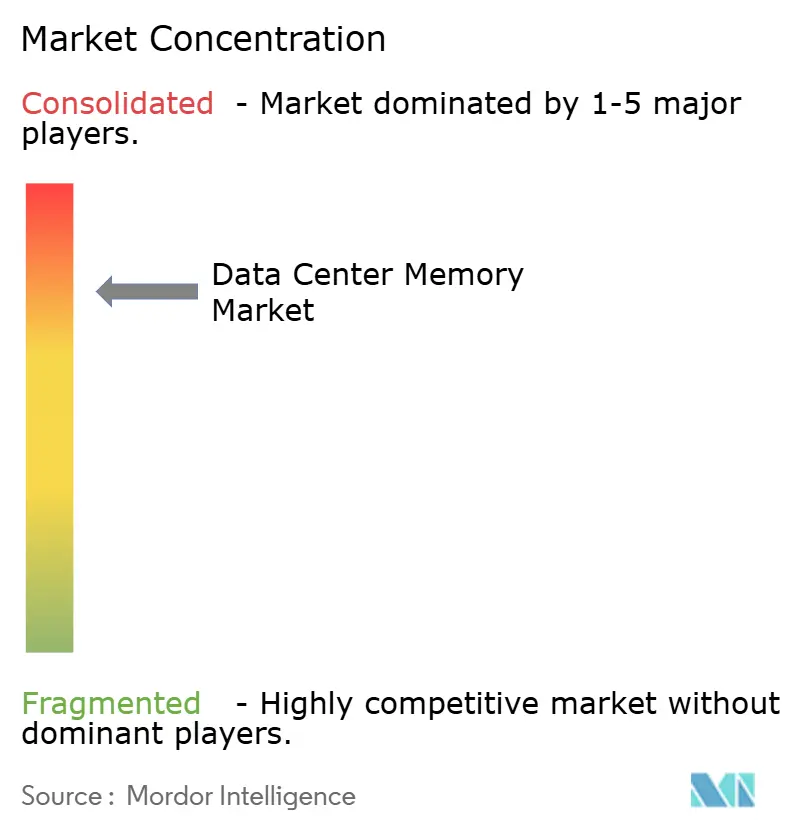
The data center memory market has a split competitive structure, with very high concentration in advanced DRAM and HBM manufacturing and a broader field of module, integration, and interface specialists around that core. Samsung Electronics, SK hynix, and Micron Technology remain the central manufacturers, and their product timing, yield progress, and customer qualification depth shape most of the performance frontier of the data center memory market. Samsung’s first commercial HBM4 shipment in 2026 showed that speed to qualification can directly affect customer capture in the AI memory tier. SK hynix’s early HBM4 development milestone confirmed its intent to protect leadership through technical execution and product readiness rather than through price competition alone. Micron’s manufacturing expansion plans in the United States added a different strategic dimension because they tied future memory output to customer security of supply and domestic production positioning.
A second competitive arena is forming around CXL and disaggregated memory infrastructure, where controller and switch vendors are trying to define the next layer of system architecture. Marvell’s 2026 CXL switch launch is one of the clearest examples, because it moves competition toward rack-level memory pooling and away from fixed server-level boundaries. Montage Technology’s memory expander controller shows that the data center memory market is also opening the door for suppliers that do not make DRAM but can still shape how memory is deployed, expanded, and managed in production servers. This layer will matter more over time because memory value is no longer defined solely by bits shipped, but increasingly by how efficiently memory can be attached, shared, and used across AI infrastructure.
The module integration layer remains more mixed, with companies such as Kingston Technology, SMART Modular Technologies, Innodisk, Netlist, and ADATA Technology positioned around qualification, product packaging, and customer-specific deployment needs. Their opportunity is strongest where buyers need enterprise-grade validation, industrial reliability, or specialized memory formats that large DRAM manufacturers do not directly commercialize across every channel. The data center memory market, therefore, remains highly concentrated at the supply core, yet still leaves some room for differentiated suppliers that can address deployment, interoperability, and qualification issues with new architectures. Competitive behavior across the market now centers on long-term supply access, faster platform alignment, and system-level fit, which is why strategic moves increasingly come through co-development, early qualification, and capacity commitments instead of through traditional price-led share gains.
Data Center Memory Industry Leaders
-
Samsung Electronics Co., Ltd.
-
SK hynix Inc.
-
Micron Technology, Inc.
-
Kingston Technology Company, Inc.
-
ADATA Technology Co., Ltd.
- *Disclaimer: Major Players sorted in no particular order
Data Center Memory Market Companies Covered in this Report
- Samsung Electronics Co., Ltd.
- SK hynix Inc.
- Micron Technology, Inc.
- Kingston Technology Company, Inc.
- ADATA Technology Co., Ltd.
- SMART Modular Technologies, Inc.
- Transcend Information, Inc.
- Innodisk Corporation
- Corsair Gaming, Inc.
- G.SKILL International Enterprise Co., Ltd.
- Team Group Inc.
- Apacer Technology Inc.
- Patriot Memory, LLC
- Netlist, Inc.
- Super Micro Computer, Inc.
- Dell Technologies Inc.
- Hewlett Packard Enterprise Company
- Lenovo Group Limited
- NVIDIA Corporation
- Advanced Micro Devices, Inc.
- Intel Corporation
- Marvell Technology, Inc.
- Rambus Inc.
- Astera Labs, Inc.
- JEDEC Solid State Technology Association
Recent Industry Developments in Data Center Memory Market
- July 2026: SK hynix announced a KRW 100 trillion (approximately USD 66 billion) investment plan in Cheongju, including KRW 80 trillion (approximately USD 53 billion) for the M17 NAND production fab and KRW 20 trillion (approximately USD 13 billion) for the P&T7 advanced packaging facility. Construction of M17 is scheduled to begin in 2027, with operations targeted to commence in the first half of 2029.
- June 2026: SK hynix commenced sampling of its HBM4E (12-layer) memory with 48 GB capacity, 16 Gbps per-pin data rate, and more than 20% power efficiency improvement over HBM4.
- June 2026: SK hynix announced a KRW 1,100 trillion (approximately USD 800 billion equivalent) mid-to-long-term investment plan spanning its Yongin, Cheongju, and new southwest semiconductor clusters, with the Yongin cluster timeline accelerated by 12 years to 2045 from the original 2045 completion schedule.
- May 2026: Micron Technology disclosed 16 Strategic Customer Agreements (SCAs) guaranteeing approximately USD 100 billion in minimum cumulative memory revenue through 2030, and the take-or-pay contracts covering hyperscalers in the data center segment represent a structural shift toward long-term committed volumes rather than spot procurement.
- May 2026: NVIDIA, Google, and Amazon made direct investment proposals to SK hynix worth tens of trillions of Korean won for funding production lines and advanced equipment, moving beyond long-term supply agreements to a model of customer-funded fab capacity.
Global Data Center Memory Market Report Scope
The Data Center Memory Market Report is Segmented by Memory Type (DRAM, High Bandwidth Memory, and Persistent and Storage-Class Memory), Module and Form Factor (RDIMM, LRDIMM, MRDIMM, and Other Server Memory Modules), Capacity (Up to 32 GB, 32 GB to 64 GB, 64 GB to 128 GB, and Above 128 GB), Data Rate (Up to 5600 MT/s, 6400 MT/s, and 7200 MT/s and Above), End-Use Application (Cloud Service Providers, Enterprise Data Centers, Colocation Providers, Government and Research Data Centers, and Edge Data Centers), and Geography (North America, Europe, Asia-Pacific, South America, and Middle East and Africa). The Market Forecasts are Provided in Terms of Value (USD).
Segmentation Overview
| DRAM |
| High Bandwidth Memory |
| Persistent and Storage-Class Memory |
| Registered DIMM (RDIMM) |
| Load-Reduced DIMM (LRDIMM) |
| Multiplexed Rank DIMM (MRDIMM) |
| Other Server Memory Modules |
| Up to 32 GB |
| 32 GB to 64 GB |
| 64 GB to 128 GB |
| Above 128 GB |
| Up to 5600 MT/s |
| 6400 MT/s |
| 7200 MT/s and Above |
| Cloud Service Providers |
| Enterprise Data Centers |
| Colocation Providers |
| Government and Research Data Centers |
| Edge Data Centers |
| North America | United States |
| Canada | |
| Mexico | |
| Europe | Germany |
| United Kingdom | |
| France | |
| Italy | |
| Rest of Europe | |
| Asia-Pacific | China |
| Japan | |
| South Korea | |
| Taiwan | |
| India | |
| Rest of Asia-Pacific | |
| South America | |
| Middle East and Africa |
| By Memory Type | DRAM | |
| High Bandwidth Memory | ||
| Persistent and Storage-Class Memory | ||
| By Module and Form Factor | Registered DIMM (RDIMM) | |
| Load-Reduced DIMM (LRDIMM) | ||
| Multiplexed Rank DIMM (MRDIMM) | ||
| Other Server Memory Modules | ||
| By Capacity | Up to 32 GB | |
| 32 GB to 64 GB | ||
| 64 GB to 128 GB | ||
| Above 128 GB | ||
| By Data Rate | Up to 5600 MT/s | |
| 6400 MT/s | ||
| 7200 MT/s and Above | ||
| By End-Use Application | Cloud Service Providers | |
| Enterprise Data Centers | ||
| Colocation Providers | ||
| Government and Research Data Centers | ||
| Edge Data Centers | ||
| By Geography | North America | United States |
| Canada | ||
| Mexico | ||
| Europe | Germany | |
| United Kingdom | ||
| France | ||
| Italy | ||
| Rest of Europe | ||
| Asia-Pacific | China | |
| Japan | ||
| South Korea | ||
| Taiwan | ||
| India | ||
| Rest of Asia-Pacific | ||
| South America | ||
| Middle East and Africa | ||
Key Questions Answered in the Report
What is the current and future size of the data center memory space?
The data center memory market was valued at USD 23.50 billion in 2025, stands at USD 28.80 billion in 2026, and is forecast to reach USD 66.90 billion by 2031 at an 18.36% CAGR.
Which memory type leads demand in data center deployments?
DRAM remained the largest memory type with 74.87% revenue share in 2025, because it is still the base memory layer across standard server platforms and large-scale cloud deployments.
What is driving the fastest growth in server memory demand?
AI inference workloads, DDR5-only server refresh cycles, and new CXL-based expansion models are the main demand drivers, because they increase both memory content per server and the total addressable memory surface.
Which module format is growing the fastest for servers?
MRDIMMs are projected to grow at a 19.18% CAGR through 2031, supported by JEDEC roadmap progress and future Intel server platform support.
Which end users are influencing product roadmaps the most?
Cloud Service Providers are the leading force, with 53.77% revenue share in 2025, because hyperscalers buy at scale, qualify earlier, and increasingly shape supplier capacity planning.
Which region offers the strongest near-term growth outlook?
Asia-Pacific is expected to post the fastest growth at a 19.28% CAGR through 2031, supported by regional AI buildout, memory manufacturing concentration, and wider data center investment activity.