
Data Center Facility Management Market Size and Share
Market Overview
| Study Period | 2020 - 2031 |
|---|---|
| Market Size (2026) | USD 4.76 Billion |
| Market Size (2031) | USD 8.58 Billion |
| Growth Rate (2026 - 2031) | 12.51 % |
| Fastest Growing Market | Middle East and Africa |
| Largest Market | North America |
| Market Concentration | Low |
Major Players *Disclaimer: Major Players sorted in no particular order Image © Mordor Intelligence. Reuse requires attribution under CC BY 4.0. | |
Data Center Facility Management Market Analysis by Mordor Intelligence
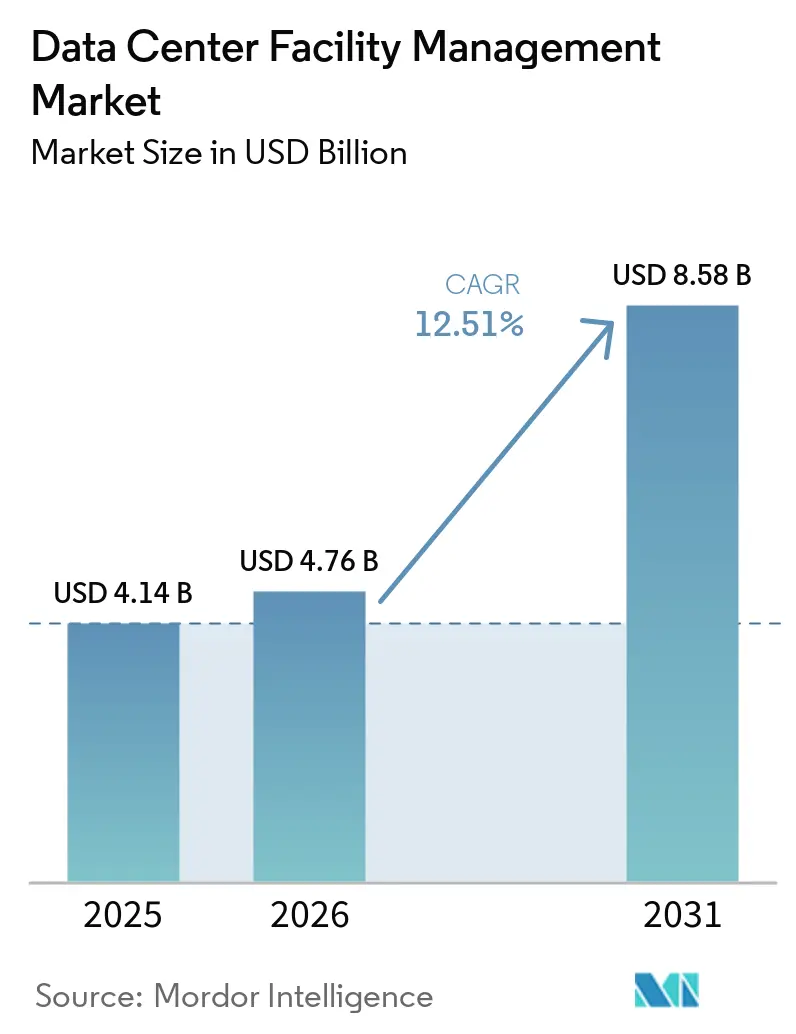
The Data Center Facility Management Market size is projected to expand from USD 4.14 billion in 2025 to USD 4.76 billion in 2026, and to USD 8.58 billion by 2031, registering a CAGR of 12.51% between 2026 and 2031. The Data Center Facility Management Market is being shaped by heavier AI workloads, which raise requirements for power, cooling, and on-site maintenance. Shortages of qualified engineers make external technical support more relevant for operators who cannot sustain large internal teams. Energy reporting and efficiency requirements also increase demand for providers that can measure performance and support compliance. These conditions favor contracts that combine monitoring, maintenance, and engineering coverage across multiple sites. Competition is strongest among integrated providers, while specialized providers can differentiate through liquid-cooling knowledge, verified uptime performance, and trained local teams.
Key Report Takeaways
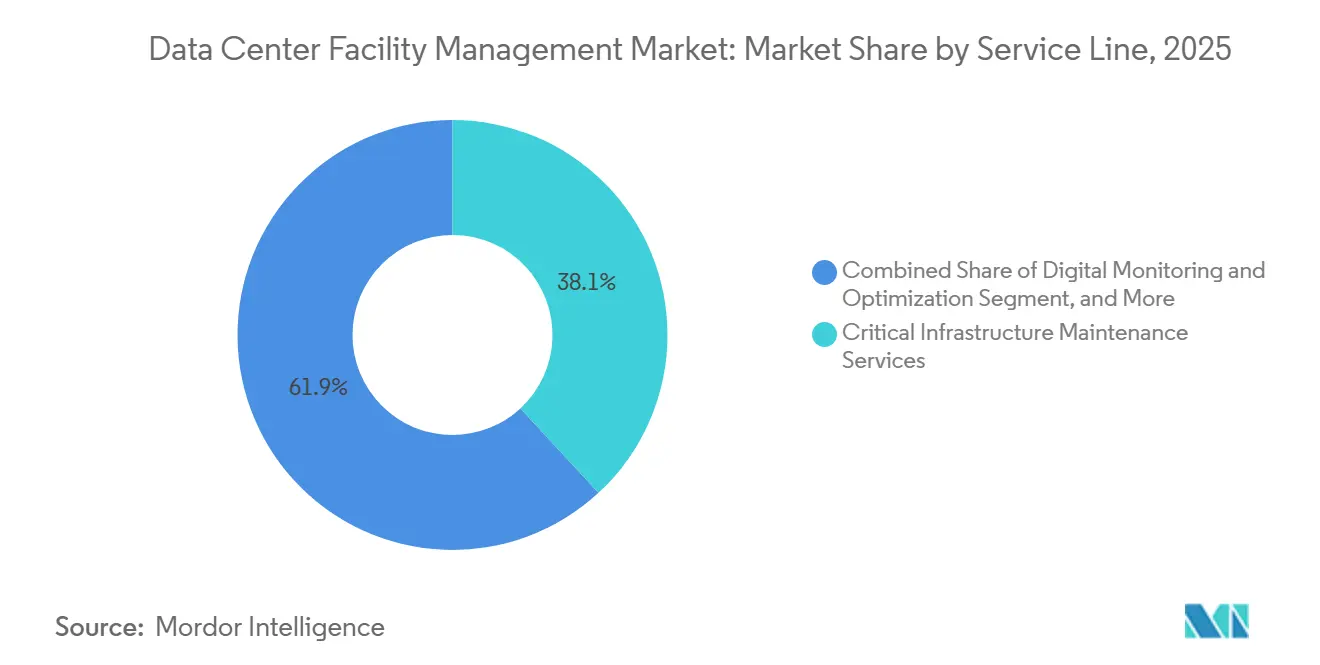
- By service type, Critical Infrastructure Maintenance Services led with 38.12% of the Data Center Facility Management Market share in 2025, while Digital Monitoring and Optimization Services is projected to expand at a 17.94% CAGR through 2031.
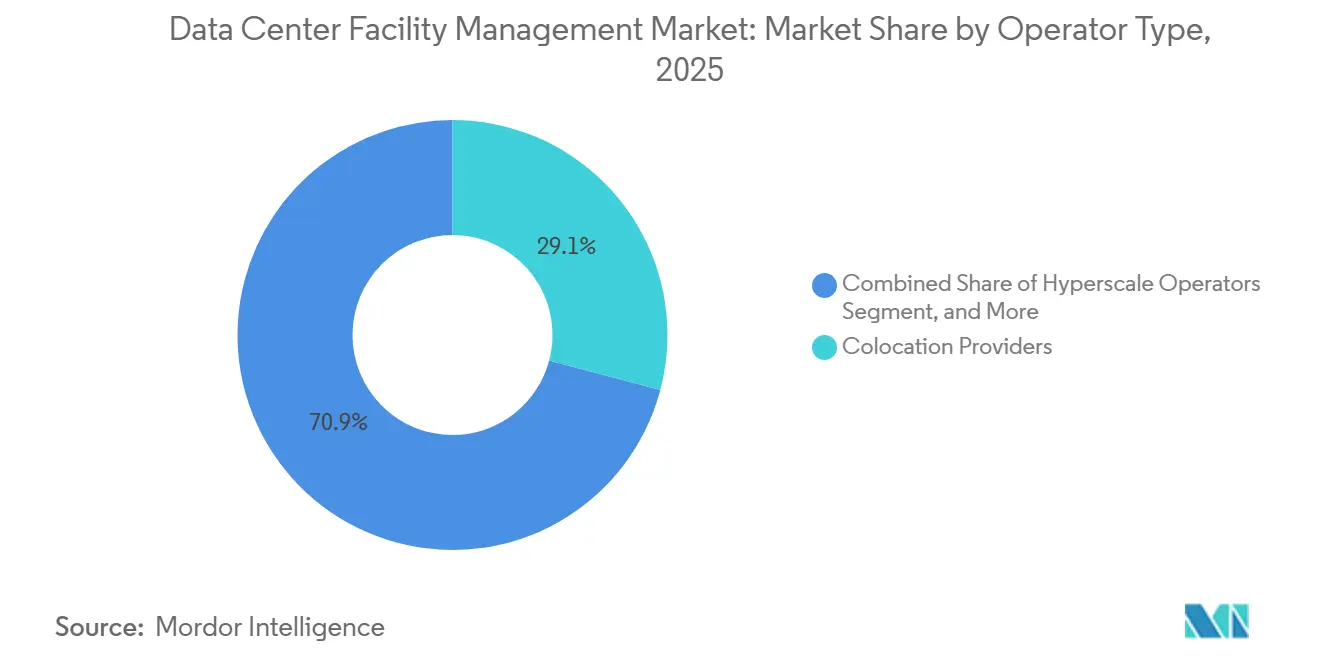
- By end user, colocation providers held 29.12% of the Data Center Facility Management Market share in 2025, while hyperscale operators are projected to record the highest CAGR of 14.94% through 2031.
- By geography, North America held 47.1% of revenue in 2025, while the Middle East and Africa is projected to expand at an 18.03% CAGR through 2031.
Note: Market size and forecast figures in this report are generated using Mordor Intelligence’s proprietary estimation framework, updated with the latest available data and insights as of January 2026.
Global Data Center Facility Management Market Trends and Insights
Drivers Impact Analysis*
| Driver | (~) % Impact on CAGR Forecast | Geographic Relevance | Impact Timeline |
|---|---|---|---|
| Rising AI Workload Density Increases On-Site Operational Complexity | +3.5% | Global, strongest in North America and Asia-Pacific | Short term (≤ 2 years) |
| Stricter Uptime Expectations Across Hyperscale and Colocation Campuses | +2.3% | Global, most acute in North America and Europe | Short term (≤ 2 years) |
| Multi-Site Standardization Pushes Outsourced FM Adoption | +2.0% | Global, particularly North America, Europe, and Asia-Pacific | Medium term (2-4 years) |
| Talent Scarcity for Mission-Critical Engineers Supports Managed Services | +1.5% | Global, most severe in North America and Europe | Short term (≤ 2 years) |
| Carbon Reporting and Energy Intensity Targets Elevate Specialist FM Demand | +1.1% | Europe and North America, emerging in Asia-Pacific | Medium term (2-4 years) |
| Remote Monitoring and Predictive Operations Improve Portfolio Visibility | +0.8% | Global, with early adoption in hyperscale-heavy locations | Medium term (2-4 years) |
| Source: Mordor Intelligence | |||
Rising AI Workload Density Increases On-Site Operational Complexity
The Data Center Facility Management Market faces distinct operating requirements as AI systems increase rack densities and cooling demands. Standard facilities had racks near 15 kW, while AI-heavy zones ranged from 300 kW to 600 kW in 2026, making scheduled maintenance less dependable than continuous condition monitoring.[1]Schneider Electric, “The Self-Aware Datacenter,” Schneider Electric, se.com New facilities are expected to use more liquid cooling, which adds work related to coolant condition, leak detection, and heat exchanger servicing. Providers without liquid-cooling capability may be excluded from new-build assignments despite their experience with air-cooled sites. Maintenance windows must also be planned around AI training workloads, where an interruption can affect client operations. This places greater value on providers that can combine engineering judgment with real-time equipment data.
Stricter Uptime Expectations Across Hyperscale and Colocation Campuses
The Data Center Facility Management Market benefits when uptime commitments require more rigorous operational support. The Uptime Institute reported in 2026 that 1 in 10 outages remained serious or severe, even as overall outage frequency improved.[2]Uptime Institute, “16th Annual 2026 Global Data Center Survey,” Uptime Institute, uptimeinstitute.com Colocation agreements commonly guarantee 99.99% monthly power availability, which increases the need for dependable engineering coverage. Hyperscale customers are also moving beyond credit-based remedies toward shared accountability for operations. Providers with independently audited uptime records and evidence of mean time to repair can strengthen their position at renewal. Longstanding on-site engineering relationships can therefore matter as much as price when operators assess risk.
Multi-Site Standardization Pushes Outsourced FM Adoption
The Data Center Facility Management Market gains from operators seeking consistent methods across distributed sites. A multinational portfolio can contain facilities of different ages, designs, and operating procedures. Applying a common approach requires either a large internal team or a qualified external partner. EN 50600-3-1:2026 sets out processes for resilience, capacity planning, risk management, security, and energy efficiency across the data center lifecycle.[3]CENELEC, “EN 50600-3-1:2026 Data Centre Management and Operational Processes,” CENELEC, standards.iteh.ai Providers that align their methods with those processes can help clients prepare for audits and maintain consistent records. The need is especially clear in newer Middle East and Africa locations where operators need established procedures from the start.
Talent Scarcity for Mission-Critical Engineers Supports Managed Services
A shortage of mission-critical engineering skills supports the Data Center Facility Management Market. More than half of operators reported difficulty attracting and retaining qualified technical staff in 2026. Competitive hiring and wage pressures are particularly challenging for smaller internal programs. A shortage of trained personnel can lead operators to rely more heavily on managed service providers. It also limits how quickly providers can expand if they cannot recruit and train field teams. Training academies and clear career paths are, therefore, meaningful operating capabilities, not simply human resources programs.
Restraints Impact Analysis*
| Restraint | (~) % Impact on CAGR Forecast | Geographic Relevance | Impact Timeline |
|---|---|---|---|
| High Switching Costs and Complex Mobilization Delay Outsourcing Decisions | -1.4% | Global, most pronounced among established enterprise operators | Short term (≤ 2 years) |
| Stringent Client Security and Access Controls Limit Vendor Scope Expansion | -1.0% | Global, highest in financial services and government sectors | Medium term (2-4 years) |
| In-House Operator Preference in Hyperscale Facilities Caps Outsourced Share | -0.8% | North America and Middle East and Africa | Medium term (2-4 years) |
| Shortage of Qualified Technicians Constrains Service Quality and Expansion | -0.5% | Global, most acute in emerging locations | Long term (≥ 4 years) |
| Source: Mordor Intelligence | |||
High Switching Costs and Complex Mobilization Delay Outsourcing Decisions
The Data Center Facility Management Market can face delays when a live facility changes providers. A transition may require staff mobilization, CMMS migration, access approvals, and periods of parallel operation. On a large campus, this work can take 6 to 18 months and raise concerns about cost and service continuity. Embedded personnel and proprietary systems can make the replacement process harder for the client to manage. This often benefits an incumbent at renewal, even when another provider offers a stronger commercial proposal. It can also postpone first-time outsourcing by operators that currently manage facilities internally.
Stringent Client Security and Access Controls Limit Vendor Scope Expansion
The Data Center Facility Management Market also faces constraints due to security regulations at hyperscale, financial services, and government locations. Background checks, layered physical access controls, isolated networks, and restricted camera areas can delay staff deployment. These requirements can narrow the use of remote diagnostics because continuous sensor access is not always permitted. Financial-sector operators face third-party ICT risk controls that can further limit vendor access and scope. Long-tenured providers may hold an advantage because their teams already have trusted access and operating clearances. New entrants may need more time to prove both technical capability and security readiness.
*Our forecasts treat driver/restraint impacts as directional, not additive. The impact forecasts reflect baseline growth, mix effects, and variable interactions.
Segment Analysis
By Service Type: Maintenance Leadership Challenged by Predictive Digitization
Critical Infrastructure Maintenance Services accounted for 38.12% of revenue in 2025, making it the largest segment of the Data Center Facility Management Market. The service includes planned and reactive work on UPS systems, generators, cooling equipment, high-voltage switchgear, and electrical distribution. These assets require physical intervention and cannot be virtualized. Higher AI density increases the number of assets requiring inspection and narrows maintenance windows. EN 50600-3-1:2026 identifies maintenance, incident management, and change management as core operating processes.
Digital Monitoring and Optimization Services is projected to expand at a 17.94% CAGR through 2031 in the Data Center Facility Management Industry. The service shifts work from calendar-based tasks to condition-based maintenance. Vertiv launched Next Predict in January 2026 with anomaly detection across power, cooling, and IT systems.[4]Vertiv, “Vertiv Announces New AI-Powered Predictive Maintenance Service for Modern Data Centers and AI Factories,” Vertiv, vertiv.com Schneider Electric stated that users achieved reductions of up to 75% in unplanned downtime and 20% in operating expenditure. Operators reported greater trust in sensor analytics and predictive maintenance than in autonomous AI applications.



By End User: Colocation Anchors Demand While Hyperscalers Drive the Growth Frontier
Colocation providers accounted for 29.12% of revenue in 2025 and were the largest end-user segment in the Data Center Facility Management Market. These operators may lack specialists for power, cooling, fire protection, and lifecycle maintenance. A single provider can combine hard services, monitoring, and compliance records into a single agreement. Enterprise operators require dependable support for hybrid-cloud environments. Telecom, government, and defense facilities also need specialized operating governance.
Hyperscale operators are projected to expand at a 14.94% CAGR through 2031 in the Data Center Facility Management Industry. AI inference expansion can stretch internal team models in locations with limited engineering talent. Operators may retain oversight while outsourcing high-voltage maintenance, liquid cooling, and predictive analytics. This favors specialists who can support defined technical work packages. JLL's September 2026 appointment for the Federal Aviation Administration's 1.5-million-square-foot, 200-building technical-center portfolio illustrates demand for facilities beyond commercial data centers.
Geography Analysis
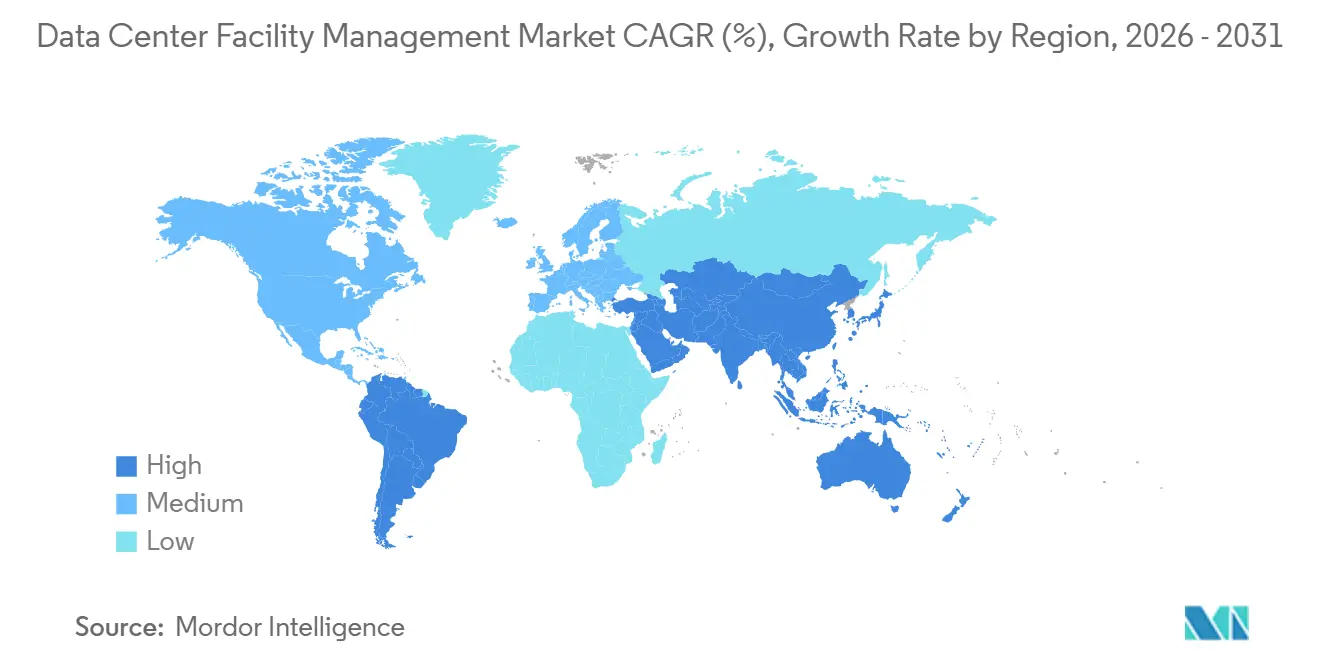
North America held 47.1% of global revenue in 2025 and remained the largest regional contributor to the Data Center Facility Management Market size. Its mature hyperscale and colocation campus base supports sustained volume in facilities contracts. The United States accounted for most activity, while Canada and Mexico provided secondary opportunities. South America, led by Brazil and Argentina, remained at an earlier stage, while hyperscale and colocation investments built asset scale for specialized outsourcing.
Europe has a regulatory-led demand profile within the Data Center Facility Management Market. Energy monitoring and reporting requirements are extending service work into auditing, PUE optimization, and waste-heat activities. The Uptime Institute reported an industry-wide average PUE of 1.52 in 2026. This creates demand for energy-management services. Asia-Pacific expansion is led by India and Australia, with secondary cities creating new requirements beyond established tier-1 locations.
The Middle East and Africa are projected to expand at an 18.03% CAGR through 2031, the highest regional rate in the Data Center Facility Management Market. Saudi Arabia's installed capacity reached 467 MW in Q1 2026, compared with 68 MW in 2021. National digital infrastructure commitments totaled SR 56.2 billion, or USD 14.87 billion. JLL received the integrated facilities appointment for Pure DC's 45 MW Yas Island campus in Abu Dhabi in March 2025. Saudi sovereign-backed operators are building internal teams, while UAE and African multi-tenant operators more often use external sourcing.

Competitive Landscape
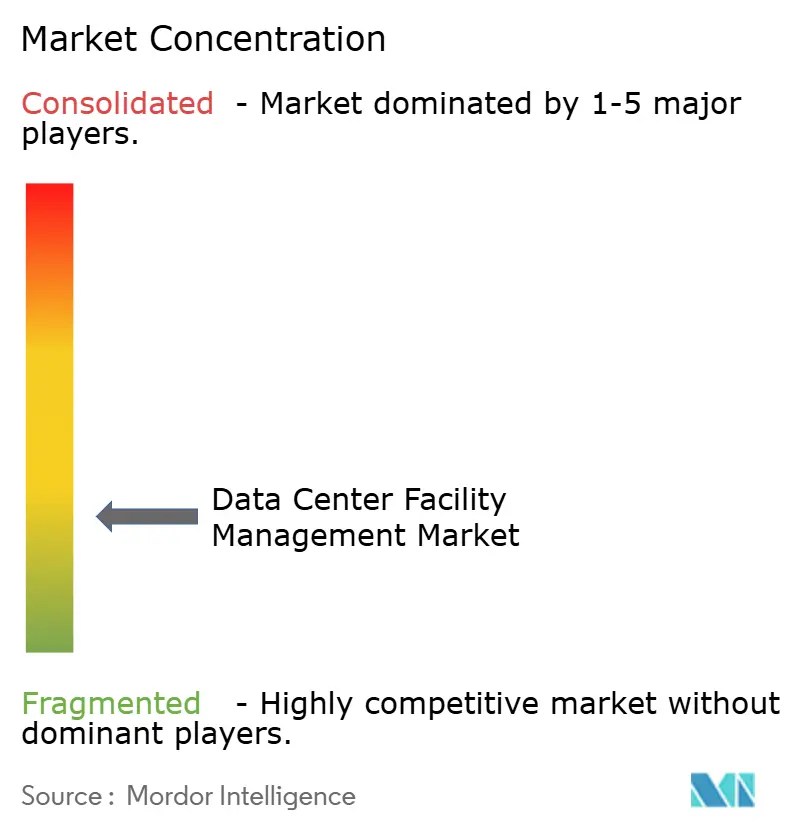
The Data Center Facility Management Market is moderately fragmented among integrated providers and fragmented among regional specialists. CBRE Group, JLL, and Cushman and Wakefield form the integrated tier with engineering, maintenance, and portfolio analytics capabilities. CBRE managed 1,300 data centers globally and acquired Pearce Services for USD 1.2 billion in November 2025. EMCOR Group, Jones Engineering, RED Engineering, and BGIS compete through electrical and mechanical expertise.
The Data Center Facility Management Market is moving toward contracts tied to equipment condition and energy performance. Providers are incorporating DCIM data to give clients continuing visibility of assets and energy use. ENGIE and Dalkia combine energy procurement, decarbonization, and operations into a single contract. EN 50600-3-1:2026 can influence European procurement by providing a shared operating reference. Alignment can help providers address resilience and efficiency requirements.
The Data Center Facility Management Market has opportunities in tier-2 locations in the Middle East and Africa and in cloud-repatriation projects. CBRE created Critical Infrastructure Services in March 2026 after reporting USD 1.7 billion in revenue for the business in 2025. Vertiv introduced Next Predict in January 2026 with AI-supported anomaly detection for managed maintenance. JLL, EMCOR Group, and Mitie remain active across North America and Europe. Technical credentials, local staffing, and uptime performance shape competitive success.
Data Center Facility Management Industry Leaders
CBRE Group, Inc
JLL (Jones Lang LaSalle)
Jones Engineering
Cushman and Wakefield plc
EMCOR Group, Inc.
- *Disclaimer: Major Players sorted in no particular order

Recent Industry Developments
- September 2026: JLL was selected by the US Federal Aviation Administration to provide comprehensive FM services for the William J. Hughes Technical Center for Advanced Aerospace in New Jersey, a 1.5-million-square-foot, 200-building portfolio, expanding JLL's critical FM reach into federal infrastructure.
- September 2026: Walbridge formed L5 Mission Critical, dedicated to data center operations across hyperscale, colocation, enterprise, and AI/neocloud clients in North America, alongside a structured technician training curriculum addressing the sector's engineering workforce shortage.
- July 2027: Schneider Electric expanded EcoCare to include 3-phase UPS systems, extending AI-powered condition-based maintenance and 24/7 remote monitoring to a critical power asset class previously reliant on scheduled inspection cycles.
- June 2026: Planon launched Planon for Data Centers, a purpose-built CMMS platform integrating natively with DCIM, BMS, and EPMS systems, covering preventive, predictive, corrective, and condition-based maintenance for power and cooling systems with full audit trails and mobile technician access for mission-critical environments.


Global Data Center Facility Management Market Report Scope
Data Center Facility Management is a comprehensive suite of services that ensures the continuous, efficient, and secure operation of data center infrastructure, encompassing critical system maintenance, energy optimization, compliance management, and digital monitoring to maximize uptime and operational resilience in mission-critical IT environments.
The Data Center Facility Management Market Report is Segmented by Service Type (Critical Facility Operations Services, Critical Infrastructure Maintenance Services, Commissioning and Operational Readiness Services, and Digital Monitoring and Optimization Services), End User (Hyperscale Operators, Colocation Providers, Enterprise Operators, Telecom Operators, and Government and Defense), and Geography (North America, South America, Europe, Asia-Pacific, Middle East and Africa). The Market Forecasts are Provided in Terms of Value (USD).
| Critical Facility Operations Services (includes Includes energy management, sustainability, compliance, and risk management) |
| Critical Infrastructure Maintenance Services |
| Commissioning and Operational Readiness Services |
| Digital Monitoring and Optimization Services |
| Hyperscale Operators (includes cloud services providers) |
| Colocation Providers |
| Enterprise Operators |
| Telecom Operators |
| Government and Defense |
| North America | United States | |
| Canada | ||
| Mexico | ||
| South America | Brazil | |
| Argentina | ||
| Rest of South America | ||
| Europe | Germany | |
| United Kingdom | ||
| France | ||
| Russia | ||
| Rest of Europe | ||
| Asia-Pacific | China | |
| Japan | ||
| India | ||
| Australia | ||
| Rest of Asia-Pacific | ||
| Middle East and Africa | Middle East | Saudi Arabia |
| United Arab Emirates | ||
| Israel | ||
| Turkey | ||
| Rest of Middle East | ||
| Africa | South Africa | |
| Nigeria | ||
| Kenya | ||
| Rest of Africa | ||
| By Service Type | Critical Facility Operations Services (includes Includes energy management, sustainability, compliance, and risk management) | ||
| Critical Infrastructure Maintenance Services | |||
| Commissioning and Operational Readiness Services | |||
| Digital Monitoring and Optimization Services | |||
| By End User | Hyperscale Operators (includes cloud services providers) | ||
| Colocation Providers | |||
| Enterprise Operators | |||
| Telecom Operators | |||
| Government and Defense | |||
| By Geography | North America | United States | |
| Canada | |||
| Mexico | |||
| South America | Brazil | ||
| Argentina | |||
| Rest of South America | |||
| Europe | Germany | ||
| United Kingdom | |||
| France | |||
| Russia | |||
| Rest of Europe | |||
| Asia-Pacific | China | ||
| Japan | |||
| India | |||
| Australia | |||
| Rest of Asia-Pacific | |||
| Middle East and Africa | Middle East | Saudi Arabia | |
| United Arab Emirates | |||
| Israel | |||
| Turkey | |||
| Rest of Middle East | |||
| Africa | South Africa | ||
| Nigeria | |||
| Kenya | |||
| Rest of Africa | |||


Key Questions Answered in the Report
What is the size of the Data Center Facility Management Market?
The Data Center Facility Management Market stood at USD 4.76 billion in 2026 and is projected to reach USD 8.58 billion by 2031 at a 12.51% CAGR.
What is driving demand for data center facility management services?
Higher AI rack density, stricter uptime expectations, multi-site standardization, and a shortage of qualified engineers are increasing demand for specialized support.
Which service type leads the Data Center Facility Management Market?
Critical Infrastructure Maintenance Services led with 38.12% of revenue in 2025 because power, cooling, and electrical assets require continuous physical maintenance.
Which end user is expected to expand fastest through 2031?
Hyperscale operators are projected to expand at a 14.94% CAGR as AI-related portfolio expansion increases the need for specialized technical support.
Which region is expected to expand fastest through 2031?
The Middle East and Africa is projected to record the highest regional CAGR at 18.03%, supported by new capacity and digital infrastructure commitments.
Page last updated on:


 Your data is secure and never sold or shared.


