
Cyber Threat Intelligence Orchestration Market Size and Share
Market Overview
| Study Period | 2021 - 2032 |
|---|---|
| Market Size (2027) | USD 6.12 Billion |
| Market Size (2032) | USD 16.5 Billion |
| Growth Rate (2027 - 2032) | 21.94 % |
| Fastest Growing Market | Asia-Pacific |
| Largest Market | North America |
| Market Concentration | Low |
Major Players *Disclaimer: Major Players sorted in no particular order Image © Mordor Intelligence. Reuse requires attribution under CC BY 4.0. | |
Cyber Threat Intelligence Orchestration Market Analysis by Mordor Intelligence
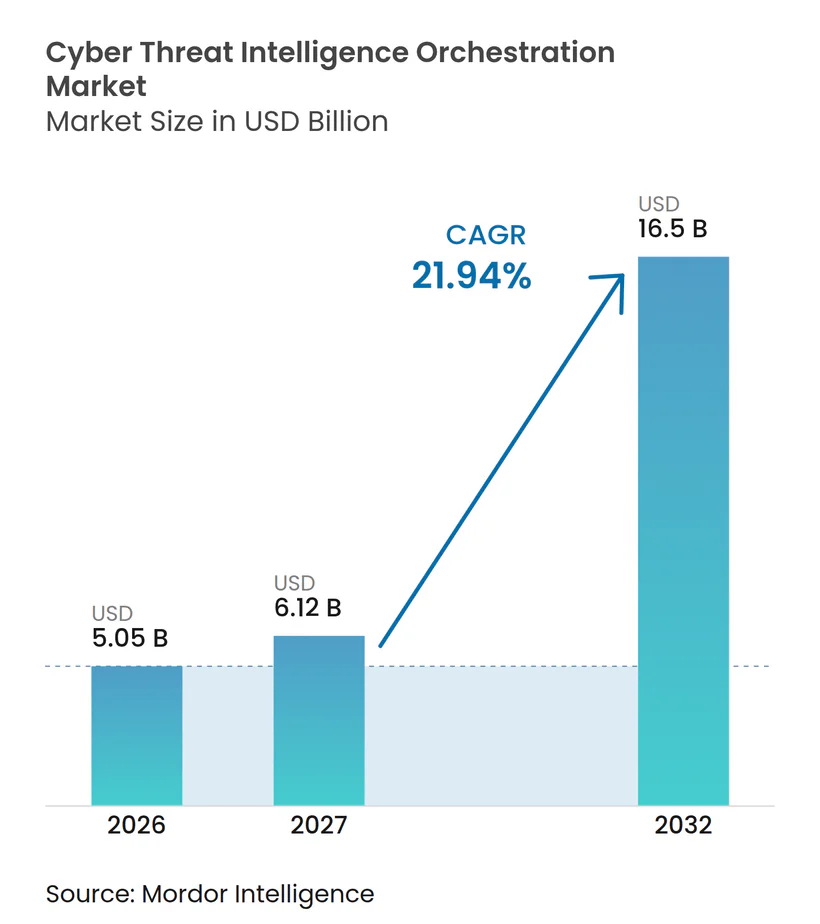
The cyber threat intelligence orchestration market size is projected to expand from USD 5.05 billion in 2026 to USD 6.12 billion in 2027, and to USD 16.50 billion by 2032, registering a CAGR of 21.94% between 2027 and 2032. The cyber threat intelligence orchestration market is growing because security teams need to turn large volumes of threat data into timely actions across cloud, endpoint, and identity environments. Fragmented tools can produce duplicate alerts and leave analysts without the context needed to prioritize an incident, which supports demand for platforms that normalize, score, and route intelligence. Ransomware, identity compromise, and attacks on cloud resources are increasing the need for coordinated investigation and response workflows. Providers are responding through acquisitions, partnerships, and AI-assisted investigative features that embed threat intelligence within broader security platforms. This creates opportunities for vendors to improve operational visibility while working within existing security investments and limited specialist resources.
Key Report Takeaways
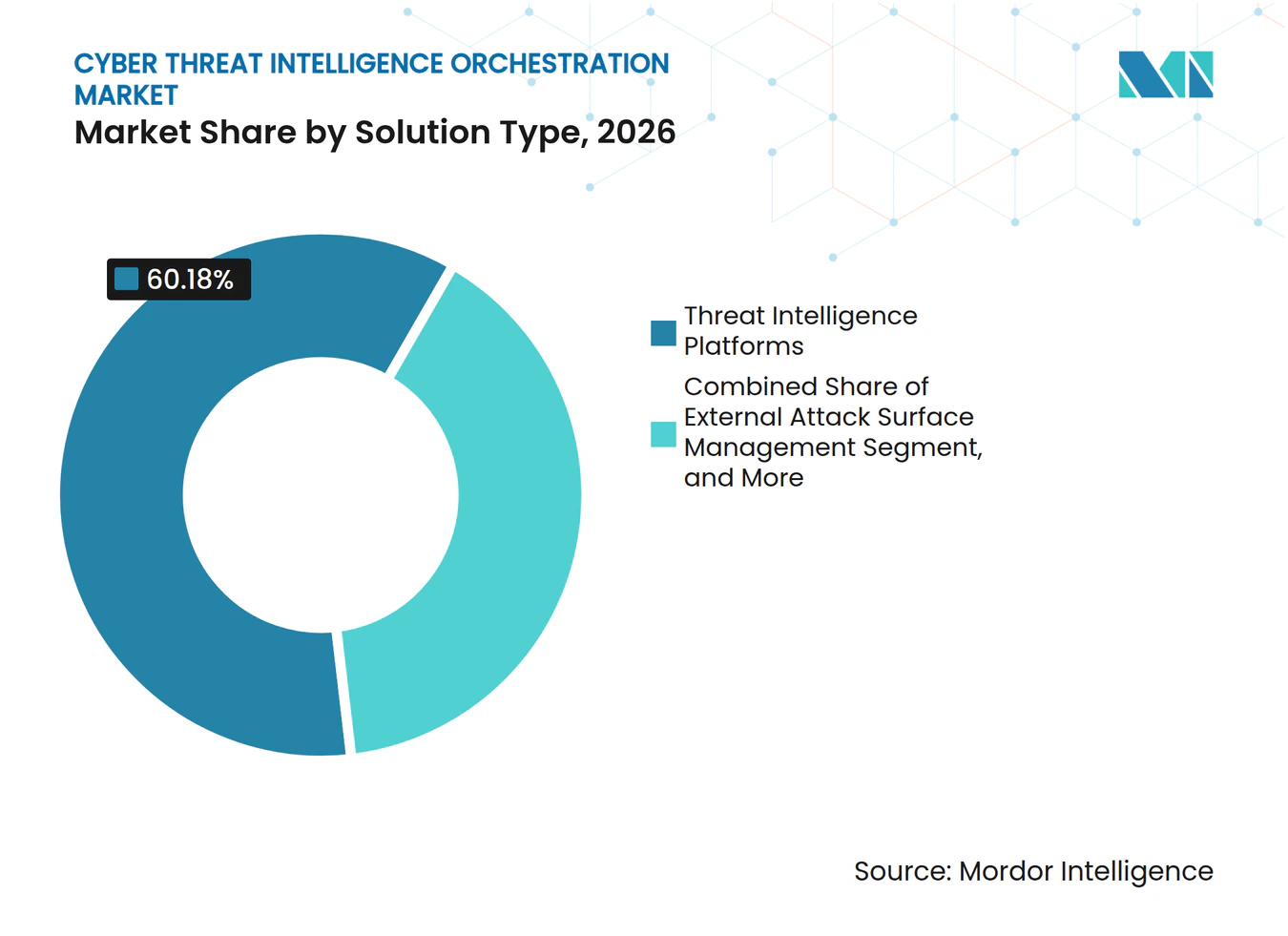
- By solution type, threat intelligence platforms held 60.18% of the cyber threat intelligence orchestration market share in 2026, while external attack surface management is projected to expand at a 23.05% CAGR through 2032.
- By deployment mode, on-premises deployments held 68.15% of the cyber threat intelligence orchestration market share in 2026, while cloud deployments are projected to expand at a 23.30% CAGR through 2032.
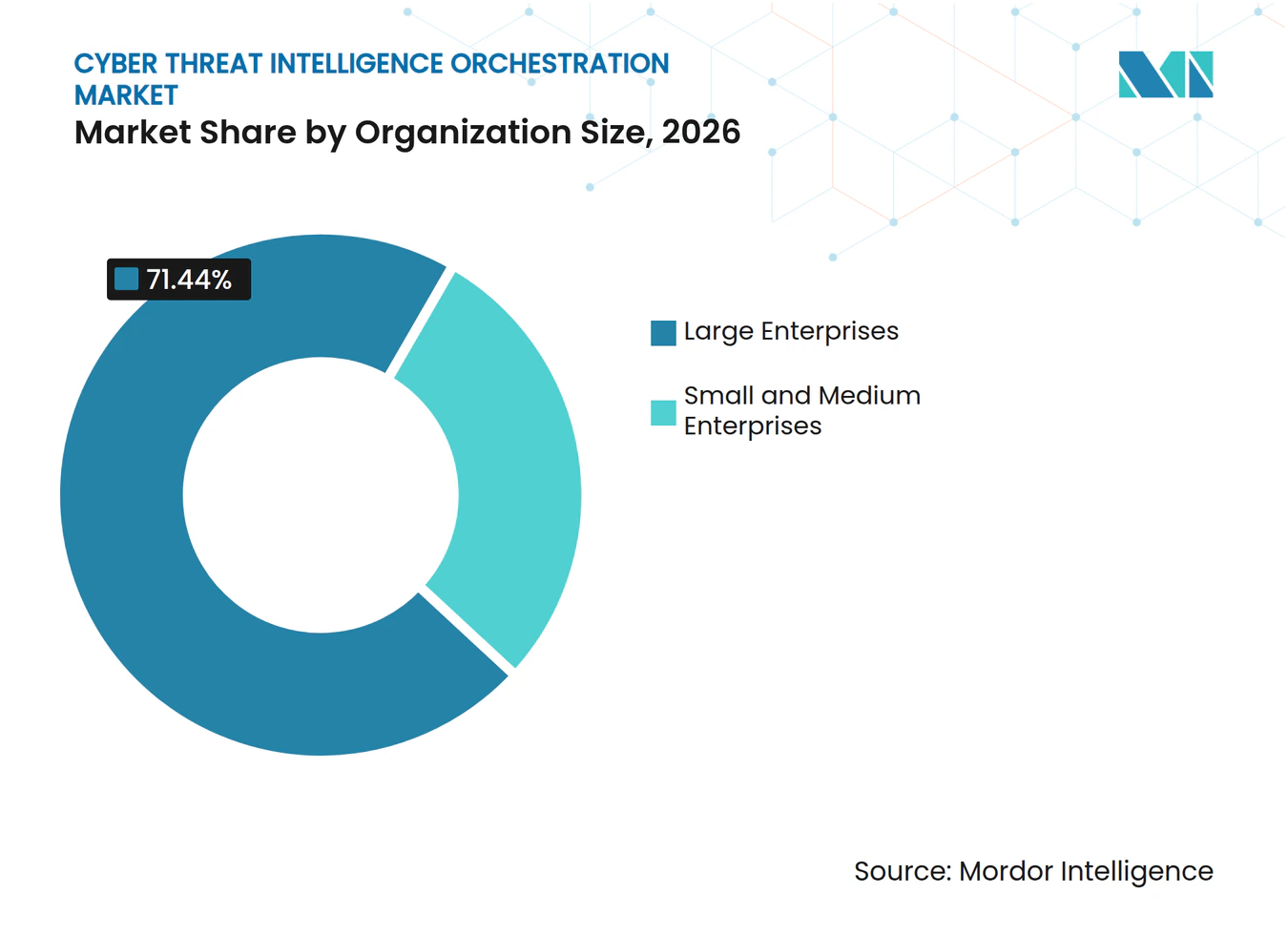
- By organization size, large enterprises held 71.44% of the cyber threat intelligence orchestration market share in 2026, while small and medium-sized enterprises are projected to expand at a 23.71% CAGR through 2032.
- By end-user industry, BFSI held 29.10% of the cyber threat intelligence orchestration market share in 2026, while government and public administration are projected to expand at a 22.36% CAGR through 2032.
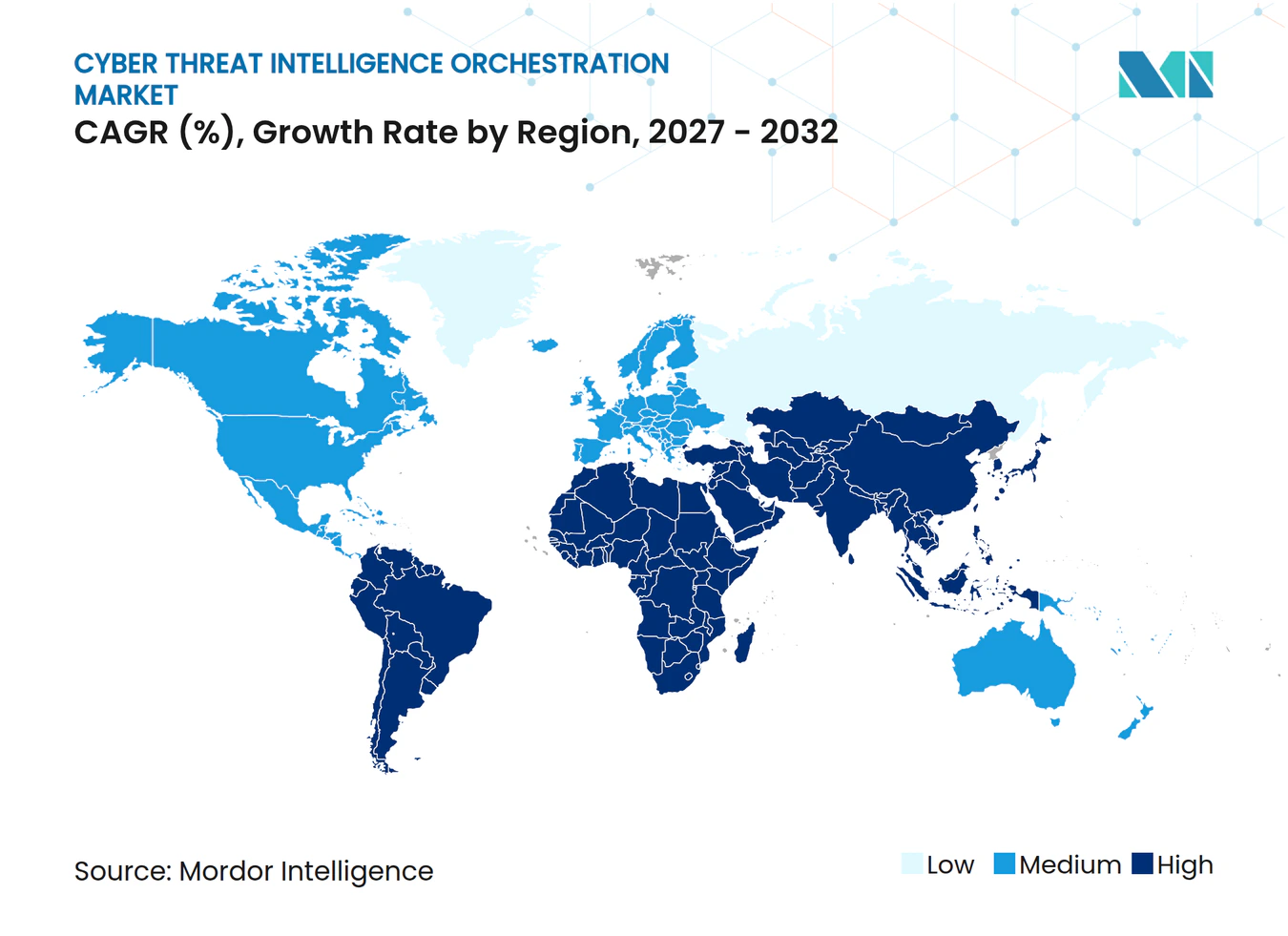
- By geography, North America held 37.55% of the market in 2026, while Asia-Pacific is projected to expand at a 22.78% CAGR through 2032.
Note: Market numbers in this report are based on Mordor Intelligence's proprietary estimation framework, which combines nine months of actuals with Q4 projections for base year 2026.
Market Trends and Insights
Drivers Impact Analysis of Cyber Threat Intelligence Orchestration Market*
| Driver | (~) % Impact on CAGR Forecast | Geographic Relevance | Impact Timeline |
|---|---|---|---|
| Escalating Ransomware and Multi-Stage Attacks | +5.2% | Global | Short term (≤ 2 years) |
| AI-Enabled Threat Detection and Automated Response Adoption | +4.8% | Global, with North America and Asia-Pacific leading adoption pace | Short term (≤ 2 years) |
| Expansion of Cloud and Identity Attack Surfaces | +3.5% | Global, most acute in North America and Europe | Medium term (2-4 years) |
| Regulatory Incident Disclosure and Intelligence-Sharing Mandates | +2.8% | North America and Europe core, with spillover to Asia-Pacific and the Middle East and Africa | Medium term (2-4 years) |
| Analyst-Ready Intelligence for Agentic SOC Workflows | +2.1% | North America and Europe, with rapid Asia-Pacific uptake | Medium term (2-4 years) |
| CTI Signal Provenance and Confidence Scoring as Procurement Gates | +1.2% | Global, concentrated in regulated industries | Long term (≥ 4 years) |
| Source: Mordor Intelligence | |||
Escalating Ransomware and Multi-Stage Attacks
Ransomware is driving demand in the cyber threat intelligence orchestration market because security teams need to quickly turn external warnings into defensive action. Verizon found ransomware in 44% of breaches reviewed in 2025, and reported that ransomware was present in 88% of breaches involving small businesses. The number of active groups and the prevalence of data theft before extortion add pressure on teams to monitor infrastructure, dark web activity, and exposed credentials in tandem. BlackFog recorded 6,604 ransomware attacks in 2025, with 130 groups active during the year. Multi-stage attacks can involve separate access brokers, ransomware developers, and affiliates, making it harder to connect the evidence using standalone tools. Orchestration platforms can bring these signals into a common workflow and help analysts connect a suspected intrusion with later activity.
AI-Enabled Threat Detection and Automated Response Adoption
AI-assisted security operations are driving growth in the cyber threat intelligence orchestration market by reducing the manual effort required to investigate and prioritize alerts. CrowdStrike introduced coordinated multi-agent investigations in September 2026 that span endpoint, identity, software-as-a-service, cloud, and network environments. Microsoft also introduced its Integrated Security Operations Center in Microsoft Defender during September 2026, bringing SIEM and threat protection functions into a common foundation for practitioners and AI agents. These product changes show that major security providers are building orchestration into their platforms rather than treating it as a separate capability. Buyers can evaluate such tools on their ability to create an auditable investigation record, not only on the range of feeds they collect. The approach is especially relevant when teams must investigate activity across multiple systems simultaneously.
Expansion of Cloud and Identity Attack Surfaces
The cyber threat intelligence orchestration market benefits from the wider attack surface created by cloud services, application programming interfaces, continuous integration pipelines, and third-party connections. The UK National Cyber Security Center states that external attack surfaces can include forgotten domains, temporary development resources, and contractor access points that organizations may not have inventoried. Identity has become a central attack path because exposed credentials can enable access across cloud and software-as-a-service environments. Security teams, therefore, need current external asset data alongside intelligence on adversaries and malicious infrastructure. Intel 471 launched Verity471 in July 2025, featuring threat exposure modules designed to connect adversary intelligence to the attack surface and third-party risk. This convergence supports platforms that make external exposure information usable within analyst workflows.
Regulatory Incident Disclosure and Intelligence-Sharing Mandates
Regulatory reporting requirements create a practical need for the cyber threat intelligence orchestration market, particularly among financial institutions and critical infrastructure operators. The European Union’s Digital Operational Resilience Act has been in place since January 17, 2025, and requires financial entities to manage information and communication technology risk and report major incidents under defined timelines.[1] The Network and Information Security Directive 2 also includes early-warning requirements that encourage organizations to promptly assemble incident facts. In the United States, the Securities and Exchange Commission requires registrants to disclose material cybersecurity incidents on Form 8-K within 4 business days after determining that an incident is material. Manual evidence collection can slow these processes when data is split across security tools. Intelligence orchestration can help teams retain context, document decisions, and prepare information for internal and regulatory reporting.
Restraints Impact Analysis of Cyber Threat Intelligence Orchestration Market*
| Restraint | (~) % Impact on CAGR Forecast | Geographic Relevance | Impact Timeline |
|---|---|---|---|
| Integration Complexity Across Legacy SIEM, SOAR, and EDR Environments | -1.5% | Global, more pronounced in Europe and North America with legacy infrastructure debt | Medium term (2-4 years) |
| Shortage of Skilled Cyber Threat Intelligence Analysts | -1.2% | Global, most acute outside North America and Europe | Long term (≥ 4 years) |
| Source Attribution and Data-Sharing Trust Friction | -0.8% | Global | Long term (≥ 4 years) |
| Alert Duplication and Model Drift in Multi-Feed Orchestration | -0.6% | Global | Medium term (2-4 years) |
| Source: Mordor Intelligence | |||
Integration Complexity Across Legacy SIEM, SOAR, and EDR Environments
Legacy security architectures can restrain adoption in the cyber threat intelligence orchestration market because every system may store and label data differently. Organizations often operate SIEM, endpoint detection and response, cloud security, identity monitoring, and automation products from several vendors. The Australian Cyber Security Center notes that multi-vendor environments can make full visibility difficult, particularly when interfaces are incomplete or inconsistent. Differences in schemas can require parser updates, rule testing, and retraining when a vendor changes its product. This work extends the time between procurement and operational use, especially for buyers with older environments. It also makes platforms with mature connectors, clear data models, and staged deployment methods more attractive.
Shortage of Skilled Cyber Threat Intelligence Analysts
The shortage of experienced analysts constrains the cyber threat intelligence orchestration market, as tools still require people to configure, validate, and govern them. ISC2 found that 59% of respondents reported critical or significant cybersecurity skills needs in 2025, compared with 44% in 2024. The same study reported that 88% of respondents had experienced at least 1 significant cybersecurity consequence linked to workforce shortages. The challenge is not limited to headcount because teams also need skills in AI oversight, cloud security, intelligence analysis, and detection engineering. Vendors are responding with natural-language search, guided workflows, and automated triage, but analyst review remains important when actions can affect a production environment. This constraint supports demand for managed security service providers and products that reduce configuration effort without removing oversight.
*Our forecasts treat driver/restraint impacts as directional, not additive. The impact forecasts reflect baseline growth, mix effects, and variable interactions.
Cyber Threat Intelligence Orchestration Market Segment Analysis
By Solution Type:
Intelligence Platforms Lead While External Exposure Tools Gain MomentumThreat intelligence platforms held 60.18% of the market in 2026. Within the cyber threat intelligence orchestration market, these platforms serve as the central repository for intelligence from internal, commercial, government, and open sources. They can deduplicate indicators, add context on threat actors and infrastructure, and distribute relevant data to security operations tools. Large organizations use this model because it provides a common intelligence layer for SIEM, SOAR, endpoint, and network teams. The position is durable when a platform becomes embedded in analyst workflows and existing integrations.
External attack surface management is projected to grow at a 23.05% CAGR through 2032 as organizations need a current view of internet-facing assets and third-party exposure. The cyber threat intelligence orchestration market size for this category is supported by the shift from periodic asset reviews to continuous monitoring of domains, cloud assets, and exposed services. The NCSC identifies shadow resources and forgotten domains as important sources of external exposure. Intel 471 introduced its Cyber Threat Exposure Bundle in March 2026, combining attack surface, third-party exposure, and brand exposure products. SIEM and SOAR tools retain a substantial installed base, although organizations increasingly use intelligence platform connectors instead of importing every feed directly. Digital risk protection services and managed intelligence feeds provide additional coverage for brand, supply-chain, and credential risks.



By Deployment Mode:
On-Premises Systems Retain a Large Base While Cloud Use ExpandsOn-premises deployments accounted for 68.15% of the market in 2026. In the cyber threat intelligence orchestration market, large enterprises and public-sector organizations use these deployments where data sovereignty, air-gapped networks, or classified intelligence sources limit cloud use. Financial services and defense organizations can also treat an on-premises platform as an integration hub for sensitive feeds. Existing investments in data centers, security operations workflows, and local data stores support the segment’s continued role. Hybrid designs extend this position by allowing local sensors and data sources to connect with broader orchestration capabilities.
Cloud deployment is projected to grow at a 23.30% CAGR through 2032. Multi-cloud environments generate data at a scale that can be difficult to process through fixed on-premises correlation capacity. Cloud delivery can also support faster deployment, elastic processing, and simpler access for distributed analyst teams. Anomali released ThreatStream Next-Gen in May 2026, featuring a Unified Security Data Lake, underscoring its emphasis on cloud-oriented intelligence delivery. Cloud adoption does not eliminate the need for controls, as buyers still assess data residency, integration, and access governance. The cyber threat intelligence orchestration market is therefore likely to retain hybrid architectures even as new deployments increasingly favor cloud-native workflows.
By Organization Size:
Large Enterprises Hold the Most Spending While SMEs Adopt Managed ServicesLarge enterprises held 71.44% of the market in 2026. Across the cyber threat intelligence orchestration market, they often have dedicated intelligence teams, established security operations centers, and budgets for enterprise licenses and professional services. Their programs may include proprietary intelligence libraries and participation in information-sharing groups. These investments create operational dependence on existing platforms and make migrations difficult. Large enterprises also need broad coverage because they operate across multiple locations, business units, cloud environments, and third-party networks.
Small and medium-sized enterprises are projected to grow at a 23.71% CAGR through 2032. Verizon reported ransomware in 88% of small-business breaches examined in its 2025 report, which raises the need for practical security operations support.[2] Managed security service providers can extend intelligence and response capabilities to these buyers without requiring comparable in-house analyst teams. AI-assisted playbook creation and natural-language querying can lower the effort required to use complex security data. Securonix’s 2025 acquisition of ThreatQuotient combined threat detection, investigation, response, and intelligence capabilities in a modular platform. Flexible licensing and smaller initial deployments can further reduce entry barriers for this customer group.

By End-User Industry:
BFSI Anchors Demand While Government Adoption Gains PaceBFSI accounted for 29.10% of the cyber threat intelligence orchestration market size in 2026. In the cyber threat intelligence orchestration market, financial institutions are frequent targets of fraud, ransomware, credential theft, and data theft, which makes intelligence relevant across security and financial crime functions. Regulatory expectations also increase the value of evidence collection, incident classification, and reporting workflows. DORA has applied to financial entities since January 2025 and sets requirements for digital operational resilience. These conditions support investment in platforms that can maintain context across detection, investigation, response, and disclosure activities.
Government and public administration are projected to expand at a 22.36% CAGR through 2032. National agencies need sovereign intelligence capabilities because they address risks affecting public services, critical infrastructure, and national security. KELA Group launched its National Cyber Resilience Suite in March 2026 for government clients managing state-backed cyber threats. Healthcare and life sciences organizations require strong protection for patient data and connected systems. Energy and utilities buyers are extending intelligence into operational technology as information technology and operational technology environments become more connected. Retail and e-commerce demand is shaped by fraud intelligence, exposed credentials, and dark web monitoring.
Geography Analysis
North America Cyber Threat Intelligence Orchestration Market
North America held 37.55% of the market in 2026. In the cyber threat intelligence orchestration market, the region has a deep base of security providers and enterprise buyers with established security operations centers. Disclosure requirements and sector-specific oversight make incident investigation and evidence management important procurement factors. The SEC’s cybersecurity disclosure rules require public companies to report material incidents on Form 8-K after making a materiality determination.[3] Consolidation also remains visible in the region, including Mastercard’s completed acquisition of Recorded Future in December 2024 and Securonix’s acquisition of ThreatQuotient in June 2025.
EMEA Cyber Threat Intelligence Orchestration Market
Europe is supported by DORA and NIS2, which make incident preparedness and timely reporting more urgent for regulated organizations. Germany, the United Kingdom, and France represent core demand centers, while transposition of NIS2 can expand adoption across the European Union. The cyber threat intelligence orchestration market in the region also benefits from security providers building automation for managed security service providers. Sekoia launched Sekoia Elevate into general availability in September 2026 after an early access program that carried out more than 425,000 autonomous alert investigations across more than 2,000 customer sites. The Middle East is developing through national cybersecurity authority frameworks and sovereign procurement programs. In Africa, financial services and telecommunications providers are likely to remain the earliest buyers as security operations mature.
APAC Cyber Threat Intelligence Orchestration Market
Asia-Pacific is projected to expand at a 22.78% CAGR through 2032. Digital transformation, state-backed threat activity, and expanding cloud use are raising the need for coordinated intelligence across the region. Japan’s Ministry of Economy, Trade, and Industry published a cybersecurity industry policy in March 2025 that set a goal of expanding the domestic cybersecurity sector over 10 years. The policy direction gives domestic security capability greater relevance in the country’s investment plans. Indonesia faces high alert volumes, which increases the need to prioritize signals and reduce manual investigation effort. China, South Korea, and other Asia-Pacific markets are also increasing adoption as public and private organizations strengthen their security programs.
Competitive Landscape
Market Concentration
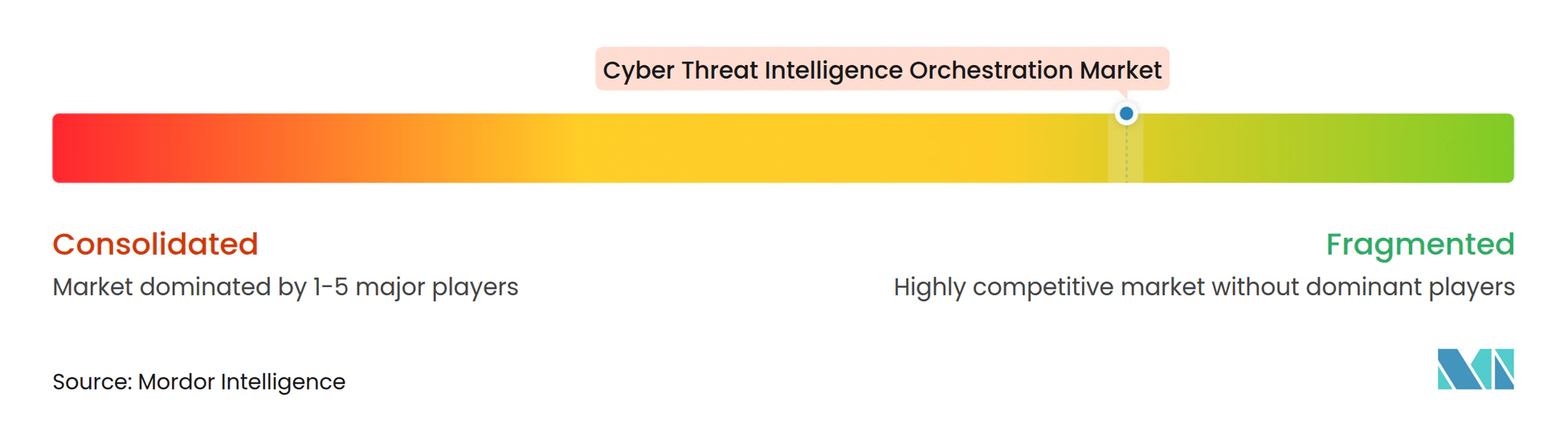
The cyber threat intelligence orchestration market is moderately fragmented, with specialist intelligence providers competing alongside SIEM, endpoint, cloud security, and automation vendors. Recorded Future remains an important dedicated provider following Mastercard’s acquisition, which closed in December 2024. The company serves more than 1,900 organizations in 80 countries, giving its platform a broad enterprise presence. Large platform providers can integrate intelligence into existing security workflows, while specialists can differentiate through research depth and external-risk coverage. This mix keeps procurement competitive because buyers can select a broad platform or a focused provider based on their integration needs, feed quality, governance controls, available implementation support, and the ability to deploy within existing security operations processes without adding unnecessary training requirements for constrained teams.
Product differentiation is shifting toward measurable gains in analyst productivity, faster case investigation, and better connections between intelligence and response. CrowdStrike’s September 2026 multi-agent investigation capabilities, themselves an example of providers using coordinated AI functions across multiple security domains, demonstrate research depth and external risk. Microsoft’s Integrated Security Operations Center is another example of a major provider bringing SIEM, threat protection, practitioners, and AI agents into a unified environment. Intel 471 has added Agent471 and MCP471 to its Verity471 platform, extending intelligence reasoning into external analyst tools. Providers that can show reliable investigation outcomes and clear analyst oversight are better positioned to compete for enterprise deployments.
Acquisitions and partnerships are changing how suppliers assemble their offerings. The cyber threat intelligence orchestration market is becoming increasingly integrated with threat detection, investigation, response, digital risk protection, and external exposure management. Securonix acquired ThreatQuotient in June 2025 to combine threat detection, investigation, response, and intelligence capabilities.[4] ZeroFox launched HNTR in July 2026 to combine digital risk protection and threat intelligence for adversary discovery and disruption. These changes can reduce the number of separate products that a customer needs to operate, while also increasing the importance of open integration with existing systems. White space remains in operational technology and supervisory control and data acquisition environments, where industrial threat coverage has distinct requirements. There is also demand for localized intelligence in Asia-Pacific and the Middle East, where local languages, regulations, and threat patterns shape buyer needs. Partnerships can help providers add dark web, external exposure, or regional intelligence capabilities without building them internally.
Cyber Threat Intelligence Orchestration Industry Leaders
-
Anomali, Inc.
-
Cyware, Inc.
-
EclecticIQ B.V.
-
Sekoia.io SAS
-
Securonix, Inc.
- *Disclaimer: Major Players sorted in no particular order
Cyber Threat Intelligence Orchestration Market Companies Covered in this Report
- Recorded Future, Inc.
- Anomali, Inc.
- ThreatConnect, Inc.
- Cyware, Inc.
- EclecticIQ B.V.
- Intel 471, Inc.
- Flashpoint Intelligence, Inc.
- KELA Group Ltd.
- SOCRadar Teknoloji A.Ş.
- Group-IB Global Private Ltd.
- ZeroFox Holdings, Inc.
- Sekoia.io SAS
- ThreatQuotient, Inc.
- Securonix, Inc.
- LookingGlass Cyber Solutions, Inc.
- Searchlight Cyber Ltd.
- Cyble, Inc.
- Resecurity, Inc.
- Silent Push, Inc.
- Sixgill Ltd.
Recent Industry Developments in Cyber Threat Intelligence Orchestration Market
- October 2026: Silent Push released Platform 6.1 with a fully automated rebuild of brand and infrastructure impersonation capabilities, introducing continuous risk scoring for look-alike domains and subdomains, enhanced SIEM and SOAR extensibility, and AI tool integrations that enable analysts to pivot faster from threat infrastructure findings to security telemetry actions.
- September 2026: SOCRadar and EclecticIQ launched a partnership delivering 3 continuously updated dark web intelligence feeds, covering dark web news, black market activity, and PII exposure, directly into EclecticIQ Intelligence Center, closing the gap between underground threat discovery and centralized analyst response.
- September 2024: Sekoia launched Sekoia Elevate into general availability following an early access program across more than 2,000 customer sites that completed over 425,000 autonomous investigations. Leading MSSPs in Europe and the United States reported up to a 5-fold reduction in analyst workload for alert investigation workflows.
- August 2026: Intel 471 launched Agent471 and MCP471 within Verity471, enabling intelligent reasoning across proprietary adversary data and extending model context protocol connectivity to external analyst tools. The capabilities were demonstrated at Black Hat USA 2026.
Global Cyber Threat Intelligence Orchestration Market Report Scope
The Cyber Threat Intelligence Orchestration Market comprises software platforms and services that aggregate, correlate, enrich, prioritize, operationalize, and automate cyber threat intelligence from multiple internal and external sources. These solutions enable organizations to streamline intelligence workflows, improve threat visibility, support threat hunting and incident response activities, and automate intelligence sharing across security operations environments. The market includes threat intelligence platforms, intelligence orchestration technologies, intelligence-driven security integrations, and associated professional and managed services. These solutions help enterprises transform raw threat data into actionable intelligence, improving cybersecurity decision-making and operational efficiency.
The Cyber Threat Intelligence Orchestration Market Report is Segmented by Solution Type (Threat Intelligence Platforms, Security Information and Event Management, Security Orchestration, Automation, and Response, External Attack Surface Management, and Other Solution Types), Deployment Mode (On-Premises, and Cloud), Organization Size (Large Enterprises, and Small and Medium Enterprises), End-User Industry (Banking, Financial Services, and Insurance [BFSI], Government and Public Administration, Healthcare and Life Sciences, IT and Telecommunication, Industrial Manufacturing, Energy and Utilities, Retail and E-Commerce, and Other End-User Industries), and Geography (North America, South America, Europe, Asia-Pacific, Middle East, and Africa). The Market Forecasts are Provided in Terms of Value (USD).
Segmentation Overview
| Threat Intelligence Platforms |
| Security Information and Event Management |
| Security Orchestration, Automation, and Response |
| External Attack Surface Management |
| Other Solution Types |
| On-Premises |
| Cloud |
| Large Enterprises |
| Small and Medium Enterprises |
| Banking, Financial Services, and Insurance (BFSI) |
| Government and Public Administration |
| Healthcare and Life Sciences |
| IT and Telecommunication |
| Industrial Manufacturing |
| Energy and Utilities |
| Retail and E-Commerce |
| Other End-User Industries |
| North America | United States |
| Canada | |
| Mexico | |
| South America | Brazil |
| Argentina | |
| Rest of South America | |
| Europe | Germany |
| United Kingdom | |
| France | |
| Italy | |
| Russia | |
| Rest of Europe | |
| Asia-Pacific | China |
| Japan | |
| India | |
| South Korea | |
| Rest of Asia-Pacific | |
| Middle East | Saudi Arabia |
| United Arab Emirates | |
| Rest of Middle East | |
| Africa | South Africa |
| Nigeria | |
| Rest of Africa |
| By Solution Type | Threat Intelligence Platforms | |
| Security Information and Event Management | ||
| Security Orchestration, Automation, and Response | ||
| External Attack Surface Management | ||
| Other Solution Types | ||
| By Deployment Mode | On-Premises | |
| Cloud | ||
| By Organization Size | Large Enterprises | |
| Small and Medium Enterprises | ||
| By End-User Industry | Banking, Financial Services, and Insurance (BFSI) | |
| Government and Public Administration | ||
| Healthcare and Life Sciences | ||
| IT and Telecommunication | ||
| Industrial Manufacturing | ||
| Energy and Utilities | ||
| Retail and E-Commerce | ||
| Other End-User Industries | ||
| By Geography | North America | United States |
| Canada | ||
| Mexico | ||
| South America | Brazil | |
| Argentina | ||
| Rest of South America | ||
| Europe | Germany | |
| United Kingdom | ||
| France | ||
| Italy | ||
| Russia | ||
| Rest of Europe | ||
| Asia-Pacific | China | |
| Japan | ||
| India | ||
| South Korea | ||
| Rest of Asia-Pacific | ||
| Middle East | Saudi Arabia | |
| United Arab Emirates | ||
| Rest of Middle East | ||
| Africa | South Africa | |
| Nigeria | ||
| Rest of Africa | ||
Key Questions Answered in the Report
What is the cyber threat intelligence orchestration market size?
The cyber threat intelligence orchestration market is projected to grow from USD 5.05 billion in 2026 and USD 6.12 billion in 2027 to USD 16.50 billion by 2032, at a 21.94% CAGR.
What is driving demand for cyber threat intelligence orchestration?
Ransomware, cloud exposure, identity threats, AI-assisted operations, and faster incident reporting requirements are increasing the need to connect intelligence with response workflows.
Which solution type leads the cyber threat intelligence orchestration market?
Threat intelligence platforms lead with 60.18% share in 2026 because they centralize intelligence collection, enrichment, and distribution across security tools.
Why are cloud deployments expanding quickly?
Cloud deployments are projected to grow at a 23.30% CAGR through 2032 because multi-cloud environments require elastic processing and broader telemetry integration.
Which end-user sector has the largest adoption?
BFSI leads with 29.10% share in 2026 due to exposure to fraud, ransomware, credential theft, and extensive compliance requirements.
Which region is growing the fastest?
Asia-Pacific is projected to grow at a 22.78% CAGR through 2032, supported by digital transformation, expanding cloud use, and heightened state-backed threat activity.