
Cryptographic Dependency Mapping Market Size and Share
Market Overview
| Study Period | 2021 - 2032 |
|---|---|
| Market Size (2027) | USD 0.57 Billion |
| Market Size (2032) | USD 1.56 Billion |
| Growth Rate (2027 - 2032) | 22.31 % |
| Fastest Growing Market | Asia-Pacific |
| Largest Market | North America |
| Market Concentration | Medium |
Major Players *Disclaimer: Major Players sorted in no particular order Image © Mordor Intelligence. Reuse requires attribution under CC BY 4.0. | |
Cryptographic Dependency Mapping Market Analysis by Mordor Intelligence
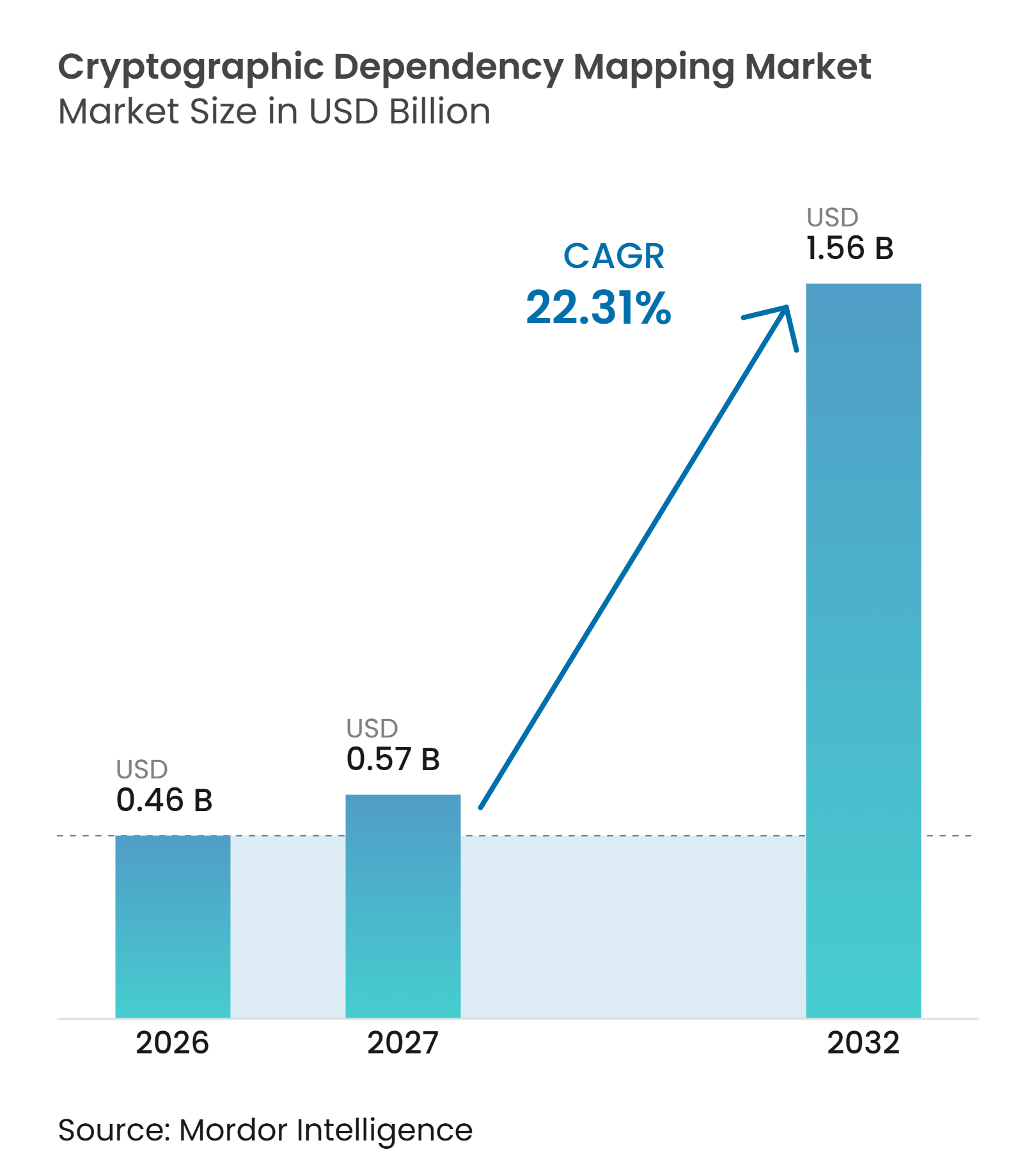
The cryptographic dependency mapping market size was valued at USD 0.46 billion in 2026 and is estimated to grow from USD 0.57 billion in 2027 to reach USD 1.56 billion by 2032, at a CAGR of 22.31% during the forecast period (2027-2032). The cryptographic dependency mapping market is shifting from periodic security reviews to a continuous compliance function as post-quantum cryptography requirements become more concrete. Government migration deadlines require organizations to identify cryptographic dependencies before they can prioritize replacement work. Certificate lifecycle pressure, cloud adoption, and software supply-chain visibility are widening the need for discovery across code, systems, and live network environments. Vendors are responding by linking inventory, cryptographic bills of materials, and remediation workflows in unified platforms. The central opportunity lies in turning a fragmented technical inventory into evidence that can support migration planning, procurement, and audit activity.
Key Report Takeaways
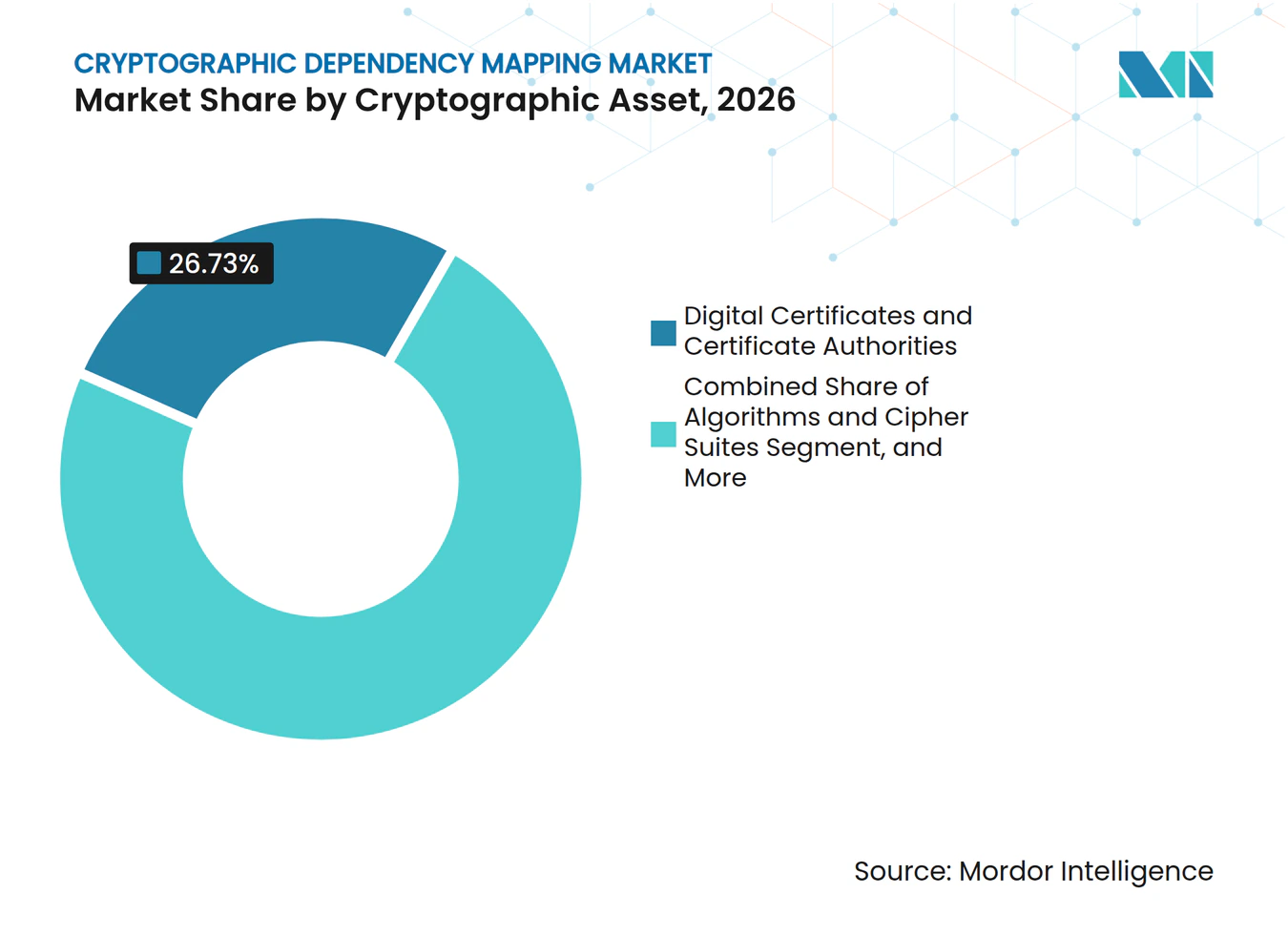
- By cryptographic asset, digital certificates and certificate authorities held 26.73% of the cryptographic dependency mapping market share in 2026, while cryptographic libraries and providers are projected to expand at a CAGR of 24.28% through 2032.
- By discovery layer, source code and repositories held 29.41% revenue share in 2026, while software dependencies and packages are projected to expand at a CAGR of 23.94% through 2032.
- By deployment model, cloud-based deployment accounted for 67.89% of revenue in the cryptographic dependency mapping market in 2026 and is the fastest-growing deployment model through 2032.
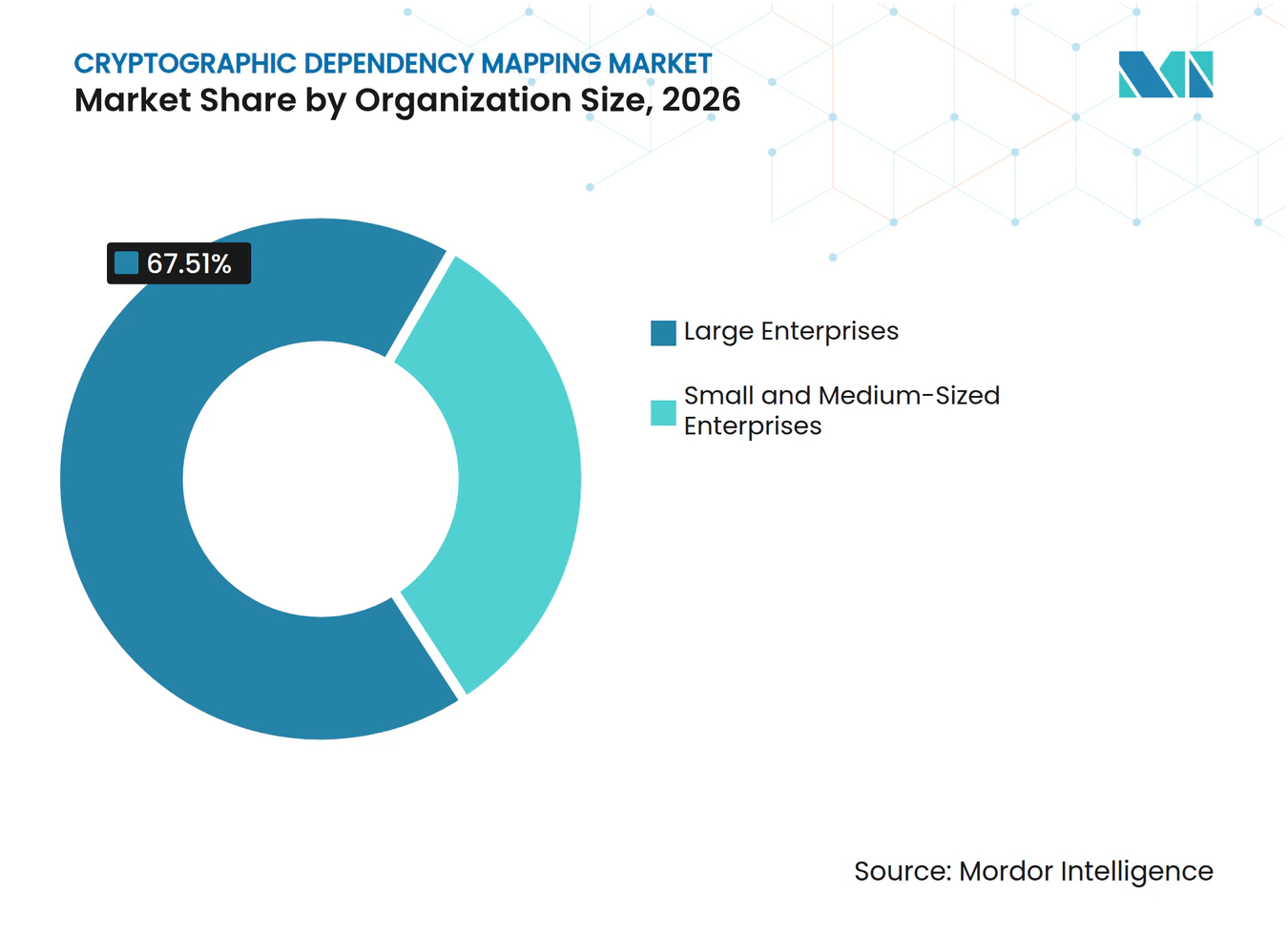
- By organization size, large enterprises held 67.51% revenue share in 2026, while SMEs are projected to expand at a CAGR of 25.43% through 2032.
- By end-user industry, BFSI held 27.39% revenue share in 2026, while government and public administration are projected to expand at a CAGR of 24.61% through 2032.
- By geography, North America accounted for 41.67% of revenue in the cryptographic dependency mapping market in 2026, while Asia-Pacific is projected to expand at a CAGR of 26.94% through 2032.
Note: Market numbers in this report are based on Mordor Intelligence's proprietary estimation framework, which combines nine months of actuals with Q4 projections for base year 2026.
Market Trends and Insights
Drivers Impact Analysis of Cryptographic Dependency Mapping Market*
| Driver | (~) % Impact on CAGR Forecast | Geographic Relevance | Impact Timeline |
|---|---|---|---|
| Accelerating Post-Quantum Cryptography Readiness Mandates | +5.3% | Global, concentrated near-term pressure in the United States, EU member states, and Japan | Short term (≤ 2 years) |
| Expansion of Cryptographic Bill of Materials Standards | +4.2% | Global, regulatory influence most acute in the United States, EU, and G7 financial systems | Medium term (2-4 years) |
| Rising Cryptographic Debt Across Hybrid and Multi-Cloud Estates | +3.7% | Asia-Pacific core and North America, with spillover to Western Europe | Medium term (2-4 years) |
| Increasing Harvest-Now, Decrypt-Later Exposure for Long-Lived Data | +3.1% | Global, immediate urgency in defense, financial services, and healthcare | Short term (≤ 2 years) |
| Increasing Automation of Cryptographic Discovery in DevSecOps | +2.4% | North America and Western Europe, with early gains in Asia-Pacific technology centers | Medium term (2-4 years) |
| Cryptographic Dependency Evidence for Audit and Incident Response | +1.8% | Global, most pronounced in BFSI, healthcare, and government | Long term (≥ 4 years) |
| Source: Mordor Intelligence | |||
Accelerating Post-Quantum Cryptography Readiness Mandates
Federal and supranational action is making post-quantum preparation an active procurement requirement in the cryptographic dependency mapping market. Executive Order 14412 required US federal agencies to appoint post-quantum migration leads and set a December 31, 2030, deadline for migration of high-value systems used for key establishments. The order also directed the development of minimum cryptographic bill-of-materials elements and proposed contractor requirements, extending the need for asset visibility into federal supply chains.[1] CNSSP-15 required new commercial national security systems to support quantum-resistant algorithms from 2027 and set 2030 for the phaseout of legacy systems. Organizations cannot produce an accountable migration plan without knowing where certificates, keys, algorithms, and protocols are used. Continuous discovery is more useful than a one-time scan because software and infrastructure changes can introduce new cryptographic dependencies after the inventory is completed.
Expansion of Cryptographic Bill of Materials Standards
A cryptographic bill of materials is becoming a practical compliance artifact rather than a voluntary record of technical hygiene. CycloneDX added CBOM as a first-class object in version 1.6 and expanded the capability in version 1.7, giving organizations a formal way to describe algorithms, keys, certificates, protocols, and their dependencies.[2] In June 2026, the PKI Consortium launched its CBOM Profiles Working Group with 16 founding organizations to develop cross-vendor guidance mapped to SPDX and CycloneDX. A reliable CBOM identifies the scope of migration work and can expose requirements for replacement tools, hardware security modules, and managed post-quantum services. The cryptographic dependency mapping market, therefore, benefits when CBOM generation is integrated into a broader remediation process. Platforms that make the record repeatable across development and operational environments can reduce the gap between compliance evidence and actual migration execution.
Rising Cryptographic Debt Across Hybrid and Multi-Cloud Estates
Cryptographic debt accumulates when organizations deploy applications and infrastructure without a shared record of their cryptographic dependencies. Hybrid and multi-cloud estates often contain different key management services, cipher policies, TLS gateways, SaaS interfaces, firmware, and custom code. The Cloud Security Alliance identified limited visibility into legacy cryptography as a leading barrier to post-quantum migration. Research presented by IBM at Eurocrypt 2026 found that a full-stack CBOM must account for software, operations, hardware, and SaaS dimensions. This need gives the cryptographic dependency mapping market a reason to favor platforms that correlate findings across source code, binaries, networks, and hosts instead of reporting one layer in isolation. As new workloads and infrastructure-as-code templates are deployed, the cryptographic dependency mapping market has a stronger case for continuous monitoring than for periodic assessments.
Increasing Harvest-Now, Decrypt-Later Exposure for Long-Lived Data
Harvest-now, decrypt-later activity involves collecting encrypted information now for possible decryption after a relevant quantum computer becomes available. The risk is acute where data must remain confidential for many years, including defense, financial services, healthcare, and satellite communications. A 2025 Federal Reserve paper found that post-quantum protection for future distributed ledger traffic would not protect historical ciphertext already collected by an adversary. A peer-reviewed study also described the prolonged exposure window created by delayed migration and found that hybrid and forward-secure approaches can reduce the risk horizon. This shifts the purchasing discussion from a future upgrade schedule to the current exposure of sensitive records. Discovery tools become important because teams need to locate vulnerable cryptography before they can identify which data flows and applications deserve early remediation.
Restraints Impact Analysis of Cryptographic Dependency Mapping Market*
| Restraint | (~) % Impact on CAGR Forecast | Geographic Relevance | Impact Timeline |
|---|---|---|---|
| Embedded and Proprietary Cryptography Opaque to Automated Tools | -3.2% | Global, most acute in energy, utilities, manufacturing, and defense sectors with legacy OT infrastructure | Long term (≥ 4 years) |
| High False-Positive and False-Negative Risk in Static and Network Discovery | -2.6% | Global, most pronounced in large, heterogeneous IT estates in North America and Western Europe | Medium term (2-4 years) |
| Migration Disruption Risk Across Legacy Applications and Operational Technology | -1.9% | Global, concentrated in regulated industries with low change tolerance, including BFSI, healthcare, and government | Long term (≥ 4 years) |
| Fragmented Ownership of Cryptographic Assets Across Internal Teams and Suppliers | -1.4% | Global, most visible in large enterprises with federated IT governance and extended supplier networks | Medium term (2-4 years) |
| Source: Mordor Intelligence | |||
Embedded and Proprietary Cryptography That Remains Opaque to Automated Tools
Firmware, proprietary ASICs, and hardware security modules can execute cryptographic operations below the operating system layer and beyond the reach of common source-code or binary scanners. Industrial systems often rely on closed-source firmware, and the operating organization may lack complete documentation of the embedded implementation. OWASP identified long-lived signing keys, hardware-bound keys, and keys embedded in firmware or silicon as areas where cryptographic inventories frequently fail.[3] These assets are also important for post-quantum transition planning because they can serve as the foundation of a security architecture. Vendors are exploring hardware-linked sensors and partnerships with original equipment manufacturers to obtain metadata from operational technology images. Progress remains slower than IT-layer discovery, leaving energy, utilities, manufacturing, and defense with incomplete inventory coverage.
High False-Positive and False-Negative Risk in Static and Network Discovery
Static analysis and passive network monitoring are common discovery methods, but each can deliver incomplete or noisy findings. Static tools may identify unused code, library headers, and test fixtures as active cryptographic use, which increases the manual review burden. Network monitoring can miss local disk encryption, offline signing systems, and air-gapped systems because those assets do not appear on an observed network path. A 2026 IEEE and ACM conference study found that a complete cryptographic inventory requires a combination of discovery layers rather than a single modality. Vendors are adding call-graph awareness and dependency tracing to distinguish reachable code from inactive artifacts. These methods can improve evidence quality, but they require more computing resources and deeper integration from security teams.
*Our forecasts treat driver/restraint impacts as directional, not additive. The impact forecasts reflect baseline growth, mix effects, and variable interactions.
Cryptographic Dependency Mapping Market Segment Analysis
By Cryptographic Asset:
Certificate Sprawl Anchors the Largest ShareDigital certificates and certificate authorities captured 26.73% of the cryptographic dependency mapping market share in 2026, the largest position among cryptographic asset types. The installed base of enterprise public key infrastructure supports this position. The CA/Browser Forum's planned reduction in certificate lifetimes to 47 days increases renewal activity and the need to identify certificates before they expire. Continuous discovery and lifecycle management can help prevent availability problems caused by overlooked certificates. Cryptographic libraries and providers are projected to expand at a CAGR of 24.28% through 2032. Their growth reflects concern that vulnerable algorithm bindings can remain embedded in application runtimes without a clear inventory.
Algorithms and cipher suites remain central because obsolete configurations, including RSA-2048 key exchange and SHA-1 hashing, must be found before a migration plan can be sequenced. Keys and key stores have different levels of importance because a compromised or vulnerable key-encryption key can affect entire certificate hierarchies. Protocols and secure channels add another layer of exposure through TLS configurations and SSH key exchange settings. Shorter certificate lifetimes make protocol configuration more visible as teams review the supporting trust architecture. IBM's Eurocrypt 2026 research stated that a unified CBOM with relationships among asset types is necessary for credible migration impact assessment. The cryptographic dependency mapping market benefits when platforms can show how one asset depends on another rather than presenting a list of separate findings.



By Discovery Layer:
Source Code Leads, Supply Chain Gains GroundSource code and repositories accounted for 29.41% of the cryptographic dependency mapping market size in 2026. This layer benefits from established static analysis practices within developer workflows. Open-source tools can generate CycloneDX CBOMs at the repository level, making source scanning accessible to development teams. Software dependencies and packages are projected to expand at a CAGR of 23.94% through 2032. Third-party libraries can contain cryptographic use that is not visible in first-party code. Dependency scanning and call-graph tracing can reveal this hidden use when a package manifest has deep transitive dependencies.
Binaries, containers, and firmware are important because compiled products may include components that do not correspond to the available source code. Third-party software development kits, CI/CD tooling, and pre-compiled components can introduce cryptographic implementations after source review. Network traffic and live TLS endpoint scans reveal the cipher suites used in production, but they cannot identify assets that never traverse a monitored path. Operating systems, hosts, and file systems contain certificate stores, key vaults, and hardware security module service accounts that serve as core trust infrastructure. The 2026 BF-CBOM study found that no single discovery layer provided sufficient coverage across an enterprise environment. This supports multi-layer architectures in the cryptographic dependency-mapping market, especially for buyers who need a single record across development, runtime, and infrastructure environments.
By Deployment Model:
Cloud-Based Deployment Widens Its LeadCloud-based deployment captured 67.89% of revenue in 2026 and is the fastest-expanding deployment model through 2032. Cloud-hosted platforms can update detection patterns quickly after standards or guidance change. On-premises agents may require manual updates and regression testing, which can delay coverage as cryptographic guidance evolves. Hybrid deployment is relevant to BFSI and government users who face data sovereignty constraints with fully hosted services. These organizations can use cloud-based orchestration alongside on-premises scanning agents. AppViewX introduced a unified, multi-source configuration scan inventory in version 2026.2, combining agent-based and agentless findings into a single CBOM.[4]
On-premises deployment remains necessary for air-gapped systems, classified networks, and operational technology environments where external connectivity is restricted. These buyers need discovery tools that work within isolated networks and export evidence through controlled channels. For the cryptographic dependency mapping market, their requirements make deployment selection a matter of operating constraints rather than preference. Cloud adoption brings new SMEs into the cryptographic dependency mapping market and helps enterprises extend coverage across cloud workloads. On-premises use continues to reflect a longer installed base replacement cycle. Vendors that apply the same CBOM schema and risk approach across cloud, hybrid, and local deployments can serve enterprises that operate in all 3 environments.
By Organization Size:
Enterprise Dominance, SME AccelerationLarge enterprises held 67.51% of the cryptographic dependency mapping market share in 2026. They operate large certificate estates, multiple cryptographic libraries, and multi-cloud environments, making manual discovery impractical. Federal contractors and major financial institutions also face the earliest compliance pressure because they sit near the top of regulated supply chains. SMEs are projected to expand at a CAGR of 25.43% through 2032. Managed discovery services and SaaS delivery reduce some of the expertise and capital barriers that have limited adoption by smaller organizations. The main demand trigger for SMEs often comes from a larger customer requesting cryptographic evidence from its software suppliers.
SME adoption is shaped by supply-chain requirements rather than internal mandates alone. In the cryptographic dependency mapping market, a supplier may need a CBOM when an enterprise customer extends its security program to third-party software. Research on SME post-quantum migration described the process as an organizational change that needs governance, vendor coordination, staged implementation, and continuous monitoring. Pre-scoped templates for containerized microservices and cloud-native Python or JavaScript applications can simplify the initial deployment. These packages may be more suitable for SMEs than a custom enterprise architecture would be. This creates an opportunity for the cryptographic dependency mapping market to deliver a lower-complexity service without reducing the underlying need for current evidence.

By End-User Industry:
BFSI Commands the Largest Share, Government Scales FastestBFSI held 27.39% of revenue in 2026, the highest share among end-user industries. Long data retention periods, systemic risk exposure, and overlapping regulatory requirements increase the cost of a cryptographic weakness in this sector. The Federal Reserve's 2025 work on distributed ledger networks showed that historical data can remain vulnerable to harvest-now, decrypt-later collection even after future communications are protected with post-quantum cryptography. The G7 Cyber Expert Group's 2026 roadmap called for a comprehensive inventory of cryptographic assets, protocols, and relevant third-party dependencies. Government and public administration are projected to expand at a CAGR of 24.61% through 2032 as sovereign mandates make discovery an early step in post-quantum planning. The cryptographic dependency mapping market is consequently exposed to demand from both regulated financial institutions and public agencies.
IT and telecommunications remain the second-largest end-user industry because providers must manage certificates across customer-facing TLS endpoints and carrier-grade PKI systems. Healthcare and medical devices require long confidentiality periods for patient records, genomic data, and medical images. A 2026 medical study identified healthcare systems as among the sectors with the longest harvest-now, decrypt-later exposure windows under delayed post-quantum adoption.[5] Energy and utilities are earlier in adoption because their operational technology assets are difficult to inspect. Their critical infrastructure status can increase the likelihood of future compliance requirements as migration rules mature. Legal services, defense manufacturing, and other critical infrastructure operators are also beginning cryptographic posture assessments as supplier obligations move from prime contractors through the value chain.
Geography Analysis
The Americas Cryptographic Dependency Mapping Market
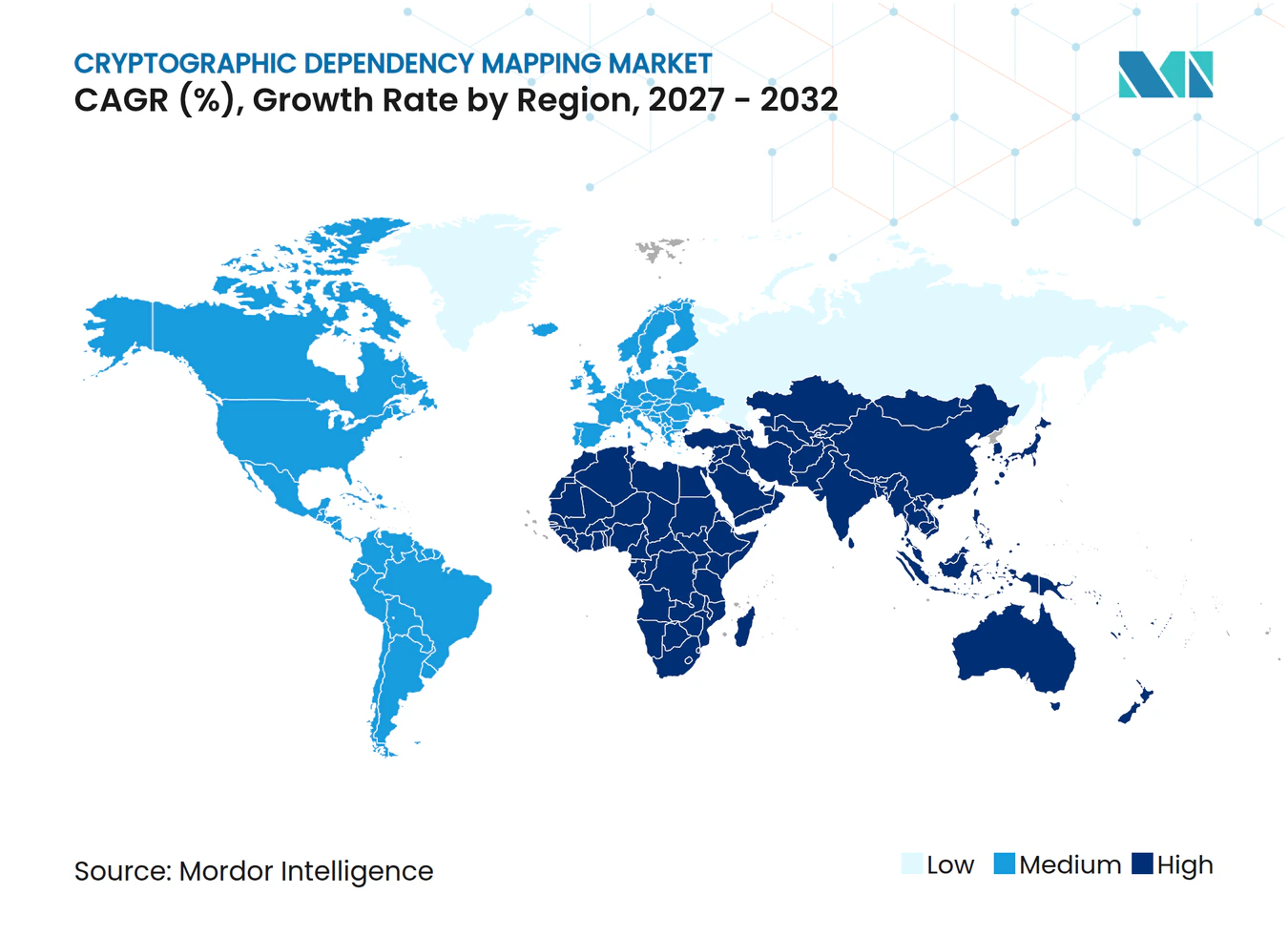
North America held 41.67% of the cryptographic dependency mapping market share in 2026. Federal procurement, early adoption of enterprise technology, and a dense population of post-quantum security vendors support this position. Executive Order 14412 established a December 31, 2030, target for high-value federal key-establishment systems and directed contractor-oriented action through the Federal Acquisition Regulation process. Canada aligns its cybersecurity posture closely with NIST post-quantum standards and NSA guidance through broader Five Eyes coordination. South America remains at an earlier stage, with demand centered on government-linked financial institutions and multinational technology companies in Brazil and Mexico.
Europe and Africa Cryptographic Dependency Mapping Market
Europe has 2 regulatory pathways that increase the importance of asset inventories. The EU Cyber Resilience Act entered into force in December 2024, and its principal obligations apply from December 2027, creating a requirement for machine-readable component records for hardware and software sold in the EU. NIS2 implementing requirements also emphasize documented cryptographic policies and current asset inventory for covered entities. Germany and the United Kingdom are active procurement markets due to financial services, advanced manufacturing, and defense-adjacent sectors, while Africa remains earlier in adoption, led by telecommunications and financial services activity in South Africa and Nigeria. The cryptographic dependency mapping market will depend on the pace of regulation and cybersecurity investment across these countries.
APAC and Middle East Cryptographic Dependency Mapping Market
Asia-Pacific is projected to expand at a CAGR of 26.94% through 2032, the fastest regional rate in the cryptographic dependency mapping market. Japan made quantum-resistant security an immediate policy priority in its 2025 cybersecurity strategy and set a 2035 completion target, while South Korea expanded its post-quantum pilot program to finance and telecommunications, as well as medical, energy, and public administration.[6] India published its quantum-safe ecosystem task-force report in February 2026, setting a CBOM requirement for critical information infrastructure operators and a migration window beginning in 2028. The Middle East, particularly the United Arab Emirates, Saudi Arabia, and Israel, is investing in cryptographic infrastructure through digital sovereignty and national AI programs, and Israel's cybersecurity base gives it a regional role in the development of discovery technology.
Competitive Landscape
Market Concentration
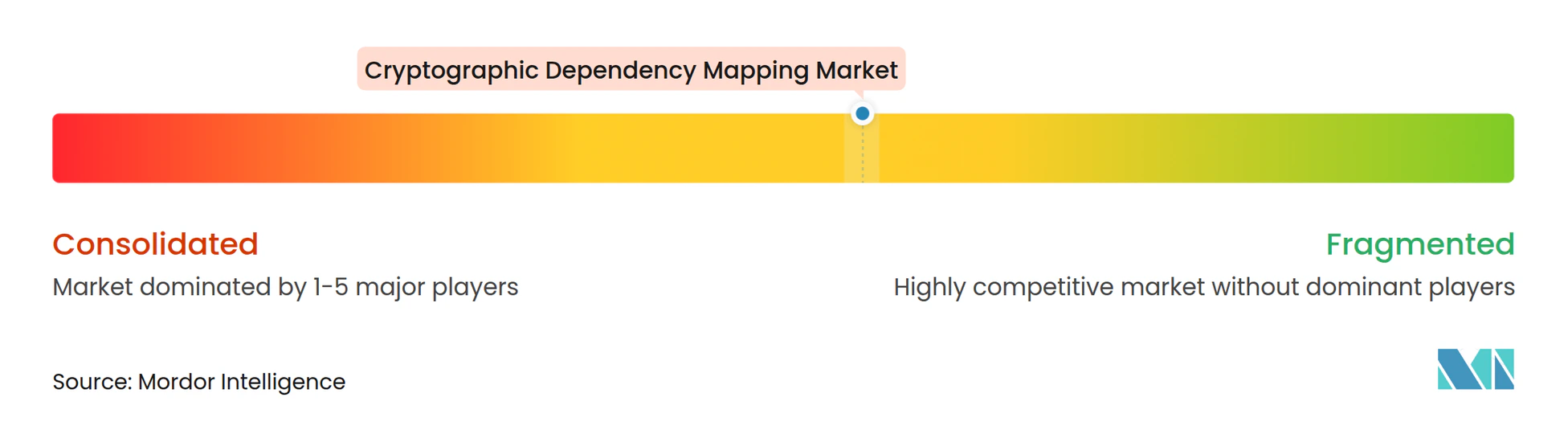
The cryptographic dependency mapping market is moderately concentrated at the platform level and more fragmented among specialists that address individual discovery layers or verticals. Established identity and security providers are using acquisitions to add discovery capability to certificate and key management portfolios. In May 2025, Keyfactor acquired InfoSec Global and CipherInsights, adding capabilities in static code, binary, cloud workload, remediation, and passive network monitoring. In July 2026, Keyfactor received a strategic growth investment exceeding USD 1 billion to support product innovation, geographic expansion, team growth, and acquisitions. These moves show how integrated cryptographic posture management is becoming a central platform strategy, while pure-play vendors must establish scale before larger platforms absorb adjacent capabilities.
IBM has introduced Quantum Safe Explorer to embed automated CBOM creation into CI/CD pipelines and reduce manual inventory work. AppViewX has combined code, dependency, configuration, and certificate scanning with readiness scoring in its post-quantum assessment tool. Quantum-native vendors are differentiating by combining CBOM generation, network telemetry, and automated risk scoring as a dedicated offering. Their approach treats discovery as a primary product rather than an extension of lifecycle management. Competition depends on technical coverage, integration capability, and the ability to turn inventory results into a practical remediation program through partnerships that reach large enterprises and government accounts.
Operational technology and firmware remain a clear area of unmet need because no vendor has established a scalable CBOM method for air-gapped industrial estates, while managed discovery for SMEs needs simpler deployments and lower-cost service models. Multi-cloud CBOM orchestration is also important for organizations that need a vendor-neutral record across 3 or more cloud providers. The PKI Consortium's CBOM Profiles Working Group can reduce concern about proprietary data structures by developing shared profile guidance. Certificate lifetimes moving toward 47 days will reinforce the need for continuing discovery across large certificate estates, and the cryptographic dependency mapping market favors vendors that show consistent coverage across cloud, local, development, and operational environments.
Cryptographic Dependency Mapping Industry Leaders
-
Keyfactor, Inc.
-
DigiCert, Inc.
-
Entrust Corporation
-
IBM Corporation
-
SandboxAQ, Inc.
- *Disclaimer: Major Players sorted in no particular order
Cryptographic Dependency Mapping Market Companies Covered in this Report
- Keyfactor, Inc.
- DigiCert, Inc.
- Entrust Corporation
- IBM Corporation
- SandboxAQ, Inc.
- QuSecure, Inc.
- CryptoNext Security
- InfoSec Global, Inc.
- AppViewX Corporation
- Thales S.A.
- Broadcom Inc.
- Cisco Systems, Inc.
- Cloudflare, Inc.
- Hewlett Packard Enterprise Company
- Microsoft Corporation
- Amazon Web Services, Inc.
- Google LLC
- Palo Alto Networks, Inc.
- Fortinet, Inc.
- PQShield Ltd.
- Utimaco GmbH
- ISARA Corporation
- SafeLogic, Inc.
- QRCS Corporation
- Qubrisk
- Encryption Consulting, LLC
Recent Industry Developments in Cryptographic Dependency Mapping Market
- July 2026: AppViewX released its Summer 2026 platform update, introducing hybrid composite PQC certificates that combine classical RSA or ECC with the ML-DSA post-quantum algorithm in a single certificate, enabling phased quantum-safe migration without a full infrastructure cutover. The release also added the Model Context Protocol (MCP) Server, allowing AI agents to discover, issue, renew, and manage certificates through governed, auditable actions, directly addressing the machine identity security gap created by AI agent proliferation.
- July 2026: Keyfactor received a strategic growth investment of more than USD 1 billion from Summit Partners, with existing investors Insight Partners and Sixth Street Growth retaining significant ownership. The capital is allocated to product innovation, geographic expansion, team growth, and strategic acquisitions, reflecting institutional conviction that trust infrastructure for the AI and quantum era represents a durable, multi-decade enterprise security category.
- June 2026: Executive Order 14412, "Securing the Nation Against Advanced Cryptographic Attacks," was signed, mandating federal agency PQC migration leads, high-value asset migration deadlines, CBOM minimum element publication within 270 days, and FAR amendments requiring contractor PQC compliance by December 31, 2030. The order formalizes cryptographic inventory as a federal compliance output and extends migration obligations into the full defense and civilian contractor base.
- June 2026: The PKI Consortium launched the CBOM Profiles Working Group, chaired by IBM Distinguished Engineer Michael Osborne, with 16 founding members including IBM, AppViewX, eMudhra, and SafeLogic. The group will develop neutral, cross-vendor CBOM profile methodology mapping to SPDX and CycloneDX standards, directly reducing fragmentation that has slowed enterprise CBOM adoption in accounts requiring multi-vendor interoperability.
Global Cryptographic Dependency Mapping Market Report Scope
The cryptographic dependency mapping Market comprises revenue generated from tools and services that identify, visualize, and track relationships between cryptographic assets and the applications, systems, data flows, devices, and third-party components that depend on them. It extends cryptographic inventory by showing where cryptography is used, which business functions rely on it, and which assets would be affected by a change to an algorithm, certificate, key, protocol, or library. Cryptographic Bills of Materials (CBOMs) provide a structured model for cataloging cryptographic assets and their dependencies.
The Cryptographic Dependency Mapping Market Report is Segmented by Cryptographic Asset (Algorithms and Cipher Suites, Keys and Key Stores, Digital Certificates and Certificate Authorities, Cryptographic Libraries and Providers, Protocols and Secure Communication Channels, and Other Cryptographic Assets), Discovery Layer (Source Code and Repositories, Software Dependencies and Packages, Binaries, Containers, and Firmware, Network Traffic and Live TLS Endpoints, Operating Systems, Hosts, and File Systems, and Other Discovery Layer), Deployment Model (Cloud-Based, On-Premises, and Hybrid), Organization Size (Large Enterprises, and Small and Medium-Sized Enterprises), End-User Industry (Banking, Financial Services, and Insurance (BFSI), IT and Telecommunications, Government and Public Administration, Healthcare and Medical Devices, Energy and Utilities, and Other End-User Industries), and Geography (North America, South America, Europe, Asia-Pacific, Middle East, and Africa), The Market Forecasts are Provided in Terms of Value (USD).
Segmentation Overview
| Algorithms and Cipher Suites |
| Keys and Key Stores |
| Digital Certificates and Certificate Authorities |
| Cryptographic Libraries and Providers |
| Protocols and Secure Communication Channels |
| Other Cryptographic Assets |
| Source Code and Repositories |
| Software Dependencies and Packages |
| Binaries, Containers, and Firmware |
| Network Traffic and Live TLS Endpoints |
| Operating Systems, Hosts, and File Systems |
| Other Discovery Layer |
| Cloud-Based |
| On-Premises |
| Hybrid |
| Large Enterprises |
| Small and Medium-Sized Enterprises |
| Banking, Financial Services, and Insurance (BFSI) |
| IT and Telecommunications |
| Government and Public Administration |
| Healthcare and Medical Devices |
| Energy and Utilities |
| Other End-User Industries |
| North America | United States |
| Canada | |
| South America | Brazil |
| Mexico | |
| Rest of South America | |
| Europe | United Kingdom |
| Germany | |
| France | |
| Italy | |
| Spain | |
| Rest of Europe | |
| Asia-Pacific | China |
| Japan | |
| India | |
| South Korea | |
| Rest of Asia-Pacific | |
| Middle East | Israel |
| Saudi Arabia | |
| United Arab Emirates | |
| Rest of Middle East | |
| Africa | South Africa |
| Nigeria | |
| Rest of Africa |
| By Cryptographic Asset | Algorithms and Cipher Suites | |
| Keys and Key Stores | ||
| Digital Certificates and Certificate Authorities | ||
| Cryptographic Libraries and Providers | ||
| Protocols and Secure Communication Channels | ||
| Other Cryptographic Assets | ||
| By Discovery Layer | Source Code and Repositories | |
| Software Dependencies and Packages | ||
| Binaries, Containers, and Firmware | ||
| Network Traffic and Live TLS Endpoints | ||
| Operating Systems, Hosts, and File Systems | ||
| Other Discovery Layer | ||
| By Deployment Model | Cloud-Based | |
| On-Premises | ||
| Hybrid | ||
| By Organization Size | Large Enterprises | |
| Small and Medium-Sized Enterprises | ||
| By End-User Industry | Banking, Financial Services, and Insurance (BFSI) | |
| IT and Telecommunications | ||
| Government and Public Administration | ||
| Healthcare and Medical Devices | ||
| Energy and Utilities | ||
| Other End-User Industries | ||
| By Geography | North America | United States |
| Canada | ||
| South America | Brazil | |
| Mexico | ||
| Rest of South America | ||
| Europe | United Kingdom | |
| Germany | ||
| France | ||
| Italy | ||
| Spain | ||
| Rest of Europe | ||
| Asia-Pacific | China | |
| Japan | ||
| India | ||
| South Korea | ||
| Rest of Asia-Pacific | ||
| Middle East | Israel | |
| Saudi Arabia | ||
| United Arab Emirates | ||
| Rest of Middle East | ||
| Africa | South Africa | |
| Nigeria | ||
| Rest of Africa | ||
Key Questions Answered in the Report
What is the size of the cryptographic dependency mapping market?
The cryptographic dependency mapping market size was valued at USD 0.46 billion in 2026 and is estimated to grow from USD 0.57 billion in 2027 to reach USD 1.56 billion by 2032, at a CAGR of 22.31% during the forecast period (2027-2032).
What is driving demand for cryptographic discovery platforms?
Post-quantum compliance requirements, CBOM adoption, hybrid cloud complexity, and harvest-now, decrypt-later risks are increasing demand for continuing cryptographic inventory.
Which cryptographic assets have the largest revenue share?
Digital certificates and certificate authorities held the largest share at 26.73% in 2026.
Which buyers are adopting cryptographic discovery tools fastest?
SMEs are projected to expand at a CAGR of 25.43%, while government and public administration are projected to expand at a CAGR of 24.61% through 2032.
Which region is expanding fastest for cryptographic asset discovery?
Asia-Pacific is projected to expand at a CAGR of 26.94% through 2032, supported by policy action in Japan, South Korea, and India.
Why are CBOMs important for post-quantum migration?
A CBOM records cryptographic assets and dependencies, helping organizations identify migration scope, prioritize remediation, and produce compliance evidence.