
Cryptographic Identity Management Market Size and Share
Market Overview
| Study Period | 2021 - 2032 |
|---|---|
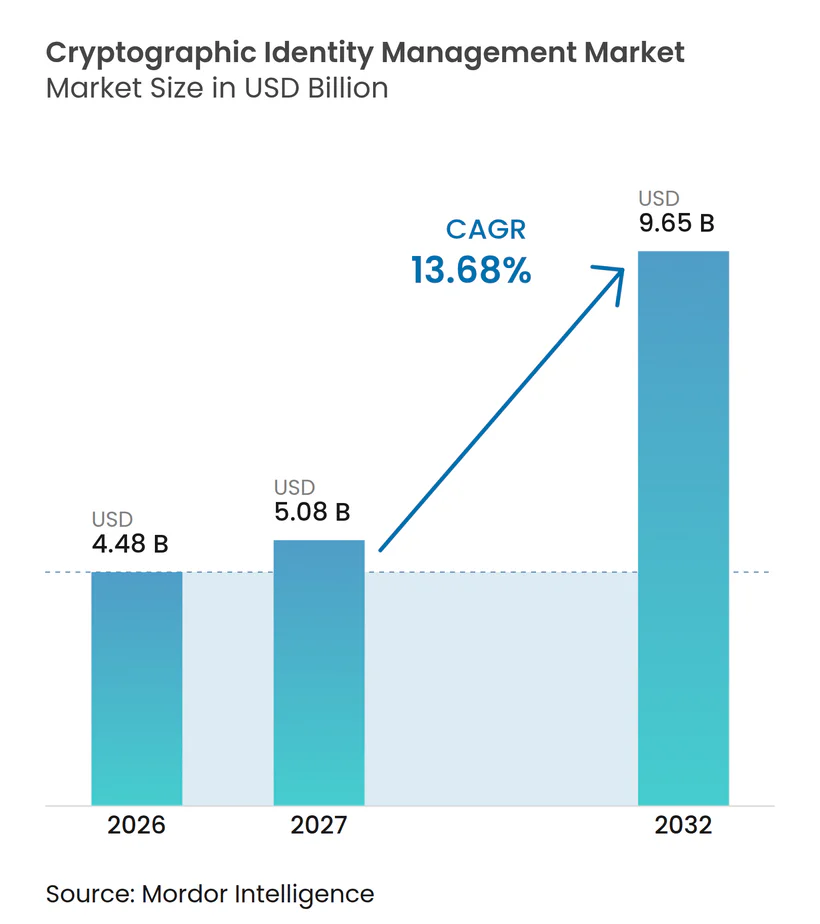
| Market Size (2027) | USD 5.08 Billion |
| Market Size (2032) | USD 9.65 Billion |
| Growth Rate (2027 - 2032) | 13.68 % |
| Fastest Growing Market | Asia-Pacific |
| Largest Market | North America |
| Market Concentration | Medium |
Major Players *Disclaimer: Major Players sorted in no particular order Image © Mordor Intelligence. Reuse requires attribution under CC BY 4.0. | |
Cryptographic Identity Management Market Analysis by Mordor Intelligence
The cryptographic identity management market size is projected to expand from USD 4.48 billion in 2026 and USD 5.09 billion in 2027 to USD 9.65 billion by 2032, registering a CAGR of 13.68% between 2027 to 2032. Shorter TLS certificate validity periods are changing certificate renewal from an occasional task into a continuous operational responsibility. The cryptographic identity management market is therefore moving toward automated certificate lifecycle management, cloud-delivered public key infrastructure, and centralized policy controls. Cloud, IoT, and AI workloads are also increasing the number of non-human identities that organizations must authenticate and govern. This creates opportunities for providers that can connect certificate discovery, issuance, renewal, revocation, and reporting across distributed environments. Competition centers on broader trust platforms, developer integrations, and post-quantum readiness, while a shortage of cryptography skills can delay customer deployments and direct buyers toward managed expertise, migration support, and simpler policy administration for organizations with differing technical maturity in evolving security environments.
Key Report Takeaways
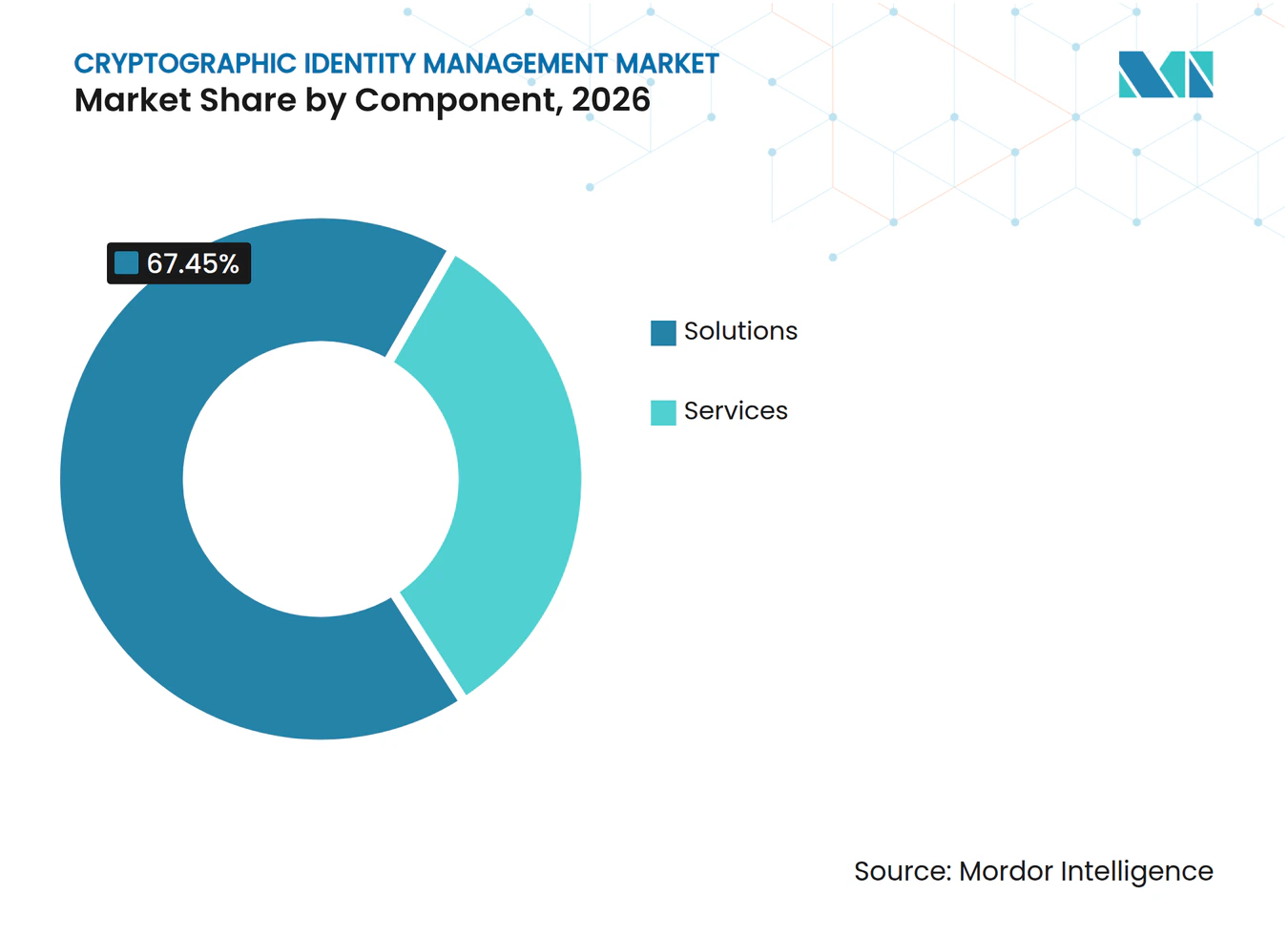
- By component, solutions held 67.45% of the cryptographic identity management market share in 2026, while services continue to support managed PKI, implementation, and post-quantum migration work.
- By deployment mode, cloud-based deployment is projected to expand at a 14.64% CAGR through 2032, while on-premises deployment remains relevant for air-gapped and highly regulated environments.
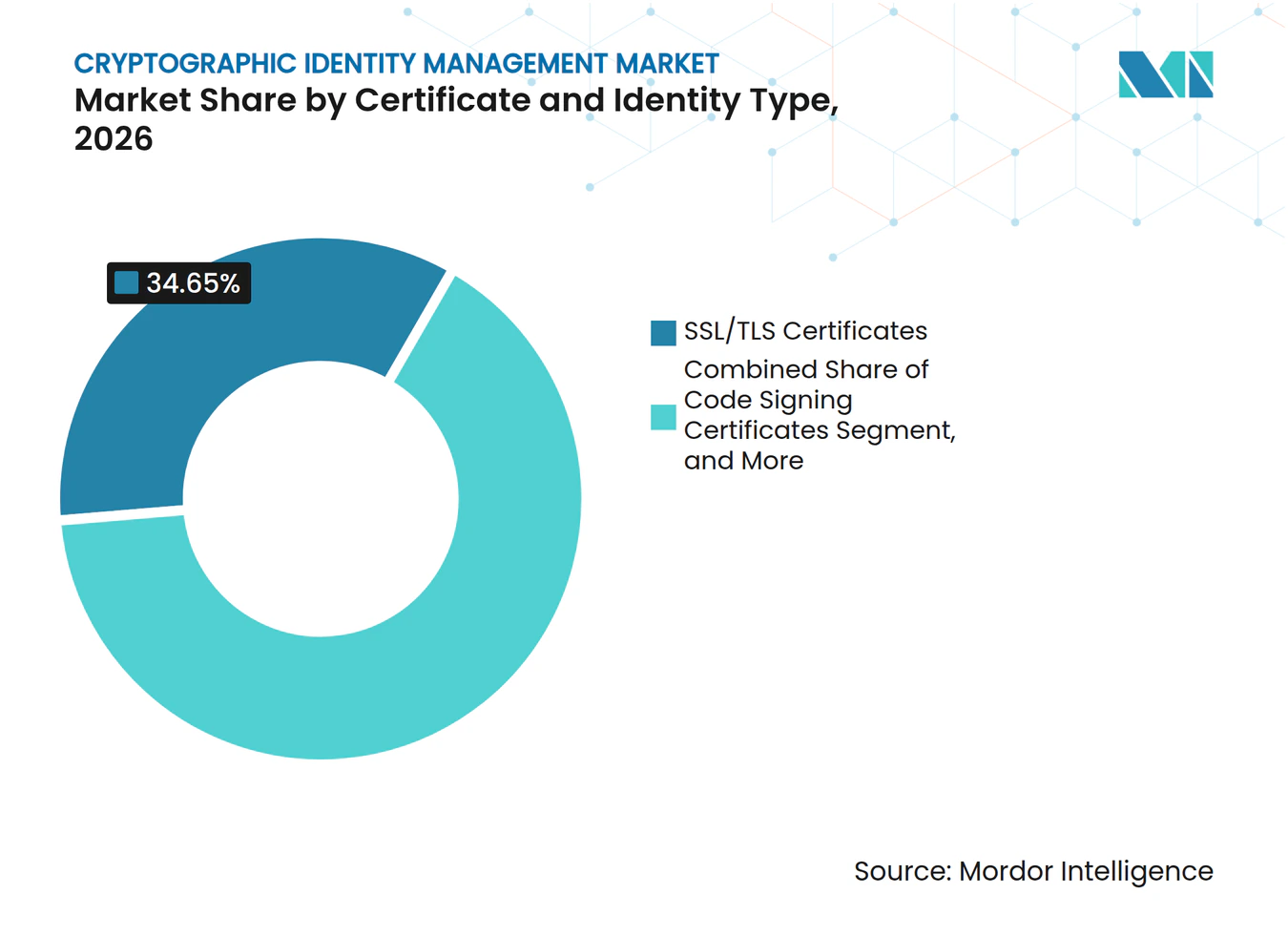
- By certificate and identity type, SSL/TLS certificates held 34.65% of the cryptographic identity management market share in 2026, while workload and machine identity certificates are projected to expand at a 14.28% CAGR through 2032.
- By end user, banking, financial services, and insurance held 24.18% of revenue in 2026, while manufacturing and automotive is projected to expand at a 14.39% CAGR through 2032.
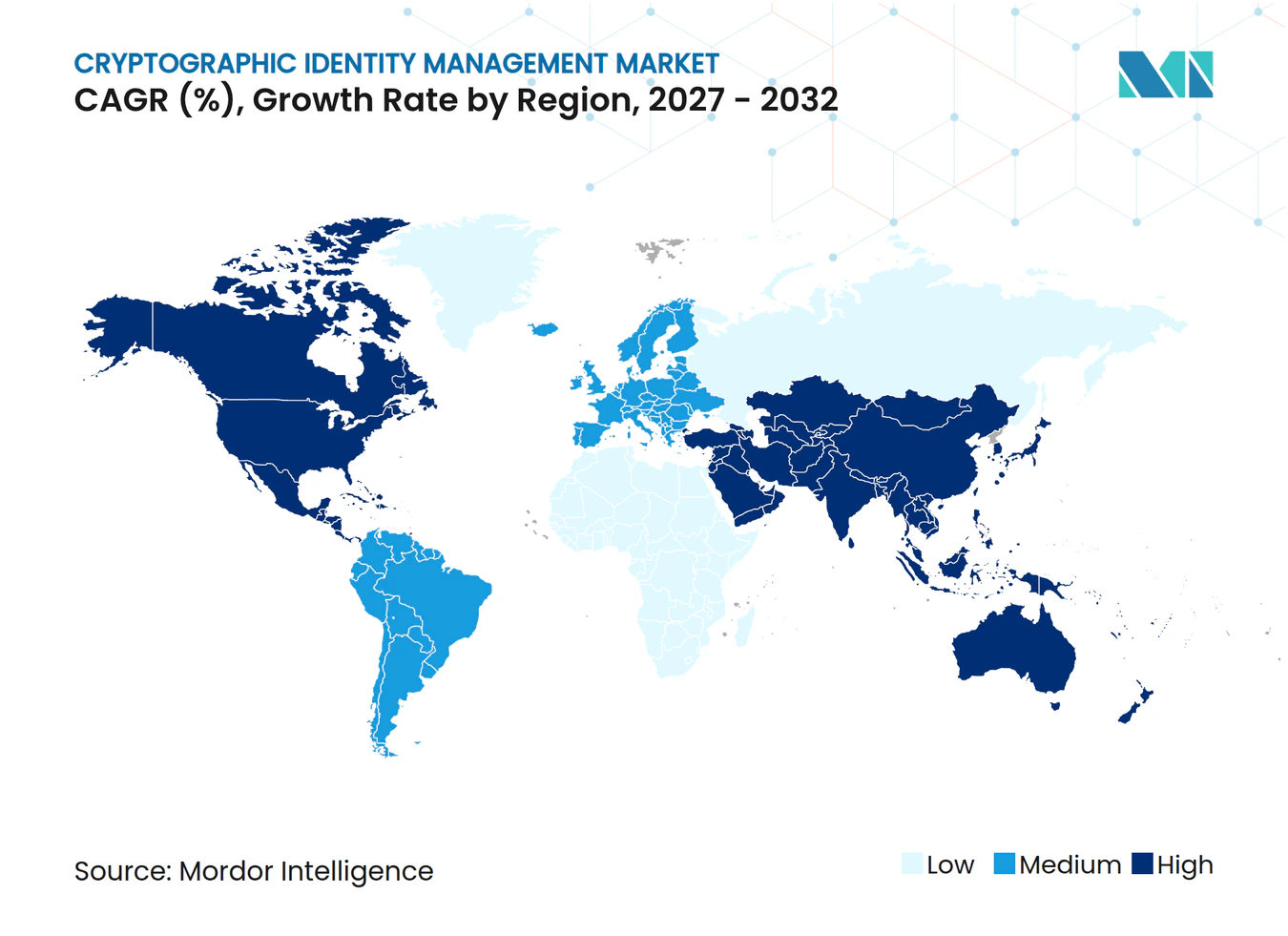
- By geography, North America held 38.02% of revenue in 2026, while Asia-Pacific is projected to expand at a 14.44% CAGR through 2032.
Note: Market numbers in this report are based on Mordor Intelligence's proprietary estimation framework, which combines nine months of actuals with Q4 projections for base year 2026.
Market Trends and Insights
Drivers Impact Analysis of Cryptographic Identity Management Market*
| Driver | (~) % Impact on CAGR Forecast | Geographic Relevance | Impact Timeline |
|---|---|---|---|
| Shortening Certificate Validity Periods | +2.8% | Global, with adoption pressure concentrated in North America and Europe | Short term (≤ 2 years) |
| Accelerating Cloud and Hybrid-Cloud Adoption | +2.4% | Global, with concentrated spending in North America and Asia-Pacific | Medium term (2-4 years) |
| Expansion of Machine, IoT, and Workload Identities | +2.2% | Global, with manufacturing concentration in Asia-Pacific and Europe | Medium term (2-4 years) |
| DevSecOps and API-Driven Certificate Automation | +1.8% | North America and Europe, with Asia-Pacific spillover | Medium term (2-4 years) |
| Post-Quantum Cryptography Readiness Spending | +1.6% | Global, with government leadership in North America, Europe, and the Middle East | Long term (≥ 4 years) |
| Digital Trust Regulation and Supply-Chain Assurance | +1.4% | Europe, North America, and Asia-Pacific national frameworks | Medium term (2-4 years) |
| Source: Mordor Intelligence | |||
Shortening Certificate Validity Periods Forces Automation Investment
The CA/Browser Forum approved Ballot SC-081v3 in April 2025, setting a staged reduction in TLS certificate validity and validation-data reuse periods.[1] Maximum TLS certificate validity fell to 200 days on March 15, 2026, and the schedule calls for 100 days in March 2027 and 47 days in March 2029. The cryptographic identity management market benefits because manual renewal processes become harder to sustain as renewal cycles accelerate. Let’s Encrypt has also stated that it will reduce certificate lifetimes to 45 days in 2028. Domain control validation reuse will shorten alongside certificate validity, reducing the operational buffer that organizations previously used during renewal. Automated issuance and renewal are becoming necessary to protect service availability across large certificate inventories.
Accelerating Cloud and Hybrid-Cloud Adoption Restructures PKI Delivery
Multi-cloud and hybrid-cloud architectures are reducing the relevance of PKI designs built for static data center servers. The cryptographic identity management market is adapting to workloads that operate across cloud providers, containers, and serverless environments. These workloads need credentials that can be issued, rotated, and revoked without waiting for manual administration. DigiCert launched a locally hosted DigiCert ONE service in India in January 2026 to address data sovereignty requirements.[2] Keyfactor made its Command MCP Server available through AWS Marketplace in December 2025, placing certificate lifecycle automation closer to cloud-native development teams. Hybrid arrangements provide a practical transition path because they can retain on-premises trust hierarchies while adding cloud-based orchestration and reporting.
Expansion of Machine, IoT, and Workload Identities Creates a Non-Human Identity Imperative
IBM stated in November 2025 that non-human identities outnumber human identities in enterprise cloud environments by more than 40 to 1. This relationship increases the cryptographic identity management market need for controls that cover devices, workloads, APIs, containers, and AI agents. NIST issued updated guidance on IoT device onboarding and lifecycle credential management in November 2025, reinforcing the need for managed device identities.[3] Workload credentials can expire in minutes or hours, which requires high-volume issuance and revocation rather than annual renewal processes. AppViewX acquired Eos in March 2026 to add an AI-native identity control plane for autonomous workloads. The change broadens the addressable need beyond conventional website certificates and device credentials.
DevSecOps and API-Driven Certificate Automation Embeds Trust in Development Pipelines
Certificate lifecycle management is being integrated into CI/CD pipelines through ACME, Terraform, and Kubernetes cert-manager connections. The cryptographic identity management market now competes in developer workflows as well as in central security operations. DigiCert offers a Trust Lifecycle API, while AppViewX released policy capabilities in November 2025 and Keyfactor expanded automation functions in March 2026. These integrations can reduce delays between application deployment and the issuance of trusted credentials. They also create a need for controls over private key generation and storage, because automated scripts can expose key material through logs or source-control systems. Providers that combine automation with policy enforcement and audit trails can address both speed and governance requirements.
Restraints Impact Analysis of Cryptographic Identity Management Market*
| Restraint | (~) % Impact on CAGR Forecast | Geographic Relevance | Impact Timeline |
|---|---|---|---|
| Shortage of PKI and Cryptography Specialists | -1.8% | Global, most acute in North America and Europe | Short term (≤ 2 years) |
| Legacy PKI Interoperability and Migration Complexity | -1.4% | North America, Europe, and mature Asia-Pacific markets | Medium term (2-4 years) |
| Commoditization and Price Pressure in Basic Certificates | -1.0% | Global, most visible in the domain-validated SSL/TLS segment | Short term (≤ 2 years) |
| Fragmented Ownership of Cryptographic Assets Across Business Units | -0.8% | Global, most pronounced in large enterprises with decentralized IT | Medium term (2-4 years) |
| Source: Mordor Intelligence | |||
Shortage of PKI and Cryptography Specialists Limits Deployment Velocity
ISACA reported in 2025 that 55% of cybersecurity teams were understaffed and 65% had unfilled positions. Sectigo reported that 97% of organizations faced significant post-quantum cryptography skills gaps, and 52% identified cryptography expertise as their most acute deficiency. This shortage can slow the cryptographic identity management market because customers may lack the specialists needed to select, deploy, and govern platforms. Managed PKI services provide an alternative for organizations that cannot hire qualified cryptography architects. ISO 27001 and NIST guidance require documented key-management practices, increasing dependence on vendors that can support implementation and evidence collection. The same gap supports managed service demand but may delay direct software adoption.
Legacy PKI Interoperability and Migration Complexity Delays Modernization
Legacy PKI systems often cannot support automation protocols such as ACME and EST without substantial redesign. The cryptographic identity management market faces extended sales and deployment cycles when customers must move trust anchors and certificate authority hierarchies with limited tolerance for outages. Sectigo completed the migration of more than 500,000 SSL/TLS, S/MIME, and code-signing certificates from Entrust between January and September 2025. Manufacturing and critical infrastructure sites face added constraints because field devices can carry embedded certificates and may not support remote updates. Older systems can also depend on cryptographic algorithms that do not support hybrid post-quantum certificates. These conditions can extend modernization programs for several years even when a vendor supports the migration.
*Our forecasts treat driver/restraint impacts as directional, not additive. The impact forecasts reflect baseline growth, mix effects, and variable interactions.
Cryptographic Identity Management Market Segment Analysis
By Component:
Solutions Lead Platform and Automation InvestmentSolutions held 67.45% of the cryptographic identity management market share in 2026. This position reflects demand for integrated certificate lifecycle management, private certificate authority administration, and cryptographic discovery. The cryptographic identity management market size for software platforms is supported by the operational volume created by shorter certificate lifetimes. Organizations cannot scale renewal activity through professional-services staffing alone. Automated workflows can assign policies, issue credentials, and produce audit records at a much larger volume.
Services still matter for managed PKI, implementation work, and post-quantum migration support. They are especially relevant for mid-sized organizations that lack internal cryptography teams. A Keyfactor-commissioned Total Economic Impact study published in February 2026 reported a 356% return on investment and USD 12.7 million in benefits over 3 years from certificate lifecycle modernization. DigiCert reported record annual recurring revenue for DigiCert ONE in March 2026. These examples support customer preference for broader platforms rather than separate point products.


By Deployment Mode:
Cloud-Based Architecture Displaces On-Premises PKI StacksCloud-based deployment is projected to expand at a 14.64% CAGR from 2027 to 2032. The cryptographic identity management market supports this pattern because cloud platforms can provide elastic issuance capacity and managed certificate authority infrastructure. SaaS-based policy enforcement also makes it easier to administer distributed environments from a central console. On-premises deployment remains necessary in defense, highly regulated organizations, and air-gapped environments. These customers may not be able to connect all certificate systems to an external service.
DigiCert’s locally hosted DigiCert ONE service in India shows how providers can respond to sovereignty requirements without abandoning automation. Hybrid deployment can place a cloud-based lifecycle management layer over existing internal certificate authorities. This arrangement preserves older trust structures while improving visibility, automated renewal, and compliance reporting. Keyfactor positions Command SaaS for self-service setup, simplified configuration, and automated upgrades during such transitions. Auditable issuance trails can also help organizations demonstrate compliance with ISO 27001 requirements.
By Certificate and Identity Type:
SSL/TLS Supports Present Demand While Machine Identity ExpandsSSL/TLS certificates accounted for 34.65% of the cryptographic identity management market share in 2026. They remain essential for websites, API endpoints, load balancers, and other internet-facing infrastructure. The planned move to a 47-day maximum validity period by 2029 will increase the frequency of certificate issuance and renewal. This increases demand for discovery, monitoring, and automation capabilities. It also raises the cost of overlooking expired or misconfigured credentials.
Workload and machine identity certificates are projected to expand at a 14.28% CAGR through 2032. The cryptographic identity management market size for this subsegment is linked to cloud workloads, containers, and AI agents that need short-lived credentials. Code-signing certificates also support software supply-chain security requirements, and DigiCert participated in a NIST-led DevSecOps security initiative in August 2025. S/MIME and email certificates have gained relevance through email authentication and sender verification, supported by DigiCert’s September 2025 acquisition of Valimail. IoT, client-authentication certificates, SSH keys, and secrets management are increasingly handled through unified cryptographic asset platforms.


By End User:
Manufacturing and Automotive Is the Fastest-Expanding VerticalBanking, financial services, and insurance held 24.18% of the market in 2026. The sector’s demand is shaped by DORA, PSD2 technical standards, and NIST digital identity guidance. Financial institutions need evidence that certificate issuance, key management, and access controls meet governance requirements. DigiCert was selected by ASC X9 to provide managed PKI service infrastructure for U.S. financial services, with a key ceremony completed in June 2025. This example shows the need for shared trust infrastructure in regulated financial environments.
Manufacturing and automotive is projected to expand at a 14.39% CAGR through 2032. Connected production systems, electric-vehicle supply chains, and industrial IoT device volumes make manual certificate provisioning impractical. The cryptographic identity management market also serves IT and telecommunications systems that use certificates for 5G network-function authentication. Government and public-sector demand is supported by CMMC Level 2 requirements in the United States and eIDAS 2.0 requirements in Europe. Healthcare and life-sciences organizations need device authentication, while retail and e-commerce organizations need controls that support PCI DSS compliance across payment systems.
Geography Analysis
The Americas Cryptographic Identity Management Market
North America held 38.02% of the market in 2026. The region combines financial-services infrastructure with federal cybersecurity requirements, including CMMC Level 2, NIST key-management guidance, and NSA CNSA 2.0 requirements. Keyfactor achieved CMMC Level 2 certification in January 2026. DigiCert’s selection by ASC X9 for managed PKI infrastructure shows how industry bodies are incorporating cryptographic controls into financial-services trust systems. Canada follows similar certificate lifecycle management patterns, while Brazil supports South American demand through the ICP-Brasil PKI framework and fintech activity.
APAC and MEA Cryptographic Identity Management Market
Asia-Pacific is projected to expand at a 14.44% CAGR through 2032. The region’s cryptographic identity management market size is supported by India’s developing PKI ecosystem, industrial IoT activity in South Korea and Japan, and China’s large digital-infrastructure programs. DigiCert’s locally hosted service in India indicates that regional demand increasingly requires local infrastructure and data-residency support. Sectigo expanded its Asia-Pacific leadership team in July 2025 in preparation for the 47-day TLS certificate transition. The Middle East is supported by Saudi Arabia’s Vision 2030 and updated UAE trust-service-provider guidelines, while South Africa leads early African adoption through banking and Nigeria is building formal PKI infrastructure.
Europe Cryptographic Identity Management Market
Europe is the second-largest regional market in the cryptographic identity management market. eIDAS 2.0 entered full application in 2026 and requires EU member states to offer European Digital Identity Wallets. This rollout requires qualified electronic signatures and certificate issuance at national scale. Germany’s BSI published updated cryptographic requirements for federal government projects in September 2025. BSI also certified the first quantum-safe smartcard under Common Criteria standards in January 2025. NIS2 and DORA requirements continue to support lifecycle-management spending across regulated European enterprises.
Competitive Landscape
Market Concentration
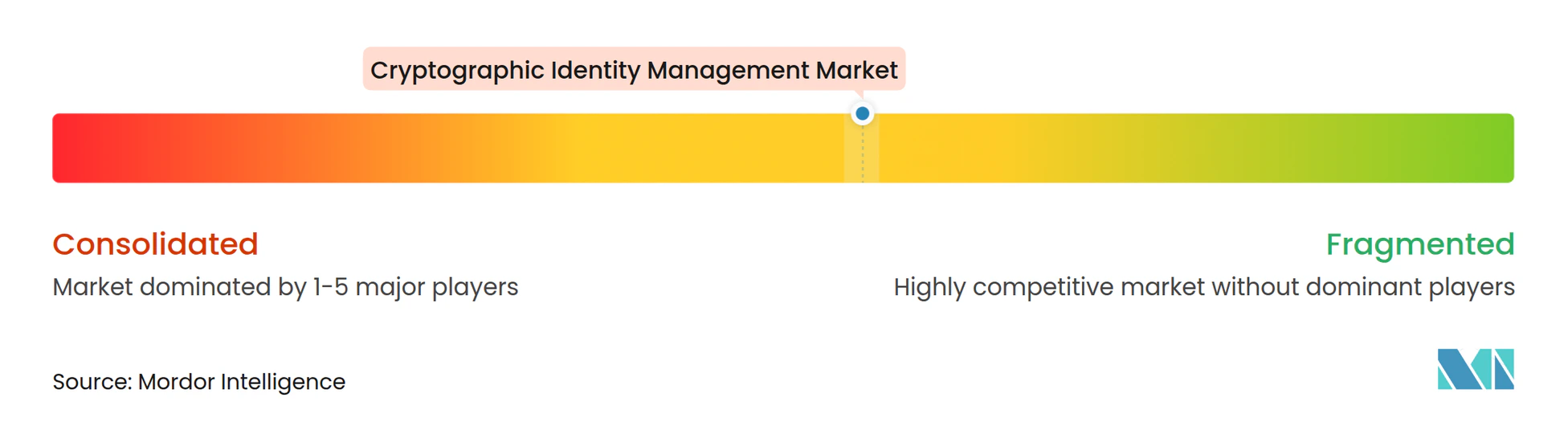
The cryptographic identity management market is moderately consolidated at the platform level. DigiCert, Keyfactor, Sectigo, AppViewX, Entrust, and Garantir are active platform providers in enterprise PKI and certificate lifecycle management. The companies compete through broader trust platforms, machine-identity coverage, and post-quantum readiness. DigiCert combines PKI, certificate lifecycle management, DNS, and email authentication through its DigiCert ONE platform. AppViewX acquired Eos in March 2026, adding an AI-native identity control plane for autonomous workloads. SEALSQ launched a U.S.-based Post-Quantum Root of Trust in November 2025, aligning its QS7001 secure element with NIST standards and CNSA 2.0 requirements.
Keyfactor announced a USD 1 billion-plus strategic growth investment led by Summit Partners in July 2026. The investment supports the cryptographic identity management market focus on AI-driven and post-quantum enterprise environments. Sectigo acquired Entrust’s public certificate business in January 2025, doubling its enterprise operations. eMudhra acquired a 51% stake in CRYPTAS Group, including PrimeSign, in June 2025 to establish a direct position in European qualified trust services. These transactions indicate that scale, regional compliance capability, and established trust relationships are important competitive assets. They also widen the product and regional resources available to buyers that must manage existing certificates while preparing for newer identity types.
A major opportunity is serving mid-sized enterprises that need post-quantum preparedness without dedicated cryptography teams. Regional providers such as eMudhra and InfoCert can compete in compliance-intensive markets through specialized local knowledge. Smallstep Labs and Garantir focus on developer workflows and API simplicity rather than broad certificate-authority portfolios. AI-assisted cryptographic discovery is also becoming a differentiator because it can locate certificates, keys, algorithms, source-code dependencies, containers, and databases. AppViewX’s Quantum Trust Hub and Keyfactor asset-mapping capabilities are positioned for this type of inventory and migration planning. The cryptographic identity management market is therefore likely to reward vendors that can make complex discovery and migration tasks practical for customers with limited specialist resources. Platform buyers also need to assess whether integrations can cover certificate, key, workload, and developer processes without forcing teams to maintain separate policy systems. This requirement favors providers that make operational reporting, policy evidence, role-based controls, and renewal status accessible alongside automated issuance across the full digital estate.
Cryptographic Identity Management Industry Leaders
-
DigiCert, Inc.
-
Sectigo Limited
-
Keyfactor, Inc.
-
GMO GlobalSign Holdings K.K.
-
AppViewX, Inc.
- *Disclaimer: Major Players sorted in no particular order
Cryptographic Identity Management Market Companies Covered in this Report
- DigiCert, Inc.
- Sectigo Limited
- Keyfactor, Inc.
- GMO GlobalSign Holdings K.K.
- AppViewX, Inc.
- Entrust Corporation
- Ascertia Pte. Ltd.
- eMudhra Limited
- SSL.com, Inc.
- HARICA S.A.
- SwissSign AG
- Buypass AS
- PrimeKey Solutions AB
- Smallstep Labs, Inc.
- Axiad IDS, Inc.
- Garantir, Inc.
- Certes Networks, Inc.
- InfoCert S.p.A.
- IdenTrust, Inc.
- Actalis S.p.A.
- WISeKey International Holding AG
- SEALSQ Corp.
Recent Industry Developments in Cryptographic Identity Management Market
- October 2026: DigiCert added Secure Releases to Software Trust Manager, extending cryptographic signing governance into post-release software integrity monitoring across enterprise CI/CD pipelines to manage supply-chain risk before and after deployment.
- September 2026: DigiCert launched AI Trust Manager, enabling enterprises to manage the cryptographic identity and risk posture of AI agents, and separately partnered with Newfold Digital, serving approximately 6 million customers, to modernize SSL/TLS infrastructure for its Network Solutions Group and Bluehost Group brands ahead of the 47-day certificate lifespan mandate.
- August 2026: AppViewX appointed former CyberArk executive Mike Durso as Chief Revenue Officer, scaling commercial execution as the company expanded beyond CLM into AI agent identity security following its acquisition of Eos.
- July 2026: Keyfactor announced a USD 1 billion-plus strategic growth investment led by Summit Partners to expand machine identity infrastructure for AI-driven and post-quantum enterprise environments, the largest single capital commitment in the cryptographic identity management space in the current period.
Global Cryptographic Identity Management Market Report Scope
The Cryptographic Identity Management Market refers to the industry focused on solutions and services that use cryptographic technologies to establish, manage, authenticate, and protect digital identities across enterprises, government organizations, cloud environments, and connected ecosystems.
The Cryptographic Identity Management Market Report is Segmented by Component (Solutions, Services), Deployment Mode (Cloud-Based, On-Premises, Hybrid), Certificate and Identity Type (SSL/TLS Certificates, Code Signing Certificates, S/MIME and Email Certificates, Client Authentication Certificates, IoT and Device Certificates, Workload and Machine Identity Certificates, SSH Keys and Secrets), End User (Banking, Financial Services, and Insurance, IT and Telecommunications, Government and Public Sector, Healthcare and Life Sciences, Manufacturing and Automotive, Retail and E-Commerce, Other End Users), and Geography (North America, Europe, Asia-Pacific, South America, Middle East, Africa). The Market Forecasts are Provided in Terms of Value (USD).
Segmentation Overview
| Solutions |
| Services |
| Cloud-Based |
| On-Premises |
| Hybrid |
| SSL/TLS Certificates |
| Code Signing Certificates |
| S/MIME and Email Certificates |
| Client Authentication Certificates |
| IoT and Device Certificates |
| Workload and Machine Identity Certificates |
| SSH Keys and Secrets |
| Banking, Financial Services, and Insurance |
| IT and Telecommunications |
| Government and Public Sector |
| Healthcare and Life Sciences |
| Manufacturing and Automotive |
| Retail and E-Commerce |
| Other End User |
| North America | United States |
| Canada | |
| Mexico | |
| South America | Brazil |
| Argentina | |
| Rest of South America | |
| Europe | United Kingdom |
| Germany | |
| France | |
| Italy | |
| Spain | |
| Russia | |
| Rest of Europe | |
| Asia-Pacific | China |
| Japan | |
| India | |
| South Korea | |
| Australia | |
| Rest of Asia-Pacific | |
| Middle East | Saudi Arabia |
| United Arab Emirates | |
| Israel | |
| Turkey | |
| Rest of Middle East | |
| Africa | South Africa |
| Nigeria | |
| Rest of Africa |
| By Component | Solutions | |
| Services | ||
| By Deployment Mode | Cloud-Based | |
| On-Premises | ||
| Hybrid | ||
| By Certificate and Identity Type | SSL/TLS Certificates | |
| Code Signing Certificates | ||
| S/MIME and Email Certificates | ||
| Client Authentication Certificates | ||
| IoT and Device Certificates | ||
| Workload and Machine Identity Certificates | ||
| SSH Keys and Secrets | ||
| By End User | Banking, Financial Services, and Insurance | |
| IT and Telecommunications | ||
| Government and Public Sector | ||
| Healthcare and Life Sciences | ||
| Manufacturing and Automotive | ||
| Retail and E-Commerce | ||
| Other End User | ||
| By Geography | North America | United States |
| Canada | ||
| Mexico | ||
| South America | Brazil | |
| Argentina | ||
| Rest of South America | ||
| Europe | United Kingdom | |
| Germany | ||
| France | ||
| Italy | ||
| Spain | ||
| Russia | ||
| Rest of Europe | ||
| Asia-Pacific | China | |
| Japan | ||
| India | ||
| South Korea | ||
| Australia | ||
| Rest of Asia-Pacific | ||
| Middle East | Saudi Arabia | |
| United Arab Emirates | ||
| Israel | ||
| Turkey | ||
| Rest of Middle East | ||
| Africa | South Africa | |
| Nigeria | ||
| Rest of Africa | ||
Key Questions Answered in the Report
What is the size of the cryptographic identity management market?
The market is projected at USD 5.09 billion in 2027 and is forecast to reach USD 9.65 billion by 2032, at a 13.68% CAGR.
Why are TLS certificate validity changes important for enterprises?
The maximum TLS certificate validity is scheduled to decline to 100 days in 2027 and 47 days in 2029, increasing the need for automated issuance and renewal.
Which deployment model is expanding fastest?
Cloud-based deployment is projected to expand at a 14.64% CAGR through 2032 because enterprises need scalable issuance and centralized policy enforcement.
Which certificate category is expanding fastest?
Workload and machine identity certificates are projected to expand at a 14.28% CAGR through 2032, supported by cloud workloads, containers, and AI agents.
Which end-user sector will expand fastest?
Manufacturing and automotive is projected to expand at a 14.39% CAGR through 2032, supported by connected production systems and industrial IoT devices.
Which region will expand fastest through 2032?
Asia-Pacific is projected to expand at a 14.44% CAGR through 2032, led by PKI demand in India, industrial IoT activity, and digital-infrastructure programs.