
Cryptographic Posture Management Market Size and Share
Market Overview
| Study Period | 2021 - 2032 |
|---|---|
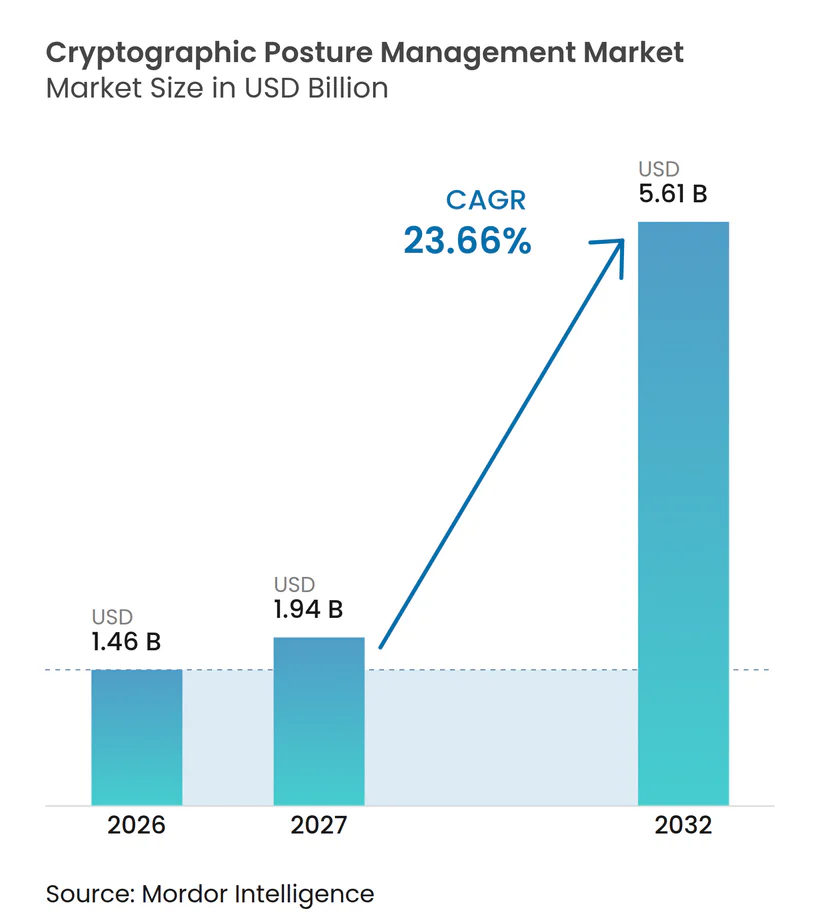
| Market Size (2027) | USD 1.94 Billion |
| Market Size (2032) | USD 5.61 Billion |
| Growth Rate (2027 - 2032) | 23.66 % |
| Fastest Growing Market | Asia-Pacific |
| Largest Market | North America |
| Market Concentration | Medium |
Major Players *Disclaimer: Major Players sorted in no particular order Image © Mordor Intelligence. Reuse requires attribution under CC BY 4.0. | |
Cryptographic Posture Management Market Analysis by Mordor Intelligence
The cryptographic posture management market size is projected to expand from USD 1.46 billion in 2026 and USD 1.94 billion in 2027 to USD 5.61 billion by 2032, registering a CAGR of 23.66% between 2027 and 2032. The Cryptographic posture management market is moving from periodic security reviews toward continuous inventory, lifecycle control, and audit reporting. Regulatory requirements are making cryptographic visibility a recurring operating need for regulated organizations. Post-quantum migration is also bringing algorithm inventories, key records, and certificate records into the same governance program. Vendors are responding with broader platforms that connect discovery, certificate automation, machine identity controls, and readiness planning. This favors providers that can support cloud, on-premises, and hybrid estates without disrupting existing security operations.
Key Report Takeaways
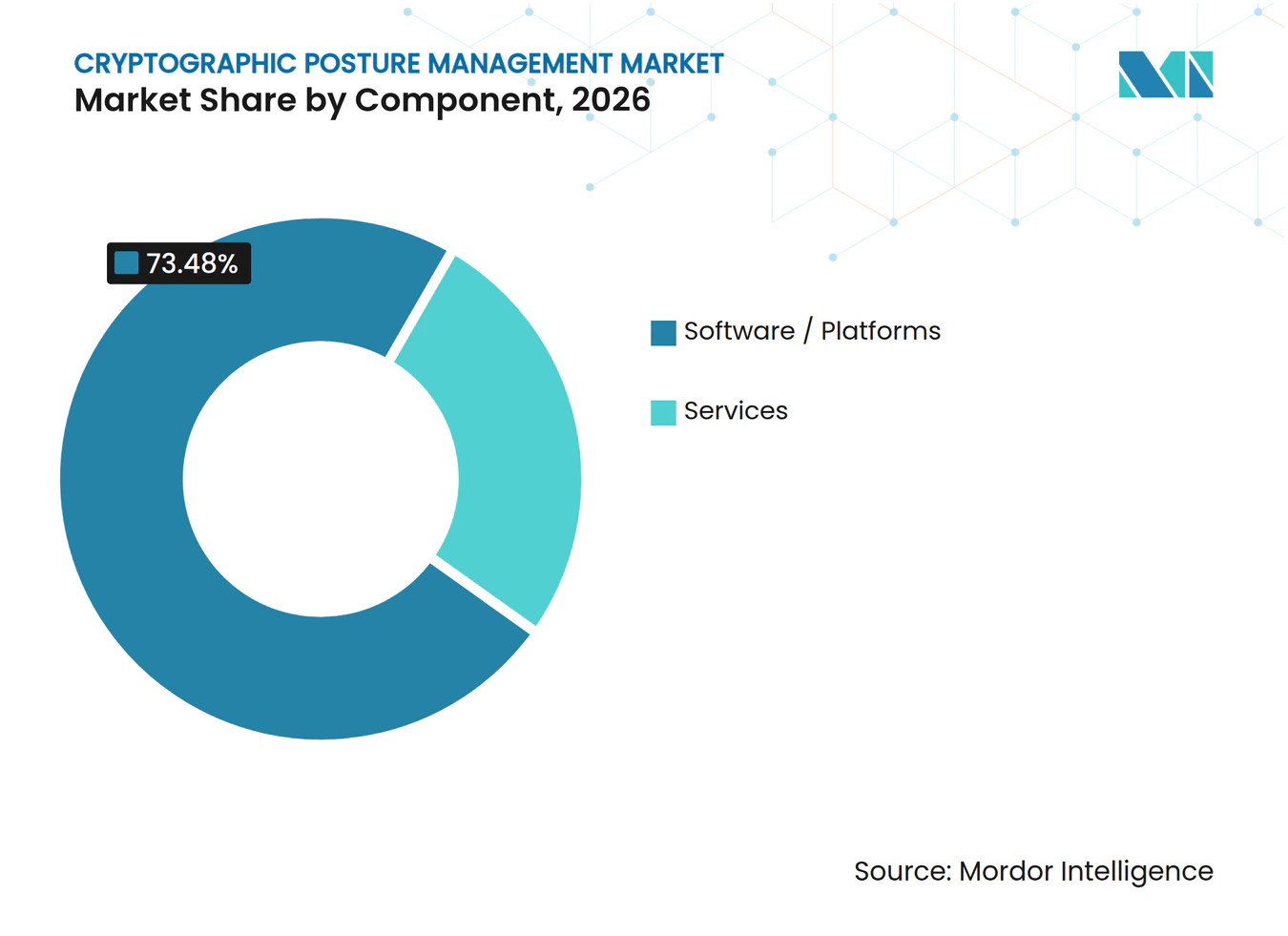
- By component, software and platforms held 73.48% of the cryptographic posture management market share in 2026, while services are projected to expand at a 25.62% CAGR through 2032.
- By deployment model, cloud-based deployment held 63.89% revenue share in 2026 and is projected to expand at a 24.68% CAGR through 2032.
- By cryptographic asset type, certificates and certificate authorities accounted for 28.82% of revenue in 2026 in the cryptographic posture management market, while algorithms and libraries are projected to advance at a 26.73% CAGR through 2032.
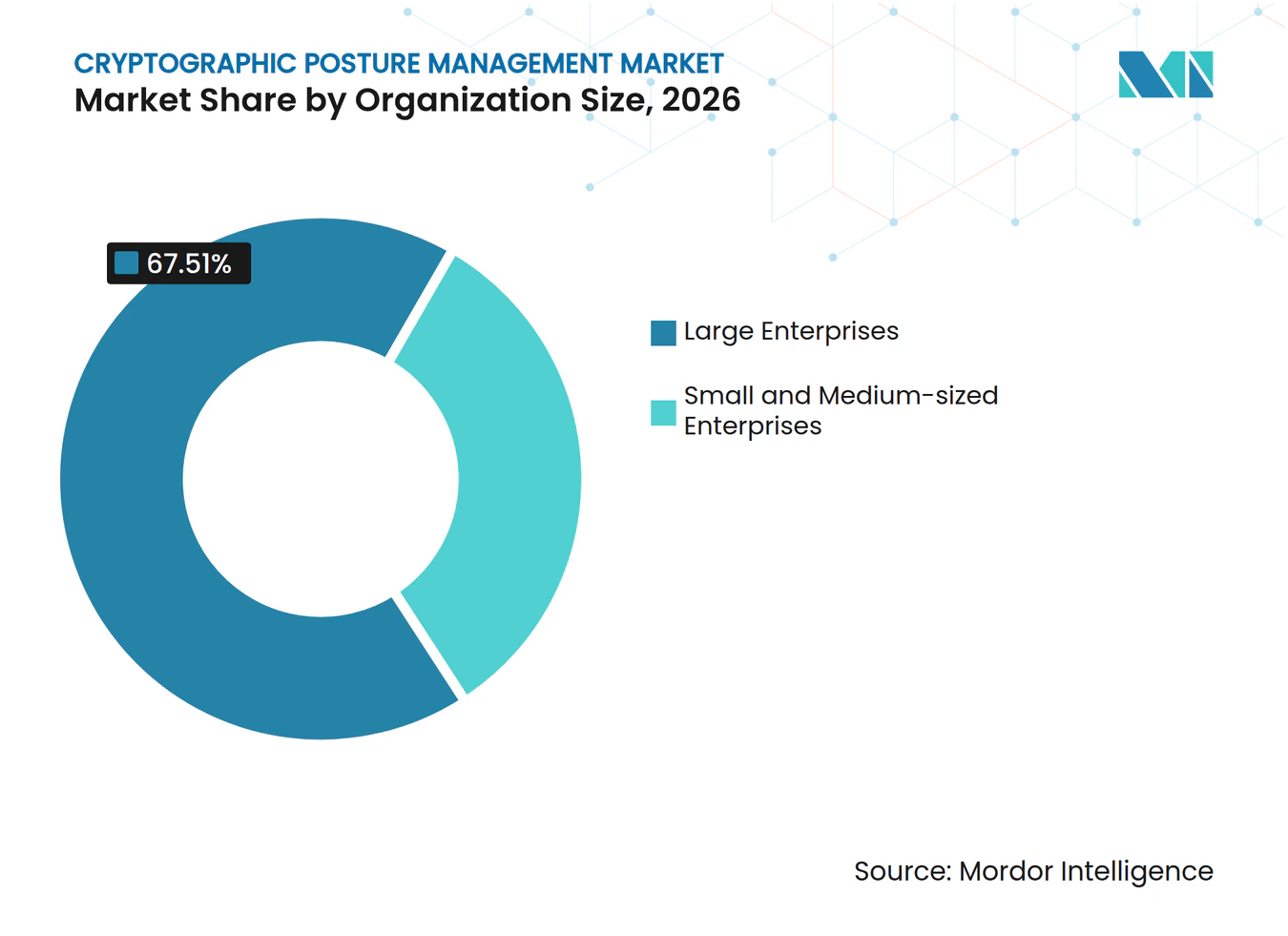
- By organization size, large enterprises held 67.51% revenue share in 2026, while small and medium-sized enterprises are projected to expand at a 25.94% CAGR through 2032.
- By end-user industry, BFSI held 34.28% revenue share in 2026 in the cryptographic posture management market, while government and defense are projected to advance at a 26.11% CAGR through 2032.
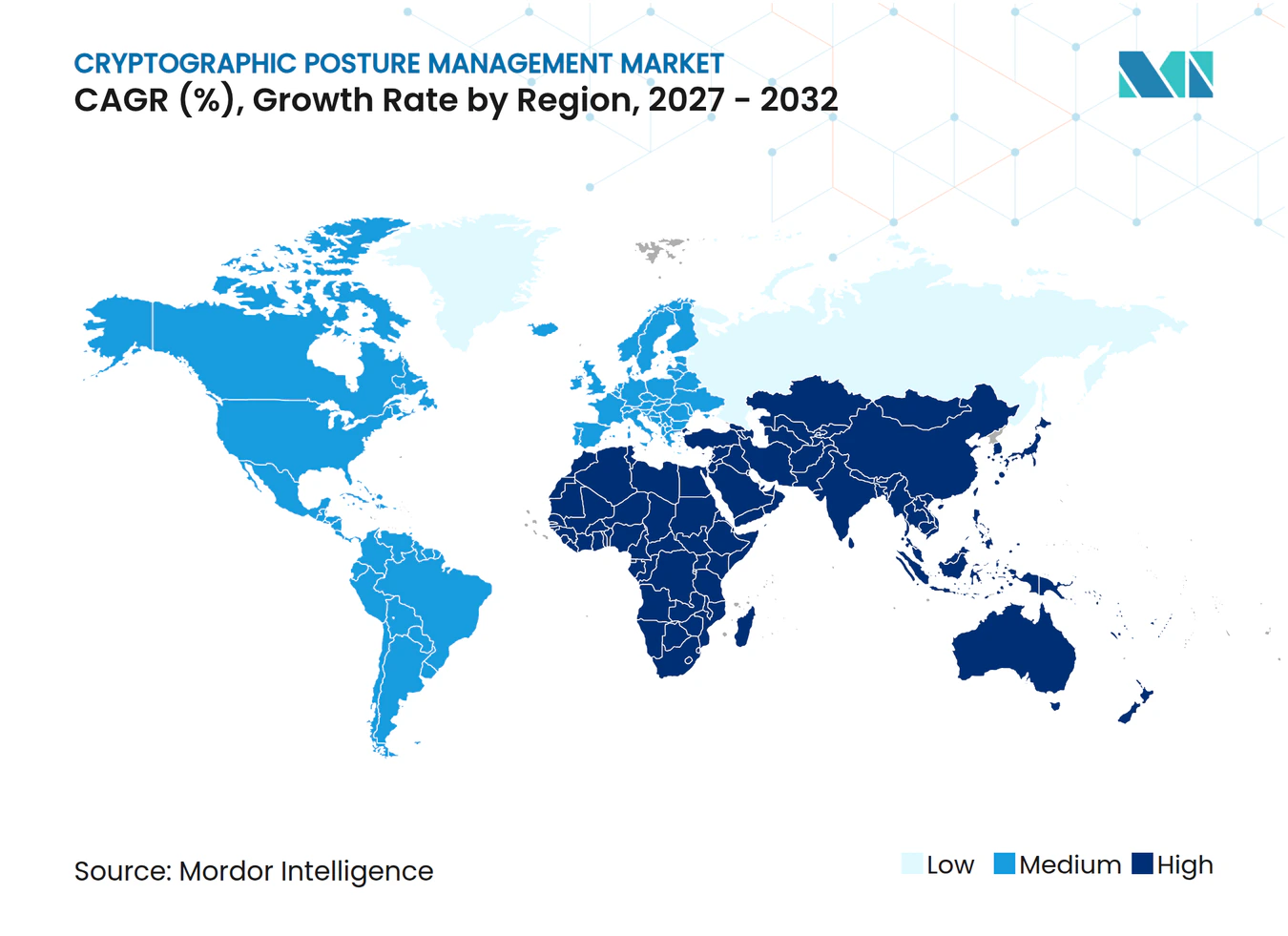
- By geography, North America held 41.67% revenue share in 2026, while Asia-Pacific is projected to expand at a 27.32% CAGR through 2032, giving the cryptographic posture management market its fastest geographic expansion rate.
Note: Market numbers in this report are based on Mordor Intelligence's proprietary estimation framework, which combines nine months of actuals with Q4 projections for base year 2026.
Market Trends and Insights
Drivers Impact Analysis of Cryptographic Posture Management Market*
| Driver | (~) % Impact on CAGR Forecast | Geographic Relevance | Impact Timeline |
|---|---|---|---|
| Regulatory Enforcement of Cryptographic Inventory and Governance | +4.5% | Global, with early gains in North America and Europe | Short term (≤ 2 years) |
| Accelerating Post-Quantum Cryptography Migration Timelines | +5.0% | Global, concentrated in North America and Europe | Medium term (2-4 years) |
| Rising Machine Identity and Certificate Volumes | +4.5% | Global | Short term (≤ 2 years) |
| Cloud, Hybrid Infrastructure, and Software Supply-Chain Complexity | +3.5% | Global, concentrated in North America and Asia-Pacific | Medium term (2-4 years) |
| Cryptographic Visibility Requirements for Audit and Operational Resilience | +2.5% | North America and Europe, with spillover to the Middle East | Short term (≤ 2 years) |
| Expansion of Crypto-Agility Requirements Across Legacy Estates | +2.0% | Global, with early gains in Asia-Pacific core markets | Long term (≥ 4 years) |
| Source: Mordor Intelligence | |||
Regulatory Enforcement of Cryptographic Inventory and Governance
Regulatory requirements are moving cryptographic inventory from a voluntary practice to an accountable control, which brings security records into routine audit, risk, and technology governance processes rather than leaving them with isolated technical teams. DORA Article 9 has applied to European financial entities since January 2025 and requires them to manage ICT-related risks, including security controls that support reliable digital operations. Germany's BSI includes cryptographic requirements in its IT-Grundschutz framework, providing critical infrastructure operators with a structured basis for security documentation and control design. Microsoft stated in April 2026 that inventory work begins by defining ownership, locating cryptographic assets, and maintaining the findings as systems change.[1] These requirements make annual assessments less adequate where certificates, keys, and algorithms change frequently. The Cryptographic posture management market, therefore, benefits when compliance teams need evidence that can be refreshed, assigned, and reviewed through normal operations.
Accelerating Post-Quantum Cryptography Migration Timelines
Post-quantum planning has reduced the time available for agencies and suppliers to understand their cryptographic dependencies, including certificates, libraries, key stores, and application interfaces that must be assessed before a transition can begin. The US National Institute of Standards and Technology released its first finalized post-quantum cryptography standards in 2024, providing a common technical base for migration planning.[2] The National Security Agency's CNSA 2.0 guidance sets expectations for post-quantum algorithms for National Security Systems and directs organizations to prepare for the transition. The White House also set federal migration expectations through Executive Order 14412 and related implementation direction in June 2026. These actions bring procurement teams, PKI teams, and application owners into the same preparation cycle. The Cryptographic posture management market is gaining relevance because discovery and classification must precede any organized algorithm replacement, allowing organizations to distinguish systems that can be upgraded directly from those that require compensating controls or longer replacement plans.
Rising Machine Identity and Certificate Volumes
Machine identities are increasing as organizations add cloud workloads, application programming interfaces, devices, and automated services, and each identity can require certificates, keys, access settings, and a clearly assigned owner to remain secure through its lifecycle. CyberArk reported in 2025 that organizations face operational exposure from the rising number of machine identities and from gaps in their management. The CA/Browser Forum adopted a staged reduction in public TLS certificate validity periods, which increases the frequency of issuance and renewal activities. Shorter lifetimes make manual tracking more difficult across large certificate estates. Certificate-related interruption risk also gives operational teams a reason to integrate ownership, renewal, and exception processes. The Cryptographic posture management market is supported by this shift because certificate lifecycle management becomes a continuing control rather than an occasional administrative task, with issuance, renewal, revocation, and exception handling requiring reliable automation and visible accountability.
Cloud, Hybrid Infrastructure, and Software Supply-Chain Complexity
Organizations often operate cloud services alongside on-premises systems, containers, devices, and third-party applications, which means that a single business service may depend on several separate key stores, certificate authorities, and cryptographic libraries. The Cloud Security Alliance has documented the need for consistent key management practices across multiple cloud environments. Each environment can use different key stores, access models, rotation processes, and hardware validation requirements. This creates a fragmented view of where cryptographic material resides and who controls it. Supply-chain dependencies add another layer because libraries and software development kits can introduce cryptographic functions outside the direct application code. The Cryptographic posture management market is positioned to address this complexity through centralized discovery, policy mapping, and reporting across varied environments, helping teams compare cryptographic controls across workloads without treating cloud and internal systems as disconnected programs.
Restraints Impact Analysis of Cryptographic Posture Management Market*
| Restraint | (~) % Impact on CAGR Forecast | Geographic Relevance | Impact Timeline |
|---|---|---|---|
| Fragmented Ownership of Cryptographic Assets | -2.0% | Global | Short term (≤ 2 years) |
| Legacy Application Dependencies and Remediation Risk | -1.5% | Global, concentrated in North America and Europe | Long term (≥ 4 years) |
| Shortage of Cryptography and PKI Engineering Talent | -1.0% | Global | Medium term (2-4 years) |
| Weak Interoperability Across Discovery, HSM, Cloud, and DevSecOps Tools | -0.8% | Global | Medium term (2-4 years) |
| Source: Mordor Intelligence | |||
Fragmented Ownership of Cryptographic Assets
Cryptographic assets are frequently divided among security, infrastructure, development, and supplier-management teams, and those groups often work to different funding cycles, operating goals, and application release schedules. Microsoft identifies governance and clear ownership as early requirements for any cryptographic inventory program. A certificate can be issued by a central security team while its business owner sits in an application unit and its underlying service runs in a separate cloud operations group. This division makes it difficult to approve remediation, allocate funds, and measure completion. Organizations may buy discovery tools before they have resolved who can act on the results. This can lengthen procurement and deployment cycles in the cryptographic posture management market because a platform cannot deliver its intended result until responsible teams agree on ownership, decision rights, and remediation priorities.
Legacy Application Dependencies and Remediation Risk
Legacy systems can contain hard-coded algorithms, unsupported software, proprietary integrations, and hardware limits that complicate cryptographic change, especially where a business-critical service was designed before current inventory, crypto-agility, and automated renewal practices became standard expectations. The UK National Cyber Security Center advises organizations to begin migration preparation early and sets a phased approach that starts with discovery and planning.[3] Research published through the IACR ePrint Archive in 2026 also identified software age, vendor dependence, and certification conditions as significant constraints on the post-quantum transition. Some systems may require isolation, proxy controls, or replacement rather than a direct algorithm update. These complications slow the conversion of inventory findings into completed remediation because application owners must test changes, maintain continuity of service, and sometimes coordinate with vendors that control a necessary component. The cryptographic posture management market can still benefit from visibility demand, but revenue realization may take longer in complex legacy estates where a complete inventory identifies risks that cannot be eliminated through a simple software update.
*Our forecasts treat driver/restraint impacts as directional, not additive. The impact forecasts reflect baseline growth, mix effects, and variable interactions.
Cryptographic Posture Management Market Segment Analysis
By Component:
Software Platforms Lead as Governance Replaces Point SolutionsSoftware and platforms accounted for 73.48% of the cryptographic posture management market revenue in 2026, and the cryptographic posture management market depends on such platforms for a unified operational record. This position reflects demand for tools that combine discovery, inventory, lifecycle automation, readiness assessment, and audit reporting, and enterprise buyers generally prefer a common record of certificates, keys, algorithms, and related ownership data. A unified platform can also help security teams identify the same asset across operational, compliance, and migration workflows. Keyfactor, DigiCert, and Entrust were identified as leading enterprise PKI providers in the supplied competitive ranking, although vendor ranking claims are not used as a source basis here. The larger software role also reflects the need to apply controls consistently across changing asset volumes.
Services are projected to expand at a 25.62% CAGR through 2032. Organizations without specialized PKI or cryptography staff use service providers for discovery, policy design, lifecycle operations, and migration planning. Managed support becomes more relevant when shorter certificate validity periods require ongoing operational attention, and the services offered can also help customers translate inventory findings into work plans for application and infrastructure teams. IBM Consulting and Keyfactor launched a joint solution in January 2026 that combined cryptographic discovery, PKI, certificate lifecycle management, and quantum-safe transformation support.[4] The Cryptographic asset management industry therefore includes both recurring software controls and specialist support needed to put those controls into use.


By Deployment Model:
Cloud-Based Delivery Combines Scale and MomentumCloud-based deployment accounted for 63.89% of global revenue in 2026 and is projected to grow at a 24.68% CAGR through 2032. Cloud delivery aligns with organizations that want to deploy certificate and key governance without operating additional on-premises management infrastructure, while native services such as AWS Key Management Service, Azure Key Vault, and Google Cloud HSM also connect cryptographic controls to broader cloud workloads. This connection can simplify integration for teams building applications on those platforms. Cloud delivery is particularly useful for smaller organizations that need automated management but have limited specialist infrastructure. It also makes centralized reporting easier, where workloads are distributed across business units.
Hybrid and air-gapped environments retain importance for regulated, defense, and high-security workloads. Large organizations may keep sensitive keys, certificate authorities, or hardware security modules within controlled facilities while using cloud services for other functions. Microsoft announced external key management capabilities for Azure Managed HSM that are intended to address customer control and sovereignty requirements. The supplied HID Global survey finding that large organizations often use hybrid PKI is directionally consistent with this operational need, but it is not relied upon for additional statistics. The cryptographic posture management market must therefore support a combination of cloud-native interfaces and isolated environments. Providers that handle policy consistency across both settings can serve a broader range of security architectures.
By Cryptographic Asset Type:
Certificates Lead While Algorithm Governance AcceleratesCertificates and certificate authorities accounted for 28.82% of revenue in 2026, the largest share among cryptographic asset types, and the cryptographic posture management market relies on consistent lifecycle control. Public TLS certificates, internal certificates, and certificate authority records are widely used across websites, applications, devices, and business services, while the CA/Browser Forum validity schedule places greater emphasis on automation because renewal will recur more frequently. Certificates are also visible to operational teams because an expired certificate can interrupt a digital service. This makes certificate inventory a practical entry point for many governance programs. The cryptographic posture management market has consequently developed around lifecycle management capabilities before expanding into related controls.
Algorithms and libraries are projected to expand at a 26.73% CAGR through 2032. Post-quantum planning requires organizations to find where encryption, signatures, and key establishment functions are embedded before selecting replacement methods. NIST's finalized standards give organizations a reference point for evaluating future cryptographic changes. Keys and secrets remain important because they support application access, data protection, and automated workflows, while hardware security modules and trusted hardware also remain relevant where validated or protected key storage is required. Embedded and application cryptography can be harder to remediate because device firmware and software dependencies may have long replacement cycles. These conditions give algorithm discovery and crypto-agility functions a larger role in the cryptographic posture management market.
By Organization Size:
Large Enterprises Anchor Spending While SMEs Increase AdoptionLarge enterprises held 67.51% of revenue in 2026, and the cryptographic posture management market benefits from their need to coordinate large, decentralized estates. They manage broad application portfolios, high volumes of certificates, multiple cloud environments, and formal compliance programs. Their scale makes manual inventory practices less reliable, especially when many teams can create or manage cryptographic assets, and large organizations also face greater exposure to sector-specific requirements and supplier reviews. This supports investment in platforms that establish a single view of ownership, lifecycle status, and policy compliance. Their spending typically includes implementation and integration work in addition to software subscriptions.
Small and medium-sized enterprises are projected to expand at a 25.94% CAGR through 2032. SaaS-based certificate lifecycle management and PKI services lower the need for dedicated infrastructure and can make automation available to smaller teams. European requirements under NIS2 bring more essential and important entities into a structured cybersecurity framework. Managed service providers can package setup, monitoring, renewal, and support for customers that do not maintain internal cryptography teams, which expands the set of organizations able to adopt formal controls. The Cryptographic asset management industry can reach this group when products are simple to deploy and are supported by clear operational guidance.

By End-User Industry:
BFSI Leads While Government and Defense Advance FastestBFSI held 34.28% revenue share in 2026, making it a central customer group in the cryptographic posture management market. Banks, insurers, payment providers, and related organizations protect sensitive data, maintain long-lived customer relationships, and operate systems that require high availability, while DORA applies to financial entities in the European Union and strengthens the focus on ICT risk management and operational resilience. PCI DSS v4.0 adds requirements relevant to organizations that protect payment account data. These overlapping obligations make recurring cryptographic governance relevant to security, audit, and technology teams. BFSI buyers also need controls that can operate across older core platforms and newer digital banking services.
The government and defense industry is projected to advance at a 26.11% CAGR through 2032. Federal migration planning, national security guidance, and procurement requirements have made post-quantum readiness a high priority for these organizations. The NSA states that its post-quantum guidance is intended to protect National Security Systems against future quantum computing threats. Healthcare and life sciences also need to protect sensitive records that may require extended retention periods, while IT and telecommunications, energy and utilities, and manufacturing and automotive face their own exposures through connected systems, infrastructure, and device fleets. The cryptographic posture management market serves these sectors when it links technical inventory information with the operational responsibilities of each environment.
Geography Analysis
North America Cryptographic Posture Management Market
North America accounted for 41.67% of global revenue in 2026, the largest geographic share of the cryptographic posture management market. US federal policy is creating a clear demand signal for organizations that must prepare for the post-quantum transition. Executive Order 14412 directed agencies to strengthen preparation for advanced cryptographic attacks and to address risks posed by cryptographically relevant quantum computers.[5] Related OMB direction requires federal agencies to organize the migration process. This affects agencies, contractors, and critical infrastructure suppliers that need records of the cryptography embedded in their systems.
Europe and South America Cryptographic Posture Management Market
Europe has a prescriptive regulatory setting for financial entities, essential services, and data controllers. DORA, NIS2, and encryption-related security duties can overlap for organizations with complex technology estates. Germany's IT-Grundschutz framework provides a national reference for documenting and managing security controls. The UK National Cyber Security Center has set a phased approach for post-quantum preparation that begins with discovery and planning. South America has emerging demand in Brazil and Mexico as digital financial services and security governance mature.
APAC and MEA Cryptographic Posture Management Market
Asia-Pacific is projected to expand at a 27.32% CAGR through 2032, giving the cryptographic posture management market its fastest geographic expansion rate. Japan's Information-technology Promotion Agency updated its Cryptographic Key Management Guideline in April 2026, reflecting formal attention to key management practices. NTT DATA announced a quantum-safe key management service in 2026, showing local vendor activity around data sovereignty and future security requirements. India's regulated entities are also increasing their focus on cyber resilience and inventory practices. China, South Korea, and Singapore contribute through digital infrastructure, PKI use, and maturing security expectations. The Middle East benefits from digital-government programs, while Africa remains a smaller contributor led by improving cybersecurity standards in South Africa.
Competitive Landscape
Market Concentration
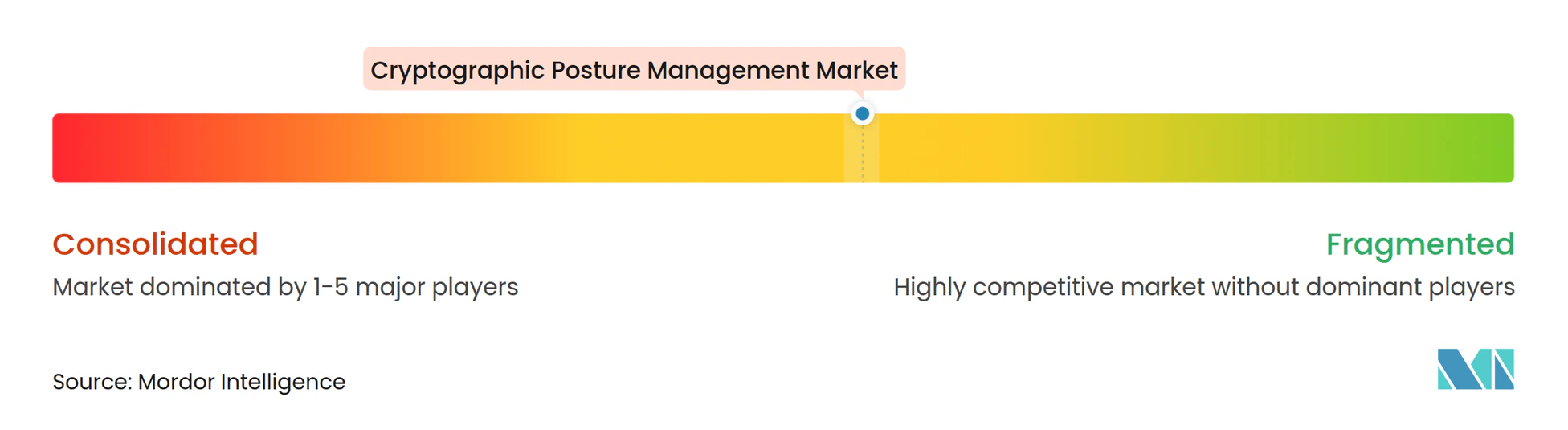
The cryptographic posture management market is moderately concentrated at the platform level. Keyfactor, DigiCert, and Entrust are established providers of enterprise PKI and certificate lifecycle management capabilities, and competition in the cryptographic posture management market centers on how well a provider can connect asset discovery, certificate automation, machine identity management, key controls, and post-quantum preparation. Buyers also assess whether a platform works across cloud services, internal certificate authorities, hardware security modules, and legacy applications. This favors vendors that can show interoperability without requiring a full replacement of existing security tools. Smaller specialists can still compete in focused areas such as post-quantum algorithms, readiness assessments, and crypto-agility.
Palo Alto Networks completed its acquisition of CyberArk in February 2026, bringing identity security and machine identity capabilities into its security platform.[6] The transaction illustrates the broader trend toward combining identity, access, and cryptographic controls, while Sectigo acquired Entrust's public certificate business in January 2025, expanding its enterprise certificate operations and lifecycle management capabilities. DigiCert acquired Valimail in September 2025 to extend its digital trust coverage into email authentication. These moves show that vendors are pursuing adjacent capabilities that can be managed through a broader trust platform.
Product development is also shaping the cryptographic posture management market, and Keyfactor launched Trust Control Plane in June 2026 as a unified model for cryptographic asset management, machine identity governance, lifecycle automation, and post-quantum readiness. Sectigo introduced Private PQC in April 2026 within its certificate management platform to support private post-quantum certificates. TOPPAN Holdings, NICT, and ISARA demonstrated a certificate authority migration approach in April 2026 for post-quantum transition. The remaining opportunity is to connect inventory and risk identification with dependable remediation in difficult legacy systems. Providers that make this work operationally simpler can strengthen recurring customer relationships.
Cryptographic Posture Management Industry Leaders
-
AppViewX
-
Amazon Web Services, Inc.
-
Entrust Corporation
-
Cisco Systems, Inc.
-
IBM Corporation
- *Disclaimer: Major Players sorted in no particular order
Cryptographic Posture Management Market Companies Covered in this Report
- AppViewX
- Amazon Web Services, Inc.
- Entrust Corporation
- Cisco Systems, Inc.
- IBM Corporation
- Akeyless Security Ltd.
- Ascertia
- Cloudflare, Inc.
- CyberArk Software Ltd.
- DigiCert, Inc.
- Encryption Consulting LLC
- Fortanix, Inc.
- Futurex, LP
- Google LLC
- HashiCorp, Inc.
- ISARA Corporation
- Keyfactor, Inc.
- Microsoft Corporation
- Oracle Corporation
- PQShield Ltd.
- QuSecure, Inc.
- SafeLogic Inc.
- Sectigo Limited
- Thales S.A.
- Utimaco GmbH
- Venafi, Inc.
- Zscaler, Inc.
Recent Industry Developments in Cryptographic Posture Management Market
- September 2026: DigiCert announced a partnership with Newfold Digital to modernize SSL/TLS certificate infrastructure for 6 million customers across brands including Network Solutions and Bluehost, selecting DigiCert ONE for short-lifecycle certificate management.
- June 2026: Keyfactor launched the Trust Control Plane, a unified operating model combining cryptographic asset management, machine identity governance, lifecycle automation, and PQC readiness into a single platform providing continuous visibility and enforced governance across on-premises, cloud, and hybrid environments.
- April 2026: Sectigo introduced Private PQC within Sectigo Certificate Manager, enabling enterprises to issue and manage private PQC SSL/TLS certificates using NIST-approved algorithms within existing CLM workflows, a low-disruption pathway for PQC readiness testing in live certificate operations.
- April 2026: TOPPAN Holdings, Japan's NICT, and ISARA Corporation jointly demonstrated a seamless PQC migration technology for certificate authorities, validating a PKI-hierarchy-level migration pathway for Japanese government and financial sector deployments aligned to NIST FIPS standards.
Global Cryptographic Posture Management Market Report Scope
The cryptographic posture management market comprises revenue generated from software platforms and services that provide continuous discovery, inventory, risk assessment, prioritization, remediation, and governance of cryptographic assets across an enterprise. These assets include certificates, keys, secrets, algorithms, libraries, protocols, cipher suites, HSMs, and embedded cryptography. Cryptographic Posture Management (CPM) differs from a one-time cryptographic inventory because it maintains an ongoing view of cryptographic risk, measures compliance against policy, and drives remediation over time.
The Cryptographic Posture Management Market Report is Segmented by Component (Software / Platforms, and Services), Deployment Model (Cloud-Based, On-Premises, and Hybrid and Air-Gapped), Cryptographic Asset Type (Keys and Secrets, Certificates and Certificate Authorities, Algorithms and Libraries, Protocols and Cipher Suites, Hardware Security Modules and Trusted Hardware, and Embedded and Application Cryptography), Organization Size (Large Enterprises, and Small and Medium-sized Enterprises), End User Industry (Banking, Financial Services and Insurance (BFSI), Government and Defense, Healthcare and Life Sciences, IT and Telecommunications, Energy and Utilities, Manufacturing and Automotive, and Other End User Industries), Geography (North America, South America, Europe, Asia-Pacific, Middle East, and Africa). The Market Forecasts are Provided in Terms of Value (USD).
Segmentation Overview
| Software / Platforms |
| Services |
| Cloud-Based |
| On-Premises |
| Hybrid and Air-Gapped |
| Keys and Secrets |
| Certificates and Certificate Authorities |
| Algorithms and Libraries |
| Protocols and Cipher Suites |
| Hardware Security Modules and Trusted Hardware |
| Embedded and Application Cryptography |
| Large Enterprises |
| Small and Medium-sized Enterprises |
| Banking, Financial Services and Insurance (BFSI) |
| Government and Defense |
| Healthcare and Life Sciences |
| IT and Telecommunications |
| Energy and Utilities |
| Manufacturing and Automotive |
| Other End User Industries |
| North America | United States |
| Canada | |
| South America | Brazil |
| Mexico | |
| Rest of South America | |
| Europe | United Kingdom |
| Germany | |
| France | |
| Italy | |
| Rest of Europe | |
| Asia-Pacific | China |
| Japan | |
| South Korea | |
| India | |
| Rest of Asia-Pacific | |
| Middle East | Saudi Arabia |
| United Arab Emirates | |
| Rest of Middle East | |
| Africa | South Africa |
| Rest of Africa |
| By Component | Software / Platforms | |
| Services | ||
| By Deployment Model | Cloud-Based | |
| On-Premises | ||
| Hybrid and Air-Gapped | ||
| By Cryptographic Asset Type | Keys and Secrets | |
| Certificates and Certificate Authorities | ||
| Algorithms and Libraries | ||
| Protocols and Cipher Suites | ||
| Hardware Security Modules and Trusted Hardware | ||
| Embedded and Application Cryptography | ||
| By Organization Size | Large Enterprises | |
| Small and Medium-sized Enterprises | ||
| By End User Industry | Banking, Financial Services and Insurance (BFSI) | |
| Government and Defense | ||
| Healthcare and Life Sciences | ||
| IT and Telecommunications | ||
| Energy and Utilities | ||
| Manufacturing and Automotive | ||
| Other End User Industries | ||
| By Geography | North America | United States |
| Canada | ||
| South America | Brazil | |
| Mexico | ||
| Rest of South America | ||
| Europe | United Kingdom | |
| Germany | ||
| France | ||
| Italy | ||
| Rest of Europe | ||
| Asia-Pacific | China | |
| Japan | ||
| South Korea | ||
| India | ||
| Rest of Asia-Pacific | ||
| Middle East | Saudi Arabia | |
| United Arab Emirates | ||
| Rest of Middle East | ||
| Africa | South Africa | |
| Rest of Africa | ||
Key Questions Answered in the Report
What is the size of the cryptographic posture management market?
The cryptographic posture management market size is projected to expand from USD 1.46 billion in 2026 and USD 1.94 billion in 2027 to USD 5.61 billion by 2032, registering a CAGR of 23.66% between 2027 and 2032.
What is driving demand for cryptographic asset management?
Regulatory inventory requirements, post-quantum planning, shorter TLS certificate validity, and more machine identities are increasing demand for continuous governance.
Which component leads cryptographic asset management spending?
Software and platforms lead, with 73.48% revenue share in 2026, because buyers need integrated discovery, lifecycle automation, and reporting.
Why are certificates important to enterprise cryptographic governance?
Certificates support applications, websites, devices, and services. Shorter public TLS certificate validity periods make automated discovery and renewal more important.
Which end-user sector has the largest revenue share?
BFSI leads with 34.28% revenue share in 2026, supported by security, operational resilience, and payment data requirements.
Which region is expanding fastest?
Asia-Pacific is projected to expand at a 27.32% CAGR through 2032, supported by governance initiatives and post-quantum key management activity.