
Cryogenic Valves Market Size and Share
Market Overview
| Study Period | 2020 - 2031 |
|---|---|
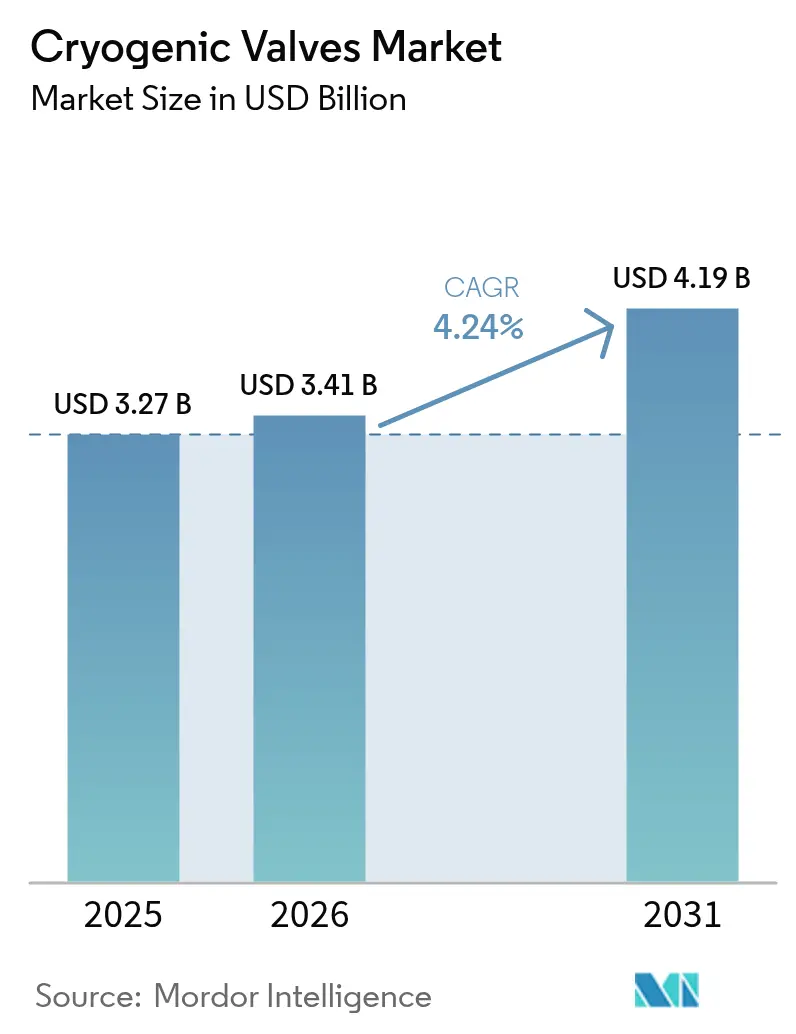
| Market Size (2026) | USD 3.41 Billion |
| Market Size (2031) | USD 4.19 Billion |
| Growth Rate (2026 - 2031) | 4.24 % |
| Fastest Growing Market | Asia-Pacific |
| Largest Market | Asia-Pacific |
| Market Concentration | Medium |
Major Players *Disclaimer: Major Players sorted in no particular order Image © Mordor Intelligence. Reuse requires attribution under CC BY 4.0. | |
Cryogenic Valves Market Analysis by Mordor Intelligence
The Cryogenic Valves Market size was valued at USD 3.27 billion in 2025 and estimated to grow from USD 3.41 billion in 2026 to reach USD 4.19 billion by 2031, at a CAGR of 4.24% during the forecast period (2026-2031). Rising investment in liquefied natural gas (LNG) terminals, green-hydrogen projects, and petro-chemical expansions underpins this steady trajectory. Large‐scale facilities each require hundreds of valves capable of sealing at temperatures below –150 °C, and owners favour suppliers able to certify products quickly for multiple codes. Asia-Pacific remains the largest regional buyer of equipment, while North America delivers high-value opportunities tied to hydrogen pilot plants. Producers able to combine cryogenic engineering depth with aftermarket services are attracting premium contract awards, as end-users seek long-term reliability and fast turn-round maintenance.
Key Report Takeaways
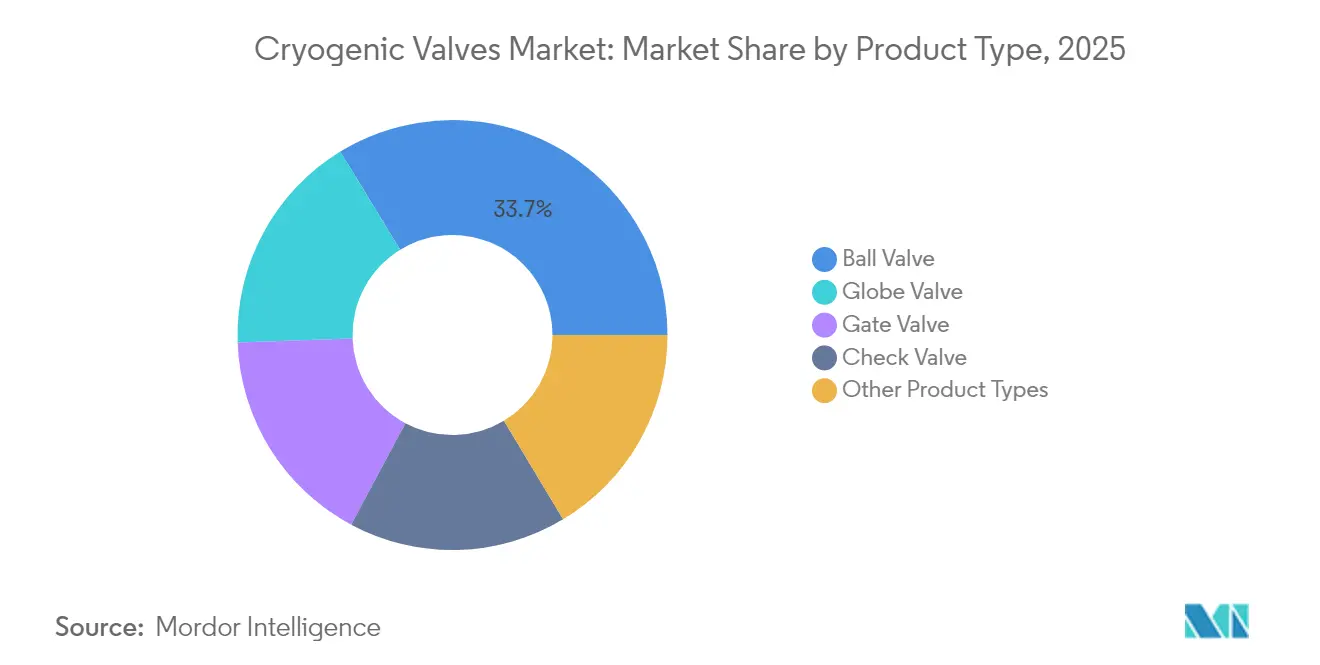
- By product type, ball valves led with 33.74% of cryogenic valves market share in 2025; globe valves are projected to post the fastest 5.18% CAGR through 2031.
- By actuation, manual systems commanded 59.10% share of the cryogenic valves market size in 2025, whereas pneumatic actuation is forecast to expand at 5.33% CAGR between 2026-2031.
- By gas handled, LNG accounted for 44.92% share of the cryogenic valves market size in 2025, while hydrogen applications are set to grow at a 5.62% CAGR to 2031.
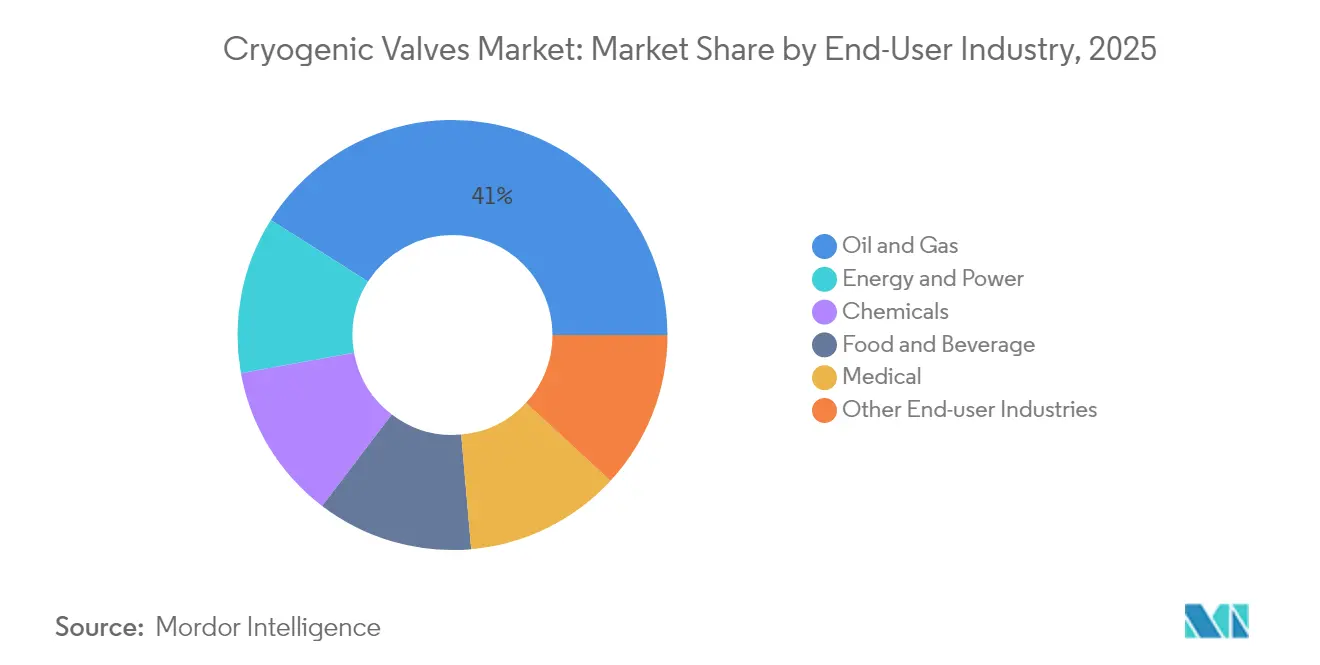
- By end-user, the oil & gas sector held 41.02% share of the cryogenic valves market size in 2025; energy & power installations record the top 5.12% CAGR outlook.
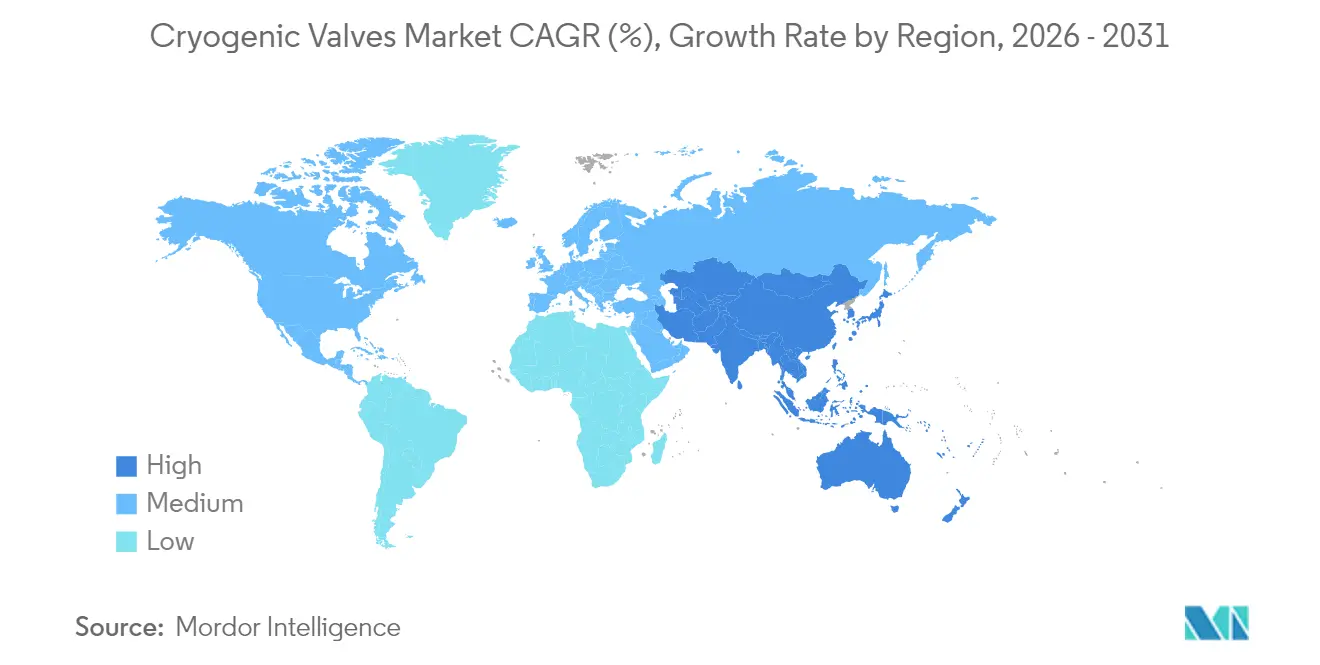
- By geography, Asia-Pacific retained 26.10% share of the cryogenic valves market in 2025 and is the fastest-growing region at a 5.48% CAGR through 2031.
Note: Market size and forecast figures in this report are generated using Mordor Intelligence’s proprietary estimation framework, updated with the latest available data and insights as of 2026.
Market Trends and Insights
Drivers Impact Analysis of Cryogenic Valves Market*
| Driver | (~) % Impact on CAGR Forecast | Geographic Relevance | Impact Timeline |
|---|---|---|---|
| Rising LNG infrastructure investments | +1.8% | Global; focus on Asia-Pacific & North America | Medium term (2-4 years) |
| Growth in industrial gas demand | +1.2% | Global; strong in Asia-Pacific & North America | Long term (≥ 4 years) |
| Hydrogen-economy project pipeline acceleration | +0.9% | North America & EU, expanding to Asia-Pacific | Long term (≥ 4 years) |
| Capacity additions in petro-chem & specialty gas plants | +0.7% | Global; Middle East & Asia-Pacific focus | Medium term (2-4 years) |
| Small-scale LNG bunkering at global ports | +0.5% | Worldwide along major shipping routes | Short term (≤ 2 years) |
| Source: Mordor Intelligence | |||
Rising LNG Infrastructure Investments
Expansions slated between 2024-2028 will lift global LNG liquefaction capacity by 40%, with the United States overtaking Qatar as lead exporter while Asia-Pacific purchases the bulk of incremental cargoes. Baker Hughes secured USD 5.6 billion of LNG equipment awards for two Louisiana trains, illustrating contractor appetite for field-proven valve partners able to guarantee ultra-low-leak performance[1]. Marine bunkering demand is forecast to exceed 16 million t annually by 2030, prompting ports to specify automated cryogenic transfer assemblies that integrate emergency shut-off valves. Enterprise Products Partners is expanding Houston Ship Channel refrigeration capacity by 300,000 bbl/d, creating new orders for triple-offset stop-valves rated down to –162 °C. Saudi Aramco’s USD 7.7 billion Fadhili upgrade will add 1.3 Bcf/d of sweet-gas processing, each train fitted with redundant cryogenic flow-paths to handle mixed refrigerants.
Growth in Industrial Gas Demand
Air Liquide’s four modular air-separation units in Texas will deliver 9,000 t/d of oxygen to ExxonMobil’s low-carbon hydrogen complex and generate the continent’s largest argon stream, placing long-cycle demand on valve makers able to certify for oxygen service[2]. Healthcare expansion keeps liquid-oxygen consumption rising, and hospitals mandate valve designs that prevent particle shedding in patient circuits. Food processors favour liquid nitrogen tunnels for flash-freezing, with valves that tolerate rapid thermal cycling down to –196 °C while maintaining hygienic finishes. Renewable-powered air-separation plants require fast-response control trim so operators can throttle output to match fluctuating grid tariffs.
Hydrogen-Economy Project Pipeline Acceleration
The U.S. Department of Energy’s H-Mat Consortium reports cryogenic hydrogen storage achieving 73.46 kg/m³ at –223 °C, nearly doubling gaseous density and intensifying demand for zero-leak HP valves. NASA plans a dedicated hydrogen test facility at the Glenn Research Center to support aviation propulsion, drawing on five decades of cryo expertise that suppliers must replicate in commercial hardware. Horizon Europe is funding liquefiers targeting 8–10 kWh/kg energy use, a step change that will employ hundreds of precision globe valves for sub-cooled flow control. Developers of 700 bar cryo-compressed tanks are specifying high-pressure stainless alloys with low-emission packings. University research into pump-free hydrogen feed systems illustrates future instrument-style valve opportunities across the transport sector.
Capacity Additions in Petro-chem & Specialty Gas Plants
Air Liquide’s USD 850 million Baytown complex will provide 9,000 t/d O₂ and 6,500 t/d N₂, plus argon, xenon and krypton, each stream segregated by low-temperature fractionation that relies on tight-shutoff valve arrays. Saudi Aramco’s Fadhili project will lift sulfur output by 2,300 t/d, necessitating alloys capable of resisting both cold shock and sour-gas corrosion. Enterprise Products Partners is adding separate flash-gas, propane and butane services, widening the mix of valve metallurgy needed for multi-grade operations. Building-in carbon-capture loops pushes operators to select valves qualified for sub-zero CO₂ phase-change cycling, further broadening specifications.
Restraints Impact Analysis of Cryogenic Valves Market*
| Restraint | (~) % Impact on CAGR Forecast | Geographic Relevance | Impact Timeline |
|---|---|---|---|
| Safety & compliance complexities | –0.8% | Global; stringent in North America & Europe | Medium term (2-4 years) |
| Stainless-steel & nickel price volatility | –0.6% | Global manufacturing hubs, notably Asia-Pacific | Short term (≤ 2 years) |
| Supply-chain gaps in vacuum-brazed components | –0.4% | Global; specialised applications most affected | Medium term (2-4 years) |
| Source: Mordor Intelligence | |||
Safety & Compliance Complexities
ASME B31.3 mandates impact-tested materials below –425 °F; complying valves use austenitic stainless or aluminium alloys proven by Charpy testing. The 2025 ASME VIII update introduces fresh cryogenic case studies, prompting designers to add thicker bonnets or bellows seals to satisfy the new rules. MSS SP-158-2021 requires high-pressure gas tests that inflate development costs, yet utilities increasingly insist on the certification to reduce outage risk. U.S. Code 49 CFR obliges valves to hold tank test pressure without seepage and to include robust guards against mechanical damage, shaping layout choices on trailers. Five-year recertification cycles for safety valves generate recurring service revenue but raise ownership costs for small operators. Smaller fabricators struggle to keep pace with multi-jurisdiction code work, giving established brands a competitive edge.
Stainless-Steel & Nickel Price Volatility
Nickel prices swinging by more than 40% during 2024 created budgeting headaches for valve projects locked into fixed-price EPC contracts. Austenitic grades 304L and 316L remain dominant due to ductility and toughness retention at –196 °C, yet their cost volatility is accelerating research into duplex stainless and aluminium-bronze options that could shave 15% off raw-material spend. Leading OEMs now sign multi-year supply agreements to guarantee tonnage and hedge cost spikes, while some invest in in-house precision foundries to de-risk cast component availability.
*Our forecasts treat driver/restraint impacts as directional, not additive. The impact forecasts reflect baseline growth, mix effects, and variable interactions.
Cryogenic Valves Market Segment Analysis
By Product Type:
Ball Valves Maintain Lead While Globe Valves AccelerateBall valves held a dominant 33.74% cryogenic valves market share in 2025, owing to proven tight shut-off and straightforward maintenance. Manufacturers supply extended-stem designs that isolate the seat from boiling liquefied gases, cutting ice buildup and seat damage. Emerson’s Fisher HP series uses spring-energised PTFE rings to hold Class VI shut-off at –198 °C. Globe valves, though smaller in installed base, are expected to grow at 5.18% CAGR as hydrogen liquefaction projects favour their throttling precision. The cryogenic valves market size for globe valves is anticipated to widen notably in pilot plants producing 8–10 t/h of liquid hydrogen, each calling for variable-flow control to manage ortho-para conversion heat.
Technical enhancements continue across both lines. Ball-valve makers are adding graphite bonnet seals certified to ISO 15848-1 Class A for ultra-low fugitive emissions, an important factor for operators seeking ESG credits. Globe-valve OEMs are deploying contoured plugs that deliver equal-percentage characteristics, enhancing process stability in multi-stage expanders. Gate and check valves retain niche uses: gate valves accommodate full-bore LNG loading lines up to 42 in, while dual-plate cryogenic check valves prevent reverse surge in boil-off gas recirculation loops. Specialty butterfly and plug valves fill gaps such as helium service at ultra-low density where very low torque is essential.

By Actuation:
Manual Systems Dominate Yet Pneumatic Momentum BuildsManual gear and hand-wheel operators represented 59.10% of the cryogenic valves market in 2025, prized for simplicity and intrinsic fail-safe capability during power loss. LNG export terminals rely on manual isolation valves to secure cargo lines during berth-side emergencies. The segment, however, grows slowly as facility owners look to remote operation to cut staffing. Pneumatic actuation will expand at 5.33% CAGR to 2031, leveraging plant air or nitrogen to deliver quick stroke times under fail-closed logic. Hydrogen sites favour pneumatic drives to avoid ignition risks linked to electric motors.
Electric actuators achieve niche uptake where data-rich position feedback is essential, such as in digitally managed nitrogen freezing tunnels that fine-tune flow to maintain product texture. Hybrid solutions that bolt a declutchable gearbox onto a pneumatic drive combine manual override with automated speed, capturing demand in dual-use installations. OEMs increasingly embed smart positioners measuring stem friction and cycle count, feeding plant historians that trigger service work orders before leakage occurs. This predictive-maintenance model strengthens aftermarket ties and lifts lifetime revenue per installed valve.
By Gas:
LNG Retains Leadership While Hydrogen Sets the Growth PaceLNG applications generated 44.92% of the cryogenic valves market size in 2025. Each liquefaction train integrates more than 800 process, isolation and safety valves rated for –162 °C, ensuring a substantial baseline for replacements as older Gulf Coast and Australian facilities reach overhaul cycles. Hydrogen, currently smaller, is poised for the swiftest 5.62% CAGR to 2031. The cryogenic valves market is responding with new alloys that curb hydrogen embrittlement while retaining low-temperature toughness, coupled with bellows seal technology that limits fugitive mass loss to under 1 × 10-⁶ sccs.
Liquid nitrogen and oxygen remain vital although slower growth sectors. Food, electronics and healthcare end-users demand ultra-clean internal finishes, driving valve suppliers to polish wetted parts to Ra ≤ 0.4 µm. Specialty gases such as helium, xenon and neon, though small in volume, command premium pricing; valves here must guard against micro-leakage that would waste product costing USD 20–100 per m³. Overall, portfolio breadth across multiple cryogenic gases improves supplier resilience against cyclical spending in any single commodity group.
By End-User Industry:
Oil & Gas Still Largest, Energy Transition Boosts Power SectorOil & gas companies owned 41.02% of the cryogenic valves market in 2025. LNG liquefaction, regasification and LPG export terminals deliver repetitive, high-ticket orders for 8-12-in ball and gate valves designed for 900-class duty. Yet the fastest 5.12% CAGR resides in energy & power, fuelled by utility-scale hydrogen demonstration plants and renewable-linked air-separation units. These projects favour globe valves paired with digital actuators to modulate flow in response to wind and solar output swings.
Chemical producers apply cryogenic separation to extract argon, krypton and CO₂ streams, utilising multi-port manifolds packed with small-bore needle valves. Food and beverage processors adopt liquid nitrogen tunnels for quality preservation, selecting hygienic ball valves with FDA-compliant seals for clean-in-place procedures. Hospitals and drug manufacturers require oxygen and nitrogen valves certified for non-lubricated service, expanding specialty revenue niches. Aerospace test facilities use helium down to –270 °C, an extreme demanding bespoke stem materials. Diversification across such sectors cushions suppliers against volatility in LNG mega-projects.
Geography Analysis
APAC Cryogenic Valves Market
Asia-Pacific controlled 26.10% of the cryogenic valves market in 2025 and is projected to expand by a 5.48% CAGR through 2031. China’s gas-to-power policy reversal and India’s heat-wave-driven demand are reviving import growth, while Japan and South Korea invest in re-loading hubs that reposition cargoes from the United States. Australia’s ageing liquefaction trains enter refurbishment cycles, pushing aftermarket valve services. Government hydrogen roadmaps in China, South Korea and Australia create incremental bids for high-pressure globe valves at pilot liquefier sites.
North America Cryogenic Valves Market
North America benefits from the United States becoming the world’s largest LNG exporter and from aggressive federal funding for hydrogen hubs. Gulf Coast brownfield liquefaction projects stipulate North American Valve Manufacturers Association membership, favouring domestic suppliers with local inventories. Air Liquide’s Baytown investment plus multiple mid-scale liquid-oxygen build-owns maintain steady industrial-gas valve uptake. Canada’s first LNG shipment slated for 2027 from British Columbia will add western-hemisphere demand.
Europe Cryogenic Valves Market
Europe, despite softer LNG imports in 2024, commits heavily to hydrogen. Germany’s planned 10 GW of electrolyser capacity links to liquefaction and underground storage schemes, each specifying ultra-low-leak isolation valves. Horizon Europe funds mobile LH₂ tank trials between Spain and the Netherlands, generating specialty cargo-handling valve orders. Nordic ports accelerate LNG bunkering roll-outs supporting green-corridor shipping alliances.
MEA Cryogenic Valves Market
The Middle East and Africa witness sizeable greenfield gas processing. Saudi Aramco’s Fadhili expansion, Qatar’s North Field South and multiple Omani petro-chem complexes need durable cryogenic metallurgy that resists sour-gas compounds. Abu Dhabi is exploring blue-ammonia, which will import design philosophies from LNG trains to valve packages. In Africa, Mozambique’s postponed onshore LNG plant, once security stabilises, promises a fresh cycle of valve procurement.
South America Cryogenic Valves Market
South America remains nascent yet promising. Brazil eyes floating storage and regasification units to manage seasonal gas deficits, requiring compact cryogenic valve skids. Argentina’s Vaca Muerta shale may eventually feed LNG export barge projects, though timetable uncertainty tempers near-term demand. Chile’s mining sector investigates liquid oxygen for process efficiency, presenting small but high-margin valve prospects.
Regulatory Landscape
Cryogenic valves are governed by a mix of pressure-equipment, low-temperature performance, fire-safety, and transport rules that vary by jurisdiction, but converge on type testing, material toughness, and leakage integrity. In Europe, compliance for valves as pressure accessories is commonly aligned to the EU Pressure Equipment Directive (PED) 2014/68/EU, supported by harmonized valve requirements such as EN 16668:2025 for metallic industrial valves. Globally, cryogenic-specific design and testing references such as ISO 28921-1 for low-temperature isolation valves and ISO 21011 for cryogenic service valves feed into LNG, industrial gas, and hydrogen liquefaction procurement specifications.
In 2025-2026, standards activity also expanded around actuation and safety governance. ISO issued updated valve interface and gearbox standards in February 2026 (ISO 22109:2026 for valve gearboxes, ISO 5210:2026 for multi-turn actuator attachments, and ISO 5211:2026 for part-turn actuator attachments), reinforcing interoperability requirements for automated cryogenic valve packages. In the United States, cryogenic fluid installations are governed through fire codes such as NFPA 55 as adopted through state or facility codes (for example, OAC 1301:7-7-55), while transport of cryogenic liquids in cylinders is regulated under 49 CFR 173.316, shaping valve and pressure-control design for trailers and cylinders.
Value Chain Analysis
The cryogenic valves value chain begins with alloy and component inputs (austenitic stainless steels, nickel-bearing alloys, aluminum alloys, and soft goods such as PTFE/PCTFE seals), then moves through casting or forging, precision machining, extended-bonnet fabrication, and specialized cryogenic qualification. Manufacturers then run type testing and inspection to meet project and code requirements, commonly including BS 6364 cryogenic testing at around -196 C, alongside ISO 28921-1/2 and project-driven combinations such as API 6D for pipeline valves, before final assembly, packing, and documentation.
End users rely on EPCs and packaged-equipment integrators (LNG trains, cold boxes, air separation units, and hydrogen liquefiers), which are supported by distributors and OEM service networks for spares, recertification, and turnaround work. Value capture is strongest in engineered valves and assemblies where documentation, qualification, and reliability drive procurement decisions, while commodity valve segments face more price competition. Differentiation points concentrate on test capacity, specialty welding and vacuum-jacket interfaces, and access to qualified subcomponents such as vacuum-brazed parts and low-emission packing systems. Recent project fulfillment reflects how large LNG and gas-processing builds pull the chain end-to-end, including AMPO POYAM VALVES supplying over 200 highly engineered cryogenic valves for the Caofeidian Xintian LNG Receiving Terminal in China (including large top-entry ball valves), and being selected to supply engineered valves for BP-linked Tangguh Ubadari CCUS work in Indonesia, both supporting demand for dual-standard compliance and faster certification cycles.
Competitive Landscape
Consolidation is reshaping the cryogenic valves market. The all-stock merger of Chart Industries and Flowserve, valued at USD 19 billion, creates a vertically integrated entity spanning process pumps, valves, and aftermarket services expected to yield USD 300 million annual cost synergies within three years. Flowserve’s earlier USD 290 million acquisition of MOGAS Industries bolsters severe-service isolation capability, positioning the group for hydrogen duties. Dover-owned PSG purchased Cryogenic Machinery Corp, and OPW bought Marshall Excelsior, broadening their clean-energy portfolios.
Technology differentiation remains vital. Emerson’s Fisher HP balanced plug design sustains tight control under 300-bar differentials, while Samson AG’s top-entry globe valves allow in-situ trim swaps that cut downtime 40%. Emerging firms such as HeLIUM Cryogenics commercialise miniature Stirling coolers that integrate proprietary micro-valves, signalling a future of decentralised refrigeration. Baker Hughes leverages compressors plus valve packages in turnkey bids, winning multi-train LNG awards worth USD 5.6 billion.
Service remains a revenue cornerstone. The combined Chart-Flowserve group expects 42% of sales from aftermarket contracts, reflecting operator preference for bundled spares and annual inspection programmes. OEMs increasingly deploy digital twins that log valve cycles and predict seat wear, strengthening client stickiness. Regionally, Japanese manufacturers retain best-in-class reputations for cleanroom-built oxygen valves; European houses lead in vacuum-jacketed assemblies; and U.S. brands dominate large-bore LNG isolation.
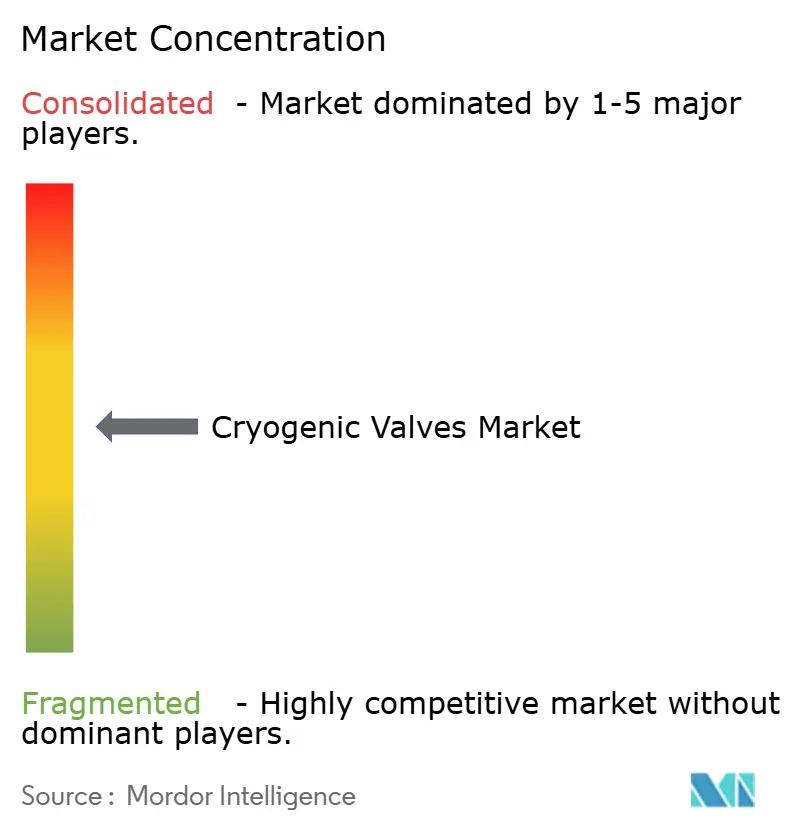
Competitive intensity is moderate: top five suppliers together control roughly 55% of installed liquefaction capacity, while hundreds of local specialists serve niche segments such as dewars and laboratory freezers. Price pressure persists in commodity ball valves, but high-spec hydrogen and aerospace projects command premium margins. Suppliers able to support rapid certification for ASME, CE-PED and KGS simultaneously capture multi-continental opportunities.
Cryogenic Valves Industry Leaders
-
Emerson Electric Co.
-
Baker Hughes
-
Flowserve Corporation
-
Velan
-
Samson AG
- *Disclaimer: Major Players sorted in no particular order
Cryogenic Valves Market Companies Covered in this Report
- BAC Valves
- Baker Hughes
- Bray International
- Burkert India Private Limited
- Cryofab Inc.
- Emerson Electric Co.
- Flowserve Corporation
- Habonim
- HEROSE GmbH
- L&T Valves Limited
- Meca-Inox
- Neway Valve
- OPW, A Dover Company
- Parker Hannifin Corp
- Powell Valves
- Samson AG
- Swagelok Company
- Velan
Market Opportunities and Future Outlook
Hydrogen liquefaction, air separation cold boxes, and LNG-related builds are pushing requirements toward tighter leakage control, higher pressure classes, and more modular maintenance. Emerson's April 2026 introduction of the Fisher IC2 cryogenic top-entry valve for cold-box duties shows supplier focus on maintainable, ultra-low temperature solutions, and it also provides a reference point for integrated valve and actuation packages specified by EPCs and cold-box OEMs. ADNOC MERAM project deliveries, including 116 engineered cryogenic valves in 2025-2026, underline regional demand for qualified cryogenic isolation and control valves. Separately, Dragonfly valve technology development by the UK Actuation Lab beginning in 2025 indicates ongoing work around low-emission actuation and fugitive-emissions-focused designs.
Recent Industry Developments in Cryogenic Valves Market
- April 2026: Emerson launched the Fisher IC2 cryogenic top-entry control valve for cold-box applications across LNG production, hydrogen liquefaction, and air separation, with performance down to -269 C and tight shutoff. The release sets a high benchmark for integrated valve packages in cryogenic duty.
- June 2025: Chart Industries and Flowserve announced an all-stock merger of equals, expanding capabilities across industrial process technologies including valves and aftermarket services. The deal extends the pair's reach in LNG, industrial gases, and hydrogen infrastructure.
- November 2024: Crane Co. completed the acquisition of Technifab Products, adding vacuum-insulated piping and cryogenic valve system capabilities to its portfolio. The move broadens Crane Co.'s engineered cryogenic packages for industrial gas, LNG, and hydrogen projects.
Cryogenic Valves Market Report Scope and Research Methodology
Market Definition and Coverage
This market covers valves engineered to control flow in very low temperature service, where tight shutoff, leak prevention, and material integrity are required for liquefied gases handling across industrial and energy settings.
Scope exclusions: We exclude general industrial valves that are not designed, certified, or sold for cryogenic temperature service, along with unrelated downstream equipment such as tanks, vaporizers, or piping systems.
Segments Covered in This Report
- By Product Type
- Ball Valve
- Gate Valve
- Globe Valve
- Check Valve
- Other Product Types
- By Actuation
- Manual
- Pneumatic
- Electric
- By Gas
- Liquid Nitrogen
- Liquid Natural Gas
- Hydrogen
- Oxygen
- Other Gases
- By End-user Industry
- Oil and Gas
- Energy and Power
- Chemicals
- Food and Beverage
- Medical
- Other End-user Industries
- By Geography
- North America
- United States
- Canada
- Mexico
- South America
- Brazil
- Argentina
- Rest of South America
- Europe
- Germany
- United Kingdom
- Italy
- France
- Rest of Europe
- Asia-Pacific
- China
- India
- Japan
- South Korea
- Rest of Asia-Pacific
- Middle East and Africa
- Saudi Arabia
- South Africa
- Rest of Middle East and Africa
- North America
Data Sources, Market Sizing, and Validation
Desk Research
Desk research was used to set the demand context and to pin down assumptions that can be checked consistently year to year. We referred to public and official sources such as energy and industrial gas statistics from agencies like the U.S. EIA, trade and customs series from UN Comtrade, and macro and industrial output indicators from the World Bank and OECD.
To link valve demand with end-use activity, we also reviewed LNG and gas infrastructure updates from port and pipeline regulators, safety and performance references from standards bodies such as ISO and ASME, and relevant peer-reviewed engineering papers on cryogenic service design and leakage behavior. Company filings, investor presentations, and reputable press releases were then used to confirm product mix shifts and regional expansion signals. In addition, paid subscriptions for company financials and news intelligence, patent databases, and shipment-level import-export data were used selectively when public data left gaps in timing or trade direction. These desk sources are not exhaustive, and many other public documents were also reviewed for data collection, cross-checking, and clarification.
Primary Interviews and Surveys
Primary work focused on confirming how cryogenic valve demand is booked and supplied across LNG chains, industrial gas distribution, and hydrogen-linked projects, and then stress-testing the pricing and replacement assumptions. We spoke with a mix of manufacturers, channel partners, and EPC and end-user stakeholders across APAC, EMEA, and the Americas, so the model reflects regional certification requirements, lead times, and typical valve specs used in live projects.
Distribution of primary research fieldwork respondents
| Company type | Respondent position | Region |
|---|---|---|
| Top tier: 27% | CXOs: 12% | APAC: 48% |
| Mid tier: 57% | Functional/Unit leaders: 38% | EMEA: 29% |
| Smaller Players: 16% | Managers: 50% | Americas: 23% |
Market-Sizing & Forecasting
Market sizing is built using a top-down and bottom-up approach, where we first reconstruct demand using end-use activity and then validate totals through supplier and channel reality checks. On the top-down side, LNG capacity additions and utilization, industrial gas consumption trends, and hydrogen project announcements are translated into valve demand pools using typical valve counts per asset class and replacement cycles.
Several practical inputs were tracked and refreshed during modeling, including regional LNG export and import capacity, industrial gas production and distribution growth, the split of cryogenic service by medium (such as nitrogen, oxygen, LNG, and hydrogen), the mix of valve types commonly specified for cryogenic duty, and observed average selling price movement by region and material grade. Forecasts were then created using scenario analysis supported by a light multivariate regression view, with key drivers including energy infrastructure buildout, industrial output, and project commissioning timelines. Interview feedback was used to cross-check those driver links.
Bottom-up approximations were used to corroborate totals, mainly through sampled supplier revenue mapping, channel checks on project order flow, and volume times ASP sanity checks in key regions. When bottom-up visibility was limited in fragmented pockets, gaps were handled through proxy indicators like trade flows, installed base growth, and conservative adoption rates, and then the model was adjusted until the signals aligned within a reasonable variance band.
Data Validation & Update Cycle
Validation is done in layers so single-source bias is reduced before numbers are finalized. We compare outputs against independent signals like LNG and industrial gas investment pipelines, regional trade direction, and published capacity commissioning schedules, and then review large swings that do not match these external markers.
Outliers are investigated through assumption backtracking, currency and inflation checks, and re-checking whether a change is structural or only timing related. If a variance remains material, we re-contact relevant primary respondents to confirm what moved, such as pricing, delivery lead times, or specification shifts. Reports are refreshed annually, and interim updates are made when major events materially affect demand. Before delivery, a final analyst pass is completed so clients receive the latest view consistent with the defined scope.
Mordor Intelligence's Cryogenic Valves Market Size Versus Other Published Estimates
Published market sizes for cryogenic valves can differ even when the topic name looks the same, because the counted boundary and the timing of the base year are not always aligned. Differences also come from how each study treats project cycles, pricing progression, and whether adjacent valve categories are grouped into the same total.
By tracking LNG capacity additions, industrial gas demand, and region-specific ASP bands, Mordor Intelligence keeps the 2026 total tied to a defined cryogenic-service valve demand pool, whereas some studies appear to anchor on earlier base years or apply faster price growth across all regions without the same checks.
Benchmark comparison
| Source | Market Size | Gaps in Research Methodology |
|---|---|---|
| Mordor Intelligence | USD 3.41 B (2026) | |
| Global Research Publisher A | USD 3.63 B (2024) | Uses a 2024 base year and a higher near-term growth curve, which can lift the market level if LNG and hydrogen project ramps are assumed to convert to valve demand faster than commissioning reality. |
| Industry Analytics Firm B | USD 4.82 B (2025) | Reports a larger 2025 value that likely reflects broader inclusion choices or higher blended pricing assumptions, and the higher CAGR path suggests less tightening for regional ASP differences and replacement cycle timing. |
The spread in the table is mainly explained by base-year selection and how tightly the model is linked to real asset buildout and replacement behavior. When scope stays focused on cryogenic-duty valves and inputs are checked against capacity and commissioning signals, the resulting total is easier to reproduce with clear steps.
Key Questions Answered in the Report
What is the current Cryogenic Valves Market size?
The market is valued at USD 3.41 billion in 2026 and is forecast to grow to USD 4.19 billion by 2031.
Which region leads demand for cryogenic valves?
Asia-Pacific holds the top regional position with 26.10% of revenue in 2025, driven by LNG import growth and expanding gas infrastructure.
Which product type has the largest cryogenic valves market share?
Ball valves lead with 33.74% share owing to tight shut-off performance in LNG and petro-chemical applications.
What gas segment is expected to grow fastest?
Hydrogen-handling valves are projected to register the highest 5.62% CAGR to 2031 as green-hydrogen investments accelerate.
What standards govern cryogenic valve safety in North America?
Key regulations include ASME B31.3 process piping, ASME VIII pressure vessel code updates, MSS SP-158 testing protocols, and 49 CFR transport rules.