
India Industrial Valves Market Size and Share
Market Overview
| Study Period | 2020 - 2031 |
|---|---|
| Forecast Data Period | 2026 - 2031 |
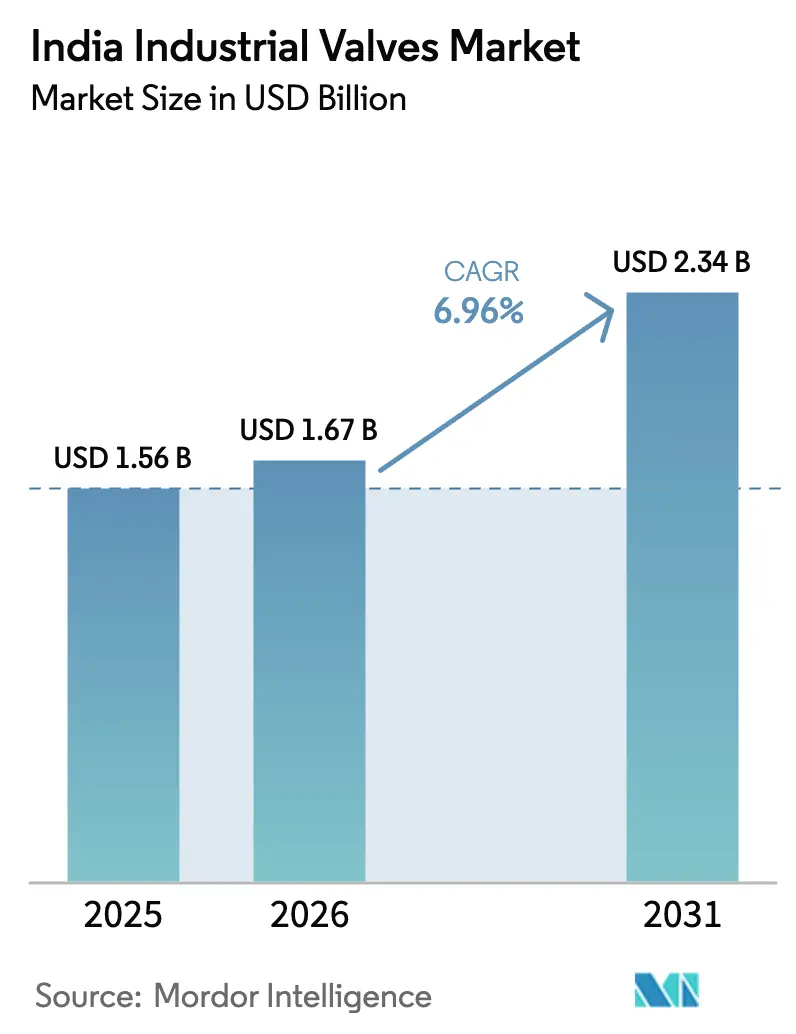
| Base Year Market Size (2025) | USD 1.56 Billion |
| Market Size (2026) | USD 1.67 Billion |
| Market Size (2031) | USD 2.34 Billion |
| Growth Rate (2026 - 2031) | 6.96 % |
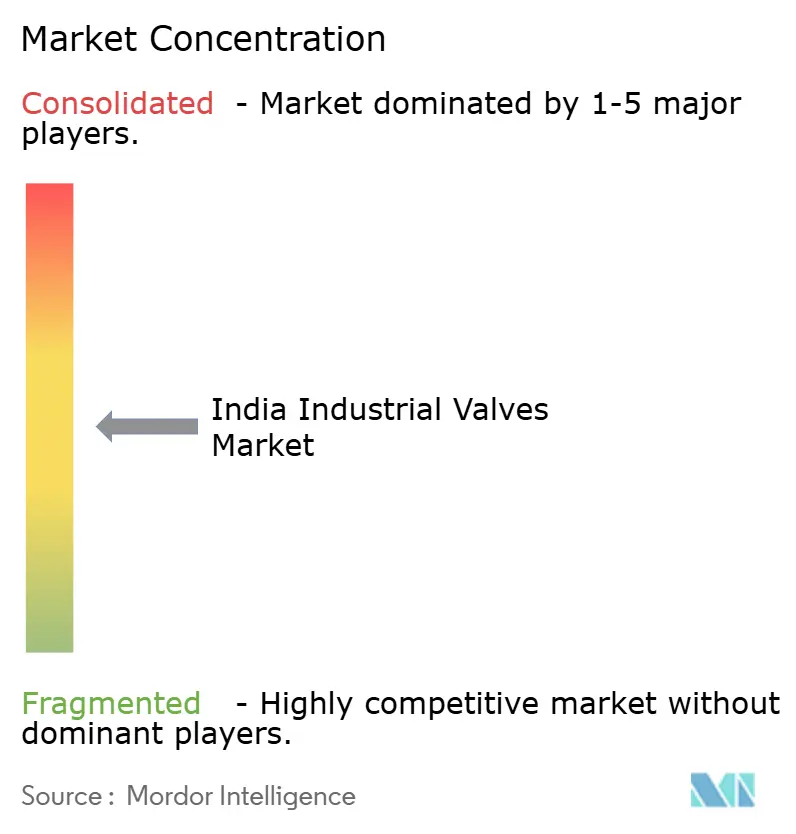
| Market Concentration | Medium |
Major Players *Disclaimer: Major Players sorted in no particular order Image © Mordor Intelligence. Reuse requires attribution under CC BY 4.0. | |
India Industrial Valves Market Analysis by Mordor Intelligence
The India Industrial Valves Market size is expected to grow from USD 1.56 billion in 2025 to USD 1.67 billion in 2026 and is forecast to reach USD 2.34 billion by 2031 at 6.96% CAGR over 2026-2031. Rising capital outlays in water supply networks, hydrocarbon pipelines, and renewable power plants keep the demand curve steep. Contract awards tied to national missions such as Jal Jeevan push public utilities to order corrosion-resistant gate, globe, and butterfly valves, while refineries, city-gas distributors, and petrochemical complexes widen the call for high-pressure ball valves. Automation programs across chemical clusters in Gujarat and Maharashtra accelerate the uptake of smart, IIoT-ready control valves, raising the average selling price. At the same time, raw-material cost swings and import competition from China compress margins, making scale and integrated machining critical to profitability. Suppliers that offer rapid-turnaround service and Bureau of Indian Standards (BIS) compliance gain an edge in winning multi-state contracts.
Key Report Takeaways
- By type, ball valves led with a 25.17% share of the India industrial valves market in 2025, while butterfly valves are projected to expand at a 7.05% CAGR through 2031.
- By product, quarter-turn valves held 39.80% share of the India industrial valves market size in 2025, and other products, including control valves and actuators, are expected to rise at a 7.25% CAGR to 2031.
- By application, oil and gas accounted for 35.20% of the India industrial valves market size in 2025; water and wastewater management is forecast to grow at a 7.08% CAGR through 2031.
Note: Market size and forecast figures in this report are generated using Mordor Intelligence’s proprietary estimation framework, updated with the latest available data and insights as of 2026.
Market Trends and Insights
Drivers Impact Analysis of India Industrial Valves Market*
| Drivers | (~) % Impact on CAGR Forecast | Geographic Relevance | Impact Timeline |
|---|---|---|---|
| Government investment in water and waste-water networks | +1.8% | National, with concentration in rural areas and tier-2 cities | Medium term (2-4 years) |
| Expansion of oil and gas pipeline and CGD projects | +1.2% | National, with focus on western and northern regions | Long term (≥ 4 years) |
| Ongoing power-generation capacity additions | +0.9% | National, with emphasis on renewable energy corridors | Medium term (2-4 years) |
| Rising chemical and process-industry investments | +0.8% | Gujarat, Maharashtra, Andhra Pradesh clusters | Long term (≥ 4 years) |
| Adoption of IIoT-enabled smart valves | +0.6% | Industrial hubs in western and southern India | Long term (≥ 4 years) |
| Source: Mordor Intelligence | |||
Government Investment in Water and Waste-water Networks
Jal Jeevan Mission and AMRUT 2.0 continue to fund household tap connections, sewage treatment plants, and water-recycling facilities. The USD 50 billion allocation through 2024 created rolling tenders for gate, globe, and butterfly valves across treatment trains, distribution mains, and sludge lines. States now extend procurement schedules to 2028 to meet both rural service and urban reuse targets. Projects specify stainless-steel trims, epoxy coatings, and actuator-ready flanges, boosting the ticket size per valve. Suppliers that secure BIS certification and deploy regional service teams win repeat orders, as municipalities insist on local support for preventive maintenance[1].
Expansion of Oil and Gas Pipeline and CGD Projects
City-gas distribution licenses covering 280 districts demand pressure-regulation stations, metering skids, and safety shut-off assemblies. Each skid integrates fire-safe ball valves, double-block-and-bleed designs, and remotely actuated isolation units. Concurrent product and crude pipelines linking refineries to consumption clusters call for ANSI Class 600 and above ball and check valves. The government’s vision of blending bio-fuels into existing networks adds dual-service specifications, favoring manufacturers with metallurgy and sealing know-how for mixed-media flows[2].
Ongoing Power-Generation Capacity Additions
Thermal units ordered under super-critical and ultra-super-critical programs require globe and gate valves that tolerate 600 °C steam and 300 bar pressure. Renewable additions headed for 500 GW by 2030 spur demand for butterfly and ball valves in solar-thermal storage circuits, wind-turbine hydraulic brakes, and pumped-hydro reservoirs. Grid modernization projects need automated control valves in substations and battery farms, anchoring steady offtake from utilities.
Rising Chemical and Process-Industry Investments
The USD 142 billion downstream program through 2035 concentrates large-scale crackers, specialty intermediate units, and polymer plants inside Petroleum, Chemicals and Petrochemicals Investment Regions. High-purity lines use PTFE-lined or alloy-20 valves, while aromatic chains specify low-leakage control valves for VOC abatement. Cluster development lets buyers negotiate volume deals, prompting suppliers to stock standard sizes in regional warehouses for rapid call-offs.
Restraints Impact Analysis of India Industrial Valves Market*
| Restraints | (~) % Impact on CAGR Forecast | Geographic Relevance | Impact Timeline |
|---|---|---|---|
| High capital cost and maintenance burden | -1.5% | National, affecting smaller industrial users | Short term (≤ 2 years) |
| Raw-material price volatility (steel/alloys) | -1.0% | National, with higher impact on domestic manufacturers | Medium term (2-4 years) |
| Competition from low-cost imports (mainly China) | -1.0% | National, particularly affecting standard valve segments | Short term (≤ 2 years) |
| Source: Mordor Intelligence | |||
High Capital Cost and Maintenance Burden
Smart valves raise purchase prices by 15-30% compared with manual versions, and long-cycle spares enlarge inventory budgets. Small water boards and MSME plants often postpone upgrades until grant funding arrives. Some municipalities specify lower-grade trims to cut capex, but this boosts lifecycle costs when corrosion sets in. Training gaps further deter adoption of sophisticated positioners, locking many buyers into basic on-off models.
Raw-Material Price Volatility (Steel/Alloys)
Carbon-steel and stainless-steel coils form up to 70% of the valve bill of materials. Benchmark prices swung more than 20% between 2023 and 2024, reflecting iron-ore shortages and coking-coal premiums. Domestic producers carry lean inventory; a sudden spike forces them to re-quote or accept margin erosion on fixed-price contracts. Long-term framework agreements with EPC contractors become difficult to price without escalation clauses, slowing the closure of large deals.
*Our forecasts treat driver/restraint impacts as directional, not additive. The impact forecasts reflect baseline growth, mix effects, and variable interactions.
India Industrial Valves Market Segment Analysis
By Type – Ball Valves Lead Multi-Application Demand
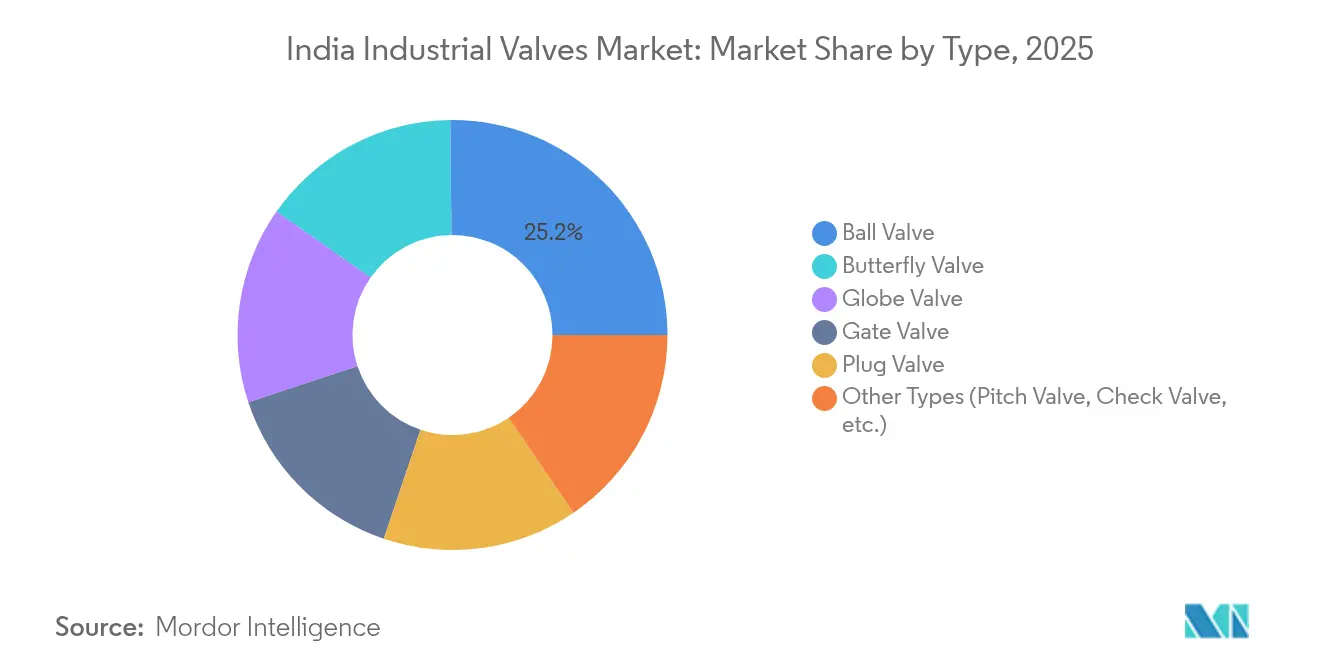
Ball valves secured a 25.17% India industrial valves market share in 2025 on account of tight shut-off, minimal pressure drop, and ease of automation. Oil terminals, CGD stations, and chemical reactors favor forged and trunnion-mounted designs that operate at up to 600 bar. The India industrial valves market size for butterfly valves is forecast to widen rapidly, supported by large-diameter intake pipelines in desalination and sewage treatment plants advancing at a 7.05% CAGR. Globe valves keep relevance in throttling duties across power-station steam circuits where precise flow is vital. Gate valves remain the default isolators in fire-water mains, while plug valves serve niche hydrocarbon vapor-recovery lines. Check valves, though smaller in ticket value, post steady volumes thanks to mandatory non-return requirements in water transfer schemes.
Mid-tier EPC firms increasingly bundle valve supply under master service agreements to shorten tender cycles. Makers that pre-qualify under multiple valve categories receive higher frame-contract volumes. Workshops equipped for cryogenic testing and fugitive-emission certification are seeing rising inquiries from LNG logistics players. Standards compliance to API 6D, ISO 15848-1, and BIS IS 14846 influences wins across refineries, water boards, and fertilizer units.

By Product – Quarter-Turn Dominance Reflects Operational Preferences
Quarter-turn devices, covering ball, butterfly, and plug variants, held 39.80% share of the India industrial valves market in 2025. Plant operators value their 90-degree stroke, clear visual indication, and compatibility with both pneumatic and electric actuators, which eases remote control. Multi-turn valves, largely gate and globe, continue to dominate high-temperature, high-pressure lines but lose share where quick isolation is critical. The India industrial valves market size for other products, chiefly control valves and actuators, is tracking a 7.25% CAGR due to process optimization programs in the petrochemical and pharmaceutical sectors.
Leading actuator suppliers roll out modular platforms that accept digital positioners and wireless sensors by design. Integration with distributed control systems lowers commissioning time. Vendors now ship pre-wired skid-mounted packages, reducing site labor. Cast-iron housings see a gradual phase-out in favor of ductile-iron or carbon-steel bodies that fit higher pressure classes without significant cost jumps.
By Application – Oil and Gas Leadership Amid Water-Sector Acceleration
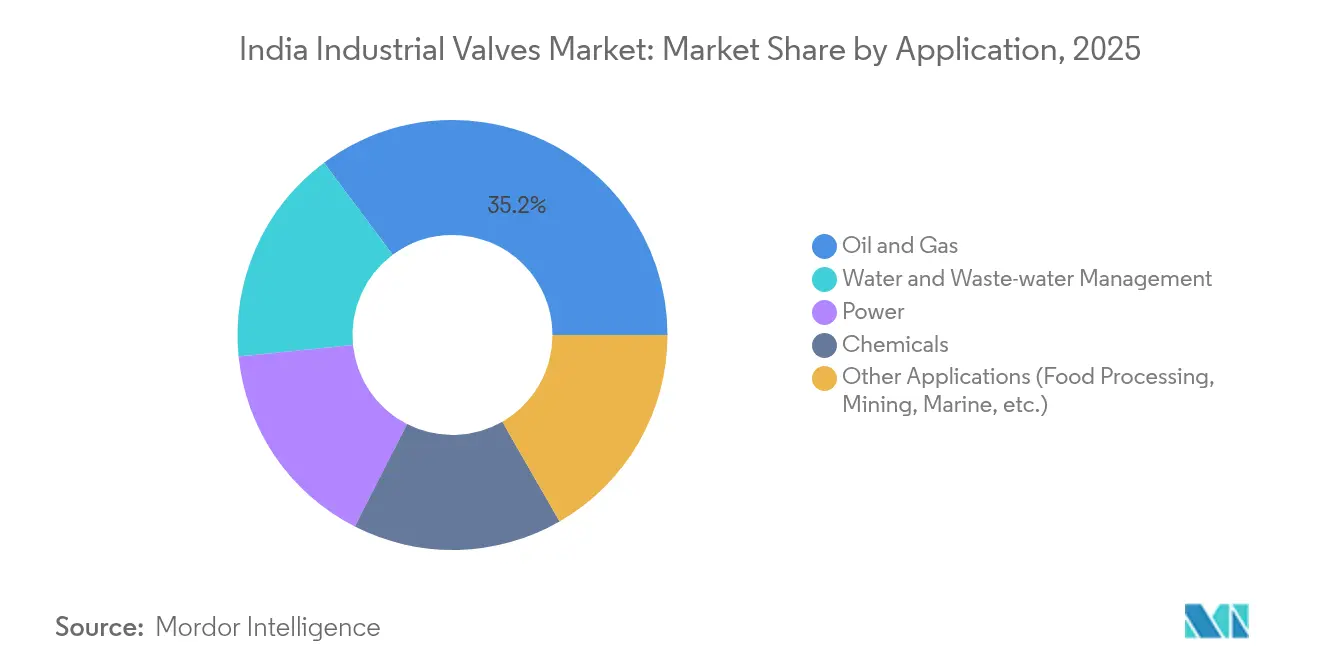
Oil and gas held a 35.20% share of the India industrial valves market size in 2025, anchored by refinery expansions, strategic petroleum reserves, and the widening CGD footprint. Specifications stress fire-safe designs, secondary seat-insert materials like PTFE-graphite, and antistatic stems. Meanwhile, water and wastewater management revenues are growing at a 7.08% CAGR, backed by mission-mode funding for surface water treatment, desalination, and reuse plants. The application mix keeps shifting toward automated knife-gate valves in sludge lines and double-eccentric butterfly designs for potable grids.
Chemical plants retain a high value-per-ton ratio, particularly within specialty intermediate blocks that demand corrosion-resistant alloys such as duplex stainless steel. Power-sector procurement splits between super-critical thermal stations and renewable support infrastructure like solar-thermal storage and pumped-hydro facilities. Miscellaneous segments—food processing, mining, and marine—contribute incremental orders, with mining valves benefiting from coal block auctions and marine valves from port-side tank farm growth.
Geography Analysis
Western and northern states lead India's industrial valves market demand owing to petrochemical clusters, oil logistics corridors, and dense urban populations. Gujarat’s PCPIR belt and Maharashtra’s refinery and chemical complexes attract high-volume, high-specification orders that favor suppliers carrying API and BIS certifications. Rajasthan, Haryana, and Uttar Pradesh add volumes through CGD rollouts and thermal-plant overhauls.
Southern India showcases the fastest uptake of automation and smart valve platforms. Tamil Nadu and Karnataka, home to strong wind and solar supply chains, specify actuator-ready butterfly valves for cooling loops and brake hydraulics. IT parks and electronics factories in these states stipulate low-leakage isolation valves for ultra-pure water systems, creating a niche for high-purity designs. Kerala and Andhra Pradesh ports adopt stainless-steel marine-grade valves to handle saline environments.
Eastern regions, notably Odisha, Jharkhand, and Chhattisgarh, register rising offtake tied to mining and steel capacity hikes. Coal washeries, slurry pipelines, and pellet plants deploy abrasion-resistant knife-gate valves and pinch valves. Northeast pipeline projects connecting gas fields to fertilizer units pull in cryogenic ball valves suited for LNG transport. Across most rural districts, Jal Jeevan civil works continue to favor cost-effective, manually operated gate valves, yet pilot projects now trial smart metering systems that would lift actuator demand in the future.
Value Chain Analysis
The India industrial valves value chain starts with raw materials such as carbon steel, stainless steel, alloy steel, and duplex and super duplex grades, along with bought-out parts including actuators, positioners, seals, fasteners, and coatings. Castings and forgings then go through machining, welding, assembly, pressure and leak testing, painting or coating, documentation, and dispatch. Supplier capability varies by segment, with higher-spec work typically requiring cryogenic testing, specialty metallurgy, and automation integration. BIS-related quality and conformity requirements, combined with Indian service conditions such as corrosion, abrasive slurries, and high-cycle operation, push process control, traceability, and testing investment across the chain.
Commercial flows are anchored in direct engagement with EPC contractors, public-utility tenders, and large industrial end users, with distributors and service networks supporting spares and maintenance. Manufacturers with captive or allied foundries and in-house machining tend to reduce lead-time risk and improve material traceability, which becomes a differentiator when buyers request documented compliance for multi-state water projects and high-pressure hydrocarbon duties. Aftermarket services, including preventive maintenance, actuator retrofits, and turnaround support, also form a downstream layer that grows more visible as smart and actuated valves increase the importance of commissioning and lifecycle support.
Competitive Landscape
The India industrial valves market exhibits moderate fragmentation. International majors such as Flowserve, Emerson, and Baker Hughes retain share in high-specification segments through global references and technology portfolios. Domestic leaders, including L&T Valves and Kirloskar Brothers, leverage local manufacturing, extensive dealer networks, and familiarity with public-tender procedures. Niche players focus on specialty alloys, cryogenic designs, or mini-valves for instrumentation panels, filling gaps that larger firms overlook. Supply-chain resilience gains attention after raw-material price shocks. Integrated foundries allied with valve plants mitigate lead-time risk and improve traceability. Firms sourcing from in-house steel shops control metallurgical consistency, easing BIS audits. For export-oriented orders, Indian producers pursue CE-PED and API monograms to tap Gulf and African projects.
India Industrial Valves Industry Leaders
-
AVK Valves India Pvt Ltd
-
Emerson Electric Co.
-
Flowserve Corporation
-
KIRLOSKAR BROTHERS LIMITED (INDIA)
-
L&T Valves Limited
- *Disclaimer: Major Players sorted in no particular order
India Industrial Valves Market Companies Covered in this Report
- Alfa Laval
- AMPO
- Amtech
- AVK Valves India Pvt Ltd
- Baker Hughes
- Bray International
- C.R.I. Pumps Private Limited
- Crane Company
- Danfoss
- Emerson Electric Co.
- Flowserve Corporation
- Hawa Engineers Ltd
- Hydreco (Daikin Group)
- IMI
- KIRLOSKAR BROTHERS LIMITED (INDIA)
- KITZ Corporation
- L&T Valves Limited
- Novel Valves India Pvt. Ltd.
- Pentair
- The Weir Group PLC
- Velan
- VIP Valves Private Limited India
Market Opportunities and Future Outlook
White-space is most apparent in standardized, compliance-led procurement, where utilities and EPCs seek consistent quality, traceability, and faster delivery across multi-location projects. BIS-linked purchasing and tender pre-qualification practices favor suppliers that can show repeatable testing, documented materials, and local service, creating room for domestic capacity additions in large-diameter butterfly valves, corrosion-resistant trims, and actuator-ready packages used in water and wastewater networks funded under Jal Jeevan Mission and AMRUT 2.0. The move toward bundled skid supply in CGD stations and pipeline terminals also supports suppliers that can provide fire-safe ball valves, double-block-and-bleed assemblies, and automated isolation solutions as integrated packages rather than standalone components.
Plant digitalization in chemical clusters in Gujarat and Maharashtra widens the addressable scope for IIoT-ready control valves, digital positioners, and retrofit kits aimed at reducing unplanned downtime and simplifying remote operations. Evidence of supplier focus on automation and facility upgrades shows up in AVK Group communications around investments in automation, capacity expansion, and digital tools, which aligns with buyer pull for higher-spec, actuator-integrated valves. Meanwhile, raw-material volatility and import competition raise the value of integrated manufacturing, regional stocking, and rapid-turnaround service models, particularly for frame contracts where delivery reliability and lifecycle support influence repeat award decisions.
Recent Industry Developments in India Industrial Valves Market
- March 2026: L&T Valves Limited secured multiple orders for PVC and CPVC projects from major domestic companies in India, alongside contracts from EPC firms in Saudi Arabia. The domestic orders boost manufacturing throughput and service footprint, while the Saudi contracts widen international exposure for valve offerings. The action strengthens local market leadership and expands cross-border project opportunities for Indian valve players.
- February 2026: Kirloskar Brothers Limited secured a contract worth INR 2.14 billion from Adani Power Limited and its subsidiaries for circulating water pumps and auxiliary cooling water pumps for thermal power projects. This scale cements leadership in Indian pump and valve ecosystems and leverages an integrated supply chain for power sector contracts. The win reinforces pipeline execution capabilities and supports BIS-aligned rapid-delivery capacities.
- January 2025: Hydreco Hydraulics inaugurated a new valve manufacturing facility in Bangalore to expand localized supply for mobile and industrial equipment. The expansion adds localized manufacturing capacity for valves, improving domestic supply resilience. It supports BIS-compliant rapid-delivery capability.
India Industrial Valves Market Report Scope and Research Methodology
Market Definition and Coverage
For this study, the India industrial valves market covers revenue generated from valves used to control, start, stop, or regulate flow in industrial piping and equipment across Indian end users, based on manufacturer and channel selling prices within the country.
Scope exclusions: We exclude installation labor, routine maintenance services, and non-industrial plumbing valves used mainly in residential or light commercial buildings.
Segments Covered in This Report
- By Type
- Butterfly Valve
- Ball Valve
- Globe Valve
- Gate Valve
- Plug Valve
- Other Types (Pitch Valve, Check Valve, etc.)
- By Product
- Quarter-turn Valve
- Multi-turn Valve
- Other Products (Control Valves, Valve Actuators, etc.)
- By Application
- Power
- Water and Waste-water Management
- Chemicals
- Oil and Gas
- Other Applications (Food Processing, Mining, Marine, etc.)
Data Sources, Market Sizing, and Validation
Desk Research
Desk research starts by building the demand context for valves in India, so we can map where valves are actually used and how quickly each end market is expanding. We lean on public sources such as India's Ministry of Petroleum and Natural Gas, Central Electricity Authority (CEA), Ministry of Jal Shakti, and the Department for Promotion of Industry and Internal Trade (DPIIT) for capex, project, and industry production signals. For trade and pricing checks, we also use datasets and releases such as UN Comtrade, India's Directorate General of Commercial Intelligence and Statistics (DGCI&S), and relevant BIS standards notes that influence product specifications.
To anchor the supplier side, we review annual reports, investor presentations, and credible press coverage for capacity additions, order books, and margin cues that affect pricing behavior. In addition, a few paid subscriptions are used for company financials and intelligence, patent lookups for actuator and sealing improvements, and shipment level import export checks where public tables are too aggregated. The sources listed here are illustrative, and many other public documents and databases were also reviewed to collect data, validate assumptions, and clarify gaps.
Primary Interviews and Surveys
Primary work is used to stress-test the desk view on what is truly counted as an industrial valve sale in India, and how demand splits between new projects and replacement cycles. We spoke with participants across manufacturing, distribution, EPC, and large user industries to confirm average selling price bands, typical specifications by service (pressure class and materials), and the timing of procurement in key projects. We triangulated inputs across major industrial clusters and buyer groups so the final model reflects procurement behavior in India, not only published capacity plans.
Distribution of primary research fieldwork respondents
| Company type | Respondent position |
|---|---|
| Top tier: 38% | CXOs: 20% |
| Mid tier: 41% | Functional/Unit leaders: 27% |
| Smaller Players: 21% | Managers: 53% |
Market-Sizing & Forecasting
Sizing is built using a top-down demand pool approach where industry capex and operating base in India are reconstructed into valve consumption needs, and then converted into value using validated price bands. For each major application area, inputs such as pipeline additions and refurbishments, water and wastewater treatment capacity additions, power generation build activity, refinery and petrochemical expansions, and the share of automated control points are used to form a practical volume and value picture.
Those totals are then checked with selective bottom-up approximations, including a roll-up of sampled supplier revenues, distributor channel checks, and a volume times ASP sanity check for commonly used valve families. When data is patchy for smaller end users, gaps are handled through conservative adoption ratios derived from interviews, followed by a cross-check against trade flows and domestic manufacturing indicators. Forecasting uses scenario analysis supported by variable-level expectations from industry experts, where project commissioning slippage, steel and alloy price direction, and replacement intensity are the key swing factors that move the curve.
Data Validation & Update Cycle
Model outputs are validated through multiple passes of checks, first by comparing implied valve demand against independent signals such as industrial production trends, project award momentum, and import export movements. If any segment shows a sharp jump that cannot be explained by a clear trigger, the assumptions are reworked and specific experts are re-contacted to confirm whether pricing, mix, or timing has changed.
Before sign-off, another analyst reviews the work for logic consistency, unit hygiene, and reasonable ranges across applications. Reports are refreshed annually, and interim updates are made when material events occur, such as large project deferrals, policy shifts affecting capex, or major pricing shocks. Right before delivery, a final refresh pass is completed so clients receive the latest updated view.
Mordor Intelligence's India Industrial Valves Market Size Measured Against Other Published Estimates
Published market numbers for India industrial valves can look far apart, even when they describe similar end uses, because the counting rules are not always the same. The biggest differences typically come from what is included in the valve scope, which pricing level is used (factory-gate versus installed), and whether replacement demand is modeled with a realistic cycle.
The main gap comes from estimates that bundle actuators, fittings, and installation into the valve market value, while Mordor Intelligence counts valve revenue only when it is sold as an industrial valve product in India, with pricing normalized to consistent USD conversion timing. Differences also show up when aggressive scenarios assume faster automation upgrades in process plants, or when older base years are not re-validated after commodity price swings.
Benchmark comparison
| Source | Market Size | Gaps in Research Methodology |
|---|---|---|
| Mordor Intelligence | USD 1.56 B (2025) | |
| Industry Research Publisher A | USD 3.74 B (2024) | Often reported as a broader valves value that can include adjacent items and more installed-price elements, which inflates totals versus product-only revenue, and it also uses a different base year. |
| Industry Research Publisher B | USD 3.40 B (2025) | Commonly applies wider category definitions and more optimistic price progression, and may not separate industrial valve sales from nearby flow-control components in a repeatable way. |
The table shows that scope and pricing treatment explain most of the spread, and timing choices add a second layer of variance. By tying the model to observable demand drivers in India and then validating ASP ranges through interviews and cross-checks, the resulting number stays traceable to clear inputs and can be re-run when conditions change.
Key Questions Answered in the Report
What is the projected value of the India industrial valves market by 2031?
The market is forecast to reach USD 2.34 billion by 2031, reflecting a 6.96% CAGR.
Which valve type currently holds the largest share in India?
Ball valves lead with 25.17% share in 2025 due to widespread use in oil, gas, and water applications.
Which end-use sector is expected to grow fastest for valve demand?
Water and waste-water management is set to advance at a 7.08% CAGR as Jal Jeevan and AMRUT 2.0 projects scale up.
What drives the adoption of smart valves in Indian plants?
Digitalization initiatives in chemical, oil, and power facilities favor IIoT-enabled valves that support predictive maintenance and remote control.
How do raw-material price swings affect valve manufacturers?
Steel and alloy cost volatility squeezes margins on fixed-price contracts, prompting suppliers to seek escalation clauses and integrated supply chains.