
Continuous Identity Verification Market Size and Share
Market Overview
| Study Period | 2020 - 2031 |
|---|---|
| Market Size (2026) | USD 2.82 Billion |
| Market Size (2031) | USD 8.94 Billion |
| Growth Rate (2026 - 2031) | 25.96 % |
| Fastest Growing Market | Asia-Pacific |
| Largest Market | North America |
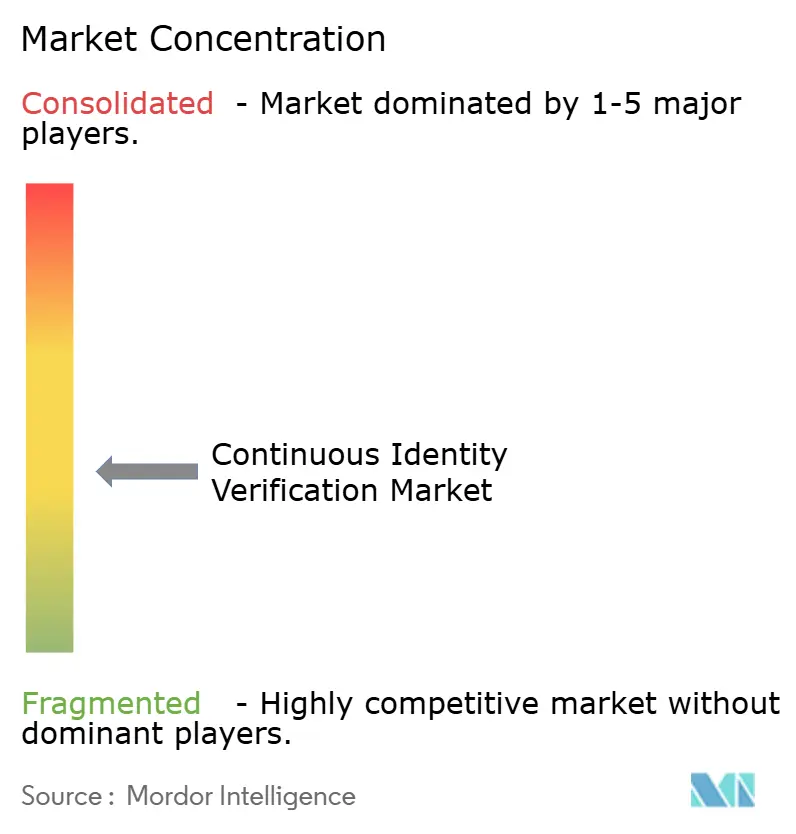
| Market Concentration | Medium |
Major Players *Disclaimer: Major Players sorted in no particular order Image © Mordor Intelligence. Reuse requires attribution under CC BY 4.0. | |
Continuous Identity Verification Market Analysis by Mordor Intelligence
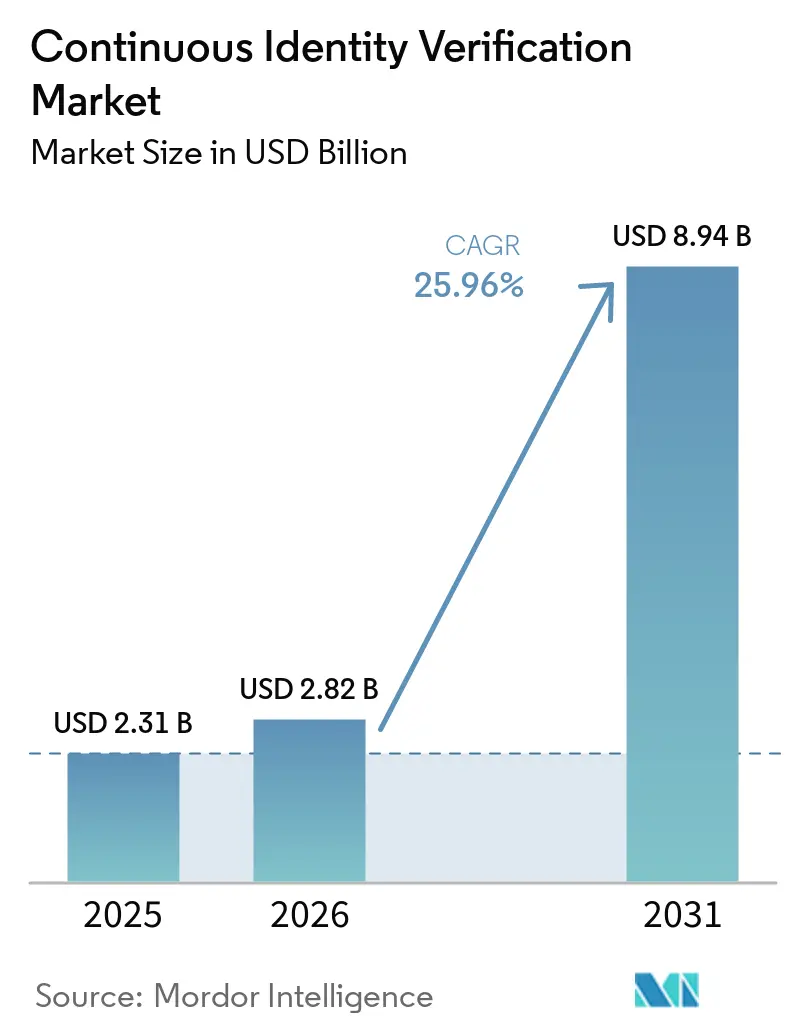
The continuous identity verification market size was valued at USD 2.31 billion in 2025 and estimated to grow from USD 2.82 billion in 2026 to reach USD 8.94 billion by 2031, at a CAGR of 25.96% during the forecast period (2026-2031). The continuous identity verification market is expanding as enterprises move from perimeter-based controls to identity-centered security programs. Higher losses from account takeover and the persistence of stolen session tokens are increasing demand for checks that continue after login. Buyers are prioritizing behavioral biometrics, passive liveness, and device-session intelligence because these tools can assess risk throughout a customer session. Large payment networks are acquiring behavioral intelligence capabilities, which is changing supplier choices for banks that manage both Visa and Mastercard portfolios. The continuous identity verification market also offers room for vendors that can support privacy controls, on-device processing, and deployment across regulated environments.
Key Report Takeaways
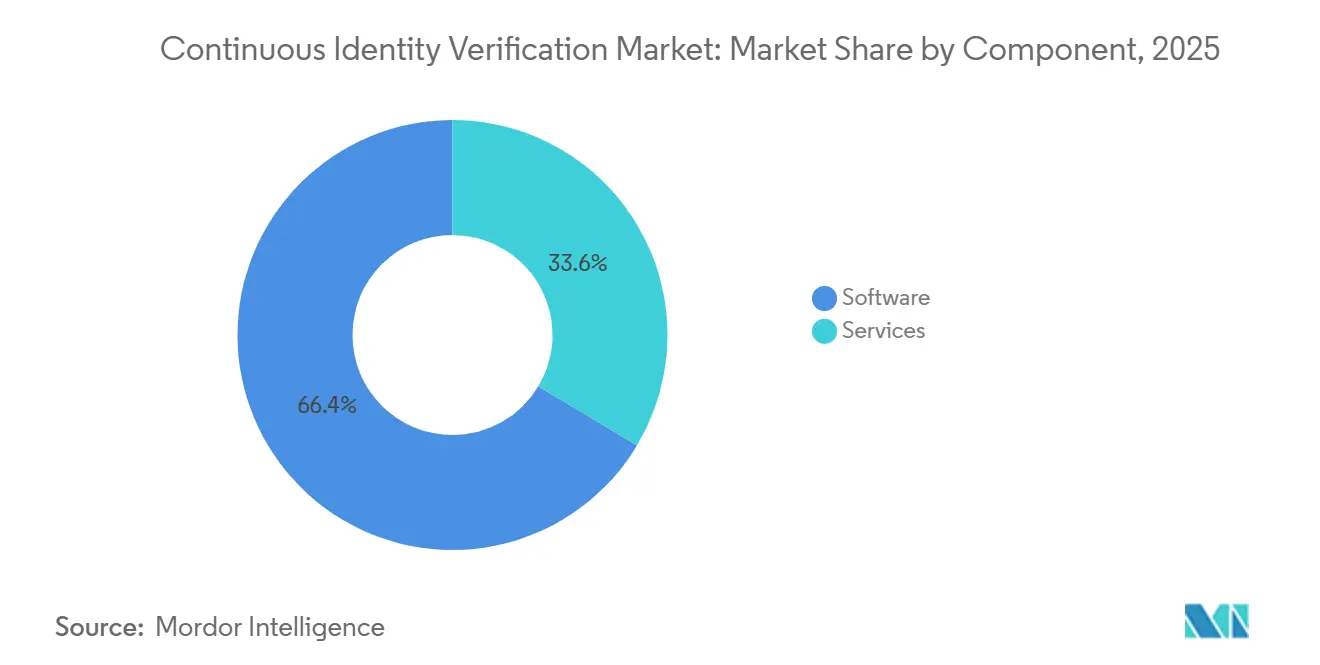
- By component, software held 66.43% of the continuous identity verification market share in 2025, while services are projected to expand at a 27.81% CAGR through 2031.
- By solution type, integrated multi-signal continuous identity platforms held 37.26% of revenue in 2025, while behavioral and interaction biometrics are projected to expand at a 31.29% CAGR through 2031.
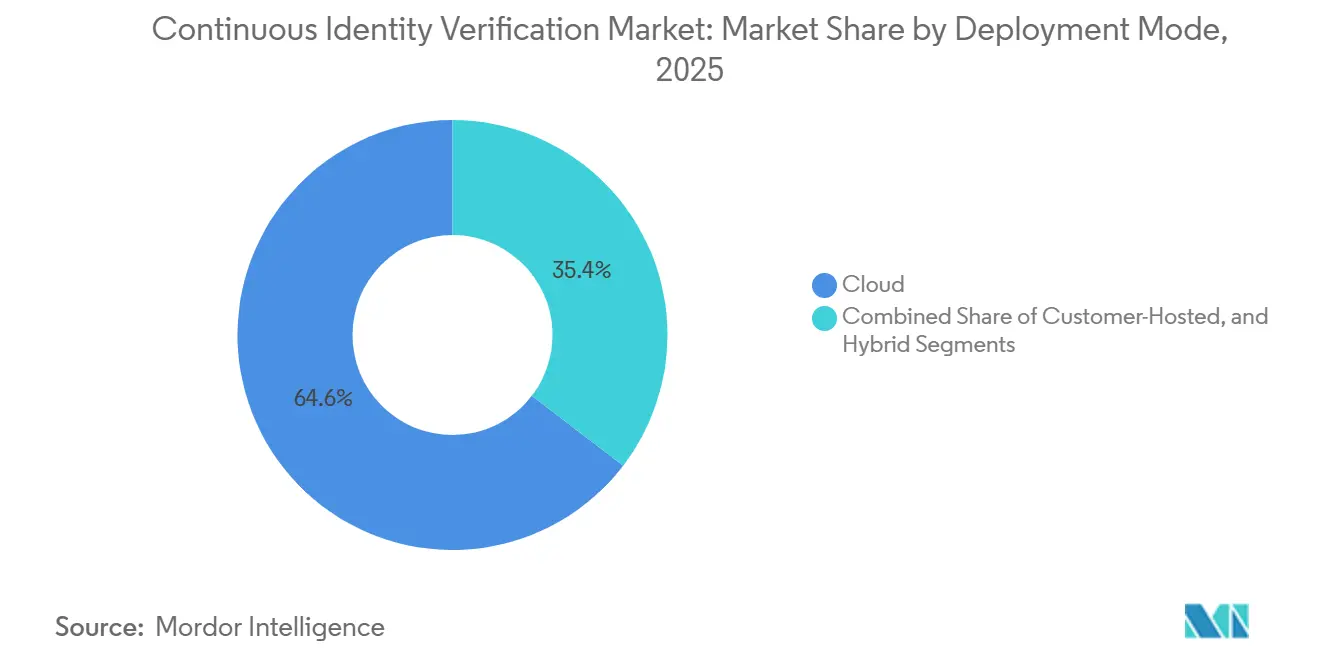
- By deployment mode, cloud deployment accounted for 64.59% of revenue in the continuous identity verification market in 2025, while hybrid deployment is projected to grow at a 28.36% CAGR through 2031.
- By end user, banks and financial institutions held 34.53% of revenue in 2025, while healthcare and life sciences are projected to expand at a 29.21% CAGR through 2031.
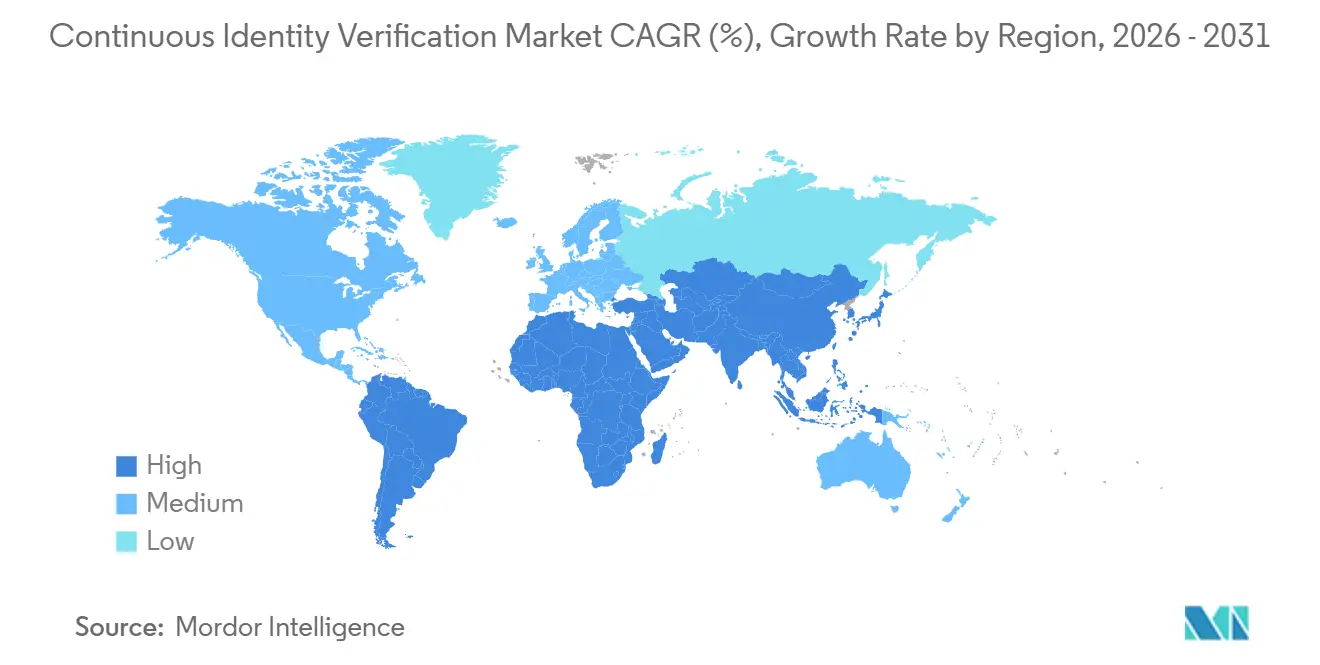
- By geography, North America held 36.72% of global revenue in the continuous identity verification market in 2025, while Asia-Pacific is projected to expand at a 31.86% CAGR through 2031.
Note: Market size and forecast figures in this report are generated using Mordor Intelligence’s proprietary estimation framework, updated with the latest available data and insights as of January 2026.
Global Continuous Identity Verification Market Trends and Insights
Drivers Impact Analysis*
| DRIVER | (~) % IMPACT ON CAGR FORECAST | GEOGRAPHIC RELEVANCE | IMPACT TIMELINE |
|---|---|---|---|
| Expansion of Zero-Trust and Identity-First Architectures | +6.5% | Global, with early gains in North America and Western Europe | Long term (≥ 4 years) |
| Escalation of Account Takeover and Session Hijacking | +5.8% | Global, concentrated in North America, the United Kingdom, and Asia-Pacific core markets | Short term (≤ 2 years) |
| Regulatory Pressure for Strong, Risk-Based Authentication | +4.3% | European Union and the United Kingdom, North America | Medium term (2-4 years) |
| Demand for Frictionless Fraud Prevention | +3.7% | Global, with faster adoption in Asia-Pacific and North America | Medium term (2-4 years) |
| Reusable Verified-Human Anchors for High-Risk Actions | +2.5% | Global, with early traction in the European Union and North America | Medium term (2-4 years) |
| Privacy-Preserving On-Device Behavioral Modeling | +2.0% | Global, with emphasis in privacy-stringent European Union and Asia-Pacific markets | Long term (≥ 4 years) |
| Source: Mordor Intelligence | |||
Expansion of Zero-Trust and Identity-First Architectures
Zero-trust programs require verification during a session rather than a check only at login. This change places identity controls at the center of access decisions in the continuous identity verification market, where the system must evaluate context rather than only validate a previously supplied credential. The National Security Agency published its Zero Trust Implementation Guidelines Primer for National Security Systems in January 2026, supporting a common approach for public-sector systems.[1] NIST Special Publication 1800-35 documented 19 commercially built reference implementations in June 2025. IBM reported in its 2025 analysis that organizations with mature zero-trust practices incurred USD 1.8 million less in breach costs than non-adopters. These requirements support budget allocation for tools that continuously assess identity risk, establish a repeatable control pattern, and do not rely solely on a fixed network boundary.
Escalation of Account Takeover and Session Hijacking
Account takeover is a major reason banks and digital businesses are reviewing persistent identity controls. The Federal Reserve described account takeover as a persistent threat in February 2026 and highlighted the need for coordinated fraud prevention measures.[2] Stolen credentials and session tokens can allow a criminal to remain active after a user completes an initial authentication step, leaving customers exposed even when a login control operates as intended. This problem gives the continuous identity verification market a role in monitoring device, behavioral, and session signals after access is granted. ThreatMark has described cases in which a coerced customer completes expected checks while fraud still occurs, which extends the need from identity matching to the detection of unusual session context. Institutions, therefore, need controls that can trigger review or step-up authentication when a valid session changes behavior, a shift that broadens the operational remit beyond login security.
Regulatory Pressure for Strong, Risk-Based Authentication
European payment rules are strengthening the case for risk-based authentication. The European Banking Authority recognizes behavioral data tied to physiological characteristics and behavioral processes as a valid inherence element for strong customer authentication. The FIDO Alliance called for standards-aligned authentication requirements in its April 2025 letter to the European Commission. The continuous identity verification market benefits when payment providers need to document how authentication decisions respond to changing risk and how their controls meet recognized authentication standards. At the same time, the EU AI Act requires controls around high-risk biometric uses, including oversight and conformity obligations. Vendors with established testing, audit evidence, and configurable policy controls are better placed to support buyers operating across jurisdictions.
Demand for Frictionless Fraud Prevention
Financial services providers need to limit fraud without creating unnecessary delays during onboarding or payments. A reusable identity can allow a prior verified biometric event to support quieter reauthentication in later sessions. Jumio reported in September 2026 that its selfie.DONE deployments in Asia-Pacific increased verification completion rates by 20%, with up to 60% of users completing verification without submitting a document. The result shows why buyers value methods that reduce the need for repeated document requests while retaining a verification record and a process for handling higher-risk events. The continuous identity verification market can benefit when a behavioral baseline reduces the operational cost of repeated checks. Adoption still depends on transparent consent and clear escalation paths for customers whose session risk changes.
Restraints Impact Analysis*
| RESTRAINT | (~) % IMPACT ON CAGR FORECAST | GEOGRAPHIC RELEVANCE | IMPACT TIMELINE |
|---|---|---|---|
| Biometric Privacy, Consent, and Algorithmic Governance Burden | -3.4% | North America, the European Union, and global markets | Long term (≥ 4 years) |
| Integration Complexity Across Identity, Fraud, and Core Systems | -2.8% | Global, especially large enterprises in North America and Europe | Medium term (2-4 years) |
| Behavioral Drift and Limited Ground Truth for New Users | -1.9% | Global | Medium term (2-4 years) |
| Adversarial Mimicry, Sensor Spoofing, and Remote-Access Tool Evasion | -1.5% | Global, with pressure in Asia-Pacific and North America | Short term (≤ 2 years) |
| Source: Mordor Intelligence | |||
Biometric Privacy, Consent, and Algorithmic Governance Burden
Biometric privacy rules can slow deployment when providers must meet different requirements in every operating location. Illinois BIPA requires notice, consent, and retention practices, and it allows private legal action for alleged violations. These requirements make governance, recordkeeping, and clear customer communication central deployment considerations. Vendors in the continuous identity verification market must manage consent flows, data-residency settings, and documentation for their models. These tasks become more demanding in multi-tenant platforms that serve customers in several legal jurisdictions. Privacy-preserving architectures can reduce the burden, but they do not remove the need for governance and customer communication.
Integration Complexity Across Identity, Fraud, and Core Systems
Large financial institutions often connect an identity platform to core banking, fraud decisioning, identity governance, and legacy authentication systems. There is no single standard application programming interface for session-level behavioral telemetry. As a result, teams must build connectors, normalize data, and reconcile risk policies across systems that were previously managed separately. ThreatMark joined EBA CLEARING's Fraud Pattern and Anomaly Detection program in March 2026, allowing its behavioral intelligence to be used within payment-monitoring flows.[3] The continuous identity verification market faces longer sales cycles when deployment requires this level of integration and when buyers must align security, fraud, and technology teams. Providers with existing connectors and managed-service capabilities may reduce implementation effort for buyers with limited internal resources.
*Our forecasts treat driver/restraint impacts as directional, not additive. The impact forecasts reflect baseline growth, mix effects, and variable interactions.
Segment Analysis
By Component: Software Supports Revenue While Services Address Deployment Needs
Software held 66.43% of the continuous identity verification market share in 2025. This position reflects recurring licensing for behavioral intelligence engines, risk-scoring modules, and identity orchestration platforms across customer onboarding, login, and transaction workflows. Platform vendors can bundle behavioral signals, device indicators, and case-management functions in one operating environment, which helps banks apply policies consistently as fraud patterns change. The software layer supports recurring revenue, but buyers still need implementation work before they use the full capability set. This durable software base gives the continuous identity verification market a practical foundation for broader identity security programs.
Services are projected to record a 27.81% CAGR from 2026 to 2031, the fastest rate within the component split. Implementation, managed detection, integration advisory, and policy configuration account for this demand. The continuous identity verification market is seeing many organizations move from contained pilots to broader deployments across business units and customer journeys. These programs require adaptation to existing fraud controls and jurisdiction-specific rules. InnaIT Technologies provides configurable behavioral trust policies aligned with the Reserve Bank of India's Authentication Directions 2025, illustrating how local compliance needs shape service work.[4]
By Solution Type: Integrated Platforms Lead While Behavioral Biometrics Grow Faster
Integrated multi-signal platforms accounted for 37.26% of revenue in 2025. Enterprises select these platforms to combine behavioral, device, biometric, and session information into a single risk score and avoid managing separate controls for each signal. BioCatch states that its platform evaluates more than 3,000 anonymized data points per session, including typing patterns, touch behavior, and application signals.[5] The continuous identity verification market favors integrated platforms when enterprises need a consistent decision process from onboarding through payment authorization. A unified approach can also simplify case review when a risk event is detected.
Behavioral and interaction biometrics are projected to grow at a 31.29% CAGR from 2026 to 2031. In continuous identity verification market deployments, these tools address session hijacking, remote-access tool fraud, and authorized payment scams that can pass static biometric or device checks. Research published in Mobile Networks and Applications in 2026 reported a behavioral two-factor authentication model that achieved a 97.28% area under the curve using sensor data. Biometric reverification, passive liveness, device and session intelligence, and continuous risk scoring are developing as distinct product categories. iProov achieved CEN/TS 18099 High and Ingenium Level 4 certification for injection attack detection in February 2026, helping define expectations for regulated-sector liveness procurement.
By Deployment Mode: Cloud Leads While Hybrid Models Address Data Controls
Cloud deployment held 64.59% of revenue in 2025. The model supports automatic updates, elastic capacity, and shared learning from signals across a provider's client base. It reduces the infrastructure work required for a customer to start using a new identity control and suits digital-first financial providers that need fast application programming interface-led integration. Cloud systems can deliver revised risk models without requiring customers to operate each change locally. The continuous identity verification market size for cloud deployments is supported by these operating advantages, although data-handling policies remain important for regulated buyers.
Hybrid deployment is projected to expand at a 28.36% CAGR from 2026 to 2031. These configurations let an institution separate local processing of behavioral telemetry from cloud-based risk scoring and orchestration. An IEEE Transactions on Services Computing study in 2026 reported more than 92.7% accuracy for a federated-learning behavioral authentication framework under differential-privacy protections. This evidence supports approaches that train or process data closer to the device, rather than centrally transferring raw biometric information. Within continuous identity verification market implementations, hybrid design can meet privacy requirements while retaining centralized analytics for European Union-regulated deployments and other buyers with strict biometric data controls.

By End User: Financial Institutions Lead While Healthcare and Life Sciences Accelerate
Banks and financial institutions held 34.53% of revenue in 2025. Their leading position reflects high transaction volumes, direct exposure to fraud, and extensive regulatory obligations. BioCatch serves more than 350 banking clients globally, including 3 of the 4 largest U.S. banks by assets as of early 2026. Fintechs and payment providers use continuous identity verification market platforms because they need cloud-based controls that fit digital customer experiences. Insurance, retail, e-commerce, telecommunications, and government programs use persistent identity checks to address account takeover, loyalty fraud, and access to digital benefits.
Healthcare and life sciences are projected to grow at a 29.21% CAGR from 2026 to 2031. Shared clinical devices, patient safety requirements, and the need to control access to electronic health records support this demand. These conditions create a need for checks that continue after an initial proofing event, rather than relying solely on a single login decision. LexisNexis Risk Solutions introduced a healthcare identity management platform in February 2026, while Ping Identity and OLOID announced a passwordless trust model for the U.S. clinical workforce in May 2026. These initiatives show why healthcare is becoming an important growth area for the continuous identity verification market.
Geography Analysis
North America held 36.72% of global revenue in 2025. Established banking deployments collect and analyze behavioral signals at scale, while the National Security Agency's January 2026 guidance and NIST Special Publication 800-63-4 support identity-centered security approaches in federal and commercial settings. State biometric laws in Illinois, Texas, and Washington are shaping requirements for consent management, processing, and on-device control. The regional position reflects the concentration of large financial institutions that require ongoing fraud monitoring.
Asia-Pacific is projected to expand at a 31.86% CAGR from 2026 to 2031. Mobile-first banking, national digital identity programs, and cross-border commerce drive demand for real-time checks, benefiting the continuous identity verification market through high-volume digital activity. Jumio expanded selfie.DONE across Asia-Pacific in September 2026, reporting a 20% increase in verification completion rates and up to 60% completion without a document submission. Facephi entered Japan through Hancom in February 2026 and contracted with Cyberlinks for eKYC and non-face-to-face authentication. India, South Korea, China, Australia, and other Asia-Pacific markets offer high-volume opportunities across financial services and public digital services.
Europe held the second-largest geographic position in 2025. PSD2 strong customer authentication requirements made behavioral biometrics a relevant infrastructure investment, and the European Banking Authority provides a regulatory basis for its use. ThreatMark joined EBA CLEARING's program in March 2026, and Entersekt partnered with CGI in Norway in June 2026 for cloud-based 3-D Secure authentication. South America is emerging, while the Middle East and Africa are earlier-stage regions where financial digitization is creating demand for cloud-based platforms.
Competitive Landscape
The continuous identity verification market is moderately fragmented at the solution layer but is consolidating at the platform layer. Visa announced a definitive agreement in August 2026 to acquire BioCatch for USD 2.4 billion, subject to regulatory approval, and stated that BioCatch processes 19 billion user sessions each month and reported USD 185 million in annual recurring revenue in 2025. This acquisition raises vendor-neutrality questions for financial institutions that manage relationships across payment networks. Callsign and ThreatMark remain important independent vendors at the banking scale. Buyers are therefore reviewing change-of-control and neutrality provisions during procurement.
Leading companies are using localized partnerships to reach regulated markets. Facephi entered Japan through Hancom and began work with Cyberlinks on eKYC and non-face-to-face authentication.[6] Entersekt partnered with CGI to provide cloud-based 3-D Secure authentication for Nordic issuing banks. Jumio introduced Jumio Watch in April 2026 to monitor behavioral, device, and network signals after onboarding. iProov launched its Workforce Solution Suite in March 2026 for remote hiring, shared-device access, privileged access, and account recovery. These actions show a shift from one-time proofing toward recurring monitoring and workforce assurance.
Technical assurance is an important source of differentiation in the continuous identity verification market. iProov's February 2026 certification for injection attack detection supports its position in government and regulated-enterprise liveness procurement. Federated learning and differential privacy are relevant for vendors targeting markets with strict biometric data rules, as examined in 2026 research on privacy-preserving mouse-dynamics authentication. Opportunities remain in mid-market healthcare, government digital services outside North America, and smaller fintech platforms that need prebuilt connectors, clear data-governance controls, and support for multi-vendor integration.
Continuous Identity Verification Industry Leaders
-
BioCatch Ltd.
-
Callsign Inc.
-
ThreatMark s.r.o.
-
Mastercard Incorporated
-
Facephi Biometria S.A.
- *Disclaimer: Major Players sorted in no particular order
Recent Industry Developments
- September 2026: Jumio launched selfie.DONE across Asia-Pacific, following successful rollouts in South America and North America. Deployments showed a 20% increase in verification completion rates, with up to 60% of users verifying via selfie alone, supported by a global identity graph of more than 75 million identities growing at 85,000 per day.
- June 2026: Jumio became the first identity intelligence provider to enable digital ID acceptance across more than 60 countries through a single integration, including eIDAS-compliant eIDs across nearly 20 European Union countries through a Trinsic partnership. The capability eliminates separate vendor relationships and country-by-country accreditation requirements for cross-border digital onboarding.
- June 2026: Entersekt and CGI announced a partnership in Norway to deliver cloud-based 3-D Secure authentication for Nordic issuing banks, with Santander Norway as the first joint client. Entersekt's EMVCo-certified Access Control Server delivers adaptive, risk-based decisioning including biometrics, in-app approval, and FIDO authentication.
- May 2026: iProov announced iProov Verified Meetings, enabling real-time biometric verification of video call participants to detect AI-generated deepfakes and injection attacks. The product forms part of iProov's Workforce Solution Suite for enterprise video conferencing.
Global Continuous Identity Verification Market Report Scope
The continuous identity verification market comprises solutions that continuously authenticate users and assess risk during active sessions, rather than only at onboarding or login. These solutions detect account takeover, session hijacking, and fraudulent activity in real time. The market uses behavioral biometrics, device and session intelligence, passive liveness detection, and continuous risk scoring to maintain trust without requiring intrusive step-up verification, such as one-time passwords (OTPs) and security questions. Solutions integrate with fraud prevention, anti-money laundering (AML), and access control systems to enable frictionless authentication aligned with PSD2/SCA exemptions and NIST AAL guidelines. They serve the BFSI, eCommerce, healthcare, and digital services sectors, addressing credential stuffing, session fixation, and man-in-the-browser attacks while supporting the behavioral biometrics market.
The Continuous Identity Verification Market Report is Segmented by Component (Software, and Services), Solution Type (Behavioral and Interaction Biometrics, Biometric Reverification and Passive Liveness, Device and Session Identity Intelligence, Continuous Identity Risk Scoring and Decision Orchestration, and Integrated Multi-Signal Continuous Identity Platforms), Deployment Mode (Cloud, Customer-Hosted, and Hybrid), End User (Banks and Financial Institutions, Fintechs and Payment Service Providers, Insurance Companies, Retail, E-Commerce and Marketplaces, Technology, Media, and Telecommunications, Healthcare and Life Sciences, Government and Public Administration, and Other End Users), and Geography (North America, South America, Europe, Asia-Pacific, and Middle East and Africa). The Market Forecasts are Provided in Terms of Value (USD).
| Software |
| Services |
| Behavioral and Interaction Biometrics |
| Biometric Reverification and Passive Liveness |
| Device and Session Identity Intelligence |
| Continuous Identity Risk Scoring and Decision Orchestration |
| Integrated Multi-Signal Continuous Identity Platforms |
| Cloud |
| Customer-Hosted |
| Hybrid |
| Banks and Financial Institutions |
| Fintechs and Payment Service Providers |
| Insurance Companies |
| Retail, E-Commerce and Marketplaces |
| Technology, Media, and Telecommunications |
| Healthcare and Life Sciences |
| Government and Public Administration |
| Other End Users |
| North America | United States | |
| Canada | ||
| South America | Brazil | |
| Argentina | ||
| Mexico | ||
| Rest of South America | ||
| Europe | Germany | |
| United Kingdom | ||
| France | ||
| Italy | ||
| Spain | ||
| Russia | ||
| Rest of Europe | ||
| Asia-Pacific | China | |
| Japan | ||
| India | ||
| South Korea | ||
| Australia | ||
| Rest of Asia-Pacific | ||
| Middle East and Africa | Middle East | Saudi Arabia |
| United Arab Emirates | ||
| Rest of Middle East | ||
| Africa | South Africa | |
| Egypt | ||
| Rest of Africa | ||
| By Component | Software | ||
| Services | |||
| By Solution Type | Behavioral and Interaction Biometrics | ||
| Biometric Reverification and Passive Liveness | |||
| Device and Session Identity Intelligence | |||
| Continuous Identity Risk Scoring and Decision Orchestration | |||
| Integrated Multi-Signal Continuous Identity Platforms | |||
| By Deployment Mode | Cloud | ||
| Customer-Hosted | |||
| Hybrid | |||
| By End User | Banks and Financial Institutions | ||
| Fintechs and Payment Service Providers | |||
| Insurance Companies | |||
| Retail, E-Commerce and Marketplaces | |||
| Technology, Media, and Telecommunications | |||
| Healthcare and Life Sciences | |||
| Government and Public Administration | |||
| Other End Users | |||
| By Geography | North America | United States | |
| Canada | |||
| South America | Brazil | ||
| Argentina | |||
| Mexico | |||
| Rest of South America | |||
| Europe | Germany | ||
| United Kingdom | |||
| France | |||
| Italy | |||
| Spain | |||
| Russia | |||
| Rest of Europe | |||
| Asia-Pacific | China | ||
| Japan | |||
| India | |||
| South Korea | |||
| Australia | |||
| Rest of Asia-Pacific | |||
| Middle East and Africa | Middle East | Saudi Arabia | |
| United Arab Emirates | |||
| Rest of Middle East | |||
| Africa | South Africa | ||
| Egypt | |||
| Rest of Africa | |||
Key Questions Answered in the Report
What is the size of the continuous identity verification market?
The continuous identity verification market was valued at USD 2.31 billion in 2025 and is estimated at USD 2.82 billion in 2026. It is forecast to reach USD 8.94 billion by 2031 at a 25.96% CAGR.
What is driving adoption of continuous identity verification?
Zero-trust programs, account takeover risk, risk-based authentication rules, and the need to reduce customer friction are supporting adoption.
Which component leads revenue in continuous identity verification?
Software led with 66.43% of revenue in 2025. Services are projected to grow faster at a 27.81% CAGR through 2031.
Which deployment approach is most widely used?
Cloud deployment held 64.59% of revenue in 2025 because it supports model updates, scaling, and application programming interface-led integration.
Why is healthcare becoming important for identity assurance providers?
Healthcare and life sciences are projected to grow at a 29.21% CAGR through 2031 as providers address shared-device access, patient safety, and electronic health record security.
Which region is expected to grow the fastest?
Asia-Pacific is projected to grow at a 31.86% CAGR through 2031, supported by mobile banking, digital identity programs, and cross-border commerce.