
Business Identity Verification Market Size and Share
Market Overview
| Study Period | 2020 - 2031 |
|---|---|
| Market Size (2026) | USD 7.02 Billion |
| Market Size (2031) | USD 15.18 Billion |
| Growth Rate (2026 - 2031) | 16.68 % |
| Fastest Growing Market | Asia-Pacific |
| Largest Market | North America |
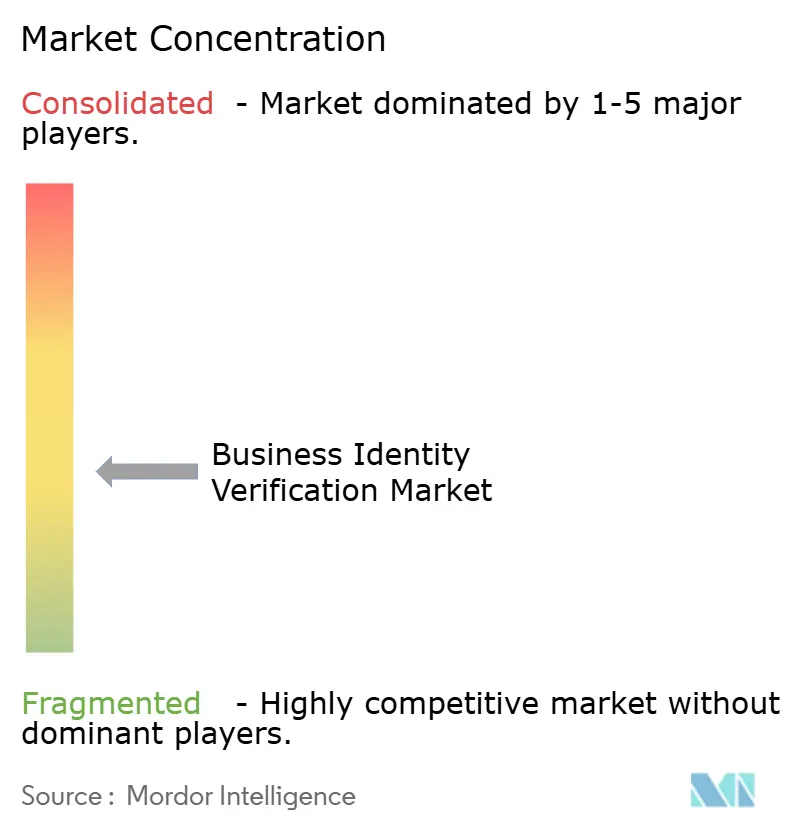
| Market Concentration | Medium |
Major Players *Disclaimer: Major Players sorted in no particular order Image © Mordor Intelligence. Reuse requires attribution under CC BY 4.0. | |
Business Identity Verification Market Analysis by Mordor Intelligence
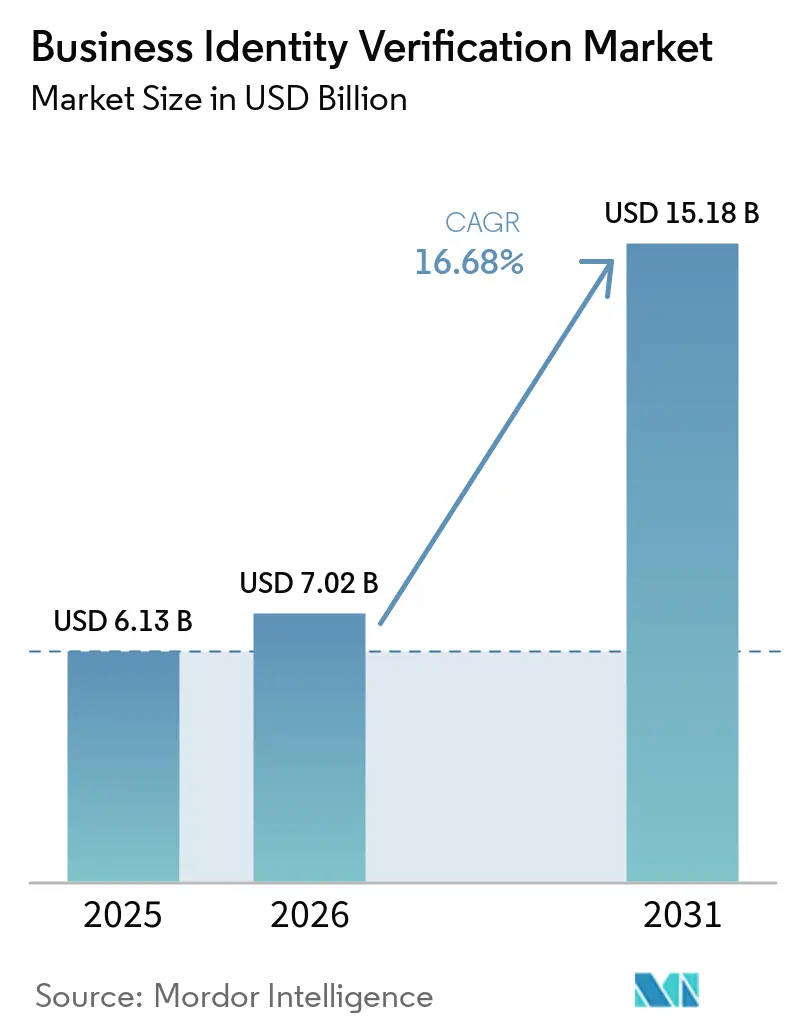
The business identity verification market size is projected to expand from USD 6.13 billion in 2025 to USD 7.02 billion in 2026, and to USD 15.18 billion by 2031, registering a CAGR of 16.68% between 2026 and 2031. The Business identity verification market is growing as digital onboarding replaces manual business verification across banking, payments, and embedded finance, where commercial relationships increasingly begin through connected online systems rather than paper forms and in-person reviews. Beneficial ownership rules have raised the standard for business due diligence and increased demand for accurate, up-to-date ownership data, since a company registration alone may not reveal the natural persons who control a business or benefit from its activities. Institutions increasingly need continuous checks rather than a one-time review onboarding, because changes in ownership, sanctions exposure, and other risk signals can emerge after a customer relationship begins. This shift favors platforms that integrate entity verification, screening, monitoring, and case management into a single workflow, while software subscriptions and managed services offer providers recurring revenue opportunities as verification volumes grow. The Business identity verification market also rewards providers with local registry links and established regulatory coverage, as buyers operating in several countries need consistent tools that still account for differences in local data and compliance requirements.
Key Report Takeaways
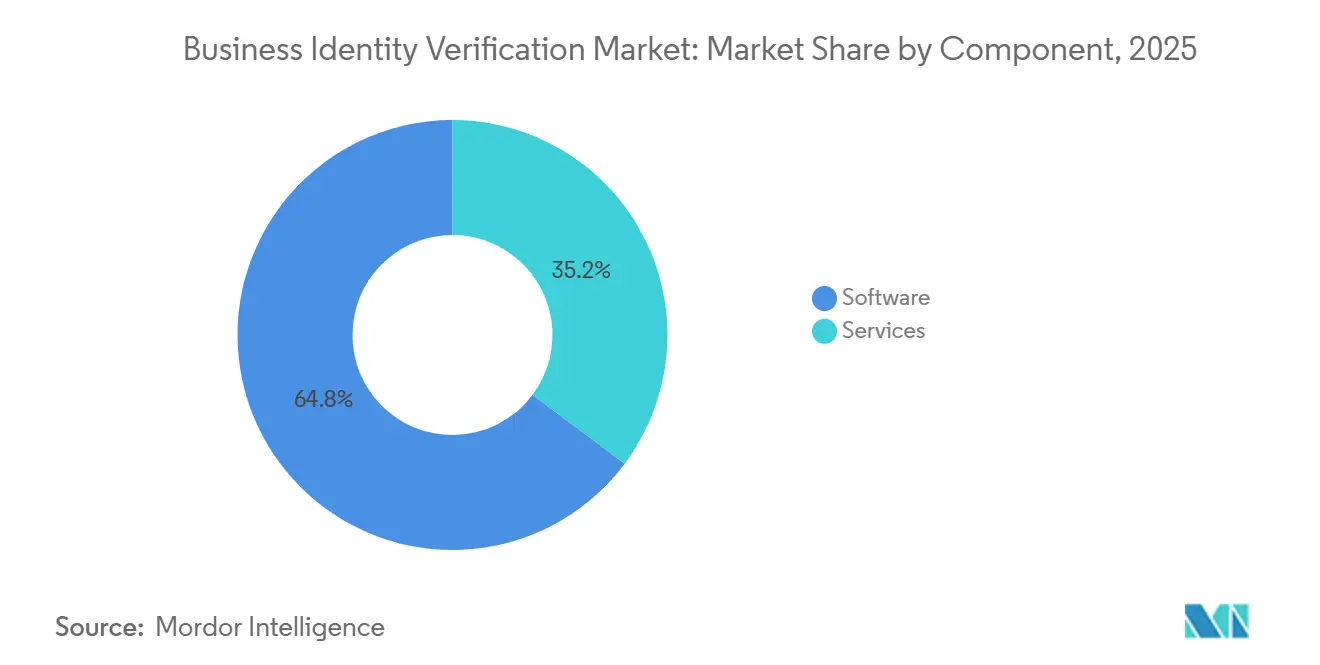
- By component, software held 64.79% of the business identity verification market revenue in 2025, while services are projected to expand at an 18.27% CAGR through 2031.
- By deployment mode, cloud-based deployments accounted for 68.53% of revenue in 2025 and are projected to grow at a 19.74% CAGR through 2031.
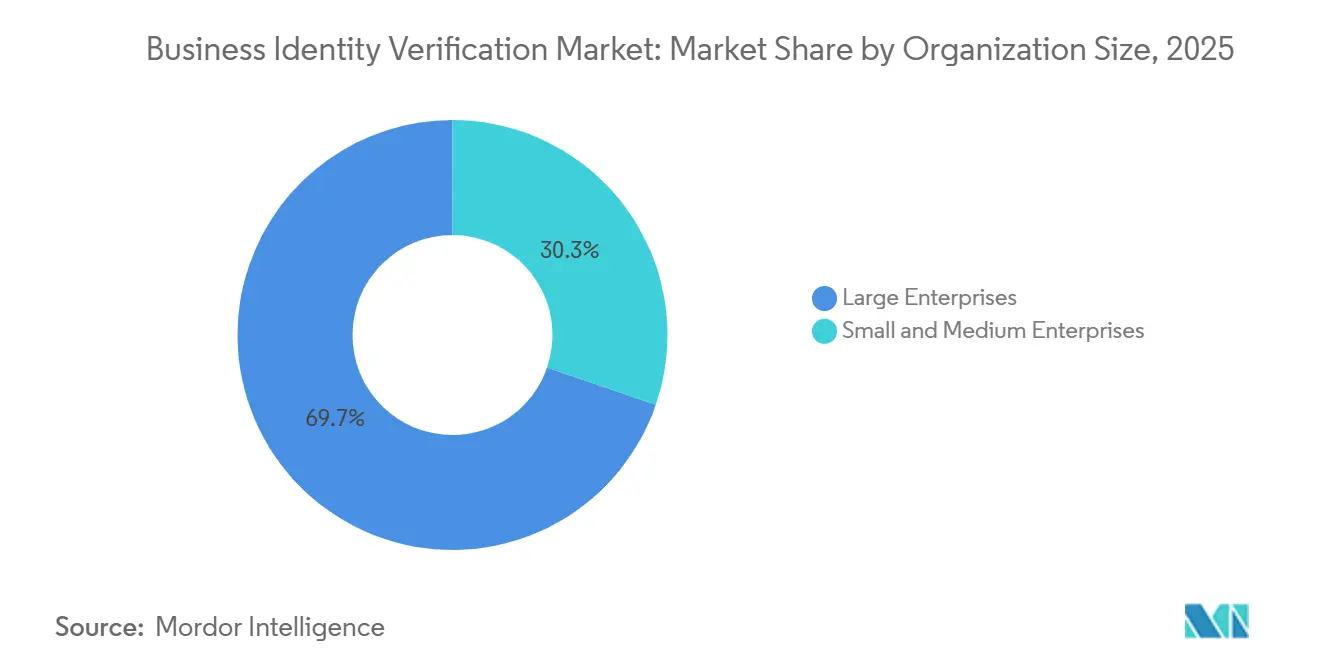
- By organization size, large enterprises accounted for 69.74% of revenue in the business identity verification market in 2025, while small and medium enterprises are projected to expand at a 19.81% CAGR through 2031.
- By end user, banking and credit unions held 39.21% of revenue in 2025, while fintech, embedded finance, and digital lending platforms are projected to expand at a 21.13% CAGR through 2031.
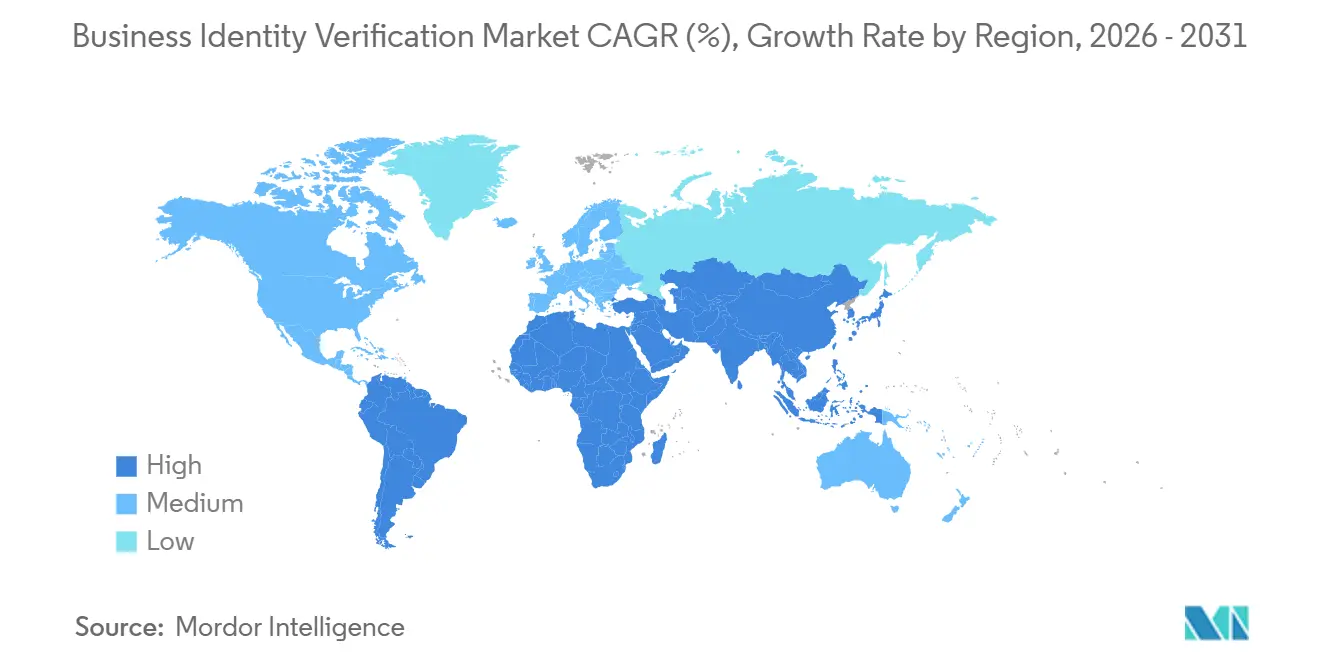
- By geography, North America held 41.38% of global revenue in the business identity verification market in 2025, while Asia-Pacific is projected to expand at a 19.27% CAGR through 2031.
Note: Market size and forecast figures in this report are generated using Mordor Intelligence’s proprietary estimation framework, updated with the latest available data and insights as of January 2026.
Global Business Identity Verification Market Trends and Insights
Drivers Impact Analysis*
| DRIVER | (~) % IMPACT ON CAGR FORECAST | GEOGRAPHIC RELEVANCE | IMPACT TIMELINE |
|---|---|---|---|
| Expansion of Digital B2B Onboarding | +4.5% | Global, with concentration in North America, Europe, and Asia-Pacific | Medium term (2-4 years) |
| Escalating Corporate Fraud and Shell-Entity Risk | +3.5% | Global, with higher intensity in North America and Europe | Short term (≤ 2 years) |
| Regulatory Push for Beneficial Ownership Transparency | +3.0% | EU, UK, US, Asia-Pacific, Singapore, India, and Australia | Medium term (2-4 years) |
| Embedded Finance and Platform KYB Adoption | +2.5% | North America, Europe, South Asia, and Southeast Asia | Medium term (2-4 years) |
| Registry Fragmentation and Entity Resolution Graphs | +1.5% | Global, acute in Asia-Pacific and South America | Long term (≥ 4 years) |
| Machine-Readable Records and Event-Driven Monitoring | +1.2% | EU, UK, North America, and Singapore | Long term (≥ 4 years) |
| Source: Mordor Intelligence | |||
Expansion of Digital B2B Onboarding
Digital commercial account opening has shortened onboarding from weeks to hours in many financial and platform settings, especially where a business relationship begins through a digital channel. The faster process also allows fraudulent or shell entities to seek access at a larger scale, before staff have time to assess ownership and operating history. The Business identity verification market benefits because regulated institutions now treat entity checks as a software-based workflow instead of a branch-level manual review, and they need systems that can handle consistent volumes without weakening controls. Registry data alone often cannot establish who ultimately controls an onboarding business, particularly when ownership is layered across several entities or jurisdictions. Trulioo reported that its U.S. KYB transaction volume rose 1,996% since 2023 and increased 102% during 2025.[1] This change converts occasional onboarding projects into recurring data, review, and monitoring needs for institutions, making verification part of their regular operating processes.
Escalating Corporate Fraud and Shell-Entity Risk
Corporate fraud and shell entities continue to expose weaknesses in document-based business verification, particularly where an apparently valid company record provides little clarity on control or risk. The Financial Action Task Force recommendations require countries to make adequate, accurate, and current beneficial ownership information available to competent authorities.[2] The business identity verification market, therefore, increasingly serves organizations that need to identify ownership changes, sanctions exposure, and other risk signals after onboarding rather than only at the initial application stage. Synthetic corporate records and misleading digital footprints can weaken workflows that depend on static documents or a single registry search. Providers are responding with continuous risk scores that incorporate registry updates, sanctions additions, and adverse media in a more connected review process. Ongoing monitoring makes business verification part of an institution’s broader financial crime control process and reduces reliance on a single decision made during onboarding.
Regulatory Push for Beneficial Ownership Transparency
The final U.S. beneficial ownership reporting rule issued in August 2026 exempted domestic companies and U.S. persons from the reporting requirement. Financial institutions must still conduct their own due diligence where applicable, which underscores the importance of independent verification when they need current, sufficient evidence for their compliance obligations. Regulation (EU) 2024/1624 creates a more unified anti-money-laundering framework for the EU and will apply from July 2027. The Business identity verification market is affected as regulations increase the importance of current beneficial ownership information, ongoing customer monitoring, and workflows that document the basis for a review. In Singapore, the Monetary Authority of Singapore imposed SGD 27.45 million (USD 20.5 million) in composition penalties on 9 financial institutions in 2025. The enforcement action focused attention on post-customer-onboarding monitoring and signaled that a completed initial check may not be enough.
Embedded Finance and Platform KYB Adoption
Embedded finance has expanded KYB requirements beyond the traditional compliance budgets of banks, because platforms now frequently connect merchants and customers with payment or lending services. Marketplaces, gig platforms, software providers, buy-now-pay-later firms, and lending platforms may be onboard business merchants at considerable volume without having legacy compliance teams. The Reserve Bank of India’s payment aggregator direction requires merchant due diligence under the KYC framework. This requirement extended business verification obligations across payment platforms and their merchant relationships, including firms that, in practice, operate as financial intermediaries. The Business identity verification market gains new buyers when platforms handle money or facilitate financial services, which extends demand beyond licensed financial institutions. A 2024 partnership between Middesk and Backbase integrated KYB capabilities into digital banking infrastructure. The partnership shows how verification is moving into the distribution layer as well as the compliance product, allowing users to access it inside existing onboarding journeys.
Restraints Impact Analysis*
| RESTRAINT | (~) % IMPACT ON CAGR FORECAST | GEOGRAPHIC RELEVANCE | IMPACT TIMELINE |
|---|---|---|---|
| Fragmented Cross-Border Regulatory Requirements | -3.5% | Global, acute across Asia-Pacific and South America | Long term (≥ 4 years) |
| Data Access, Privacy, and Data Sovereignty Constraints | -2.5% | EU, Asia-Pacific, and Middle East | Medium term (2-4 years) |
| False Positives in Complex Ownership Structures | -1.8% | Global, with high impact in North America and Europe | Medium term (2-4 years) |
| Adversarial Manipulation of Corporate Digital Footprints | -1.2% | Global | Short term (≤ 2 years) |
| Source: Mordor Intelligence | |||
Fragmented Cross-Border Regulatory Requirements
Cross-border regulatory differences remain a core constraint for the Business identity verification market because buyers cannot assume that an approach accepted in one country will meet requirements in another. FATF Recommendation 24 provides a global reference, but countries implement ownership thresholds, document rules, and registry access in different ways. Vendors must connect data sources and encode local compliance logic as they enter each additional jurisdiction, which can make international coverage slower and more expensive to build. The Business identity verification market favors providers that have already invested in these integrations and can maintain them as rules, registers, and data access methods change. Fenergo stated that its Fen-AI system incorporates regulatory logic for 120 jurisdictions. Buyers may still require supplementary tools where a single platform does not cover their target markets or cannot support their particular operating model.
Data Access, Privacy, and Data Sovereignty Constraints
KYB workflows depend on corporate registers, ownership information, and third-party intelligence, but the availability and permitted use of that data vary considerably by jurisdiction. EU anti-money-laundering rules place requirements on the use and handling of personal data linked to beneficial owners.[3] Providers operating across borders must handle data residency, consent, storage, and transfer requirements within their own systems, rather than treating data access as separate technical questions. These requirements can delay new-market deployment and add legal work to product implementation, especially when a global system must comply with local storage rules. The Association of Belgian Banks outlined ongoing efforts to identify ultimate beneficial owners during the transition to the AMLR. The business identity verification market must therefore address unresolved technical and operational details as institutions prepare their systems and controls for the new framework.
*Our forecasts treat driver/restraint impacts as directional, not additive. The impact forecasts reflect baseline growth, mix effects, and variable interactions.
Segment Analysis
By Component: Software Leads Revenue While Services Expand
Software held 64.79% of the business identity verification market share in 2025. License and subscription models support recurring revenue as customers process more business checks. API-led platforms can process additional entity verifications without a corresponding increase in consulting headcount. This operating model explains why software remained the largest component. Software also provides the system layer for screening, ownership research, monitoring, and case management. Institutions use these functions to integrate business due diligence into their existing onboarding systems.
Services are projected to expand to an 18.27% CAGR from 2026 to 2031. Demand includes implementation support, regulatory advisory, and managed KYB operations. Mid-tier banks, payment aggregators, and insurers may lack the internal resources to maintain complex verification programs. These buyers increasingly seek an operating outcome rather than a standalone tool. The Business identity verification market is therefore developing a larger managed services revenue stream alongside its platform revenue. Ongoing obligations under the EU AMLR are expected to reinforce demand for specialist support after initial implementation.
By Deployment Mode: Cloud Systems Support Real-Time Verification
Cloud-based deployments accounted for 68.53% of revenue in 2025 and are projected to grow at a 19.74% CAGR through 2031. This position reflects the need for API-based verification and access to data across several jurisdictions. Cloud systems can support real-time checks as customer volumes change. They also enable providers to update screening and monitoring functions without a separate installation at each customer site. These features make cloud deployment central to the Business identity verification market for organizations with digitally managed onboarding.
On-premises systems remain relevant for large institutions with legacy governance requirements or strict data-residency rules. Hybrid configurations are gaining use among global banks that need cloud operations while retaining local controls. The EU framework will influence design choices where institutions reconcile information across member-state registers. Fenergo’s Fen-AI is a cloud-native platform designed to incorporate jurisdiction-specific regulatory logic. As technical standards mature, more organizations are expected to move toward cloud-based operations.
By Organization Size: Large Enterprises Lead While SMEs Gain Access
Large enterprises held 69.74% of revenue in 2025. Banks and global insurers have statutory due diligence obligations and the resources to deploy enterprise-grade platforms. A large bank may require a single platform across many markets, resulting in much larger contract values than a typical small-business implementation. The Business identity verification market size for this group reflects its early adoption of formal business verification tools. Large enterprises also need coverage across more registries, risk categories, and legal entities.
Small and medium enterprises are projected to expand at a 19.81% CAGR from 2026 to 2031. Their adoption is linked to the requirements set by payment platforms, marketplaces, and embedded-finance providers. Merchant due diligence rules can bring smaller firms into formal verification workflows even when they are not directly regulated institutions. The Reserve Bank of India’s payment aggregator direction illustrates this channel because it requires merchant onboarding due diligence under the KYC framework. Middesk launched its Signal tool in 2024 to provide rapid business risk scoring for high-volume verification workflows.[4] Product design is adapting to the speed and volume requirements of onboarding smaller businesses.
By End User: Banking Anchors Demand While Fintech Grows Faster
Banking and credit unions held 39.21% of revenue in 2025. Their position stems from mandatory entity due diligence under U.S., EU, and national anti-money-laundering frameworks. Banks must identify businesses and understand ownership before opening or maintaining many commercial relationships. The Business identity verification market share held by this group reflects the established compliance needs of deposit-taking institutions. Their workflows are shifting from onboarding checks toward continuous monitoring of customers and ownership data.
Fintech, embedded finance, and digital lending platforms are projected to expand at a 21.13% CAGR from 2026 to 2031. These platforms are on board with merchants and business customers across payments, lending, and marketplace models. Payments, merchant acquiring, and e-money institutions face related obligations and represent another important user group. Capital markets, asset management, and wealth management firms are subject to greater attention on institutional counterparties and beneficial ownership. Cryptoasset providers, insurance firms, real estate platforms, government bodies, healthcare organizations, and telecommunications providers add smaller but growing pools of demand. The KYB verification industry is extending into these settings as ownership transparency requirements reach beyond traditional banking.
Geography Analysis
North America held 41.38% of global revenue in 2025. FinCEN customer due diligence requirements and the Bank Secrecy Act have kept formal business verification central to commercial customer onboarding in the United States. The August 2026 final rule exempted domestic U.S. companies and U.S. persons from federal beneficial ownership reporting.[5] Banks and fintechs still need independent verification where their own obligations apply, so the rule does not remove the need for reliable ownership research. Trulioo reported 1,996% growth in U.S. KYB transaction volume since 2023, indicating greater use of automated business checks by established and newer buyers. Canada’s FINTRAC framework also supports continuing attention to corporate transparency and financial crime controls across the region.
Europe is the second-largest regional concentration of demand in the Business identity verification market. Regulation (EU) 2024/1624 will apply from July 2027 and will create a directly applicable EU anti-money-laundering rulebook. The rules strengthen the focus on current beneficial ownership information, consistent customer review, and controls that work across national boundaries. Europe’s Business identity verification market size is supported by the need to reconcile data from national registers while meeting a shared regional framework. Switzerland’s Legal Entities Transparency Act takes effect on October 1, 2026, adding a federal beneficial ownership register and another requirement for firms working across Swiss and EU jurisdictions. South America has slower regulatory development, but Brazil and Mexico have active embedded-finance and e-commerce activity that requires business verification at scale.
Asia-Pacific is projected to expand at a 19.27% CAGR from 2026 to 2031. The region combines stricter regulatory expectations with a large base of embedded finance, merchant payments, and digital lending activity. Trulioo reported 51% year-over-year growth in Asia-Pacific business verification volume during 2025. It's reported that beneficial ownership coverage reached 98% in Vietnam, 81% in Singapore, and 70% in the Philippines, where fragmented registries can complicate automated ownership research. Singapore’s monitoring requirements and India’s payment-aggregator rules continue to support adoption across bank and platform workflows. The Middle East and Africa are growing from a smaller base as formal financial services activity and ownership transparency requirements expand.
Competitive Landscape
The Business identity verification market is moderately fragmented, with global platforms and a wider group of regional or specialist providers. Trulioo, Fenergo, Sumsub, and Socure are among the providers serving enterprise and mid-market financial services customers. Their buyers require business verification for onboarding, beneficial ownership checks, and ongoing customer review. Regional suppliers compete through local registry coverage, workflow design, sector knowledge, and pricing that may better fit narrower use cases. The Business identity verification market, therefore, does not have a single standard provider across all jurisdictions or customer types.
Leading providers are moving beyond a single verification API toward platforms that combine onboarding, monitoring, screening, and case management. This approach helps customers consolidate several compliance tasks that were previously handled in separate tools and through manual review. Fenergo launched Fen-AI in July 2026 as a governed artificial intelligence system for client lifecycle management. The company said the system embeds regulatory logic for 120 jurisdictions and links outputs to a legal entity system of record. This effort addresses the operational burden created when firms must apply different ownership and due diligence rules across their markets.
Trulioo launched its UBO Discovery Agent in July 2026 to reconstruct beneficial ownership chains across jurisdictions. The company reported coverage of more than 700 million business entities across 195 countries, providing a broad base for ownership research. Sumsub announced an AI-powered trust infrastructure in July 2026 that combined identity and business verification, screening, fraud-signal detection, risk profiling, case management, and reporting. The Business identity verification market has further opportunities in the Middle East, South America, and Sub-Saharan Africa, where registry coverage remains uneven, and fintech ecosystems are expanding. AsiaVerify, Kyckr, and Vespia are among the smaller providers pursuing these regional needs through local connections and tailored workflow tools. These competitive approaches place considerable weight on auditable ownership research, credible data sources, and AI controls that regulators can examine.
Business Identity Verification Industry Leaders
-
Trulioo Information Services Inc.
-
Middesk, Inc.
-
Veriff OÜ
-
Sum and Substance Ltd. (Sumsub)
-
Persona Identities, Inc.
- *Disclaimer: Major Players sorted in no particular order
Recent Industry Developments
- September 2026: Fenergo was selected by Ninety One to support a staged digital transformation of its compliance operating model across South Africa, the UK, and Luxembourg. The implementation brings KYC, customer due diligence, enhanced due diligence, transaction monitoring, and intelligent automation under one platform.
- July 2026: Sumsub announced an AI-powered trust infrastructure that combined identity and business verification, AML screening, fraud signals, risk profiles, case management, and compliance reporting in one environment. The company stated that the environment serves more than 4,000 global customers.
- July 2026: Trulioo launched the UBO Discovery Agent, an AI-governed system for reconstructing beneficial ownership chains across jurisdictions. The company reported that early deployments improved UBO coverage by 20% to 80% compared with registry-only research.
- July 2026: Fenergo launched Fen-AI, a governed AI system for client lifecycle management in regulated financial institutions. The system incorporates regulatory logic for 120 jurisdictions and uses AI agents for high-frequency compliance operations.
- March 2026: AsiaVerify launched KYB Complete, a 6-factor due-diligence platform for instant business verification across China, Singapore, and Hong Kong supply chains. The product combines registry data, ownership intelligence, and risk benchmarking in one report.
Global Business Identity Verification Market Report Scope
The business identity verification market, also known as Know Your Business (KYB), comprises solutions that verify the legal status, ownership structure, and legitimacy of commercial entities during onboarding and periodic reviews. The market serves financial institutions and non-financial sectors, including eCommerce, gaming, telecommunications, healthcare, real estate, and crypto/virtual asset service providers (VASPs), for B2B customer due diligence. These solutions validate business registration numbers, such as Employer Identification Numbers (EINs), VAT numbers, and company registration numbers; cross-reference government and commercial databases; verify authorized signatories; screen for sanctions, politically exposed persons (PEPs), and adverse media; and assess business risk profiles. They support expanding regulatory requirements beyond traditional financial services under AMLD5/6, PSD2, the FATF Travel Rule, and crypto regulations.
The Business Identity Verification Market Report is Segmented by Component (Software, and Services), Deployment Mode (Cloud-Based, On-Premises, and Hybrid), Organization Size (Large Enterprises, and Small and Medium Enterprises), End User (Banking and Credit Unions, Payments, Merchant Acquiring, and E-Money Institutions, Fintech, Embedded Finance, and Digital Lending Platforms, Capital Markets, Asset Management, and Wealth Management, Insurance, Cryptoasset and Digital-Asset Service Providers, E-Commerce, Marketplaces, and Gig-Economy Platforms, Real Estate and Property Platforms, Government and Public Sector, Healthcare and Life Sciences, IT and Telecommunications, and Other End Users), and Geography (North America, South America, Europe, Asia-Pacific, and Middle East and Africa). The Market Forecasts are Provided in Terms of Value (USD).
| Software |
| Services |
| Cloud-Based |
| On-Premises |
| Hybrid |
| Large Enterprises |
| Small and Medium Enterprises |
| Banking and Credit Unions |
| Payments, Merchant Acquiring, and E-Money Institutions |
| Fintech, Embedded Finance, and Digital Lending Platforms |
| Capital Markets, Asset Management, and Wealth Management |
| Insurance |
| Cryptoasset and Digital-Asset Service Providers |
| E-Commerce, Marketplaces, and Gig-Economy Platforms |
| Real Estate and Property Platforms |
| Government and Public Sector |
| Healthcare and Life Sciences |
| IT and Telecommunications |
| Other End Users |
| North America | United States | |
| Canada | ||
| South America | Brazil | |
| Argentina | ||
| Mexico | ||
| Rest of South America | ||
| Europe | Germany | |
| United Kingdom | ||
| France | ||
| Italy | ||
| Spain | ||
| Russia | ||
| Rest of Europe | ||
| Asia-Pacific | China | |
| Japan | ||
| India | ||
| South Korea | ||
| Australia | ||
| Rest of Asia-Pacific | ||
| Middle East and Africa | Middle East | Saudi Arabia |
| United Arab Emirates | ||
| Rest of Middle East | ||
| Africa | South Africa | |
| Egypt | ||
| Rest of Africa | ||
| By Component | Software | ||
| Services | |||
| By Deployment | Cloud-Based | ||
| On-Premises | |||
| Hybrid | |||
| By Organization Size | Large Enterprises | ||
| Small and Medium Enterprises | |||
| By End User | Banking and Credit Unions | ||
| Payments, Merchant Acquiring, and E-Money Institutions | |||
| Fintech, Embedded Finance, and Digital Lending Platforms | |||
| Capital Markets, Asset Management, and Wealth Management | |||
| Insurance | |||
| Cryptoasset and Digital-Asset Service Providers | |||
| E-Commerce, Marketplaces, and Gig-Economy Platforms | |||
| Real Estate and Property Platforms | |||
| Government and Public Sector | |||
| Healthcare and Life Sciences | |||
| IT and Telecommunications | |||
| Other End Users | |||
| By Geography | North America | United States | |
| Canada | |||
| South America | Brazil | ||
| Argentina | |||
| Mexico | |||
| Rest of South America | |||
| Europe | Germany | ||
| United Kingdom | |||
| France | |||
| Italy | |||
| Spain | |||
| Russia | |||
| Rest of Europe | |||
| Asia-Pacific | China | ||
| Japan | |||
| India | |||
| South Korea | |||
| Australia | |||
| Rest of Asia-Pacific | |||
| Middle East and Africa | Middle East | Saudi Arabia | |
| United Arab Emirates | |||
| Rest of Middle East | |||
| Africa | South Africa | ||
| Egypt | |||
| Rest of Africa | |||
Key Questions Answered in the Report
What is the business identity verification market size?
The business identity verification market size is projected to expand from USD 6.13 billion in 2025 to USD 7.02 billion in 2026, and to USD 15.18 billion by 2031, registering a CAGR of 16.68% between 2026 and 2031.
What is driving adoption of business verification platforms?
Digital B2B onboarding, beneficial ownership requirements, fraud risk, and embedded-finance merchant onboarding are supporting adoption.
Which component generated the most KYB revenue?
Software led with 64.79% of revenue in 2025 because subscription and license models support recurring verification activity.
Which deployment model is growing fastest?
Cloud-based deployment is projected to grow at a 19.74% CAGR through 2031 as organizations need API-led and real-time verification.
Which end users are expanding fastest?
Fintech, embedded finance, and digital lending platforms are projected to grow at a 21.13% CAGR through 2031.
Which region is expected to grow fastest?
Asia-Pacific is projected to expand at a 19.27% CAGR through 2031, supported by financial-services digitization and tighter compliance requirements.