
Number Verification Platforms Market Size and Share
Market Overview
| Study Period | 2020 - 2031 |
|---|---|
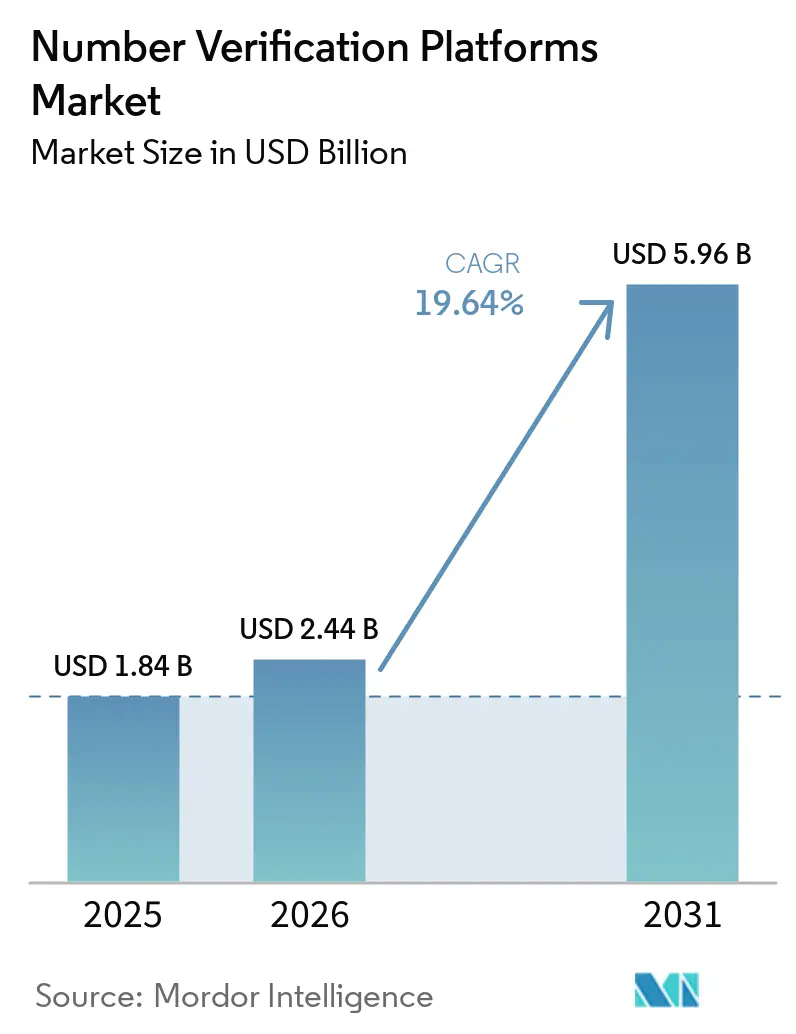
| Market Size (2026) | USD 2.44 Billion |
| Market Size (2031) | USD 5.96 Billion |
| Growth Rate (2026 - 2031) | 19.64 % |
| Fastest Growing Market | Asia-Pacific |
| Largest Market | North America |
| Market Concentration | Medium |
Major Players *Disclaimer: Major Players sorted in no particular order Image © Mordor Intelligence. Reuse requires attribution under CC BY 4.0. | |
Number Verification Platforms Market Analysis by Mordor Intelligence
The Number Verification Platforms Market size is projected to expand from USD 1.84 billion in 2025 to USD 2.44 billion in 2026, and to USD 5.98 billion by 2031, registering a CAGR of 19.64% between 2026 and 2031. The Number Verification Platforms Market is shifting from message-delivery checks to network-based identity verification. Enterprise buyers are using carrier data to validate whether a mobile number is active, associated with a subscriber, and safe to use during sensitive events. GSMA Open Gateway has made this transition more practical by creating common interfaces for operator APIs across many networks. This reduces the need for separate carrier integrations and shifts the competitive focus toward routing, fraud signals, and implementation support. The Number Verification Platforms Market also faces pressure to replace SMS-only processes as enterprises seek lower-friction authentication and stronger controls against account takeover.
Key Report Takeaways
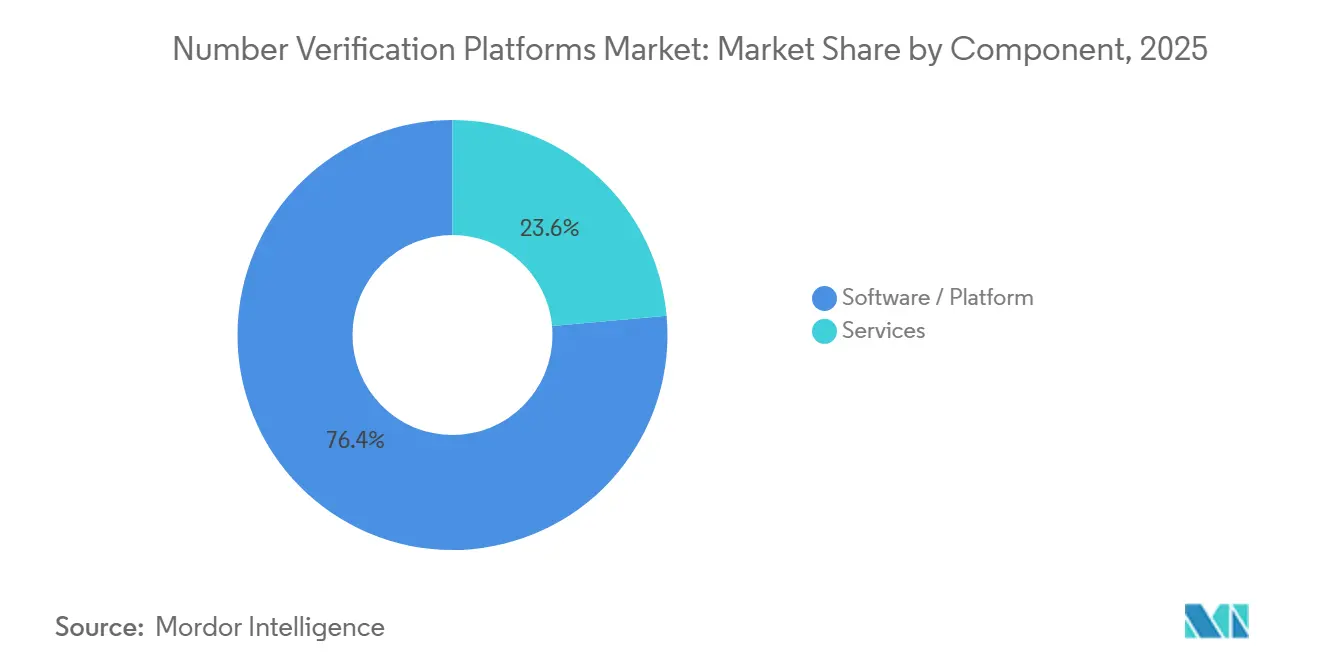
- By component, Software/Platform held 76.42% of the Number Verification Platforms Market revenue in 2025, while Services is projected to expand at a 21.22% CAGR through 2031.
- By deployment mode, cloud-based deployment held 82.36% of revenue in 2025 and is projected to grow at a 20.12% CAGR through 2031.
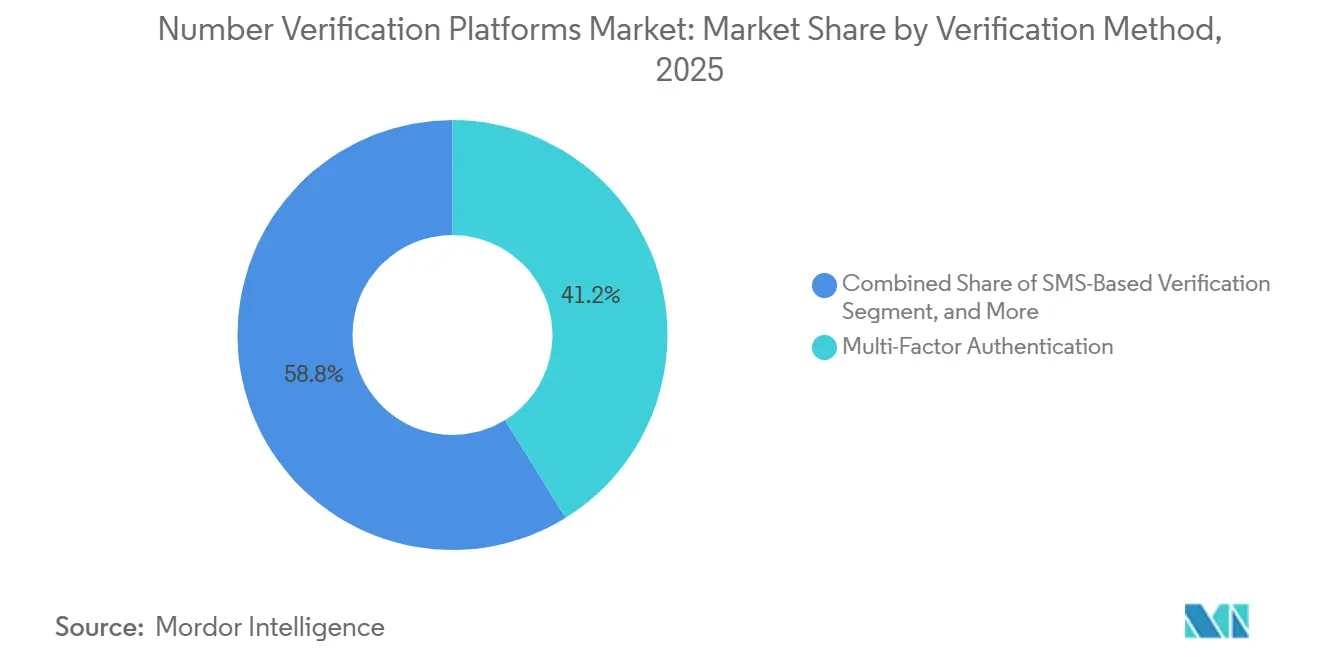
- By verification method, Multi-Factor Authentication held 41.18% of the Number Verification Platforms Market revenue in 2025 and is projected to grow at a 22.21% CAGR through 2031.
- By application, User Authentication held 38.24% of the Number Verification Platforms Market revenue in 2025, while Fraud Detection and Prevention is projected to expand at a 20.22% CAGR through 2031.
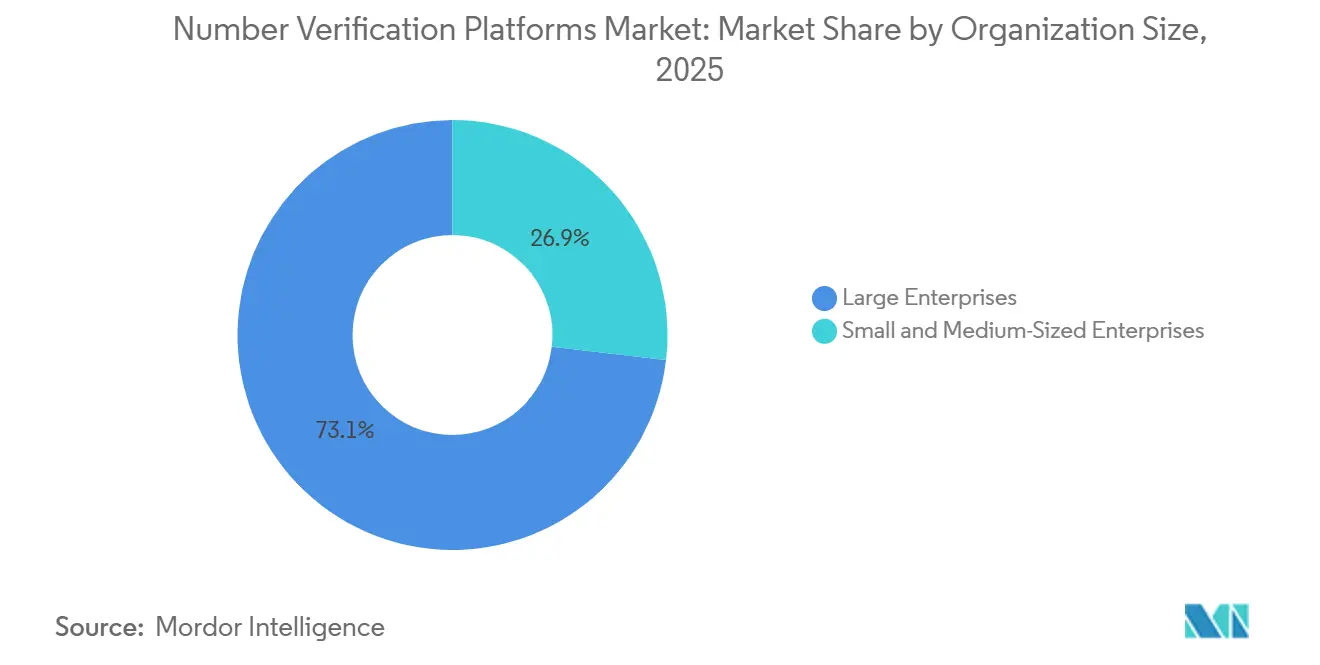
- By organization size, Large Enterprises accounted for 73.14% of the Number Verification Platforms Market revenue in 2025, while Small and Medium-Sized Enterprises are projected to grow at a 21.89% CAGR through 2031.
- By end-user industry, BFSI held 34.16% of revenue in 2025, while Gaming and Online Betting is projected to expand at a 22.32% CAGR through 2031.
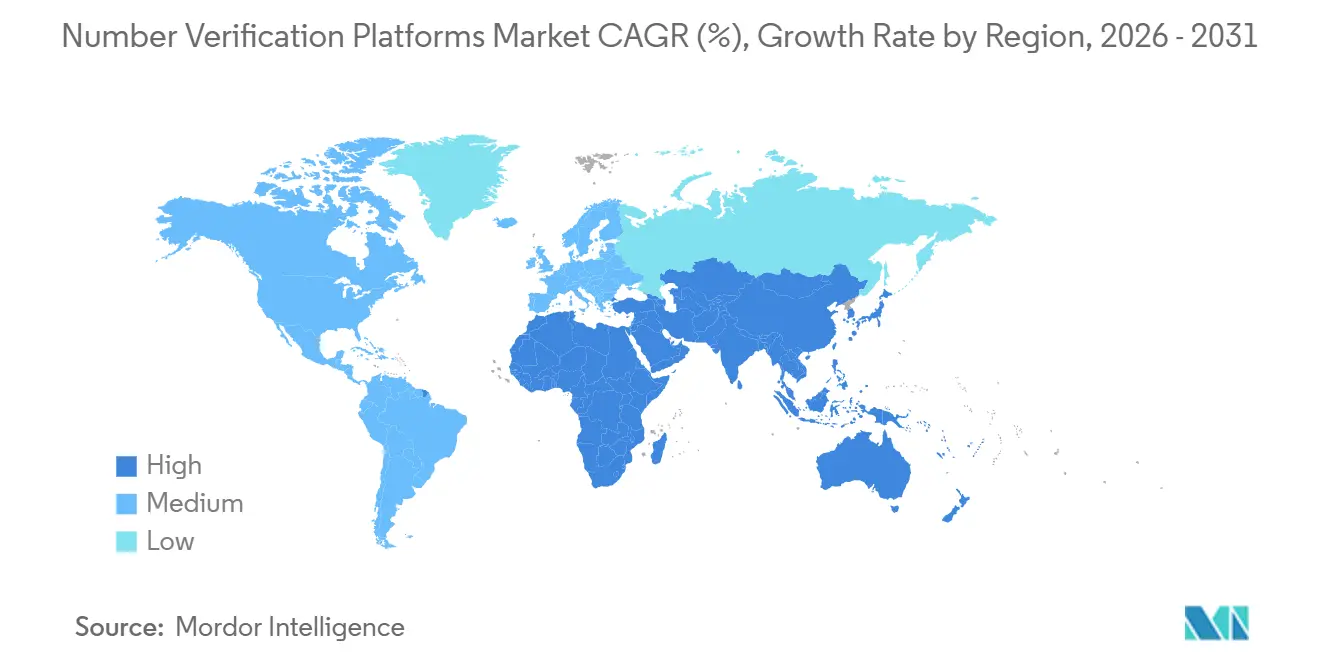
- By geography, North America accounted for 33.12% of the the Number Verification Platforms Market revenue in 2025, while Asia-Pacific is projected to grow at a 23.12% CAGR through 2031.
Note: Market size and forecast figures in this report are generated using Mordor Intelligence’s proprietary estimation framework, updated with the latest available data and insights as of January 2026.
Market Trends and Insights
Drivers Impact Analysis of Number Verification Platforms Market*
| Driver | (~) % Impact on CAGR Forecast | Geographic Relevance | Impact Timeline |
|---|---|---|---|
| Rising Account Takeover and SIM-Swap Exposure | +4.5% | Global, with highest intensity in North America, UK, Brazil, and India | Short term (≤ 2 years) |
| Regulatory Migration Beyond SMS OTP | +4.0% | EU, Japan, South Korea, Australia, and North America | Medium term (2-4 years) |
| Expansion of Digital Onboarding and Account Recovery | +3.5% | Global, with acceleration in Asia-Pacific and South America | Medium term (2-4 years) |
| Carrier Monetization of Network Identity APIs | +3.2% | Global, led by EU, Asia-Pacific, and Brazil | Long term (≥ 4 years) |
| Growth of Cloud-Native Verification Orchestration | +2.7% | Global | Medium term (2-4 years) |
| Rising Demand for Frictionless Mobile Authentication | +2.2% | North America, Western Europe, and Asia-Pacific | Medium term (2-4 years) |
| Source: Mordor Intelligence | |||
Rising Account Takeover and SIM-Swap Exposure
Account takeover has made number verification a more immediate security requirement for banks and payment providers. UK Finance reported that banks prevented GBP 1.68 billion (USD 2.1 billion) in unauthorized payment fraud during 2025. That represented GBP 0.70 for every GBP 1.00 attempted, underscoring the scale of prevention activity.[1] Cifas recorded a 402% increase in unauthorized SIM-swap cases during the first half of 2026 compared with the same period in 2025. These events create demand for real-time checks before a password reset, payment, or account change is accepted. The Number Verification Platforms Market benefits because network signals can identify a recent SIM change before an attacker completes a high-risk action.
Regulatory Migration Beyond SMS OTP
Regulators are encouraging stronger identity checks where SMS one-time passwords have known weaknesses. The EU framework for the European Digital Identity Wallet sets a December 2026 target for Member States to make wallets available.[2] It also places identity processes within a defined technical and compliance framework. Japan's amended Mobile Phone Improper Use Prevention Act took effect in April 2026 and requires IC chip-based identity verification for online mobile contract applications.[3] These changes encourage carriers and platform providers to support verified onboarding flows. The Number Verification Platforms Market, therefore, benefits from requirements that shift security controls from a voluntary feature to a formal operational requirement.
Expansion of Digital Onboarding and Account Recovery
Digital onboarding has increased the number of points where enterprises need to confirm a customer's phone number. Account recovery presents a separate need because SMS messages can be intercepted, phished, or redirected after a SIM swap.[4] CFIT found that 92% of medium-sized UK SMEs considered digital company identity services appealing. The same study found that 85% were willing to pay for a service that delivered fraud-detection and compliance benefits. The Number Verification Platforms Market can reach smaller firms through payment platforms and software providers that embed verification into their own onboarding flows. This distribution model reduces the need for each smaller business to procure and integrate a separate verification product.
Carrier Monetization of Network Identity APIs
Mobile operators are treating network identity data as a commercial API service rather than only as a network function. Nokia projected that authentication and fraud prevention APIs will generate USD 4.9 billion in operator revenue by 2030. Nokia also found that these APIs accounted for 89% of operator API revenue in 2025. BTS joined GSMA Open Gateway with infrastructure that handled more than 6 million API requests each day. The Number Verification Platforms Market is becoming more accessible through standardized carrier connections. Vendors still need to add value through workflow design, coverage management, fraud-data enrichment, and developer tools.
Restraints Impact Analysis of Number Verification Platforms Market*
| Restraint | (~) % Impact on CAGR Forecast | Geographic Relevance | Impact Timeline |
|---|---|---|---|
| Fragmented Carrier Coverage and Inconsistent Network Data | -0.9% | Emerging markets, Sub-Saharan Africa, South and Southeast Asia, and Central America | Long term (≥ 4 years) |
| Privacy, Consent, and Cross-Border Data Complexity | -0.7% | EU, Asia-Pacific, China, India, South Korea, and North America | Medium term (2-4 years) |
| SMS Interception and SIM-Swap Vulnerabilities | -0.4% | Global, with the highest exposure in markets with weak telecom regulation | Short term (≤ 2 years) |
| Complex MNO and Aggregator Revenue-Sharing Models | -0.3% | Emerging markets and markets with multiple operator tiers | Long term (≥ 4 years) |
| Source: Mordor Intelligence | |||
Fragmented Carrier Coverage and Inconsistent Network Data
Carrier coverage remains uneven in markets with several smaller mobile operators. GSMA Open Gateway had commercial API deployments across 85 networks in 50 markets by early 2026. That footprint still left gaps in Sub-Saharan Africa, Central America, and parts of South and Southeast Asia. Platforms must use other data sources when a carrier does not provide a suitable network signal. This can reduce confidence in the result and increase false positives. The Number Verification Platforms Market is affected because global banks and digital platforms need consistent service levels across every country in which they operate.
Privacy, Consent, and Cross-Border Data Complexity
Phone number verification depends on personal data, which is regulated differently across countries. The EU rules restrict transfers of subscriber information unless the transfer has a lawful basis and appropriate safeguards. China and India also require local consideration of how personal data is stored and processed. This can require different technical designs for European, Chinese, Indian, and North American deployments. The Number Verification Platforms Market must absorb additional legal, engineering, and operational work when serving multinational customers. Privacy requirements are likely to remain a significant cost factor as more countries set their own data protection rules.
*Our forecasts treat driver/restraint impacts as directional, not additive. The impact forecasts reflect baseline growth, mix effects, and variable interactions.
Number Verification Platforms Market Segment Analysis
By Component:
Software Platforms Lead Revenue While Services Gain GroundSoftware/Platform held 76.42% of the Number Verification Platforms Market share in 2025. Enterprises favor API-led software because it can connect with existing identity, payment, and customer service systems. Most verification value is created through API calls, data queries, and automated decision rules. These activities fit naturally within the software layer. Software products also allow customers to manage authentication journeys from a central interface. They can configure routing rules, fallback paths, and risk thresholds without changing every application separately. This supports consistent controls across customer onboarding, login, payment, and account recovery. The large software position reflects the recurring nature of demand for transaction-based verification.
Services are projected to expand at a 21.22% CAGR from 2026 to 2031. Banks, insurers, and retailers often need help coordinating carrier access and applying standards across several markets. Managed providers can handle integration work, carrier negotiations, and fraud-signal enrichment. Sinch launched number validation within its Engage platform in July 2026. The release brought real-time phone status checks into campaign workflows rather than limiting them to a developer API. This makes number intelligence available to a wider group of business users. Service demand can also include compliance reporting and operational support. The Number Verification Platforms industry, therefore, has room for providers that combine software access with practical implementation expertise.
By Deployment Mode:
Cloud-Based Delivery Sets the Operating ModelCloud-based deployment accounted for 82.36% of revenue in 2025. It held the largest share because authentication traffic can change sharply during payment peaks, promotions, or account attacks. Cloud infrastructure provides organizations with capacity that scales without permanent overprovisioning. It also supports the real-time exchange of carrier data through distributed endpoints. This is useful when a platform must process many verification events across several locations. Cloud services can also release updated API features without on-site software changes. For these reasons, the Number Verification Platforms Market continues to favor cloud delivery for high-volume workflows. The model supports both large enterprise programs and embedded verification services.
Cloud-based deployment is projected to grow at a 20.12% CAGR through 2031. Vonage made Silent Authentication generally available in its Verify API during February 2026. The service uses real-time carrier data through cloud-connected endpoints and can reduce the need for a visible one-time password. On-premises deployments remain relevant where data residency, system isolation, or sovereignty requirements limit cloud use. Hybrid models allow organizations to keep selected domestic events in their own environment. They can send international or lower-sensitivity events to cloud services. These choices are important in regulated accounts, but they do not change the cloud's leading role. The Number Verification Platforms Market is likely to use hybrid delivery, primarily where specific compliance requirements necessitate it.
By Verification Method:
MFA Combines Scale With Faster AdoptionMulti-Factor Authentication held 41.18% of revenue in 2025 and led the verification method category. It combines a phone number with another control, such as a device, a passkey, an application code, or a biometric check. This approach reduces the risk that a single compromised factor grants access. Okta reported that workforce MFA adoption reached 70% of users in January 2025. The report also recorded 63% year-over-year growth in phishing-resistant authentication. Organizations with significant fraud exposure tend to invest more heavily in stronger methods. The Number Verification Platforms Market is supported when these organizations use network data as an additional signal in their authentication policies.
MFA is projected to grow at a 22.21% CAGR from 2026 to 2031. Passkeys and other phishing-resistant controls are changing the role of SMS in identity journeys. The FIDO Alliance reported growing global adoption of passkeys in 2026. SMS-based verification still has a broad installed base because almost every mobile subscriber can receive a message. Voice verification remains useful for users who cannot receive SMS or depend on landlines. App-based one-time passwords provide greater protection against SMS interception. Providers must continue to support SMS for reach while building silent authentication and MFA options. The Number Verification Platforms Market will reward vendors that can manage this mix without creating an inconsistent customer experience.

By Application:
User Authentication Leads as Fraud Prevention ExpandsUser Authentication accounted for 38.24% of revenue in 2025. Login and transaction approval events occur much more often than onboarding or document checks. That volume supports its role as the largest application within the Number Verification Platforms Market size in 2025. Financial services, e-commerce, and digital services all use phone-based checks at login. The application also supports step-up authentication when a user changes a password or adds a new device. Its role is not limited to blocking unauthorized access. It can also reduce friction for recognized customers by allowing a low-risk event to proceed. This makes user authentication a basic workflow for platform buyers.
Fraud Detection and Prevention is projected to grow at a 20.22% CAGR through 2031. Enterprises are using verification during payment processing, profile changes, withdrawals, and other high-risk events. Sumsub reported that the volume of suspicious iGaming transactions was 4.5 times higher year over year in the first quarter of 2026. The company also reported that fraudsters spent 4.6 times as long attempting verification as legitimate players did. Customer Onboarding and KYC have fewer events but carry substantial regulatory importance. Account Takeover Prevention assesses changes during an active session, such as a SIM swap or device change. Marketing and CRM Validation helps companies avoid contacting inactive numbers. Transaction Security applies a network check when a high-value payment needs confirmation.
By Organization Size:
Large Enterprises Account for Most SpendingLarge Enterprises held 73.14% of revenue in 2025. Their authentication environments are complex, and they must support large volumes across several products and countries. They also have formal audit requirements for verification activity and customer decisions. API integration costs can be absorbed more easily at this scale. Itaú Unibanco used SIM Swap and Number Verification APIs through GSMA Open Gateway in Brazil. The bank accumulated more than 50 million SIM Swap API calls and 3 million KYC API queries within 6 months of commercial deployment. These volumes support the position held by large organizations. They also create switching costs once a provider is integrated into payment and identity processes.
Small and Medium-Sized Enterprises are projected to expand at a 21.89% CAGR through 2031. Their adoption is increasingly connected to payment platforms, marketplaces, and vertical software providers. These businesses may use verification as part of another service rather than buy it directly. CFIT found that 85% of UK SMEs were willing to pay for digital identity services with clear fraud and compliance benefits. Embedded delivery makes controls available to smaller firms without a separate sales and technical implementation process. It can also present verification as a normal feature within business banking or payment software. This distribution route broadens the customer base beyond large direct accounts. The Number Verification Platforms Market can therefore grow through partners that already serve these firms.
By End-User Industry:
BFSI Holds Demand While Gaming and Online Betting Grows FastestBFSI held 34.16% of revenue in 2025 and was the largest end-user group. Banks, insurers, and payment companies need reliable identity controls because fraud can lead to direct losses and regulatory exposure. They use number verification during onboarding, login, transfer approval, and account recovery. The checks can identify a recent SIM change before a transfer or password reset proceeds. These institutions also need logs that support investigation and audit work. Their high transaction volumes make automated API access important. The Number Verification Platforms Market relies heavily on this group because it combines security requirements with recurring use. E-commerce and retail constitute another large demand cluster because they face account fraud, checkout abuse, and payment risk.
Gaming and online betting are projected to grow at a 22.32% CAGR from 2026 to 2031. Real-money gaming operators must verify a customer's identity and age before allowing them to play. This makes rapid verification important at registration, not only at withdrawal. RSA reported in 2026 that 50% of organizations still relied on OTP for authentication. The same report found that 25% used bidirectional authentication. Telecommunications operators are also important buyers because they use number checks for subscribers and enterprise API customers. Healthcare, government and public sector, information technology and software, media and entertainment, and travel and hospitality add further demand. Each of these verticals faces more customer interactions through digital channels.
Geography Analysis
North America Number Verification Platforms Market
North America held 33.12% of the Number Verification Platforms Market share in 2025. The region has a large base of financial services, technology, and digital commerce companies that generate many verification events. These organizations require strong controls for payments, account recovery, and customer onboarding. Vonage commercially launched Silent Authentication and SIM Swap Network APIs across major U.S. carriers in November 2025. The launch marked a move from pilot programs toward broader commercial use. Canada and Mexico contribute through cross-border digital commerce and group banking requirements. The U.S. compliance environment also favors suppliers with established carrier and legal operations.
Europe and South America Number Verification Platforms Market
Europe is a regulation-focused region for the Number Verification Platforms Market. The EUDI Wallet program sets a clear direction for interoperable digital identity services. Poland's T-Mobile, Orange, Plus, and Play launched Number Verification and SIM Swap APIs in February 2026. COSMOTE TELEKOM and Vodafone Greece followed with similar deployments in March 2026. Germany, the UK, France, Italy, and Spain remain important revenue centers. South America has a practical carrier-enterprise model in Brazil, where operators supported Itaú's scaled adoption of APIs. Uruguay's Antel and Claro joined the Open Gateway initiative in June 2026.
APAC and MEA Number Verification Platforms Market
Asia-Pacific is projected to grow at a 23.12% CAGR through 2031, leading the geographic growth outlook. Japan's April 2026 rules have encouraged IC chip-based eKYC for online mobile contract applications. India’s largest mobile operators announced access to a federated Open Gateway API during the India Mobile Congress 2025. China launched several pilot programs for protection service businesses in 2025. Qatar’s Ooredoo and Vodafone launched Number Verification and SIM Swap APIs in 2025. Sub-Saharan Africa remains at an earlier stage due to fragmented carrier coverage. This leaves room for platforms that can provide dependable service across operators.
Competitive Landscape
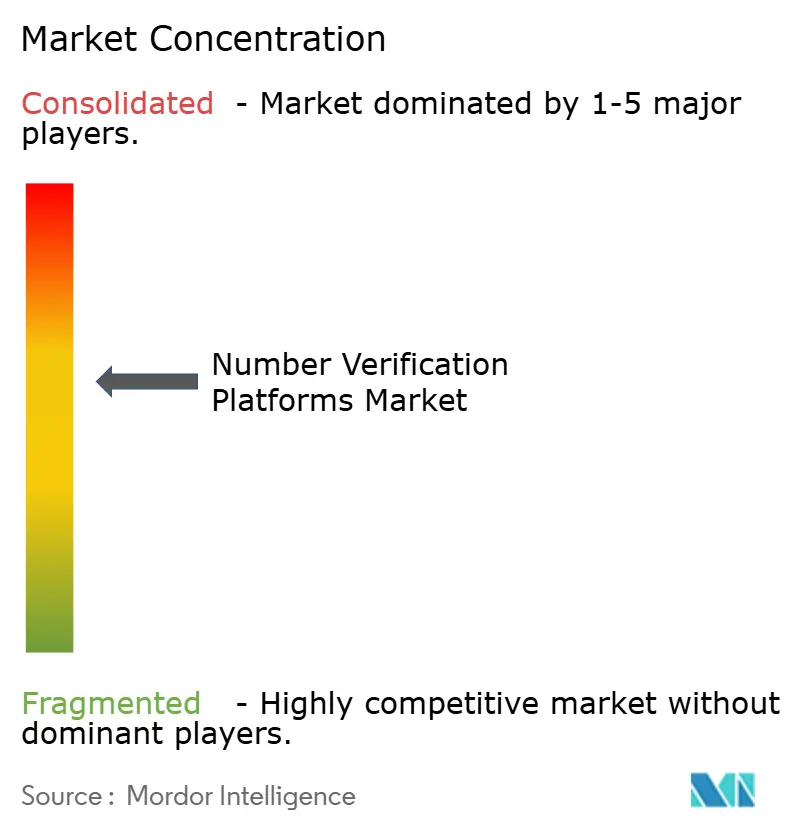
The Number Verification Platforms Market includes large communications platform providers and specialist phone-intelligence firms. Twilio, Sinch, Infobip, and Vonage verify within broader communications API portfolios. Telesign, Prove Identity, TMT ID, XConnect, and netnumber focus more closely on phone data, fraud signals, and routing. Large providers compete on carrier coverage, developer support, and enterprise procurement reach. Specialists compete through data depth and vertical-specific risk analysis. Nokia found that SIM Swap and Number Verification APIs dominated current operator API revenue in 2025. This creates an advantage for providers that already aggregate carriers across several markets. The Number Verification Platforms Market remains moderately concentrated because no supplier has complete carrier reach or enough enterprise customers to control pricing.
Standards compliance is becoming more important in supplier selection. Infobip received GSMA Open Gateway certifications for SIM Swap and Number Verification APIs during September 2025. The certification was validated through the CAMARA conformance program. It gives enterprise buyers an additional way to compare API readiness across vendors. Sinch introduced number validation within Sinch Engage in July 2026. That move extended carrier intelligence into marketer-facing workflows. Vonage also made Silent Authentication generally available in February 2026. These actions show that suppliers are integrating verification into more business systems rather than offering a stand-alone technical service.
The opportunity is strongest where buyers need easier deployment, broader regional reach, or a better combination of fraud signals. Small-business users need products that reduce implementation effort without removing necessary controls. Sub-Saharan Africa and South and Southeast Asia need wider operator coverage before carrier-native verification can perform consistently. API orchestration can combine SIM-swap status, device information, number tenure, and behavioral signals during a high-risk event. The Number Verification Platforms Market is likely to compete more on this decision layer as basic carrier connectivity becomes more standardized. Providers also need to manage privacy rules and revenue-sharing arrangements that differ by market. These operational capabilities can matter as much as the underlying API itself.
Number Verification Platforms Industry Leaders
-
Twilio Inc.
-
Infobip Ltd.
-
Sinch AB
-
Telesign Corporation
-
Vonage Holdings Corp.
- *Disclaimer: Major Players sorted in no particular order
Number Verification Platforms Market Companies Covered in this Report
- Twilio Inc.
- Sinch AB
- Infobip Ltd.
- Telesign Corporation
- Vonage Holdings Corp.
- Bird B.V.
- Plivo Inc.
- Route Mobile Limited
- CM.com N.V.
- Mitto AG
- Kaleyra Inc.
- netnumber, Inc.
- TMT ID Limited
- Pangea Connectivity Technology Limited
- Acudo Group Limited
- Prove Identity, Inc.
- Trulioo Information Services Inc.
- ID.me, Inc.
- iDenfy UAB
- Sumsub Ltd.
- Onfido Limited
- Entersekt Technologies (Pty) Ltd
- XConnect Limited
- Socure, Inc.
Recent Industry Developments in Number Verification Platforms Market
- July 2026: Sinch launched number validation within Sinch Engage, enabling real-time phone-number status checks against global carrier databases directly inside marketer-facing campaign workflows. The capability moved carrier-grade number intelligence from a developer-only API to a marketer-accessible feature, broadening Sinch's addressable market and increasing the commercial footprint of its Engage suite.
- June 2026: TIS Inc. and Intec commercially launched transaction authentication functionality within their joint telephone authentication service in Japan. The enhancement directly addressed Japan's amended Mobile Phone Improper Use Prevention Act, effective April 2026, which mandated higher-assurance phone-based authentication for financial transactions and online contracts.
- June 2026: Uruguay's operators Antel and Claro joined the GSMA Open Gateway initiative, commercially launching SIM Swap and Number Verification APIs for banks, fintechs, and insurance companies. The launch positioned Uruguay among the first South American countries to offer CAMARA-standardized fraud-prevention APIs for enterprise buyers.
- March 2026: COSMOTE TELEKOM and Vodafone Greece jointly launched Number Verification and SIM Swap APIs under the GSMA Open Gateway initiative. The multi-operator deployment made Greece one of the first Southern European markets to offer carrier-backed, CAMARA-compliant identity APIs for BFSI and e-commerce platforms.
Global Number Verification Platforms Market Report Scope
The number verification platforms market refers to software solutions and associated services that validate and authenticate users' phone numbers to verify identity and prevent fraud. This includes verification methods such as SMS-based OTPs, voice call verification, and multi-factor authentication (MFA). Deployed across cloud, on-premises, or hybrid environments, these platforms are utilized by organizations of all sizes across industries such as BFSI, e-commerce, and IT. By ensuring that phone numbers are active, reachable, and genuinely belong to the user, these solutions secure critical digital touchpoints like customer onboarding (KYC), login processes, and transaction security, thereby mitigating risks such as account takeovers, fake account creation, and unauthorized access.
The Number Verification Platforms Market Report is Segmented by Component (Software / Platform, and Services), Deployment Mode (Cloud-Based, On-Premises, and Hybrid), Verification Method (SMS-Based Verification, Voice Call Verification, Multi-Factor Authentication, One-Time Password Verification, and Others), Application (User Authentication, Fraud Detection and Prevention, Customer Onboarding and KYC, Account Takeover Prevention, Marketing and CRM Validation, and Transaction Security), Organization Size (Large Enterprises, and Small and Medium-Sized Enterprises), End-User Industry (Banking, Financial Services and Insurance, E-Commerce and Retail, Telecommunications, Information Technology and Software, Healthcare, Government and Public Sector, Media and Entertainment, Travel and Hospitality, and Gaming and Online Betting), and Geography (North America, South America, Europe, Asia-Pacific, Middle East, and Africa). The Market Forecasts are Provided in Terms of Value (USD).
Segmentation Overview
| Software / Platform |
| Services |
| Cloud-Based |
| On-Premises |
| Hybrid |
| SMS-Based Verification |
| Voice Call Verification |
| Multi-Factor Authentication |
| One-Time Password Verification |
| Other Verification Methods |
| User Authentication |
| Fraud Detection and Prevention |
| Customer Onboarding and KYC |
| Account Takeover Prevention |
| Marketing and CRM Validation |
| Transaction Security |
| Large Enterprises |
| Small and Medium-Sized Enterprises |
| Banking, Financial Services and Insurance |
| E-Commerce and Retail |
| Telecommunications |
| Information Technology and Software |
| Healthcare |
| Government and Public Sector |
| Media and Entertainment |
| Travel and Hospitality |
| Gaming and Online Betting |
| North America | United States |
| Canada | |
| Mexico | |
| South America | Brazil |
| Argentina | |
| Chile | |
| Rest of South America | |
| Europe | Germany |
| United Kingdom | |
| France | |
| Italy | |
| Spain | |
| Rest of Europe | |
| Asia-Pacific | China |
| Japan | |
| India | |
| South Korea | |
| Australia | |
| Rest of Asia-Pacific | |
| Middle East | United Arab Emirates |
| Saudi Arabia | |
| Qatar | |
| Rest of Middle East | |
| Africa | South Africa |
| Egypt | |
| Nigeria | |
| Rest of Africa |
| By Component | Software / Platform | |
| Services | ||
| By Deployment Mode | Cloud-Based | |
| On-Premises | ||
| Hybrid | ||
| By Verification Method | SMS-Based Verification | |
| Voice Call Verification | ||
| Multi-Factor Authentication | ||
| One-Time Password Verification | ||
| Other Verification Methods | ||
| By Application | User Authentication | |
| Fraud Detection and Prevention | ||
| Customer Onboarding and KYC | ||
| Account Takeover Prevention | ||
| Marketing and CRM Validation | ||
| Transaction Security | ||
| By Organization Size | Large Enterprises | |
| Small and Medium-Sized Enterprises | ||
| By End-User Industry | Banking, Financial Services and Insurance | |
| E-Commerce and Retail | ||
| Telecommunications | ||
| Information Technology and Software | ||
| Healthcare | ||
| Government and Public Sector | ||
| Media and Entertainment | ||
| Travel and Hospitality | ||
| Gaming and Online Betting | ||
| By Geography | North America | United States |
| Canada | ||
| Mexico | ||
| South America | Brazil | |
| Argentina | ||
| Chile | ||
| Rest of South America | ||
| Europe | Germany | |
| United Kingdom | ||
| France | ||
| Italy | ||
| Spain | ||
| Rest of Europe | ||
| Asia-Pacific | China | |
| Japan | ||
| India | ||
| South Korea | ||
| Australia | ||
| Rest of Asia-Pacific | ||
| Middle East | United Arab Emirates | |
| Saudi Arabia | ||
| Qatar | ||
| Rest of Middle East | ||
| Africa | South Africa | |
| Egypt | ||
| Nigeria | ||
| Rest of Africa | ||
Key Questions Answered in the Report
What is the size of the Number Verification Platforms Market?
The Number Verification Platforms Market was USD 2.44 billion in 2026 and is projected to reach USD 5.98 billion by 2031, at a 19.64% CAGR.
What is driving adoption of number verification platforms?
Account takeover, SIM-swap exposure, stronger digital identity rules, and increased digital onboarding are expanding demand.
Which verification method leads revenue?
Multi-Factor Authentication led with 41.18% of revenue in 2025 and is projected to grow at a 22.21% CAGR through 2031.
Why is cloud deployment widely used for number verification?
Cloud-based deployment held 82.36% of revenue in 2025 because it can manage sharp changes in authentication traffic.
Which end-user sector is growing fastest?
Gaming and Online Betting is projected to grow at a 22.32% CAGR through 2031 as operators need real-time identity and age checks.
Which region is expanding fastest?
Asia-Pacific is projected to grow at a 23.12% CAGR through 2031, supported by carrier API programs and digital identity requirements.