
Age Assurance Platform Market Size and Share
Market Overview
| Study Period | 2020 - 2031 |
|---|---|
| Market Size (2026) | USD 6.11 Billion |
| Market Size (2031) | USD 13.97 Billion |
| Growth Rate (2026 - 2031) | 17.99 % |
| Fastest Growing Market | Asia-Pacific |
| Largest Market | North America |
| Market Concentration | Medium |
Major Players *Disclaimer: Major Players sorted in no particular order Image © Mordor Intelligence. Reuse requires attribution under CC BY 4.0. | |
Age Assurance Platform Market Analysis by Mordor Intelligence
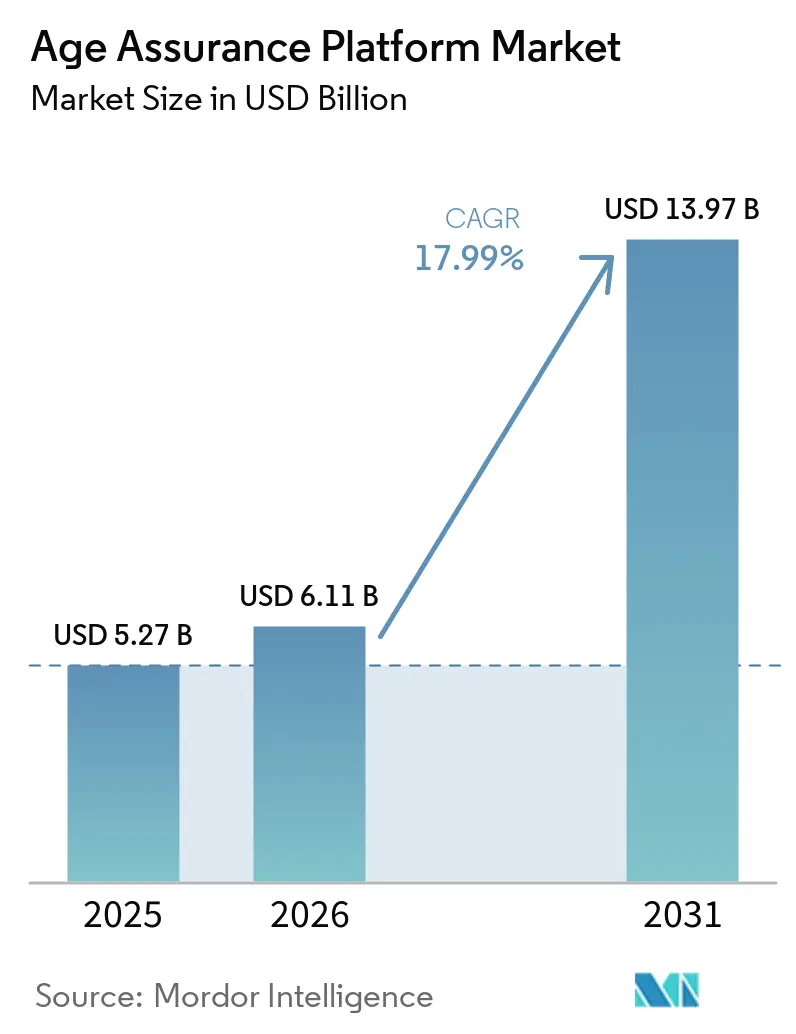
The age assurance platform market size is expected to grow from USD 5.27 billion in 2025 to USD 6.11 billion in 2026, and is forecast to reach USD 13.97 billion by 2031, at a 17.99% CAGR over 2026-2031. The age assurance platform market is expanding as governments require stronger proof of age across digital services, including content platforms, gambling services, online retail, and emerging conversational interfaces used by people of all ages every day. Rules in the United Kingdom, the European Union, Australia, and Brazil have shortened compliance timelines for platforms, especially where regulators have defined practical expectations for protecting minors from restricted content and transactions. These requirements are moving buyers away from self-declared ages and toward methods that can be audited, since platform operators need records that show how their access controls work in practice. Providers are responding with document checks, facial estimation, reusable credentials, and compliance support, while also adapting those methods to local rules, user risk, and the device used to access a service. The age assurance platform market also faces privacy, fairness, and fraud risks that make multi-method approaches important, as no single method is equally suitable for every service, age threshold, or legal setting.
Key Report Takeaways
- By verification method, identity document age verification held 29.83% of the age assurance platform market share in 2025, while reusable digital age credentials and wallets are projected to expand at a 20.76% CAGR through 2031.
- By service model, the self-managed platform model held 54.81% revenue share in 2025, while the platform with managed compliance support is projected to expand at a 21.93% CAGR through 2031.
- By customer type, online gambling and betting platforms held 31.28% revenue share in 2025, while generative AI and conversational platforms are projected to expand at a 21.62% CAGR through 2031.
- By geography, North America held 41.39% of the age assurance platform market share in 2025, while Asia-Pacific is projected to expand at a 22.51% CAGR through 2031.
Note: Market size and forecast figures in this report are generated using Mordor Intelligence’s proprietary estimation framework, updated with the latest available data and insights as of January 2026.
Global Age Assurance Platform Market Trends and Insights
Drivers Impact Analysis*
| DRIVER | (~) % IMPACT ON CAGR FORECAST | GEOGRAPHIC RELEVANCE | IMPACT TIMELINE |
|---|---|---|---|
| Expansion Of Online Child-Safety Regulation | +4.5% | Global, concentrated enforcement in the UK, EU, Australia, and Brazil | Short term (≤ 2 years) |
| Shift From Self-Declaration To Risk-Based Assurance | +3.8% | North America and EU, with spillover to Asia-Pacific | Short term (≤ 2 years) |
| Reusable Digital Age Credential And Wallet Adoption | +3.2% | EU core, with early gains in the UK, Germany, and Nordic markets | Medium term (2-4 years) |
| Low-Friction Facial Estimation At High Volumes | +2.6% | Global, led by North America, UK, and Australia | Medium term (2-4 years) |
| Age-Gated Commerce And Adult-Content Requirements | +2.0% | North America, EU, and Australia | Short term (≤ 2 years) |
| Age Controls In Gaming, Social, And Generative AI | +1.8% | Global, led by North America and Asia-Pacific | Medium term (2-4 years) |
| Source: Mordor Intelligence | |||
Expansion of Online Child-Safety Regulation
Mandatory age-assurance rules are creating a direct need for verified access controls across major digital markets, where platforms must decide whether a user can enter a restricted space, view content, or complete a transaction. The United Kingdom applied the Online Safety Act duties to pornography publishers in January 2025 and to user-to-user services in July 2025. In June 2026, the UK government announced proposed under-16 social media restrictions under Section 214A, with regulations expected to be presented to Parliament by the end of 2026 and protections anticipated in spring 2027.[1] Ofcom reported more than 69 million age checks across 32 regulated services in the second half of 2025, compared with the preceding 6 months. This enforcement environment shifts age assurance from a voluntary website feature to a procurement requirement, bringing legal, product, customer support, and data governance teams into the platform’s purchasing decision. The age assurance platform market benefits when platforms need evidence that their controls can meet an applicable legal standard, rather than merely offering a checkbox that asks a user to state an age.
Shift From Self-Declaration to Risk-Based Assurance
Regulatory expectations are making unsupported age declarations less acceptable for higher-risk services, particularly where a service can expose children to adult content, gambling activity, or restricted purchases. The age assurance platform market is therefore moving toward checks based on credentials, document matching, mobile accounts, open banking, and facial estimation. Ofcom identifies technical accuracy, robustness, reliability, and fairness as central considerations for highly effective age assurance. This pushes platforms to select approaches that fit their users and the legal risk of the service, rather than applying the same check to every interaction and every customer group. It also makes a single, low-assurance method less suitable for platforms operating in several jurisdictions, because the accepted form of proof and expected safeguards can differ between national regulatory systems. Vendors that combine methods and provide audit support can address this wider operational need.
Reusable Digital Age Credential and Wallet Adoption
Reusable credentials can allow a person to verify age without repeatedly sharing identity details, which is particularly relevant when the same user visits several age-gated services over time. The age assurance platform market is affected because reusable proof can reduce user friction and platforms' operating costs. The European Commission made its age-verification blueprint feature-ready in April 2026 and recommended adoption by the end of 2026 under eIDAS 2.0. ETSI stated that its standards support interoperable digital wallets for 450 million Europeans.[2] As wallets become available, providers will need to connect credential verification with local rules and user journeys, including clear routes for people who do not hold a compatible wallet or credential. Competition can then shift from a single verification event to the ability to manage credentials across services and countries.
Low-Friction Facial Age Estimation at High Transaction Volumes
Facial age estimation is becoming more relevant where services must assess large numbers of users quickly, especially when the service needs an immediate result and cannot reasonably require every user to present a document. Yoti stated that it was on course to complete more than 400 million age checks globally in 2026, with 15% completed through its digital ID wallet. This approach can be useful for social platforms, retail purchases, and other cases where a document request may interrupt the user journey. Its role in the age assurance platform market is strongest when a provider can direct uncertain users to another method, allowing the initial check to remain simple while preserving a stronger path for difficult cases. Performance and fairness remain important because the legal consequences of an incorrect result can be significant near the minimum-age threshold. Providers are consequently combining estimation with liveness detection, document checks, and escalation paths.
Restraints Impact Analysis*
| RESTRAINT | (~) % IMPACT ON CAGR FORECAST | GEOGRAPHIC RELEVANCE | IMPACT TIMELINE |
|---|---|---|---|
| Privacy, Biometric-Data, And Data-Minimization Liability | -3.2% | EU, UK, and Australia | Long term (≥ 4 years) |
| Accuracy, Bias, And Challenge-Age Performance Gaps | -2.4% | Global | Medium term (2-4 years) |
| User Drop-Off From High-Friction Or Intrusive Checks | -1.8% | Global, particularly acute in North America | Short term (≤ 2 years) |
| Circumvention Through Deepfakes, VPNs, And Account Sharing | -1.5% | Global | Medium term (2-4 years) |
| Source: Mordor Intelligence | |||
Privacy, Biometric Data, and Data-Minimization Liability
Privacy rules limit how providers can collect and retain sensitive verification data, requiring platforms to consider the requested data fields, the place of processing, retention periods, and access controls. The European Commission’s blueprint is designed to support proof of age without disclosure of a user’s full identity. This direction favors designs that minimize data collection and avoid unnecessary retention, while still providing the platform with sufficient evidence that its age-assurance process was applied properly. The age assurance platform market must therefore balance a buyer’s need for reliable evidence with a user’s right to privacy. Full document and biometric matching may offer stronger identity linkage, but they require careful controls over storage and processing. On-device approaches and reusable credentials can help reduce exposure when they meet the required assurance level.
Accuracy, Bias, and Challenge-Age Performance Gaps
Age estimation is most difficult where a user is close to the legal age boundary, because a small difference in the estimated result can determine whether a person gains access or must complete another check. The age assurance platform market cannot rely on facial estimation alone, as uncertainty could allow a minor into a restricted service or block an eligible adult. Ofcom’s criteria require systems to be accurate, robust, reliable, and fair, which makes demographic performance relevant to buyer assessments. Appearance changes, synthetic media, VPN use, and shared accounts can further weaken a simple check. These risks support layered workflows that require additional proof when a result falls within a challenge range, rather than treating an uncertain result as a final decision on either access or refusal. They also keep supplier testing, monitoring, and user appeals central to deployment decisions, since platforms need to identify performance issues and provide a reasonable route for legitimate users who are challenged.
*Our forecasts treat driver/restraint impacts as directional, not additive. The impact forecasts reflect baseline growth, mix effects, and variable interactions.
Segment Analysis
By Verification Method: Document Checks Lead While Wallet Credentials Gain Ground
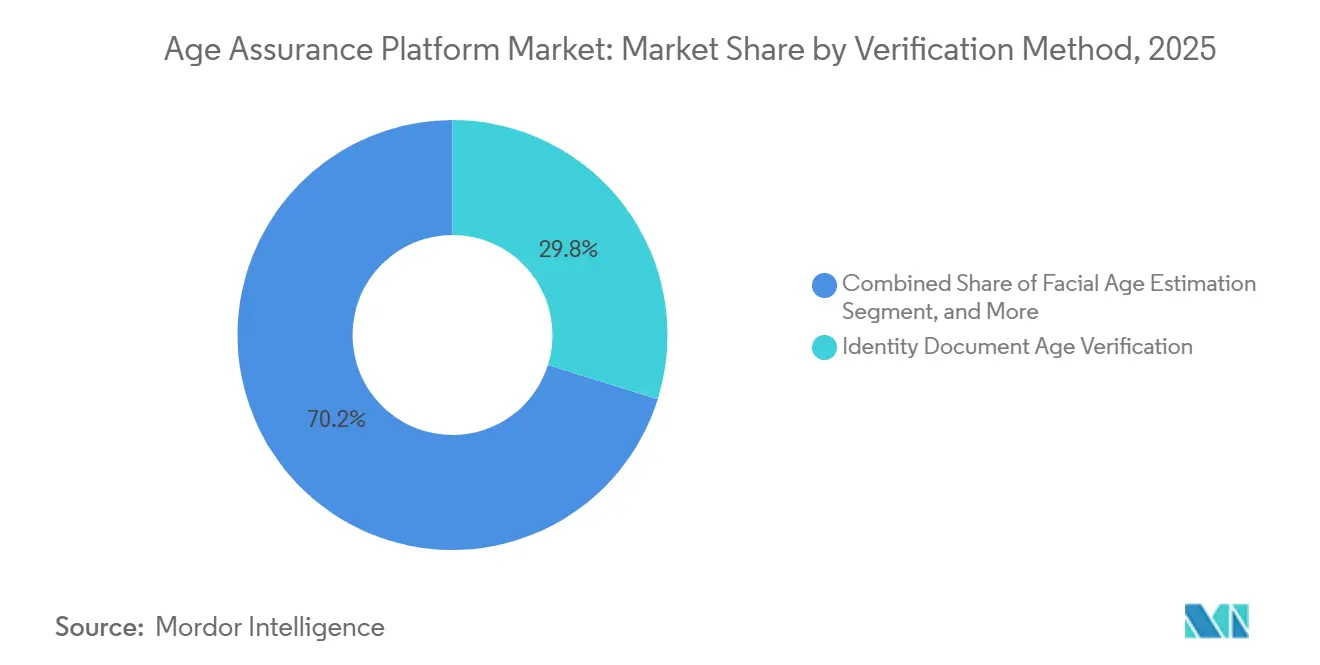
Identity document age verification held 29.83% of the age assurance platform market share in 2025. It remains important in regulated settings where a verified connection between a person and an identity document is required, because the platform must be able to show that the person seeking access is the person associated with the submitted proof. Gambling and adult-content providers often need this stronger evidence before allowing access or transactions, as their compliance process may require more than a simple assessment that a person is likely to be over the relevant age. Authoritative database and credit-reference checks remain relevant for established financial services and gambling operators, particularly where those organizations already use trusted data sources in their broader identity and risk-control processes. Mobile network operator and telecom account checks can be useful where account ownership is a reliable signal of adult status, although their suitability depends on local telecom practices, the quality of account records, and whether the relevant service accepts that evidence.
Account, behavioral, and activity-based inference remains a smaller part of the age assurance platform market because behavioral signals alone may not meet high-assurance expectations. Veratad received ISO/IEC 27566-1:2025 certification for its VX platform in April 2026.[3] Certification can matter when platforms want a provider that can demonstrate a defined assurance process, especially in tenders where buyers need to compare providers on documented controls rather than marketing claims or isolated product features. Reusable Digital Age Credentials and Wallets are projected to expand at a 20.76% CAGR from 2026 to 2031. The European Commission’s blueprint supports privacy-preserving proof of age and uses technical specifications aligned with the EUDI Wallet.

By Service Model: Managed Compliance Support Addresses Regulatory Complexity
The self-managed platform model accounted for 54.81% of service model revenue in 2025. Large gambling operators, adult-content networks, and financial services firms have used this approach because they have dedicated compliance and engineering teams, existing system connections, and internal processes for reviewing changes in their operating requirements. It gives these organizations direct control over workflows, system integrations, and internal review procedures. Vendor-managed age-assurance services serve organizations that lack comparable in-house capability, including newer regulated businesses that need a functioning control mechanism without having to build and maintain every technical component themselves. Smaller publishers entering the regulatory scope may prefer that a provider operate the technical process.
The age assurance platform market is also moving toward service models that pair technology with regulatory support. The platform with Managed Compliance Support is projected to expand to a 21.93% CAGR from 2026 to 2031. This model lets an operator retain control of its customer experience while outsourcing regulatory monitoring and implementation support, which can reduce the internal burden of interpreting several rules and translating them into practical verification workflows. It is relevant when a business must comply with requirements from multiple authorities simultaneously, as internal teams may otherwise need to track updates, revise policies, and adjust customer flows across a complex set of services. Incode launched On-Device Age Estimation in 2026, a solution that processes the check on the user’s device without biometric data leaving the endpoint.[4]
By Customer Type: Gambling Remains the Largest Buyer Group While Generative AI Expands
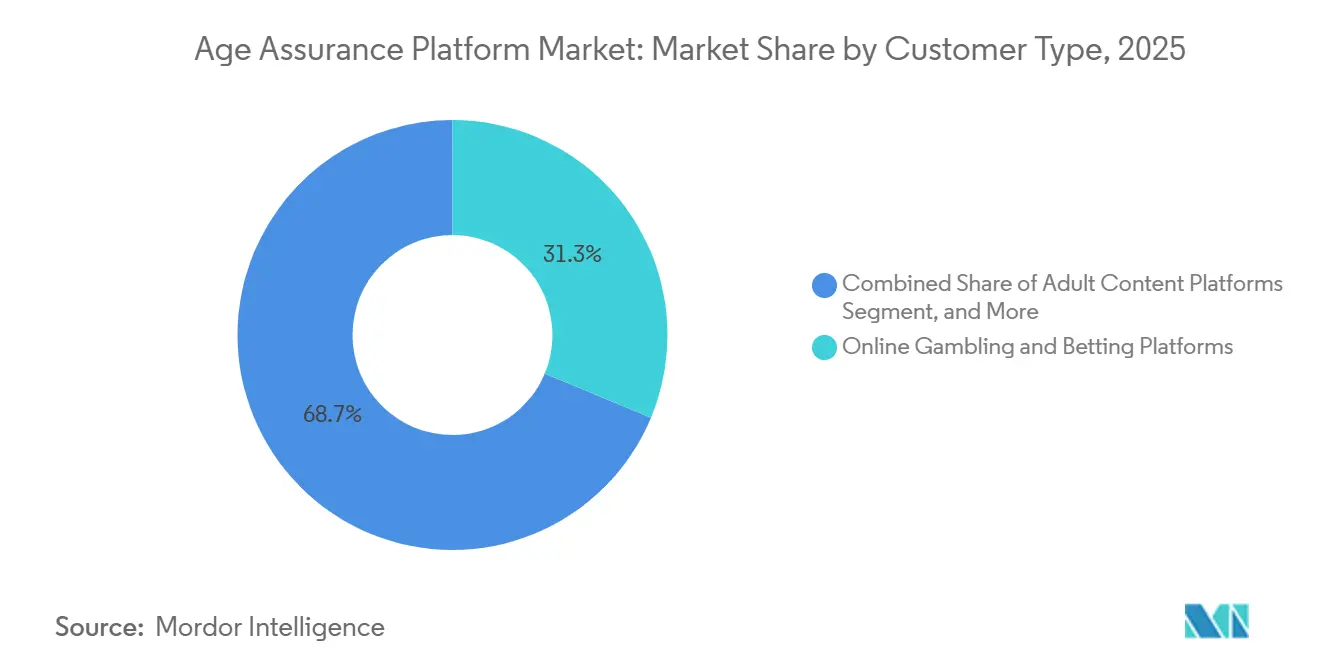
Online gambling and betting platforms held 31.28% of customer-type revenue in 2025. Their position reflects long-standing licensing rules that require operators to verify users before they engage in gambling activity. These platforms need reliable controls because age and identity checks are part of their operating obligations, and the verification process must work before a user can begin an activity that could create legal and customer-protection concerns. Social media and user-generated content platforms are driving demand as child-safety rules apply more broadly, with operators needing controls that work at sign-up, for access to certain features, and at other points within a service. Online gaming, adult content, age-restricted e-commerce, streaming, dating, telemedicine, and financial services also require age-related controls in different contexts, because each has a distinct combination of product risk, customer expectations, and applicable legal obligations.
Generative AI and conversational platforms are projected to expand at a 21.62% CAGR from 2026 to 2031. The segment is gaining attention as conversational services and AI companions become more accessible to younger users, creating a need to consider age before a conversational tool provides material or completes a restricted transaction. The European Commission’s age-verification work covers age assurance for online services and supports solutions that protect privacy. Veratad launched its VX Agent Toolkit in July 2026 for real-time identity and age verification before agentic transactions. This use case expands the age assurance platform market beyond traditional websites to transactions initiated through AI interfaces.
Geography Analysis
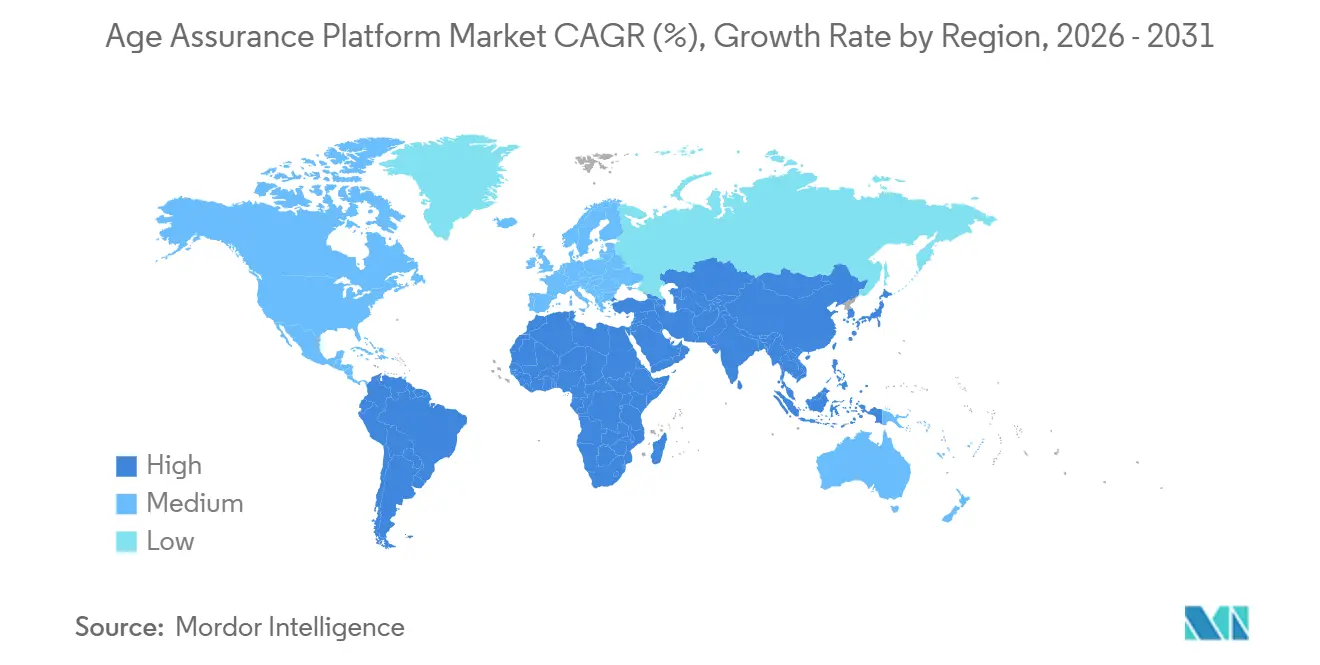
North America accounted for 41.39% of the age assurance platform market in 2025. The region has a strong identity infrastructure in financial services and growing state-level activity around age controls, which provides a practical basis for providers to connect age assurance with established identity, fraud, and customer verification processes. New obligations for app distribution can extend age-assurance requirements beyond the services that host content, placing a larger role on the parties that control access to applications before an end user reaches the underlying service. In September 2026, Proof launched a Verifiable Digital Credential for use across financial institutions after federal guidance recognized verifiable credentials in the Customer Identification Program.[5] A reusable financial services credential can support verify-once use cases across participating institutions.
Europe does not have a regional share figure in the supplied material, but it remains a high-complexity area for the age assurance platform market. GDPR, the Digital Services Act, the UK Online Safety Act, and national rules create overlapping obligations, requiring platforms to consider privacy protections, content-access rules, evidence requirements, and country-specific enforcement simultaneously. The European Commission’s age-verification blueprint became feature-ready in April 2026 and is available for customization by member states and providers. This supports demand in Germany, the UK, France, Spain, Italy, and other European countries. ETSI wallet standards can enable cross-border interoperability for 450 million European citizens.
Asia-Pacific is projected to expand to a 22.51% CAGR from 2026 to 2031. Australia’s Social Media Minimum Age requirement took effect in December 2025 and increased regional demand for compliance systems, as covered services need to determine how to identify under-16 users and manage access consistently. India’s data-protection framework makes the country a prospective compliance market as implementation guidance develops, given the scale of its online population and the potential need for platforms to apply age-related safeguards across widely used digital services. South Korea’s digital identity systems and China’s national ID integration provide a foundation for deployment in major regional economies. South America is led by Brazil, where Digital ECA requirements took effect in March 2026, while the Middle East and Africa remain in an earlier stage, with the UAE, Saudi Arabia, and South Africa representing near-term opportunities.
Competitive Landscape
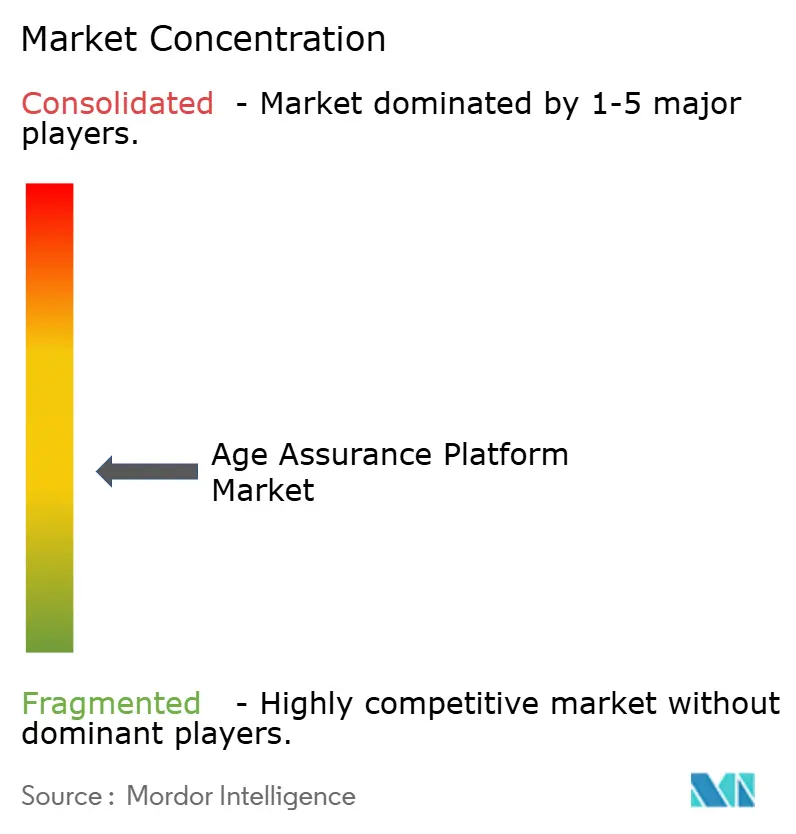
The age assurance platform market is moderately fragmented, although fewer than 12 vendors have the capacity to operate across major jurisdictions with certified, multi-method offerings. Purpose-built specialists include Yoti, VerifyMy, AgeChecked, and Veratad. These companies compete with broader identity platforms such as Jumio, Veriff, Sumsub, Trulioo, and AU10TIX. Providers compete on their ability to select an appropriate method based on jurisdiction, risk tier, and user context, while maintaining a clear process for exceptions, failed checks, repeat users, and cases where an initial result requires stronger supporting evidence. This orchestration capability can create switching costs because customers must integrate workflows, policies, and reporting processes and adapt these elements as their legal coverage, product features, and customer channels change.
Certification is becoming more important where buyers need evidence that a provider can meet an assurance standard, since compliance teams may need to document why a given product, method, or supplier was selected for a regulated use case. Yoti stated that its digital ID and age-estimation capabilities support high-volume age checking, including wallet-based checks. Veratad’s ISO/IEC 27566-1:2025 certification strengthens its position in multi-method age and identity assurance. Veriff acquired Vespia in February 2026 to add Know Your Business capabilities across more than 300 jurisdictions. That move broadens its trust offering beyond age verification and can increase the value of its customer contracts. Incode’s on-device age-estimation launch provides another strategic example, with privacy-focused processing positioned as a differentiator.
The age assurance platform market has room for providers focused on reusable credentials, privacy-preserving estimation, and cross-border interoperability. Trinsic, Xydus, Veritage Technologies, and Tuteliq are targeting the reusable credentials layer. Their position could become more valuable if EUDI Wallet adoption develops as intended, since a widely used wallet environment would increase the need for connections between credential issuers, relying platforms, and local compliance workflows. The age assurance platform market also rewards providers that can keep regulatory requirements up to date across the UK, EU, United States, Australia, Brazil, and Asia-Pacific, while offering customers practical implementation options for services that operate across several of those regions.
Age Assurance Platform Industry Leaders
-
Yoti Limited
-
VerifyMy Limited
-
AgeChecked Limited
-
Veratad Technologies, LLC
-
Luciditi Trust Limited
- *Disclaimer: Major Players sorted in no particular order
Recent Industry Developments
- September 2026: Proof launched its Verifiable Digital Credential after US banking regulators recognized verifiable credentials under federal Customer Identification Program rules, enabling consumers to verify once and reuse identity across financial institutions.
- September 2026: Germany unveiled its national EUDI wallet "d-you," launching January 2, 2027, with 40 partners providing age verification, bank account opening, and contract execution.
- July 2026: Veratad Technologies launched the VX Agent Toolkit, the first commercially available identity and age verification layer purpose-built for AI agents, enabling real-time verification before agentic transactions in financial services, e-commerce, gaming, and age-restricted commerce.
- July 2026: Ofcom published its statutory Report on the Use of Age Assurance, documenting 69 million age checks across 32 services in the second half of 2025, a 23-fold increase, and confirming fines exceeding GBP 4.38 million (USD 5.56 million) against 7 providers covering 24 non-compliant sites.
- April 2026: The EU Commission's age verification blueprint became feature-ready and available for customization by member states and market players, with the Commission recommending rollout by end-2026 under eIDAS 2.0.
Global Age Assurance Platform Market Report Scope
The age assurance platform market comprises technology solutions that verify, estimate, or infer online users’ ages to support compliance with child safety regulations and age-restricted content and access requirements. It includes document-based verification, facial age estimation, database checks, and hybrid approaches that combine multiple signals to provide varying levels of assurance. These platforms support applications such as adult content access, online gambling, cannabis, and other age-restricted e-commerce and social media age-gating, while helping organizations comply with the UK Online Safety Act, U.S. state age-verification laws in Louisiana, Arkansas, Texas, Utah, and other states, the EU Digital Services Act, and GDPR age-appropriate design codes. Deployment models range from self-managed SaaS platforms with API/SDK integration to vendor-managed verification services and managed compliance support for multi-jurisdictional regulatory mapping and audit trail maintenance.
The Age Assurance Platform Market Report is Segmented by Verification Method (Facial Age Estimation, Identity Document Age Verification, Reusable Digital Age Credentials and Wallets, Authoritative Database and Credit-Reference Checks, Mobile Network Operator and Telecom Account Checks, Account, Behavioral, and Activity-Based Age Inference, and Other Verification Methods), Service Model (Self-Managed Platform, Vendor-Managed Age-Assurance Service, and Platform with Managed Compliance Support), Customer Type (Social Media and User-Generated Content Platforms, Online Gaming Platforms, Online Gambling and Betting Platforms, Adult Content Platforms, Age-Restricted E-Commerce and Marketplaces, Streaming and Digital Media Services, Generative AI and Conversational Platforms, Dating and Community Platforms, Telemedicine and Digital Health Platforms, Financial Services and Payment Platforms, and Other Digital Services), and Geography (North America, South America, Europe, Asia-Pacific, and Middle East and Africa). The Market Forecasts are Provided in Terms of Value (USD).
| Facial Age Estimation |
| Identity Document Age Verification |
| Reusable Digital Age Credentials and Wallets |
| Authoritative Database and Credit-Reference Checks |
| Mobile Network Operator and Telecom Account Checks |
| Account, Behavioral, and Activity-Based Age Inference |
| Other Verification Methods |
| Self-Managed Platform |
| Vendor-Managed Age-Assurance Service |
| Platform with Managed Compliance Support |
| Social Media and User-Generated Content Platforms |
| Online Gaming Platforms |
| Online Gambling and Betting Platforms |
| Adult Content Platforms |
| Age-Restricted E-Commerce and Marketplaces |
| Streaming and Digital Media Services |
| Generative AI and Conversational Platforms |
| Dating and Community Platforms |
| Telemedicine and Digital Health Platforms |
| Financial Services and Payment Platforms |
| Other Digital Services |
| North America | United States | |
| Canada | ||
| South America | Brazil | |
| Argentina | ||
| Mexico | ||
| Rest of South America | ||
| Europe | Germany | |
| United Kingdom | ||
| France | ||
| Italy | ||
| Spain | ||
| Russia | ||
| Rest of Europe | ||
| Asia-Pacific | China | |
| Japan | ||
| India | ||
| South Korea | ||
| Australia | ||
| Rest of Asia-Pacific | ||
| Middle East and Africa | Middle East | Saudi Arabia |
| United Arab Emirates | ||
| Rest of Middle East | ||
| Africa | South Africa | |
| Egypt | ||
| Rest of Africa | ||
| By Verification Method | Facial Age Estimation | ||
| Identity Document Age Verification | |||
| Reusable Digital Age Credentials and Wallets | |||
| Authoritative Database and Credit-Reference Checks | |||
| Mobile Network Operator and Telecom Account Checks | |||
| Account, Behavioral, and Activity-Based Age Inference | |||
| Other Verification Methods | |||
| By Service Model | Self-Managed Platform | ||
| Vendor-Managed Age-Assurance Service | |||
| Platform with Managed Compliance Support | |||
| By Customer Type | Social Media and User-Generated Content Platforms | ||
| Online Gaming Platforms | |||
| Online Gambling and Betting Platforms | |||
| Adult Content Platforms | |||
| Age-Restricted E-Commerce and Marketplaces | |||
| Streaming and Digital Media Services | |||
| Generative AI and Conversational Platforms | |||
| Dating and Community Platforms | |||
| Telemedicine and Digital Health Platforms | |||
| Financial Services and Payment Platforms | |||
| Other Digital Services | |||
| By Geography | North America | United States | |
| Canada | |||
| South America | Brazil | ||
| Argentina | |||
| Mexico | |||
| Rest of South America | |||
| Europe | Germany | ||
| United Kingdom | |||
| France | |||
| Italy | |||
| Spain | |||
| Russia | |||
| Rest of Europe | |||
| Asia-Pacific | China | ||
| Japan | |||
| India | |||
| South Korea | |||
| Australia | |||
| Rest of Asia-Pacific | |||
| Middle East and Africa | Middle East | Saudi Arabia | |
| United Arab Emirates | |||
| Rest of Middle East | |||
| Africa | South Africa | ||
| Egypt | |||
| Rest of Africa | |||
Key Questions Answered in the Report
What is the size of the age assurance platform market?
The age assurance platform market size is expected to grow from USD 5.27 billion in 2025 to USD 6.11 billion in 2026, and is forecast to reach USD 13.97 billion by 2031, at a 17.99% CAGR over 2026-2031.
What is driving demand for online age verification?
Child-safety requirements, stricter treatment of self-declaration, and reusable digital credentials are supporting adoption across digital services.
Which verification method held the largest share in 2025?
Identity Document Age Verification held 29.83% share in 2025, supported by use cases that require a strong link to a verified identity.
Which customer group is expected to grow fastest through 2031?
Generative AI and Conversational Platforms are projected to expand at a 21.62% CAGR from 2026 to 2031.
Which region is expected to grow fastest through 2031?
Asia-Pacific is projected to expand at a 22.51% CAGR from 2026 to 2031, supported by regulatory activity and digital identity infrastructure.
Why are reusable digital age credentials important?
They can let users prove an age condition without repeatedly disclosing identity details, which can reduce friction and support privacy-focused verification.