
Consent Management Market Size and Share
Market Overview
| Study Period | 2020 - 2031 |
|---|---|
| Market Size (2026) | USD 1.07 Billion |
| Market Size (2031) | USD 2.34 Billion |
| Growth Rate (2026 - 2031) | 17.05 % |
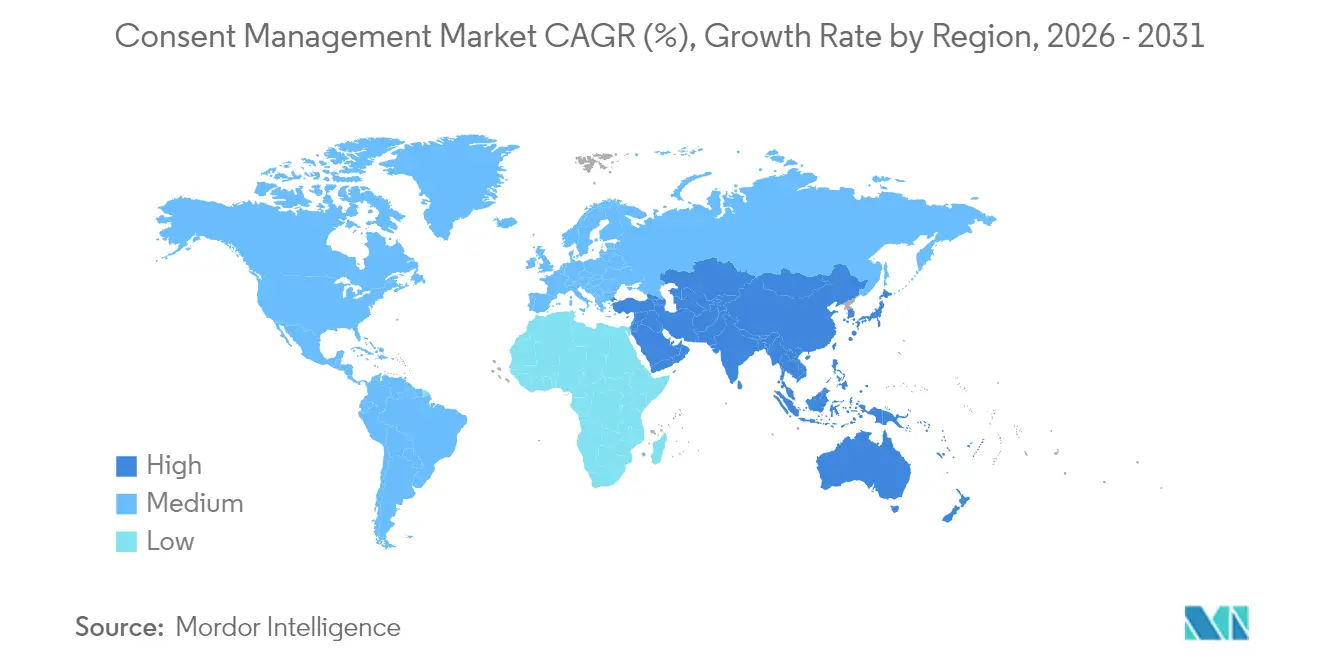
| Fastest Growing Market | Asia-Pacific |
| Largest Market | North America |
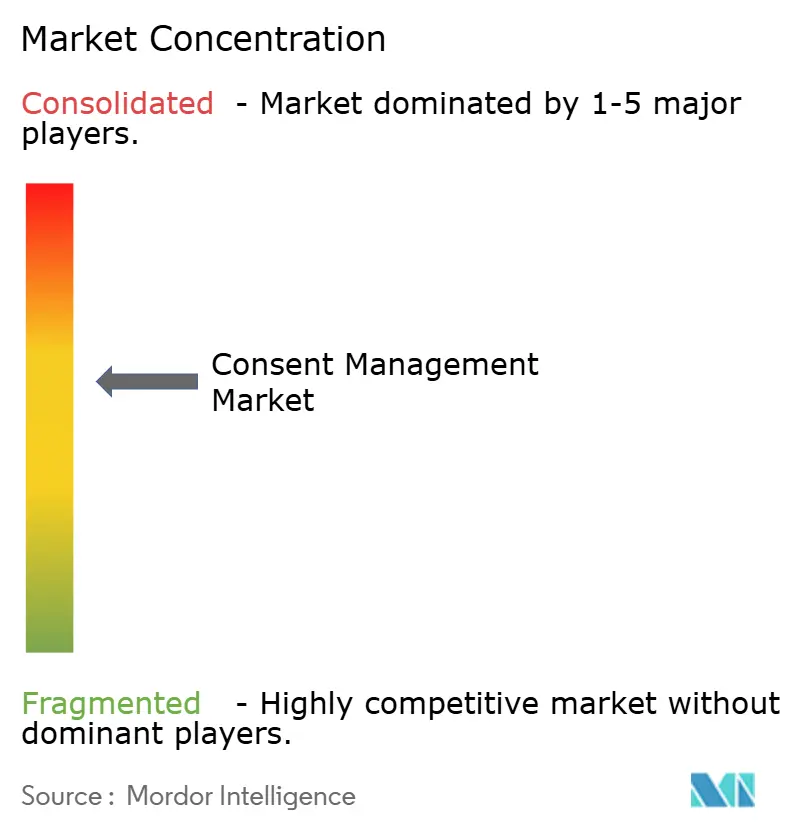
| Market Concentration | Medium |
Major Players *Disclaimer: Major Players sorted in no particular order Image © Mordor Intelligence. Reuse requires attribution under CC BY 4.0. | |
Consent Management Market Analysis by Mordor Intelligence
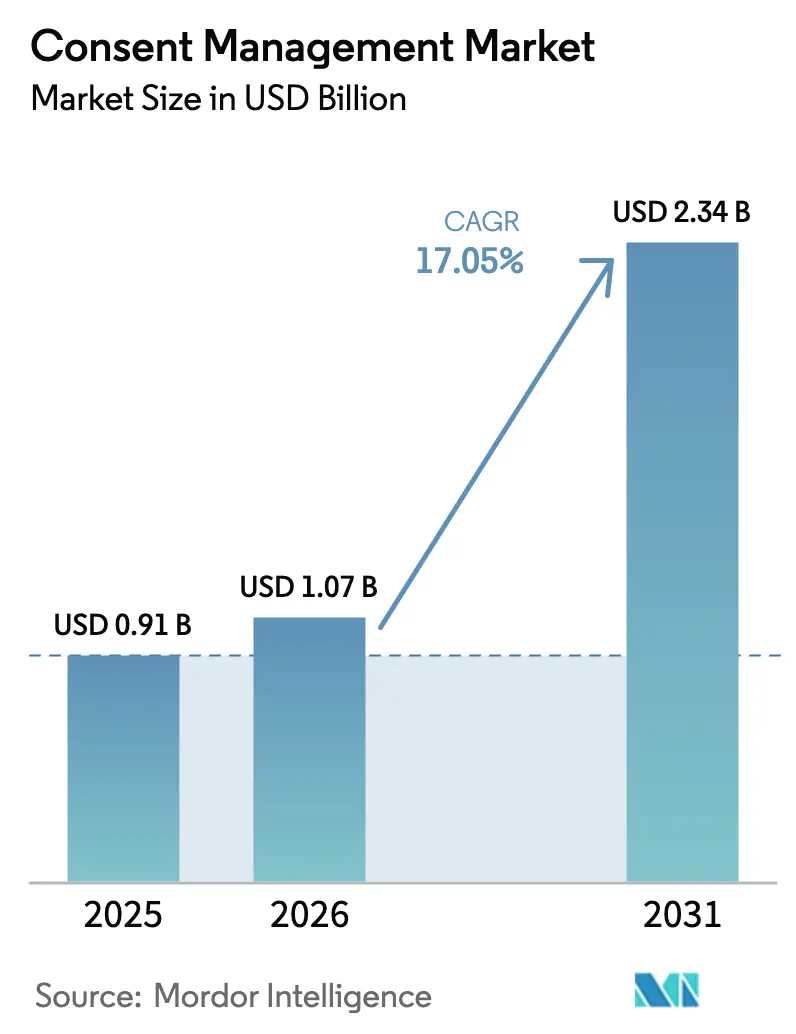
The consent management market size was valued at USD 0.91 billion in 2025 and estimated to grow from USD 1.07 billion in 2026 to reach USD 2.34 billion by 2031, at a CAGR of 17.05% during the forecast period (2026-2031). Strong global privacy mandates, an industry-wide move toward first-party data strategies, and rising executive recognition of consent as a driver of customer trust all underpin this expansion. Heightened enforcement activity in North America, swift regulatory rollouts in Asia Pacific, and rapid innovation in cloud-based consent orchestration are steering vendor investments toward platform breadth, AI-driven automation, and seamless identity integration. Competitive differentiation increasingly hinges on the ability to embed granular permissions across web, mobile, and IoT touchpoints, while also providing real-time analytics that translate consent signals into actionable marketing intelligence. Consolidation persists as large technology firms enter the field, prompting incumbent vendors to broaden their feature sets, extend partner ecosystems, and pursue vertical-specific solutions.
Key Report Takeaways
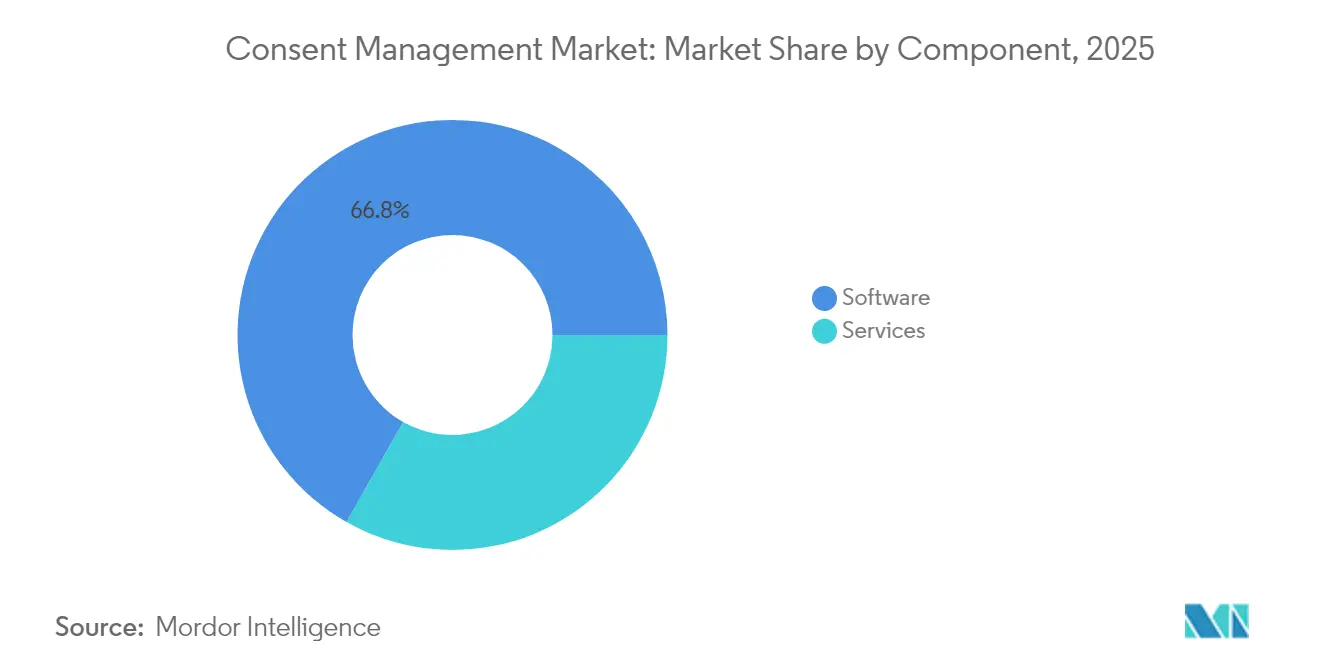
- By component, software accounted for 66.80% of the consent management market share in 2025, while services are forecast to expand at a 17.1% CAGR through 2031.
- By deployment model, cloud solutions captured 64.10% of the consent management market size in 2025 and are expected to grow at an 18.0% CAGR between 2026 and 2031.
- By touchpoint, web applications led with 55.40% revenue share in 2025; mobile apps are projected to advance at a 18.6% CAGR to 2031.
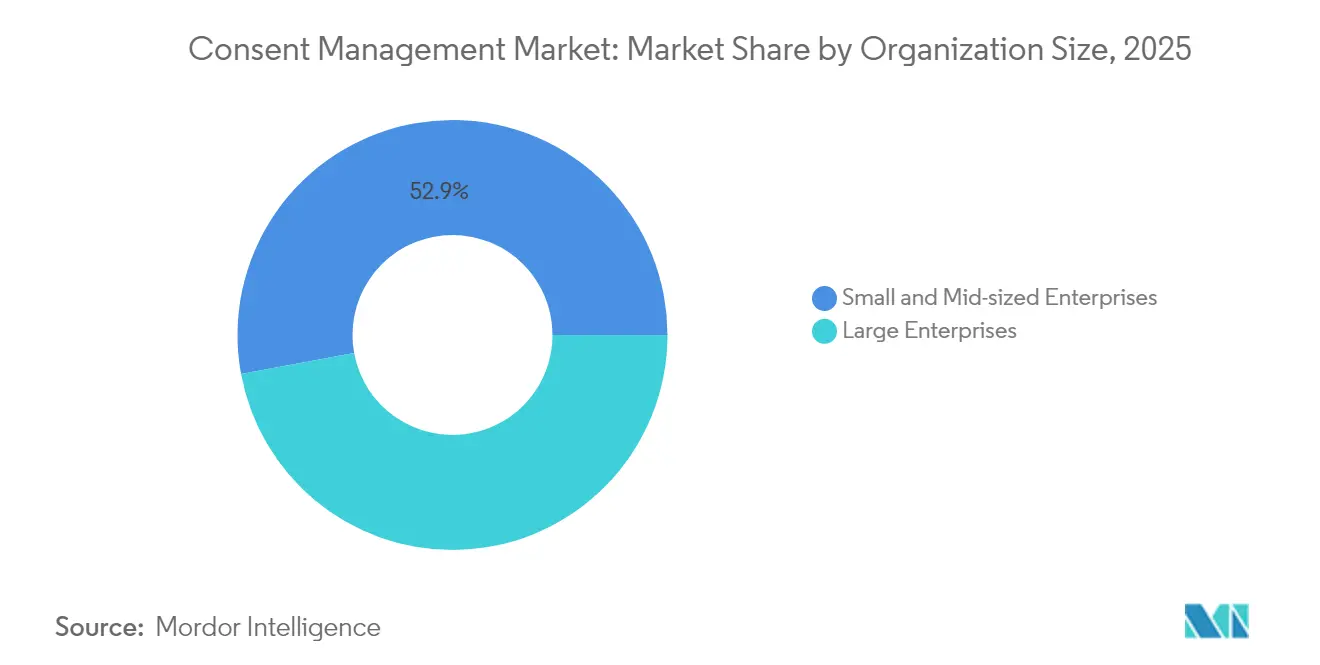
- By organization size, large enterprises held 47.10% of the consent management market share in 2025, while SMBs are poised for the fastest growth at an 18.2% CAGR through 2031.
- By end-user industry, retail and e-commerce controlled 24.80% of the consent management market size in 2025; healthcare is set to grow at a 18.7% CAGR to 2031.
- By geography, North America commanded 36.20% revenue in 2025, whereas Asia Pacific is on track for a 17.4% CAGR between 2026 and 2031.
Note: Market size and forecast figures in this report are generated using Mordor Intelligence’s proprietary estimation framework, updated with the latest available data and insights as of 2026.
Market Trends and Insights
Drivers Impact Analysis of Consent Management Market*
| Driver | (~) % Impact on CAGR Forecast | Geographic Relevance | Impact Timeline |
|---|---|---|---|
| Stringent global and sector-specific privacy rules | +4.2% | North America and EU, expanding global | Long term (≥ 4 years) |
| First-party data strategies after cookie deprecation | +3.8% | North America and Asia-Pacific | Medium term (2-4 years) |
| Data-trust user experience as a differentiator | +2.9% | North America and EU, rising in Asia-Pacific | Medium term (2-4 years) |
| Embedded consent in IoT-edge devices | +2.1% | APAC core, spillover to North America | Long term (≥ 4 years) |
| Automated privacy-as-code pipelines | +1.8% | North America and EU | Short term (≤ 2 years) |
| Consent tokens for Web3 ecosystems | +1.5% | Early adoption in North America | Long term (≥ 4 years) |
| Source: Mordor Intelligence | |||
Stringent global and sector-specific privacy rules drive market expansion
Intensified enforcement arrived in 2025 as eight additional US state privacy statutes, India’s Digital Personal Data Protection Act, and new Department of Justice national-security rules forced enterprises to refresh consent tooling and governance processes. State laws such as Maryland’s ban on sensitive data sales and New Jersey’s heightened protections for minors require hyper-granular permissioning that legacy cookie pop-ups cannot deliver. Financial institutions face parallel pressures from rising GDPR penalties, India’s biometric safeguards, and Australia’s stricter open-banking mandates. Penalties levied in 2024, often reaching multimillion-dollar sums, have reframed consent platforms as core infrastructure rather than discretionary add-ons, triggering budget reallocations and board-level oversight.
First-party data strategies reshape consent architecture
Google’s decision to retain third-party cookies, while releasing an integrated CMP setup in August 2024, elevated the consent management market by shifting the enterprise focus from cookie compliance to holistic data governance. Research shows that 78% of B2C brands now prioritize direct data collection, creating demand for orchestration engines that honor user preferences across web, app, and server environments. Microsoft’s requirement that advertisers pass consent signals by May 5, 2025, accelerated the adoption of consent mode and real-time preference APIs.[1]Microsoft, “Advertising Consent Mode FAQ,” learn.microsoft.comServer-side tagging, championed by firms such as Didomi, is gaining traction as a privacy-preserving alternative that maintains campaign performance without sacrificing compliance.
Data-trust user experience emerges as a competitive differentiator
European regulators now scrutinize interface design as closely as legal language. Germany’s 2025 Consent Management Ordinance obliges businesses to shorten notices, remove dark patterns, and present genuine choices, spurring UX-first rebuilds of consent workflows. Brands are embedding behavioral analytics to A/B test banner copy, sequencing, and iconography, quantifying how each iteration affects opt-in rates. “Consent or pay” models remain under intense review by the European Data Protection Board, encouraging vendors to create preference centers that provide frictionless subscription alternatives. Academic work from UC Berkeley underscores how privacy engineering now blends design thinking with code, elevating consent from a compliance hurdle to a lever for lifetime value.
Embedded consent inside IoT-edge devices stimulates technical innovation
Wearables, vehicles, and home sensors collect expanding volumes of sensitive data, yet often lack conventional user interfaces. Device makers are integrating voice prompts, QR opt-in flows, and blockchain-based consent tokens to synchronize permissions across constrained networks. [2]Ministry of Electronics and Information Technology, “IoT SAFE Protocol Overview,” meity.gov.inAutomotive OEMs now must track individual passenger choices, enable jurisdiction-aware cross-border transfers, and retain audit trails that regulators can verify on inspection. The emerging IoT SAFE protocol further demands secure device authentication, prompting consent platforms to offer lightweight agents capable of offline operation with batched synchronization on reconnection.
Restraints Impact Analysis of Consent Management Market*
| Restraint | (~) % Impact on CAGR Forecast | Geographic Relevance | Impact Timeline |
|---|---|---|---|
| Constantly shifting multi-jurisdictional requirements | -2.1% | Global, particularly affecting multinational operations | Medium term (2-4 years) |
| Low executive budgets in SMBs for privacy tooling | -1.8% | Global, with higher impact in emerging markets | Short term (≤ 2 years) |
| Consumer "consent fatigue" reducing opt-in rates | -1.4% | Global, with acute impact in EU and mature markets | Medium term (2-4 years) |
| Absence of universal consent interoperability standards | -1.2% | Global, affecting cross-platform implementations | Long term (≥ 4 years) |
| Source: Mordor Intelligence | |||
Constantly shifting multi-jurisdictional requirements create implementation barriers
Organizations operating across 19 US states, the EU, China, and India must juggle conflicting opt-in, opt-out, and data-localization rules, inflating configuration overhead and legal consulting spend. India’s concept of licensed “consent managers” adds a new actor to data flows, while China’s cross-border security assessments require consent records that satisfy domestic cybersecurity auditors' data guidance. Absent global standards, enterprise privacy teams maintain parallel rule sets, consuming as much as 40% of total program budgets and prolonging deployment cycles.
SMB budget constraints limit market penetration
Sophisticated CMPs often require professional services and custom integrations beyond the reach of smaller firms. Many SMBs still rely on low-cost cookie pop-ups that fail to satisfy regional rules, exposing them to fines and advertising restrictions. Google’s certified CMP requirement for Ad Manager properties operating in Europe forces even micro-brands to upgrade their consent stack. Yet, upfront costs and limited technical staff remain deterrents.[3]Google, “Google CMP Partner Program,” support.google.comVendors addressing this gap through simplified, flat-fee SaaS offerings and guided setups may unlock a sizeable untapped segment, but adoption lags nonetheless, suppressing the aggregate growth curve.
*Our forecasts treat driver/restraint impacts as directional, not additive. The impact forecasts reflect baseline growth, mix effects, and variable interactions.
Consent Management Market Segment Analysis
By Component:
software dominance faces services accelerationSoftware platforms generated 66.80% revenue in 2025, reflecting enduring demand for automated banner rendering, preference vaults, and compliance dashboards that scale across digital estates. Services, covering implementation, integration, and managed compliance, are expanding at 17.1% annually as organizations outsource regulatory interpretation and ongoing monitoring. This momentum underscores how policy complexity outpaces point-and-click configuration, elevating demand for multidisciplinary teams that combine legal, UX, and DevSecOps skill sets.
Services providers are embedding automated scanning, script categorization, and edge consent monitoring into packaged offerings, shortening project timelines and lowering total cost of ownership. Enterprises can thus delegate continuous rule-set updates, ensuring banners adapt as legislatures revise statutes. Over the forecast window, hybrid models bundling licensed software with value-added services will become prevalent, especially for mid-market buyers lacking in-house privacy engineers.



By Deployment Model:
cloud supremacy acceleratesCloud delivery captured 64.10% revenue in 2025, expected to register a CAGR of 18.0% over the forecast period. As brands pursued always-on rule updates, global edge nodes for latency-free banner calls, and elastic compute for consent signal processing. The consent management market size for cloud solutions will expand fastest, supported by automatic feature releases that eliminate upgrade projects. On-premises deployments persist in healthcare and financial services, where data residency and internal audit obligations dictate local storage, yet even these sectors gravitate toward hybrid architectures that route analytics and non-identifying data to secure-cloud environments.
Edge computing introduces additional nuance. Connected cars, smart factories, and remote medical devices demand low-latency consent checks that cannot always rely on central servers. Cloud vendors respond with lightweight agents that cache policy logic locally while synchronizing state when connectivity resumes, marrying sovereignty requirements with global orchestration.
By Touchpoint:
mobile apps challenge web dominanceWeb properties retained 55.40% share in 2025, but mobile apps are advancing at 18.6% CAGR as in-app commerce and content streaming surge. The consent management market share for mobile will expand rapidly because smaller screens require novel UX patterns such as stacked dialogs and gesture-based opt-ins. Push toward native SDKs that harmonize consent across iOS, Android, and cross-platform frameworks simplifies developer adoption and promotes consistent preference handling.
APIs enabling consent portability across chatbots, voice assistants, and AR overlays gain relevance as omnichannel journeys scale. Token-based credentials allow a user’s choice to roam between devices, minimizing fatigue and reinforcing trust. These APIs also support server-side data collection, ensuring marketing tags fire only when permitted preferences exist.
By Organization Size:
SMBs drive growth despite enterprise dominanceLarge enterprises accounted for 47.10% of 2025 revenue, supported by complex international footprints and budgets able to absorb platform and consulting costs. However, SMB adoption races ahead at an 18.2% clip as regulatory obligations broaden and advertising platforms cut off non-compliant sites. Vendors are launching tiered licenses, wizard-based deployments, and templated notices to lower barriers.
Success in the consent management market ultimately hinges on meeting SMB expectations for quick time-to-value. Offerings that bundle basic tag scanning, granular analytics, and auto-translated notices into a single dashboard reduce implementation friction. Over 2026-2031, SMBs will account for a larger portion of net-new subscriptions, though revenue per customer will remain lower than enterprise accounts.
By End-User Industry:
healthcare leads growth amid retail dominanceRetail and e-commerce accounted for 24.80% of 2025 turnover, as omnichannel personalization, loyalty programs, and high traffic volumes necessitated robust consent orchestration. Meanwhile, healthcare accelerates at the fastest rate, with a 18.7% CAGR, spurred by national security restrictions on the transfer of protected health information and stricter HIPAA enforcement. The consent management market size for healthcare is expected to more than double by 2031, driven by telemedicine, medical device data streams, and patient portals that handle sensitive biometric data.
Financial services, media, telecommunications, and public sector entities likewise deepen investment as identity verification, interest-based advertising, and smart-city initiatives require transparent data permissions. Education adds incremental demand as ed-tech providers adopt parental consent workflows for minors, rounding out a diverse industry adoption profile.
Geography Analysis
North America Consent Management Market
North America generated the largest portion of 2025 revenue at 36.20%, buoyed by the California Privacy Rights Act, rising state-level statutes, and corporate focus on first-party data governance. Federal agencies further tightened oversight in April 2025, restricting foreign access to sensitive US personal data and compelling health providers and cloud processors to upgrade consent verification. Canada’s PIPEDA amendments and Mexico’s emerging framework compound regional complexity, driving enterprises to platforms that can auto-calibrate notices by state and country.
APAC Consent Management Market
Asia-Pacific is the fastest-growing region, rising at 17.4% CAGR through 2031 as India’s Digital Personal Data Protection Act formalizes “consent managers” and China enforces cross-border transfer security assessments. Japan, South Korea, and Australia maintain stable adoption under mature regimes, while Indonesia, Vietnam, and the Philippines enter enforcement phases that will unlock fresh demand. User fatigue within populous markets fuels innovation in visually streamlined notice design and alternative lawful bases.
Europe Consent Management Market
Europe remains a mature yet evolving arena. The GDPR continues to anchor compliance, but Germany’s Consent Management Ordinance and the EU AI Act add fresh layers that require interface refinements and algorithmic transparency. Pan-EU debate around “consent or pay” models spurs the development of preference centers that offer equitable free alternatives. The United Kingdom’s evolving post-Brexit rules create divergent opt-out mechanics, forcing vendors to maintain configurable templates for EU and UK visitors.

Regulatory Landscape
Consent management requirements are tightening across major jurisdictions, pushing organizations from banner-level compliance toward auditable consent lifecycle controls (capture, propagation, enforcement, and recordkeeping). In the United States, the California Privacy Protection Agency (CPPA) brought updated California Consumer Privacy Act regulations into effect on January 1, 2026, adding requirements that elevate operational governance, including automated decision-making technology (ADMT) rights and cybersecurity audit concepts that intersect with how consent and preference signals are collected and applied.
In Europe, the IAB Transparency and Consent Framework (TCF) 2.3 moved into enforcement on February 28, 2026, while a Belgian Market Court decision on January 7, 2026 clarified elements of prior Belgian DPA positions relevant to the TCF, keeping publisher and ad-tech consent strings under heightened scrutiny. Consent obligations are also being shaped by adjacent regimes, including the EU AI Act (with transparency-related obligations such as Article 50 applying from August 2, 2026) and broader 2026 cybersecurity implementations discussed by industry bodies such as the IAPP, reinforcing demand for consent systems that can demonstrate transparency, accountability, and cross-border governance alignment.
Competitive Landscape
Market concentration is moderate, with the top quintet controlling roughly half of global revenue. Competitive tension intensified in 2024 when Google rolled out an integrated CMP setup and Microsoft mandated consent mode for EEA ad campaigns, pushing incumbents to invest in AI-assisted banner optimization, cross-device ID stitching, and zero-touch mobile SDKs.
Strategic consolidation reshapes the field. EQS Group’s December 2024 purchase of OneTrust’s ethics division illustrates vendor moves toward end-to-end governance that spans whistle-blowing, incident response, and consent orchestration. Partnerships such as ForgeRock and OneTrust bring identity federation and consent management into unified journeys, easing authentication-to-authorization handoffs. Disruptors, including Transcend and Privado, differentiate through code-centric privacy tooling and continuous monitoring; 90% of Transcend customers report tighter compliance post-migration, while Privado’s 2024 study found 75% of websites still violate consent rules, signaling substantial whitespace for innovation.
Emerging niches include IoT consent orchestration, Web3 credential issuance, and privacy-embedded DevSecOps pipelines. Vendors that deliver measurable business value, lower campaign drop-off, higher opt-in rates, and reduced legal spend will outpace purely compliance-driven offerings as buyers increasingly view consent as a growth enabler rather than a cost center.
Consent Management Industry Leaders
OneTrust
TrustArc
Usercentrics (incl. Cookiebot)
Crownpeak
Quantcast
- *Disclaimer: Major Players sorted in no particular order
Consent Management Market Companies Covered in this Report
- OneTrust
- TrustArc
- Cookiebot
- Quantcast
- Crownpeak
- Didomi
- BigID
- Osano
- Piwik PRO
- Trunomi
- HIPAA-T
- Ketch
- Usercentrics
- Civic UK
- ConsentManager.net
- Sourcepoint Technologies
- Termly
- Securiti.ai
- MineOS (Mine PrivacyOps)
- Privado.ai
- IBM
- Salesforce

Market Opportunities and Future Outlook
A key whitespace sits in operationalizing end-to-end consent across complex data flows, not only collecting user choices but also propagating them through tags, SDKs, server-side pipelines, identity layers, and downstream processors with verifiable enforcement and evidentiary logs. Platform buyers are responding to concrete ecosystem deadlines and rule changes, such as Microsoft Advertising requiring advertisers to pass consent signals for EEA, UK, and Switzerland campaigns by May 5, 2025, and Europe moving to enforce IAB TCF 2.3 from February 28, 2026, which together raise the bar for real-time consent signal handling across advertising and analytics stacks.
Another opportunity is convergence: privacy, cybersecurity, and AI governance are increasingly managed as a unified operating model, creating demand for interoperable systems that connect consent and preference management to risk assessments and control testing. In practice, this is reinforced by regulatory anchors such as CPPA regulations effective January 1, 2026, and EU AI Act transparency obligations starting August 2, 2026, which increase the need to demonstrate accountable processing and user-facing transparency. Vendors and integrators that package consent orchestration with policy-as-code, accessibility-aligned UX templates, and multi-jurisdictional rule libraries can address multi-country implementation friction and the lack of universal consent interoperability standards highlighted in enterprise deployments.
Recent Industry Developments in Consent Management Market
- July 2026: OneTrust partnered with Arsaga Partners to implement OneTrust AI governance capabilities for Japanese enterprises. The collaboration expands OneTrust's governance footprint in AI deployments and accelerates market adoption in enterprise Japan.
- June 2026: Adesso (via partnership with OneTrust) expanded its partnership with OneTrust to include AI governance, data governance, and GRC capabilities alongside consent management. The expanded alliance strengthens joint capabilities for large-scale enterprise consent and AI risk management deployments.
- January 2026: Usercentrics acquired MCP Manager to extend consent enforcement into AI-driven workflows. The acquisition broadens UGC/AI-ready consent orchestration in enterprise workflows.


Consent Management Market Report Scope and Research Methodology
Market Definition and Coverage
For this methodology, the consent management market covers software and related services used by organizations to capture, store, update, and prove user consent choices for personal data across digital channels, and to support privacy compliance.
Scope exclusions: The sizing excludes general cybersecurity tools and advertising tech that do not provide a dedicated consent capture and preference audit trail.
Segments Covered in This Report
- By Component
- Software
- Services
- By Deployment Model
- Cloud
- On-premises
- By TouchPoint
- Web App
- Mobile App
- API/SDK
- By Organisation Size
- Large Enterprises
- Small and Mid-sized Enterprises
- By End-User Industry
- IT and Telecom
- Government and Public Sector
- Healthcare and Life Sciences
- Retail and E-commerce
- BFSI
- Media and Entertainment
- Others (Travel, Education)
- By Geography
- North America
- United States
- Canada
- Mexico
- South America
- Brazil
- Argentina
- Rest of South America
- Europe
- Germany
- United Kingdom
- France
- Italy
- Spain
- Russia
- Rest of Europe
- Asia Pacific
- China
- Japan
- India
- South Korea
- Australia
- Rest of Asia Pacific
- Middle East and Africa
- Middle East
- Saudi Arabia
- United Arab Emirates
- Turkey
- Rest of Middle East
- Africa
- South Africa
- Nigeria
- Kenya
- Rest of Africa
- Middle East
- North America
Data Sources, Market Sizing, and Validation
Desk Research
Desk research begins by setting the compliance and usage context that drives demand for consent workflows. We reference public and official materials such as U.S. Federal Trade Commission (FTC) privacy and enforcement updates, European Data Protection Board (EDPB) guidelines, NIST privacy resources, OECD digital privacy publications, and national data protection authority guidance and decision notices (illustrative examples).
From there, the market model is anchored using widely available company filings, investor presentations, product documentation, implementation guides, and reputable press coverage on privacy program changes. Select paid subscriptions are used only when needed, for example company financials and intelligence, news and financials, patent databases, and global contracts and tenders, mainly to cross-check direction of spend and activity. These are not the only sources used, and additional references were reviewed for data collection, validation, and clarification.
Primary Interviews and Surveys
Primary work is used to confirm what buyers consider a consent management purchase, and how it is deployed across web, mobile, and API or SDK driven touchpoints. We interview a mix of privacy decision-makers, marketing operations and data teams, and delivery leaders across major regions, so assumptions on adoption timing, typical pricing steps, and services attachment can be checked and refined.
Distribution of primary research fieldwork respondents
| Company type | Respondent position | Region |
|---|---|---|
| Top tier: 38% | CXOs: 19% | APAC: 50% |
| Mid tier: 42% | Functional/Unit leaders: 22% | EMEA: 32% |
| Smaller Players: 20% | Managers: 59% | Americas: 18% |
Market-Sizing & Forecasting
Sizing is built using top-down logic where privacy mandate coverage, digital channel footprint, and expected consent workflow penetration are used to reconstruct the demand pool, which is then translated into spend using typical subscription pricing and service attach rates. To keep totals grounded, we use selective bottom-up approximations as checks, including sampled vendor revenue signals, channel feedback on average selling prices, and volume proxies such as number of governed domains, apps, or tracked properties.
Inputs used in the model include the pace of privacy law enforcement and updates, cloud versus on-premises deployment share, the share of consent captured through web banners versus in-app prompts, implementation intensity during rollout and re-platforming, and renewal-led expansion tied to first-party data strategies. Where bottom-up checks do not sufficiently cover smaller adopters, gaps are handled through calibrated penetration ranges by organization size and industry, and then adjusted based on interview feedback.
Forecasting is run using scenario analysis informed by trends in privacy operations budgeting, digital traffic growth, and likely timing of stricter consent expectations. Assumptions are reviewed with respondents so the forecast reflects real implementation cycles rather than smooth, unrealistic adoption curves.
Data Validation & Update Cycle
Validation is done through multiple checks so the outputs are not dependent on one data point. We compare modeled totals against independent signals such as documented product adoption patterns, public compliance initiatives, and the direction of software versus services mix described by interviewees.
Anomalies are flagged for rework, and then key drivers are revisited, including pricing progression, deployment mix, and regional weighting, before sign-off. Reports are refreshed annually, with interim updates when material events can shift adoption assumptions, such as major regulatory actions or sudden changes in enterprise tracking practices. Before delivery, an analyst performs a fresh pass so clients receive the latest updated view.
Mordor Intelligence's Consent Management Market Size Compared With Other Published Estimates
Published market sizes for consent management can look far apart because the category boundary is not treated the same way across publishers, and because revenue streams are not always counted consistently. Differences commonly come from what is included as consent software versus broader privacy tooling, whether professional services are bundled into the number, and which digital touchpoints are assumed to be in-scope.
The table also reflects how base-year choices and adoption-speed assumptions change the curve, especially when estimates jump from cookie banners to enterprise-wide preference and consent orchestration. Some estimates fold in adjacent privacy management modules or apply steep price expansion, which can move the market size by a lot for the same year.
Benchmark comparison
| Source | Market Size | Gaps in Research Methodology |
|---|---|---|
| Mordor Intelligence | USD 0.91 B (2025) | |
| Global Consultancy A | USD 3.56 B (2025) | Applies a broader definition that can combine consent tools with wider privacy management and governance modules, and it often assumes higher enterprise packaging levels across most buyers. |
| Industry Brief B | USD 0.45 B (2022) | Anchors the market in an earlier adoption stage that emphasizes cookie-consent use cases, and it can miss later-stage expansion into mobile, API-first consent flows, and ongoing services. |
The spread is mainly explained by whether adjacent privacy modules are counted, and by how quickly multi-touchpoint consent orchestration is assumed to replace basic implementations. By counting revenue only when consent capture, preference storage, and auditable updates are delivered across web, mobile, and API or SDK integrations, the 2025 value stays aligned to a repeatable demand pool in Mordor Intelligence.


Key Questions Answered in the Report
What is the current size of the consent management market?
The consent management market is valued at USD 1.07 billion in 2026 and is forecast to reach USD 2.34 billion by 2031.
Which region leads in revenue?
North America leads with 36.20% revenue share in 2025, driven by state-level privacy laws and strong enterprise adoption.
Which segment is growing the fastest?
Healthcare shows the fastest growth at a 18.7% CAGR for 2026-2031 due to stricter rules on protected health information transfers.
Why are services expanding quickly?
Regulatory complexity and a shortage of in-house privacy expertise push firms toward implementation consulting and managed compliance services, driving a 17.1% CAGR for services.
How does cloud deployment benefit consent management?
Cloud platforms provide real-time regulatory updates, elastic scalability, and global edge delivery, supporting the highest forecast CAGR of 18.0% among deployment models.
Page last updated on:


 Your data is secure and never sold or shared.


