
Composite Insulators Market Size and Share
Market Overview
| Study Period | 2020 - 2030 |
|---|---|
| Market Size (2025) | USD 7.72 Billion |
| Market Size (2030) | USD 11.29 Billion |
| Growth Rate (2025 - 2030) | 7.90 % |
| Fastest Growing Market | Asia Pacific |
| Largest Market | Asia Pacific |
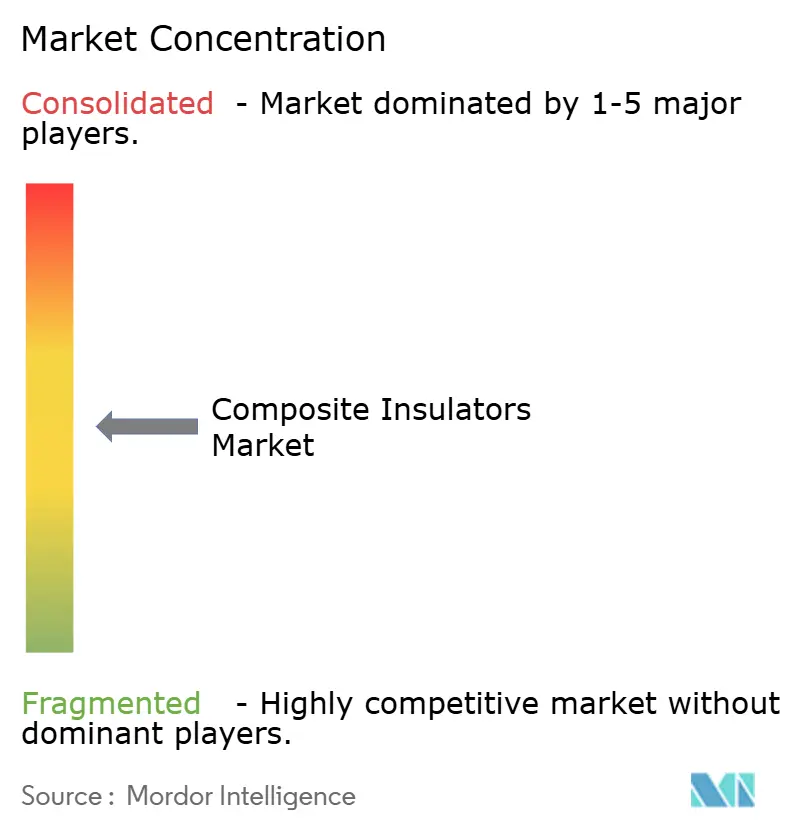
| Market Concentration | Medium |
Major Players *Disclaimer: Major Players sorted in no particular order Image © Mordor Intelligence. Reuse requires attribution under CC BY 4.0. | |
Composite Insulators Market Analysis by Mordor Intelligence
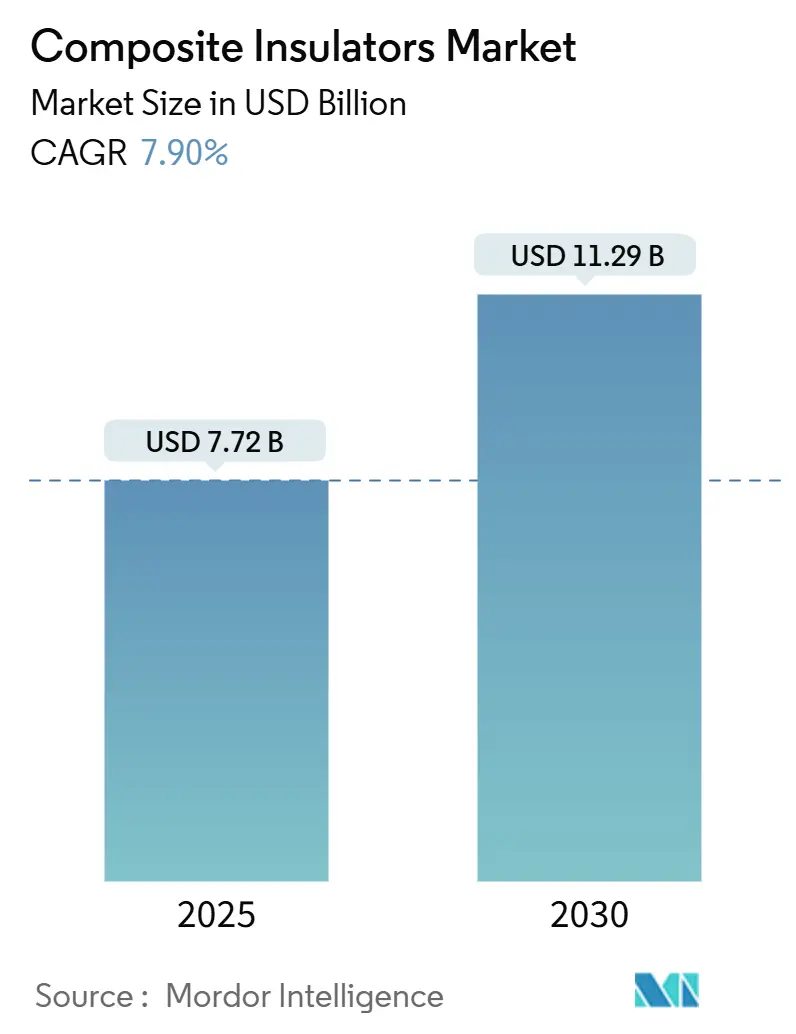
The Composite Insulators Market size is estimated at USD 7.72 billion in 2025, and is expected to reach USD 11.29 billion by 2030, at a CAGR of 7.90% during the forecast period (2025-2030).
Grid modernization programs, ultra-high-voltage direct-current (UHVDC) transmission projects, and renewable-energy-linked line build-outs underpin demand growth. Utilities increasingly specify polymer solutions because they outperform ceramic and glass units in polluted or coastal environments, weigh 80–90% less, and enable live-line maintenance. Digital condition-monitoring retrofits further de-risk polymer adoption by giving operators real-time asset health data. Competitive dynamics favor firms that combine advanced materials with embedded sensors and predictive analytics, while price volatility in silicone rubber and fiberglass pressures margins.
Key Report Takeaways
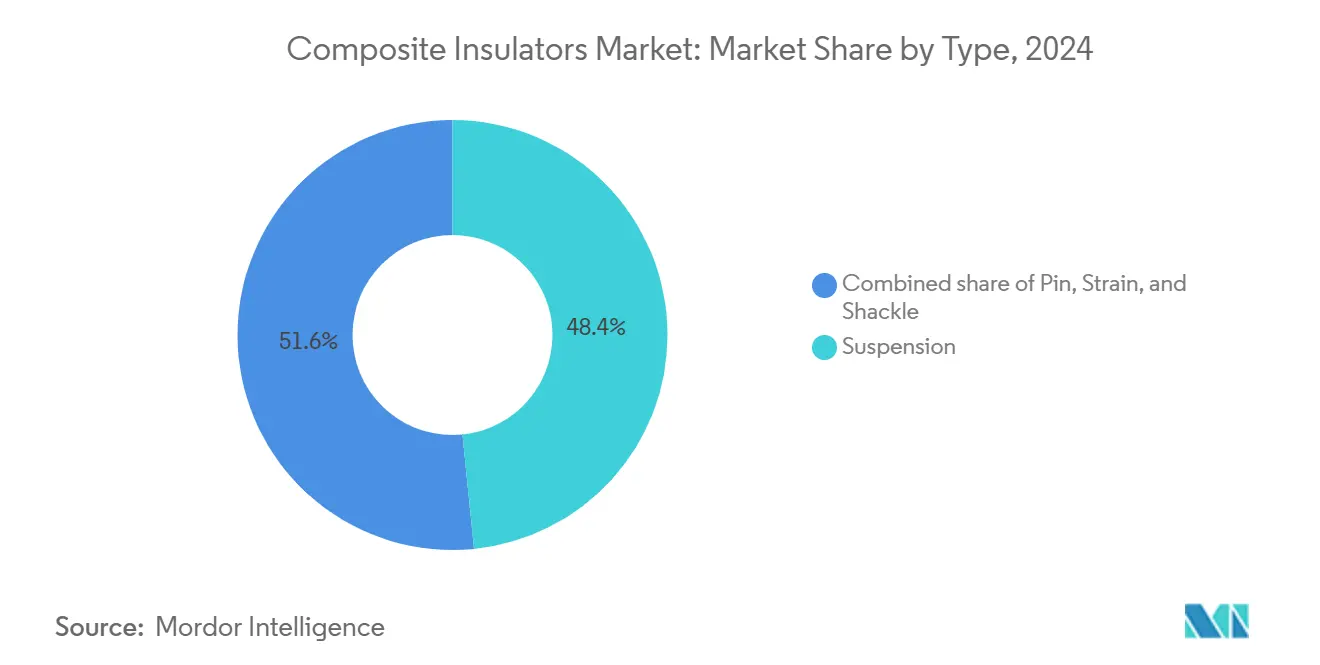
- By type, suspension insulators captured 48.4% of the composite insulators market share in 2024; strain units are projected to advance at a 9.3% CAGR through 2030.
- By voltage rating, applications above 69 kV commanded a 56.3% share of the composite insulators market size in 2024; the segment above 69 kV is poised for an 8.2% CAGR to 2030.
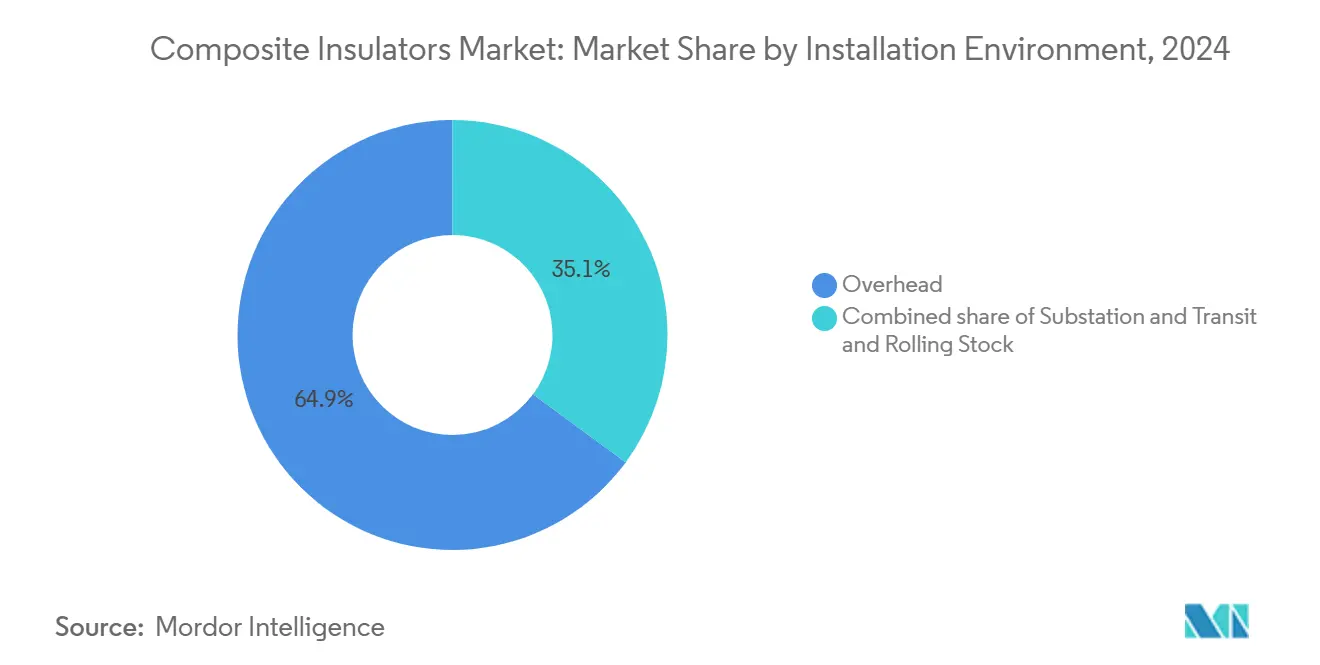
- By installation environment, overhead lines led with a 64.9% revenue share in 2024; transit and rolling stock installations are expected to climb at an 8.9% CAGR between 2025 and 2030.
- By end user, utilities accounted for 70.1% of demand in 2024, while industrial users are set to grow at an 8.0% CAGR.
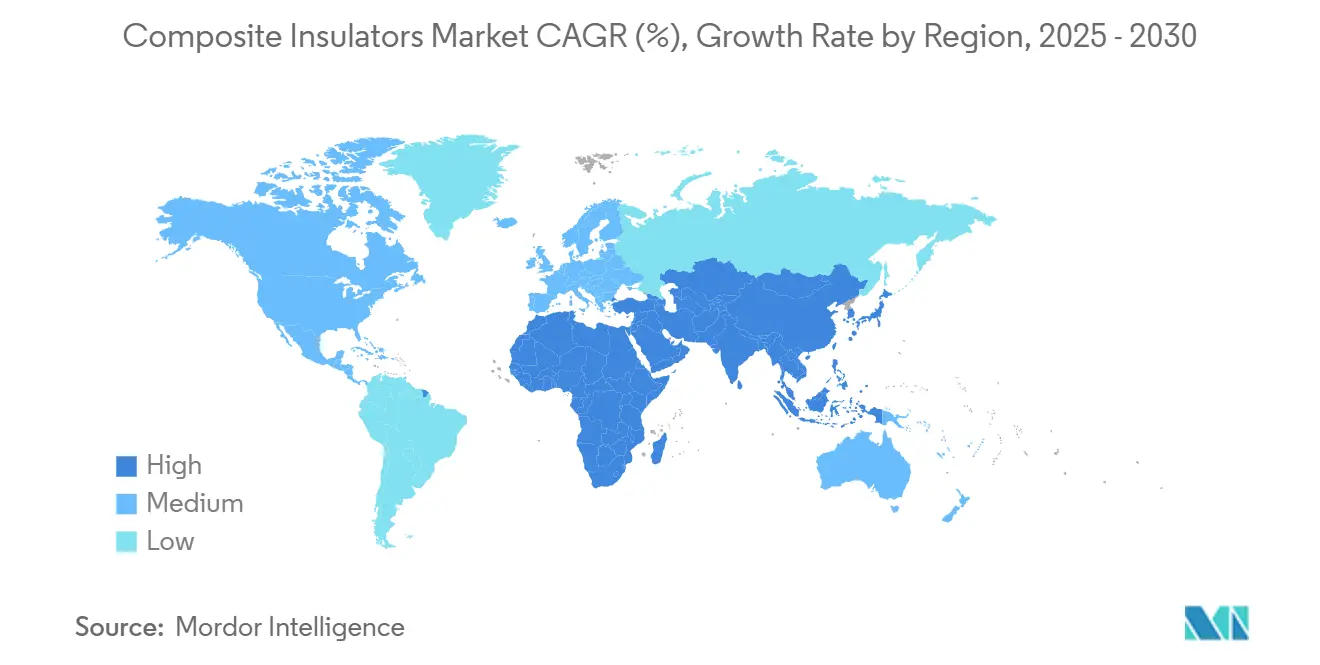
- By geography, the Asia-Pacific region commanded a 49.5% revenue share in 2024 and is also forecasted to register the fastest CAGR of 8.4% from 2024 to 2030.
Market Trends and Insights
Drivers Impact Analysis of Composite Insulators Market*
| Driver | (~) % Impact on CAGR Forecast | Geographic Relevance | Impact Timeline |
|---|---|---|---|
| Grid modernisation & expansion of T&D infrastructure | 1.8% | Global, with concentration in APAC and North America | Long term (≥ 4 years) |
| Accelerated renewable-energy-linked HV line build-outs | 1.5% | Global, led by Europe and APAC | Medium term (2-4 years) |
| Performance advantage of composites over ceramic/glass | 1.2% | Global, particularly in high-pollution regions | Long term (≥ 4 years) |
| Surge in ±1000 kV UHVDC projects in APAC | 1.0% | APAC core, with spillover to MEA and South America | Medium term (2-4 years) |
| Digital condition-monitoring retrofits easing utility approvals | 0.8% | North America and Europe, expanding to APAC | Short term (≤ 2 years) |
| Live-line maintenance mandates to curb outage costs | 0.7% | North America and Europe | Short term (≤ 2 years) |
| Source: Mordor Intelligence | |||
Grid Modernization & Expansion of T&D Infrastructure
Utilities are replacing aging ceramic and glass strings with polymer units to harden networks against extreme weather and accommodate bidirectional power flows. The United States plans to construct 103,000 miles of new lines by 2038, including MISO’s USD 22 billion build program, which specifies the use of composite insulators to reduce structure weight and minimize outage risks.[1]Lineman Central, “2025 State of Power Line Jobs,” linemancentral.com Dominion Energy has already switched to composite structures to boost coastal resilience.[2]T&D World, “Powering Up Resilience,” tdworld.com Similar modernization waves in India and Brazil are broadening the customer base. As utilities standardize live-line work, lightweight polymer housings further reduce crew exposure times. Together, these factors sustain the composite insulators market growth trajectory through 2030.
Accelerated Renewable-Energy-Linked HV Line Build-Outs
Long-distance lines connecting remote wind and solar clusters with urban load centers require insulators that endure variable loading and ice-salt cycles. Finland’s USD 4.3 billion Lowlands Line exemplifies Europe’s emphasis on 400 kV corridors dedicated to wind power. China’s 2,370 km Gansu-Zhejiang ±800 kV link transmits approximately 800 billion kWh of renewable energy annually.[3]China Daily, “Ultra-High-Voltage Flexible DC Project,” chinadaily.com.cn These schemes require long creepage paths, hydrophobic surfaces, and embedded sensors to ensure a 30-year service life, thereby amplifying premium demand within the composite insulators market.
Performance Advantage of Composites Over Ceramic/Glass
Silicone rubber sheds retain hydrophobicity under salt spray and industrial pollution, preventing flashover that often plagues porcelain strings. Weight savings of up to 90% lower tower costs and simplify live-line washing. Seismic tests confirm superior lateral stiffness and benign failure modes compared with rigid porcelain columns. These attributes drive utilities in coastal China, the Gulf, and Latin America to shift new and refurbishment orders toward composites, reinforcing the overall momentum of the composite insulators market.
Surge in ±1000 kV UHVDC Projects in APAC
China’s ±1100 kV corridor demands polymer insulators engineered for 1,000 kV DC stress, extra creepage, and tight dimensional tolerances. Such projects accelerate material science advances—nano-filled silicone blends resist DC aging, while fiberglass cores use optimized sizing to thwart stress corrosion. The knowledge spillovers into India and the Middle East foster technology export opportunities for leading Chinese and Japanese vendors, thus catalyzing the composite insulators market worldwide.
Restraints Impact Analysis of Composite Insulators Market*
| Restraint | (~) % Impact on CAGR Forecast | Geographic Relevance | Impact Timeline |
|---|---|---|---|
| Volatility in silicone-rubber & fiberglass prices | -0.9% | Global, particularly affecting emerging markets | Short term (≤ 2 years) |
| Field-installation failures creating brand-risk for utilities | -0.7% | Global, with higher impact in regions with limited technical expertise | Medium term (2-4 years) |
| Lack of globally harmonised DC-aging standards | -0.5% | Global, affecting international project deployment | Long term (≥ 4 years) |
| End-of-life recyclability & looming polymer-waste rules | -0.4% | Europe and North America leading, expanding globally | Long term (≥ 4 years) |
| Source: Mordor Intelligence | |||
Volatility in Silicone-Rubber & Fiberglass Prices
Silicone prices track silicon-metal and petrochemical costs, while fiberglass relies on the supply of kaolin and quartz. Recent spikes in fiberglass input costs have lifted them by 22%, squeezing small manufacturers that lack forward contracts.[4]Nanjing EFG, “Fiberglass,” egfglassfiber.com Rising material bills translate into bid premiums, delaying tenders in cost-sensitive markets such as Southeast Asia. Suppliers are adopting dual-sourcing and lightweight rod designs to mitigate volatility; however, persistent swings could temper the adoption rates of composite insulators over the next two years.
Field-Installation Failures Creating Brand-Risk for Utilities
Water ingress at the silicone-rod interface and mishandled fittings account for 57% of composite rod fractures reported in post-mortem studies. Utilities wary of reputational damage are hesitant to specify polymer units on critical circuits if the contractor's skill sets are uncertain. Manufacturers respond with factory-crimped hardware, RFID tagging for traceability, and installer certification programs. Widespread adoption of training will be essential to prevent failures and sustain the growth outlook of the composite insulators market.
*Our forecasts treat driver/restraint impacts as directional, not additive. The impact forecasts reflect baseline growth, mix effects, and variable interactions.
Composite Insulators Market Segment Analysis
By Type:
Suspension Units Anchor DemandSuspension strings generated the largest revenue in 2024, supported by high mechanical loads in transmission spans. The composite insulators market size for suspension products is projected to climb to USD 5.4 billion by 2030. Digital sensor retrofits accelerate uptake as operators seek real-time leakage current data. Strain insulators, while smaller today, will record the fastest gains as renewable linkages use long-span conductors that impose higher tensile forces. Vendors utilize pultruded rods and aramid reinforcement to enhance tensile ratings without incurring weight penalties, thereby improving acceptance for river crossings and mountainous terrain.
Transverse vibration fatigue remains a design focus. Vendors supply tapered sheds that dissipate wind-induced oscillations, cutting clamp wear. Pin and shackle styles fill legacy distribution roles but lose market share where utilities adopt covered conductors and spacer cable systems, which pair best with polymer suspension units. Across all styles, embedded fiber Bragg gratings enable crew-free checks, enhancing the appeal of the composite insulators market to maintenance-constrained utilities.



By Voltage Rating:
Above 69 kV Drives Material InnovationApplications above 69 kV dominated revenue and will pace expansion at an 8.2% CAGR. Projects such as the Gansu-Zhejiang corridor rely on polymer units verified through DC aging chambers to 30 years equivalent service. Medium-voltage installations still switch to composites in coastal areas because the hydrophobic surface suppresses salt fog flashovers. Low-voltage traction feeders represent a niche where compact form factors outweigh cost premiums.
Material breakthroughs nano-siloxane fillers, corona-resistant fiberglass, and water-blocking end seals, originate in the high-voltage niche and cascade downward, broadening the composite insulators market base. Utilities also utilize higher thermal ratings to transmit power through legacy rights-of-way using advanced conductors, a trend that indirectly increases polymer insulator volume.
By Installation Environment:
Overhead Lines Remain CoreOverhead circuits accounted for nearly two-thirds of 2024 revenue as line refurbishments specified polymer strings to reduce tower reinforcement costs. The composite insulators market share continues to rise in seacoast and desert corridors, where ceramic washing cycles have proven unsustainable. Substation posts utilize hollow-core composites to reduce the footprint inside gas-insulated switchgear.
Transit and rolling stock installations, while smaller, show the sharpest trajectory because rail operators prioritize weight savings and vibration tolerance. Lightweight posts simplify pantograph design and raise acceleration efficiency. The shift aligns with national transit electrification drives in Europe, India, and Japan, creating a new recurring demand node within the composite insulators market.
By End User:
Industry Gains TractionUtilities remained the primary buyers in 2024; however, industrial facilities now require distribution-level resilience to protect sensitive manufacturing loads. Factories deploying rooftop solar and battery storage require bidirectional fault-withstand capability, which is achieved by using polymer insulators that limit flashover risk.
Package substations for data centers integrate composite bushings to shrink footprints, while petrochemical plants adopt arc-tracking-resistant designs for corrosive atmospheres. The industrial appetite for predictive maintenance dovetails with smart insulator offerings, cementing an 8.0% CAGR trajectory that narrows the dominance gap and diversifies the composite insulators market revenue stream.
Geography Analysis
APAC Composite Insulators Market
Asia-Pacific held 49.5% of global revenue in 2024 and is projected to post an 8.4% CAGR through 2030. China’s ±1100 kV builds and India’s green corridor links spearhead spending on electric insulator systems, pushing local vendors to scale nano-filled silicone lines. Supply-chain localization benefits regional champions but raises dependency risks for Western utilities sourcing specialty housings.
North America and Europe Composite Insulators Market
North American demand stems from grid hardening against climate extremes and 103,000 miles of planned new lines; U.S. utilities, such as Dominion Energy, have validated 60-year life estimates for composite poles and strings. Europe emphasizes the integration of renewables and compliance with the circular economy, spurring trials of recyclable silicone chemistries.
South America and MEA Composite Insulators Market
South America, the Middle East, and Africa collectively form the most dynamic emerging block. Brazil’s wind and solar expansion, backed by Chinese investment, accelerates the development of the 400 kV corridor. Gulf utilities retrofit polymer units to handle dust storms, while Kenya’s geothermal expansion triggers distribution upgrades. These varied projects collectively lift the composite insulators market footprint into new geographies.

Competitive Landscape
Global leaders—Hitachi Energy, NGK Insulators, Siemens Energy, and Seves Group—encompass broad portfolios that cover both AC and DC services. They funnel 4–6% of revenue into R&D, targeting nano-dielectric blends and IoT-ready fittings. Hitachi Energy trialed sensorized 400 kN strings on an Alberta 500 kV line in April 2024, integrating cloud diagnostics into the utility’s asset platform. Siemens Energy partnered with Heimdall Power to embed Neuron™ sensors for dynamic line rating in June 2024.
Regional specialists exploit cost and proximity advantages. Bharat Heavy Electricals increased domestic silicone rod capacity by 25% in 2024 to meet India’s bulk tender rules. China’s Chaozhou Three-Circle ramped a new facility dedicated to ±1100 kV units, underscoring the technology lead cultivated by APAC firms. Fragmentation persists, yet digital services are nudging the sector toward solution bundles that could spark consolidation.
Material suppliers also shape competition. Dow’s SILASTIC™ elastomers and Rogers Corporation’s high-temperature silicones allow insulator makers to tailor shed blends that resist corona cutting under DC stress. Vendors aligning with recyclability mandates—through the chemical recovery of silicone oil or repurposing fiberglass into asphalt—gain early mover reputational advantages, reinforcing their market positioning in the composite insulators market.
Composite Insulators Industry Leaders
Hitachi Energy
NGK Insulators Ltd.
Seves Group (Sediver)
Siemens Energy
Hubbell Power Systems
- *Disclaimer: Major Players sorted in no particular order
Composite Insulators Market Companies Covered in this Report
- Hitachi Energy
- NGK Insulators Ltd.
- Seves Group (Sediver)
- Siemens Energy
- Hubbell Power Systems
- General Electric Vernova
- Pfisterer Holding
- Global Insulator Group
- Lapp Insulators
- Bharat Heavy Electricals Ltd.
- MacLean Power Systems
- Victor Insulators
- Aditya Birla Insulators
- TE Connectivity (Raychem)
- Toshiba Energy Systems & Solutions
- Arteche Group
- Zhejiang Jinlihua Electric
- Chaozhou Three-Circle (CTC)
- Sediver (if not already counted with Seves)
- Tridelta Meidensha

Recent Industry Developments in Composite Insulators Market
- January 2025: CHINT showcased a new meter plant and polymer insulator line at SENDI 2025 as part of a USD 110 million expansion plan in Brazil.
- September 2024: Dominion Energy has deployed 30 composite poles in Virginia Beach, sourced from the Creative Composites Group, with plans to expand to hundreds of units.
- July 2024: China commenced construction of the USD 4.82 billion, 2,370 km Gansu-Zhejiang ±800 kV flexible DC link, requiring specialized composite insulators.
- June 2024: Fingrid committed USD 4.3 billion for the 400 kV Lowlands Line, including three new substations.


Global Composite Insulators Market Report Scope
Segmentation Overview
| Pin |
| Suspension |
| Strain |
| Shackle |
| Low (Below 1 kV) |
| Medium (1 to 69 kV) |
| High (Above 69 kV) |
| Overhead |
| Substation |
| Transit and Rolling Stock |
| Utilities |
| Industrial |
| Commercial |
| Residential |
| North America | United States |
| Canada | |
| Mexico | |
| Europe | Germany |
| United Kingdom | |
| France | |
| Italy | |
| NORDIC Countries | |
| Russia | |
| Rest of Europe | |
| Asia-Pacific | China |
| India | |
| Japan | |
| South Korea | |
| ASEAN Countries | |
| Rest of Asia-Pacific | |
| South America | Brazil |
| Argentina | |
| Rest of South America | |
| Middle East and Africa | Saudi Arabia |
| United Arab Emirates | |
| South Africa | |
| Egypt | |
| Rest of Middle East and Africa |
| By Type | Pin | |
| Suspension | ||
| Strain | ||
| Shackle | ||
| By Voltage Rating | Low (Below 1 kV) | |
| Medium (1 to 69 kV) | ||
| High (Above 69 kV) | ||
| By Installation Environment | Overhead | |
| Substation | ||
| Transit and Rolling Stock | ||
| By End User | Utilities | |
| Industrial | ||
| Commercial | ||
| Residential | ||
| By Geography | North America | United States |
| Canada | ||
| Mexico | ||
| Europe | Germany | |
| United Kingdom | ||
| France | ||
| Italy | ||
| NORDIC Countries | ||
| Russia | ||
| Rest of Europe | ||
| Asia-Pacific | China | |
| India | ||
| Japan | ||
| South Korea | ||
| ASEAN Countries | ||
| Rest of Asia-Pacific | ||
| South America | Brazil | |
| Argentina | ||
| Rest of South America | ||
| Middle East and Africa | Saudi Arabia | |
| United Arab Emirates | ||
| South Africa | ||
| Egypt | ||
| Rest of Middle East and Africa | ||


Key Questions Answered in the Report
What is the projected value of the composite insulators market by 2030?
The market is forecast to reach USD 11.29 billion by 2030, growing at a 7.9% CAGR from 2025.
Which type commands the largest share in today’s demand?
Suspension insulators lead with 48.4% revenue share in 2024.
Why are utilities switching from porcelain to polymer designs?
Composite units weigh up to 90% less, maintain hydrophobic surfaces that curb flashover, and support live-line maintenance, lowering lifecycle costs.
Which region is expanding the fastest?
Asia-Pacific is advancing at an 8.4% CAGR through 2030 due to massive UHVDC investments and grid upgrades.
How are digital technologies influencing product design?
Embedded sensors and cloud analytics turn insulators into smart assets, enabling predictive maintenance and boosting utility confidence in polymer solutions.
Page last updated on:


 Your data is secure and never sold or shared.


