
Porcelain Insulators Market Size and Share
Market Overview
| Study Period | 2021 - 2031 |
|---|---|
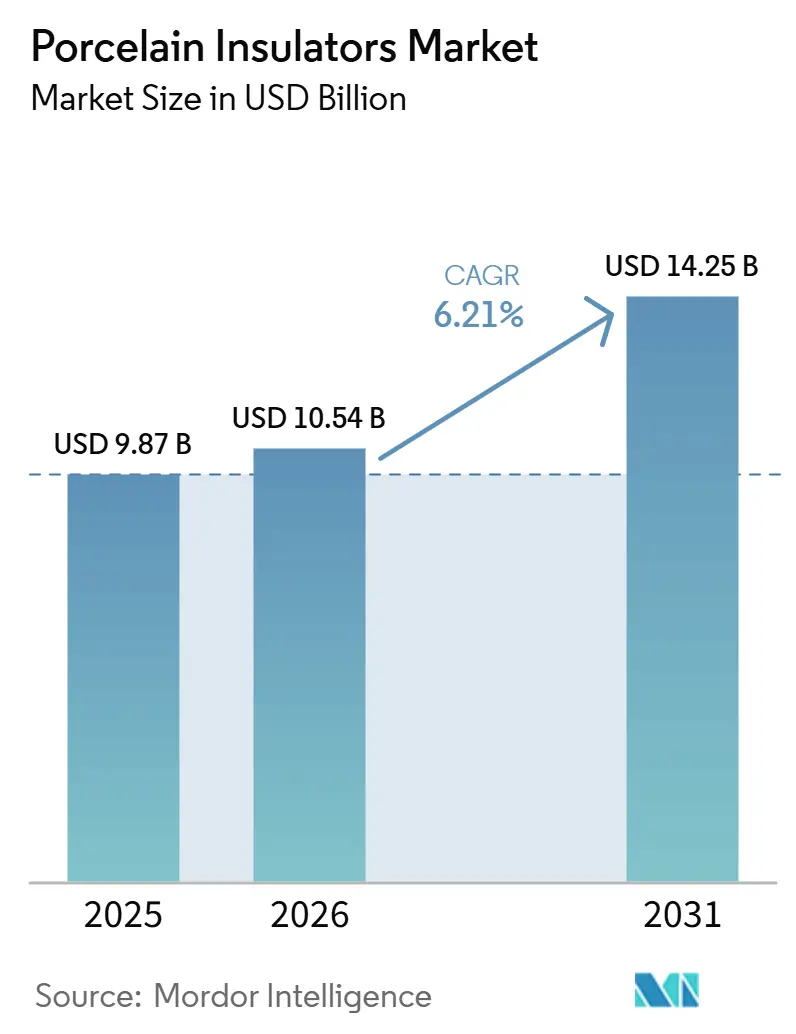
| Market Size (2026) | USD 10.54 Billion |
| Market Size (2031) | USD 14.25 Billion |
| Growth Rate (2026 - 2031) | 6.21 % |
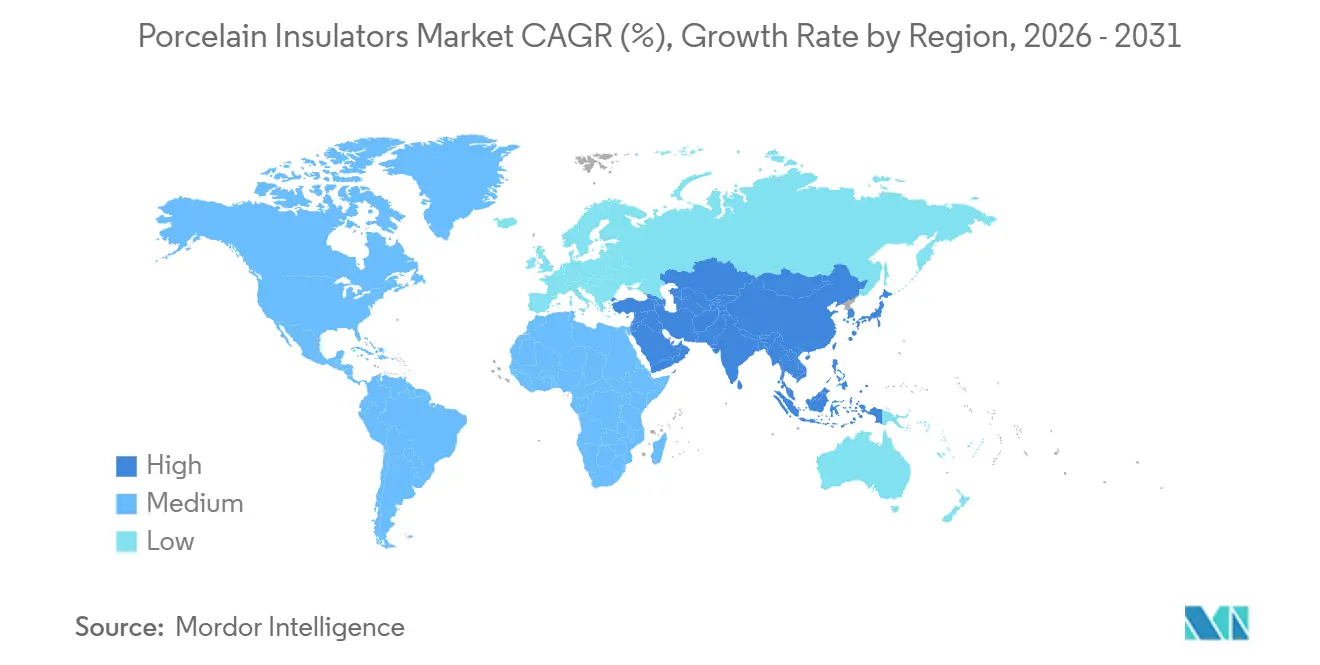
| Fastest Growing Market | Asia Pacific |
| Largest Market | Asia Pacific |
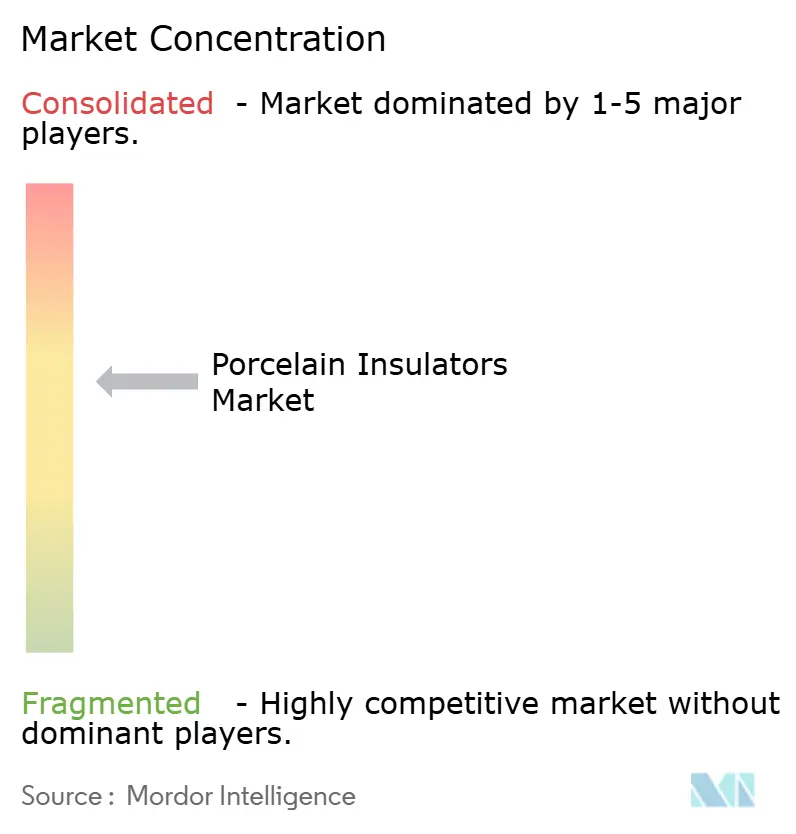
| Market Concentration | Medium |
Major Players *Disclaimer: Major Players sorted in no particular order Image © Mordor Intelligence. Reuse requires attribution under CC BY 4.0. | |
Porcelain Insulators Market Analysis by Mordor Intelligence
The Porcelain Insulators Market size is projected to expand from USD 9.87 billion in 2025 and USD 10.54 billion in 2026 to USD 14.25 billion by 2031, registering a CAGR of 6.21% between 2026 to 2031. Rising utility spending on ultra-high-voltage transmission corridors in Asia, refurbishment of aging grids in North America and Europe, and the near-universal electrification of India’s rail network are sustaining demand despite the gradual shift toward lightweight composite alternatives.[1]State Grid Corporation of China, “±800 kV Qinghai UHVDC Project,” stategrid.com.cn High-alumina porcelain remains the preferred choice in pollution-class IV environments because long-term hydrophobicity of polymer units is still unproven. Input-cost volatility in alumina and kaolin adds margin pressure for mid-tier manufacturers; vertically integrated players with captive refineries are better positioned to absorb price swings. Ongoing consolidation among Western original-equipment manufacturers underscores a strategic pivot toward bundled transmission-infrastructure portfolios that package insulators with conductors, towers, and EPC services.
Key Report Takeaways
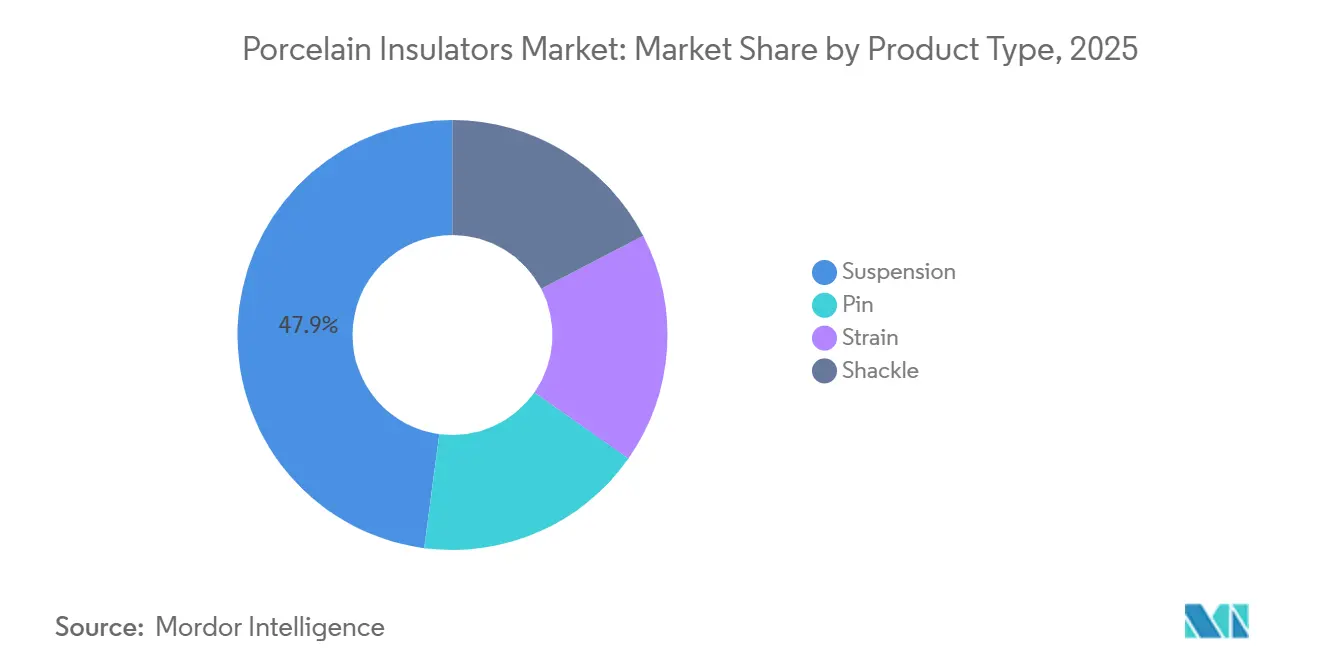
- By product type, suspension units led with a 47.9% share in 2025, while strain units are expected to expand at the fastest rate, at 7.6% during 2026–2031.
- By voltage rating, high-voltage insulators above 69 kV accounted for 55.3% of the porcelain insulators market share in 2025 and are projected to grow at a 6.5% CAGR through 2031.
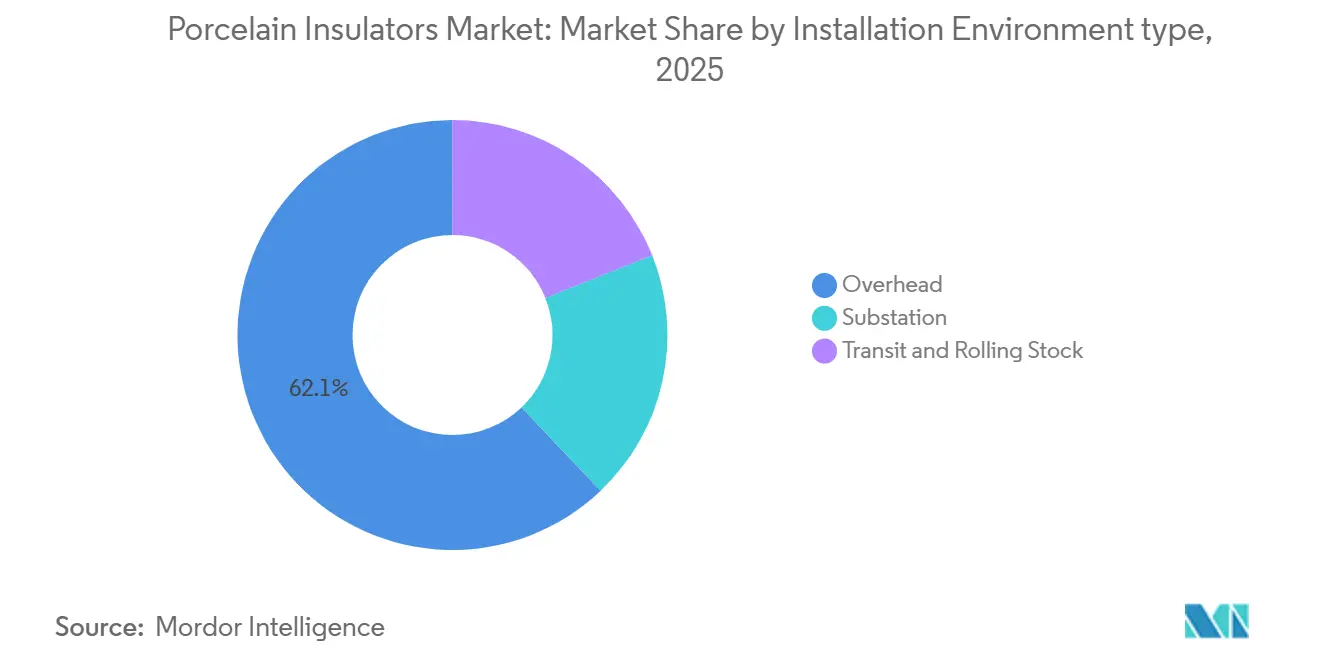
- By installation environment, overhead lines accounted for 62.1% of revenue in 2025, while substation applications are expected to grow at 7.2%, driven by gas-insulated switchgear upgrades.
- By end user, utilities held a 69.5% revenue share in 2025, while industrial customers are projected to record the highest CAGR at 6.3% through 2031.
- By geography, Asia-Pacific accounted for 49.4% of revenue in 2025 and is expected to grow at 6.7%, driven by gas-insulated switchgear upgrades.
Note: Market size and forecast figures in this report are generated using Mordor Intelligence’s proprietary estimation framework, updated with the latest available data and insights as of January 2026.
Market Trends and Insights
Drivers Impact Analysis of Porcelain Insulators Market*
| Driver | (~) % Impact on CAGR Forecast | Geographic Relevance | Impact Timeline |
|---|---|---|---|
| Expansion of HV transmission corridors in Asia & Africa | +1.2% | Asia-Pacific, Middle East & Africa | Medium term (2-4 years) |
| Grid refurbishment programs in OECD economies | +0.9% | North America, Europe | Long term (≥ 4 years) |
| Rural electrification roll-outs (South & SE Asia) | +0.7% | Asia-Pacific (India, Indonesia, Bangladesh) | Medium term (2-4 years) |
| Rail-traction electrification surge | +0.8% | Asia-Pacific, Europe, Middle East & Africa | Short term (≤ 2 years) |
| Adoption of hydrophobic nano-coated porcelain strings | +0.5% | Global, with early adoption in coastal zones | Medium term (2-4 years) |
| Local-content mandates boosting domestic sourcing | +0.4% | India, Brazil, select African markets | Short term (≤ 2 years) |
| Source: Mordor Intelligence | |||
Expansion of HV transmission corridors in Asia & Africa
China commissioned ±800 kV UHVDC links in Qinghai during 2025, with each kilometer requiring 120–180 porcelain suspension or strain insulators that meet IEC 60815-1:2024 pollution-class IV criteria. The Kenya–Tanzania 400 kV interconnector applies 31 mm per-kV creepage to guard against Indian Ocean salt fog, favoring ceramic over polymer units. Indonesia budgeted USD 270 million in 2025 for village electrification that stipulates locally made porcelain hardware.[2]Indonesian State Electricity Company PLN, “Rural Electrification Program,” pln.co.id These projects collectively add an estimated 18,000 circuit-kilometers a year, sustaining baseline demand even as mature markets plateau. Utilities prefer porcelain because hydrophobicity degradation in humid tropical climates compromises polymer performance over the expected 30-year service lives. Government export-credit support and Belt & Road financing further accelerate order flow to Asian manufacturers.
Grid refurbishment programs in OECD economies
More than 70% of U.S. transmission lines exceed 40 years of age, and utilities opt for like-for-like porcelain replacements to avoid new tower-geometry approvals. European distribution operators face similar aging profiles, with roughly 40% of lines past the 40-year mark. Reconductoring that swaps in higher-capacity conductors often leaves original porcelain strings intact, as composite alternatives alter weight distribution. Regulatory certainty and standardized mechanical fittings shorten procurement cycles when porcelain is selected. The International Energy Agency projects refurbishment to represent 35% of the USD 600 billion in annual grid investment through 2030, anchoring a steady replacement pipeline.[3]International Energy Agency, “Electricity 2026,” iea.org Maintenance crews value porcelain for its predictable failure signature, easing condition-based inspection planning.
Rural Electrification Roll-outs in South & Southeast Asia
India's Saubhagya and Revamped Distribution Sector Scheme aim to achieve universal household electricity access, driving the installation of thousands of kilometers of new 11 kV and 22 kV feeders that rely on low-cost porcelain pin and shackle units. Indonesia's 5,700-village electrification program depends on domestic ceramic factories to meet local value-addition requirements. Bangladesh's Rural Electrification Board continues to expand its 33 kV backbone network across riverine terrain, specifying porcelain insulators because moisture ingress degrades polymer sheds more rapidly in monsoon climates. Local-content policies generate captive demand for domestic manufacturers, offsetting import competition. Successful tenderers often include technical training for village-level maintenance teams that have limited experience with polymer-washing procedures.
Rail-traction electrification surge
Indian Railways completed 99.4% network electrification in 2025, consuming approximately 640,000 strain insulators rated for 25 kV AC and 120 kN tensile loads. The Rail Baltica 870-km corridor specifies EN 50119-compliant porcelain to address ultraviolet degradation concerns at high latitudes. The Mombasa–Uganda extension applies porcelain under IEC 60273:2024, with local assembly conducted through Chinese-Kenyan joint ventures. Railway projects operate on 15–20 year replacement cycles, which accelerates aftermarket demand compared with 30–40 year grid applications. Strain insulators are also seeing increased adoption in metro and tram systems using 1.5 kV DC catenary, broadening the customer base beyond national railways.
Restraints Impact Analysis of Porcelain Insulators Market*
| Restraint | (~) % Impact on CAGR Forecast | Geographic Relevance | Impact Timeline |
|---|---|---|---|
| Rapid shift toward composite & polymer insulators | -1.3% | Global, accelerated in coastal & high-pollution zones | Medium term (2-4 years) |
| Volatile alumina/kaolin input prices | -0.6% | Global, most acute in Europe & India | Short term (≤ 2 years) |
| PFAS-linked glazing restrictions | -0.4% | Europe, North America | Long term (≥ 4 years) |
| Counterfeit insulators in price-sensitive markets | -0.3% | Asia-Pacific, Middle East & Africa | Medium term (2-4 years) |
| Source: Mordor Intelligence | |||
Rapid shift toward composite & polymer insulators
Composite units weigh approximately 85% less than porcelain, reducing tower foundation costs and enabling helicopter stringing on steep terrain. Scandinavian and Canadian utilities now specify polymer strings for new 145 kV lines to limit permafrost excavation. Polymer insulators also offer greater resistance to vandalism, which is relevant in rural corridors where gunfire damage to porcelain is a concern. However, field audits in Malaysia and Indonesia have identified chalking and tracking after 8-10 years, prompting a reversion to porcelain for 275 kV networks. Utilities must weigh the 25-year composite design life against porcelain's 40-year service expectancy, which is slowing wholesale substitution.
Volatile Alumina / Kaolin Input Prices
North American smelters paid USD 0.43 per kg for alumina in March 2026, while European producers faced USD 0.52 per kg. Indian costs reached USD 0.55 per kg amid elevated coal tariffs. Kaolin prices in India climbed to USD 134.25 per t in Q4 2025, up 14% year on year as rotary-kiln energy costs spiked.[4]Indian Bureau of Mines, “Kaolin Market Review 2025,” ibm.gov.in Fixed-price utility contracts lock mid-tier suppliers into thin margins when feedstock rises by double digits. Vertically integrated players such as NGK and Aditya Birla offset volatility through captive refineries, widening the competitive gap.
*Our forecasts treat driver/restraint impacts as directional, not additive. The impact forecasts reflect baseline growth, mix effects, and variable interactions.
Porcelain Insulators Market Segment Analysis
By Product Type:
Strain Insulators Extend Growth MomentumStrain units recorded a 7.6% CAGR from 2026 to 2031, outpacing the broader porcelain insulators market growth rate, driven by the higher tensile ratings required for railway and dead-end transmission towers. Suspension designs retained a 47.9% revenue share in 2025, supported by their widespread use on tangent towers. Innovations such as multi-shed compact discs have reduced overall string length by 18%, enabling shorter towers on 132 kV upgrades. Pin and shackle categories remain common in rural 11 kV feeders, although urban undergrounding limits volume growth. Manufacturers that develop silver-braze metal-ceramic joints achieve a 12% weight reduction and improved seismic resilience, offering an advantage over cemented cap designs.
Hybrid strain designs now achieve 50 kV lightning-impulse withstand ratings in form factors previously limited to 36 kV, opening substation-bus applications. Additional demand comes from retrofit spacing constraints within compact gas-insulated switchgear. Advanced glazing that reduces dielectric loss has enabled strain discs to support higher corona inception voltages, extending inspection intervals.



By Voltage Rating:
High Voltage Segment Drives Premium GrowthHigh-voltage classes above 69 kV accounted for 55.3% of 2025 revenue and are projected to sustain a 6.5% CAGR, significantly above medium-voltage feeder growth, as China, India, and East Africa prioritize 400 kV and higher transmission backbones. A single 400 kV double-circuit line requires up to 12,000 suspension discs per 100 km, supporting bulk orders that stabilize kiln utilization. Medium-voltage demand remains fragmented across industrial campuses and distribution refurbishments, keeping pricing competitive.
Ultra-high-voltage projects require strings exceeding 6 m in length, which few manufacturers can produce without automated kiln tracking and ISO 9001-certified laboratories. These barriers favor established manufacturers and limit new-entrant threats. The porcelain insulators market share attributed to high-voltage applications remains resilient, as polymer alternatives face challenges with long-term pollution flashover performance at elevated system voltages.
By Installation Environment:
Substation Applications Gain TractionThe substation porcelain market is projected to grow at 7.2% through 2031, driven by the increasing adoption of gas-insulated switchgear (GIS) in dense urban areas. Overhead lines continue to account for 62.1% of revenue; however, GIS retrofits offer higher margins, as each bushing undergoes partial-discharge and capacitance grading tests. Condition-based infrared monitoring extends the service life of overhead strings, which moderates replacement volumes but supports demand for aftermarket sensors.
Substation modules are now shipped pre-assembled with SF₆ seals, reducing onsite outage time. Utilities favor GIS for its smaller footprint and lower audible noise, driving adoption in metropolitan areas such as Mumbai and Jakarta. This shift increases specification complexity, creating entry barriers for low-cost manufacturers and enabling premium pricing for producers with in-house test facilities.
By End User:
Utilities Drive Infrastructure Investment CyclesUtilities held a 69.5% share in 2025 and are projected to grow at a 6.3% CAGR as renewable generation zones connect to demand centers. Industrial buyers in steel, mining, and petrochemicals add demand diversity by installing captive 132 kV substations, increasing demand for electric insulator applications. Semiconductor fabs in India's Gujarat and Tamil Nadu alone are expected to require more than 200,000 bushings by 2027. Commercial and residential uptake remains modest, as underground cables and aerial-bundled conductors bypass traditional pin-type hardware.
Utilities require IEC 60383 certification, routine factory audits, and long-term warranties, which lengthen qualification cycles but create switching inertia. Industrial clients place greater weight on delivery speed, creating an opportunity for regional specialists who can offer eight-week lead times. The utility segment's share of the porcelain insulators market provides demand predictability for large producers that align kiln capacity to multi-year framework agreements.
Geography Analysis
APAC Porcelain Insulators Market
Asia-Pacific accounted for 49.4% of global revenue in 2025 and is projected to record a 6.7% CAGR through 2031. China operates more than 30,000 km of ±800 kV or above UHVDC corridors, each consuming up to 25,000 discs per 1,000 km. India plans 37 GW of inter-regional transmission capacity by 2027, translating to approximately 1.2 million porcelain units. Southeast Asia's rural electrification programs generate steady mid-voltage demand and support local content requirements, anchoring factory investments in Vietnam and Indonesia.
North America and Europe Porcelain Insulators Market
North America and Europe are growing primarily through grid refurbishment. The average age of the U.S. grid exceeds 40 years, and most utilities replace existing porcelain strings rather than adopt composites that alter tower loading. Europe is enforcing PFAS-free glazing standards from 2026, requiring manufacturers to use high-temperature firing processes that increase costs by up to 12%. Reconducting activity keeps string volumes stable while raising per-disc mechanical requirements.
South America and MEA Porcelain Insulators Market
South America, the Middle East, and Africa are recording higher percentage growth from a smaller base. Brazil's 500 kV Amazon-to-Southeast transmission link specifies NBR 5032 ceramic for tropical pollution conditions. Gulf utilities, led by Abu Dhabi's TRANSCO, are deploying nano-coated porcelain that reduces washing schedules by 28%, indicating market acceptance of premium technology. Kenyan and Tanzanian interconnector projects are supporting regional manufacturing partnerships, strengthening supply chains across the continent.

Competitive Landscape
The porcelain insulators market is moderately consolidated. Quanta's USD 1.27 billion acquisition of MacLean and Regal Rexnord's USD 4.3 billion acquisition of Hubbell reflect a strategy to bundle hardware with turnkey EPC offerings, reducing total installed costs for utilities.
Chinese firms Zhejiang Tailun, Xiangtan Gaoxin, and China XD are expanding kiln capacity to serve Belt & Road corridors, underpricing Western competitors by up to 25% due to proximity to alumina supplies and automated glazing lines. Patent activity is increasing; NGK has filed 14 nano-coating and low-firing-temperature patents since 2024, targeting 9% energy savings per disc. Hitachi Energy's INR 300 crore expansion in Mysuru has added robotized glaze sprayers that deliver ±2% thickness consistency, a key variable in flashover risk.
Niche players in Vietnam and Bangladesh have secured IEC 60383 certification for medium-voltage pins and are exporting to Africa at 30% price discounts, though counterfeit concerns continue to hinder high-voltage tenders. Utilities now require QR-coded certificates and third-party laboratory tests, raising the compliance bar. Opportunities are emerging in hydrophobic-coating services, with utilities willing to pay 12-15% premiums for pre-treated strings that reduce washing frequency by half.
Porcelain Insulators Industry Leaders
Seves Group
NGK Insulators Ltd.
MacLean Power Systems
PPC Insulators
Aditya Birla Insulators Limited
- *Disclaimer: Major Players sorted in no particular order
Porcelain Insulators Market Companies Covered in this Report
- Aditya Birla Insulators
- Arteche Group
- Bharat Heavy Electricals Limited (BHEL)
- China XD Group
- Hitachi Energy Ltd.
- Hubbell Power Systems, Inc.
- Maschinenfabrik Reinhausen GmbH
- LAPP Insulators Holding GmbH
- MacLean Power Systems, LLC
- NGK Insulators, Ltd.
- PPC Insulators Group
- Sediver S.A.
- Seves Group S.a.r.l.
- Siemens Energy AG
- TE Connectivity Ltd.
- Toshiba Energy Systems & Solutions Corporation
- Victor Insulators, Inc.
- Xiangtan Gaoxin Electric Porcelain Electric Apparatus Co., Ltd.
- Zhejiang Tailun Insulator Co., Ltd.

Recent Industry Developments in Porcelain Insulators Market
- March 2025: Hitachi Energy committed an additional USD 250 million to scale transformer-component and insulation capacity, addressing a global shortage and boosting porcelain demand for 145-800 kV bushings.
- January 2025: China energized the world’s highest UHVDC project, a 1,901 km link delivering 40 billion kWh annually, equipped with custom porcelain strings rated for 4,000 kN.
- September 2024: Hitachi Energy injected USD 155 million into North American factories in Reynosa, South Boston, and Mount Pleasant, expanding high-voltage switchgear and insulator lines.
- July 2024: State Grid Corporation announced 600 billion yuan 2024 transmission capex, a 60 % hike centered on UHV corridors that specify porcelain units for 800 kV AC service.
- July 2024: India’s DPIIT revised procurement policy, reclassifying Production Linked Incentive products under Class II unless 50 % local content is met, steering porcelain contracts to domestic plants


Global Porcelain Insulators Market Report Scope
Porcelain insulators, crafted from ceramic materials, serve a dual purpose: they not only create an electrical isolation barrier between live conductors and grounded structures, such as utility poles, but also offer robust physical support for the weighty wires.
The Porcelain insulators market is segmented by product type, voltage rating, installation environment, end user, and geography. By product type, the market is segmented into pin, suspension, strain, and shackle. By voltage rating, the market is segmented into low, medium, and high. By installation environment, the market is segmented into overhead, substation, transit and rolling stock. By end user, the market is segmented into utilities, industrial, commercial, and residential. The report also covers the market size and forecasts for the porcelain insulators market in 18 countries across major regions. For each segment, the market sizing and forecasts have been done on the basis of value (USD).
| Pin |
| Suspension |
| Strain |
| Shackle |
| Low (Below 1 kV) |
| Medium (1 to 69 kV) |
| High (Above 69 kV) |
| Overhead |
| Substation |
| Transit and Rolling Stock |
| Utilities |
| Industrial |
| Commercial |
| Residential |
| North America | United States |
| Canada | |
| Mexico | |
| Europe | Germany |
| United Kingdom | |
| France | |
| Italy | |
| NORDIC Countries | |
| Russia | |
| Rest of Europe | |
| Asia-Pacific | China |
| India | |
| Japan | |
| South Korea | |
| ASEAN Countries | |
| Rest of Asia-Pacific | |
| South America | Brazil |
| Argentina | |
| Rest of South America | |
| Middle East and Africa | Saudi Arabia |
| United Arab Emirates | |
| South Africa | |
| Egypt | |
| Rest of Middle East and Africa |
| By Product Type | Pin | |
| Suspension | ||
| Strain | ||
| Shackle | ||
| By Voltage Rating | Low (Below 1 kV) | |
| Medium (1 to 69 kV) | ||
| High (Above 69 kV) | ||
| By Installation Environment | Overhead | |
| Substation | ||
| Transit and Rolling Stock | ||
| By End User | Utilities | |
| Industrial | ||
| Commercial | ||
| Residential | ||
| By Geography | North America | United States |
| Canada | ||
| Mexico | ||
| Europe | Germany | |
| United Kingdom | ||
| France | ||
| Italy | ||
| NORDIC Countries | ||
| Russia | ||
| Rest of Europe | ||
| Asia-Pacific | China | |
| India | ||
| Japan | ||
| South Korea | ||
| ASEAN Countries | ||
| Rest of Asia-Pacific | ||
| South America | Brazil | |
| Argentina | ||
| Rest of South America | ||
| Middle East and Africa | Saudi Arabia | |
| United Arab Emirates | ||
| South Africa | ||
| Egypt | ||
| Rest of Middle East and Africa | ||


Key Questions Answered in the Report
What is the projected value of the porcelain insulators market in 2031?
The Porcelain Insulators Market size is projected to expand from USD 9.87 billion in 2025 and USD 10.54 billion in 2026 to USD 14.25 billion by 2031, registering a CAGR of 6.21% between 2026 to 2031.
Which application will add the most new volume through 2031?
Overhead transmission lines will stay volume leader, but substation bushings show the strongest growth at 7.2% as gas-insulated switchgear gains ground.
Are nano-coated porcelain strings commercially proven?
Yes, Abu Dhabi TRANSCO documented a 28% outage reduction over 18 months on 400 kV circuits, validating field performance.
What impact do PFAS restrictions have on suppliers?
EU Regulation 2025/718 forces glaze reformulation, lifting kiln energy use by up to 12% and favoring producers that have invested in high-temperature lines.
How vulnerable are manufacturers to raw-material shocks?
Mid-tier producers without captive alumina or kaolin face margin erosion when feedstock prices spike, whereas vertically integrated firms hedge cost swings more effectively.
Is the market highly consolidated?
No, with the top five firms holding about 40% of revenue, competition remains active, although recent mergers aim to create vertically integrated portfolios.
Page last updated on:


 Your data is secure and never sold or shared.


