
Coating Pretreatment Market Size and Share
Market Overview
| Study Period | 2020 - 2031 |
|---|---|
| Market Size (2026) | USD 5.01 Billion |
| Market Size (2031) | USD 6.15 Billion |
| Growth Rate (2026 - 2031) | 4.17 % |
| Fastest Growing Market | Asia Pacific |
| Largest Market | Asia Pacific |
| Market Concentration | Medium |
Major Players *Disclaimer: Major Players sorted in no particular order Image © Mordor Intelligence. Reuse requires attribution under CC BY 4.0. | |
Coating Pretreatment Market Analysis by Mordor Intelligence
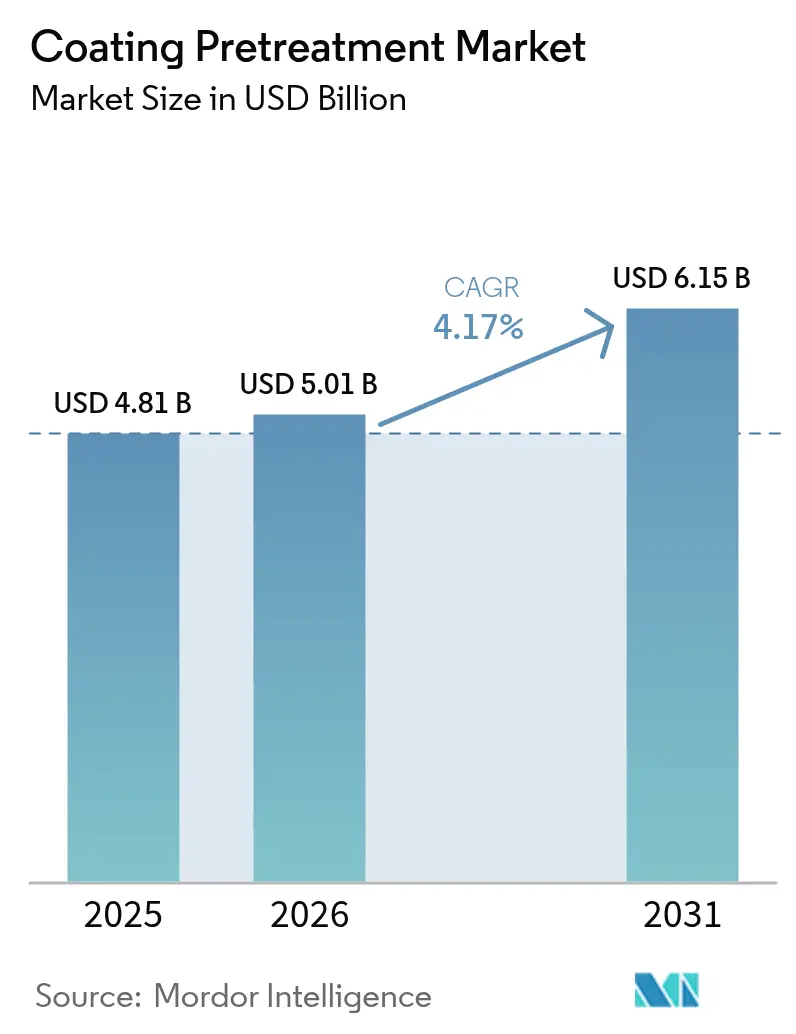
The Coating Pretreatment Market size was valued at USD 4.81 billion in 2025 and estimated to grow from USD 5.01 billion in 2026 to reach USD 6.15 billion by 2031, at a CAGR of 4.17% during the forecast period (2026-2031). Heightened environmental regulation, the shift toward lightweight vehicle architectures, and the adoption of smart-factory operations are the primary forces influencing revenue growth. Phosphate systems still dominate large-scale automotive lines because of their proven corrosion protection, yet the rapid switch to silane and zirconium nano-coats is accelerating as regulators restrict chromate chemistries. Smart inline monitoring, particularly in automotive body shops, is driving higher chemical efficiency, while the aerospace sector’s move to composite structures opens a premium niche for advanced adhesion promoters. On the competitive front, diversified suppliers with chrome-free portfolios gain share, whereas traditional phosphate specialists face margin compression from costly energy inputs and CAPEX-intensive line upgrades.
Key Report Takeaways
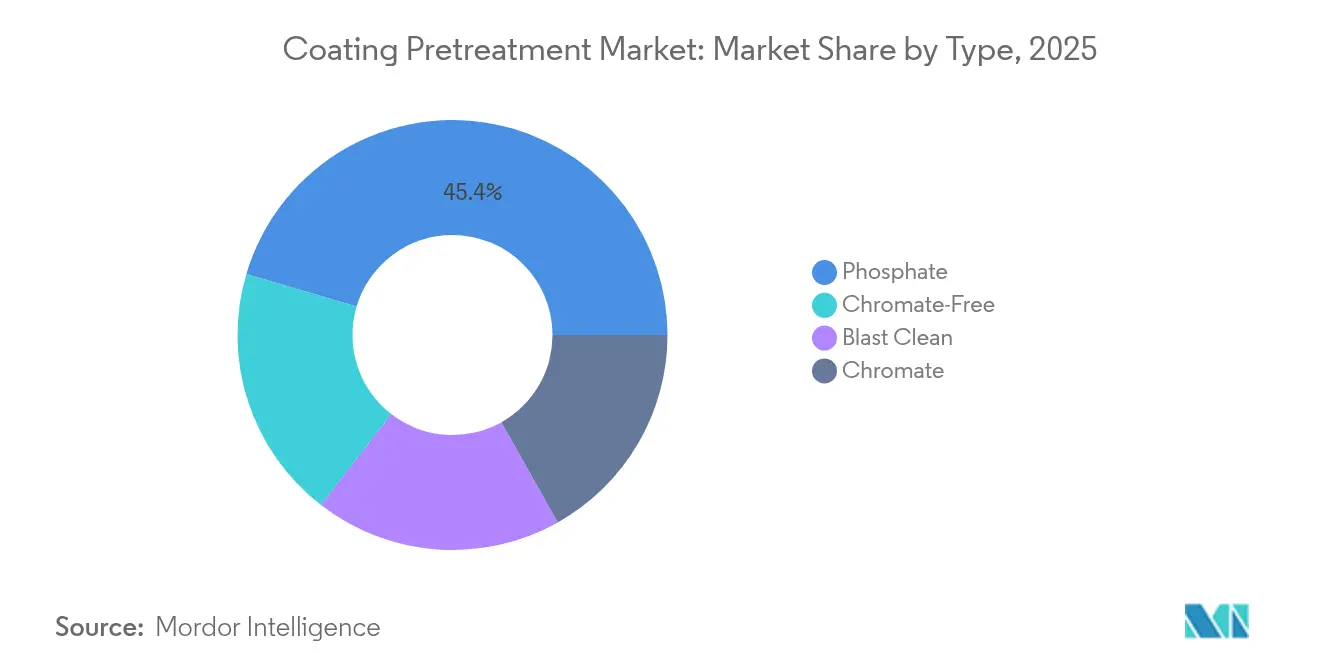
- By type, phosphate systems retained 45.42% of coating pretreatment market share in 2025, while silane technologies are projected to advance at a 5.57% CAGR through 2031.
- By metal substrate, steel accounted for 59.62% of the coating pretreatment market size in 2025, whereas aluminum is forecast to grow at 5.34% CAGR to 2031.
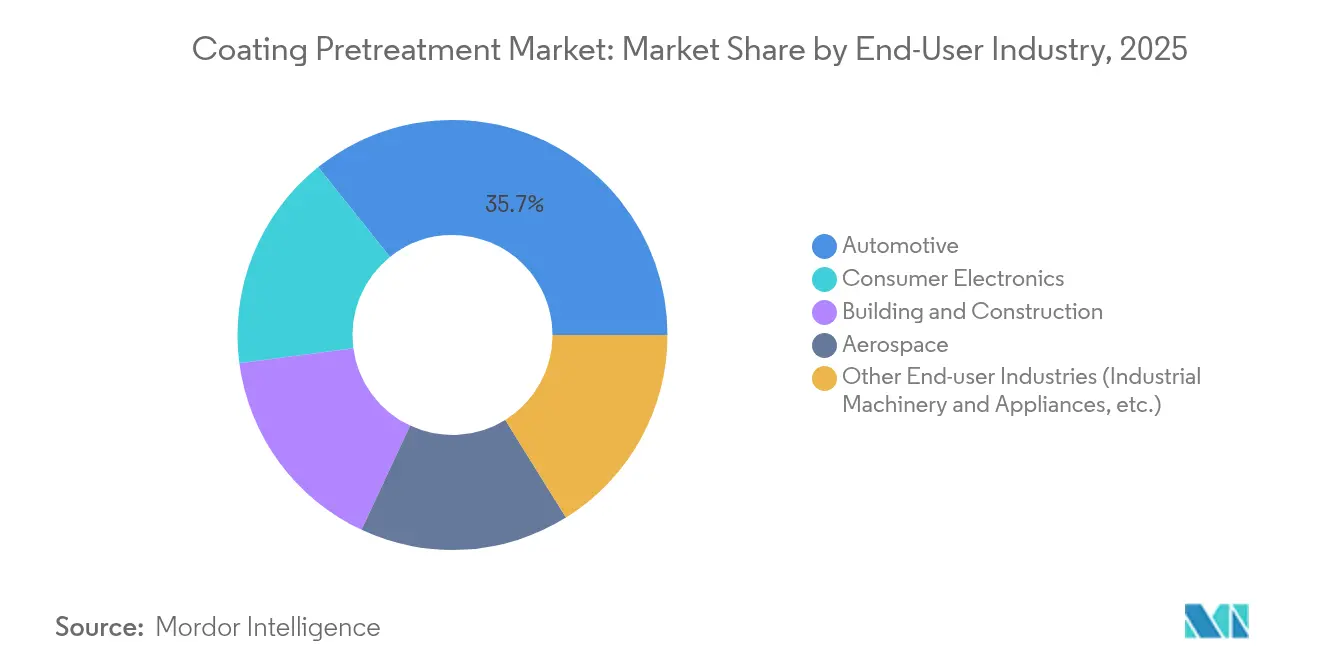
- By end-user industry, automotive and transportation captured 35.74% revenue share in 2025; consumer electronics is anticipated to post the fastest 5.27% CAGR through 2031.
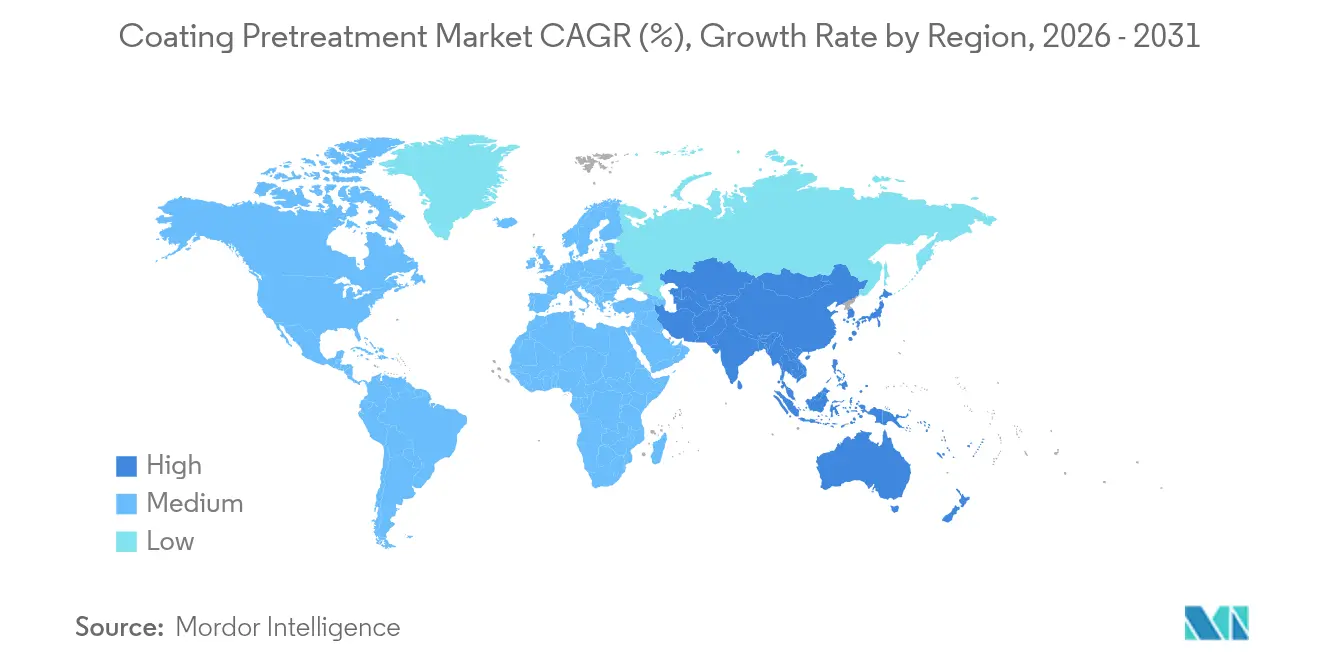
- By geography, Asia-Pacific led with a 44.78% share of the coating pretreatment market size in 2025 and is set to expand at 5.12% CAGR to 2031.
Note: Market size and forecast figures in this report are generated using Mordor Intelligence’s proprietary estimation framework, updated with the latest available data and insights as of 2026.
Market Trends and Insights
Drivers Impact Analysis of Coating Pretreatment Market*
| Driver | (~) % Impact on CAGR Forecast | Geographic Relevance | Impact Timeline |
|---|---|---|---|
| Surging OEM demand for phosphate-based multi-metal systems | +1.2% | Global, with concentration in North America & Asia-Pacific | Medium term (2-4 years) |
| Rapid switch to eco-friendly zirconium and silane nano-coats | +1.8% | Europe & North America leading, Asia-Pacific following | Long term (≥ 4 years) |
| Smart-factory retrofits boosting inline pretreatment adoption | +0.7% | North America & Europe, expanding to Asia-Pacific | Short term (≤ 2 years) |
| Aerospace composites requiring novel adhesion promoters | +0.4% | North America & Europe primarily | Long term (≥ 4 years) |
| OEM warranty extensions driving corrosion-resistance specs | +0.6% | Global, strongest in developed markets | Medium term (2-4 years) |
| Source: Mordor Intelligence | |||
Surging OEM Demand for Phosphate-Based Multi-Metal Systems
Global automakers continue to favor advanced zinc phosphate baths that deliver reliable corrosion protection on mixed-metal body-in-white assemblies. PPG’s Versabond formulation enables fast kinetics and consistent crystal formation, allowing line speeds to rise without compromising quality. The rise of battery-electric vehicles intensifies the need for galvanic-corrosion mitigation between steel frames and aluminum battery housings. Toyota’s USD 922 million Kentucky paint-shop upgrade exemplifies OEM commitment to high-throughput, multi-metal capable processes. Asian steelmakers echo this trend: Angang Guangzhou commissioned an additional 400,000 tpa galvanizing line to feed expanded vehicle output.
Rapid Switch to Eco-Friendly Zirconium and Silane Nano-Coats
European REACH updates and the UK’s 2024 chromate ban catalyze adoption of low-sludge zirconium and silane chemistries[1]. BASF’s Oxsilan and PPG’s ZircoBond deliver equivalent corrosion protection at half the coating weight of conventional phosphates while cutting sludge up to 80%. Silane nano-layers polymerize at room temperature, lowering energy use by around 30% compared with 60–70 °C phosphate baths. As OEMs pursue Scope 3 emission cuts, these low-energy chemistries become integral to plant decarbonization roadmaps.
Smart-Factory Retrofits Boosting Inline Pretreatment Adoption
Industry 4.0 tools—inline pH probes, ML-driven dosing algorithms, and vision-guided robot sprayers—have shrunk chemical usage and scrap rates. PPG’s digital transformation raised a US plant’s monthly revenue by USD 400,000 while trimming recordable injuries 6.5%. ABB’s Paint 4.0 suites push first-pass yields near 100% through early defect detection. Dürr installed 120 EcoBell3 atomizer robots at BYD’s European paint shop, capturing quality data in real time to optimize film build.
Aerospace Composites Requiring Novel Adhesion Promoters
The growing ratio of carbon-fiber structures in aircraft drives demand for chromate-free primers that bond to non-metallic substrates. The University of Oklahoma secured USD 4.8 million to advance non-toxic aerospace primers that meet MIL-SPEC durability standards. PPG’s adhesion-promoter range, designed for composite fuel tank and nacelle components, pairs with low-VOC topcoats to satisfy OEM sustainability targets. Electrochemical oxidation treatments on carbon fiber have lifted interfacial shear strength by 48.8%, demonstrating material-level innovations critical to next-gen aircraft.
Restraints Impact Analysis of Coating Pretreatment Market*
| Restraint | (~) % Impact on CAGR Forecast | Geographic Relevance | Impact Timeline |
|---|---|---|---|
| Tightening chromate regulations and disposal costs | -1.1% | Global, most severe in Europe & North America | Short term (≤ 2 years) |
| Energy-intensive high-temperature phosphate lines | -0.8% | Global, particularly impacting energy-intensive regions | Medium term (2-4 years) |
| Rising CAPEX for multi-metal flexible lines | -0.5% | Global, affecting smaller players disproportionately | Medium term (2-4 years) |
| Source: Mordor Intelligence | |||
Tightening Chromate Regulations and Disposal Costs
The UK’s September 2024 prohibition on hexavalent chromium pretreatments underscores fast-moving policy action, exposing legacy chrome users to sudden competitive risks. California’s Air Resources Board mandates full phase-out of hex-chrome decorative plating by 2030, offering USD 10 million in grants but leaving many small platers facing steep retrofit bills[2]. Hazardous-waste disposal fees continue to climb as permitted treatment capacity tightens, compelling manufacturers to accelerate R&D on trivalent or non-chromium routes.
Energy-Intensive High-Temperature Phosphate Lines
Maintaining phosphate baths at 60–70 °C absorbs sizeable electrical and steam loads. In Europe, carbon taxes inflate operating costs, pushing total pretreatment energy outlays toward 25% of line OPEX. Audi’s Neckarsulm wet-on-wet paint project showed energy savings of 140 kWh per vehicle by re-engineering bake and flash zones. The financial case for room-temperature silane or zirconium pathways strengthens as volatile natural-gas prices erode phosphate economics.
*Our forecasts treat driver/restraint impacts as directional, not additive. The impact forecasts reflect baseline growth, mix effects, and variable interactions.
Coating Pretreatment Market Segment Analysis
By Type:
Silane Innovation Challenges Phosphate DominancePhosphate baths held 45.42% of the coating pretreatment market in 2025 thanks to entrenched OEM approvals and broad substrate compatibility. They remain the default for high-volume, corrosion-critical applications such as automotive underbodies. However, silane chemistries are expanding at a 5.57% CAGR because of lower sludge generation and ambient-temperature processing that minimizes energy spend. The coating pretreatment market size for silane platforms is on track to double by 2031 as sustainability mandates intensify, while chromate share collapses under legislative pressure. Suppliers differentiate through hybrid zirconium-silane formulations that combine nano-layer uniformity with faster cure windows, helping line operators avoid throughput penalties.
Silane suppliers also benefit from easier waste-water management; discharge limits tighten worldwide, and nano-coats typically exhibit lower metals load. Process simplicity further appeals to electronics finishers that require tight film-build control on intricate geometries. As OEMs harmonize approval specifications across global plants, silane adoption is poised to accelerate in Asia’s greenfield factories, narrowing phosphate’s historical cost advantage.

By Metal Substrate:
Aluminum Growth Outpaces Steel DominanceSteel dominated with 59.62% coating pretreatment market share in 2025 because most mass-produced cars still rely on press-hardened steel for passenger-cell strength. Zinc-phosphate layers on steel achieve paint-adhesion metrics that meet stringent 10-year anti-perforation warranties. Despite that dominance, the aluminum sub-market is growing 5.34% annually, reflecting automotive lightweighting and the broader use of aluminum skins in mobiles and laptops. The coating pretreatment market size attributed to aluminum is projected to close the gap as EV makers favor extruded battery enclosures and hood assemblies.
Process engineers now integrate non-etch silane cleaners that preserve brushed finishes on premium electronics housings, preventing micro-pitting that can appear under anodized colors. Aerospace primes for aluminum-lithium alloys incorporate sol-gel precursors that enable robust bonding to composite fairings. Together, these technical advances underpin aluminum’s rising throughput share across global pretreatment lines.
By End-User Industry:
Electronics Surge Challenges Automotive DominanceAutomotive accounted for 35.74% of total revenue in 2025, reflecting the sector’s large unit volumes and tight OEM corrosion standards. Yet the electronics segment is projected to grow 5.27% CAGR through 2031 as high-end smartphones and wearables demand flawless cosmetic coatings. The coating pretreatment market share leadership may gradually diversify as consumer electronics brands specify chrome-free, low-VOC chemistries that also work on magnesium and stainless sub-frames.
Aerospace remains a value-rich but lower-volume customer, buying sophisticated adhesion promoters for composite wings and nacelles. Building and construction applications, such as coil-coated roofing panels with cool-pigment fluoropolymers, sustain steady demand for phosphoric-based cleaners, while heavy machinery and appliance manufacturers adopt hybrid zirconium technologies to balance cost and durability.
Geography Analysis
APAC Coating Pretreatment Market
Asia-Pacific held 44.78% of global revenue in 2025 and is forecast to expand 5.12% annually to 2031, cementing its position as both the largest and fastest-growing regional hub. China’s electric-vehicle surge drives extensive investments in multi-metal pretreatment capacity, illustrated by BYD’s new European plant equipped with over 120 Dürr robots designed in Shenzhen for export installations. Japanese Tier-1 suppliers focus on low-sludge nano-coats to align with corporate carbon-neutral pledges, while Vietnam’s electronics boom spurred PPG to double its local waterborne-coating output.
The Americas and EMEA Coating Pretreatment Market
North America leverages deep aerospace and light-truck production, with smart-factory retrofits leading to faster digital uptake. Europe tightens regulatory screws, forcing line conversions to chrome-free chemistries ahead of other regions. South America and the Middle East & Africa, although smaller, represent upside tied to vehicle assembly shifts and infrastructure expansion requiring corrosion-resistant steel fabrication. The coating pretreatment market size in these emerging regions remains modest today but attracts multinational suppliers keen to localize service capability.
Regulatory Landscape
Regulatory pressure continues to shift pretreatment chemistries away from hexavalent chromium and other restricted auxiliaries, particularly in Europe and North America. In the European Union, REACH Annex XVII updates in 2026 added additional restricted substances relevant to industrial coatings and surface-treatment auxiliaries, and ECHA advanced restriction workstreams that keep Chromium(VI) under active scrutiny, including a SEAC consultation process running into August 2026. These actions reinforce the ongoing conversion toward chrome-free zirconium and silane pretreatments, with compliance work extending beyond formulation into SDS, labeling, and batch documentation for exporters and multi-site OEM supply chains.
Sector standards and air-emissions rules also influence product selection and process design. QUALISTEELCOAT implemented Technical Specifications Version 5.01 from January 2026, tightening approval procedures for chemical pretreatment systems on steel and pushing coaters to align pretreatment qualification with corrosion-class requirements. In the United States, the EPA finalized amendments to National VOC Emission Standards for Aerosol Coatings in January 2025, expanding specialty categories and updating limits, which supports broader low-VOC and reformulated coating system adoption that pairs with compliant pretreatment steps in finishing operations.
Value Chain Analysis
The coating pretreatment value chain spans upstream inorganic and organic chemical inputs (acids, metal salts, silanes, zirconium compounds, surfactants, inhibitors), followed by formulation and blending into cleaners, conversion coatings, and sealers. Distribution then runs through direct-to-OEM supply, regional distributors, and on-site service models. Major pretreatment suppliers differentiate through technical service and lab support, and increasingly through digital dosing and monitoring tools that help secure consumables pull-through, particularly in automotive and other high-throughput finishing lines.
Downstream, applicators and end users integrate pretreatment with washers, multi-stage spray lines, wastewater treatment, and quality control. OEM qualification and standards body requirements shape switching costs, especially when moving from hot phosphate to lower-temperature silane or zirconium systems, which changes bath management, sludge handling, and effluent treatment needs. As a result, process-control equipment and field service capabilities matter more. Diversified suppliers with global footprints, including PPG, Henkel, and Chemetall, also benefit from multi-regional manufacturing and logistics as customers look for supply continuity and consistent approvals across plants.
Competitive Landscape
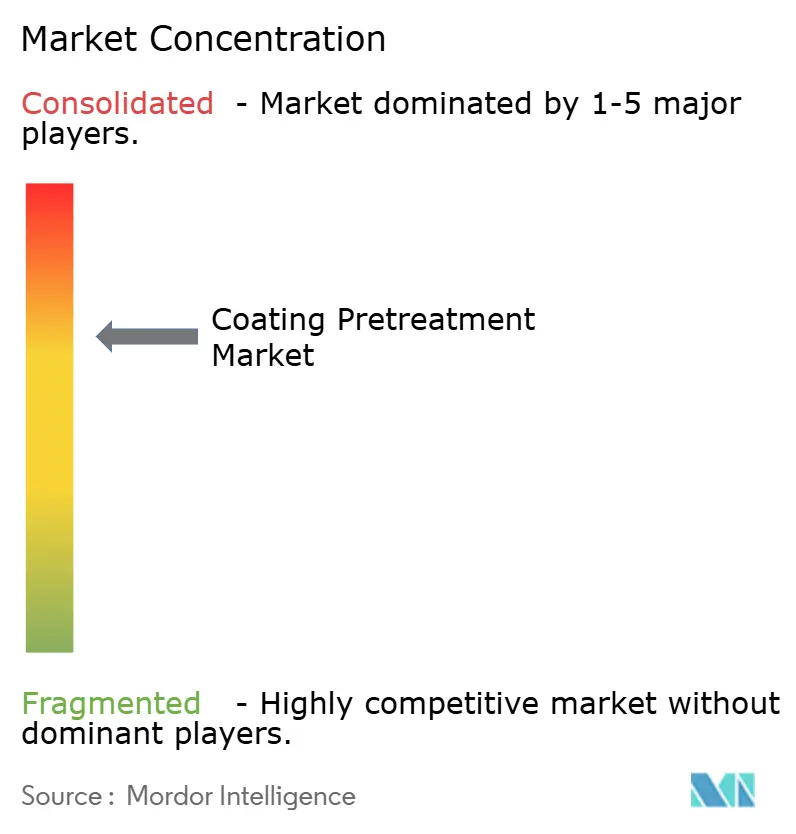
The market demonstrates moderate consolidation: the top five companies together control about 60% of global revenue, yet numerous regional applicators and chemical formulators thrive in specialist niches. PPG, Henkel, Chemetall, Quaker Houghton, and Nippon Paint anchor the leadership tier, wielding broad product catalogs and multi-regional manufacturing. PPG allocated USD 300 million for North American plant automation, capturing 30% productivity gains from digital dashboards. Quaker Houghton’s USD 153 million purchase of Dipsol Chemicals expanded its Asia-Pacific steel-pretreatment footprint to serve automakers in Thailand and Indonesia.
Niche innovators target chrome-free solutions: OxMet Technologies advances zirconium-silane blends for aerospace MRO, while start-ups like Coventya Digital deliver cloud-linked dosing pumps for medium-sized coaters. Incumbents emphasize service contracts and on-site lab support to lock in consumables revenue amid rising raw-material volatility. Overall, suppliers with agile R&D and shared intellectual property agreements gain a strategic edge as OEM qualification cycles shorten under sustainability pressure.
Coating Pretreatment Industry Leaders
-
Henkel AG & Co. KGaA
-
PPG Industries, Inc.
-
Axalta Coating Systems, LLC
-
BASF
-
Akzo Nobel N.V.
- *Disclaimer: Major Players sorted in no particular order
Coating Pretreatment Market Companies Covered in this Report
- 3M
- Akzo Nobel N.V.
- Atotech
- Axalta Coating Systems, LLC
- BASF
- Bulk Chemicals, Inc.
- Henkel AG and Co. KGaA
- Hubbard-Hall
- IFS Coatings
- Nihon Parkerizing Co., Ltd.
- Nippon Paint Holdings Co., Ltd.
- PPG Industries, Inc.
- The Sherwin-Williams Company
- Troy Chemical Industries
- Westchem Technologies Inc
Market Opportunities and Future Outlook
A whitespace exists in conversion pathways that cut energy and water while meeting corrosion specifications across mixed-metal assemblies and under stricter restricted-substance policies. Programs and standards updates make this more concrete. QUALICOAT published its QCT-VOL.2-25.0 specification in January 2025, standardizing pretreatment instructions and approval procedures for chemical manufacturers. QUALISTEELCOAT moved to Technical Specifications Version 5.01 from January 2026, increasing the value of pre-qualified, easy-to-audit pretreatment packages. OEM capex and throughput priorities also support integrated, fewer-stage solutions, including Henkel promoting combined cleaning and coating in a single step and broader adoption of smart inline monitoring in automotive body shops.
Technology development also creates scope for premium offerings in low-temperature and restricted-substance-free systems. In August 2025, AD International, partnering with Corialis Group, highlighted a vertical powder-coating pretreatment optimization that reduced water consumption by 87% and energy usage by 66.7%, linking pretreatment choices to measurable operational savings. In 2026, several routes reflect the shift: Proquimia described a nanotechnology phosphatation approach operating at 35-45 C while targeting zinc-phosphate-like performance, and NOF Metal Coatings Europe introduced PFAS-free and chromium-free zinc flake technologies with curing as low as 70-100 C. These initiatives align with tightening chemical restrictions and emissions requirements, supporting offerings that combine compliance, reduced utility load, and simplified line layouts.
Recent Industry Developments in Coating Pretreatment Market
- April 2026: Henkel launched Bonderite M-ED 11204, a mid-temperature sealing solution for aluminum anodizing positioned to reduce energy, water, and CO2 consumption versus conventional sealing conditions. The release strengthens Henkel's pretreatment-adjacent portfolio for aluminum-intensive value chains such as transportation and electronics, where anodized components increasingly coexist with painted or powder-coated assemblies.
- December 2025: Henkel introduced a new color variant of its thin organic coating for metal surfaces, expanding options for functional and aesthetic protection on metal parts. Broadening thin-coating choices supports finishers looking to reduce process steps and align metal surface protection with downstream coating systems under tighter chemical compliance expectations.
- July 2024: Henkel announced an all-in-one approach combining metal passivation and pretreatment in a single step to improve finishing-line efficiency. Consolidating stages can cut water use, reduce footprint, and simplify wastewater management, directly addressing operational constraints that accelerate adoption of chrome-free pretreatment alternatives.
Coating Pretreatment Market Report Scope and Research Methodology
Market Definition and Coverage
This market covers materials and processes used to prepare metal surfaces so that later paints or protective coatings bond better and last longer. It includes cleaning, conversion layers, and mechanical preparation steps used across industrial manufacturing.
Scope exclusions: It excludes the value of the final paint or coating layer itself, along with general metal fabrication services that do not include a defined pretreatment step.
Segments Covered in This Report
- By Type
- Phosphate
- Chromate
- Chromate-Free
- Blast Clean
- By Metal Substrate
- Steel
- Aluminum
- By End-User Industry
- Automotive
- Aerospace
- Consumer Electronics
- Building and Construction
- Other End-user Industries (Industrial Machinery and Appliances, etc.)
- By Geography
- Asia-Pacific
- China
- Japan
- India
- South Korea
- ASEAN Countries
- Rest of Asia-Pacific
- North America
- United States
- Canada
- Mexico
- Europe
- Germany
- United Kingdom
- France
- Italy
- Spain
- Russia
- NORDIC Countries
- Rest of Europe
- South America
- Brazil
- Argentina
- Rest of South America
- Middle East and Africa
- Saudi Arabia
- South Africa
- Rest of Middle East and Africa
- Asia-Pacific
Data Sources, Market Sizing, and Validation
Desk Research
Desk research is used to set the market boundaries and build the first set of demand and supply indicators, before assumptions are stress tested through interviews. We rely on public and official references such as EPA guidance on surface preparation and metal finishing, European Chemicals Agency restrictions for hazardous substances, OSHA and NIOSH safety references tied to cleaning and blasting, UN Comtrade trade statistics for relevant chemical categories, and USGS materials indicators where they help explain downstream metal activity.
We also review company annual reports, investor presentations, and press releases to understand product portfolios and application exposure across automotive, construction, appliances, and electronics. In a few places, paid subscriptions for company financials and intelligence, patent databases, and import and export shipment-level databases are used to speed up screening and to cross-check volumes and price direction. The sources listed above are illustrative, and many other public references were used for data collection, validation, and clarification.
Primary Interviews and Surveys
Primary work focuses on confirming what is actually being purchased and applied at plant level, then tightening assumptions around usage intensity and pricing. We speak with pretreatment chemical suppliers, formulators, distributors, applicators, and end users in automotive, aerospace, building and construction, and industrial manufacturing across APAC, EMEA, and the Americas so the model reflects real process choices and compliance-driven shifts.
Distribution of primary research fieldwork respondents
| Company type | Respondent position | Region |
|---|---|---|
| Top tier: 30% | CXOs: 12% | APAC: 42% |
| Mid tier: 56% | Functional/Unit leaders: 40% | EMEA: 37% |
| Smaller Players: 14% | Managers: 48% | Americas: 21% |
Market-Sizing & Forecasting
Sizing is built using a top-down approach where manufacturing activity and coated metal demand are reconstructed by end-use, then translated into pretreatment value using typical process routes and chemistry mix. In coating pretreatment, key inputs include metal finishing output proxies, especially for steel and aluminum parts, pretreatment line adoption by end use, conversion coating mix shifts (phosphate, chromate, chromate-free, blast clean), compliance-driven substitution rates, and average selling price ranges by chemistry that were sanity checked in interviews.
After the first pass, we corroborate totals with selective bottom-up approximations, such as supplier revenue splits, channel checks for major end-use pockets, and sampled price x volume calculations for common pretreatment chemistries. When bottom-up coverage is incomplete, gaps are handled using conservative penetration assumptions tied to the observed installed base of coating lines and the mix of captive versus outsourced finishing.
Forecasts are developed using scenario analysis supported by expert input on how quickly restrictions, lightweighting, and process upgrades can change chemistry mix and pricing. The scenario paths are anchored to macro indicators like vehicle production, construction output, and industrial production, then adjusted for expected changes in pretreatment intensity per unit produced.
Data Validation & Update Cycle
Validation is done through triangulation across independent signals, then the model is challenged for outliers at the country and end-use level before sign-off. We compare implied pretreatment spend per unit of coated metal with interview ranges, check whether regional growth aligns with manufacturing and trade indicators, and investigate sharp shifts in chemistry mix that do not match regulatory or customer adoption timelines.
The work goes through multi-step analyst reviews, and respondents are re-contacted when pricing, adoption, or regulation assumptions create large variances versus external signals. Reports are refreshed annually, with interim updates when major events materially change input costs, compliance rules, or industrial output. Before delivery, a final pass is performed so clients receive the most current view in the model and narrative.
Mordor Intelligence's Coating Pretreatment Market Sizing Compared With Other Published Estimates
Published market sizes for coating pretreatment can differ even when the topic sounds the same, because scope lines are drawn differently and pricing is treated with different timing choices. Differences also come from how much of the process chain is counted, how regional currency conversion is handled, and how aggressively adoption is assumed for chromate-free transitions.
A refresh-led gap shows up when annual pricing is updated with consistent currency timing and then cross-checked against multiple demand signals, which is one reason the 2026 value below lands where it does for Mordor Intelligence.
Benchmark comparison
| Source | Market Size | Gaps in Research Methodology |
|---|---|---|
| Mordor Intelligence | USD 5.01 B (2026) | |
| Global Consultancy A | USD 4.34 B (2024) | Uses a different base year and may carry 2024 pricing into later years without fully adjusting for chemistry mix changes and region-level currency timing, which can compress the value when compared on a 2026 basis. |
| Industry Analytics B | USD 3.76 B (2024) | Leans on an earlier base-year value and can undercount higher-priced chromate-free systems if average selling prices are kept flat across end uses, especially when validation is lighter at the application and line-level. |
Looking at the spread, the biggest driver is the year used for comparison, followed by how prices and mix are refreshed as regulations and customer specifications shift. When the same scope is held constant, a model that updates FX timing and pretreatment ASPs in step with real adoption signals tends to reduce drift and makes the estimate easier to trace back to clear variables and repeatable checks.
Key Questions Answered in the Report
What is the coating pretreatment market size in 2026 and how fast is it growing?
The market is valued at USD 5.01 billion in 2026 and is projected to expand to USD 6.15 billion by 2031 at a 4.17% CAGR.
Which region currently holds the largest share of the coating pretreatment market?
Asia-Pacific leads with 44.78% of global revenue in 2025 and is also the fastest-growing region at a 5.12% CAGR through 2031.
Why are silane-based pretreatments gaining rapid adoption?
Silane chemistries operate at ambient temperature, cut sludge by up to 80%, and align with strict environmental rules, driving their 5.57% CAGR.
How do smart-factory retrofits influence pretreatment operations?
Inline sensors and machine-learning dosing tools have boosted first-pass quality near 100% and lifted plant productivity by roughly 30%.